
Thursday, February 17, 2005

Sermon: Thursday of Lent 1 (Invocavit)

17 February 2005 at Chapel of Lutheran High School, Metairie, LA

Text: Matthew 4:1-11

In the Name of + Jesus. Amen.

Today’s text is the assigned Gospel reading for the first Sunday in Lent – the forty day period of fasting and struggling against the Devil that Christians have observed since the earliest days of the church. There are 40 days in Lent, because our Lord likewise fasted and struggled against temptation for forty days. And while Lent can be an uncomfortable time of being reminded of our sins, it is also comforting to know that Jesus, our “Great High Priest,” is also one of us: a human being who struggled with temptation, and with being uncomfortable.

We sometimes forget that Jesus is 100% human. Being God at the same time did not make his body hurt any less when he fasted – or when he was being beaten and crucified, for that matter. Our Lord suffers, struggles, and endures temptation at the hand of the devil. And if God Himself had to struggle, can we expect any less?

Notice that it is God who leads him into the desert to confront Satan. Our text tells us “Jesus was led by the Spirit.” It was God’s will that Jesus be tempted, for without a confrontation, there couldn’t be a battle. Without a battle, there can be no victory. Without a cross, there can be no resurrection. And Lent, dear Christian brothers and sisters, is a time in which we are encouraged to take up our arms, put on our helmets, grab our shields, and prepare for war. We are all soldiers in the faith, and the enemy is the Evil One. We are to follow our General into the minefield, we are to engage the enemy amid the bombs and screams, and we are to look the devil in the eye and be willing to die in this war rather than surrender.

The Christian life is not for sissies. For Scripture describes our Enemy in many ways, as a clever serpent, as the father of lies, and as a lion looking to eat us. Engaging the devil in battle is no child’s play. And this is why Lent is such a serious time. Our churches become more plain, like Spartan military camps. Our words become more precise and focused – the way soldiers communicate in the heat of battle. And we look death in the face as our pastors somberly smear ashes on our heads: “You are dust, and to dust you shall return.”

And where is this battlefield? It is inside of us. Each Christian is a self-contained civil war, a battle between the sinful lusts of the flesh, and the godly impulses of the spirit. And as in any war, shots are fired back and forth. Ground is exchanged back and forth. Sometimes God wins the skirmish, but sometimes Satan wins the fire-fight. There are times when we turn our backs to sin, and thus deliver Satan a mighty blow, but other times, when we when we cave in to temptation, the devil gains ground on us.

But let’s face it, dear friends, in this war, we are out-manned and outgunned. We carry around our sinful nature like a hundred-pound backpack. We are not as clever or as knowledgeable as Satan. And there is a very real part of every soldier in this war that secretly cheers for the enemy. Let’s face it, we like to sin. It’s fun. It makes the ugly part of us happy. We sabotage our own efforts in the battle. We betray our own army, and our General. In fact, our own efforts are so tainted with sin, there are times when we think we’re going good and fighting evil, when the reality is, we’re sinning and advancing the kingdom of darkness without even realizing it.

All the while we put on a happy, holy face for the world, we are all rotten inside. We gossip so often we don’t even know we do it. We cheat a little here, a little there. Everyone does it. We dishonor our parents, we break the laws, we defy godly authority. We laugh when those we consider to be our enemies slip up, or make mistakes, or get caught doing something wrong. We are daily given opportunities to be compassionate, or kind, or caring – but we think about ourselves instead. Instead of helping others up, we push them down at laugh at them. There is a very good reason we confess our sins at the beginning of the Sunday liturgy – “we poor miserable sinners” who sin against God in “thought, word, and deed” are a disgrace to our Lord who died for us. No matter how much we polish our halos for everyone in public, we are sinful to the core. Like St. Paul, we must cry out in misery: “Who will deliver me from this body of death?” We are miserable soldiers, ineffective and weak.

But let’s not forget, our God pulls for the underdog. He has a soft spot in his heart for the weak. It was the little boy with the slingshot that killed the might giant in battle. It was the former slaves who had no weapons at all that triumphed over mighty Pharaoh and his army. And it was not an angel, but a flesh-and-blood Man, a helpless baby, a human being who suffered hunger and temptation, a condemned criminal who endured a gruesome execution – who single-handedly conquered sin, death, Satan, hell, and all of the forces of evil. While we are out-gunned, we have a secret weapon on our side – the Blood of Jesus who has already won the battle for us.

And notice in our text how Jesus wages cosmic warfare against Evil. Three times, the devil did his worst, offering temptations to Jesus that each one of us, (if we’re honest with ourselves) would snap up in a New York minute. How many of us would jump at the opportunity to do anything, absolutely anything, if we were offered a million bucks. We would take the money, and justify ourselves for the sake of our greed. There’s a reason why reality shows are so popular right now. We love money, and we would gladly turn against Jesus for a price – whether it be thirty pieces of silver, or thirty million dollars. Anyone who says otherwise is a liar. Every one of Jesus’ disciples abandoned him when it got scary – and we all do the same thing.

But notice how Jesus fought back against Satan. He did not rely on his own power (though he could have). He did not play the “God card” (though it was in his power). Instead, he showed us how we could fight the devil. Jesus clearly showed us what the weapon of choice is against Satan: and that is the Word of God. For in each of the three temptations, our Lord hurled the Scriptures against the devil. And, dear friends, the Word of God is our only sword to keep the mighty devil at bay.

And Scripture tells us the Word of God is a two edged blade. One side is the Law, and the other side is the Gospel. In waging war against Satan, we need both edges. For the Law cuts down our hypocrisy, our lies, our self-delusion that we are righteous. It exposes the Enemy lurking inside each of us. And the Gospel slices back the other way, cutting our Enemy down, by forgiving our sins, and turning the devil’s powerful attacks into empty, hollow threats. For we can look the growling lion in the face, and smile at him with the words “I am baptized.” For it is written: “He who is baptized and believes will be saved.”

And when the devil perverts the flesh, that which God designed to be good, and uses it as a temptation for evil, we Christians can point to the Flesh that the devil can’t corrupt: the Flesh of Christ. For it is written: “Take eat, this is my Body. Take drink, this is my Blood. Shed for the forgiveness of sins.” The Blood of Jesus is the Atomic Bomb dropped on the devil’s head, and we have the opportunity to make use of that weapon every Sunday.

And when the devil uses our tongues to do his work of evil, perverting our words (which mocks the fact that Jesus is himself “The” Word), it is the tongue of the pastor who pronounces our sins forgiven. He uses not his own words, but God’s Word, for it is written: “If you forgive anyone his sins, they are forgiven.” This Word of God sends the demons of hell scurrying for cover.

So dear brothers and sisters, let us make use of the Word of God in this Lenten season. It is the Word of the Gospel, the Word of Scripture, the Word of Absolution, the Word of Baptism, and the Word of Holy Communion. For the Word is truly the weapon that destroys our enemy. And alongside of our Lord, we are empowered to boldly say: “Away with you, Satan, for it is written…” Amen.

In the Name of the Father and of the + Son and of the Holy Spirit. Amen.

Thursday, February 03, 2005

Sermon: Thursday of Sexagesima

3 February 2005 at Chapel of Lutheran High School, Metairie, LA

Text: Luke 8:4-15

In the Name of + Jesus. Amen.

In out text, Jesus explains how the Kingdom of God works.

He not only tells the parable, but gives us the exact meaning – lest anyone should say: “Well, that’s just YOUR interpretation – I see it differently.” No, Jesus is quite clear. Faith is created by the Word of God. This Word is represented by a seed. And we, dear Christians and dear non-believers alike, are dirt. Just as Adam was created from the dust of the earth, we human beings are like soil waiting to be made alive by a seed. Some soil is ideal for growth, some soil allows for temporary growth – but later fails, and some soil is so hard that no growth happens at all. And how does the dirt get the seeds? A farmer, that is, a preacher tosses them out.

This is a rather unappealing description of God’s kingdom: farmers tossing seeds on soil. A preacher as a sower, his listeners as piles of dirt, and the very word of God as a little seed. Jesus does many things well, but most experts today would find him to be pretty weak in the area of marketing. I mean, what could be more boring than a seed. They’re little, usually some plain color of brown or green. They’re quiet. You have to wait on them. Let’s face it: seeds are not “sexy.” They don’t grab our attention. And describing the people sitting in the pews as “dirt” is no way to treat a customer. And farmers? Most people don’t get too excited by agriculture. In today’s fast-paced, technological, buy-and-sell world, Jesus really blew it. Or did he?

Preachers and churches today often trade Jesus’s “farmer” model of ministry for something they think works better. They know better than Jesus, they know better than God, right? Instead of a preacher tossing seeds, they see the Kingdom of God as motivated salesmen marketing a product. Instead of wasting most of the seed on bad soil, the true salesman identifies a clientele, that is, a specific customer base, and aggressively tries to close the sale. Whereas a farmer scatters the seed everywhere and quietly waits for the soil, water, and light to make plants, a salesman makes things happen himself. He is a hustler with the gift of gab, a go-getter with a spiffy suit, flashy jewelry, and a blinding smile. And the modern sales model is more “successful” than Jesus’s “farmer” model. Churches that sell Jesus pack people in. Farmers get just what Jesus promises – maybe one in four people who are considered “good soil” – with most people turning away uninterested.

For example, a so-called church in Tampa, Florida is raffling off a $50,000 car. And all you have to do to be entered is to visit their church. Of course, the attendance numbers have gone through the roof since the promotion started. Some so-called preachers refer to what they do as a “show” and describe it in theatrical terms. They pack stadiums and really entertain. They don’t preach sermons, but rather give “uplifting and inspirational messages.” They don’t talk about sin, Jesus, and the Gospel of his atoning death for us (that’s such a “downer”), rather they fill their listeners heads with pop-psychology and appeals for money (you know, exciting stuff – “as seen on TV!”).

Now, to be fair, some of these showmen argue that they only engage in the marketing and salesmanship to get the customers in the door – at which time they can try to sell them Jesus in a classic “bait-and-switch” sales operation. “We must keep the customer happy,” they argue “so they will stay and hear the Gospel.” And indeed, in a sales model, there’s an old saying: “The customer is always right.” You have to tell the customer just what he wants to hear – otherwise the salesman hears the dreaded word “no!” So such preachers have to modify God’s Word to not talk about sin and repentance. They have to go light on the law, lest a sinner be offended. Sometimes, they will go heavy on the law, and ignore the Gospel – if that’s what the customer wants.

But what does Jesus say about “the customer is always right”? In his own preaching, he often offended his “customers” by calling them sons of the devil and telling them prostitutes would go to heaven before they would. Jesus is never going to make middle-management with that kind of pitch! Jesus raised the controversial issue of eating his flesh and drinking his blood – after which a third of his disciples left him. As any good modern salesman knows, you must avoid anything that causes division or offense. Let’s face it, Jesus is a lousy salesman. A good salesman doesn’t die on a cross.

Another bit of sales wisdom is: “It’s not about the steak, it’s about the sizzle.” In other words, the perception is more important than the reality when it comes to closing the deal. Marketing is about selling an image – and the truth of that image isn’t really important. But our Lord calls us to a higher calling – to proclaim the truth, for he said “I am the way, the truth, and the life.” Preachers are to preach the same Gospel, in season and out of season. According to Jesus, it’s all about the steak, not about the sizzle.

I once heard a pastor actually suggest that seminary students be required to work a summer as a door-to-door salesman. He said this would help, since we pastors are actually “selling Jesus.” I thought: “How said.” This retired pastor who had spent half a century in the ministry never got it. It isn’t about salemanship, marketing, gimmicks, putting one’s foot in the door, and saying “Now how much would you pay?” It isn’t about saying “I won’t take no for an answer.” The Christian life isn’t like Amway and Ginsu knives. The preacher isn’t the guy on late-night TV trying to sell pocket-fishermen and George Foreman grills. It’s not about the preacher at all. To describe the preacher as a salesman is to deny the power of the Holy Spirit.

For the Spirit himself works through the Word of God to bring people to faith. When someone hears the Law of God, repents, and receives the forgiveness of the Gospel – it is a true miracle – just as surely as if a person in a wheelchair gets up and dances around. The preacher isn’t there to provide sizzle, but rather to be faithful. The church isn’t there to raffle off cars, but rather to give away eternal life. Sunday worship isn’t about putting on a show, but rather about taking the focus off of ourselves – our sinful, egotistical selves - and putting it on Jesus, where it belongs.

You see, Jesus’s parable is true. The seed of the Word of God looks weak, and even at times silly. The preacher appears foolish as he simply throws pellets at the dirt. But look at what happens. Seeds that hit good soil germinate. And spurred on by water and sunshine, they grow rapidly. The most mighty redwood trees come from a single little seed. All of the fruits and vegetables you eat come from seeds. The creative power of God Almighty is packed into the tiny sliver that the farmer flings about. It’s a true miracle – and no amount of science and can salesmanship duplicate what the humble seed does every day.

And the Word of God – though rather weak and silly looking to the senses – is likewise packed with God’s re-creative power – eternal life, victory over sin, death, and the devil. And it is all there, all in the tiny seed. The soil does nothing. It simply gets wet through holy baptism, and allows the sun of Word and Sacrament to nourish it, and within the soil, the Word of God grows. It becomes a little stem with a single leaf. But given time, it becomes a mighty tree that produces seeds itself, further spreading the Kingdom of God.

So dear Christian friends, please don’t be deceived by smooth-talking, slick salesmen who try to market “religion” to you, who try to sell Jesus like laundry soap and vacuum cleaners. For this is a false Christ. And our Lord promised we would have false Christs before his return. Look to that which is genuine: a preacher who doesn’t call attention to himself, but rather to his master, a church that isn’t in the game of entertainment or gimmicks, but rather struggles to be faithful to that Word, and a preached word that isn’t simply telling you what you want to hear, but rather is the true Word of God, the Gospel of the forgiveness won for the whole world through the death and resurrection of our Lord Jesus Christ.

Don’t settle for the sizzle when you can have the steak. Don’t be content with a trinket when you can have everlasting life. Remember the power of the lowly seed, and may our Lord use his sowers to bombard you with the life-giving Word of God, that you may be good soil for the true growth of God’s Kingdom – within you, and in the world.

And may the peace of God which passes all understanding keep your hearts and minds in Christ Jesus.

In the Name of the Father and of the + Son and of the Holy Spirit. Amen.

Thursday, January 27, 2005

Sermon: Thursday of Septuagesima

27 January 2005 at Chapel of Lutheran High School, Metairie, LA

Text: Matt 20:1-16

In the + Name of Jesus. Amen.

There’s an old saying: “Rank has its privileges.” This is why first class passengers get to eat on fine china while the rest of us are lucky to get a stale bag of pretzels. This is why seniors get to park in the back lot, while all the other students have to hit the bricks. This is why teachers get to grow beards, but stubbly-faced students are given detentions, or charged a dollar for a plastic razor, and told to come back with a smooth baby-face. Rank has its privileges, indeed. Life really isn’t fair at all. But how about God?

Surely, we can expect God to be fair. But is he? Of course, if anyone can expect to pull rank and enjoy privileges the rest of us don’t have, it must be God. So he does run a fair universe? Is God an impartial judge, or does he play favorites? Does God give everyone what they deserve, or does he treat some people better than others?

As much as our flesh would like to think otherwise, God is not fair at all. He has his pets, and he shamelessly takes care of them, getting them out of trouble, and letting them even, in some cases, get away with murder. In the words of the ancient hymn called the Te Deum Laudamus, and based on Holy Scripture, Jesus will be our judge on the final day. But this judge is also our attorney. By the way, he is also the jury. Look at what a crooked courtroom God runs! Imagine this, the defense attorney gets to be the judge and the jury! The prosecutor doesn’t have a chance. By the way, the prosecutor is Satan. And there is no higher authority, no Supreme Court, he can appeal to. He can cry “injustice” all he wants, but God simply continues to bend justice in favor of his cronies.

Of course, being one of God’s cronies doesn’t always mean you will be treated fairly, at least according to our standards. In the Old Testament, God allowed Joseph to be kidnapped by his jealous brothers, sold into slavery, falsely accused of rape, spending many years in a prison cell. God allowed this good man to suffer. In the end, Joseph’s suffering saved the children of Israel from famine – but God does have a strange notion of right and wrong, doesn’t he? He says: “My ways are not your ways.” Yeah. Ain’t that the truth?

And how about poor John the Baptist? You will not find a more faithful preacher. Jesus calls him the greatest man born of a woman. And yet, John finds himself in a dungeon to be beheaded. Where is God’s justice? It’s no wonder so many of the Psalms cry out to God, asking him why he doesn’t punish the wicked. Sometimes it seems as if evil runs unchecked, and one has to even wonder if God enjoys it sometimes. If God is fair, I defy anyone to explain why our dear friend and brother Brandon Fury has had to endure month after month of medical treatments. He has done nothing to deserve any of this, and I have done nothing to deserve not to be in his situation.

Now consider our text in which Jesus tells a story about workers and pay. The bottom line is this: the boss gave everybody the same salary – no matter how long they worked. Those who slaved away in the hot sun for 12 hours got a denarius. Those who showed up an hour before quitting time got a denarius. If a boss today did such a thing, his workers would be organizing a labor union and suing him for being unfair. And yet, Jesus tells us this story in order to tell us what God is like.

So what gives? Why is God so unfair?

The unfairness of God reached its peak when the only truly innocent man who ever lived was allowed to be put on trial by amoral religious leaders and politicians, flogged by sadistic soldiers, mocked by a bloodthirsty mob, and finally nailed to a cross and executed by a corrupt imperial government on behalf of all of us – sinful people who reject the living God every day of our lives. As we sin, day after day, year after year, we join the mob in yelling “crucify him!” We drive the nails. We spit on him. We plunge the spear into his side. God allowed his only begotten Son, whom he loves, to suffer like this. And thanks be to God that God is so unfair! For this is why we call it “Good” Friday.

For by virtue of this sacrifice, we who deserve death and damnation, we who have earned the fires of hell, receive a pardon. We are unfairly let off the hook. By faith, we who believe are all “Rabbi’s Pets.” Even though we grieve him when we sin, even though we disappoint him, he continues to pardon our sins. When we repent and seek forgiveness for our sins, our unfair God looks the other way and spares us the punishment we deserve. And who are we to complain when someone else gets a break? We’re quick to complain about “unfairness” those rare times when “fairness” would benefit us, but we’re even quicker to ask for God to be “unfair” with us when we deserve to be punished.

There’s a word for this kind of unfairness. It’s called “mercy.” This is why we poor miserable sinners find such comfort in God’s unfairness. This is why we pray again and again: “Lord, have mercy. Christ, have mercy. Lord, have mercy.”

And let us not be afraid or ashamed to “pull rank.” For by the Sonship of Jesus, we too are children of God. This is why we are so bold to pray to God as “Our Father.” And our Father runs the universe. Rank indeed has privileges. The greatest privilege is to be a baptized child of God, one of God’s chosen, one of the Great Teacher’s pets, one who is indeed treated unfairly. Where we deserve death, we receive life. Where we deserve condemnation, we receive pardon. God is absolutely unfair. Thanks be to God!

In the Name of the Father and of the + Son and of the Holy Spirit. Amen.
Sunday, January 16, 2005

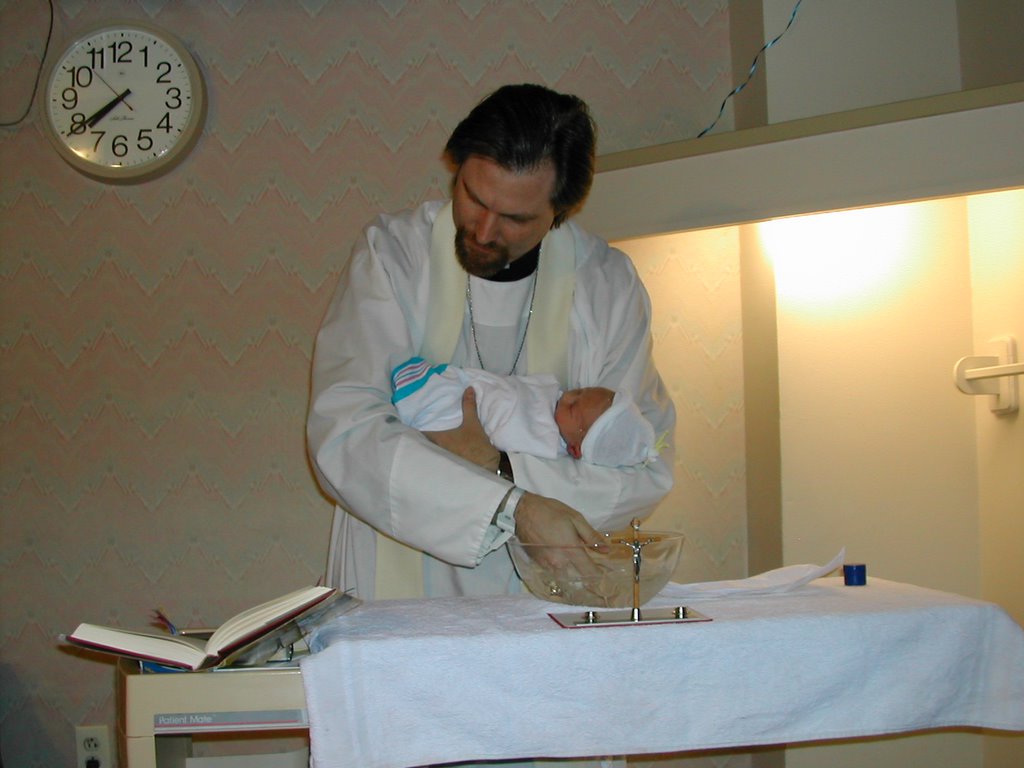
Sermon: Baptism of Leonidas Beane


2nd Sunday after Epiphany, January 16, 2005

at East Jefferson General Hospital, Metairie, Louisiana

Text: John 2:1-11


In the Name of + Jesus. Amen.

Happy Birthday, Leo. Happy Birthday.

I say this twice because you have two birthdays. Yesterday, you emerged from the safety and tranquillity of the watery womb into a raucous world filled with sights and sounds you could not have imagined in your former life. And if that weren’t enough, today, you were drowned in water and were reborn, risen with Christ to yet another birth. You emerged from the raucous world filled with sin, misery, and death into a tranquil world, an eternal world, a sin-free world that none of us can even imagine in this life, on this side of the resurrection. In this second birth, you join all of us in the “now” of the Christian life, and in the “not yet” of its completion. Whereas I had to wait 18 years between my first and second births, you, Leonidas Martin Gregory Beane, have the blessing of God to experience the miracle of birth twice in two days. Happy Birthday, and again I say, Happy Birthday. Now you are truly alive. Welcome to the real world.

Your mother and I are honored and humbled to be instruments in your creation. God used us as his ministers of the sacrament of earthly life. You were procreated, made incarnate, from our love for one another. Until yesterday, not one second of your existence were you not physically touching your mother. This privilege of mothers is like no other in God’s universe. And I have the privilege to baptize you into your second birth – being God’s unworthy and humble instrument, a priestly minister of the sacrament of life from above, authorized to act in the person of Christ (though I’m sure over the years you will wonder how one such as I can speak with such authority). I have the distinct honor of being your father twice over – biologically and spiritually.

Today is the second Sunday after Epiphany. In our Gospel text, our Lord turns ordinary water into something miraculous: wine. And wine is the very substance he would later change into something even more miraculous – his Holy Blood, by which he saves us. He began with water contained in stone jars used for ritual purification, and he blessed this water – making it truly pure by his presence. Thus he fulfills the law. Similarly, Leonidas, our Lord purified the water in this humble font – a bowl of crystal given to your mother and me for our wedding by your grandmother. Our Lord has blessed our union with a child – making our union truly pure and complete by his presence. Similarly, he fulfills the law on your behalf, presenting the wine of his blood and the water from his pierced side to you as a gift, and cleansing you from all your sins, making you truly pure and complete by his presence. You are even made pure of that which you have inherited from your parents and grandparents all the way back to Adam and Eve. We have indeed saved the good wine until now, my dear son!

You have the distinction of perhaps being the only Lutheran you may ever meet who was baptized in Latin. An English priest named Ronald Knox was once asked to conduct a baptism in English. He declined, saying: “The baby does not understand English, and the devil knows Latin.” Fr. Knox understood what Christians have always understood – baptism is really a form of exorcism. In Baptism, our Lord conquers Satan yet again, rescuing another beloved lamb from death and hell. The western church had spoken the baptismal formula in Latin for many centuries. And while the words are just as powerful in any language, it must give Satan horrific flashbacks to hear the words of our Lord spoken in the same way as they have been millions of times over in the past. For in a sense, baptism is addressed to the devil – just as the first Gospel was spoken to him in the Garden of Eden. This is why we opened this service by exorcising you, my son. Hopefully, by the time you are my age, this once-common practice will again be fully restored among our people.

Now regarding your name: your mother and I have a great appreciation for history, and a love for the saints and heroes of the church - as well as for people who have defended freedom throughout the ages. Leonidas is a name that honors the great Spartan king who stood defiantly against a tyrannical emperor at the Battle of Thermopylae. It is also the name of a Christian martyr (St. Leonidas, the father of Origin). Leonidas literally means “son of the lion” or “son of Leon” – and Leon is my middle name and that of your paternal grandfather. Leonidas Polk was also a man of courage, as well as a churchman: the first Episcopal bishop of Louisiana and a Confederate general who died in the cause of Southern Independence. The short form, Leo, pays tribute to Pope St. Leo the Great, who articulated the two natures of Christ at the Council of Chalcedon.

Your name Martin is a tribute not only to St. Martin of Tours and Blessed Martin Luther the Reformer, but also to your maternal grandfather. Gregory is the name of heroic theologians of the East and West: Sts. Gregory of Nyssa and Gregory of Nazianzus, as well as Pope St. Gregory the Great, a bishop of Rome who left the church a legacy of liturgical chant and wise pastoral counsel.

We chose your name very carefully, Leo. But the greatest name you received today has nothing to do with Spartan kings, Confederate generals, popes, bishops, reformers, and grandparents – but rather the Name of Jesus Christ. For today, you have taken the most important name of all: “Christian”: heir of eternal life and a true son of the Father. You received the Name of the Holy Trinity today, and that trumps every name – for at this Name, every knee shall bow, and every tongue shall confess that Jesus Christ is Lord. Your first birth took place on the Saturday of the week of the Baptism of our Lord. In that Gospel text, our Lord Jesus Christ was also baptized with water as the Triune God was manifested in this miraculous work. And the voice of God the Father rang out from the heavens and proclaimed, “This is My beloved Son, in whom I am well pleased.” So also has your Father in heaven spoken these words even as they are spoken in a less lofty way by me. You are a beloved son twice over – son of God the Father, and my beloved son as well. And we are very pleased indeed.

So once again, my son, happy birthday, happy birthday. Your mother and I, your extended family, and every member of the communion of saints throughout history look forward to life with you that will have no end. Amen.

In the Name of the Father and of the + Son and of the Holy Spirit. Amen.
Thursday, January 06, 2005

Sermon: Epiphany

6 January 2005 at Chapel of Lutheran High School, Metairie, LA

Text: Matt 2:1-12

In the Name of + Jesus. Amen.

There is an ancient Hebrew hymn called “The Hanukkah Song” by Adam Sandler.

Okay, it’s not really ancient, but it sure is funny, and we get to hear it every year around Christmas-time. The song points out famous people who are Jewish, who celebrate Hanukkah. And who would have thought so many words rhyme with Hanukkah? Adam Sandler compares it to Christmas this way: “Hanukkah is the festival of lights, Instead of one day of presents, we have eight crazy nights.” With all due respects to this genuinely funny comedian, Christmas is really much more than “one day of presents.” In fact, today, January 6, marks the end of Christmas – which is really a 12-day celebration.

This explanis the song “The Twelve Days of Christmas” – although the nonsense about partridges and five golden rings has nothing to do with the Christian faith. The story floating around that the parts of that song are a secret confession of Christianity during persecution is just an “urban legend.” It’s a great story, but it just isn’t true. Those of you who are my students know – or should know – to check things like this out at www.snopes.com.

But while “The Twelve Days of Christmas” is no more Christian than Adam Sandler’s “Hanukkah Song,” it does serve as a reminder that Christmas is a season, not merely a day. The Christian Christmas is truly different, and more meaningful, than WalMart’s Christmas.

While the day after Christmas the stores are already tearing down their Christmas displays and moving on to Valentine’s Day, and while many people chuck their Christmas trees to the curb before they turn the page of the calendar, the Christian celebration of the incarnation of God in the form of a man continues for several weeks. Today, the day after the twelfth day of Christmas, is known as the Epiphany. This is a Greek word that means “a showing.”

From his conception, through his birth, ministry, death, and resurrection, Jesus is constantly showing us, giving us epiphanies, of who he is. Like Hansel and Gretl, Jesus drops breadcrumb-like clues to show himself to us and to the world. And sometimes the breadcrumbs he drops are more like atomic bombs. Jesus showed himself to be God when he changed water into wine, healed the sick, cast out demons, and raised the dead. He epiphanied himself as he was baptized, and as he preached and gave out the Lord’s Supper. He was shown for the God that he is when he was transfigured on the mountain, and glowed with dazzling bright light. Our Lord’s epiphanies came to a peak when he gave his life for us on the cross, and while dying there, pronouncing our sins to be forgiven, and then rose gloriously from the dead. The whole world has seen this unique Man show himself to us. It was a great epiphany when our Lord Jesus Christ, risen from the dead, asked St. Thomas to place his finger in the holes in his side and in his hands. Thomas received this epiphany, this showing of who Jesus is, with a confession: “My Lord and my God!”

Today, on the day we call “The Feast of the Epiphany,” our Lord shows himself in a different way, a mysterious way, a way which brings hope to you, to me, and to the entire world. There is no dazzling light beaming from his face – although a light leads the wise men to the infant Jesus. There is no bombastic miracle of a dead man walking around – only the quiet miracle of God wriggling in swaddling cloths. There is no mystical meal in which God takes bread and wine and declares them to be his Body and Blood, only a seemingly ordinary act of a baby nursing. And Jesus, at this epiphany, doesn’t say “Father, forgive them,” and yet, by his very presence, the baby Jesus brings forgiveness of sins to the entire world, to all nations, to Gentiles and Jews alike.

For it was indeed shown to the wise men, to Gentiles who lived hundreds of miles away, who this Jesus was, is, and forever will be. This is God himself. Yet this God has a mother. This is the Eternal One – and yet this God has taken on mortal flesh, and will die. This is the Almighty, and yet this God must wear diapers, for his weakness is even such that he can’t control his own body.

Dear Christian friends, this is the miracle itself. That God loves us enough to send his only begotten Son into the flesh – vulnerable, helpless, and ultimately, to die in our place, for us. And then, to rise again. This is the ultimate epiphany. God isn’t showing us his might and power. God isn’t creating a flood that destroys the whole world. God isn’t creating a universe and destroying worlds with a blast from his nostrils. No, the miracle is not “our God is an awesome God,” but rather, our God is one of us, an infant. And this infant is also a priest – a priest who not only goes to God on our behalf, but is God himself. A priest who not only knows of our humanity, but shares in it.

God knows what it means to be human – the struggles each of us experience: temptation, hunger, sadness, and death itself. He knows, because he took all of these on himself. And he did so to save us – from sin, death, and the power of the devil. And this Messiah is not only a savior of the Jewish race, but even of these distant wise men, these astrologers to whom our Lord was revealed by the Old Testament. Jesus is the savior of all people, regardless of race, language, sex, or station in life. The wise men understood this epiphany, this showing. For they not only gave the Baby-King gifts of material wealth, they also presented themselves as gifts to the Baby-God – bowing to him in holy worship. The were reverent in the presence of their God. Since God showed to them undeserved mercy, they showed their thanks to him as quiet respect and reverent worship.

This Day of Epiphany links Christmas – the miraculous birth of our Lord – to his passion and death. For even as we begin the Carnival season today with the Epiphany (perhaps even with the showing of the Christ Child in king cakes), our joyous celebrations end at Mardi Gras. For the day after Mardi Gras is Ash Wednesday – beginning yet another 40-day journey with Jesus, a journey of repentance and self-examination to the cross that culminates in the empty tomb.

Although he didn’t mean to, Adam Sandler missed the point of Christmas. But he is right that Christmas is about gifts – but it isn’t only one day. And in reality, it isn’t even only about 12 days. Christmas is about gifts that we receive over and over again, from God himself – even unto eternity. We receive baptism, the Lord’s Supper, Holy Absolution, and the preaching of the Gospel again and again. We receive forgiveness of all our sins over and over. We fall down, and our God-Man picks us up, time and again. And we receive everlasting life and communion with him who showed himself to the wise men, and to us, as a gentle baby on a mission to lay down his life for us. This epiphany is a showing of God as love beyond all love.

May this holy love of Jesus continue to show itself to you, and through you to others. And may the divine love of our Lord Jesus Christ surround you and keep you unto eternity. Amen.

In the Name of the Father and of the + Son and of the Holy Spirit. Amen.

Sunday, January 02, 2005

Sermon: Epiphany (Transferred)

2 January 2005 at Gloria Dei L.C.

Text: Matt 2:1-12 (Isa 60:1-6; Eph 3:1-12) (Historic)

In the Name of + Jesus. Amen.

Today, we celebrate the Epiphany. This is a Greek word that means “manifestation,” or a “showing” of something. We usually use this word in English to mean something that very suddenly pops into our heads: that moment when everything clicks, the “aha” experience. Maybe you’ve been wrestling with a very difficult problem: a math equation, a puzzle, a mystery novel. You think and think until your brain hurts. Then it all hits you – usually at 3:00 in the morning. “Aha!” The answer comes to you from nowhere.

Or maybe you suddenly come to the conclusion that you have been headed in the wrong direction. Something happens that makes it clear as day, that you must repent and change direction. And when such epiphanies happen, you wonder how you could have missed it all this time. It’s like a missing puzzle piece drops into place, and suddenly everything comes together.

The Festival of the Epiphany, the Twelfth Day of Christmas, the 6th day of January (which we are transferring to today) is something like that. Our Gospel text is a “Great Aha,” a stunning revelation, a bolt of lightning which makes everything bright and clear about who Jesus is. It is the account of the wise men, the magi, who were on a quest to find the great King, and they found him, manifested, shown, epiphanied as a helpless infant.

These wise men were probably Persian or Babylonian. They seem to have had contact with the prophecies of the Old Testament – probably since there were Jews living there from the Babylonian exile. The wise men were also astrologers, and an unusual star led them on this journey. They knew the baby King was a Jew, but they also knew something else: “we have come to worship him,” they said. Worship is only something offered to divinity, to God. These wise men were looking for, in the words of the Epiphany hymn: “God in flesh made manifest.” This search was obviously important to them in order for them to leave everything and travel by beast of burden and on foot several hundred miles in order to experience this epiphany.

The wise men were traveling based on faith. And think about how remarkable their faith was! These were Gentiles. They had no blood relation to the baby King of the Jews. They did not live in the holy land. In fact, they were considered unclean by the Jews. In spite of all of this, they made this extraordinary journey to find the promised King and to fall on their knees before him, presenting him gifts fit for royalty. Somehow, it was revealed to them, it was made manifest, it was shown to them that this Messiah would be a blessing not only to the Jews, but to all the nations as well. And like Abraham two millennia earlier, they left a faraway country in the east to set out to find the promised land, a land where the Promise himself was being made manifest, epiphanied to them and to the whole world, in the flesh.

But not everyone in the world was thrilled with the news. For on the throne of the Jews sat an imposter, a half-breed, a political hack, a Roman puppet king named Herod. Herod was the pretender sitting on Jesus’s throne. And like all pretenders, all fakes, all impostors, he became uneasy when people began speaking of the real king, the rightful heir. Herod conspires with his lackeys in the clergy, who consulted with Scripture, and laid out the unpleasant epiphany to the so-called King Herod. So hell-bent was Herod on preserving his bogus rule, that he would attempt to use these remarkable visitors, the magi, as pawns in a murder plot. Herod wanted the magi to lead him to the true King, not so that he might worship him (as he claimed), but rather so that he might snuff him out. And even when this plan was thwarted, Herod would seek to keep his throne by the mass murder of babies. In the name of convenience and lifestyle maintenance, people can even be convinced to take the life of helpless infants. For centuries, the Church has remembered these baby-martyrs on the 28th of December, a day that has taken on a new and sobering meaning in this country since the legalization of infanticide in 1972.

But Herod’s diabolical plan would not snuff out the true King. For Herod’s wicked scheme was made manifest, was epiphanied to the magi in a dream. And to their joy, the star reappeared, and led them to the Christ-child. And this, dear Christian friends, was the greatest epiphany experienced by the magi, for they gazed with their own eyes upon their God. They knelt in worship, and offered all that they had, gifts of created things given in love to their Creator. They gave him gold fit for a kingly crown (though this king would wear thorns). They gave him frankincense fit for a priest, though this Priest would be surrounded by the stench of death. They gave him myrrh, fit for the anointing of a prophet, although this Prophet would be anointed with his own bloody sweat. And having seen their God face to face, “God in flesh made manifest,” the helpless Almighty King, they returned home – different than they were when they left. For being in the physical presence of Jesus Christ, they had an epiphany.

These Gentiles were not to be left out of God’s long-standing promises to the children of Israel. Far from it. At the end of the Sunday liturgy, we often sing about Jesus as “a light to reveal you to the nations,” the word “nations” meaning literally in the Greek: “Gentiles.” This is the same Light, the uncreated Light, spoken of in our Old Testament lesson. Isaiah prophesies: “Arise, shine, for your light has come!” And this manifested light is nothing less than the “Glory of the Lord.” This is the very same light that shone as a pillar of fire above the Ark of the Covenant. And Isaiah promises that the Gentiles would indeed come to this light. And furthermore, this light would reflect off of them, and glorify them, and bless them, causing hearts to swell with joy! This is the “joyous light of glory” that brings salvation to the world, to Jew and Gentile alike. And Isaiah saw that the Gentiles would indeed bring gold and incense and offer them in praise to the Lord. Jesus is most certainly “God of God, light of light, very God of very God.” Just as Peter, James, and John witnessed a glorious epiphany of blinding light when our Lord was transfigured, the magi also saw his glorious light – in the form of the star that led them to his bodily presence.

And by this incident, it was made manifest to us that the Lord Jesus is King of kings, and Lord of the universe. He is the fulfillment of the Old Testament prophecies. But he is also the enemy of the wicked. We “poor miserable sinners” would stop at nothing to snuff out this Light of the world. Like Herod, we would respond to this epiphany of “God in flesh made manifest” by plotting his murder.

The very same Jesus who lay in the manger would later hang on the cross. The same Jesus who began to breathe air as he emerged from his mother’s body would exhale his dying breath as she watched on helplessly, 33 years later. The same Jesus who would escape one Herod would later be condemned by another Herod, working with Pilate, and Caiphas – not to mention all of us – and would willingly die for all of us sinners who put him on his cross.

Yes, dear brothers and sisters, this is the most painful epiphany of all. Jesus was not condemned merely by a Roman bureaucrat, a handful of sadistic soldiers, a Jewish puppet ruler, corrupt priests, and a bloodthirsty Jewish mob – but rather by all of us. We strike Jesus in the head in mockery every time we sin. We drive in the nails every time we fear, love, and trust in other things before God. We smite him with the barbaric whip every time we use his name in vain. We join the soldiers and the mob in their torture of Jesus every time we cease to hallow the sabbath, despise our parents and other authorities, hurt or harm our neighbor, act and speak in ways that are sexually immoral, behave dishonestly with regard to our neighbors property, gossip, lie, or harm our neighbor’s reputation. And we drive the spear into his side every time we covet our neighbor’s wife or possessions.

This is not a very pleasant epiphany. And yet it is God’s honest truth. The Blood of Jesus is on our hands, but more importantly, dear friends, it is on our tongues. For this is the epiphany to end all epiphanies: Jesus died to give his life as a ransom for us, even for us “poor miserable sinners” who deserve nothing less than present and eternal punishment. The blood that we drew out of our Lord, he freely gives us to our benefit, to drink for our forgiveness, for our life, and for our salvation! The body we racked with pain and death is given to us every Sunday, here at this altar. And this is the most remarkable epiphany of all: the very same body born of Mary, worshipped by the angels and the magi, plotted against by Herod, this same body that worked miracles and was crucified, is the very same body that was raised from the dead, reigns over the universe, and is manifested to us, epiphanied to us, under the humble forms of bread and wine, of water, and of words.

So while the magi could only gaze upon the baby Jesus, maybe even daring to touch his holy body with their unworthy hands, we have a much greater epiphany than they. For his holy Flesh is taken into our unworthy flesh, and his life-giving Blood is drawn into our death-ridden blood. His perfect and eternal righteousness is bonded to our corrupt and mortal sinfulness. His light shines upon us, we who sit in darkness and the shadow of death, we are glorified by his arising over us. This is the mystery Paul speaks of, “revealed by the Spirit to his holy apostles and prophets.” This is indeed what Paul calls the “unsearchable riches of Christ.”

By virtue of this miracle, this epiphany, we, though unworthy, are able to let our light shine before the world. For in Christ, we have the gift of “boldness, and access with confidence through faith in him.” Bearing this gift of faith, we like the magi can leave this holy place where the Body of Christ is manifested to us, and we can also depart for our own country. And we, the Lord’s unworthy servants, may join Simeon in his song:

Lord, now you let your servant go in peace

Your word has been fulfilled.

My own eyes have seen the salvation

Which you have prepared in the sight of every people:

A light to reveal you to the nations

And the glory of your people Israel.

May our “God in flesh made manifest” bless you with the epiphany of his holy Body and Blood unto life eternal. Amen.

In the Name of the Father and of the + Son and of the Holy Spirit. Amen.

Sunday, December 19, 2004

Sermon: Advent 4 (Rorate Coeli)

19 December 2004 at Salem Lutheran Church, Gretna, LA

Text: John 1:19-28 (Historic)

In the Name of + Jesus. Amen.

Rain down, you heavens, | from above,*

and let the skies pour down the | Righteous One;

Let the earth o- | pen her womb,*

and bring forth Sal- | vation. (Isaiah 45:8)

In our introit, the prophet Isaiah speaks of the Righteous One, the Messiah, our Lord coming to us from heaven as rainwater. He speaks of the earth opening her womb to give birth to our salvation. Isaiah is well aware of our Old Testament lesson, in which through Moses, a great Prophet is announced, one whom the Lord would raise “from among the brethren.”

And so we find John the Baptist in our Gospel text, himself a great prophet, himself raised from among the brethren – and the people want to know who he is. Is he Elijah? Is he Christ? Could this preacher be The Prophet, the Messiah, who was foretold by Moses? Is this preacher of baptism the one whom God rains down as water from heaven?

After 400 years of silence, the Lord is once again speaking through a prophet. There is great excitement surrounding John. He has bands of disciples. All of Judea knows about him. The priests don’t know what to make of him. The Pharisees and Sadducees are also puzzled. There is a whispering campaign that the Messiah, the Prophet, the Christ has come, and he is in the desert baptizing people.

Of course, John is not the Messiah, but as he himself testifies, he is the one who is “The voice of one crying in the wilderness: ‘Make straight the way of the LORD.’” So, John is “a” prophet, but not “the” Prophet. John is himself prophesied in the Old Testament, but he would not be the one to usher in the New Testament. He would be the greatest of men born of woman, and yet he would decrease while the One to come would increase. John would be put to death without ever seeing the Prophet come into his kingdom by being put to death himself. Though he would bring thousands to the cleansing waters of baptism, he would not see the earth open her womb to give birth to the firstborn of the dead. Blessed are they who have not seen, and yet believe.

Why did God raise up John the Baptist in the first place? It seems odd to have this great prophet and preacher creating such a stir in Judea, baptizing thousands, and yet he is not the Prophet, not the Messiah. He would be the most famous man in the whole region, only to quickly be forgotten. His disciples would leave him to follow Jesus. He would then be put in a cold, dark, lonely dungeon only to have his life taken away by a dancing girl and a dysfunctional family. God’s ways are certainly not our ways.

We Lutherans sometimes give John short shrift. Every Eastern Orthodox church includes a large icon of John the Baptist in front of the altar. There are hundreds, if not thousands, of Churches dedicated to St. John the Baptist around the world – and yet, how many times have we seen a “St. John the Baptist Lutheran Church”? John is the patron saint of many countries and cities around the world, and his feast day is celebrated as the National Holiday of Quebec. And yet, aside from Advent, we don’t have much to say about John – and perhaps that is as it should be – since John’s entire mission was to point us away from himself to Christ.

John is a symbol of the Church. He never seeks glory for himself, never looks to his own works as something to be praised, but rather every ounce of his being points to his fleshly and divine cousin Jesus. John is a symbol of the unborn – joyfully recognizing Jesus even while still in the womb – ironically bringing the hope of the resurrection to those whose children die before receiving Holy Baptism. John is a symbol of the preacher. He calls men to repentance, proclaims the Gospel, baptizes them, and never takes any credit for what God has done, does not preach in hope of a reward of filthy lucre, a Rolex, a stadium full of worshipers, a bestselling book promising health and wealth – but rather only the humble ministry of bringing sinners to our Lord through his holy Word and his holy Sacraments. John is a symbol of Advent, for in John we find God’s plan on the verge of completion, his Kingdom at hand, and we wait in anticipation of the Prophet, the raining down from heaven of the Righteous One – whose kingdom will have no end.

And so, once again, the Church finds herself standing with John, proclaiming a Gospel of hope and victory amid a hostile world of sin. We, like John, point to an unlikely Prophet, a baby in a food trough, who would one day make his royal arrival on a donkey, be crowned with thorns, and reign upon a bloody cross: our Lord who is both our Brother and our God, the One whose sandals we are not worthy to untie, and yet who unties us from the bonds of sin and death, and who stoops to wash our filthy feet with holy water. And we, like John, have faith in the promise of his coming again, though we have no scientific evidence to support what we believe, no smoking-gun “Bible Code” or “Left Behind” scenarios. Like John, we simply continue to pour water upon repentant sinners, young and old, allowing the Righteous One to rain down from the heavens. Like John, we do so in faith and in expectation, giving all the glory to God alone.

And yet the Church today has a luxury that John did not have – we have indeed seen the earth open her womb, and bring forth salvation. For while we anticipate Christmas, we also know what comes later. We know that the Baby-King in the box would become the Criminal-King on the cross. We know that his blessed virgin mother, who bore his body from her own body, would one day bear a sword piercing her heart even as a spear pierced the heart of her Son. We know that the same Christ wrapped in swaddling cloths would later be wrapped in a shroud. We know the God who was born in the flesh would also be the God who dies in the flesh. And the tomb would be transformed into a womb. For as the tomb is the most unnatural place in the universe, a place of death, a place God never intended, a cold and morbid place of emptiness and rotting flesh, the womb is just the opposite – a warm and nurturing place of life, a place God himself would sanctify by being himself conceived and birthed.

And unlike John, we can see our Lord’s empty grave. Unlike John, we can physically experience his risen Body and life-giving Blood – which becomes one with our own flesh and blood right here at this altar – an altar that symbolizes an empty slab, a tomb which has become a womb. Unlike John, we do not have to wait until the future for the reign of Jesus to begin. And yet we are a lot like our brother John. We too have our doubts and must be reassured. We too become impatient for our Lord to complete his work. We too await his coming – his second coming that will end those doubts, that will finally and forever make death extinct, that will transform the tomb of every baptized Christian into a womb that brings forth life that will have no end. Thanks be to God! Amen.

In the Name of the Father and of the + Son and of the Holy Spirit. Amen.

Thursday, December 02, 2004

Sermon: Thursday before Advent 2 (Populus Zion)

2 December 2004 – Lutheran High School Chapel, Metairie, LA

Text: Luke 21:25-36

In the name of + Jesus. Amen.

At this time of year, when someone asks us if we are ready, it usually means “have you done all your Christmas shopping?” But the Church’s question “Are you ready?” in this the upcoming second week of Advent means “Are you ready for the coming of Jesus?”

Scripture tells us Jesus is the one who was, who is, and who is to come. We Christians speak of his coming in terms of past, present, and future. So let’s take a few minutes to reflect on Jesus coming to us in the past, present, and future.

We know that Jesus of Nazareth came in the past. He is a real historical person. He was conceived by the Virgin Mary during the reign of Caesar Augustus. He was born in humble circumstances in Bethlehem. And we prepare to celebrate yet again this most wondrous of all miracles, the Incarnation of our Lord. Advent is a time of preparation for this great festival we call “Christmas” – which is a contraction of the words: “Christ’s Mass. It is a high holy feast day in which all the world ponders anew the meaning of God becoming man, and of man becoming God.

Of course, the secular culture is more likely to see dollar signs than the sign of the cross, more likely to think of gifts from Santa than gifts from God the Father. This commercialization of Christmas has led people to call for putting Christ back in Christmas. Indeed, the church needs to remain focused on our Lord, but we should also remember that it isn’t Christ who left Christmas, but rather we “poor miserable sinners” who have relegated him to the back burner. We would do well to have a more churchly focus in this holy season, a time of reflection of God’s wondrous miracle of 2,000 years ago when the Eternal God took human flesh. And although this is a historical event of long ago, it continues to shape us today.

But Jesus is not merely a past-tense figure of long ago.

Jesus is also one who is coming again in the future. Today’s Gospel text has our Lord speaking of great and wondrous signs that would signal his return. And as we have been in what the Bible calls the “last days” since the first coming of our Lord, his second coming can be at any time. In fact, our Lord tells us repeatedly in parables to be ready, that he will come like a thief in the night. We need to keep the oil burning in our lamps and wait for him to come. We are told in today's text to “watch and pray.” We are to expect his return, and prepare ourselves and each other for the end of all time and space, for the great cosmic event that will signal a new order of the universe.

But Jesus is not merely a figure from the past, who is to come in the future, he also comes to us in the present.

Before his ascension into heaven, Jesus promised he would always be with us. Though he sits at God’s right hand, he is also with us where two or three gather together in his name. That is, when the church meets, there our Lord is present. He is there when his Word is proclaimed. Jesus told his ministers “when they hear you, they hear me.” He is there when his sacraments are administered. Jesus said: “Take, eat, this is my body. This is my blood. Given and shed for you, for the forgiveness of sins.” And so he comes to us every Sunday as the Gospel is read, the sermon is preached, and Holy Communion is celebrated.

Sometimes children will blurt out how they wish Christmas could be every day – with a special feast, and with a man in funny clothes handing out gifts. But in a very real way, we do celebrate the Festival of the Lord’s Incarnation every Sunday, as our Lord manifests himself miraculously in our space and time, under the humble elements of bread and wine. The early church fathers saw a clear connection between the Incarnation and the Eucharist, between Bethlehem (which means “House of Bread”) and Christian altars around the world – where the Bread of Life is given to God’s people. In fact, just as we desire to see Christ put back in Christmas, we should equally strive to put the Mass back into Christmas. Just as the Wise Men met Jesus where he was and where he was promised, we too need to come to Our Lord where he tells us we can find him.

And along these lines, instead of getting angry about the world’s use of Santa Claus, maybe the church should reclaim him. For “Santa Claus” is another way of pronouncing Saint Nicholas – a bearded 4th century pastor. Santa’s white-lined red suit is really the adaptation of the bishop’s red clerical garb, and his pointy hat is a suggestion of the bishop’s miter. And indeed, the real Saint Nick handed out goodies to children, but the greatest gifts he gave them were Baptism, the Gospel, Absolution, and the Lord’s Supper. For these are greater than any Gameboy or big-screen TV, because these gifts are treasures to be stored up in heaven, where neither moth, rust, nor changing technology can destroy them.

And these gifts given by St. Nicholas and his fellow Christian pastors not only celebrate Christ present among us in the here and now, but they also bring Christ to us to make us ready for the great and terrible day when “there will be signs in the sun, in the moon, and in the stars; and on the earth distress of nations, with perplexity, the sea and the waves roaring;” when hearts fail from fear and the “expectation of those things which are coming on the earth, for the powers of heaven will be shaken.” For on that day as history comes to a close, we will “see the Son of Man coming in a cloud with power and great glory.” But we, the Lord’s baptized, forgiven, redeemed children need not fear, for our Lord tells us plainly “when these things begin to happen, look up and lift up your heads, because your redemption draws near.”

This sure and certain Second Coming of our Lord is why the church keeps the custom of Advent – a time to think of our sins, to seek forgiveness for them, and to repent. The baptismal waters which washed us clean are renewed and revisited every time we hear those magnificent words: “I forgive you all your sins in the Name of the Father and of the Son and of the Holy Spirit.” Advent is a time to hear those words even more often.

So dear Christian brothers and sisters, while we may not be ready in terms of our Christmas shopping and preparations, rest assured by the promise of God himself that we Christians are ready for our Lord’s return. And as we enjoy the festivities of this coming Christmas, let us keep our hearts and minds fixed on our Lord Jesus. Let us ponder his coming in the past, in the present, and in the future – a glorious future that will have no end!

In the Name of the Father and of the + Son and of the Holy Spirit. Amen.