... by Christopher Walken and Tim Meadows on how to complete a census. For information on how the federal government has used this "confidential" information in the past, click here.

Friday, April 09, 2010


Your Complimentary Musical Interlude
A 1980s rock and roll/big band retro performance of "Face the Face" by Pete Townshend's Deep End. Try to sit still during this one. I dare ya.
Father H. is sending this one out to the Rev. Greg Alms and the Rev. Dr. Larry Rast.
If you enjoyed this piece of mid-80s high-test musicality, you may also like "Slit Skirts," "A Little is Enough," "Give Blood," and the greatest rock anthem of all time: "Won't Get Fooled Again" - all performed by Deep End with the same full brassy sound. But who allowed Pete Townshend and David Gilmour to be in the same place at the same time? Somehow, that has to stress the core of the earth to concentrate that kind of talent in one geographical place. Maybe we should ask Al Gore how much more of that kind of thing The Environment can take.
Others who prefer their Townshend a little more al dente, with (unintentional but present) baptismal overtones, will appreciate this virtuoso acoustic performance of "Drowned," or the really toned down ukulele-driven meditation on contentment "Blue, Red, and Grey."
Who needs MTV when we have Blogspot and YouTube?
Remember to turn it up, boys and girls, because if it's too loud, you're too young. And don't forget, all the best cowboys have Chinese eyes.
Thursday, April 08, 2010
New pictures, and some new old pictures, uploaded
 Mrs. H. in 1988, three years before we met at an outdoor table right under the awning behind her in this pic, at the Mayflower
Our fifth annual Adult Retreat pics are here. My trek through the French Quarter is chronicled here. And what Crescent City blogger would omit culinary photos? Here are a few pictures of our church for Good Friday and Easter Sunday (including bruch and the easter egg hunt). Our Easter dinner with neighbors and friends can be found here.
For those (like my sister in law Pia) who enjoy the classics, here are some scanned oldies...
- Some additions to my Old Friends file
- Travel pics of beautiful places and strange things
- A handful of family photos
- Cool 1990s shots of myself and Mrs. H. from the many places we lived in that decade
- A few shots, mostly in Mobile, from our sort-of Honeymoon trip
- A smattering of pictures from a historic monument dedication in 1995
- Classic Grace, a file of pre-1990s snapshots of Mrs. H. and her friends, mostly from 1988
Good Friday in Pictures at Redeemer - Fort Wayne

Though we are now in the joyful celebration of Eastertide, I commend to you some
beautiful pictures of the somber Good Friday Mass as celebrated by one of our sister LCMS congregations, historic Redeemer Lutheran Church in Fort Wayne, Indiana.
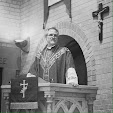
The pastor in the pulpit chanting the Reproaches is the Rev. Douglas Punke, who ordained me at Redeemer's sister historic congregation, Zion Lutheran Church (where he serves as senior pastor), also in Fort Wayne. The kantor (shown in the last two pictures), the Rev. Dr. Daniel Reuning, is a beloved and learned professor emeritus from the Fort Wayne Seminary, an expert on Liturgics, former dean of Kramer Chapel, and now serves as the conductor of the critically acclaimed Fort Wayne Bach Collegium.
Redeemer has been the church home of many Fort Wayne professors throughout the years, including one of my most beloved professors, mentors, and fathers in Christ, the sainted Rev. Prof. Kurt Marquart. The Rev. Dr. Charles Evanson, who has served many years now as a seminary professor in Lithuania (on loan, so to speak, from Ft. Wayne), was Pr. Petersen's predecessor as Redeemer's pastor.
Redeemer is a congregation where the Law is proclaimed in all its fierceness, the Gospel is preached in all its sweetness, and the sacraments are given and received with joy, with reverence, and with an unabashed fidelity to our Lutheran tradition.
 Christ is risen!
The pastor in the pulpit chanting the Reproaches is the Rev. Douglas Punke, who ordained me at Redeemer's sister historic congregation, Zion Lutheran Church (where he serves as senior pastor), also in Fort Wayne. The kantor (shown in the last two pictures), the Rev. Dr. Daniel Reuning, is a beloved and learned professor emeritus from the Fort Wayne Seminary, an expert on Liturgics, former dean of Kramer Chapel, and now serves as the conductor of the critically acclaimed Fort Wayne Bach Collegium.
Redeemer has been the church home of many Fort Wayne professors throughout the years, including one of my most beloved professors, mentors, and fathers in Christ, the sainted Rev. Prof. Kurt Marquart. The Rev. Dr. Charles Evanson, who has served many years now as a seminary professor in Lithuania (on loan, so to speak, from Ft. Wayne), was Pr. Petersen's predecessor as Redeemer's pastor.
Redeemer is a congregation where the Law is proclaimed in all its fierceness, the Gospel is preached in all its sweetness, and the sacraments are given and received with joy, with reverence, and with an unabashed fidelity to our Lutheran tradition.
 Christ is risen!
Tuesday, April 06, 2010
My Day as a Flâneur
 My friend and brother in Christ, Deacon Latif Gaba, posted this wonderful reminder to enjoy life, encouraging his readers to be flâneurs in their own cities. If you don't know the term flâneur (as I didn't), I would encourage you to read Br. Latif's blog post The Virtue of the Flaneur. It is a treat.
I took Br. Latif's advice yesterday, being a flâneur in New Orleans - more specifically the French Quarter.
I have to say that it was a glorious experience.
It has been so long since I have had a true day off, I forgot what it means to relax, to be a flâneur. Now that the Lenten and Holy Week flurry of activity has ended, and now that school is out all week, I am trying to catch up on some relaxation. The way that I speak of it as a "to do" item demonstrates that I really need to pay heed to Deacon Gaba's admonition - as well as that of some of my own parishioners (you know who you are, and I really appreciate your concern and desire to take care of your shepherd).
Mrs. H and Leo are spending their days this week in French Camp. It is run by Lango Kids and held in New Orleans at one of the campuses of Ecole Bilingue de la Nouvelle Orleans, a local French immersion preschool and grade school. Mrs. H., a native Canadienne whose first language was French, is serving as a teacher's aid - which enables Leo to attend gratuis. They are having a great time.
Though I don't like to be separated from the fam, it is allowing me some quiet time, time to reflect, to relax, and even to get some work done at a slower pace and in a more contemplative setting.
Yesterday morning, I walked to the French Quarter from my front door. And yes, I did walk across the Mississippi River. Unlike our blessed Lord, I required the assistance of a boat. The Gretna Ferry now connects us West Bankers to the Canal Street ferry station. Walking to the Quarter is describable in no other way than by the French injection: Super-cool! It was also free, at least as far as any government operation is free (in other words, it is paid for by property taxes and other government funding schemes).
The ride was a relaxing twenty minute cruise along the bend of the Mississippi, water spraying as the ferry cut its way through the rapid currents near the mouth of the world's third largest river.
The weather was a glorious 70-something with the sun shining upon Canal Street as I headed toward the French Quarter with my backpack. I carried only the essentials: books, notebook, camera, and more books. I did leave room in the backpack for books, as there are some magnificent bookstores in the Vieux Carré. I did break a strap on my backpack (I wonder how that happened...), but that was a little later in the adventure.
There are always tourists in the city, in various degrees of sobriety, from every imaginable socio-economic level, of every race, and speaking many languages. There are also plenty of locals - both residents of the Quarter and flâneurs like me out for a stroll. It is never difficult to find French-speakers in New Orleans. Although we are nowhere near as francophone as the parishes to our west, there is still a remnant dating back to the age of the deportation of the Acadians, to the era of the Creoles, and even further back to the age of French colonialism to account for the language's survival even to the 21st century.
Near the St. Louis Cathedral (which viewers of The Princess and the Frog will recognize), I found a little French import store. I wandered in and was greeted with a "bonjour" by the friendly and proper frenchwoman behind the counter. We chatted in French, which means she spoke beautiful native Parisian while I stammered - but my interlocutress was most gracious and patient.
It turns out that she is not the owner, but was helping out her friend who owns the shop - which features elegant French knick-knacks, clocks, artwork, soaps, etc. In fact, she is actually a French teacher who works at Alliance Française de La Nouvelle-Orléans. Her father was born in Paris and her mother was born in a small town in Québec. She lives in New Orleans full time now, and isn't fond of our hot summers, but prefers them to the cold Canadian winters.
We had a delightful conversation - about 90% of which was in French - at least insofar as my own attempts can be classified as a recognizable version of the language. My own experience with French people is far from the stereotype of Gallic arrogance and rudeness. Like this temporary shopkeepress, I have found most French people - be they European, Canadian, or Lousianian - to be kind, polite, easy-going, and filled with joie-de-vivre.
I wondered around the streets of the Quarter with no particular place to go, in no particular hurry, not wanting to see anything in particular. I snapped a few pics here and there. I did visit William Faulker's old house on Pirate's Alley - which is today one of the landmark French Quarter bookstores. While there, I picked up yet another copy of the bookstore map - that is, the map showing the various bookstores in the Quarter. Have I mentioned books yet?
Strolling north of the Cathedral on Orleans Street, I visited the Acadian Bookstore. The owner has signs on the window indicating that he is also a French speaker as well as being a supporter of CODOFIL - an agency dedicated to the promotion of the French language in Louisiana. It is a sad reality that most young people do not speak French - whereas their grandparents often did. The state constitution of nearly a century ago forbade the use of French in public life - including in the public schools (where children were given corporal punishment for speaking French). That ill-advised policy nearly rendered Cajun French extinct. Fortunately, there are those (like CODOFIL) working to resurrect the language. They have made inroads among the young.
The Arcadian Bookstore is what a bookstore should look like. It contains a wonderfully disordered sense of order - the owner knowing precisely where to find any genre amid the anarchic and chaotic stacks and piles. The only thing missing was the typical bookstore cat - and he may have been lost in the stacks anyway. A bracket was laid diagonally connecting two stacks of books. It contained more books in addition to an electric fan. I hit the jackpot, finding the stash of books pertaining to Latin pedagogy - not to mention hundreds of French language books. To Mrs. H.'s relief and delight, I restrained myself, only purchasing two inexpensive Latin titles. But it was a fun place to hang out.
The Crescent City Books has a completely different feel, but was also a bibliophile's delight - with floor-to-ceiling bookshelves, old couches, and rickety stairs connecting to even more books.
Contrary to what most book-lovers would like to believe, man cannot live on books alone. It was time to eat. I have always wanted to dine at the Napoleon House. And so that is exactly what I did. The Napoleon House is just that, a house - a building built as a private residence at 500 Chartres Street (at the corner of St. Louis) for the mayor (Nicholas Girod) in 1797.
In 1821, Dominique You, the half-brother of the famous pirate Jean Lafitte (it is impossible to write about New Orleans without the word "pirate" - and I have done so twice already- I think it is part of the Napoleonic Code as a literary requirement) was persuaded to hatch a plan to liberate the deposed French Emperor Napoleon (living in exile at St. Helena) and move him to New Orleans, with the intent of putting him up in this very house. Napoleon died that year, which ended the plot. But his personal physician, F. C. Antommarchi, did move into the house and practiced medicine there for some 13 years. This is why the State of Louisiana has one of the three death masks made of Napoleon Bonaparte - housed in the New Orleans Cabildo Museum next to the St. Louis Cathedral (the other two are in Paris).
The Napoleon House was purchased by the Impastato family in 1914, and remains in their possession to this day. The house was converted to a landmark restaurant and bar, and is still run by the family. It features open beams, peeling plaster, and a wood floor. The doors and windows are wide open. There is no air conditioner, as ceiling fans move the breeze around. I was seated at a small round wooden table next to one of the plastered brick walls. Graffiti abounds - not the crude and crass variety, but rather various odes and proclamations of love to the city. I watched the horse-and buggy roll by outside, observed every kind of person walk past - from well-heeled conventioneers to liberally-tattooed local denizens. Classical music plays as the waiters and bartender efficiently and yet with great warmth ply their trade - clad smartly in traditional white shirts and black bow ties. There is additional seating available in a peaceful little courtyard in back, featuring a fountain and banana trees.
Lunch was a pleasurable experience consisting of an Italian sausage po-boy and a Stella Artois. I did some writing before and after my meal: old fashioned pen-on-notebook - no laptop, no MicroSoft Word. No hurries and no worries. It was sheer delight.
And here is a video that captures the essence of the Napoleon House.
After lunch, I continued to wander to and fro, finally heading back towards the Cathedral. I decided to drop back into the little French store, realizing that I had not taken any pictures to show Mrs. H. or to share with Fr. H. readers. Upon entering, it became apparent that the nice French lady had been replaced by her less cordial friend - whose mannerisms and speech came across in a more stereotypically French way. It was really rather comical.
When I asked if I could take a couple pictures, she scowled: "No!"
I smiled and said "Pas de probleme."
She then barked back with great suspicion in a heavy accent: "Why do you want to take pictures of my store?" perhaps supposing me to be a terrorist or a rival importer of French goods looking for trade secrets.
I replied: "Because your store is so beautiful."
"I know it's beautiful" she replied, tossing her head back in an exaggerated gesture of pride. "But why do you want to take pictures?"
I did my best Gallic shrug and repeated that I understood her prohibition: "Ce n'est pas une problem."
So, I won't give her store a plug or a recommendation. Pas de problem. But in this day and age, courtesy is a nice policy, as anyone with a camera could be uploading a full video to YouTube. You just never know. So, I won't mention the name of the store or give it a bad report, but will try again at a later time. Maybe she was just having a bad day. Or she may be the living stereotype of French hauteur that has actually pretty-much evaded me until now.
In spite of this little blip of unusual rudeness, my time as a flâneur did not end on a sour note. The sun was still shining, the air still exuded the scent of flowers, the streets and shops and buildings were still every bit as charming as before. C'est la vie.
I strolled back by the Cathedral where a brass band was playing and a man had hair dyed the same color as the magnificent azaleas that were in full bloom. Jackson Square was all gated up in preparation for the upcoming French Quarter Festival, as workers put finishing touches on equipment. From St. Peter Street, I headed back to Canal Street to the ferry ride home.
The set of pictures of my little adventure as a flâneur can be found here.
Monday, April 05, 2010
Finnish Lutherans Have a Faithful Bishop, Now with Video Goodness!
A few days ago, I posted this article about the new faithful Mission Province Lutheran Bishop of Finland, the Rt. Rev. Matti Väisänen.
Now, thanks to Dr. Chris Barnekov, the news authority for Scandinavian Lutheranism for English speakers, you can see the above video of the multilingual episcopal consecration of Bishop Väisänen which he posted at his Scandinavia House website. Chris has also posted a link to video of the consecration of Bishop Roland Gustafsson of the Mission Province.
Deo gratias!
Napoleon was right, about this, anyway...

"In politics, stupidity is not a handicap."
--- Attributed to Napoleon Bonaparte
--- Attributed to Napoleon Bonaparte
Check out these two videos of a knucklehead politician (sorry for the redundancy).
Many of America's problems would decrease, if not go away, if only federal politicians of both major parties and all three branches had even a clue what the Constitution says, or what it means that they are obliged to obey it.
Am I being unreasonable here?
I mean, a fifth grader ought to know that the Constitution does not say: "life, liberty, and the pursuit of happiness" (this is a quote from Thomas Jefferson's Declaration of Independence, written eleven years before the Constitution). I am reminded of the time I had a bust of Thomas Jefferson on display at a street fair, and I was joking around with a popular U.S. congressman from Pennsylvania by asking him if he knew who it was. His lackey immediately ("desperately" is a more accurate word) whispered "Thomas Jefferson!" into his ear, as if I couldn't hear him tipping off the congress-person-place-or-thingy. It was a hilarious (and yet pathetic) tableau right out of a Simpsons cartoon.
But what's worse is the complete lack of care this fellow has to the document to which he is not only bound by oath, but restricted to by law. Ignorance can be fixed, but indifference is harder to correct. There is nothing unreasonable about asking any bureaucrat at any level of government to cite the portion of the charter that permits him to propose, vote for, sign off on, or enforce any law or legislation. That is how republican governance works. Only tyrannies have unchecked and unlimited power. This is especially true at the federal level, as the Constitution is written so as to only allow the federal government strictly enumerated, delegated, and limited powers - the vast majority of the authority being reserved by the states and the people.
I'm not sure which is worse, the fact that this politician doesn't know his history or doesn't care what that history is!
And it that were not enough juggling to make a circus, look at how he continues to ignore the question posed to him in the first place - even in his own video that his P.R. handlers no doubt told him to put on The Interwebs. He simply brushes off his own responsibility to act within the boundaries of the Constitution to Someone Else. But it isn't Someone Else's job, but his. He still doesn't get it. And look at the arrogance! My goodness! He has obviously forgotten for whom he works. Maybe it's time to revoke the country club status these jokers get. They expect to be fawned over like demigods. They expect to be exempt from their own laws. They expect us to shut up and hang on their every word.
And there is no way this guy read the bill in its entirety. It's a simple matter of mathematics. I would respect him at least a smidgen if he came clean on that one. But then again, the old humorous adage that you can tell if a politician is lying by the fact that his lips are moving is so often vindicated by the real world.
And even after all the rigmarole, this elected genius still can't (or won't) answer the simple question posed to him by a constituent.
If the people in this man's district themselves knew the Constitution (or cared), their Congress-critter would be recalled within the month. But government is no longer about obeying the Constitution, it's about bringing home the bacon - even as the American appetite for pork fat is busting our ramen noodles budget - and clogging the national arteries to boot. That is the real American health-care crisis. The body politic is moribund, if not dead-on-arrival.
And frankly, when a "prole" breaks the law, he goes to jail. With rare exceptions, when a politician breaks the law of the land, he climbs the political ladder all the way to the rotting capital of the pillars of the ruins of the Republic, like the Napoleon of the dung heap, decked out in ostrich feathers and gewgaws. But one day, the little emperor will swagger one step too far and place his feet on a rung that doesn't exist. The bad news is that he and those like him will drag the rest of us with them when they come tumbling down. "All the king's horses and all the king's men..."
I believe we are getting the government we deserve. With rare exceptions, every member of the three branches, from the left to the right, wants the federal government to do its bidding - no matter the cost, no matter what the Constitution says. And this is exactly the will of the electorate and the party syndicates. And thus, we have an entire Congress full of game-show rejects who quite literally are not smarter than a fifth grade history or civics student. Amid all the marbled pomp and circumstance of Capitol Hill, these putative aristocrats are basically self-important slack-jawed jesters, who produce nothing, and yet strut about in material grandeur and enjoy a pension and health care plan like no other in America.
And they squeal like stuck pigs when a constituent asks a simple question.
I would say that they deserve to be walking behind circus animals carrying shovels, but I see no reason to insult hard-working carnies who at least admit they are shoveling it (and who may well understand the Constitution better than the rubes in Congress).
Many of America's problems would decrease, if not go away, if only federal politicians of both major parties and all three branches had even a clue what the Constitution says, or what it means that they are obliged to obey it.
Am I being unreasonable here?
I mean, a fifth grader ought to know that the Constitution does not say: "life, liberty, and the pursuit of happiness" (this is a quote from Thomas Jefferson's Declaration of Independence, written eleven years before the Constitution). I am reminded of the time I had a bust of Thomas Jefferson on display at a street fair, and I was joking around with a popular U.S. congressman from Pennsylvania by asking him if he knew who it was. His lackey immediately ("desperately" is a more accurate word) whispered "Thomas Jefferson!" into his ear, as if I couldn't hear him tipping off the congress-person-place-or-thingy. It was a hilarious (and yet pathetic) tableau right out of a Simpsons cartoon.
But what's worse is the complete lack of care this fellow has to the document to which he is not only bound by oath, but restricted to by law. Ignorance can be fixed, but indifference is harder to correct. There is nothing unreasonable about asking any bureaucrat at any level of government to cite the portion of the charter that permits him to propose, vote for, sign off on, or enforce any law or legislation. That is how republican governance works. Only tyrannies have unchecked and unlimited power. This is especially true at the federal level, as the Constitution is written so as to only allow the federal government strictly enumerated, delegated, and limited powers - the vast majority of the authority being reserved by the states and the people.
I'm not sure which is worse, the fact that this politician doesn't know his history or doesn't care what that history is!
And it that were not enough juggling to make a circus, look at how he continues to ignore the question posed to him in the first place - even in his own video that his P.R. handlers no doubt told him to put on The Interwebs. He simply brushes off his own responsibility to act within the boundaries of the Constitution to Someone Else. But it isn't Someone Else's job, but his. He still doesn't get it. And look at the arrogance! My goodness! He has obviously forgotten for whom he works. Maybe it's time to revoke the country club status these jokers get. They expect to be fawned over like demigods. They expect to be exempt from their own laws. They expect us to shut up and hang on their every word.
And there is no way this guy read the bill in its entirety. It's a simple matter of mathematics. I would respect him at least a smidgen if he came clean on that one. But then again, the old humorous adage that you can tell if a politician is lying by the fact that his lips are moving is so often vindicated by the real world.
And even after all the rigmarole, this elected genius still can't (or won't) answer the simple question posed to him by a constituent.
If the people in this man's district themselves knew the Constitution (or cared), their Congress-critter would be recalled within the month. But government is no longer about obeying the Constitution, it's about bringing home the bacon - even as the American appetite for pork fat is busting our ramen noodles budget - and clogging the national arteries to boot. That is the real American health-care crisis. The body politic is moribund, if not dead-on-arrival.
And frankly, when a "prole" breaks the law, he goes to jail. With rare exceptions, when a politician breaks the law of the land, he climbs the political ladder all the way to the rotting capital of the pillars of the ruins of the Republic, like the Napoleon of the dung heap, decked out in ostrich feathers and gewgaws. But one day, the little emperor will swagger one step too far and place his feet on a rung that doesn't exist. The bad news is that he and those like him will drag the rest of us with them when they come tumbling down. "All the king's horses and all the king's men..."
I believe we are getting the government we deserve. With rare exceptions, every member of the three branches, from the left to the right, wants the federal government to do its bidding - no matter the cost, no matter what the Constitution says. And this is exactly the will of the electorate and the party syndicates. And thus, we have an entire Congress full of game-show rejects who quite literally are not smarter than a fifth grade history or civics student. Amid all the marbled pomp and circumstance of Capitol Hill, these putative aristocrats are basically self-important slack-jawed jesters, who produce nothing, and yet strut about in material grandeur and enjoy a pension and health care plan like no other in America.
And they squeal like stuck pigs when a constituent asks a simple question.
I would say that they deserve to be walking behind circus animals carrying shovels, but I see no reason to insult hard-working carnies who at least admit they are shoveling it (and who may well understand the Constitution better than the rubes in Congress).

The state as god

The religious landscape in Sweden has shifted radically in the last century.
What used to be a Lutheran country has become a radicalized society of so-called humanists who seem, in reality, to hold humanity in contempt. A brutal and severe religion of atheism, socialism, and feminism - carried out by force of the state - has taken the place of Christianity and has displaced the former's emphasis on the sanctity of life, of individual liberty, and of the duties of government officials to behave ethically and with restraint.
When the state becomes god, there is no longer any check on its power. If we have learned nothing from the 20th century, everyone on the planet ought to understand that there is nothing more ominous than an omnipotent state.
I think there are sobering lessons for in Scandinavia's experience with a shifting culture and rapidly changing religious landscape. Much of the rest of Europe is headed in the same direction, and I believe the U.S. is on a similar trajectory. As an aside, and as a word of hope amid the gloom, Christianity is not dead in Sweden. There is a faithful remnant of the Church of Sweden that continues to thrive - even against the grain - in pockets throughout Sweden. There is a similar heroic Christian resistance all across Scandinavia.
When the people of a civilized society turn away from God, they replace their religious devotion with the service of a god that does not respect individual freedom nor see the natural family as inviolate. In our day and age, that god is often the state. Many of these fights between the Church and Caesar are being waged on the battlefield of education. Do parents ultimately have this authority, or is this within the sphere of the state? Do parents grant teachers a temporary authority to act in loco parentis to educate their children, or does the state grant a temporary authority to parents to raise their citizens?
Unfortunately, when the government is god, children are wards of the state first, sons and daughters second. This leads to the extraordinary belief that it is profitable for children to be taken from their families to be raised by strangers in the name of the state - even to the point of arresting them on their way to leave the country and breaking up families for years! This is not the stuff of dystopian literature, but rather current events in the lives of real people around the world - even in the United States.
The following article appeared in the Home School Court Report of the HSLDA, Vol XXVI No. 1. I could only find it online cached here (reproduced below). Here is an additional report from the Johannsson family.
"State-Napping Exemplifies" UN Treaty’s Dramatic Potential
Seven-year-old homeschooler Dominic Johansson and his family were sitting on an airplane on June 25, 2009, ready to leave Sweden to start a new life in Mrs.
Johansson’s native country of India. Without a warrant—or even any accusation of crime—Swedish police officers under the direction of local social workers boarded and took Dominic from the plane and from his parents. Courtesy of the familyDominic Johansson in happier times.

Mr. and Mrs. Johansson are facing this simply because they decided to homeschool their son. Local officials said that the action to intervene in this family was intended to guarantee Dominic’s right to an education. The Johanssons have been separated from their son since June, only being allowed to visit with him under supervised conditions for an hour or so every 3–5 weeks.
| ... THERE IS A TROUBLING TREND IN SOME EUROPEAN COUNTRIES TO RESTRICT HOMESCHOOLING ... |
Just as disturbing is Swedish Embassy official Stig Berglind’s appeal to the United Nations Convention on the Rights of the Child (CRC) in defense of the local Swedish authority’s actions.
Mr. Berglind noted in his response to a letter from Home School Legal Defense Association President Mike Smith that the CRC requires that a child’s best interests and the child’s “right to be heard” be “obvious starting points in all actions concerning children in social services.” However, Mr. Berglind and Gotland’s officials apparently ignored the fact that the convention also notes that children have a right to be with their parents as a family, and that separation is a serious act to be used only as a last resort. This action in light of an incredible proposal within the Swedish parliament to allow homeschooling only under “extraordinary circumstances” (essentially banning home education) is of grave concern and is part of a troubling trend in some European countries to restrict homeschooling.
 Courtesy of the family Dominic Johansson and his mother in early 2009: Little did they know their family would soon be fighting for custody of Dominic because of their decision to homeschool. |
The inhuman treatment of this family by a so-called Western civilized nation is indefensible. HSLDA calls on Swedish officials to return Dominic to his parents. To find out how you can help the Johansson family, go to www.hslda.org/sweden.
Although the United States has not ratified the CRC, the Obama administration is looking to submit this treaty to the U.S. Senate for ratification in the near future. The Johanssons’ story graphically illustrates how the CRC would endanger parental rights. Visit to learn how the passage of a Parental Rights Amendment would help to preserve your rights as parents.
— by Michael P. Donnelly
Sit and listen!
 A Thank you The Rev. Joel Brondos for sharing this gem from the Rev. Dr. Martin Luther regarding the Christian's attitude toward the Word of God and worship.
"If you can sit day and night in a tavern or somewhere else with good companions, gossiping, talking, singing, and bawling, and not grow tired or feel that it is work, then you can also sit in church for an hour and listen in the services of God and his will.(The American Edition of Luther's Works, vol. 51, pp. 264-265.)
But now we have the damnable devil, who makes the people so blind and so surfeited and sated that we do not realize what a treasure we have in the dear Word and go on living so rudely that we become like wild beasts.
Let us take it to heart then and remember, whenever we preach, read, or hear God’s Word, whether it be in the churches or at home through father, mother, master, or mistress, and gladly believe that wherever we can obtain it we are in the right, high, holy service of God, which pleases him beyond all measure. Thus you will be warmed and stirred to love hearing it all the more and God will also grant that it bear fruit, more than anybody can tell.
For the Word never goes out without bringing forth much fruit whenever it is earnestly heard, without your being the better for it. Even though you do not see it now, in time it will appear. But it would take too long to tell all the fruits now, nor, indeed, can they all be numbered.
Let this suffice as a foreword to St. Paul’s message, to stir us to listen more diligently to God’s Word, as indeed it is necessary to be reminded of this every day and in every sermon. And it also is pertinent to this text we have taken from St. Paul, for in it he reproaches these same shameful spirits who take hold of God’s Word with their own wisdom and likewise soon allow themselves to think they know it well and that they no longer need to listen to it or learn from anybody else. They turn to unprofitable talk about whatever is new or strange and the mob likes to hear.
They presume to be masters of the Scripture and everyone’s master; they want to teach the whole world and still they do not know what they are saying or asserting. For this is precisely the plague that results; when the Word of God is not proclaimed with earnestness and diligence, the listeners become listless and the preachers become lazy; there the concern must soon collapse and the churches become desolate.
Then inevitably there appear these false spirits, who offer something new, attract the rabble to themselves, and boast that they are masters of the Scriptures, and yet are always the kind of people who themselves have neither known nor ever experienced what they are teaching. This is already gaining ground among us and God’s wrath and punishment for our weariness and ingratitude is coming down upon us."
Sunday, April 04, 2010
Sermon: Easter Festival
 4 April 2010 at Salem Lutheran Church, Gretna, LA
Text: Mark 16:1-8 (Job 19:23-27, 1 Cor 15:51-57)
In the name of + Jesus. Amen.
Christ is risen! He is risen indeed! Alleluia!
“The sting of death is sin,” proclaims St. Paul, and the power of sin is the law.” Death stings us because it is unnatural. The empty chair is a grim reminder that we live in a world that has been corrupted by sin. And this corruption, this mortality, that which St. Paul calls “the perishable” is why death is so ugly and terrible.
In spite of all the world’s attempts to put a happy face on death, death is the ugliest thing in all the world. Death robs us of our loved ones: taking away from us their voice, their presence, their wisdom, their touch, and expressions of their love. It stings us because it separates us. And since death is the wages of sin, death will be required of all of us sinful men. We all, like Jesus, are headed to a tomb.
The disciples of Jesus knew this sting, this pain of separation – and it was intensified when their Lord was crucified, when His tortured and anguished body breathed one final breath, falling limp and lifeless, and placed into a cold, dark stone tomb. He was sealed inside with a large stone, so that they didn’t even know how they were going to anoint His body with spices according to Jewish custom.
The disciples felt the sting of death on that most awful of Friday evenings.
But there was to be no victory for death, as evidenced by the following Sunday morning. For indeed, it did begin to come to pass the saying that is written: “Death is swallowed up in victory. O death, where is your victory? O death, where is your sting?”
For the Marys found an empty tomb. To their shock and their astonishment, they found death declawed and defanged. In fact, they found death utterly defeated by the One who died to destroy death, once and for all. Their lives would never be the same – and neither will ours, dear friends.
Instead of the lifeless body of Jesus, the Marys found a vibrant messenger with Good News: “He has risen. He is not here.” No greater words were ever uttered by man or angel – for with these words, all of the promises of God since the days of Eden were confirmed and vindicated, including the promise that the sting of death was to be no more, including the promise that our sins have been forgiven, including the promise that we have been given the gift of everlasting life, including the promise that we, like the Master we follow, will likewise leave behind an empty grave.
“O death where is your victory?”
The Marys took this Good News to the apostles, who in turn took this Good News to the ends of the earth: “He has risen.” Jesus, who died in our place, rose in anticipation of our own rising again. He who carried our sins to the cross and poured out His life in water and blood, now offers to the world life-giving baptismal water and death-destroying Eucharistic blood, given in tandem with the life-and-death proclamation of the Good News that death has truly lost its sting. He who laid down His life has taken it up again.
This is the message of Easter and this is the proclamation the Church has to give to a sinful, dying world: “Death is swallowed up in victory,” Christ’s victory on the cross and in the empty tomb.
And His victory is our victory!
This is how it is that we can join the Old Testament prophet Job in his own joyful confession of faith: “I know that my Redeemer lives, and at the last He will stand upon the earth.” Dear brothers and sisters in Christ, because He lives, we will also live. We likewise sing and confess with Job: “And after my skin has been thus destroyed, yet in my flesh I shall see God, whom I shall see for myself, and my eyes shall behold, and not another.”
Our Lord’s resurrection is our resurrection. For His death paid the wages we have deserved. Death no longer holds sway over us. This is the Good News the angel gave the Church to proclaim. This is the Good News we hear again and again, week in and week out, comforting us, strengthening our faith, and fortifying us against the attacks and assaults of the devil.
For Satan wants us to fear death. Satan wants us to see death as final. Satan also wants us to embrace death and treat it as a beloved friend instead of a conquered foe.
This is why the words “He is risen” is utterly appalling to the forces of evil, to demons and devils, to those who love the darkness and hate the Church, and to those who despise the truth. And on this holiest of days, Christian churches all around the world ring out this truth in the face of a death-loving and hostile world that not only refuses to believe, but wants you not to believe as well.
But hear the words of the holy apostle anew:
“Behold! I tell you a mystery. We shall not all sleep, but we shall all be changed, in a moment, in the twinkling of an eye, at the last trumpet. For the trumpet will sound and the dead will be raised imperishable and we shall be changed.”
Like our Lord, we too will conquer death. We too will be imperishable. We too will stand upon the earth and see God with our own eyes.
We know that our Redeemer lives! Death is swallowed up in victory! “Thanks be to God, who gives us the victory through our Lord Jesus Christ!” Amen.
Christ is risen! He is risen indeed! Alleluia!
In the name of the Father and of the + Son and of the Holy Spirit. Amen.
Sermon: Easter Vigil

4 April 2010 at Salem Lutheran Church, Gretna, LA
Text: John 20:1-18 (Gen 1:1-2:2; Gen 7:1-5, 11-18; Gen 8:6-18; Gen 9:8-13; Ex 14:10-51:1, Ezek 36:24-28; 1 Cor 15:1-11)
In the name of + Jesus. Amen.
Christ is risen! He is risen indeed! Alleluia!
If you look at a very large clock, you can see the minute hand moving. It is slow, and you have to watch carefully, but you can actually see its determined and steady motion down from the twelve and up from the six. But the hour hand seems to be motionless.
We know it is moving. Our mind understands this very well. But our eyes cannot perceive its motion.
All of us creatures of the Creator on this side of the grave live in time. Our history is continually unfolding. The seconds go by obvious to us, and even days and years, but centuries and millennia seem not to move. We don’t even notice the long changes of history – except maybe when the numbers change in just the right way.
We mark our years according to how long Jesus has been in the flesh, according to how long in human history it has been since God took the form of a man. For history has never been the same – though from our perspective, maybe it doesn’t seem that all that much has changed.
We still live trapped in a mortal body that aches and ages, that gets sick and betrays us, that is tempted to sin and lives and moves in the midst of a violent and hateful world. Even though it has been nearly two millennia since the coming of Jesus, it seems that little has changed in our fallen world. We watch the hour hand, and it seems stuck.
But this is only from our small perspective, dear friends.
Holy Scripture lays out the overview of history. We have taken in a sweep of it this morning. “In the beginning, God created the heavens and the earth.” Everything was good, everything was perfect, everything was made to last. We lived in time but without death. Time was truly on our side. In fact, the weekly marker of time included a day of rest to enjoy creation – which ran like a perfectly calibrated clock.
But we rebelled against this perfect order. Our shared human history took a disastrous turn. We yielded to temptation and sin. We broke communion with God. We believed the lies of the devil. We invited death into our history.
We destroyed the creation to the point where the only redeemable part of humanity was a single historical family. Noah and his seven relatives were preserved from sin and death by an ark, by God’s protection, and by cleansing water that destroyed the evil around them. The God of history gave us a chance to start over – though not without sin.
God chose the children of Abraham to lead history into a new era, one of redemption. And God raised up a son of Abraham, Moses by name, to once again lead the new creation through water to freedom and new birth, to a land of promise, to a fullness of time.
God promised Ezekiel that He would turn back the clock on sin and death, while moving the clock forward to a new and greater age. Eventually, the clocks will all be useless, as time slips into an eternal new era: “I will cleanse you” God promises, “And I will give you a new heart, and a new spirit I will put within you…. You shall be My people, and I will be your God.”
Our God who created the universe in six days, our God who caused a historic worldwide flood to happen in real time, our God who called Abraham and Moses to lead a people over thousands of years of history, takes on human flesh, breaks into a real time and real place, joins fallen man in our mutual wretchedness, suffering even death itself – the consequence of all human history – and did something remarkable and unique: He rose bodily and physically, literally and historically – from the grave!
It may appear to us that the hour hand does not move, but on the night when Jesus was raised from the dead, mankind was brought into eternity. Now we are in the last days, and time is counting down instead of up. With each passing day, week, month, year, decade, century, and millennium, we are closer and closer to our own resurrection from the dead, and a life once more in paradise, without sin, sickness, death, and the devil.
Jesus died on the cross as a sacrifice to pay for our sins, to pay back the wages we deserve, to redeem us by a divine ransom, and to sanctify our flesh by taking our flesh. All of this was accomplished on Good Friday, 30 AD. And yet, God was not done acting in human history. On the third day, on the first Easter vigil, in the middle of the still night that stands as the border between the Past and Eternity, the crossroads between death and life, the passing away of the temporally old and the ushering in of the eternally new, our Lord came back to life. His flesh was reanimated with a blast of creative divine energy. He rose again and turned history upside down. And contrary to appearances, nothing has ever been the same.
The days of mourning and slavery are over. “Woman, why are you weeping?” the risen Jesus asks Mary Magdalene. Mankind’s long and desolate history of imprisonment to sin and captivity to the devil are now over. The frightfulness of the tomb is a thing of the past and of the passing away. For Jesus called her by name: “Mary.” And he sent her to tell the Good News.
The risen Lord also appeared to the disciples, ordaining them as apostolic ministers and preachers of the Good News, commanding them to make disciples by baptizing and teaching. And through them, He continues to ask a sin-laden and death-weary world: “Why are you weeping?” Jesus continues to use ministers of the apostolic Church to call us by name, baptizing us in the name of the Father and of the Son and of the Holy Spirit, baptizing and teaching, proclaiming the Good News, and wiping away tears from every eye.
And in these last days, the Lord offers His grace to all men, bidding them to come, to be baptized, to hear the Good News, to have their sins forgiven, to eat and drink His body and blood and to join His conquest of death. And yet, the hour hand yet looks still. We are waiting for the fullness of time when the Risen Lord will indeed return, consummating a new heaven and a new earth in eternity. We still live in an imperfect and sinful body in a fallen and mortal world – and yet we have the promise, the down-payment of the treasure yet to come at the end of time.
We Christians will indeed follow our Lord in walking out of our own tombs.
We confess with St. Paul to a world looking for hope: “I delivered to you of first importance what I also received: that Christ died for our sins in accordance with the Scriptures, that He was buried, that He was raised on the third day in accordance with the Scriptures, and that He appeared.”
The fact of Jesus’s resurrection changes history forever. By His rising from the dead and conquering of the devil, Jesus turns us poor miserable sinners into saints. He liberates us from the bondage to sin. He opens up our own tombs. He calls us by name, He bids us to cease our mourning, and He invites us to the feast that will have no end.
In light of the resurrection, how fast or how slow the hands on a clock move make no difference. For we have better hands to look to, the nail-pierced hands of the Word of God made flesh, hands that knew death and hands that defeated the enemy. And now those resurrected hands are raised to the Father in prayer for you, dear brothers and sisters, holy hands raised in blessing and benediction upon you, now in time, and even for eternity.
Christ is risen! He is risen indeed! Alleluia!
In the name of the Father and of the + Son and of the Holy Spirit. Amen.
Friday, April 02, 2010
Sermon: Good Friday
 2 April 2010 at Salem Lutheran Church, Gretna, LA
 Text: John 18:1-19:42 (Isa 52:13-53:12, 2 Cor 5:14-21)
In the name of + Jesus. Amen.
Imagine the confusion among those first Christians, the sense of failure, the feeling that they had wasted years of their lives as followers of a charlatan, as they observed the horrifying events of Good Friday unfold. Their whole world had come undone, and did so with a rapidity that made it impossible for their brains to take it all in.
The disciples had followed Jesus for three years. They heard Him preach and teach like no other rabbi. They saw the miracles, the changed lives, the lepers cleansed, demons exorcised, the blind and the lame and the deaf cured. They were there when Jesus fed thousands by miraculously multiplying bread. He even raised the dead.
Were these all tricks? Or worse yet, was Jesus a devil? Maybe they were all hallucinating. Maybe their own minds were betraying them. But now, reality was crashing in all around them, imploding on them while they watched helplessly.
First, Jesus was betrayed by one of the twelve. There was a violent scuffle with the police. Jesus was arrested. He was tried by the Jews and convicted quickly of blasphemy. He was roughed up and sent to the Romans for yet another trial, this time for sedition and treason against the government. The mobs were seething with rage. The Governor had Jesus cruelly flogged. And yet this was not enough to sate the blood-thirst of the crowds.
Finally, Jesus was crucified. There was nothing left for the disciples but to watch their seemingly false Messiah suffer and die, forsaken by God, stricken, smitten, and afflicted, mocked and humiliated, His lifeblood oozing from His broken body. The dream was over. It was finished.
Where was their God now? And what would happen to them? They were now officially a terrorist cell, and the number one terrorist had been executed. Would they live the rest of their lives on the run? Would they too end up on a Roman cross?
Such confusion. Such terror. They could not eat or sleep. They had no place to go. What a strange beginning for a church, for a vibrant organization of people that includes billions around the world today – even as the Roman Empire is nothing but dusty ruins.
The first disciples were confused. They expected a different end to the story. They should have listened more closely to the prophet Isaiah. For he prophesied: “Behold, My servant shall act wisely; He shall be high and lifted up, and shall be exalted.” But God had something in particular in mind when He said “lifted up.” The Messiah was to be lifted up on a cross, as the prophet explains: “His appearance so marred, beyond human semblance, and His form beyond that of the children of mankind.” What a strange definition God has of what it means to be “exalted.”
For the Lord’s Kingdom is “not of this world.” The “King of the Jews,” who is also the King of the Universe is also the “Lamb of God that takest away the sin of the world.” He is also the One who has “borne our griefs and carried our sorrows… wounded for our transgressions… crushed for our iniquities; upon Him was the chastisement that brought us peace, and with His stripes we are healed.”
St. Paul understood this substitutionary rescue mission of Christ crucified, describing the happy exchange of the atoning work of our Blessed Lord in this way: “For our sake He made Him to be sin who knew no sin, so that in Him we might become the righteousness of God.”
Jesus is the King of Peace, because He purchased peace by winning the war. He defeated Satan, He conquered death. He took away our reproach to make peace between rebellious man and righteous God. For “He bore the sin of many and makes intercession for the transgressors.”
But on this first not-so-Good Friday, the disciples did not see any of this. They only saw an ugly death, excruciating pain, bloody wounds, the agony of suffocation, and a racing heart, amid the roar of mocking crowds milling about like virulent and violent dogs. The disciples saw man at his very worst: cruel, hateful, bloodthirsty, greedy, envious, and self-destructive. And they saw themselves included in this loathsome mirror of their own true nature.
And later, in the coming days and weeks, they would begin to make sense of it all. They would understand the ironically true utterance of the impostor High Priest Caiaphas, speaking of the True High Priest, when he said that it would be expedient that one Man should die for the people.
Jesus Himself would teach them one last time from the cross, His final word being instruction as well as proclamation: “It is finished!” This is a victory cry, an ancient Greek expression of military triumph. To someone ignorant of the struggle going on, to someone who has rejected Jesus as the Lord’s Messiah, this is a curious statement. Why would a dying man, a condemned terrorist, a seemingly defeated and exposed charlatan call a defeat a victory? Was this the last desperate and disturbed utterance of a delusional and pathetic man?
Unlike the first confused disciples living as these events quickly unfolded, there is no confusion on our part. We have the hindsight of history, the comfort of one thousand nine hundred and eighty Easters behind us, and another yet to come on the first day of this next week, yet another new week of creation, an eternal eighth day of glorious life ripped once more from the twisted mouth of death.
We know how those events played out. We know how the Marys would find the tomb. We know how Thomas would come to believe. We know how the disciples would indeed die for the sake of their True Messiah, some themselves on Roman crosses. We know how St. Paul would proclaim the Crucified One to the ends of the known world, and how our own ancestors would come to faith by the testimony and proclamation of the Church’s growing army of missionaries. We know the hope and the truth that we, the Church, continue to proclaim, even to the very same mockers and unbelievers that the Lord Himself died for, and prayed for. We are still derided by twisted mouths of death, asking “Where is your God now?” those who believe in fairy tales, like self-creating matter and beneficial mutations, over and against the obvious – that we are fearfully and wonderfully made creatures of a God who not only created us, but loves us enough to redeem us.
But today, this Good Friday, we join the first Christians to look upon the “sacred head now wounded,” to see Him “led to the slaughter, like a sheep before its shearers… silent.” We ponder His holy wounds, His passion and death, and His Sabbath rest in the tomb – all for us men and for our salvation, all for the forgiveness of sins, all to make all things new. We consider the wretchedness of our own sins and the boundless love that impels Him to die for us. And yet we are not confused. It is truly Good Friday.
And in anticipation of His bursting from the spiced tomb and awaiting His coming again to create a new heavens and earth, we join St. Paul in confessing and proclaiming: “The love of Christ controls us, because we have concluded this: that One has died for all, therefore all have died; and He died for all, that those who live might no longer live for themselves but for Him who for their sake died and was raised.”
It is finished! Amen.
In the name of the Father and of the + Son and of the Holy Spirit. Amen.
Thursday, April 01, 2010
Sermon: Maundy Thursday
 1 April 2010 at Salem Lutheran Church, Gretna, LA
 Text: John 13:1-15, 34-35
In the name of + Jesus. Amen.
In her creeds, the Church confesses herself to be “holy.” Scripture teaches us this. Jesus teaches us this. “Holy” means “set apart.” Holiness is the technical term for what the writers on Sesame Street referred to when “one of these things is not like the others.” The Church is holy because she is separated from the world, set apart, and different.
Jesus tells us today that we are to be different.
Christians are different as a matter of faith. We believe, as we confess in our creeds, in the Father, Son, and Holy Spirit. We believe that Jesus of Nazareth is both God and Man, that “for us men and for our salvation” that He “came down from heaven and was incarnate by the Holy Spirit of the virgin Mary and was made man.” He “was crucified, died, and was buried” and walked out of His own tomb – physically and literally. We believe that He, by the sacrifice of the cross, by grace, through faith, forgives all our sins, justifies us freely, and saves us from hell, giving us everlasting life.
No other group of people, no other religion, confesses this. We are a particular and a peculiar people.
But holding the right doctrine alone is not the complete mark of the Christian.
In fact, in the Athanasian Creed, this one true faith, this catholic faith held by Christians universally, is this: “that we worship one God in Trinity and Trinity in Unity.” According to our confession, it is not enough to intellectually hold doctrines in one’s head, for the faith is lived out in community, in the subject and verb “we worship.” Christians are a “we” people, a community, a body comprised of many parts, the head of which is Christ. And that community manifests itself in “worship.”
On Maundy Thursday, our Lord Jesus establishes worship making use of the Lord’s Supper, a communion that is impossible to celebrate alone. It is a communal meal in which the churchly body of Christ feeds on the physical body of Christ, in which the Church drinks the blood of the Lord, exchanging His perfect life for our sinful one by the sacrificial blood He shed for us. We Christians are a Eucharistic people, those who give thanks before sharing the Bread of Life and the Cup of Thanksgiving. And this is no mere option for Christians. One cannot willfully refuse this holy meal, for our Lord Himself says: “Do this.” It is mandatory. And this “mandate” is part of the “Maundy” in Maundy Thursday.
It is as impossible to willfully sever oneself from the life of the Church and remain a Christian as it is for branches of a vine to live having been cut off from the rest of the plant.
And yet, holding the right doctrine and faithfully attending services of Word and Sacrament are not the marks of the Christian that our Lord leaves us with right before He goes to the cross.
For as He so often does, our Blessed Lord does something surprising, shocking, and profound – and yet something common and unpretentious: He washes His disciples’ dirty feet in the manner of a common slave. What greater image of God is there than this: a servile God on His hands and knees scrubbing dirt while sinful men are served and made clean. This is not the image of the powerful Prophet with resounding words and wonders, nor is this the image of the mighty King issuing commands and exhibiting power. Rather this is the humble Priest – the manifestation of Christ that Dr. Luther considered the most comforting of all.
For our Priest is there to offer a sacrifice on our behalf – which He does on Good Friday. He is there to offer a watery sacrament to us to place His holy Triune Name upon us, cleansing us and sealing us as one of God’s own – which He establishes on the day of His ascension when He commanded the apostles to “go and make disciples, baptizing …” He is also there to offer this continual cleansing by words of Holy Absolution and preaching, along with the lavish gift of baptismal water, for “The one who has bathed does not need to wash, except for his feet, but is completely clean. And you are clean” He says to His Church.
We are clean because Jesus has cleansed us. And this cleansing by water and the Spirit is also a mark of the Christian: “He who believes and is baptized will be saved.”
And yet, once more, a person who has intellectual doctrinal knowledge, faithfully attends divine services, is baptized and cleansed by the Gospel, may still not be readily identifiable as a Christian. This, our Lord tells us, is done by a different mark of the Christian – perhaps the most important of all: “that you love one another.”
Our Blessed Lord used the washing of the feet as an example of love and service, of brotherly affection, of our willingness to wrap a towel around ourselves, roll up our sleeves, get on our hands and knees, and serve our brothers and sisters.
Our Lord says: “By this” – not by your doctrine, not by your faithfulness in church attendance, nor even by your baptismal certificate – but “by this,” your love for one another, “by this all people will know that you are my disciples.” And if this is still unclear, the Lord repeats it: “…if you have love for one another.”
This is not to say that doctrine is unimportant. Far from it! Satan lures people from the true faith with lies about God, about Christ, and about how God saves us. It is imperative that the Church clearly articulate the reason for the hope within us, the one true faith, the non-negotiable truth taught in Holy Scripture and by the church catholic from the time of the apostles.
And this is not to say church attendance is unimportant. Far from it! Satan lures people from the one true faith by tempting them to cut themselves off from Word and Sacrament, from the Gospel, from being in a flock with others of the Lord’s fold, exposing themselves and their children to being devoured by the devil, who prowls around like a ravenous lion. Do not take this “blest communion” for granted, dear friends. Grace is free, but it is not cheap. We are weak, and only the Lord can fortify us and keep us in the faith.
And this is not to say baptism is unimportant. Far from it! Satan lures people from the baptismal life, the life of being washed in the waters of regeneration, of being born again, instead putting their faith in their works or in their faith itself instead of trusting the Word by way of the gift poured upon you in the name of the Trinity. Do not despise your baptism, but meditate on it often, with every sip of water, every rain storm, every sign of the cross, lay hold of this most gracious new birth by water and the Spirit.
But as St. Paul taught the Corinthians, even if we have every spiritual gift – even with “prophetic powers” and even if we “understand all mysteries and all knowledge” – yet if we lack love, we are just noisy gongs and cymbals, useless noisemakers. For love founds, marks, and completes the life of the Christian, the holy life of the Church, the doctrinal life of the Christian’s study, the piety of the Christian’s worship, the reception of the Lord’s grace in Word and Sacrament by the Christian, in everything the disciple of Jesus does and is. For we were saved by love, we were given the gift of love, and now, the Lord gives us a command, a mandate, to share this love.
The Lord bids us to love, dearly beloved brothers and sisters in Christ, not so that we can earn our salvation, not so that we can point to our own piety – but rather for the sake of the Kingdom. For when you let your light shine before men, they glorify the Father. More have been won to the Kingdom by acts of love and mercy than were convinced by doctrine alone, by church attendance alone, or by baptism alone. For true living faith is never alone, but is always bound together in love. Love is proof that our faith is genuine, that it extends beyond the head to the heart and the soul, that it reflects the love of God in Christ Jesus.
Love is the difference. Love is what the parched world thirsts for. Love is the thing that makes the Christian holy and “not like the others.” Love is holiness in action. Love binds the persons of the Trinity. Love sent the Son to take human flesh. Love gives us the body and blood of Christ. Love baptizes us, gives us absolution, preaches to us, serves us, and covers a multitude of sins. And as the Holy Spirit revealed to St. Paul: “Love never fails.”
The grace of our Lord Jesus Christ, the love of God, and the communion of the Holy Spirit be with you all…
In the name of the Father and of the + Son and of the Holy Spirit. Amen.
Wednesday, March 31, 2010
Tax Dollars at Work, Part 2,312

Alice in Wonderland, meet George Orwell. George, say "Hello" to Alice...
This is what it takes to be a criminal in Nanny State England these days.
This is what it takes to be a criminal in Nanny State England these days.
Conservative?
 Here is the problem with modern American "conservatism" as evidenced by a "conservative" Senator in the form of an op-ed piece.
And the sad part is, this poor guy probably really thinks he is a conservative. And so do a lot of people who voted for him. But conservatism is by definition a philosophy of small and limited government, of adherence to the Constitution, of states rights and individual freedom.
But look at Sen. Brown's objection to the health care law in his own published words.
He isn't against it in principle because it transgresses the Constitution - including putting burdens on the states and the people that run afoul of the tenth amendment and the body of the Constitution itself. When he talks of "repeal" he really means rolling back a few features of the bill that he doesn't like, a sort of cosmetic tweaking that would make it acceptable to him.
To "repeal" only the "worst parts" of the bill is no repeal at all. It is to misuse the word, and to do so in a clever way to appear to be conservative. This is a crafty and careful use of deceptive language, and it is unlikely a word he came up with himself. Conservative Americans are being sold a bill of goods by Republican strategists and focus-group driven marketeers. Brown also states that he is "working on legislation that would allow states to opt out of this federal health care bill because states need flexibility, not a federal government takeover of health care."
And therein lies the problem.
To speak of "allowing" the states to do what they already have the right to do is to grant the premise of big government - even while giving the appearance to the contrary. It is to embrace the very things the rank and file conservatives claim to be against - and to do so under the radar screen. It is to agree with the Democrat Party philosophically and to lock arms with them constitutionally - all the while using rhetoric to appease the Tea Party movement. A true conservative would have used "allow" to speak of what the federal government may or may not not do. The federal government has no authority to "allow" the states to do anything. He may be proposing a slightly longer leash, but he still wants the states under federal control. That is the antithesis of conservatism.
Sen. Brown has revealed his true colors - which are well within mainstream Republican thought.
Brown even invokes the Republican-authored Massachusetts health care plan - which operates under the same basic schema as ObamaCare, and in fact is not all that different. President Nixon's health care proposal was also quite similar to the new law. And as Anthony Gregory and Paul Krugman have shown even the allegedly conservative Heritage Foundation's proposal was basically the same thing.
But does the federal government have any authority to mandate health care in any way, shape, or form? Is it even a good idea for state governments to be so involved in the operation of the market mechanism? Those are the kinds of questions real conservatives would ask. And the answers have to do with what the law is, not what would be popular or what we think we can get away with, nor even what would be a good idea. If federal mandates over health care are indeed a good idea, then the Constitution needs to be amended to allow for it - otherwise there is effectively no Constitution and no rein or limit on government of any sort.
That is what a conservative would say, anyway.
At best, Sen. Brown is a cautious moderate or a pragmatic left-leaning centrist. He has wandered away from the conservative fold while still cluelessly waving the banner, like a sports fan who is unwittingly sitting on the wrong side of the stadium wearing the wrong colors unable to understand why everyone around him is cheering at inappropriate moments.
He also writes:
"I am leading a charge to take the billions of dollars sitting unused in the stimulus slush funds of federal bureaucracies and give immediate tax relief — as much as $100 a month — to every American worker so that they can support their families now and inject money into the economy rather than let it stagnate in Washington."
Rather than use the language of "repeal" to speak of the bipartisan stimulus plans, rather than condemning these Republican and Democrat schemes as unconstitutional, Sen. Brown simply proposes spreading the wealth in a different way. This is so typical of federal bureaucrats who call themselves "conservative." He promises to get his constituents more of the federal take, while it doesn't seem to dawn on him that the federal should not "take" to begin with.
Economically, Sen. Brown reveals that he is a Keysian at heart.
The poor fellow seems to think the government can actually create jobs in the private sector. He may be right that Americans say they want "their government to fully focus its attention on the economy and getting our citizens back to work." But the Constitution has nothing to say about "focus[ing] its attention on the economy" and tinkering with the market in an attempt to make work. That is a play right out of FDR's book, which was already torn out of Karl Marx's. The only positive thing government can do for the economy is to get out of the way. A big step would be to abolish the Federal Reserve and to bring sanity back to our money and banking system. But to do so would be for the federal government to let go of its reins of control over the states and the people and trust the market and individual liberty.
But then again, that devotion to freedom is a conservative idea, one that Sen. Brown seems to have abandoned.
Maybe the current Republican rhetoric that ObamaCare will bankrupt the country and turn America into a third-world Socialist has-been state is true. But at least they can take comfort in knowing that the destruction of America is a bipartisan effort. There is no "I" in "team" after all.
We are indeed "all Socialists now."
But the real eye-opener is Sen. Brown's goal of "faith in government." This flies in the face of not only conservatism as a philosophy, but of the Constitution and the entire American experience itself. "Faith" is the language of religion. And the Constitution, including the Bill of Rights, was written because our founders knew better than to put faith in government. If that was their intent, they would not have written a Constitution, but simply trusted the federal government with a lot of power - which is how the British Empire worked. Instead, they seceded from that Empire and created a decentralized government of checks and balances with a written charter of specifically enumerated powers. There is no language in this op-ed article.
But the most glaring "smoking gun": a conservative could not have written this piece without once using the word "Constitution."
Sunday, March 28, 2010
Sermon: Palmarum (Lent 6)
 28 March 2010 at Salem Lutheran Church, Gretna, LA
 Text: Matt 27:11-54 (Zech 9:9-12; Phil 2:5-11, Matt 21:1-11)
In the name of + Jesus. Amen.
“Jesus Christ is Lord.” Jesus Christ is God. The name of Jesus is “the” name, the divine name, the “name that is above every name.” The name of Jesus is the Trinitarian name into which we are baptized. Jesus is the “I AM” that the Angel of the Lord spoke when Moses wanted to know God’s name.
Not every tongue confesses that Jesus is God, that His name is the “name above every name,” the name at whose mention “every knee should bow.”
In fact, there are billions in the world today who do not make such a confession. There are even some who claim to be Christians who will not bow the knee and “confess to the glory of God the Father” that Jesus is Lord and has the divine name.
In seeing with the eyes apart from the eyes of faith, it is difficult to see a humble man riding on a donkey and consider Him to be God. It is equally taxing to our reason to see a child born of a disgraced mother lying in a manger as the maker of heaven and earth. And there is no greater act of faith than to gaze upon the lifeless body of the crucified One and proclaim: Truly this was the Son of God” like the centurion; or to stick one’s finger into the nail print in the living hands of the risen One and confess: “My Lord and my God!” like St, Thomas.
This is because our sinful nature has a difficult time synthesizing God’s Almighty power with the humility of our Lord Jesus. For He “did not count equality with God a thing to be grasped, but made Himself nothing, taking the form of a servant.”
The prophet Zechariah implored the children of God to “rejoice” and to “shout aloud,” for as he proclaims: “your king is coming to you, righteous and having salvation is He, humble and mounted on a donkey.”
But in spite of this king’s gentleness toward His people and His taking of a form of a servant, the prophet tells us: “His rule shall be from sea to sea and from the River to the ends of the earth.” From the river in which He was baptized to the very ends of the earth where His baptism is carried in His name, there is His kingdom, His domain, His might – all cloaked in humility.
The sinful nature hates humility. Indeed, the Old Adam loves raw demonstrations of might. Those who deny our Lord’s divinity make a grave error: they interpret His forbearance as weakness; they misread His mercy as a lack of power.
And yet, St. Paul points out that every knee will indeed bow before our divine King Jesus – not because of His power, but because of His humility. In love, Jesus was humble enough to lay down his life, and powerful enough to take it up again. There will come a time when even those who pierced Him, those who deny Him, those who attempt reduce Him to the status of a guru or dismiss Him as just another failed Messiah will indeed kneel in submission before His divine name.
Pilate was amazed with Christ not because of His cleverness and forcefulness, but rather by His silence. When the people had the opportunity to show mercy to a prisoner, they chose to release Barabbas, a terrorist whose name means “son of the Father” rather than release the true and only begotten “Son of the Father” who was accused falsely of being a terrorist. They petitioned for the freedom of a criminal who sought to overthrow the government while seeking the death of the rightful King, who in no way revolted against either the Jewish King or the Roman Caesar.
And when Pilate asked the mob point blank what evil Jesus committed, they gave the same answer as Jesus: nothing. Rather than answer the simple question, a reasonable question considering this was a trial, they instead “shouted all the more, ‘Let Him be crucified!’”
Not knowing what they were saying, the crowds said: “His blood be on us and on our children.” And having said this, Pilate had our blessed Lord scourged, causing that blood, that royal blood of David’s line, that priestly blood of the order of Melchizedek, that sacrificial blood of the “Lamb of God pure and holy” to be spilled and placed on the daughter of Zion, the daughter of Jerusalem. For this is the blood of the covenant, the New Testament in His blood, shed for you, for the forgiveness of sins.
For truly we are all Barabbases, sons of the Father, having been released by our Lord who takes our place at the cross, who spills the blood we deserve to shed, who died the death we have earned by our many sins. And like Barabbas, we walk free thanks to our Lord’s humble mercy.
In humility Jesus endures the humiliation of the mockery and thorns, and in love he suffers the pain and agony, restraining Himself of His mighty and divine power, all for the sake of showing mercy – even to those who crucified Him, even to us whose sins were atoned for by His act of love.
They mocked Jesus for being king, and that is exactly what He is. They mocked Him for His statement about destroying the temple and rebuilding it in three days – and yet that is what He did as the Redeemer. They mocked Him for saving others – and yet that is what He did as the Savior. And the crucified God, the giver of life, yielded up His own Spirit, and the temple curtain that once separated God from man “was torn in two” as the God-Man Himself was being torn on the cross. Creation itself trembled for the sake of the Creator, and “the earth shook.” Even the dead walked out of their graves in a little preview of the resurrection – both that of our Lord and that of those who bow the knee to Him in faith and confess Him as Lord.
For indeed, He is Lord. Our eyes see the weakness of mortal humility, but faith sees the strength of divinity. Our eyes see a man defeated by death, but faith sees death defeated by a Man who is also, in the good confession of the centurion: “the Son of God.”
Jesus is the one name above every name, the single and strong name of the Trinity, the sole name into which we are baptized, the unique name before which every knee will bow, the only name in which we can be saved.
And indeed, “Blessed is He who comes in the name of the Lord.” Amen.
In the name of the Father and of the + Son and of the Holy Spirit. Amen.
Friday, March 26, 2010
Back in the USSA and the German Democratic Republic

Remember when Americans and their federal government used to universally denounce communism, fascism, and totalitarianism? I guess these once unpopular "-isms" became fashionable on this side of the pond after German unification and Soviet disillusion.
Here is what the federal government is becoming and with whom it is collaborating.
Here is what the federal government is becoming and with whom it is collaborating.
Daily Prayer

The Rev. William Weedon has wise and practical pastoral advice for Christians who want to participate in the precious and yet abounding treasury that is daily prayer in words addressed to a teenager, but applicable to all Christians. Click here.
Subscribe to:
Posts (Atom)