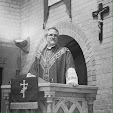
St. Polycarp (69-155) was one of the church's greatest heroes who was part of the first wave of bishops ("the apostolic fathers") after the holy apostles.

Showing posts with label Society of St. Polycarp. Show all posts
Showing posts with label Society of St. Polycarp. Show all posts
Friday, August 09, 2013
Short Video about St. Polycarp, Bishop of Smyrna
St. Polycarp (69-155) was one of the church's greatest heroes who was part of the first wave of bishops ("the apostolic fathers") after the holy apostles.


Wednesday, May 16, 2012
Father William Weedon at the International Center

In case you missed this interview over at Gottesdienst Online, this is an informal chat with the Rev. William Weedon who is the synod's new director of worship and International Center chaplain.
Pastor Weedon is my predecessor as the dean of the Society of Saint Polycarp.
I'm pleased and honored to have Father William entrusted with the worship life of our synod, as his own own words and deeds as a seasoned Lutheran parish pastor, evangelical preacher, theologian of the cross, and teacher of the good news of Jesus Christ, attest in no uncertain terms to his faithfulness to our confession "in doctrine and ceremonies."
There is much to be encouraged about as the leaders of our synod are steering us back in the direction of our evangelical catholic heritage and our bright future as bearers of the torch of the Gospel. I look forward to Pastor Weedon's contribution to our Walk Together.
Thursday, July 01, 2010
The Swingin' Polycarpians...
 ... would be a good name for a retro band. Or, the title of the above pic of myself and my dear old friend and brother in Christ, Deacon Latif Gaba, while lazily strolling about Milwaukee with our families.
Picture courtesy of the legendary Ruth Gaba.
Tuesday, June 22, 2010
Amtrak and God's Merciful Providence
We recently got back from our trip to Milwaukee for the annual Society of Saint Polycarp retreat at Holy Hill Monastery. This was essentially the same journey as last year, but with some joyful changes - both expected and unexpected.
Once again, we took Amtrak's legendary City of New Orleans train from New Orleans to Chicago, an overnight trip in a sleeper room - followed by an hour-and-a-half commuter ride on the Hiawatha completing the journey to Milwaukee. The return trip was the same, only in reverse.
We learned our lesson from last year and took an earlier Hiawatha (Milwaukee to Chicago) on our return trip so as not to miss our connection. And we're glad we did. Instead of being stranded in Chicago overnight and then relegated to coach for the overnight trip, we were able to enjoy our privacy and comfort and stay on schedule.
Once again, the meals on Amtrak were outstanding, and the service friendly. And Leo being five instead of four made a great difference. Under the circs, the "Last of the Spartans" did really well. Especially considering that he was stuck in a monastery for a couple days with no children to play with - that is, unless one considers Brother Latif to be in that category. The game of "toss the beret on the deacon's head" was a hit.
And speaking of Br. Latif, he and his wife Ruth were most gracious in putting us up for a couple days of vacation and sightseeing after the conclusion of the retreat (not to mention a cookout that, in the words of Arlo Guthrie, "could not be beat"), even treating us to a visit to the Milwaukee Art Museum, trips to local coffeehouses (and Jimmy John's!) on Brady Street, and a bag of Alterra coffee to take home. We also experienced The Spice House for the first time. Thank you, dear friends!
The retreat itself was a time of great refreshment, of prayer, worship, and discussion of spiritual matters with both lay and clergy brethren within our beloved Evangelical Lutheran tradition and confession within the Church Catholic. We celebrated the Holy Eucharist each day. There was a lot of time built in for catching up, as well as for presentations and book reports on a wide range of topics.
The meals at the monastery were largely home cooked by Christina (who remembered us from last year, but who unfortunately for us is moving on to better opportunities). The food was simply wonderful. We also enjoyed a couple meals in town together with all of us and our families. After the conclusion of the retreat, we met with a pastor from Oklahoma who was in town for another conference, and he was received into the Society.
Mrs. H. and I also met with fellow Polycarpian (and former parishioner) Mike Green and his wife Amy - as well as (for the first time) their daughter Jillian, who is our goddaughter. She is a delightful baby - happy and intelligent - and it was a great joy to see our friends Br. Mike and Amy for the first time in months. They are wonderful parents, and seem to be really enjoying the ride. We look forward to watching Jillian grow up.

The only real downside came in the form of disappointment in not seeing my friend and colleague who had fully expected to be there, the Reverend Shane Cota, whose radiator decided to go bad on the ride up. Fr. Shane is a devoted pastor and churchman, and was sorely missed. I hope to see him before next year's retreat.
Also, thanks to the Reverend Tim May for being "pastor-on-the-spot" and taking care of the retreat arrangements for us - as well as saying Mass for us two of the three times while we were on retreat. Thanks also for his celebration of the daily Divine Service at his parish, St. Stephen (LCMS) - which we also attended while in town.
It was, of course, also a great joy to see all of the rest of the brethren - whom for the most part I had not seen since last year - as well as a few new faces. Each year, our retreat has gotten larger. We're already starting to plan and make improvements for next year.
One unexpected grace came by what can only be described as pure unbridled divine providence: I got to meet with, and sit in on a Latin class by, the Carmelite monk Fr. Reginald Foster. Fr. Reggie was, until very recently, the pope's personal Latinist. All Vatican documents must be officially translated into Latin, and that was Reggie's job. He also developed quite a reputation for his unusual teaching methods and generosity (the latter of which got him in hot water with the Pontifical Gregorian University for which he formally taught).
Vatican Radio produced a series of podcasts featuring the unpredictable, irascible, and quick-witted friar known as The Latin Lover bantering with his equally unflappable co-host Veronica Scarisbrick (archives available for your listening pleasure here). I especially enjoyed this episode in which Fr. Reggie explains what it is like to be a Carmelite. This NY Times article from 2004 captures Reggie quite well - at least based on my own limited observation and reading what others have written.
Fr. Foster's class on the Janiculum Hill in Rome has been attended by people from every walk of life - including pastors of the Lutheran Church - Missouri Synod. It seemed an impossibility to ever sit in on one of his classes, as parochial and family duties (not to mention those two impediments "time" and "money") prevent my traveling abroad.
Fr. Foster had returned to Milwaukee last year suffering with health problems (from which he has made a remarkable recovery). Meanwhile, he turned 70- years old and was officially retired from the Vatican. He now lives in a Carmelite monastery in Milwaukee and teaches Latin out of a local church basement. His teaching schedule is as rigorous as it was in Rome, and his classes are still free.
I would have been completely ignorant of this opportunity were it not for a fellow traveler on the Hiawatha, a gracious college student whose name was Gus. We didn't speak at all until we arrived in Milwaukee. I noticed the temperature was 63 degrees and commented to Mrs. H. that this was cold for us. Gus chuckled and told us he was from North Dakota originally and had the opposite perspective. We spoke about why we were in Milwaukee. Gus, it turns out, is a university student who is interested in linguistics - especially Latin. He explained that he was in town to study under Fr. Foster.
This was simply unbelievable! I took out my small Latin dictionary from my pocket and brandished it like a passport.
I told Gus that I teach Latin to middle school kids using Hans Oerberg's book Lingua Latina per se Illustrata. It turns out that Gus's ambition is to become a Latin teacher and use this very same book! As our ride was nearly over, we closed out our conversation. I asked Leo: "Ubi est Roma?" and he replied "Roma in Italia est." Gus asked how old he was, and then asked him to count to five in Latin - which he did. I gave Gus my card and asked if he would contact me in the case that I might be able just to shake Fr. Foster's hand. I would consider that a great honor. I also got Gus's e-mail address.
A couple days later, I got a call on my cellphone. Gus said that Reggie would love to meet us, and passed along his cellphone number. I called him, and he was very gracious and invited us to meet him in the church basement. Br. Latif, Ruth, Mrs. H., Leo, and myself showed up just as he was finishing a session.
He sat in a wheelchair in front of a projector and "scolded" Latif and me for being late. We were given a copy of his large photocopied collections of readings that comprise his course. He held class for a few minutes until the break - at which time, we introduced ourselves. We took pictures and some video. He was delightfully cranky and contrary (all with a smile on his face). He was a good sport as we snapped his picture with this one and that. Leo even grabbed his projection device and moved it. Reggie tried to look annoyed, but shook Leo's hand and greeted him.
I repeated the question to Leo: "Ubi est Roma?" and upon Leo's reply, Fr. Foster knew that I was using the Oerberg text - which he proceeded to make fun of and explain that he doesn't like it (which he later said that it was actually a good text, but for him, a slow way to learn Latin). After blurting out gruffly that he doesn't sign books, that's just what Fr. Reggie did for us - inscribing beautiful Latin for both myself and Br. Latif - in my case, writing inside my little yellow dictionary that Reggie deemed "cute." I will keep the inscription to myself, as he was gracious and kind in his remarks about me and my family. I know Fr. Reggie has his cantankerous reputation to uphold, and far be it from me to spoil it.
Following the break, Fr. Foster allowed Latif and I to sit in on his "lecture" - though he corrected me that this was not a "lecture" but rather an "experience." Indeed, it was. On this occasion, he taught using Cicero, Caesar, Livy, and a medieval German author. He questioned students around the room, cracking jokes, telling stories, detailing intricacies of language, and used mild profanity on occasion. He was dressed in rumpled street clothes and drank PBR out of the can. He made a few wisecracks about us Lutherans, took shots at modern academia, and peppered his speech with grunts, groans, and eye-rolling (this very sentence could well have been written about one of our own beloved seminary professors - I'll just mention his initials: D-A-V-I-D S-C-A-E-R). I managed to scribble out a couple pithy quotes. Fr. Reggie's students (to use the imperfect tense) were loving it.
The Wikipedia article explains:
Foster's teaching style has made him the subject of BBC documentaries and a chapter in Alexander Stille's book The Future of the Past. It is characterized by a gruff style that feigns anger, disappointment, and a sense of despair for the future of Latin studies. Yet most students see that the demeanor is merely part of his style, and consider his "tough love" approach a refreshing contrast to the coddling of undergraduate American curricula. His pedagogy often can be a bit contrarian: In terms of his teaching, the task of translating any bawdy Latin text might, for example, go to a pious sister, and a text from St. Augustine or Pope St. Leo the Great to an atheist or a Jew.
Fr. Foster's class was education at its pinnacle.
There were about two dozen students, all young save for one (not counting Latif and me who are not young, of course). Their cars in the parking lot were from as far east as Massachusetts and as far west as British Columbia. They are there for the summer, and are receiving no college credit; likewise Fr. Foster is not charging them anything. Professor and students were all there for one reason: love of the Latin language. The students are not there for grades or a piece of paper.
After an hour-and-a-half session that flew by, we thanked Gus (who was very gracious and respectful), thanked Fr. Foster again, and took our leave. If circumstances were different, I would have loved to have enrolled for the summer. But that is just not to be. But the Lord in His infinite wisdom, mercy, and providence allowed me to enjoy a short but wonderful and inspiring opportunity to meet Fr. Foster and take part in a little of the "experience."
So our retreat and subsequent vacation were an unmitigated success. Though it is good to be back home, where the only time it is sixty-three is when you walk into an air conditioned restaurant. The people of Milwaukee were, yet again, gracious and vivacious. The folks in Chicago were typically Chicagoan. There is no need to elaborate. But we sure are glad to get back to our home, critters, books, and bed. There is a lot to do this summer, and a little R&R is just what the doctor ordered.
More pictures are here.

Tuesday, June 30, 2009
The Grand, the Glorious, and the Ugly

This year's annual retreat of the Society of Saint Polycarp was held at Holy Hill, a monastery of the Discalced Carmelite order of monks near Milwaukee, Wisconsin.
This was my first trip away from the parish in a couple years. We made it a family trip, and instead of flying or driving, chose to ride the iconic City of New Orleans train, which runs from its namesake city out of Union Station near the Superdome all the way to another Union Station in Chicago. From there, we caught the Hiawatha train to Milwaukee. All three of us fit comfortably in a sleeper car with all meals included. This was our first long-distance train ride since our delayed honeymoon in 1994 that took us from Philadelphia to Atlanta, Mobile (then by auto to New Orleans and Biloxi), St. Augustine, Charleston, and back home to Philly.
Of course, this time, we traveled with our four year old boy.
If our trip had been a Clint Eastwood movie, we might have modified the title to The Grand, the Glorious, and the Ugly.
The Grand
We left after Mass at Salem Lutheran Church Sunday, June 14, as some very helpful parishioners took us to the station and saw us off. The plan was to have the Rev. Al Kornacki fill in for me on Wednesday night, and I would be back at Salem's altar and pulpit the following Sunday. That was the plan, anyway.
We went into the Magnolia Lounge for sleeper car passengers, which was basically a small room equipped with a couple tables, a TV, and a coffee pot. We met some of our fellow travelers - including the one-in-every-crowd who announced to me that he "gave up Christianity for Lent." Yuk yuk. From there, we walked a little ways to the train platform, boarded, got on our way, and got settled in.
Our room included a good sized seat that folded out into a bed. There was also a fold-down table and armchair. Over the big seat was a foldout bunk style bed. We also had a small mirror and sink, as well as a (very tiny) closet area and space for washcloths/towels. The room was also equipped with a tiny, but operable, bathroom that included a shower stall. Though our quarters were roughly the same size as our bathroom at home, we were comfy. Leo had his DVD player, I had my computer, and we all had our books.
The bedroom also had a large window that provided phenomenal views of the scenery.
We quickly rolled through the New Orleans cityscape, past the Louis Armstrong airport in Kenner, and suddenly found ourselves in the swamps. We didn't see any alligators, but that is certainly their milieu. We saw plenty of herons and cranes, butterflies and cypress trees. It is a magnificent glimpse into South Louisiana's natural environment.
We walked away from the bayou view from our bedroom over to the more civilized environs of the dining car. There, we were served top-notch meals that included herb-roasted chicken and veal so tender you barely needed to put any pressure on the fork to slice it. It was delicious. Leo was treated to chicken tenders. The City of New Orleans features a dining car that actually resembles a diner - as opposed to our previous Amtrak experience with the white tablecloths and china. It was more casual, but still nice and laden with ambiance. The meal was outstanding and included such desserts as Häagen-Dazs ice cream, Mississippi mud cheese cake, and pecan pie, the latter made with (of course) bourbon. In addition to the dining car, there is an additional seating area in the Cross Country Café.
After indulging in dinner and dessert (part of the time in plain view of the stately Mississippi state capitol building) and following up with a remarkably decent cup of coffee, we headed back to our room.
The terrain in northern Mississippi is very different than Louisiana's swamps. The large agricultural fields were flat, and covered in what appeared to be bean crops. The ride through the Magnolia State is quite bumpy, and there were a few unexplained delays along the way. But we were having a great time. Leo was very well-behaved, and he was thoroughly enjoying the adventure.
Our stewardess was a New Orleanian named Florence. She was always happy to help us out with anything. She and Mrs. Hollywood became buddies along our trip. They said goodbye in proper Nawlins style with a hug and a kiss. But I'm getting a little ahead of myself in this as-of-now northbound Odyssey (with apologies to Steve Goodman and Arlo Guthrie). We did listen to Arlo's version of the anthem to our train on the computer as we rolled "along past houses, farms, and fields." It just seemed like the thing to do.
Our quarters were cold, as the air conditioner mercilessly blasted the marrow of our deep South bones. The controls did not seem to work at all. Florence explained that we were on an older car, and she showed us a trick - stuff towels into the vent. It wasn't the most elegant solution, but it helped tremendously. Grace and Florence worked together to get our bed to fold out (it was a little stubborn). By the time I had fetched the conductor for help, they had it fixed up.
As the evening rolled on, Leo chatted with other passengers and demonstrated proper wrist motions for slinging webs à la Spider Man. We had a coffee pot down the hall and could grab refills whenever.
Finally, it was time to hit the hay. We all managed to fit into the lower bed. It was a tight fit, but not outrageously so. The rocking motion and the white noise of the train put me to sleep rather handily. Mrs. H. had to reposition herself to get comfy.
Breakfast was very early, and limited to a brief window in time. So we had asked Florence for a 5:30 am wake-up knock. This is Mrs. H's normal time to get up back home, as by this time, the feline chorus has already typically dispatched Churchill (the one with the biggest voice) as the envoy petitioning piteously, but firmly, for breakfast.
And on that note, we were very grateful to have Linda Boudreaux as our pet sitter. She is professional, loves animals, and keeps us posted. If you are in the New Orleans area and need pet sitting services, we cannot recommend her enough!
As the sun rose, we got dressed and headed to the dining car for breakfast. The offerings included a Mexicali omelet, French toast, scrambled eggs, and a kind of bread pudding breakfast concoction. We both settled on the omelets, while Lion Boy opted for French toast. Outstanding! The meal also included juice and coffee. Service was excellent.
This is by far a more relaxing alternative to driving, and is certainly better than flying. We could bring two carry-ons apiece (and not the scrawny airline carry-ons either), and this did not include Leo's DVD player, my laptop, or the car seat we brought along for Leo. There was no strip search, no pat-down, no taking off of shoes, no long lines, no surly TSA agents, no worries about toothpaste and shampoo. I was even able to bring my Swiss Army knife onboard. Passengers may bring their own food, and even alcoholic beverages so long as they are consumed in their own sleeper cars. And forget about the airline mentality that a tiny bag of pretzels and a full can of soda somehow constitute top-notch service. This is a much more civilized way to travel that offers a little respite from the post-911 hysteria, not to mention the airline paradigm of being squeezed into a seat with a shoehorn, bombarded with "federal regulations" and phony smiles from people demonstrating how to use a seat belt.
Late morning, we arrived at Chicago's Union Station after being treated to a magnificent view of the skyline. We gathered all our things, said goodbye to Florence and our fellow passengers, and made our way inside. Our train was late, so we had to catch the next train to Milwaukee, which set us back a couple hours.
My typical experience with Chicagoans is that they are unhelpful, dour, impatient, and annoyed to be "bothered" with questions. Sadly, this time was no exception. However, the Chicago waiting area for sleeping car passengers, the Metropolitan Lounge, was magnificent. It was large, filled with comfy chairs, had a computer online for our use, a soda fountain, coffee, and it was possible to avoid the TVs. We were able to stow our luggage in the lounge, and go for a walk.
We strolled around the block, grabbed lunch at a McDonald's, and got back in time to board the Hiawatha to Milwaukee. We had normal coach seats for the hour and a half ride. But we had plenty of room, and were quite comfy. Leo slept the whole way. Upon our arrival, we called the Rev. Tim May to pick us up. This was only the second time Tim and I had met in person. He gave us a ride through Milwaukee over to the monastery.
Our excursion from New Orleans to Milwaukee (obligatory pictures here) was not just good, but grand.
The Glorious
But our experience was only to get gloriously better!
Fr. Tim drove us through Milwaukee to our destination: Holy Hill. The monastery is aptly named, as we zigged and zagged through the wooded country road that climbed higher and higher. The imposing bell towers of the awe-inspiring stone basilica church that came into view signaled that we were getting closer.
Although our retreat formally began at 12:00 noon, it took a while for many of us to arrive. When we got there at about 3:00 pm, most of our crew was there.
Our rooms were the usual small but comfortable accommodations offered at retreat houses. We had access (and exclusive use) of a meeting room (set up with an altar in a recessed window area) in a building a few feet away. Our rooms were also connected to the building that houses the monastery book store. Many of us had not met one another in person. Introductions and handshakes ensued. Some of the men brought their wives and children.
We spent time socializing and becoming familiar with the pleasant, rustic grounds.
Unfortunately, the caterers we had contracted with for meals had apparently skipped town. The new caterers were very nice and accommodating, but were not offering us dinner. So for Monday evening, we headed off to a restaurant close by, the Mineshaft, a vibrant tavern establishment with a large variety of food on the menu, as well as a huge game room upstairs to the pleasure of the children. Dinner afforded yet more opportunity for the men in the SSP and some of the wives in attendance to get to know one another better.
We were all looking forward to the evening's high point - celebration of the Holy Eucharist and the consecration of our lay brother Latif Gaba into the diaconate. Owing to his third shift work schedule, Br. Latif was in his room sleeping while we were all enjoying a fine meal. Some of Br. Latif's family were in town for the service (Latif had previously inquired as to the time of the service in typical Latifian fashion: "I want to let Fatime, and Bedull, and Daut know as soon as I can (my family has such good Lutheran names)."
With dinner ended, we scrambled back to our cars. Mrs. H. and I were a source of myrth to the brethren from the frozen tundra of places like Minnesota - as the early evening temperatures dipping below 70 on the Fahrenheit scale found us shivering. We all headed back to the monastery and met at the meeting room/chapel where the details of the evening's service were all hashed out.
The incense and candles were lit, bulletins distributed, participants vested, procession put into order, and the service was under way. The Pollock boys and Leo Beane helped put incense on the charcoal, and brought the thurible to Br. Latif - who prepared the holy altar. As we began to process, I chanted the first stanza of Veni Creator Spiritus in Latin, and the congregation responded by singing the hymn in English (LSB 499: Come, Holy Ghost, Creator Blest).
Rev. Fr. David Juhl, SSP carried the century-old altar cross of St. Stephen's Lutheran Church in procession and placed it reverently upon the altar. The order of worship followed the liturgy for the daily low Mass said at St. Stephen's, where Rev. Tim May, SSP serves as pastor, and where Br. Latif Gaba, SSP assists him. On this evening we used a mixture of both Latin and English in the service.
After the confession and absolution (which followed the traditional Confiteor service used both in traditional Masses and in the Compline service common to many American Lutheran hymnals, including LSB p. 254), we went directly to the service of making a deacon - largely drawn from the old Book of Common Prayer.
I officiated during this part of the rite. Candidate Gaba was prostrate on the floor. A lengthy litany ensued in both Latin and English. Br. Latif was asked a series of questions concerning his confession of the faith according to Scripture and as confessed by the ecumenical creeds and the Lutheran symbols. At the appropriate part of the service, I installed Br. Latif into his diaconal office. I imposed the deacon's stole over his shoulder and vested him in his dalmatic. Five years ago next month, it was then-Subdeacon Latif Gaba who assisted the Rev. Douglas Punke at my presbyterial ordination, as my own deacon's stole was reconfigured to be worn in the manner of a presbyter/bishop. I was wearing the same red stole on both solemn occasions.
Following the singing of Holy God, We Praise Thy Name (LSB 940), I served as the evening's preacher.
Afterward, Rev. Fr. Tim May took over and served as the celebrant at Mass. Although the surroundings were humble, the spoken liturgy was full and reverent. Fr. Tim distributed the most holy body of our Lord while Br. Latif administered the chalice to all communicants present as we knelt on the floor.
In honor of our Society' patron saint, we closed with By All Your Saints in Warfare (LSB 517), making use of a heretofore unpublished stanza in honor of St. Polycarp, bishop and martyr:
Praise for our patron Polycarp
Our father in the faith.
Whose life, a fragrant off'ring
Led to a martyr's death.
May we who wear his mantle
Confess Thy Son our Lord,
In life, in death, in battle,
The Word of God our sword.
Of course, there were the obligatory pictures, as well as a late night of fellowship and theological reflection.
The next day (Tuesday) was to be our only full day of retreat.
Those of us not accustomed to fasting for morning daily Mass enjoyed breakfast, while those who were fasting snatched up food for later. We had a great time around the breakfast table as Miss Tina cheerfully took care of all our meals for us - which were all quite good!
Following breakfast, we headed back to the meeting room. We celebrated the Mass (of the Holy Angels), and our "preacher" was St. Basil, who proclaims that the angels give glory to God (thanks to the Sunday Sermons of the Great Fathers, edited by M.F. Toal), read by our celebrant, Fr. Tim May.
Following the service, Fr. Dave Juhl, SSP gave a remarkable presentation on a most relevant book he had recently read: Towards a Renewed Priesthood by Arthur Middleton, a traditionalist Anglican priest. One could simply strike out the word "Anglican" wherever it appears, substitute "Lutheran," and it could be read as-is by contemporary Lutherans (and not just pastors) all over the United States. Thoughtful and pastoral discussion flowed from Fr. Dave's presentation.
I led us in a brief order of prayer, using Responsive Prayer 1 from LSB (page 282) combined with readings from the Treasury of Daily Prayer. We broke for lunch, followed by free time visiting the outstanding bookstore and touring the manicured grounds - including the 178-step ascent up the bell tower (in may case, with an extra person on my shoulders), which was rewarded by a magnificent panorama of the surroundings. We also toured the basilica church and the St. Therese Chapel.
Later in the afternoon, Fr. Dave continued his presentation on the Middleton book.
We went to dinner at a local restaurant called Alpine Retreat. It was pricey, but Mrs. H. and I shared a meal - which made it a little more bearable. The prime rib was very good. Service could have been better. Perhaps the waitress was a transplant from Chicago.
Upon our return, we closed out the day gloriously as Fr. David led us in singing the Order of Compline.
On Wednesday, we rose for breakfast followed by Mass in commemoration of our Society's patron St. Polycarp, bishop of Smyrna, a disciple of the apostle John. St. Polycarp was martyred around the year 155 AD. Dr. John Stephenson, theology professor at St. Catharines Lutheran Seminary in Canada has called St. Polycarp the most important Christian saint for our times.
Our "preacher" for the service was Fr. Raniero Cantalamessa, a portion of whose writing was read by Fr. Tim May, our celebrant. Fr. Cantalamessa is the remarkably evangelical preacher who is the pope's personal chaplain, a post he has held since 1980. Fr. Tim read from Cantalamessa's extraordinary book The Eucharist: Our Sanctification.
Following the service, Fr. Ben Pollock, SSP gave a brief but informative presentation on the monastic theologian St. John Cassian and his writings on the affliction of acedia (despondancy) - which is analogous to what we call depression today.
Br. Latif Gaba, SSP shared with us an advanced copy of his forthcoming published edition of an English-Latin Psalter, making use of the Coverdale English translation and the Clementine edition of the Vulgate for the Latin. The book is in its final revisions and will be available for purchase very soon!
I closed out the presentations with a brief roundup of Society business to consider in the future.
We met one more time for lunch, followed by an Itinerarium prayer service (employing LSB Responsive Prayer 2, page 285) and again employing readings from the Treasury of Daily Prayer. We prayed this final office in front of one of the magnificent outdoor stations of the cross.
Though this was the end of our glorious retreat, our joy was to continue as Grace, Leo, and I were to be houseguests of Deacon Latif for a couple days. Unfortunately, Latif's wife Ruth was out of town at a conference (she is a librarian at Concordia University - Mequon). Br. Latif drove us back to Milwaukee while playing a CD of Lil Rev, a local musician whose recordings often feature the beloved and sainted Fr. Stephen Wiest playing harmonica. He continued on back to his home on the East Side of Milwaukee - a little urban paradise that made us feel right at home. Latif lives just a couple blocks from Alterra Coffeehouse. It is only a slight exaggeration to call this place heavenly. You can watch the beans being roasted and prepared from your table as you sip on coffee that can only be called extraordinary. The aroma is glorious! If the coffee were any fresher, the beans would still be growing in your mouth. The service at Alterra is top-notch, and to paraphrase the opposite of how John F. Kennedy described the inner workings of Washington, DC, combines northern efficiency and southern charm.
This was only one of several coffeehouses we would visit in our short stay in Milwaukee. All of them are distinct and have their own ambiance and character. But they all had a sense of joie-de-vivre, of not only good service, but genuine friendliness.
Milwaukee is a gorgeous city. Our overall impression is that it is clean, has a real culture of physical fitness, is laid-out well, has all the benefits that access to a lake and several rivers has to offer. Unlike the surly and dour chip-on-the-shoulder Chicago culture, we found the Milwaukee spirit to be remarkably similar to that of New Orleans. People often address one another using endearments, such as "sweetie" or "dear" (Louisianians also use these forms of address, as well as the iconic "dawlin'" and "babe").
After our visit to Alterra, we went back to the Gaba home, visited, unwound, and enjoyed Br. Latif's hospitality. We were treated like visiting royalty. It speaks volumes of a man's character as to how he treats guests in his home. We Christians are exhorted to be hospitable - and this is something the Hollywoods are also working on. Thank you, once again, Latif, for bringing us such joy.
Thursday Morning, Br. Latif kindly indulged our need for morning coffee and we swooped by Alterra on our way to St. Stephen's daily 9:00 am Mass. Fr. Tim May and Br. Latif Gaba led the liturgy, a low (spoken) Mass at the more than 100 year old church. It was an edifying way to start the day.
St. Stephen's is take-your-breath-away remarkable! It is gothic with arches and vaults. The altar is similar to Salem's (my parish in Gretna) - made of polished wood with an Agnus Dei motif carved in the front. There is a beautiful statue of our Lord on the raredos. The stained glass windows simply take one's breath away. This is the only Lutheran church I've ever seen that has a window honoring the Sacred Heart of Jesus. This was Br. Latif's first Mass in his home parish serving as a consecrated deacon. We loaned St. Stephen our thurible, and Deacon Gaba knew exactly how to employ incense in the liturgy.
The eloquent and witty Rev. Mike Carter was also present for Divine Service this morning, as he often is at St. Stephen's.
After Mass, we all went out for breakfast at a coffeeshop whose name escapes me. But the coffee and the food were excellent, and our high view of Milwaukee culture was only confirmed.
After breakfast, we all headed to Marquette University. Br. Latif shared with all of us one of the great treasures of his beloved city: the St. Joan of Arc Chapel at Marquette. This extraordinary 15th century chapel (Chapelle de St. Martin de Sayssuel) was moved from near Lyons, France and rebuilt in the U.S. - ending up at Marquette. It includes the stone (recessed in a windowsill) kissed by Joan of Arc, which stood before a statue of the Blessed Virgin Mary. There are several artifacts on display dating from as far back as the 13th century.
We popped in quickly inside the university chapel, but we unable to look around too much as services were underway. After saying goodbye to Frs. May and Carter, Br. Latif and the Hollywood family headed to a local Catholic bookstore, mainly to find copies of Fr. Cantalamessa's book on the Eucharist (the store had exactly two in stock!). The lady working at the store was remarkably helpful and obviously pious in her faith.
After having a quick lunch at a local sandwich shop, we decided to crash the party at the Concordia Catechetical Academy (CCA) conference that was going on near Milwaukee. The main reason we wanted to drop by was to say "hello" to the Rev. Dr. Burnell Eckardt and the Rev. David Petersen - both of whom serve as editors of Gottesdienst. It is rare that I get to see these men face to face, so we decided to sneak in to a brief Q&A session in order to greet them afterward.
As non-paying guests, we sort-of sneaked in and took seats in the back. However, Frs. Petersen and Eckardt spotted us, pointed us out from the platform, and every head in the place was soon turned around to look at us. All I could do was offer a sheepish wave. So much for my career as a party crasher. I was never much good at that kind of thing.
After the panel discussion, I greeted the two men, and I was in turn greeted by several gracious folks who actually read Father Hollywood. And Dr. Bender didn't even scold me for dropping in uninvited! Br. Latif purchased a couple of CDs for me as a gift - two talks given at the CCA by his pastor, the aforementioned bluesman and professor, the Rev. Dr. Stephen Wiest.
We had good intentions of returning later in the day to greet the Gottesdienst editors for more fraternal discussion, but that just didn't work out. We are considering attending the CCA conference next year, however. Upon returning to Milwaukee, Latif gave us a tour of Brady Street, and we ate Greek food at the Apollo Cafe. Tasty and delightful!
We dropped in to the local Wallgreen's to get some supplies. Br. Latif bought some M&Ms. As we were paying, the older lady running the cash register had to ask him if he wanted to purchase additional M&Ms in the smaller sized package (it was a promotion the store was running). She explained that she had to ask the question, or she would have been compelled to give the candies away free. She was kind of miffed at this. She whispered to me (clad in my clerical collar): "What the h__ is with that b__s__?" Immediately thereafter, she took hold of my crucifix for a closer look and said: "Nice cross, dear." It was a wonderful "conversation" that made me smile. The exchange made me feel right at home, as folks in New Orleans are also likely to employ such an endearing mixture of mild profanity and affectionate familiarity toward the clergy.
We walked near the lake, and were treated to wonderful views of the cityscape - against a cloudless sky. We returned to the Gaba home and adjourned the day's festivities with ice cream.
On Friday, we began our day with the now-familiar routine: Alterra and Mass at St. Stephen's. At my request, the Mass was offered this time in Latin (which is actually the custom on Monday mornings at St. Stephen's). I snuck a few pictures (without flash) during the service. Afterward, I took a good many photos of the church. Again, the attendees were the deacon and celebrant, the Hollywood family, and Rev. Mick Carter. This was the first time I ever attended a Lutheran Latin Mass. Latin is an extraordinarily beautiful tongue, and I thoroughly recommend its study by all and sundry.
Afterward, we all headed over the the Central Market (I think I have the name right) for coffee and breakfast. The food and the company were delightful. We then all headed on a little pilgrimmage to Stemper's, a church supply house headquartered in Milwaukee. We spent a good bit of time browsing and buying a little bit here and there. Fr. May bought for St. Stephen's a used thurible of the exaclt same type we brought with us for use at our retreat. The owner of the store was very helpful, and seemed genuinely happy to have us browsing in his shop. We then headed to McDonald's for a bite, and proceeded to St. Josaphat's Basilica. To describe this magnificent church as "breathtaking" and "stunning" is an epic understatement. It is simply glorious.
After a brief visit to the basilica bookstore, we bid one last goodbye to Tim and Michael.
Latif continued our magnificent tour by leading us walking downtown by the river. After a brief visit to Border's (as a reward to Leo, who was remarkably well-behaved, especially considering how many churches, services, bookstores, and time with only adults we subjected him to), and after Br. Latif bought Leo a gift from the store, we then stopped at yet another coffeehouse: Mocha's.
With our time winding down, we took a nice stroll along the lakefront by the Discovery World. We got a few more pictures, stretched our legs one last time, and then prepared to head over the the train station.
Br. Latif accompanied us to the train station, hanging out with us until it was time to board. I snapped a nice shot of Leo giving Uncle Latif a hug. He has always loved his "uncle" and several times described Latif as "silly" or "crazy." It was indeed a glorious time (obligatory pictures here).
But now, it was time to board the Hiawatha for the last part of our adventure - which was destined to become a little ugly.
The Ugly
Things started out fine on the Hiawatha returning to Chicago. However, the weather turned ugly, signals were out, and the train was creeping along at times less than 20 mph. At first, the conductor assured us that no connections would be missed, though it was going to be tight. However, as time went on, his optimism waned, and he began to warn us about what to do in the case of missed connections.
At this point, a little background is in order. The Hiawatha arrives in Chicago only 45 minutes before the City of New Orleans departs. When we first booked our trip, I asked if we should take an earlier train from Milwaukee on our return - since the City of New Orleans only runs once a day. In other words, if we miss the connection, we're looking at a 24 hour wait (as well as missing Sunday's service). I was told not to worry about it. The Hiawatha to the City of New Orleans is a guaranteed connection, and if the Hiawatha were running behind, the City of New Orleans would be held.
I should have listened to the little voice in my head instead of the Amtrak clerk.
Anyway, it became apparent that we would not be in Chicago in time to make our connection. I called Amtrak on my cell, explained the situation, and was assured that the City of New Orleans would be held for us. However, a lady sitting near us was getting different information.
This was a cause for concern.
I called Amtrak back, explained this discrepancy, and asked for clarification. I was on hold 15 minutes, just long enoughh for the clerk to return and inform me that the City of New Orleans had left without us.
This was indeed getting ugly.
We arrived 27 minutes after the train left, headed through Union Station, found the office labeled "passenger relations" and asked what our options were. Being in Chicago, we were not only treated to rudeness and indifference, but an amusement and antagonism at our situation.
The conversation took on a Catch-22 feel when Mrs. Hollywood offered: "A guaranteed connection means the connection is guaranteed," to which the clerk replied (no joke, this is the exact exchange): "No, that's not what it means."
The clerk called the station manager, who scolded us for not allowing enough time to make our connection. When we explained the situation, both ladies looked at us skeptically and made snide remarks. It was surreal, and yet so typical of my past experiences with "Chicagoland." New Yorkers are downright compassionate by comparison.
There was no way to get back in time via Greyhound. I was unable to rent a car one way. We were stuck. They put us up in a hotel - a very nice hotel - but we were so steamed that we could not enjoy it in the least.
Another lady was in a similar situation. She was supposed to meet her children, and was concerned about not being able to travel with them. The station manager basically scolded her for being concerned about her children. Nice.
The next day, we took a cab back to Union Station, established ourselves back at the Metropolitan Lounge before swapping out our tickets. Of course, there was no sleeper car available for us - so we were going to be riding 19 hours in coach with a four year old. We accepted our fate and spent all day in the lounge. We read, Leo watched DVDs, and I even managed to watch Clint Eastwood's Gran Torino on my laptop.
Of course, before I could do anything relaxing, I had to find out what to do with my congregation, as I was going to miss Sunday morning services. I called Pr. Kornacki - knowing he was booked. He suggested I call another area pastor who is at this time without a call, Rev. Warren Schulingkamp, who lives in Baton Rouge. I was not optimistic, as this was extremely short notice and on Father's Day to boot. But Pr. Schulingkamp was the anwer to our prayers! He agreed to fill in for me. I e-mailed him all the information he needed, and at least that was settled. Thanks a billion, Warren!
The ugliness of the situation was beginning to dissipate.
Finally, we boarded the train at about 7:30 pm, dragging our baggage to coach. We settled in, and realized that there was no place to plug in Leo's DVD player. Mrs. H. frantically looked for electrical outlets, only finding one seat per car so equipped. All of those seats were taken. This was going to be a long trip for a four-year old.
Just then, a mother and four children hurried onto the train, and took up seats right in front of us. She had also come from Milwaukee, and was running late. She was concerned that she would miss the train, but had just made it. We started to roll, but then backed up, and sat there for more than a half hour. Had this delay been the previous day, we might have been home by this time.
As it turns out, the family in front of us were practically our neighbors, fellow Westbankers. They were from Harvey - the next town over from Gretna. We were like long lost pals. It was so good to be "among our own kind" again. We were soon hanging out like family. Some folks up north might have been shocked that these people whom we consider "our own kind" were black. In spite of the stereotypes and decades of a diet of self-righteous fiction designed to convince northerners of their moral superiority, the reality is that black and white Southerners (especially in Louisiana) feel more at home with each other than with those of our own race from somewhere else.
Leo was soon sitting with the other family and playing with the children. This went on for hours. He had so much fun that the issue of the DVD player never came up. Our neighbor was traveling with daughters aged 13, 9 and an infant, as well as a 3-year old boy. They were all very well behaved, polite, and easy to travel with. Even the baby was quiet. We were all looking forward to getting back home.
A young guy behind us joined the conversation, and seconded all of our impressions about the cultural differences between the regions. Needless to say, he was also greatly looking forward to getting back home. He had just bought a house in the Garden District.
Armed with our letter from the manager entitling us to our meals, we headed to the dining car. The manager stopped us before we could get to the diner car. We explained the situation and showed him our letter. He looked at it skeptically, and initially refused to honor it. Here we go again... I pressed the issue, and he agreed to give us one meal, but he said he needed to keep the letter. I asked for it back, showed him where we were entitled to all three meals. He agreed to give us two meals. Mrs. H. was beginning to turn colors. Fortunately, our waiter assured us he would take care of us, and told us not to worry.
And he sure did take care of us!
He escorted us to our table for each meal, and made sure we had all the courses. Can you guess that he was not from Chicago? He was indeed from South Louisiana.
The only difficult part of the return trip was sleeping. Grace and Leo were on one pair of seats together, and I on one by myself. It was a long night for Grace, though Leo can pretty much sleep anywhere and in any position. Maybe we should have laid him out on a luggage rack or something. As for me, I had trouble getting comfy. I was cold. I was to discover another advantge of the cassock. I unbuttoned it all the way, and, voila, a train blanket. I was having trouble settling my mind, so I put on some headphones and listened to Who's Next. The last song I rememeber before drifting off was Bargain, as my brain was racing to make Christological interpretations of the lyrics. I was sound asleep for the rest of the album - as well as those that followed it on my MP3 player. I remember hearing The Who in my dreams.
Later, I did awake, and changed over to Pink Floyd's The Wall. The tune Comfortably Numb always knocks me out. I fell back asleep until sunrise.
In the morning, we awoke, got dressed, and headed to the diner car for breakfast. The worst of the trip was over. There was to be no more ugly from this point on. We had a lovely breakfast, and having been sufficiently caffinated, returned to our seats.
The closer we got to home, the better our mood became. Leo continued to play with his friends. Another three year old boy appeared on the train, and began to make visits to us. We watched the scenery as we ambled through Mississippi. We enjoyed one last lunch onboard, chatted with the staff (who were interested in the details of our Odyssey), and we went back to our seats one more time.
We rolled once more through the swamps, with the cypresses and Spanish moss seeming to wave "hello" to us, cheering us on home. The last part of the trip was agonizingly long, as we rumbled slowly past the airport and into New Orleans. But we got there safe and sound.
Our parishioners were there to pick us up, take us home, and hang out with us a little while. Boy, we were happy to see them! Our feline friends were obviously well cared for in our absence, but were nonetheless excited to have us back home. Linda had left a detailed log for our perusal, complete with humorous observations of each of our critters, notes that made it very clear she actually spent time with them.
Epilogue
Our grand and glorious trip was only slightly ugly. We cannot recommend train travel enough - especially with a sleeper car. It was a truly pleasurable and civilized way to travel. Just allow lots of time for connections! And get everything in writing. Avoid Chicago wherever possible (the Metropolitan Lounge, excepted). We also recommend a visit to Holy Hill. Plans are already underway for next year's retreat to be held at the same place. We also commend to FH readers the City of Milwaukee. It is a beautiful city, not simply because of its vistas and buildings, but also because of its culture and its people.
We want to thank Br. Latif again for his fine hospitality and for sharing with us the treasures of his city.
It was also a great joy to meet some of the men in the SSP for the first time. Our retreat was spiritually edifying and a great encouragement to both Grace and myself in our sojourn as Christian pilgrims on this side of the grave.
We did see some of the iconic sights from the anthem The City of New Orleans: such as the train pulling "out of Kankakee, the "houses farms and fields," the "trains that have no names" and the "graveyards of the rusted automobiles." We did indeed "feel the wheels rumblin' neath the floor" just like "magic carpets made of steel." There were really "mothers with their babes asleep," that were "rockin' to the gentle beat" and "the rhythm of the rails." We changed "cars in Memphis Tennessee" and rolled "down to the sea."
It was indeed an "Odyssey."
And the whole point of an Odyssey is to be happy to be home. We love our parish, our parishioners, our house, and our beloved city and region. It was good to sleep in our own bed, surrounded by our critters. Even the Lousiana summer heat was a welcome homecoming.
And the whole point of an Odyssey is to be happy to be home. We love our parish, our parishioners, our house, and our beloved city and region. It was good to sleep in our own bed, surrounded by our critters. Even the Lousiana summer heat was a welcome homecoming.
To answer the question raised in song, we do "know what it means to miss New Orleans."
The next day after our return, we went to Sam's Club. We were having so much fun, we didn't realize the store had been closed for 15 minutes. A clerk told us, and we apologized profusely, half-expecting a Chicago-style scolding. It never came. Instead, she joked with us. When we got to the cash register, we also apologized to the clerk working the register. We explained that we were new Sam's Club members and didn't know the hours. Her response was: "You're new? Well, welcome to Sam's Club!"
Yes, indeed, it's good to be back home!
Monday, June 15, 2009
Sermon: Monday of Trinity 1, Consecration of Latif Gaba as Deacon

15 June 2009 at Holy Hill, Milwaukee, WI
Text: 1 Tim 3:8-13, Luke 12: 35-38
In the name of + Jesus. Amen.
Reverend Fathers and Brothers, brothers and sisters in Christ, Reverend Deacon Gaba, family and friends.
When Deacon Gaba recommends a book, it is generally good advice to read it. In one such book, Slaughterhouse Five by Kurt Vonnegut, the narrator often relates horrific accounts of our fallen world, of our sinful nature, of what St. Augustine called our “lust for domination.” And at the end of each depressing anecdote comes the matter-of-fact line: “And so it goes.”
We have become so used to sin, evil, temptation, cruelty, man’s inhumanity to man, tyranny, and all such things that lead to death, as to barely elicit a shrug. And so it goes.
The first of a very long chain of deacons in the history of the Church did not have what our church bureaucrats would today call “a successful ministry.” Not long after his consecration, St. Stephen suffered and died a painful summary execution by stoning, because the religious authorities of his day were hard of heart. And so it goes.
Our patron, St. Polycarp, the aged bishop of Smyrna likewise died a cruel death at the hands of the enemies of the cross for the sake of his confession of our Lord Christ. And so it goes.
Another Stephen, a man of our own times, Br. Latif’s now sainted spiritual father, was not stoned to death or burned at the stake, but he too suffered for the sake of the Gospel by those in authority – being forcefully removed from his ministry and being injured in reputation and livelihood, and all for such grave issues as the wearing of a cassock. And so it goes.
When I first met Latif as a seminarian, we became fast friends. I found him to be not only theologically astute, but devout, indeed “grave, not doubletongued, not given to much wine, not greedy of filthy lucre, holding the mystery of faith in a pure conscience.” I also found his wife Ruth to be “grave,” and not a slanderer, but rather “sober,” and “faithful.” I looked forward to the day when Latif and I would go out together to serve as pastors. I was honored when Latif served as the subdeacon at my priestly ordination. I looked forward to impressing Latif into service as my father confessor upon his own priestly ordination. Many of us were to be disappointed, and terribly so. We were given a terribly bitter and painful pill to swallow. And so it goes.
And in this continuity of the fallen world, the seemingly never-ending parade of bad news, the relentless assault of the devil upon those who strive to serve the Triune God – here we are today, placing the same burden of St. Stephen’s office of service to our Lord and His Bride upon Br. Latif. And so it goes.
But unlike when uttered by Kurt Vonnegut – the refrain “and so it goes” does not, for us, reflect an indifferent lack of hope. Far from it. To the contrary, the expression “and so it goes” reflects continuity, the sense that no matter how bad things get in this fallen world, the Church, the faith, the Gospel, the ministry of Word and Sacrament, the forgiveness of sins, and everlasting life go on and on. And so it goes!
For St. Stephen did not die in vain as the world might see it, but died confessing his Lord, bound for glory, with the beatific vision and life that has no end, singing with angels and archangels, now and forever. And so it goes!
St. Polycarp likewise went to eternal glory, to where old bodies are made new, where the pain of sword and stake gives way to the joy of song and praise. St. Polycarp gave us a saintly example of humility and faithfulness, leaving us a legacy that is as fresh today as it was in the second century. And so it goes!
And Blessed Stephen Wiest, far from being a failure, his brief ministry on this side of the grave brought Christ to many people, and brought many people to Christ. As a priest, professor, and preacher, he was equally at home in a cassock among the Jesuits, or playing a harmonica on a barstool at a blues club. And in eternity, he no longer suffers the indignity of injustice or the agony of cancer. He too joins with St. Stephen the deacon and St. Polycarp the bishop in eternal glory. And so it goes!
And dear brother Latif, though the Lord has not seen fit to place you into presbyterial ministry at this time, he has, in His own due season, placed you under holy orders, bound to a faithful pastor, in the service of a faithful congregation, called to be a faithful servant of Jesus Christ, given to “purchase to [yourself] a good degree, and great boldness in faith which is in Christ Jesus.” And so it goes!
The 20 centuries of continuity from Deacon Stephen to Deacon Latif is a testimony to the continuity of the Church. On the one hand, it is tragic that our synod does not recognize diaconal ministry – at least not for men. We have feminized and emasculated the concept of diaconal ministry, even as we have somehow placed works of mercy and compassion entirely into the sphere of “women’s work” usually pulling women out of the home and away from their husbands and children to do so.
I’ve been told “we don’t have deacons in the LCMS.” This is simply untrue. While the office of deacon is officially a congregational office and unrecognized by our synod as a rostered form of official church work – there are indeed deacons in the LCMS. I was consecrated a deacon myself while on vicarage – and it continues to be a blessing to me as a deacon today.
I once saw an Anglican friend being consecrated a deacon. The preacher was a bishop who told the candidate: “You will always be a deacon. No matter how far you rise in the Church, you will always be a deacon. You might become a priest, a bishop, or even a primate – but you will always be a deacon, a minister, a servant.” I never forgot his words, and now I pass those words on to you, Deacon Gaba. Whether you eventually serve as a presbyter or not, you will always be a deacon, a servant of Christ. And so it goes.
We who serve as pastors in the Church would all benefit from being consecrated into this holy order as a reminder of our call to compassion, to love, to humility, to hard work, and to a martyr’s death if need be. Every pastor should wear his stole to the diagonal on occasion.
Too often, we in the Church stress that which is exulted in the eyes of the world – being up front, being the pastor of a big and growing congregation, wearing a miter, having the title “president,” wearing a suit and a tie and occupying a big office like those who are deemed successful in the eyes of the world, even given the title “dean” of a religious society. But what does our Lord esteem?
He tells us that instead of seeking titles and the praise of men, we are to “let [our] loins be girded about, and [our] lights burning.” We are to manfully “wait for the Lord.” For “blessed are those servants whom the Lord, when He cometh shall find watching.” For our Lord will reward these servants by serving them. Interestingly, the Greek reads “deaconing them.” When the Lord returns, he expects us to be “deaconing”: serving, working, and confessing Christ. This is the work of every Christian. But it is especially the work of men like Br. Latif who have been consecrated to assist the pastor in his evangelical work.
Br. Latif, we’ve often heard the quip of our clever seminary classmate, who likewise served as a deacon, who passed his dalmatic on to me, which I now pass on to you. He said: “What the Missouri Synod needs are male deaconesses.” And so it goes. But we know exactly what he meant by that. What we need are deacons. We need men who assist pastors in their work. We need consecrated men who will teach, assist in visitation, pray, serve in the liturgy, perform works of love and mercy, men who confess Christ even to the point of martyrdom. We need men who understand that the sanctuary is a holy place, and that we, as Christians, are called upon to be sanctified through prayer, through formation of the Holy Spirit, through the Word of God and His Holy Sacraments.
Br. Latif, the Lord has seen fit to place you into the office of St. Stephen, serving in the congregation of St. Stephen. The Lord blessed you with the spiritual formation of your father in the faith, the Blessed Stephen, and has called upon you to confess in the manner of Deacon St. Stephen – speaking truth to power, “with boldness in the faith which is in Christ Jesus,” not in self-aggrandizement, but in love and diaconal service for the sake of the kingdom.
Whether or not you ever get to be my father confessor is irrelevant. For now, you are called upon to be a confessor of our Lord Jesus Christ, a servant of his Church, to “be proved” and to be “blameless”, with loins girded, with lights burning, waiting and watching for the Lord, busy with the work of the kingdom.
And so it goes, now and forever, world without end. Amen.
In the name of the Father and of the + Son and of the Holy Spirit.” Amen.
 Br. Latif Gaba, SSP and Fr. Tim May, SSP
Friday, January 02, 2009
Coincidentally...

Mrs. H. and I just finished the preface of our latest tandem read, Coincidentally by George W. Rutler. Fr. Rutler is a highly educated Roman Catholic priest in the archdiocese of New York, a writer with a wicked sense of humor - and he is not afraid to use it.
As we've only started the book, I can't yet give it the official Father Hollywood Imprimatur, but if the preface can itself be commended to the FH reader, then consider it done.
This book not only has value because of its content, but it is a treasure in and of itself. It was a gift to me and Mrs. H. from our dear friend, the Rev. Subdeacon Latif Gaba, who served in his subdiaconal role during my holy ordination to the presbyterate. Br. Latif is also a member of the Society of Saint Polycarp (SSP) of which I serve as the current dean, a religious society of Lutheran men, both lay and clergy, bound by a rule of prayer. Br. Latif is also one of my oldest friends from my seminary days, arguably one of the foremost authorities on liturgical matters in the Lutheran Church - Missouri Synod. His wife, Ruth, is a gifted and brilliant lady who served for many years as librarian at Concordia Theological Seminary - Fort Wayne. We had the pleasure of hosting Latif in the Hollywood Manse a few days during our last SSP retreat, and Lion Boy still laughs at the antics of "Uncle Latif."
The Gabas today live in Milwaukee, and are members of St. Stephen Lutheran Church under the pastoral care of the Rev. Tim May, SSP.
But back to Fr. Rutler's book...
Coincidentally is actually a collection of columns that Fr. Rutler wrote - usually with tongue in cheek - regarding coincidences of history. And regarding such matters, Rutler has an almost Lutheran way of looking at them - that one can tumble off the side of the horse on the side of superstition, that sees connections everywhere to the point of paranoia and fanaticism - but one can also fall off the other side and refuse to see any of the providential hand at work. In support of providence, Fr. Rytler cites an old saying that "coincidences are divine puns" (page x).
Fr. Rutler is, I believe, the first author that I have ever read that used a word that sent me to the Oxford English Dictionary (his use of the word "ambisinistrous" on page xiii initially drove me to a fruitless quest to find the word in the Merriam-Webster Collegiate Tenth Edition). If you like words, you will thoroughly enjoy reading Fr. Rutler. To call him a "wordsmith" would be like making reference to a surgeon as a meat-cutter.
Like all brilliant men, Fr. Rutler not only abhors political correctness, he mocks it. I believe he is spot on when he writes:
"We Americans place such an exaggerated confidence in the power of politics to change things that we tend to interpret most acts politically, and this is the recipe for undisciplined moral zeal. Even philosophers and theologians are characterized as 'conservative' or 'liberal' and speech is either politically correct or incorrect. This was carried to an extreme when an American diplomat at the United nations in the Clinton administration referred to Nelson Mandela as an 'African American South African.' No American in the audience seemed to think the lingusitics odd, presumably because absurdity is not recognized by such as those who take politicized language seriously."Absurdity is exactly what we are left with when language is made to bow to political power.
I could not help but think of the ridiculousness of a recent Lutheran Witness article about a group of people providing nativity sets to poor churches ("Bringing a Nativity Set to Every Home," Lutheran Witness, December 2008, p. 15). The article at first addresses the absurdity of political correctness by making reference to the "cultural outlook that nativity-set displays in public settings were potentially 'offensive.'" The author notes her appropriate disdain for PC by putting "offensive" in quotes.
But what she gives with one hand, she takes with the other. In the next paragraph, she refers to a nonprofit group that buys nativities for churches "starting their own nativity-set ministries" - using the synodically-correct term "ministry" to describe any act by any religious organization whatsover. But it gets better. The group seeks to "purchase African-American and Hispanic sets."
Oh goodness!
People (even people receiving charity) now want an "African-American" or "Hispanic" Jesus, Mary, and Joseph. Nevermind that there is nothing American (or African, or Hispanic, for that matter) about the real flesh-and-blood Semitic Messiah born in Bethlehem centuries before anyone even knew what America was. Furthermore, at the time of our Lord, Hispania wasn't even yet a Roman province, let alone the ancestor a politically-charged racial word. This kind of PC pandering takes the focus off of our Blessed Lord who came at a specific place and time in human history, of specific heritage, and seeks to claim him for one's own ancestral group - in the same way that one can manipulate the race or ethnicity of a fictional literary charcter. Such an approach to our Blessed Lord - at least as it is deliberately done in our day and age and political culture, a time of racially-charged lingusitics and symbolics - only serves as a form of gnostic idolatry, a making of God "in our image" - which likewise serves the Oprah-god of "self-esteem." And so the author of this article falls right into the lingusitic trap of political correctness even in her use of language, like an innocent lamb wandering into a pit of quicksand.
But at least such absurdities provide us with something to laugh at, some point of realistic reference that reminds us that the world of political correctness is just plain ridiculousness on its face, a nonsensical world of Cheshire Cats and White Rabbits - such as the time when a newspaper reported that a strruggling business was now safely "in the African American."
Anyway, I know I have gone off on a tangent, and that's why this is a blog and not a thesis. If you've read this far, you're obviously a kind and indulgent reader - and when I've finished Coincidentally, I'll provide you with a more complete review - which of course, dear reader, you are free to read or ignore.
But thanks again to Latif for his gift from months ago. Books are like little time bombs that may tick away for months or even years. So far, we're having a "blast."
Wednesday, July 16, 2008
So, I was bringing my Gaba to Winn-Dixie...
 What's a Gaba, you ask? That's the same thing Lion Boy asked as we were shuffling out the door to "make groceries" at the Winn-Dixie.
And while we Lutherans don't believe in Purgatory in the afterlife, there is nothing in the Lutheran confessions about standing in grocery store lines - so the concept of temporal Purgatory is an open theological question. I must always have reading material with me while being purgated in the queue, or even while walking the aisles. Usually, the reader software on my Palm device provides literary material for the grocerial grind. However, on this occasion, I reached for the small black binder on the fireplace mantle as we made our great egress out of the Hollywood Presbytère.
Hence Lion Boy's question, and my answer: "This is my Gaba. It's a prayer book. It has all the Psalms in English and in Latin. Uncle Latif wrote it." Leo's response was priceless. "Ooooh," he said in wonder, like he had just seen a fireworks display, and was waiting for the responsorial "ahhhh." Leo loves "Uncle Latif" who was recently in town staying with us, as Latif has the gift of making children laugh. Leo also knows the table prayer in Latin, and the Hollywood prayers are officially held in English, Latin, or French.
"Uncle Latif" is an old friend of mine and lay brother in the Society of St. Polycarp. In fact, the Reverend Subdeacon Latif Haki Gaba served as the subdeacon and reader at my presbyterial ordination at Zion Lutheran Church in Fort Wayne, Indiana (the fourth anniversary of which I will commemorate two days hence).
So, I refer to the prayer book as the Gaba.
But you can't get a Gaba yet. I have a pre-publication copy. The working title is The Lutheran Prayerbook: A Manual of Prayers in English and Latin.
I had the Gaba printed in landscape on 8 1/2 x 11 pages, in booklet form, double sided, and had the pages cut in half. Thus it is half the size of standard notebook leaf. I punched it three-hole style and put it in a black vinyl-bound notebook. It's not exactly rich Corinthian leather, but it is only a draft copy. Besides, the real treasure is within.
The Gaba is bilingual. With a few exceptions, including his own remarks, rubrics, and those things he has not yet found extant in Latin, everything in the Gaba Prayerbook is in both English and Latin - in facing columns. Along with his own annotations, the prayer book includes:
- A Preface
- Basic prayers
- Passages of Scripture
- Liturgical Hymns
- Biblical Canticles
- Creeds
- Various daily prayers
- Four divine offices (Matins, Sext, Vespers, and Compline)
- Collects for every week of the church year
- An Itinerarium office (a brief prayer service before travel)
- All the texts and rubrics for Holy Mass
- The Small Catechism (in a traditionally-worded public domain text)
- The Way of the Cross
- A complete bilingual Psalter (the English being the traditional Book of Common Prayer/Coverdale Psalter, the Latin being the Clementine Vulgate translation from the Septuagint Greek)
- Various charts, schedules, and tables (such as reading schedules for Bible and Catechism readings, church calendars, Books of the Bible, and the Lutheran symbols).
This prayerbook and its big brother (yes, its big brother) called Opus Dei, a full-blown Lutheran breviary suitable for monastic use, represent a good deal of Latif's life work in bringing traditional prayer offices back into use among Lutherans who wish to partake of such piety.
The Gaba unapologetically makes use of traditional churchly language and grammar, is firmly grounded in the Lutheran confessions and the centrality of the Gospel, and avoids copyright infringement by employing source material that is either his own copyright or is in the public domain.
I've started using the Gaba for my own prayer of the offices - and I'm impressed and pleased. While I do enjoy chanting, this prayer book only makes use of spoken prayer (the Brotherhood Prayer Book is an excellent resource for those wishing to maintain this kind of traditional prayer piety in a way that incorporates Gregorian chant). I find that praying the Psalms in Latin, and having to reflect more on their meaning, actually increases the meditative nature of praying the Psalter. As my eyes dart back and forth between English and Latin, I can't help but notice the depths of the literary devices and the inspired language used by the Psalmist. Praying in Latin is, in some ways, a "speedbump" that serves, rather than detracts from, the contemplation of the holy words.
I hope that the Gaba makes its way into general publication. I believe it is a project worthy of (and feasible for) the Society of St. Polycarp, and will be a great boon for traditionalist Lutheran Christians seeking a piety grounded in the rhythms of the ancient prayer offices and the richness of the traditional Latin texts.
Meanwhile, Brother Latif, please keep up the good work that you have been doing by the grace of our Lord Jesus Christ. It is my prayer that Subdeacon Gaba return to the seminary and become part of the ministerium of the Church of the Augsburg Confession. For the Church not to make use of Latif's gifts would be a terrible example of poor stewardship that could only further the devil's work of either denying a parish a godly and gentlemanly pastor, or of depriving a seminary or university of a true churchman and scholar.
Dominus vobiscum!
Friday, June 13, 2008
Riding the Rails
After a lovely visit as part of the 2008 retreat of the Society of St. Polycarp, the Hollywoods said good-bye to one of our dearest friends, the Rev. Subdeacon Latif Gaba, SSP. Brother Latif made his way to the Crescent City by way of a 21 hour train odyssey that included the famed train line, the City of New Orleans, that runs between its namesake and the Windy City.
Much to Lion Boy's disappointment, this afternoon, we brought Br. Latif back to the New Orleans Union Passenger Terminal where he boarded the City of New Orleans once more to head back north to Fort Wayne, Indiana, by way of Chicago. As of the time of this writing (11:40 pm CST), assuming the train is on time, Latif has left Memphis and is somewhere in Tennessee.
And although the song was written by, and sung by, Steve Goodman, there simply is nobody who does it better than Arlo Guthrie.
Here are the lyrics according to the Guthrie Standard Version:
The City of New Orleans
by Steve Goodman

Riding on the City of New Orleans,
Illinois Central Monday morning rail
Fifteen cars and fifteen restless riders,
Three conductors and twenty-five sacks of mail.
All along the southbound odyssey
The train pulls out at Kankakee
Rolls along past houses, farms and fields.
Passin' trains that have no names,
Freight yards full of old black men
And the graveyards of the rusted automobiles.

CHORUS:
Good morning America how are you?
Don't you know me I'm your native son,
I'm the train they call The City of New Orleans,
I'll be gone five hundred miles when the day is done.

Dealin' card games with the old men in the club car.
Penny a point ain't no one keepin' score.
Pass the paper bag that holds the bottle
Feel the wheels rumblin' 'neath the floor.
And the sons of pullman porters
And the sons of engineers
Ride their father's magic carpets made of steel.
Mothers with their babes asleep,
Are rockin' to the gentle beat
And the rhythm of the rails is all they feel.

CHORUS

Nighttime on The City of New Orleans,
Changing cars in Memphis, Tennessee.
Half way home, we'll be there by morning
Through the Mississippi darkness
Rolling down to the sea.
And all the towns and people seem
To fade into a bad dream
And the steel rails still ain't heard the news.
The conductor sings his song again,
The passengers will please refrain
This train's got the disappearing railroad blues.

Good night, America, how are you?
Don't you know me I'm your native son,
I'm the train they call The City of New Orleans,
I'll be gone five hundred miles when the day is done.

©1970, 1971 EMI U Catalogue, Inc and Turnpike Tom Music (ASCAP)
Subscribe to:
Posts (Atom)