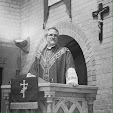
Friday, August 15, 2008

Passion and Lutheran Worship


A reader named Blake commented on my earlier post regarding the Texas youth gathering. I find his questions to be honest and helpful to discussion - since I do think his remarks capture the thoughts of a lot of people who are genuinely baffled by the controversy.

Here is what Blake wrote, followed by my own comments...

I would simply ask, what is "Lutheran Worship"? Is there one way that Lutheran's worship. The way that I know one should worship is in "spirit and truth". Outside of that, I believe there is freedom in Christ. At least that is what I have learned and been taught from my LCMS professors.

I think it would a shame if people in this church (being the LCMS) refused to learn from those who are part of the Church.


Also, it is the current practice of the LCMS to allow women to become DPM's (Director of Parish Music).

Father Hollywood, I would challenge you to attend one of these events. I have attended several different types of churches both LCMS and not and have observed in many a passion that others lack. Why is that? Just a question.

Anyhow, my prayer is that God would lead your churches into worship in spirit and truth whether led by man, woman, or child.


God's Peace,


Blake


Blake is correct about worship being a matter of "spirit and truth" (John 4:23). Both of these words are greatly misunderstood - especially in America's secular and religious context.

A couple years ago, I was having a coffee at the local cafe, a couple blocks from my church. I ran into a local pastor of a non-denominational megachurch of a Pentecostal bent. He expressed a desire to attend our Wednesday night service. He had never been to a Lutheran service before. One of his members was there with him, and she asked if we were "Spirit filled." "We sure are!" I replied. And of course we are. The first words in the liturgy invoke the Holy Spirit and the other Persons of the Trinity.

Of course, our Pentecostal brethren's understanding of "Spirit" is different than ours. As it turned out, my cafe friends were disappointed at our service, since by their definition, it wasn't "Spirit-filled" at all. There was no-one rolling around on the floor, giggling hysterically, jumping up and down, throwing their heads back in ecstasy with hands raised up like they do on TBN. Nobody received any dramatic and direct new revelations from God. There seemed to be no physical and visible manifestation of the "Spirit" - which is half of the equation Blake cites from our Lord in John 4.

In the minds of most people, being "in the Spirit" involves what Blake calls "passion." There is great irony here, since "passion" comes directly from the Latin "passio, passionis" ("suffering"). In this more ancient usage comes the context of our Lord's passion and death (e.g. the title of the Mel Gibson film The Passion of the Christ). Passion, as it has related to the Christian faith for two millennia, has referred to the road to the cross - for "by His stripes we are healed." But today, in the (post)modern American religious context, "passion" is front and center as to what constitutes appropriate worship. "Passion" is an important and commonly invoked word. And far from the context of suffering, of the cross, of the atoning work of Jesus, rather "passion" today means the opposite: pleasure, desire, even eroticism. "Passion" to most people means an emotional high, being "stoked" and excited, "pumped," or ecstatic in the Charismatic sense, in an emotional froth - which is precisely what is conveyed in most contemporary Christian music - Kari Jobe's band included.

My Pentecostal guests mistook a lack of jumpiness in our worship as a lack of the Spirit. And I do believe dignified, reverent liturgical, traditional Lutheran worship is unfairly stereotyped as joyless, dour, just going through the motions, and lacking "passion." But then again, most people never see what I see. When people are receiving the true Body and Blood of our Lord from my hands, I see their faces. When these people are kneeling before me, sometimes they show emotion and sometimes they don't. But I see the joy of the gospel in the eyes of my parishioners when I hold the host before their faces and make the sign of the cross over them, saying: "the Body of Christ, given for you!" Some are physically relieved as they quietly nod their assent, others vocalizing their "Amen." The eyes of some tear up. Others cross themselves with obvious gratitude for what the Lord has done for them, in response to the utterly majestic mystery of the miracle they have just partaken of.

Nobody leaps from the communion rail speaking gibberish. No-one rolls around on the floor or barks like a dog. Nor do any of my parishioners raise their hands up and arch their backs in "passionate" ecstasy. And yet, "the Word of the Lord endures forever." That same Word does not return to God void. There is passion there of a different sort than one sees at a rock concert.

I also visit the sick and dying, giving them the same Holy Sacrament through their tears of gratitude and bittersweet joy. I lay hands on their heads and pronounce absolution, tracing a reverent cross upon their saintly foreheads as they grab my hands and thank me like a person in a desert getting a sip of water. It might not be a "mosh pit," but it is "worship in spirit and truth" to be sure. And the "passion" is there - the crosses they bear, crosses pointing to the Passion of our Lord crucified for them in their hour of need.

Entertainment-based worship is good at whipping up emotional frenzy, but there is no "staying power" to carry a person through depression, illness, suffering, and death. That can only be accomplished through the cross and passion of our Lord Jesus Christ.

And this is the answer to the question: "What is Lutheran worship?" It is ultimately about what God has done, and continues to do, for us (not vice versa). It is about "passion" - the suffering and death of our blessed Lord "for us men and for our salvation" - not merely a state of drum-and-guitar-powered emotion. Lutheran worship is liturgical and reverent in response to this miraculous Presence, precisely because of our freedom in the gospel - not freedom in the libertine sense of "I'm free to do what I want," but rather free in the sense of the gospel: "I'm freed from sin and death and the law, and now I am freed in order to submit to Christ, to link myself to believers of every time and place who have 'handed over' (Latin: "traditio") the treasure of the Church from the time of the apostles to the present, and in so doing, to submit to our Blessed Lord Himself - unworthy as I am."

Our Gospel freedom empowers us for reverence, not from it. It frees us to submit to the Church (which Luther and other church fathers refer to as our "mother") and to God ("our Father", as our Blessed Lord prays with us), not to rebel from them. It also binds style and substance according to the ancient dictum lex orandi, lex credendi (i.e. - we pray as we believe and we believe as we pray) instead of the modern delusion that the way one does something has no effect on what is done (a delusion even proven false even by physicists and cosmologists!).

And indeed, women contribute to worship in their holy office of the laity. They sing with soaring voices, they teach children to pray and be reverent, they play the organ, they sing in (and direct) choirs, they serve the Lord on altar guilds, and they lend their voices to the people of God in the holy dialogue of the liturgy. Is that not enough? They do not put "Pastor" after their names and stand in the front of a worship gathering with a microphone calling attention to themselves through a "performance". I don't really know what a DPM does - as we have a multiplicity of bureaucratic titles in the LCMS - but I know Pastor Jobe is not a DPM. She is considered by her church to be something entirely different, something that is not merely contrary to Lutheran sensibilities, but contrary to the Bible and the created order of God Himself.

As far as being challenged to "attend one of these events," this is nothing new. I've been to church services of every stripe, from Tridentine Masses to Charismatic tongue-speaking prayer meetings. I've been to Christian rock concerts and contemporary worship services within and without Lutheranism. I've seen chancel dramas, testimonials, spontaneous jumping up and down and "singing in tongues." I've been to worship services with drums and guitars, with jazzy lounge singers, and with scantily clad pop divas.

My own congregation swore off these "official youth gatherings" when they observed toilet paper rolls being hurled during the distribution of Holy Communion. Interestingly, the last youth conference the young people of my congregation attended was of an "unofficial" nature (Higher Things). They were not able to attend this year's, but for last year's conference, one of the area pastors asked to borrow my thurible, so the young people could partake of the Lord's Supper with incense being used. Such ceremonial reverence is indeed an expression of the freedom we have in the Gospel. These Higher Things conferences do not feature rock anthems and praise bands, but only services and hymns from our hymnal. These liturgies and hymns will serve them their whole lives long - even as their tastes in music will likely change and transform over the years. And within the reverent tradition of the Church, they worship (along with the rest of us of every age and ethnicity) in "spirit and in truth" without resorting to hiring pop singer pastorettes and non Lutheran teachers to instill a sense of "passion."

Blake sincerely prays that God will lead us to "worship in spirit and truth whether led by man, woman, or child." But to worship in "truth" means to confess and submit to the Truth - as it has been revealed by the Spirit. The truth is that God has established a holy office of men to lead such "worship in spirit and truth" - and the Holy Spirit has revealed this truth in Scripture. No matter how much "passion" a woman may have and display, it is simply a truth revealed by the Holy Spirit that she is not to serve in that capacity. Our freedom in the Gospel does not liberate us either from the Spirit or from the Truth - not even in the name of "passion."

I've seen my share of "passion" - but thanks be to God, I have also seen my share of "Passion" - quiet assurance that the Savior is miraculously present, proclaiming the forgiveness of sins, and bringing people the peace of communion with the Holy Trinity. That kind of "Passion" is not manifested in bombastic earthquakes, rushing whirlwinds, or even Red Bull-fueled and electronically amplified music, but rather in a "still small voice" (1 Kings 19:11-13).

The former "passion" is overrated. The latter is underappreciated. But it is only through the latter, the Passion of the Christ, are we miraculously recreated anew and born again. Only that Passion will abide eternally.

Thursday, August 14, 2008

Texas DP's "Commercial" for Higher Things


The Texas District President's slippery, bureaucratic response to criticism regarding his district's own published reports of allowing a woman pastor to serve as "lead worshiper" (later downgraded to "song leader") might as well be a full-blown endorsement of Higher Things as a superior alternative to the "official" LCMS youth events.

If you want to send your children to hear "songs" performed by a woman Pentecostal pastor that are somehow acceptable as hymnody for Lutheran worship, if you think "the awesome responsibility of nurturing the faith of young people" at a Lutheran gathering should include speakers and musicians "of another faith tradition," by all means, send your children to this event.

But it is hardly baffling that Higher Things gets bigger and bigger as more and more people become disgusted at what goes on at the "official" youth gatherings. In fact, this evasive and misleading communication from the Texas District President (as well as the entire debacle) serves as a de facto commercial for Higher Things.

I'm going to comment within the context of the statement itself in red.

The District President's original statement can be found here.

Dear brothers and sisters in Christ,

We’re very excited about the upcoming youth gathering, GLORYbound,
happening in the Texas District November 28-30, 2008. In the past week,
however, a number of emails and blogs have been forwarded which have
stated that a woman was going to be serving in a pastoral role at
GLORYbound. We want to let you know that these rumors are completely
untrue. The Texas District upholds the LCMS' position regarding women as
pastors.

I challenge President Hennings to reveal these "emails and blogs." I
challenge him to produce a quote that a woman would be "serving in a
pastoral role." That is a straw man that simply does not exist. What
I wrote, and what others picked up on, are the following facts:


1) Kari Jobe had been listed on the GLORYbound website as "Lead Worshiper"
and given top billing.

2) In response to the criticism, her title was changed to "Song Leader" and
she was given less prominence

3) Kari Jobe's church lists her as an "associate pastor."
4) Kari Jobe's church openly denies baptismal regeneration and the Real
Presence in Holy Communion - which means these profound theological truths
central to Lutheran worship will be unconfessed in any of her band's songs.

5) None of this was based on "rumor" - but rather the actual published websites
of the Texas District, Miss Jobe, and Miss Jobe's Church.


Here are the facts: Kari Jobe and her band are leading the music at the
gathering but she is not a speaker or presenter. The planning committee
asked her and her band to play and sing. Their role is to provide
music—more akin to a church organist than a pastor or liturgist.

And yet, Kari Jobe is not just "Kari Jobe," but "Rev. Kari Jobe." Somehow,
I doubt that the Texas District would allow, say, a Wiccan priestess,
for example, to have a band perform at the youth gathering, even if her
repertoire had been "vetted" by the appropriate committee. Women's ordination
is repugnant, an antichristian rebellion against Scripture. To shrug this
terribly scandalous fact off is basically to say "it's not that bad." The
Texas District President is defending the placing of an "ordained" female pastor
in the front of a crowd of LCMS young people. This is offensive, and the fact
that the President doesn't even acknowledge that this is scandalous is itself
scandalous.


Throughout GLORYbound's many year history in the Texas District, there
have often been musicians who are Christians of another faith tradition.

There is a difference between a guitar player who is "of another faith tradition"
performing in a concert vs. a woman pastor out front singing her own music, her
own proclamation of her own religion at a worship event for Lutherans. She is
not a lay organist playing Lutheran chorales behind the scenes.


All songs are vetted by the planning team for content. LCMS pastors and
church workers lead and supervise every aspect of this gathering. An
LCMS pastor is leading and preaching at the Sunday morning service.
Another LCMS pastor is one of the speakers. An LCMS Vicar and former DCE
is serving as the Bible Study leader. As in past GLORYbound events,
there are several other speakers who are not LCMS.

The fact that it has been done in the past doesn't make it more acceptable now.
This is a red herring.


The communion policy of the event has also been questioned in these
blogs suggesting that GLORYbound will have open communion. This is also
untrue. The communion policy which will appear in the Gathering Book has
been used for the last nine years of GLORYbound events as suggested to
us by the Secretary of the LCMS when it was requested in 1999:

The celebration of the Lord’s Supper on Sunday of GLORYbound will be a
significant part of our gathering. St. Paul Lutheran Church, Ft. Worth
is serving as host congregation for the Worship Service and Holy
Communion. Those who have been instructed in the teachings of the
Lutheran Church-Missouri Synod and believe in the real presence (body
and blood of Christ is in, with and under the bread and wine for the
forgiveness of sins) are invited to come with a penitent heart to
receive the sacrament.

Notice that the President doesn't say that only those in communion with the LCMS
would be permitted to commune. This wishy-washy statement means an ELCA member
who used to be LCMS can commune. It means an Episcopalian or Roman Catholic who
attended a Concordia University can as well. This is not "closed" or "close"
communion. This communion statement makes a mockery of the work other LCMS
professional church workers - who have worked so hard to achieve altar and pulpit
fellowship with our sister churches. Instead, it reduces communion fellowship to
something flabby and fuzzy untied to the public profession of one's church.
What a disgrace.


The GLORYbound team has carefully planned this event for two years
keeping in mind the awesome responsibility of nurturing the faith of
young people in the saving Gospel of Jesus Christ. They are fine church
workers and I thank God for them along with all other professional
church workers in our District.

In closing, let me encourage each of you to renew your commitment to our
Lord and Savior, Jesus Christ, and to work to advance the saving message
of our Savior throughout Texas and the world.

You're in Christ,

Ken Hennings


There you have it. Pure bureaucratic gibberish. Isn't it interesting that you
don't get this kind of circumlocution and "synod-speak" from HT?

Monday, August 11, 2008

More LCMS Winking at Women's Ordination

ECAC "pastors" who were "ordained" earlier this month

While many of us are shocked and appalled at the fact that the Texas District is allowing a woman pastor to be involved in the worship services of its youth gathering, it seems that this LCMS dabbling with "ordained" women has been quietly going on for at least 15 years.

The Lutheran Church - Missouri Synod has a strange working relationship with a Lutheran Church body (a partner church of the ELCA) that is not only a founding member of the World Council of Churches (WCC) and the Lutheran World Federation (LWF), but has more than half a century of "ordained" women under its belt, and currently an ordained roster that is 30% female.

The Evangelical (Lutheran) Church of the Augsburg Confession in Slovakia (ECAC) explains its position on women in ministry here (emphasis in the original):

Today, 30% of the ordained ministers are women. They are pastors, assistant pastors, teachers of religion, counselors in Lutheran schools, teachers at the Seminary, they work at bishops' offices, in social work, church gremials and many other places. Some of them are single, but many are married and have family.

Sometimes a congregation refuses to accept a woman as their pastor, there is sometimes a fear of "overfeminization", or an opinion that women should not have a high position in the church. Some groups still dispute the very ordination of women.


From the LCMS website, here is an article about a rostered LCMS pastor with a call to the LCMS Board for Mission Services who serves in Bratislava as a professor at the ECAC seminary:

Dr. David Daniel serves God at the Evangelical Theological Faculty of Comenius University in Bratislava, Slovakia. As head of the department of church history and vice-dean for scholarship and international contacts, he develops instructional materials and helps prepare future workers for the Evangelical Church of the Augsburg Confession in Slovakia and other countries of central and eastern Europe.

David was born in Bethlehem, Pa. and is a graduate of Concordia Theological Seminary in Springfield, Ill. He studied at the University in Vienna, Austria, prior to receiving his Ph.D. from the Pennsylvania State University, where he taught for nine years. He served as pastor or vacancy pastor in congregations in Penn., Mo., and Ill. From 1979 to 1988, he taught at Concordia Seminary in St. Louis, Mo. David has lived and worked in Bratislava since 1988. In 1997 he accepted a call from LCMS World Mission to serve full-time as a theological educator at the Theological Faculty in Bratislava.

David is married to Slavka, a native of Slovakia, who serves as the head of the department of religion and chaplain at the Evangelical Lyceum in Bratislava.

They ask you to pray that the Spirit would energize and strengthen teachers as they prepare students to serve church and society. Pray that believers will grow in faith and that the members and workers of the churches in central Europe may be effective witnesses to Christ so that those who are not Christians may be brought to faith. Prayer Card. (top)


I can only wonder how many other LCMS pastors would be permitted to remain on the clergy roster if their wives were not in communion fellowship with them, being rostered church workers of church bodies with whom we don't share fellowship. This is a bizarre situation.

And here is another article published by the LCMS regarding the many LCMS workers who are working with this church. I can't help but think about the many struggling orthodox partner churches we have where members of the LCMS could be helping instead of a church where 30% of the pastors are women.

Here, a contributor to a Texas Ablaze!(tm) website recounts a 1992 "mission trip" to Slovakia. This is very shortly after the fall of the Iron Curtain.

And here, on the website of the Lutheran High School in Bratislava, Slovakia, is an explanation of the LCMS and ELCA involvement in work at the school going back to 1991:

"A lot of effort by many people made the re-opening of the school possible, including cooperation from parents, school board authorities, teachers, students, and the Lutheran church bodies of Slovakia and the United States (Evangelical Lutheran Church of America and The Lutheran Church Missouri Synod)."


Here is summary of the Slovakian Church's ecumenical relationships:

Lutheran Church in Slovakia

Here and here are LCMS appeals for missionaries working with this church.

Here is a description of another LCMS long term missionary (with no mention that she is working for a church outside of our fellowship that "ordains" women):

Laurie Lenz

Laurie Lenz serves the Lord as a long-term missionary in Slovakia, where she teaches English as a Foreign Language (EFL) at a Lutheran high school of 280 students in Tisovec. Students are not only Lutheran, but many still feel the weight and affects of communism and its relationship with religion. Prior to her service in Slovakia, Laurie participated in a two-week LCMS World Mission training program in St. Paul, Minn.

Laurie was born in Fort Dodge, Iowa. Her home congregation is Trinity Lutheran Church, Algona. She received her education from Concordia University Wisconsin, Mequon, where she studied secondary education, history, and missions. While a university student, Laurie participated and led three spring break mission trips to Juarez, Mexico. She also attended two Beautiful Feet Mission Conferences for LCMS college students. In January 2005, Laurie visited the Panama mission field and helped with vacation Bible school.

Please pray for Laurie as she embarks on this new journey. Aside from this being her first experience as a teacher, Laurie will also have to show patience and understanding, as well as adjust to a new culture and language. Pray also that she builds strong relationships with other missionaries, teachers, and her students. Finally, Laurie asks that her supporters pray that she is able to "teach and witness the Gospel as Christ taught it." Prayer Card. (top)


And here is a video from one of our long term missionaries (also available through LCMS World Mission here). Notice that she mentions "pastors" and "chapel services" at the Lutheran high school in Tisovec (which is affiliated with the ECAC) - but she doesn't indicate whether these pastors are women, or to what extent LCMS church workers and volunteers participate in these services. In 2001, Tisovec had a celebration of the fiftieth anniversary of the first woman "ordained" in the ECAC.

When there are LCMS church workers and volunteers spending months or years working with this church body, it begs the question, are they taking communion there? And think of what these young, impressionable missionaries and church workers are being exposed to. Is this any less egregious than the Texas District youth gathering's inclusion of a woman pastor in the worship line-up? But this has been quietly going on under the radar screen for 15 years. And shouldn't the LCMS be disclosing this fact before asking for funds?

Surely, Rev. Robert Roegner, who is pictured here in Bratislava, is aware of the status of the ECAC. Not only that, but the LCMS is training church planters for this church body:

European missionaries to attend U.S. institute

In their quest to make western Europe Ablaze! with the Gospel, missionaries from Lutheran church bodies in Germany and Slovakia are planning to attend the Missouri Synod's Mission Planters Institute this month in Orlando, germanyFla.

The institute, sponsored by the Center for U.S. Missions, Irvine, Calif., with assistance from LCMS World Mission and LCMS districts, is designed to share ideas and encouragement for church planting. Participants include outreach-minded pastors and laypeople from LCMS congregations nationwide.

Germany's Independent Evangelical Lutheran Church and the Evangelical Church of the Augsburg Confession in Slovakia each plan to send a missionary and a mission "coach" to the Orlando institute "to get ideas to implement for the training of missionaries in Europe," according to Dr. Robert Scudieri, associate executive director for the national mission team of LCMS World Mission.

Scudieri was in Germany and Slovakia in November, where he led church-planting workshops for more than 40 Lutheran missionaries, church leaders and seminary faculty from Germany, Slovakia, France and Denmark. Prior to his visit, he had invited the church bodies in Germany and Slovakia to send representatives to the U.S.-based institute.

Scudieri said he "learned a great deal about how a church in an unchurched culture can minister." German Lutherans, he said, "are doing some very exciting things in church planting, and this gave them a framework for considering something like a 'center for European missions.'"

Such a center could be modeled after the Center for U.S. Missions, and LCMS World Mission could "provide resources to make it a reality," Scudieri said. He stressed that the center and its curriculum would come from the European Lutherans, but that "we can come alongside them and help implement it."

Scudieri plans to lead a similar church-planting forum in Latvia later this year.

Posted Feb. 2, 2004


Again, the LCMS is in partnership with many struggling churches around the world. Why are we sending church workers and missionaries to an LWF church - especially when the LWF is bullying faithful Lutheran churches with whom we share communion - and usually specifically over their refusal to ordain women? Why are we so cozy with this particular church body? And what message does this send to those who spend months or years in such an environment with the full blessing of the synod? And why is the status of this church body never discussed in any official LCMS organ?

I just don't get it.

Three Revolutionary Women

When it comes to being counter-cultural, these three ladies makeTimothy Leary look like Richard Nixon. By contrast, check out the stories in the right side-bar of the Daily Mail.

Madonna is just so establishment (yawn).

Sunday, August 10, 2008

Tom In The Box


If you enjoy satire when combined with the crazy world of the modern American Church, then Tom in the Box is for you! "Tom" writes from the Reformed perspective, and is not only witty and funny, but has a keen insight into the foibles of modern American Christian life.

I've thrown together some links to some "TBNN" headlines that I found particularly amusing, a sort of Tom 2008 sampler:

Judge Accused of Judging Others
"The One Week Bible" Not Catching On
Authentic Teen VBS Draws Hundreds
Climbers Discover KJV on Mount Ararat
Hinn Granted First HWPG Sainthood
Mysterious "Van of Glory" Sparks Small Town Revival
California Court Recognizes Heterosexual Marriage
California Narcissist Plans to Marry Himself
"Build-Your-Own-Belief-System" a Huge Success
California Court Rules "Parents Have No Rights to Raise Their Kids"
tx bble (The Text Message Bible)
Remember the Moment Stopwatch $12.95
Unintelligible Man Speaks Clearly in Tongues
Blogging in Tongues Yields Interesting Results
"Speaker-Sensitive" Churches Growing
Forty-Seven Church Splits Finally Brings Doctrinal Perfection
Just Divided Over What They "Just" Want God to Do
Episcopal Church Discourages Home-Schooling; Kids Know Too Much Bible

Sermon: Feast of St. Lawrence


10 August 2008 at Salem Lutheran Church, Gretna, LA

Text: Mark 8:34-38

In the name of + Jesus. Amen.

Our blessed Lord puts everything in sharp perspective for us today, dear brothers and sisters. The Christian life is not about fame, fortune, and riches, being appreciated and loved by many, seven steps to a better you, or anything of the sort.

The Christian life is about bearing the cross. “Whoever desires to come to Me” says our Lord, “let him deny himself and follow Me.” He goes on to say that the Christian life is a paradox of love – for the one who selfishly seeks to save his own life will lose it, but the one who gives of himself, even his very life, will find it.

Jesus does all of the work to secure your salvation. He is not asking you to give your life as a ransom – for He has already ransomed you. Now he asks you to sacrifice your life for the sake of others. Having been given the free gift of eternal life, you can now lay down your life for the sake of the kingdom, motivated not by self-preservation, but by selfless love.

The Church has many examples of those who bore the cross and laid down their loves for the sake of their neighbors, for the sake of the kingdom, for the sake of making a good confession before paupers and kings alike, for the sake of love. And the Church celebrates one of her own beloved saints today – Lawrence the martyr of Rome.

St. Lawrence lived a life of 33 years, and was martyred in 258 AD during the persecutions of Emperor Valerian. Lawrence was not a priest, but rather a deacon. His job was to help his pastor – who happened to be Pope Sixtus II, the Bishop of Rome, both in the administration of the Church and in the distribution of the sacraments.

Like the men who serve our congregation as members of the Board of Elders, Lawrence was not a preacher, but he was a witness whose life proclaimed the Gospel. He did not celebrate and sing the Mass, but he held the chalice of the Lord’s most holy blood and helped his pastor to bring Christ to the people. Lawrence helped to administer the material possessions of the Church and helped to distribute the Church’s charitable goods to the poor.

Lawrence was a servant and a steward. And though Lawrence was not a pastor, he offered his life as a priestly sacrifice of service to the Lord – as all lay people are called to do. And he laid down that very life as a thank offering to His Savior – something that most of us will never be called to do. St. Lawrence understood what his calling was, however, and he carried it out. In the words of a sermon preached by St. Leo the Great more than 1500 years ago on this anniversary Lawrence’s martyrdom, Lawrence the deacon “was outstanding not only in the performance of the liturgy, but also in the management of the Church’s property.”

Deacon Lawrence’s pastor, St. Sixtus, the bishop of Rome, was beheaded on August 6, 258. According to St. Ambrose, the Roman madmen who were persecuting the Church turned next to Lawrence - for they had heard that the Church was laden with treasure. Lawrence cleverly sent away various relics in the possession of the Church. Then, when asked to turn over the Church’s treasures, Lawrence took a group of poor, blind, and crippled Christians to the Prefect, and said: “Here is the true treasure of the Church.” He added: “The Church is truly rich, far richer than your emperor.”

Four days after his pastor was executed, the faithful deacon and confessor was himself ordered to recant his Christian faith. Having refused, he was taken to a hot grid-iron, upon which he was laid out and tortured to death.

As our Lord has reminded us anew: “whoever loses his life for My sake and the gospel’s will save it,” so too does the life and service of St. Lawrence remind us of where the treasure in the Church lies.

Our sinful flesh so often misses the point. Of course, we need material possessions to live. And quite often, people are driven to beg out of need. But so often people will only come to the church when they need money. Often a person will approach the pastor not because of the burden of his sins, not because he seeks to “lose his life” for the sake of Christ and the gospel, but rather because he seeks to save his life through money. In seeking the treasures of this world, they miss out on the “true treasure of the Church” – the Gospel, the very grace of God.

Indeed, what will a man give in exchange for his soul? For those who seem to have nothing have everything. They have the kingdom. They have eternal life. For the true treasure of the Church isn’t the chalice, but rather the blood inside. And unlike gold vessels that can be stolen and sold, the blood of Christ is given away by the Church, free of charge, without price, without limit, and without asking for anything in return.

St. Lawrence understood just what the treasure of the Church was as he served as a deacon, caring for the poor, those beloved of God but spurned by the world. St. Lawrence understood just what the treasure of the Church was as he served at the altar, giving rich and poor alike the greatest riches of all: “the blood of Christ, shed for you.”

St. Lawrence clearly understood our Lord’s preaching in today’s Gospel, dear friends. For he did not desire to save his own life, but knowing that it was the Lord who had already secured for eternal life for him – he forfeited his own precious life for the sake of his Savior and of the Gospel as a testimony to an “adulterous and sinful generation.”

In every generation since, whenever Christians call to mind those who cared for the poor and those who endured suffering and death for the Gospel, they have lovingly called to mind our dear brother Lawrence, whose brief life on this side of the grave has inspired us for 1,750 years, and who lives in eternity.

As Pope St. Leo preached in the fifth century regarding the martyrdom of St. Lawrence:

“You gain nothing, you prevail nothing, O savage cruelty. His mortal frame is released from your devices, and, when Lawrence departs to heaven, you are vanquished. The flame of Christ’s love could not be overcome by your flames, and the fire which burnt outside was less keen than that which blazed within. You but served the martyr in your rage, O persecutor: you but swelled the reward in adding to the pain. For what did your cunning devise, which did not redound to the conqueror’s glory, when even the instruments of torture were counted as part of the triumph? Let us rejoice, then, dearly-beloved, with spiritual joy, and make our boast over the happy end of this illustrious man in the Lord, Who is wonderful in His saints, in whom He has given us a support and an example, and has so spread abroad his glory throughout the world, that, from the rising of the sun to its going down, the brightness of his deacon's light does shine.”

May we likewise serve as lights of the love and mercy of God, mirroring the faithfulness of our Lord Jesus Christ, who bore the cross for us, He who chose to give His perfect life as a ransom for us poor miserable sinners, He who called St. Lawrence to likewise lay down his life. May we, like St. Lawrence recognize where the true treasure of the Church is, and may we carry out our vocations of grateful service to Him who has saved us by His grace. And may we too be proven faithful to Him “when He comes in the glory of His Father with the holy angels.” Amen.

In the name of the Father and of the + Son and of the Holy Spirit.” Amen.

Saturday, August 09, 2008

ESV with Apocrypha


Here is an interesting and informative blog post reporting that Oxford University Press will be publishing the English Standard Version of the Bible (ESV) with the Apocrypha in February 2009.

In the last century, we English-speaking Lutherans have been largely denied a good bit of our own biblical heritage since our congregations switched from German to English. Older German Bibles (typically based on Luther's translation) included the Apocrypha between the Old and New Testaments. When Lutherans began buying English language Bibles, they were published by various Protestant publishers, and the Apocryphal books largely vanished from our usage.

In fact, most Lutherans are somewhat shocked to find that these "Catholic" books were originally part of the Bibles their grandfathers and grandmothers used in their churches and read at home.

However, even to this day, traditional liturgical texts do continue to make use of passages from the Apocrypha (such as some of our Introits and Graduals) - as well as some of our hymnody (including the Christmas carol It Came Upon a Midnight Clear and the beloved Lutheran hymn Now Thank We All Our God. Most such references in the Lutheran Service Book materials do not acknowledge the Apocrypha, but rather read "liturgical verse" or some such. However, some of our Introits and Graduals are word for word quotes from books such as the Wisdom of Solomon, Ecclesiasticus, and the Song of the Three Young Men - which one is not likely to find in his or her Bible.

Like the early Church, we Lutherans do not establish doctrine on the sole witness of the Apocrypha (which interestingly places the Apocryphal books in the same category as the New Testament books that were disputed by the early Church fathers, known collectively as the antilegomena (of which James, Jude, 2 Peter, 2 and 3 John, Hebrews, and Revelation are universally treated as canonical today - though Lutherans traditionally make a distinction between these and the other never-questioned books (homologoumena) - and thus do not establish doctrine based solely on their testimony).

Hopefully, the Lutheran Church - Missouri Synod's near-endorsement of ESV, combined with this coming new edition with the Apocrypha will result in a resurgence of appreciation for and study of the Apocryphal books in our churches.

Thursday, August 07, 2008

Wilson's List...

of "Great American Inventions".

[Nota bene: In the interest of full disclosure, I do at times partake of decaf. I pretty much agree with Dr. Wilson on the rest... +HW]

A miracle!


The mayor is in jail, but it's not the mayor of New Orleans!

The end is near!

(But don't get too comfy, Mayor Nagin, from what the paper has been reporting the past few days, you and Kwame might become roommates).

Germans using force and compulsion? No way!


"Don't mention the war! I mentioned it once, but I think I got away with it!"
--- Basil Fawlty

Why am I not surprised at this account of the bureaucratized government's use of jack booted thuggery and compulsion from, uh, where else? And how is it that the people of Marburg can "not see" that this is for their own good and the good of the Vaterland?

Some volks just never learn lessons from history.

Wednesday, August 06, 2008

Word games and communion statements

A parishioner of mine was out of town and brought back a bulletin. He asked me to look at the communion statement, it included:

"Please read and answer the following questions. They are helpful in preparing for the Lord's Supper:

1. Have I been baptized in the name of the Triune God, Father, Son, and Holy Spirit?

2. Do I believe that I am a sinful human being without hope of eternal life except for God's mercy in Christ?

3. Do I believe that Jesus Christ is God's Son and my personal Savior from sin, death, and the power of the devil?

4. Do I believe that Jesus Christ is personally present in the Sacrament of Holy Communion with His true Body and Blood?

5. Do I intend, by the power of the Holy Spirit, to live a Godly life?


Our Holy Communion practice is called "CLOSE" communion, not "CLOSED" communion. "Close" communion invites all those who answer the above questions in the affirmative. "Closed" communion practice allows only confirmed members of ----------- Lutheran Church to commune. We do NOT attempt to obstruct or restrict anyone from coming to the Lord's table. We DO seek to help each guest; visitor, and member, to prepare for the celebration of the Sacrament. Because of the importance and value of Holy Communion, we ask that each one present carefully read, understand, and answer the above questions before communing, and if it is your first time communing with us, please speak to one of our Ushers, Elders, or Pastors."


There is an additional line that says:

"A wine that has been chemically treated to remove all alcohol and sulfites is offered in clear glasses in the individual trays."

Oh boy.

First of all, this "closed" vs. "close" is a lot of nonsense. It is a false dichotomy. Notice this church's practice - if you, as an individual, can accept the five questions (which everyone from Roman Catholic to Reformed can), you are welcome at this Missouri Synod Lutheran church's altar.

However, this overlooks the fact that the Missouri Synod congregations are specifically in fellowship with a couple dozen churches around the world - which means we are in doctrinal agreement resulting in altar and pulpit fellowship. An LCMS Lutheran is in communion with the Lutheran Church Canada, the Evangelical Lutheran Church of England, the Evangelical Lutheran Church of Kenya, and many other church bodies around the world. An LCMS Lutheran is not in communion with the Evangelical Lutheran Church of America, the United Methodist Church, or the Roman Catholic Church. There are simply doctrinal differences that separate us - many of which involve disputes over just what one is eating and drinking at the altar - and those doctrinal divisions are not addressed in five simple questions to scan at the beginning of the service so that we can make individual choices about communing. The Church is, by definition, an "assembly" - a community of faith. These are not decisions properly left to individuals, but rather to our whole family.

You are either in communion with, or not in communion with Christians of other church bodies. As a pastor, I may be invited to preach and officiate at the Eucharist at one of our sister churches in the Russian Ingrian Lutheran Church. However, I may not concelebrate a wedding at a local Russian Orthodox Church or preach in a local Pentecostal church. To do so would be to send a false message. One could not do that with integrity. It all has to do with being in communion.

That is the nature of fellowship and communion that is completely lost in this church's approach, and their artificial use of "closed" and "close" to describe two different policies.

Notice that the church presents only two extreme scenarios: 1) closed communion means no visitors can commune (not even LCMS visitors), and 2) close communion means opening the rail to Roman Catholics, Reformed, and ELCA Lutherans. Those are the two options according to this church. But of course, the traditional and ancient understanding of communion - which has been upheld by the Missouri Synod since its inception until recent years - is neither of these extremes.

There is no other word for this convenient game-playing to achieve a specific result (open communion). It is simply a lie.

Our churches are part of a network of churches that share doctrine and practice and are in a state of communion with each other. This particular congregation's approach to communion completely ignores this reality that is our agree-upon paradigm. Exceptions need to be handled by the pastor (and indeed, there always are exceptions) - but this is not a matter of pastoral exception, but published policy.

The idea that we "do NOT attempt to obstruct or restrict anyone from coming to the Lord's table" flies in the face of St. Paul's words (which were ironically quoted in the bulletin on the very same page) from 1 Corinthians 11:27-29 that a person may well eat and drink to his judgment. This is why the sacraments ("the mysteries of God") have men (pastors) charged with administering them ("the stewards of the mysteries of God" - 1 Cor 4:1). In the same way that pharmacists don't hand out prescription drugs willy-nilly, neither do pastors (at least those who believe in the supernatural power of the consecrated elements) do the same with Holy Communion. This is why our Augsburg Confession positively cites the traditional example of the pastoral care according to St. John Chrysostom, and confesses with clarity and integrity how our churches are to administer the holy sacrament:

"On holy days, and at other times, when communicants are present, Mass is held and those who desire it are communicated. Thus the Mass is preserved among us in its proper use which was formerly observed in the church and which can be proved by St. Paul's statement in 1 Cor. 11:20 ff. and by many statements of the Fathers. For Chrysostom reports how the priest stood every day, inviting some to Communion and forbidding others to approach." (AC XXIV:35-36)

This is the very opposite of saying: "we do NOT attempt to obstruct or restrict anyone."

There is an additional ambiguity in question 4: "Do I believe that Jesus Christ is personally present in the Sacrament of Holy Communion with His true Body and Blood?" The "with" seems to divide the "personal" presence of Jesus from His physical presence. In fact, the use of "personal" instead of "physical" is one way to make Lutheran communion acceptable to Reformer Christians - a tactic tried by many groups in history to jam the square peg of Lutheran theology into the round hole of Reformed practice for the sake of an artificial unity. In this case, it is either by design with a bad intent, or by ignorance with a bad result. For the sake of the eighth commandment, let's presume in this case the latter.

Nevertheless, there is another use of "weasel words" that cannot simply be excused by ignorance. Consider the line in the church's bulletin (cited earlier) that "A wine that has been chemically treated to remove all alcohol and sulfites is offered in clear glasses in the individual trays."

A wine that has been "chemically treated" to remove one of the component parts that makes it wine is, by definition, not wine. In fact, it is "grape juice." Notice how the writer goes to great pains to circumvent the ontologically correct (and more concise and precise) term to instead use a sort of hocus-pocus to transubstantiate the innovation of grape juice into dominically mandated "wine."

To take the reverse, most parents would have no problem giving their young children a big glass of grape juice. But what if we gave Junior a big glass of "grape juice" that was "chemically treated" with a process of fermentation to "add alcohol and sulfites" - would it still be "grape juice"? Of course not. It would be wine, and the same parents would not serve it. It's simply not the same thing.

We do not fear God if we delude ourselves into thinking that our synod will not be chastened by the Lord for such unfaithfulness. What better definition of "integrity" is there than "confession" - simply and plainly saying the same thing as the Lord in His revealed Word? We need to pray fervently that the Holy Spirit will open the eyes of the pastors and lay people in these congregations.

Tuesday, August 05, 2008

Now she's the "song leader"...


It looks like the Texas District must be getting a little negative feedback. The website of the youth gathering has been changed.

The LCMS pastor has been bumped to top billing, and Pastor Jobe's official Texas LCMS title has been changed from "Lead Worshiper" to "Song Leader." She also fell two slots in this "bull market."

Lord have mercy, I don't know what's more fun to watch: Louisiana secular politics or the ecclesiastical version of our neighbors to the West. Great show!

Perhaps the Next Texas Ute Gaddering?


Let's keep this our little secret. Don't give the Texas District any more bright ideas.

And for the Lutheran remnant in the Lonestar State: "Remember the Augustana!"

Pastor Jobe in her own words


Is there any way that Lutheran pastors and congregations currently being held hostage in the rebel Texas District can place themselves under the ecclesiastical oversight of African bishops? "Evangelical Lutheran Church of Kenya - Texas Missionary District" - I like it.

"Do not despair, O little flock." Come, Lord + Jesus.

Monday, August 04, 2008

Woman Pastor to Lead Worship at LCMS Youth Event

Thanks to "Chuck Finney" for bringing this to light.

The Texas District's 2008 Youth Gathering coming up in November has an interesting array of speakers scheduled. Note that the "lead worshiper" is Kari Jobe (see below).

Kari Jobe - Lead Worshipper
For over 13 years, I have been involved with worship groups that have ministered around the world... I believe it's not enough for us to merely experience God's presence; we must also affect the lives of others and help them draw closer to God. My passion is to see people impacted and changed by His goodness, and to see the world changed by the reality and nearness of God's presence. - Kari Jobe


Kari is an associate pastor at the non-denominational Gateway Church, a congregation that denies baptismal regeneration and the Real Presence in Holy Communion - which of course is completely at odds with Lutheran doctrine as well as the centrality of altar, font, and pulpit to Lutheran worship. How she can be the "lead worshiper" of a gathering of Lutherans without falling into unionism is quite a mystery.

Furthermore, the Lutheran Church - Missouri Synod, at least as of this writing, affirms the masculinity of the pastoral office and upholds the scriptural and traditional proscription against women clergy. According to Gateway's website of ministry staff, Kari is an "associate pastor" (see below)

Kari Jobe
Associate Pastor, Worship


Pastor Kari sums up her understanding of her ministry at her MySpace page (see below).

About Kari Jobe

For over 13 years, I have been involved with worship groups that have ministered around the world. In April 2006, I took a position as a Worship Pastor at Gateway Church in Southlake, Texas, where I serve on a regular basis. I believe it's not enough for us to merely experience God's presence; we must also affect the lives of others and help them draw closer to God. My passion is to see people impacted and changed by His goodness, and to see the world changed by the reality and nearness of God's presence.


I hope I will be proven wrong, but I'm going to "go out on a limb" (and not a very flimsy limb at that) and make a few predictions:

No officials in the LCMS will say anything about this. Anyone who complains will be cast as "unloving" or some such. Neither the praesidium, nor the seminaries, nor any district presidents will denounce women pastors leading worship at youth gatherings. There will be no disciplinary actions taken against anyone.

This kind of thing will expand, and will continue to send a message to our young people that women's ordination is okay, as are unionistic worship, and worship that not only sets aside our Lutheran confession of sacraments as well as the traditional western liturgy. What will be deemed as an acceptable replacement is emotional, exciting, entertainment based religion of a general non-denominational sort.

Then we wonder why people leave - why those who actually strive for the sacramental and liturgical Presence of our Lord Jesus (as confessed in the Lutheran confessions) seek that Presence outside of Lutheranism. On the other hand, we also see the exodus of young people who have been taught there is no difference between Lutheranism and non-denominationalism, and so they likewise leave Lutheran churches in seek of even bigger and better entertainment.

It is no wonder why so many of our young people are confused and leaving the LCMS. It is also no wonder why so many of our seminarians, vicars, and pastors are appalled at the dissonance between what we confess on paper and how we worship in the real world, and leave the LCMS for Anglicanism, Eastern Orthodoxy, or Roman Catholicism. In many cases, the doctrine and practice of those churches is closer to the Lutheran confessions than our own churches! I'm not in favor of either group's departure from the LCMS, but it takes a great deal of self-delusion to overlook why this is happening. Maybe our dwindling membership is a judgment against the LCMS for its infidelity. And if this is the case, no amount of corporate marketing gimmicks can replace repentance.

And it is utterly galling to hear our LCMS bureaucrats take backhanded swipes at the Higher Things youth conferences (which originated and grew exponentially as a reaction against this kind of anything-goes theology and practice) by saying these "official" gatherings (unlike Higher Things) have passed doctrinal review (implying that Higher Things is some kind of un-Lutheran rogue organization). Of course, Martin Luther's baptismal "flood prayer" initially failed the doctrinal review process, so I suppose it should not come as a shock that women clergy leading worship may well receive a doctrinal green light.

So, if you want unionism, rock and roll, and women clergy, it appears that you can get it in at least one official event put on by the LCMS.

Like our synodical president said: "This is not your grandfather's church!"

Sunday, August 03, 2008

A Trio of Musical Articles


Today's paper had three convergent articles about music and New Orleans, testifying to the ability of music to bring people together, forge community, and bring a sense of joy to our lives.

First, here is a lyrical tribute to the ubiquity of music in New Orleans, as documented by Chris Rose as only this master of pen and heart can present it.

Next, here is a story about a former cop who took up the violin in middle age, and now serenades the city.

And finally, here, a musical former Marine saves the life of a suicidal comrade at a chance meeting with the power of a trumpet and human contact.

Sermon: Trinity 11


3 August 2008 at Salem Lutheran Church, Gretna, LA
Text: Luke 18:9-14 (Eph 2:1-10)


In the name of + Jesus. Amen.

Dear Christians, our Lord Jesus speaks to us today concerning mortal sin. There is a tendency for us sinners to categorize certain sins as bad, and others as not so bad. And the way we do it is pretty simple: the sins other people do are really bad, the sins we do are minor.

To us sinners, the mortal sins are the really big ones, like mass murder, genocide, blowing up buildings, and things like that. In fact, most of us would add things like murder, adultery, and abusing children to the list of sins we believe are unforgivable.

Some may even add homosexuality and abortion to the list, as these sins are high on the political agenda.

But all of these sins are forgivable. These sins can be confessed, repented of, and absolved. A person can ask to be forgiven of these sins, and our Lord Jesus Christ died specifically for these transgressions, even as He charged me “by virtue of my office” to absolve these trespasses.

But a sin that is mortal is a sin that kills. It destroys both body and soul. It is a sin that, by definition, can’t be forgiven. And what makes a sin mortal is not necessarily the amount of damage done, but rather the fact that the sinner refuses to be forgiven.
Any sin can well become mortal, can drag us body and soul into hell. The quickest way to condemnation is not to go on a serial killing spree, but rather refuse to be forgiven!

Some people refuse to be forgiven out of despair. We see this in Judas Iscariot. He is the son of perdition. Satan blinded his eyes to faith, so that even a very sorry Judas refused to believe that the holy sacrifice of our blessed Lord even covered his sins. The refusal to believe, the lack of faith, is mortal. For you cannot make a man accept salvation any more than you can make the proverbial unwilling horse take a drink.

But there is the kind of refusal to be forgiven that isn’t based on despair, but rather the opposite.

Jesus is warning the Pharisees, and He is warning us, dear brothers and sisters, that the first step to hell is to trust in yourself. Notice what provokes our Lord’s story: “some who trusted in themselves that they were righteous.” These people did not “fear love and trust in God above all things,” but rather placed themselves on that pedestal, “trusting in themselves that they were righteous.”

For if you trust in your own righteousness, why do you need a pastor to absolve you of your sins? Why do you need to come to communion? In fact, if you trust in your own righteousness, Jesus is a fool, for He went to the cross for nothing. If you trust in your own righteousness, the Holy Spirit is also a fool, for He inspired the Scriptures that tell us again and again that we are all “like sheep that have gone astray,” that “there is none righteous, no, not one,” that “the wages of sin is death,” that through one man, death came to all men.

If you trust in your own righteousness, you not only have no need of the Christian religion, you have no need of Christ. If you trust in your own righteousness, you have no need of a Savior, because you are your own savior.

And what a sad delusion this is, dear friends! God the Father has given us His “only begotten Son,” the “Lamb of God that taketh away the sin of the world,” who “bears our iniquities” and “by whose stripes we are healed.” God gives us the Holy Spirit, who inspires Scripture like our crystal-clear letter of St, Paul to the church of Ephesus: “For by grace you have been saved through faith, and not of yourselves; it is the gift of God, not of works, lest anyone should boast.”

It doesn’t get much clearer than that, dear friends. The Holy Spirit has articulated the Gospel through St. Paul, the apostle and servant of Christ Jesus – who likewise preached the same Good News and backed it up by dying and rising.

In our Lord’s parable, there are two men, but only one of them “went down from his house justified rather than the other.” The world would look at the religiousness of the Pharisee, and conclude that he is by far the one who is justified. After all, this man is a churchgoer, a big giver to the treasury, a volunteer who serves on boards and councils, a respected pillar of the community.

And what must the world think of the tax collector? He is a petty thief, a man who is so great a sinner that his guilt impels him to hunch over in church and carry on begging for mercy. Why, he even calls himself a sinner in his prayer!

This is a no-brainer, isn’t it? Well, it is to our Lord.

For our Lord doesn’t judge by shallow appearances and the public face we wear as a mask. What does our Lord see in these two men? In the Pharisee, he sees a man who trusts in himself that he is righteous. He sees a man who not once asks for mercy or prays for a Savior. He sees a man immersed in sin, but deluded into not seeing it. He sees a man who is so blind that he cannot even see his own sins. He sees a man who worships himself instead of the Triune God. He sees a man in mortal danger if he doesn’t confess and repent – which is exactly what the tax collector is doing.

It is the humble tax collector, not the arrogant Pharisee, who goes down to his house justified. And it is by his fruits that we know him. While the Pharisee is loudly confessing other peoples’ sins and boasting that he doesn’t do any of them, the Pharisees, as our Lord points out, not only trusts in his own righteousness, but they also despises others. Seeing everyone else as a sinner, the Pharisees love themselves but hate their neighbors – all the while patting themselves on the back and dismissing their need for forgiveness.

But notice the attitude of the tax collector. He has stolen from people, and it grieves him. He is guilty of breaking the commandments, and his heart is contrite. This is a man who in spite of his sins, truly loves other people and regrets the way he has treated God. And, what’s more, he knows who God is, and it’s not himself. Instead of confessing the sins of others, he confronts his own. Instead of boasting, he is broken. Instead of justifying himself, he prays the true “sinner’s prayer”: “God, be merciful to me, a sinner.” For he confesses his sin, and though he feels unworthy, still has enough faith to ask for God’s mercy. He doesn’t ask for it unless he believes he can get it. He is confident, but not cocky. He has faith, but a humble faith that is anchored in the promises of God rather than in his own righteousness.

Our sinful flesh always wants to be the Pharisee, always seeks glory, always demands recognition and credit, always loves and trusts in itself rather than in God, all the while, despising others. And it is this Pharisee that must be drowned daily in the repentance given to us and our second birth at the font. It is this demon that must continually be exorcised by the sign of the cross. It is the mortality that must be put to death before it becomes mortal.

And so here we are again, dear friends, gathered to hear the promises of God, kneeling humbly to eat His flesh and drink His blood – all because we know we need a Savior, all because the one thing we truly know about ourselves is that we can’t trust in ourselves that we are righteous.

You who are humbled by your sins, take heart! For hear the final word of our blessed Lord once more: “Everyone who exalts himself will be humbled, and he who humbles himself will be exalted.” Amen.

In the name of the Father and of the + Son and of the Holy Spirit. Amen.

Saturday, August 02, 2008

The Gospel According to Quadrophenia


The 1979 film Quadrophenia is not appropriate for Sunday School class by any means.

It bears an R rating because of its explicit vulgarity, violence, depictions of drug use, and some brief nudity. And yet, with that kept firmly in mind, there is also the familiar Christian themes of redemption, of the triumph of life over death, of the shallowness of disorder and violence, and a repudiation of the false promises of materialism. The film also makes metaphorical use of the Biblical imagery of water as a means of grace and cleansing, the bringer of both life and death.

The film has a gritty, street feel to it. The acting is realistic, and well played. I found the working-class English accents tough to discern at first (and there are no subtitles on the DVD). The pacing is a little slow by modern American standards, but the storytelling and cinematography are outstanding. In 2004, the movie publication Total Film named it as the 35th greatest British film of all time.

On its surface, it is a fictionalized docudrama about a clash of youth cultures (Mods vs. Rockers) in the mid 1960s in England. But in reality, the film investigates some very deep philosophical themes - as all art endeavors to do. Set around the time of the peak of the Mod-Rocker violence ("the Second Battle of Hastings") in 1964, the story focuses on the troubles of "Jimmy" - a working class teenage boy who identifies with the "Mod" lifestyle.

The Mods rode small Italian motor scooters (typically customized with extra lights and mirrors), dressed in snazzy suits, listened to British and Caribbean pop music, and took pills to fuel their dance parties and mob fights. Their opponents were the Rockers, who rode motorcycles, wore jeans and leather jackets, listened to American rock music, and mainly stuck with alcohol as their drug of choice. It's fairly easy to see the antagonism between the two subcultures.

The violence between Mods and Rockers reached a peak in 1964, and was the cause of a lot of panic among Britons.

In Quadrophenia, Jimmy is going through the growing pains of being an adolescent in search of his own identity. He rebels against his parents, despises his low-end job as the mail-boy in an office, takes solace in his scooter, drinking, drugs, sexuality, and Mod music - trying desperately to fit in somewhere.

The title is a play on words, as Jimmy's father accuses his son of having a split personality - a common misunderstanding of schizophrenia. Jimmy feels that he has four personalities - hence "Quadrophenia". This four-part personality doesn't really emerge in the film, but is part of the short-story written by Pete Townshend in the liner notes of the original 1973 album of the same name by Townshed's band, The Who (a musical favorite of the Mods in the early 1960s).

Jimmy's teen angst and alienation leads him on a series of misadventures including parties, drinking, drugs, sex, and violence. The story reaches a breaking point during a long weekend in which many Londoners visit the beach at Brighton. In 1964, Mods and Rockers descended on Brighton Beach by the thousands.

The mob mentality serves as an adrenaline rush to Jimmy, who finally feels he fits in as part of the Mods. His life appears to have meaning in this place at this time. He looks up the larger-than-life Mod leader "Ace Face" (played by rock musician Sting in his first major acting role), who epitomizes "cool" - something Jimmy seeks as the guiding force in his own life. While at Brighton, Jimmy gets involved in rioting and wild partying. He seduces the girl he has been yearning for with pills, and gets the payoff of a tawdry sexual encounter in the back alley shed, as mob violence is in full force outside. He feels alive and part of something bigger than himself, a sense of belonging, of being loved.

But things soon unwind into a rapid Job-like descent into misery. He is arrested. His girlfriend dumps him. He is fired from his job. His parents throw him out of his home. He crashes his scooter. His friends look upon him more and more as an outcast. He spends his entire severance pay on drugs, and then boards a train to go back to Brighton in a desperate search of his former sense of fitting in.

But while there, things only get worse.

He sees his former hero, Ace Face - but is utterly dismayed to learn that this man he idolized is, in fact, a lowly bellboy at a hotel, clad in his uniform and being ordered about by the hotel's well-heeled customers.

Shouting: "Bellboy!," Jimmy steals Ace's fancy Vespa scooter, and drives to the beach. He speeds along, perilously near the edge of the breathtaking white cliffs of Dover. The camera angles show Jimmy zooming along the cliffs as the sea churns below. There were several references to water and drowning in the film. It begins to become obvious where this is headed.

Death by drowning seems to be the only solution to Jimmy's completely messed up life and sense of not fitting in anywhere. He points the scooter at the cliff as The Who sings in the soundtrack:

I've had enough of dancehalls
I've had enough of pills

I've had enough of streetfights

I've seen my share of kills

I'm finished with the fashions

And acting like I'm tough

I'm bored with hate and passion

I've had enough of trying to love.


The music stops abruptly. Jimmy guns the bike and heads toward the cliff at full speed. The ending is a bit of a surprise, however, as the Vespa is seen hurling into space with no rider. It crashes on the ground below in front of the sea. The film is a little ambiguous of Jimmy's fate, but the short story makes it clear that he does not commit suicide. Rather, he finds redemption in the cleansing, pouring rain.

The next word we hear is the same as the last one: "love." Both the short story/concept album and the film end with the song "Love Reign O'er Me" - in which the play on words is between "rain" (an image invoked in the song) and "reign." The love that Jimmy seeks is something that he submits to (something completely missing in his life of rebellion and anti-authoritarianism). In his prayer "Love reign o'er me," he is submitting to a "reign" and in so doing he is surrendering to something greater. He finds his redemption in genuine love, a love that rules over him. It is a love dropped upon him by grace, unexpected grace, anchored in the imagery of water.

In seeking to drown, Jimmy finds life - but only in drowning his old man, in repentance, in surrender and submission. This takes place amid the chalky white cliffs of Dover, symbolizing purity, and amid the crashing of the bike - symbolic of the treasures of this world which are passing and never satisfy, but are mere desires rooted in materialism and conformity. All of that is worthless as Jimmy finds his salvation and new life in water, and in being reigned over and rained upon, from heaven.

The imagery in the film is powerful, and the ending is perhaps even more powerful given the no-holds-barred realism of the depravity of Jimmy's former existence. Though not explicitly Christian in any way, the movie carries with it the theme of redemption, of life overcoming death, of a new man emerging from water, a grown man, a man who has been plucked from the "wages of sin" itself. This theme of redemption has influenced art in the west since the days of Constantine.

I find the film beautiful even in its ugliness, and an exposition of baptismal regeneration and repentance - even in spite of what some may only see as the glorification of violence and youth rebellion. In fact, I see the film as a stark repudiation of the youth culture, as it leads Jimmy only further into a spiral of despair, while his redemption, by contrast, comes in the form of repentance and love rained (and reigned) over him from the heavens.

Friday, August 01, 2008

Live the Dream wordle


I got a very slick mailing from HealingPlaceChurch (all the hippest swinging happening megachurches eliminate space between their words), a non-denominational millennialist, charismatic megachurch from Baton Rouge, Louisiana.

Anyway, the mailing was huge, the paper stock was thick enough to double as door panels for my Toyota. It was elegant to the point of opulent, and came with a DVD (which I have yet to watch).

It was an invitation to their annual women's conference called Live the Dream. The cover letter was from a lady named De Lynn Rizzo, the "women's pastor" of the congregation. It was signed "love ya" - and all that was missing was the cloying scent of perfume and lipstick on the envelope.

I looked over the materials, and there are some quotes from Scripture - all carefully cherrypicked to support their theology of glory and "name it and claim it" positive-thinking religion. Surprisingly, "Jesus" was mentioned, I think twice (which is sometimes more than He is in letters I get from various LCMS bureaucratic entities) - but there is no mention whatsoever about sin, atonement, redemption, the cross - i.e. the Gospel. The entire mailing is a tribute to living large and painting on a happy face (perhaps with botox, if not Prozac) - complete with perfectly coiffed tresses, beaming perfectly straight white teeth, and perfect beauty-queen features. Goodness, women must spend hours upon hours getting ready to attend their services!

Very slick, and overwhelming in presentation. It had the glittery feel of a Super Bowl halftime show.

Anyway, I chunked their website (for the Live the Dream conference) through Wordle, and above is a diagram of the most commonly used words in their presentation - the larger words being more common. You'll note that our Lord Jesus didn't make the cut. You can click on the Wordle to make it bigger.

This is utterly typical of the plastic and shallow megachurch movement that unfortunately has become synonymous with Christianity in the minds of many cynical non-believers. It is also a seductive siren song calling people away from historic and traditional communions into an optimistic religion with only a coincidental and occasional overlap with Christianity.