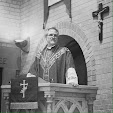
Wednesday, December 24, 2008

Merry Christmas, y'all!

From the Deep South:

What Louisiana nativity would be complete without an alligator?


When December gives you lemons...


Christmas Eve oranges and the thermometer (notice it's dipping down close to 75 degrees, brrr!).


Mrs. Hollywood's homemade pralines (with a hat tip to our friend, Louisianian in exile Stacy McDonald, who reminded us not to forget the bourbon).


Spiders...


...and Spider Man!


O Tannenpalm, O Tannenpalm. This is a block from our house, at our "old new house" (we were going to try to buy it, but the seller decided to keep it, and we ended up in the "new new house" instead.). Now that's a Nuh-Wahluns Christmas tree, dawlins!

A blessed Festival of the Holy Nativity of our Lord to all. Gloria in excelsis Deo!

Sermon: Christmas Eve - Early


24 December 2008 at Salem Lutheran Church, Gretna, LA

Text: John 1:1-14


In the name of + Jesus. Amen.

“In the beginning was the Word, and the Word was with God, and the Word was God…. And the Word became flesh and dwelt among us, and we beheld His glory, the glory as of the only begotten of the Father, full of grace and truth.”

Christmas is such a glorious time that we often hear little children wish that every day could be Christmas. And in a very real sense, every day is Christmas, for every day around the world, God takes a visible, humble, and even helpless form in order to be with His beloved people. For the word “Christmas” is a contraction of “Christ’s Mass” – the reality that Christ is truly present with us, that He is “pleased as Man with man to dwell” in his Word and in His Sacrament.

For “in the beginning was the Word.”

Over the course of many centuries, it was the custom in Christian churches to read the first fourteen verses of John’s Gospel at the very end of the divine service. After the priest gave the final blessing, he would send all the faithful off on their way by reminding them of the reality that God, the Word, took on flesh – which is especially important as this reading took place shortly after the people had just consumed Lord’s flesh and blood in Holy Communion. This custom of reading the “Last Gospel” was a fitting reminder that every Sunday is a form of Christmas.

The thing that makes Christmas special and wonderful is not merely the things that we do – the baking, the gift-giving, the visiting, the family rituals, the feasting, the decorations, the candlelight rendition of “Silent Night” and all other such things. For all of these things are there to point us to Christ, the very “Father’s love begotten.”

The thing that makes Christmas special and wonderful is what God did for us, does for us, and will always do for us. Christmas is not limited to December 25th every year, but like the Charles Dickens’ story A Christmas Carol, the spirit of Christmas is past, present, and future. More accurately, Christmas is eternal. For “in the beginning was the Word.” Our Lord Jesus Christ is God. And though He had a human birth, He had no beginning in time. He is “eternally begotten of the Father.” He is “Alpha and Omega, He the source, the ending, He.”

For our God became the Christ child in those days when Caesar Augustus ordered that everyone in the empire should be counted in order to be taxed, and He comes to us anew even though Caesar Augustus is only part of the rubble that is the empire today. We aren’t merely counted by a Caesar in order to be taxed, but rather we are all counted worthy of being saved by the King of Kings and Lord of Lords, a ruler who pays the tax Himself with His own blood. Our God took human flesh, became one of us to be fed by one of us, nurtured by one of us, and to die for all of us, in order to rise again as the first fruits of all of us, we who are baptized and believe in Him, so that we could then be fed by Him, nurtured by Him, and live by Him forever.

Our God continues to come to us, year after year, week after week, day after day, moment by moment. He has promised to be with us always. He is the Christ and He comes in the Mass – Christmas. And that continual Christmas bears the “always” of the Lord’s promise.

The Eve of Christmas, today’s feast, is a wonderful time to worship our God and King, our Creator and Redeemer, our Savior and Brother, our Priest and Deity. It is fitting that men should crowd into churches like the Shepherds that first Christmas squeezing into the stable, to “see this thing that has happened.” It is fitting that Christians assemble where they will find their Savior – no longer in swaddling cloths in a manger, but enrobed in bread and wine in a chalice and paten, in a cup and a plate, the Christ child that we can, in a way not completely unlike the Virgin Mary, carry the within us bodily.

“In the beginning was the Word... And the Word became flesh.”

This Christ, this Word, is proclaimed year-round in the Church, from pulpits like this one – many more humble and many more grand. This preaching of the Divine Word of Christ has gone on non-stop for nearly twenty centuries. This eternal Christmas has continued without interruption these two millennia – in spite of war and famine, in the face of persecution and bloodshed, in the constant struggle with disease and death, over the constant attacks of the devil and of our sinful nature.

That sinful nature of ours is why God did something so drastic and radical and extreme as to take on our flesh. For the Baby in the manger is only the beginning of the story. Thirty years later, He would be the Man on the cross, dying for our sins. He would be the Body in the tomb, resting that Holy Sabbath Day for us. He would descend into hell to proclaim His victory over death and Satan, and He would rise again in glory that first Lord’s Day to bring life to all of us as well, we who are the branches of His Vine.

Our sinful nature explains why we have more people in church on Christmas than on other days. Some of this is because visitors are in town to be with family members. Some of this is because some people are elderly or physically debilitated and cannot come every week. But most of it is because there are many people, even people who are members of this congregation, who do not believe church is important the rest of the year. They come on Christmas or Easter because it is a custom, or to hear beautiful music, or because they convince themselves that this makes them a Christian.

If this describes you, dear friend, please listen carefully. We Christians, we redeemed sinners, have been celebrating our Lord’s Incarnation for nearly 2,000 years. We are all waiting for the Lord to return. He will return, but we do not know when. And even if it isn’t in your lifetime, you will die. You will need the Baby in the manger, the Man on the cross, the one who rose from the dead that you might rise as well. If you truly believe the Word became flesh, it is because your flesh is sinful and in dire need, just like mine, and just like that of everyone in this church.

And that need is so great and so dire and so urgent that it isn’t a once a year or twice a year thing. If you only come here every few months, you need to repent. As the hymn says: “Let every heart prepare Him room.” You can indeed celebrate the wonder of Christmas year-round, partaking of the Christ Mass of Word and Sacrament every Sunday. You can hear the Good News of the Word made flesh, week in and week out. And this is why Christ has come! This is the one and only meaning of Christmas!

For if you really believe that God became a man and was laid as a baby in a Bethlehem manger, you will want to gather around Him at every opportunity. For He has come with good news! He has come to forgive us! We all need to hear that forgiveness and hear it often. And this is where you hear it according to the Lord’s promise. If it is important to hear that your sins are forgiven at Christmas, then it is equally important to hear it every week.

Jesus is bidding you to come, inviting you to Himself, pleading with you to open your hands to the unlimited riches He is tossing out to the whole world, the gold, frankincense, and myrrh of forgiveness, life, and salvation that comes from His Word made flesh that indeed dwells among us.

For this is all good news, dear brothers and sisters! Our Lord came into our world to save us, to rescue us, to cleanse our sinful flesh by His holy Word made flesh. Our Lord Jesus Christ came into the world not to condemn, but to save. And you will find Him here, doing His work of forgiving and transforming all of us who struggle with sin, who are beaten up by this world, who need to repent and hear the Good News week after week. Jesus is here, calling sinners to repentance and giving us “poor miserable sinners” reason to rejoice, to sing, to offer praises to God, and to be made a son of God by adoption because of the Sonship of Jesus Christ and by His promise to be with us “always.” The Lord doesn’t promise to be with us once a year, or only when we feel holy enough, or only when we are confronted with an event in life that drives us to our knees. He is here for us always, even to the end of the age.

And we know He is here, because His Word is here, His Gospel is here, His people, the redeemed sinners in need of Good News, are gathered here – like the shepherds bowed down before this humble and yet holy God who has come to save us.

Let us sing praises to Him, the Merciful One, who has come to Redeem His people. Let us adore our King, the Victor, on bended knee. Let us offer our thanks for his divine mercy and goodness to all of us, we who have done nothing to deserve it. Let us “behold His glory… full of grace and truth.” “O Come let us adore Him,” the Word made flesh, now and unto eternity! Amen.

In the name of the Father and of the + Son and of the Holy Spirit. Amen.

Tuesday, December 23, 2008

Hallelujah!


The winner of the British TV show X-Factor, Alexandra Burke (video above), won with a cover of an old song that is suddenly very popular again, Leonard Cohen's 1984 piece called "Hallelujah."

I've embedded the above performance of Miss Burke, and though I think she does a fantastic job, I prefer the more gritty version of Jeff Buckley, that seems to have become the standard. But Mrs. Hollywood likes the Burke version best of all, so it gets top billing here. Interestingly, the song is currently both #1 and #2 on the British charts at the same time, with Miss Burke's getting top honors and Mr. Buckley's just behind - a remarkable achievement for Cohen and his song.

I first heard the song (the Buckley version) at the end of a House episode a couple years ago (it is also in the movie Shrek). It is a catchy tune that gets in the head, combined with a poetic use of language and biblical allusion that is cryptic if not nonsensical. And yet, the piece has a simple melancholic riff about it that is attractive and haunting.

The author, 74-year old Jewish Canadian poet Leonard Cohen is as enigmatic as the tune. Being a "Cohen," he claims descent from the Aaronic priests, and describes his sense of Jewishness growing up as "Messianic." For a while, he became a Zen monk, while still claiming to be Jewish.

Nearly all of his life savings, including his legacy from his father (who was a well-to-do merchant in Montreal) was stolen by one of his managers. Although Cohen won his lawsuit, he will likely never collect anything. He has had to go out on the road out of financial necessity. Fortunately, his song "Hallelujah" is enjoying a rediscovery in England. So hopefully, he will recover some of his devastating financial losses. If you're reading, Mr. Cohen, Fr. Hollywood is pulling for you!

Cohen is in the Rock and Roll Hall of Fame, the Canadian Music Hall of Fame, the Canadian Songwriters' Hall of Fame, and holds the honor of the Order of Canada.

Hallelujah is one of those songs that just about everyone has covered, in numerous styles: among them: Bob Dylan, Bon Jovi, Rufus Wainwright, Allison Crowe, K.D. Lang, Cheryl Crow, Amanda Jenssen (runner-up of of Swedish Idol), Jason Castro (American Idol contestant), Kate Voegele, John Cale, a Norwegian band called Lind, Nilsen Fuentes and Holm; and Linda and the Outriders (British country singer), and one that you simply have to see, an impromptu rendition by the MSU Accafellas in a college hall.

It's also on YouTube in Danish, Swedish, German, and Italian.

And here is Hallelujah as sung by the author. I think he's a better poet than singer.

Great tune. But you know what is going to happen. Some dying-to-be-seen-as-hip "emergent" type - probably a Missouri Synod Lutheran, aided and abetted by his district office - will try to turn it into a sermon series and have the "worship team" sing it right into the toilet. Hopefully, the song is too "viral" to be ruined by the "usual suspects."

I'd like to hear the song covered by the following: Mark Knopfler, Roger Daltrey, Meat Loaf, Bruce Springsteen, and the Fort Wayne Seminary Kantorei.

Monday, December 22, 2008

Sermon: Funeral of Verna Keller, Monday of Advent 4 (Rorate Coeli)


22 December 2008 at Salem Lutheran Church, Gretna, LA

Text: John 3:16-21 (Isa 6:1-7, 1 Cor 12:31b-13:13)


In the name of + Jesus. Amen.

Dear family, friends, brothers and sisters in Christ, and guests.

We find ourselves mourning in the midst of all the excitement of Christmas. In this sanctuary, we have a casket and an Advent wreath. We have the sadness of our grief, combined with the symbols of hope of the Christmas season. Decorated trees and waiting tombs are not the kinds of things we typically associate with each other.

And although death was never the intended result of the creation our Lord gave is, it is the reality that we all live with. For the wages of sin is death, and as the hymn we just sang at Verna’s request confesses, we can indeed all confess the same thing: that I am the chief of sinners.

However, that is not where the story ends. For we all know why the Christ child lay in a manger – He came to save us, to give us life, to re-create us anew, to pay the wages of sin, and to take on our death at the cross. And because He lives, we too, dear friends, shall also live.

Verna is experiencing this first hand. Like the prophet Isaiah as he found himself in God’s throne-room, and though Isaiah rightfully felt the weight of his sins in God’s presence, that sin and guilt was to be purged away once and for all: “Behold, this has touched your lips; your guilt is taken away, and your sin atoned for.”

And so Isaiah could join the heavenly chorus of “Holy, Holy, Holy” – for his sin was atoned for, paid for, purged away, made no more. Verna’s sins were likewise atoned for, and so are ours, we who have been baptized and who believe, we who have been rescued. For during her sojourn in this life on this side of the grave, the Lord’s messengers placed the burning coal of the body and blood of our dear Lord in the form of Holy Communion upon Verna’s lips. The Lord Himself said: “Behold, this has touched your lips; your guilt is taken away, and your sin atoned for.”

Verna also requested the passage from 1 Corinthians 13 to be read today: Paul’s famous sermon on love. For Verna knew, knows, and will always know, that God atoned for her sins by the crucifixion of our Lord Jesus Christ – and that this sacrifice was indeed an act of love, for in the words of our Blessed Lord Himself, “Greater love has no one than this, that someone lay down his life for his friends.”

The love of Christ is given to us, dear brothers and sisters. And though we reflect His love imperfectly, the Christian life is indeed what St. Paul calls “a more excellent way.” The love you felt from Verna – be it as a mother, an aunt, a grandmother, or a dear friend – this is love rooted in Verna’s baptism, the love of Christ toward her, the love which saved her by grace and comforts us in our mourning.

That holy, divine love is purely by God’s grace and favor. For “God so loved the world, that He gave His only begotten Son.” The Father gave His Son to the world, gave Him to be born of Mary, gave Him to be crucified for us as a ransom for our sinfulness, gave Him to be placed into a tomb from which He rose again, and gave Him to be given to us in the Holy Sacrament.

Like all believers, Verna was imprinted with the very cross of Christ at her Holy Baptism, being made a disciple of Jesus Christ, one of the redeemed and ransomed, one for whom our Blessed Lord has taken to Himself in heaven, one who has been given eternal life. For as the familiar passage in John 3 continues: “God did not send his Son into the world to condemn the world, but in order that the world might be saved through him.”

This is the meaning of Christmas, and it is the meaning of Christianity. The Gospel is precisely for times like these, when we are confronted with the wages of sin, and we need the reassurance that all of these sins that bring death upon us were atoned for at the cross.

And this, dear brothers and sisters, is how St. Paul can say that although we Christians mourn the loss of loved ones like anyone else, we don’t mourn as the unbelievers. For we have been given a revelation, both in the form of the Word made flesh, the babe of Bethlehem, the Savior who died and rose for us men and for our salvation, and we also have the written Word, the Holy Scriptures, which speak of the magnificent throne-room of God, of saints and angels, of the joyful praise of our Triune God, as well as His love for us, a love reflected in the love of Christians for us and for their Lord.

And no matter how pious a person is, no matter how beloved he has been in this life, no-one is perfect. And that, dear friends, is why the Lord provided a Savior. He provided Verna with a Savior for her salvation, even as He provides for the salvation of all who are baptized and who believe. Verna was not perfect, but today she is. Like the rest of us, she had to see in the mirror dimly, but now she sees with clarity, face to face with God Himself. Formerly, she was burdened with aches and pains, with suffering, with the debilitation of age, with sickness, sadness, and mourning – but today, she has come through all of that, standing like Isaiah in the wondrous presence of the God who gave his only begotten Son as a sacrifice and atonement for her.

Dear brothers and sisters, Christmas has come early for our dear sister in Christ, and though we all have longer to wait for our perfection, for our reunion with her and with our Savior, we can still confess presently with the eyes of faith what Verna knows from standing before God in His fullness:

“Love is patient and kind; love does not envy or boast; it is not arrogant or rude. It does not insist on its own way; it is not irritable or resentful; it does not rejoice at wrongdoing, but rejoices with the truth. Love bears all things, believes all things, hopes all things, endures all things.”

It is in this love that our Lord has for us that we can bear, believe, hope, and endure all things – even unto eternity. Amen.

In the name of the Father and of the + Son and of the Holy Spirit. Amen.

Sunday, December 21, 2008

Sermon: Advent 4 (Rorate Coeli) and Baptism of Myaro Miller


21 December 2008 at Salem Lutheran Church, Gretna, LA

Text: Luke 1:39-56

In the name of + Jesus. Amen.

Among Christians around the world, today is named Rorate Coeli, Latin for “Rain, O heavens.”

After the heavenly water rained down on the world’s newest Christian, Myaro Miller, we sang together a prophetic passage from Isaiah:

“Rain down, you heavens, from above,
and let the skies pour down the Righteous One;
Let the earth open her womb,
and bring forth Salvation.”

Life-giving rainwater being showered upon us from above, providing us with earthly nourishment and physical nutrition is a very real reminder of the spiritual reality of the life-giving water of baptism that rains upon us from the Heavenly Realms of the Almighty Triune God into whose name we are baptized.

And on this last Sunday before Christmas, this raining down from the heavens takes on an even deeper meaning. The prophet Isaiah points us to the Righteous One, who opened the Virgin’s earthly womb, who has brought Salvation to us in a heavenly flood. For even as water destroyed sin and preserved eight people in the great flood, water also poured from the side of Him who died for all of us. And the One whose side poured out water placed men into holy orders with the charge: “make disciples of all nations, baptizing them in the name of the Father and of the Son and of the Holy Spirit.”

That holy water rains down yet again, as the Church has once more become a holy mother to a son of God, born of water and the Spirit, washed in the waters of regeneration, a raining down of the living waters that are the living Christ Himself!

What a glorious time to celebrate and remember baptism, that holy second birth even as we are days away from commemorating the holy birth of our Holy Lord who preceded us in Holy Baptism.

The Holy Spirit is given at baptism, and is given even to little children. St. Luke has recorded for us the reaction of the fetal John the Baptist, who was yet to open his elderly mother’s womb. When John encountered the Righteous One who lay hidden in the Blessed Virgin’s womb, the baby prophet testified with a jump! And no true prophet speaks on his own, but rather only confesses what the Spirit has revealed to him.

The Holy Spirit was given, and the Christ was revealed to, the baby John, and the holy Spirit was given, and the Christ was revealed to, the baby Myaro – even as the Holy Spirit is given to all of us who confess Christ, we who leap inwardly when confronted with the true presence of our Lord, even as He lies hidden under the forms of bread and wine.

And notice what happens when the Holy Spirit encounters the human spirit. Blessed Mary sang: “My soul magnifies the Lord, and my spirit has rejoiced in God my Savior.” St. Mary is filled with praise of the Lord, whom she acknowledges to be her Savior. Many years later, her Son would say to St. Peter upon His confession that Jesus is the Christ: “Flesh and blood has not revealed this to you.” Indeed, for any of us to confess Jesus as Savior, as very God of very God, is not something mere flesh and blood teaches us. This is revealed by the Holy Spirit, who attached Himself to the Lord Jesus – whether delivered through the Holy Gospel preached, through the Holy Supper celebrated, or through Holy Baptism administered – this revelation is a holy and sacred revelation, the very Word of God – the same Word made flesh whose birth we are so close to celebrating, the same Word that attaches Himself to baptismal water.

The Lord so typically comes through such revelation not to the mighty (who are so often cast from their thrones) nor to the rich (who are so often sent away empty), but rather he comes to the lowly and the hungry, to the impoverished Mary, to the formerly barren Elizabeth, to the helpless unborn child John, and yes, even to this little infant Myaro today. For our Blessed Lord Himself was to come into the world as a humble child, a prince in a food trough, a king in a stable, God Almighty in swaddling cloths and a diaper, being nursed by His mother and being protected by His step-father.

And notice too how the most highly favored Lady sings of “mercy” in her song: “In remembrance of His mercy.” The Lord has come to Mary as an act of mercy. He has given her the unique gift in all of creation to carry the living God in her womb, to birth Him, to nurse Him, to care for Him, to raise Him, to observe Him carrying out His Father’s will, even to the point of watching Him suffer and die on the cross. Indeed, the angel Gabriel who announced the Lord’s conception to Mary prophesied the bitter sword that would pierce the soul of the mother of God as she would watch her Holy Son defeat the devil and win salvation for those who are baptized and believe in Him.

And yet, that same soul pierced by the sword was the very same soul that magnifies the Lord.

But the Magnificat is not only Mary’s song. For Mary is a symbol of the entire Church. For our souls magnify the Lord as well, even as our spirits rejoice in God our Savior. We too are humble servants of low estate who have been given the riches of a reward we don’t deserve – eternal life and salvation, given through water and the Word. Like Mary, we can ponder and treasure these things in our hearts and wonder why we have been chosen to be the recipients of such great mercy.

And like Mary, whom every generation has indeed called Blessed, we too carry the Word made flesh in our bodies. Of course, Mary carried the Lord in her womb, even as her flesh nourished His flesh, but we also carry the Lord Jesus bodily – though it is His flesh that nourishes our flesh, it is His blood that makes sacrifice for our blood, so that instead of shedding our blood to pay for our sins, we receive the wine of His blood shed for the forgiveness of our sins.

The mother of God knew what the holy prophet meant when he cried out: “Rain down, you heavens, from above.” For the Holy Spirit came upon her, raining down upon her like the life-giving precipitation that falls on all men, good and evil alike, the showers that give life to the world.

And so do we, dear baptized children of God, so do we understand the prophet’s oracle. For we have all had the heavenly rain wash over our sin-soiled bodies, being cleansed in the heavenly flood with the words: “I baptize you in the name of the Father and of the Son and of the Holy Spirit.” We humble servants can, along with the Blessed Virgin Mary, magnify the Lord and rejoice in God our Savior.

“Rain down, you heavens, from above,
and let the skies pour down the Righteous One;
Let the earth open her womb,
and bring forth Salvation.” Amen.

In the name of the Father and of the + Son and of the Holy Spirit. Amen.

Friday, December 19, 2008

Outstanding Documentary


This 42 minute documentary is a gem. It is called "Money, Banking, and the Federal Reserve." That is, I admit, a dry and boring sounding title, but don't let it fool you. This program is extremely well done, and is anything but dry and boring. It will hold your interest - especially if you are interested in American history. It is a look at the ancient origins of money, of banks, and of the modern American banking system. It was made in 1996, and considering the recent events in our economy, the premises of this presentation are absolutely borne out.

If you care about the future of our country and your family, you'll want to spend a little time thinking about how money is made and circulated in the United States today.

Post Election Blues

Wednesday, December 17, 2008

Make it a three-fer...

Well, sort of. It's not an Aaron Wolf article, but he is quoted in this Daily Mail piece written by Brussels-based journalist Mary Ellen Synon. It's all business as usual in the "Land o' Lincoln" (hey, at least for once the spotlight of corruption isn't on my state, the "Land o' Long," and as the Great You-Know-What himself is reputed to have quipped: "You can't fool all of the people all of the time." Some lies take longer than others to shake out.

Sermon: Wednesday of Advent 3 (Gaudete)


17 December 2008 at Salem Lutheran Church, Gretna, LA

Text: 1 Thess 5:16-24


In the name of + Jesus. Amen.

One week to go. One week! The pace picks up. The intensity has been turned up a notch. The activity increases. The list of things to do becomes more frantic.

Seven days to get it all done. The deadline will not slide. The calendar will not accommodate our schedule. The time is coming, ready or not.

We’re in the home stretch. There are the last decorations to put up, cards to send, lists to check. We need to drive here and drive there, wrap this and wrap that, place orders, buy food, cook this and bake that. We have to clean and make our homes ready for company. And all of this on top of the rest of our obligations. There isn’t even time to take a breath. We have to talk faster, walk quicker, and maybe even preach shorter. We wonder how it will all be done.

St. Paul’s exhortations to us in his letter to the Thessalonians has this same hurried context. Paul is getting to the end of the scroll, and perhaps running out of time. Through him, the Holy Spirit has much to say to us, and there is little time for embellishments and clever turns of phrase at this point.

St. Paul rattles off a list of things Christians are exhorted to do as part of their life as redeemed sinners, as God’s beloved people who have been saved by grace alone. Listen to both what the Apostle says, and how he says it:

Verse 16: “Rejoice always,” verse 17 “pray without ceasing,” verse 18 “in everything give thanks; for this is the will of God in Christ Jesus for you.” Verse 19 “Do not quench the Spirit.” Verse 20 “Do not despise prophecies.” Verse 21 “Test all things; hold fast what is good.” And verse 22 “Abstain from every form of evil.”

In a way that is unusual for St. Paul, he says a lot with a few rushed words. It is almost as if Paul has to catch a ride in two minutes, but has ten minutes worth of preaching to do.

In this letter, St. Paul has just addressed the day of the Lord, the end of time, the events that will herald in the last judgment and the resurrection. And just as our Lord’s first advent was sudden, and once the birth process was put into motion, there was no calling it off, no extensions and no delays, our Lord’s second advent will likewise come upon us suddenly. And when these events happen, there will be no turning back. The Lord will return, and all that has been promised will come to pass.

Dear brothers and sisters, this will be a time of rejoicing and glory for the Lord’s Church, a time of fulfillment for His people. His coming will be the answer to our prayer. We his weary and at times worn out people pray: “O Emmanuel, our King and our Lord, the Anointed for the nations and their Savior: Come and save us, O Lord our God.

For not only are we harried by the hustle and bustle of Christmas, we are also wearied by the changes and chances of this life. Even as we can’t wait for the seasonal commotion to end so that we can take our rest, we also cannot wait for the groaning of all creation under the burden of sin and the weight of mortality to be completed, so that we can take our eternal rest in the Kingdom of God.

For listen anew to St. Paul’s exhortation. Let us slow down for a moment and meditate, let us ponder, let us truly listen to the Spirit’s Word given to us as a free gift this evening.

“Rejoice always.” Dear brothers and sisters, there is the kind of rejoicing that is a passing thing: the celebration of the moment, the joy of giving a gift, the delight of a meal, even the victory of a sports team. But these things all pass and pass away. But the rejoicing that is done “always” is an eternal rejoicing. This isn’t a command, but simply a description of the Christian life. Think about what this means! We will rejoice for all time, without end. This is a result of what our dear Lord – born at Bethlehem, crucified at Calvary, whose body and blood are given to you here –
has done for you. You can rejoice for all time – even in the midst of the hustle and bustle.

“Pray without ceasing.” We Christians ought to offer prayers around the clock. We will certainly do this in its fullness after our Lord comes back again. But even in this valley of tears, we have access to our Creator, Redeemer, and Sanctifier at any time and in any place. He is always eager to hear our prayers.

“In everything give thanks; for this is the will of God in Christ Jesus for you.” And we can be thankful at all times and in all places, for look what awaits us, dear friends! No matter what we must endure in this brief life, we have an eternity of rapture and glory. And even in this life of sin and death, we have our dear Father’s love, a love begotten in the form of our Lord Jesus Christ, who has come to be our King and Rescuer.

“Do not quench the Spirit.” There is no reason, dear brothers and sisters, to allow the cares of this world to choke out the Seed of the Word of God that has been implanted into us. The Spirit is at work in us, brooding over us, calling us to repentance, giving us life, working by means of the Word and the sacraments to feed us. Nothing is too important to prevent us from coming here to be fed and nurtured, to hear the Good News of our rescue from sin and death, to be refreshed by the Spirit’s breath.

“Do not despise prophecies.” The Word of God is a treasure. Though it takes time and effort to study the Word of God, though it takes patience and commitment to pray the Word of God, the rewards are absolutely endless, and the strength one finds in the Word of God are like no other comfort or power on this side of the grave.

“Test all things; hold fast what is good.” Always test the Spirits, and always side with what is right. We have been given the Holy Spirit, dear brothers and sisters. We know right from wrong. We are in a great battle between good and evil. We need to encourage ourselves and our brothers and sisters in Christ to keep fighting, to hang in there, to support one another, and to seek righteousness. The Lord’s return is around the corner, and we can take heart like a tired runner who sees the finish line.

“Abstain from every form of evil.” The pleasure we may get in sinning is truly a passing thing. But there is a price. Sins cause damage. Evil is not something to toy with, but rather a thing to be shunned. Since we are so close to the finish line, now is not the time to be distracted, but rather to keep our eyes on the prize, put our head down, and run the race with joy.

St. Paul is not giving us a burdensome list of new commandments. These are not hoops we must jump through in order to have salvation. For our Blessed Lord jumped through every hoop on the cross, dotting every “I” and crossing every “T” when he said: “It is finished.” We are now living the life of the redeemed. And our Christian life is a life lived in the glory of that rescue. We have been freed from Satan’s tyranny, and given victory over the grave. The Lord will preserve you blameless. He is faithful and will do it.

For us Christians, though we await the coming of our Lord, our eternity has really already begun. It began when our Lord took flesh. It began for us when we were baptized and born again into the kingdom. And though the clock is ticking, we are approaching the age in which the clock will no longer tick and goad us from here to there, when the calendar pages will no longer flip and order us about, when time itself will have been completed, and we will never again be subject to hurrying and scurrying. We have a little glimpse into that eternal window, dear friends, right here, in our Lord’s presence. Rejoice! Now and unto eternity.

“Now may the God of peace Himself sanctify you completely; and may your whole spirit, soul, and body be preserved blameless at the coming of our Lord Jesus Christ. He who calls you is faithful, who also will do it.” Amen.

In the name of the Father and of the + Son and of the Holy Spirit. Amen.

Sunday, December 14, 2008

Sermon: Advent 3 (Gaudete)


14 December 2008 at Salem Lutheran Church, Gretna, LA

Text: Matt 11:2-11 (Isa 40:1-11, 1 Cor 4:1-5)


In the name of + Jesus. Amen.

We opened this Divine Service by singing an Introit from St. Paul’s letter to the Philippians: “Rejoice in the Lord always. Again will I say, rejoice.” Because of this, today is known as “Gaudete” which is Latin for “Rejoice.” Even in the midst of Advent, a time which, for the Church anyway, is a time of focus on our sins, of meditation upon our need to repent, a season of yearning for the Lord to return to deliver us from this body of death and from this valley of tears – we are to “rejoice in the Lord always.”

The rose-colored candle on the Advent wreath has been lit as a symbol of our joy. Isaiah repeats anew the oracle from the Lord that the preacher is to “comfort My people.” Our Lord Himself can hardly contain His joy at His own report of what is happening: “The blind see and the lame walk; the lepers are cleansed and the deaf hear; the dead are raised up and the poor have the gospel preached to them.”

And yet, where is John the Baptist? He is in a dungeon not long for this world. Can John partake of this joy?

It seems that everyone has been invited to the party except for John, the last of the prophets, the one of which our Blessed Lord said that among those born of women, no-one is greater.

So is John to rejoice as well? Is there good news for John in his prison cell?

And what about those among us who are downtrodden, the oppressed, the falsely accused, the persecuted, the sick and dying, the lonely, those gripped by chronic pain, the depressed, those with distressing family problems, those with nagging doubts, people facing medical tests, those whose jobs are in jeopardy, and every other source of grief and anxiety? Do they have anything to rejoice about?

What about people around the world who live in squalor, who are subject to civil war and military occupation, people who are decimated by AIDS or leprosy, the families facing hyperinflation in Zimbabwe and Christians staring down the sword in Saudi Arabia? What about the victims of terrorism in India and those persecuted for the sake of the Gospel in China, Russia, and Scandinavia?

Is it not an insult for us to sit here in comfortable surroundings and tell the world to “rejoice” and to “rejoice always?”

Dear friends, nobody can be ordered to rejoice on command. Rejoicing is the natural response to kindness and mercy. This is why our Introit which begins “rejoice” from Philippians is coupled with Psalm 85: “Lord… you have brought back the captivity of Jacob. You have forgiven the iniquity of Your people. You have covered all their sin.”

We are not told to rejoice in the sense of a legalistic “do it or else,” but rather we are reminded of the Lord’s goodness and mercy. For no matter what happens in this brief life, this current world overcome by sin and death, we have eternity to look forward to. We have been forgiven of all our sins! We have full communion with our loving Father through the very real forgiving work of the Son as sealed upon our foreheads by the baptismal waters which bequeathed to us the Holy Spirit.

This is why the early martyrs could go to their deaths singing hymns and praising God. This is how Christians, no matter how poor and hungry, can join together as a family and pray the Lord’s prayer with transcendent joy. This is why, when Christians partake of Holy Communion – no matter the circumstances, be it at a death bed, in a prison camp, or on a battlefield, the act of partaking of the sacrament is called a “celebration” and the pastor who serves the body and blood of the Lord is called the “celebrant.”

For the worst thing that will happen to us in this life is that we will die. And we know this will happen anyway. But the good news, the cause of rejoicing, the reason for the rose colored candle and the joy of the Eucharistic celebration, is that death will no more hold us than it held our Lord! All the suffering, all the bad news, all the causes of pain and sorrow in this life are to be wiped away in an instant, in the blinking of an eye. Our Lord is coming to restore Eden, to give us life, to bring us into harmony with the Triune God and all of creation! He has done this for us – it is as much a matter of history as Caesar Augustus and Pontius Pilate, of Bethlehem and Calvary, of the Jordan River and every baptismal font in every church in history.

The promise that brings us such joy in the midst of suffering is as tangible and solid as this marble pulpit and can be tasted and ingested in nothing less than the physical realities of bread and wine, which are truly the Lord’s body and blood, the very Lamb of God who takes away the sin of the world, the One who is there in the flesh to bring you joy without end.

For what do we see surrounding our Lord Jesus? “The blind see and the lame walk; the lepers are cleansed and the deaf hear; the dead are raised up and the poor have the gospel preached to them.”

The imprisoned and the falsely accused, the faithful prophet who is to be beheaded, believers of every time and place who suffer in body and spirit, those who mourn and doubt, those who struggle in vain to feed their families or strive to avoid bloodshed and violence – can indeed all rejoice. For the worse their conditions are in the present, the greater their joy when the Lord returns to create a new heaven and a new earth.

For the same apostle who exhorted us to “rejoice… always” also proclaims: “judge nothing before the time, until the Lord comes, who will both bring to light the hidden things of darkness and reveal the counsels of the hearts. Then each one’s praise will come from God.”

Our joy is not in this life of sin and sorrow, dear friends. Our joy is in Christ, who made full atonement for each one of us, who provides the Church with “stewards of the mysteries” to celebrate the sacraments and to proclaim the Good News, to bring comfort to you, His people, bearing the good tidings that the war is over, that our iniquity is pardoned, the messenger who holds the Lord’s body aloft and says: “Behold your God,” the God who will “feed His flock like a shepherd” and who “will gather the lambs with His arm, And carry them in His bosom.”

These holy words conveyed by stewards and prophets, by Scripture and the Holy Spirit, have comforted and filled our brothers and sisters with joy since the Lord sent His Word among us to do His work of re-creation – joy even in the most adverse conditions and cause of suffering.

Those times when we around us and we are bereft of joy because of what we see are precisely the times to look up and be filled with every reason to rejoice – because we have not only a promise, but a Savior, not only a blessed hope, but a holy assurance that we see now with the eyes of faith, but that we will see with our eyes when the time comes:

See, the Lamb, so long expected,
Comes with pardon down from heav’n.

Let us haste, with tears of sorrow,

One and all to be forgiv’n.


So, when next He comes in glory

And the world is wrapped in fear,

He will shield us with His mercy

And with words of love draw near.


Amen.

In the name of the Father and of the + Son and of the Holy Spirit. Amen.

Saturday, December 13, 2008

An Aaron Wolf Twofer


One of the most frustrating things about the Missouri Synod is our intellectual inbreeding.

What I mean is that most of our thinking and writing is done "in house." Unlike great theologians, philosophers, social critics, and other thinkers from Roman Catholic, Eastern Orthodox, Anglican, Reformed, and Evangelical traditions, we Lutherans largely find our best minds "preaching to the choir."

One felicitous exception is LCMS lay theologian, historian, thinker, journalist, and writer par excellence Aaron D. Wolf, who is one of the editors and columnists at Chronicles: a Magazine of American Culture. Fr. Hollywood readers may remember a post from two years ago highlighting Aaron's brilliant piece about Christmas and church music - an article that introduced me to Martin Luther's favorite composer, the glorious Josquin des Prez. [Have I really been blogging that long? +HW]

Aaron has broken out of the Missouri ghetto and is a voice for not only Lutheranism, not only conservatism and confessionalism, but full-blown unapologetic traditionalism - not only in the sense of Evangelical Catholic Christianity, but also in matters of Western Civilization and American conservatism.

His writing is delicious, laced with poetic turns of phrase, deep with rich and provocative thought, and spiced with puns and irony. Aaron's columns are Chestertonian, while at the same time reflecting contemporary American life in a very different era and culture than that of G.K.

A couple recent Aaron Wolf offerings:
Thanks again, Aaron, not only for your insights, but for being a voice of Traditional Lutheranism in a very dark world of gnostic and entertainment based religiousity. And thank you for being a "thinking man's conservative" - as opposed to doling out the usual blather in the conservative world more suited to the realm of professional wrestling than of critical thought and commentary.

Dear readerm if you're looking for interesting reading from a conservative persuasion, check out Chronicles online. Better yet, support Chronicles with a subscription to the journal itself, or give out subscriptions for Christmas gifts.

Friday, December 12, 2008

Subversive Radio


To the dismay of readers who are still using dial-up, I've added yet another widget to the right-hand margin of this blog labeled "Subversive Radio." Hopefully, if Homeland Security is doing some kind of keyword search, I won't be in too much trouble for advocating subversion, though I suspect my advocacy of the abolition of the Federal Reserve might have gotten me on the radar screen anyway. Was that cat not out of the bag? Oops, mea culpa...

Although most Father Hollywood readers already know about Issues, Etc., if you don't, you might want to have a listen.

Issues, Etc. is a rarity among radio programs. Its slogans - which by the way are not the usual marketing schlock, but are rather accurate descriptions of the programming: "talk radio for the thinking Christian" and "Christ-centered, cross-focused talk radio" - say it all.

In a secular culture dominated by intellectual mush, violence, crassness, shock-value, and outright blasphemy, and over and against a Christian culture characterized by charlatans, fads, "the theology of glory", and anti-intellectualism - Issues, Etc. is truly subversive radio at its finest. And, as a bonus, if you're like most people and can't get the show on broadcast radio, you can get it at your convenience by podcast.

This is marvelous technology for people like myself whose work doesn't afford a lot of time to listen to love radio. In between classes, for example, I can load up the "on demand" page and listen to a segment of previous programming. I'm always educated and edified when I do so. I'm genuinely impressed with the program and the people who run it.

This is a program run by conservative, confessional Lutherans who don't equivocate in their confession, and yet, have a format that is open to different viewpoints and representatives of a variety of Christian traditions, engaging timely topics of interest to the thinking, cross-focused Christian from the perspective of orthodox, Biblical Christianity.

You will find interviews with seminary professors, pastors, laymen, experts in many different fields from all walks of life. The host of the program, the Rev. Todd Wilken, maintains a refreshing, respectful decorum and intellectual climate unlike many other conservative radio shows that devolve into a kindergarten class or a screeching tirade. And, the program is just plain interesting and engaging.

So if you'd like to take part in the holy subversion against the world, the devil, and our sinful flesh, click on the Issues, Etc. widget and join the resistance.

Thursday, December 11, 2008

Sneaux!

We had snow yesterday for the third time in 17 years (the last was Christmas Day, 2004).

It became an "event." Morning devotions were called off, as faculty and students alike ran through the halls from windows to doors - just in case the snow would stop before we got a chance to see it.

Due to the unprecedented nature of this event (at least in the lives of many of my students, some of whom never saw snow in New Orleans before this), 6th grade Religion class was spent throwing snowballs and getting cold fingers and soaked clothing.

Our 6th grade homeroom teacher even made a "bonhomme de neige" - even if he was a pygmy (see picture below).

The Times-Picayune ran an article with some great pics, and can be found here. [And here is an editorial from a few days later +HW]

Meanwhile, here are a few more memories of the "snowstorm of ought eight".


Wednesday, December 10, 2008

Sermon: Wednesday of Advent 2 (Populus Zion)


10 December 2008 at Salem Lutheran Church, Gretna, LA

Text: Mark 1:1-8 (Isa 40:1-11, 2 Pet 3:8-14)


In the name of + Jesus. Amen.

We’ll all familiar with the old saying “Don’t shoot the messenger.” And the reason is, obviously, messages are not always good news. Sometimes the messenger has to carry bad news. And even though it’s not the messenger’s fault, he makes for a convenient target.

The Lord spoke to the prophet Isaiah and told him to deliver a message. He was told to:

“Comfort, yes, comfort My people!...

Speak comfort to Jerusalem, and cry out to her,
That her warfare is ended,
That her iniquity is pardoned;
For she has received from the LORD’s hand
Double for all her sins.
The voice of one crying in the wilderness:

‘Prepare the way of the LORD;
Make straight in the desert
A highway for our God.
Every valley shall be exalted
And every mountain and hill brought low;
The crooked places shall be made straight
And the rough places smooth.’”

But for speaking these words of comfort, this prophet Isaiah, this voice of one crying in the wilderness, was put to death by a wicked king by being sawn in half.

Why would such a messenger bearing comfort be executed? Well, one man’s comfort is another man’s discomfort. Isaiah told the oppressed that they would be freed – which was not well received by the oppressor. For every valley that is to be exalted, there is a mountain to be brought low.

And yet, holy Isaiah continued with his preaching, faithful unto death.

Seven centuries later, another Isaiah-like messenger came to the wilderness to be a prophetic voice crying out. He preached the same message of comfort as Isaiah. His name was John, and he was also a holy messenger – in fact, the last prophetic messenger. He too preached comfort to the people of God and exhorted: “Prepare the way of the LORD; Make His paths straight.” And John’s message of repentance was likewise met with mixed reviews. All of Judea came to be baptized by him, but there were also those who refused to repent.

One of those whose hearts were hardened, who held the same title of “king” as the one who executed Isaiah, put John into a prison and ended up beheading him.

Faithful John, like faithful Isaiah before him, was cut in two.

Another messenger, the holy apostle St. Peter encourages us with beautiful words such as his divine testimony that the Lord “is longsuffering toward us, not willing that any should perish but that all should come to repentance,” and that “[W]e, according to His promise, look for new heavens and a new earth in which righteousness dwells. Therefore, beloved, looking forward to these things, be diligent to be found by Him in peace, without spot and blameless.”

And yet, that little word “repentance” is what turns what is otherwise seen by the world as a harmless and sentimental “do-gooderism” into something offensive and worth killing over. St. Peter was likewise put to death by a king, being crucified in the name of the Roman Caesar like his Lord before him.

Quite often, God’s messengers are not merely shot, but sawn in half, beheaded, crucified, burned at the stake, thrown to hungry lions, beaten, tortured, imprisoned in lonely cells, and being removed of all worldly comforts.

And still these messengers proclaim. They proclaim in the course of life, they proclaim while dying, and through the Word of God, they proclaim centuries after their deaths. They continue to preach “comfort” – not in the sense of wealth and ease, of a carefree lifestyle, of a favorite recliner, or a berth on a cruise ship. Rather these holy messengers preach an eternal comfort in which “He will feed His flock like a shepherd; He will gather the lambs with His arm.”

This message of ended warfare; of pardoned iniquity; of a new heaven and earth; of One mightier than all of us who baptizes us not only with water, but with fire and the Holy Spirit – is indeed the message that brings comfort to the Lord’s redeemed, those who have been baptized with water by messengers throughout the centuries, and those who have heard the good tidings proclaimed by preachers and who in turn believe in Him who sent them.

The proclamation of the Gospel is not received any better today than it has been in the past. The very idea that mankind is sick and in need of help is offensive to our human pride – which clings to our old Adam and deceives us into thinking we need no Savior. The message is as scandalous as ever, and the old evil foe seeks nothing less than the silencing of the message through the silencing of the messengers.

But nevertheless, the Church still proclaims and confesses. She still remains faithful to the message of the good tidings of the once and future coming of our Lord Jesus. She continues to wait with joy and repentance, for the advent of her Bridegroom. She continues to exhort the world to repent and believe this good news, and even today, is treated as though she is bringing bad news.

Dear friends, sometimes the messengers do get shot. You may incur the wrath of your family for suggesting that every person is in dire need of being in full communion with our Lord and with the Church, that they ought to be praying, drinking in God’s Word, and assembling with the faithful to receive the Lord’s Most Holy Body and Blood. Your friends and neighbors may treat you as some kind of an oddity for believing and teaching that the coming of our Blessed Lord is not a mere myth or a quaint story designed to make everybody comfortable. For clearly, the prophetic voice of “comfort” does not bring comfort to those who stop up their ears and refuse to repent. And in some places, Christians are still being rounded up, persecuted, harassed, gagged, and sometimes even imprisoned and executed.

But no matter how Satan may try to silence the One who crushed his skull, the Word of God goes forth and never returns void.

Let the Church continue in her prophetic message of the prophets, apostles, martyrs, and saints; the good news of our Lord incarnate, crucified, resurrected, and victorious; of sins forgiven, of the Gospel proclaimed, of sacraments administered, and of repentant and joyful lives immersed in the Holy Spirit unto eternal life. Let us sing with saints around the world as we praise God for these faithful messengers embodied in the life and preaching of the Holy Forerunner:

Our thanks for John the Baptist
Who till his dying day,
Made straight paths for the Savior
And heralded His way!
In witnessing to Jesus
Through times of threat or shame
May we with faith and courage
The Lamb of God proclaim.


Amen.

In the name of the Father and of the + Son and of the Holy Spirit. Amen.

Tuesday, December 09, 2008

A NOLA Musical Interlude


Last Saturday, we managed to visit the new Borders on Canal Street for their grand opening. The store, located in a particularly luscious part of New Orleans, is magnificent. And needless to say, you will never get bored hanging out or talking with the staff. There are always interesting people to talk to in the Crescent City.

A local music sensation, Theresa Andersson played in the coffee shop.

What can you say about Theresa Andersson? She is a Swede who followed her musical dreams not just to the States, but to where some of the greatest music in the States originates: New Orleans. She went from only hearing Allen Toussant's music in Sweden to actually having him record music with her in her kitchen (more on that later). Having landed in the Crescent City, she just never left. I could not detect even the hint of a foreign accent. She has now become well known in the local music scene where she has been performing since 1990. She may be on the verge of a national or even international breakout. Mark your calendars for February 4, when she will appear on Conan O'Brien. She will also have a track on an upcoming Starbucks compilation CD. Her YouTube videos have gone viral.

She can do it all: violin (any style, including playing it like a guitar with a slide mechanism), guitar, dulcimer, drums, and an ethereal angelic voice. And she has an absolute blast playing music. You can't fake the spontaneous joy she exudes while playing.

Her latest CD, Hummingbird, Go!, was recorded without a band and without a studio. More accurately, she was the band, and the studio was the small kitchen in her historic shotgun house right here on the West Bank in historic Algiers Point, a stone's throw from the ferry station on the Mississippi River. Her latest style of performance is to actually sample music on the fly: violin, drums, guitar, tambourine, chimes, and all the vocals - along with anything and everything else to make music (such as a Barq's root beer bottle, thumping her hand against a microphone, and a vinyl record of a friend's drum riff). The samples are then looped, and she layers in live performance over top the almost-live performances which run in a big loop governed by a series of pedals and knobs, which she turns on and off with her feet, with great precision.

It sounds like a gimmick, but it is anything but. It is sheer virtuosity - mesmerizing both to watch, and to listen to. Watching her play is a little like observing an organist with both hands and both feet flying away, managing to create heavenly harmony out of what appears to be neurological chaos. For me, this is like watching a miracle - as I can't even come close to being able to multitask like that). The catchy YouTube above ("Na Na Na") has over 700,000 hits. She has a performance of a more bluesy/jazzy, almost retro song that really highlights her voice, called "Birds Fly Away" on YouTube as well, and you can watch it here. If you want to see her really rip up the violin while playing an old American spiritual (that as a bonus even mentions our Blessed Lord), check this live performance out.

Fans of the Swedish language will be pleased to know that one track on Hummingbird, Go! is in Swedish ("Innan Du GÃ¥r", which she recorded with Ane Brun, a famous Norwegian songstress who now lives in Stockholm).

Watching Theresa Andersson perform live just a few feet away in a Borders coffee shop was a real treat. It was Quintessential Big Easy. You can see the street cars ambling along Canal Street through the window behind the stage, as well as last year's Mardi Gras beads dangling from the old, twisted live oak trees that line the venerable old boulevard. She performed for a good half hour, and in between tunes, explained all about her "recording studio" (you can see the fridge covered with magnets in the video above) in a genuinely self-deprecating way. She even gave individual names to the different voices she recorded in (known collectively as "The Kitchenettes"), explaining their individual personalities, complete with gestures and a little acting out of their "behaviors." Musicians are at their very best when they are having fun doing what they are doing. And the crowd, which did more than just give lip-service to diversity, likewise had fun watching her have fun with her instruments and her harried pedal-pushing with bare feet. If Theresa Andersson doesn't make you smile, you must not be human. In spite of the almost comical way the music is performed, she can make real and quality music that is haunting, melodic, soaring, and inspiring, as well as fun, imaginative, playful, and daring.

In other words, Theresa Andersson is a microcosm of New Orleans itself.

As a timely postscript, here is an article from the Dec 12 Lagniappe section of the Times-Picayune.

Straight Talk on Gun Control


I don't think this will change anyone's mind, but here is a cogent, rational, and straight to the point examination of the issue in light of recent events.

War is peace...


...freedom is slavery, ignorance is strength, and it's not a bailout, says Chrysler.

If they could make cars like they can sling you-know-what, they wouldn't need the non-bailout. If they invested wisely, spent money on R&D instead of slick marketing and instead of donating millions to the re-election campaigns of the same politicians who will now definitely be handing over billions of dollars of OPM, if they built a decent car, if they knew how to run a business - then they wouldn't need a slick marketing campaign to fleece the American people.

After my previous car died, we did our homework. The highest rated cars in the category we were interested in were Toyota and Honda - many of which are built in American plants by American workers. The American cars, for the most part, ranged from sub-par to outright junk. We went with the Toyota and are very happy. I've had exclusively American cars since 1981. Most of them were mediocre at best. The last one I was really happy with was my 1992 Saturn - which was made before GM took over Saturn. Our next two Saturns were simply inferior. None of my American cars could hold a candle to the quality of my Toyota (with the exception of the 1992 Saturn, which I got rid of only because it couldn't pass a government-mandated emissions test after 240,000 miles due to the fact that it was only running on three cylinders (!) - though even with that handicap, it was still holding up well. But like I said, that was a pre-GM Saturn, before the creativity and innovation were sucked out by the corporate vampires.

When you make junk, guess what? People don't want to buy it. No amount of Orwellian slogans, celebrity endorsements, scantily-clad women, or commercials shot in wide-angle with special effects will turn a rusty tin can into a gold ingot - which is to say, will turn a Chrysler into a Toyota or a Ford into a Honda.

Not enough people want to buy Chrysler's product. That's why they're failing! So what are we going to do? Force the American people through confiscatory taxation and/or inflation of the money supply and debt spending to reward Chysler's incompetence with billions of dollars plus the burden of having the government nationalize and run a business and engage in central economic planning. That's called Socialism - whether it is done by Democrats, Republicans, or both.

So, instead of allowing the old dinosaurs to fail and be replaced by upstart companies with new ideas, with an ear to the market, with the ability to allocate resources from the carcasses of the dying companies - we're going to prop up the Big Three like the main character from Weekend at Bernie's and try to revive the decaying corpse with a green blood transfusion. We're going to rob the hungry entrepreneur Peter to pay the bloated ne'er-do-well Paul. We're going to nationalize the out-of-date and out-of-touch industrial behemoth and try to turn it into a moneymaking operation, competitive with the leanest and meanest manufacturers run by the finest minds around the world - all using government bureaucrats to oversee it.

Yeah. That always works. Just ask the Soviet Union.

Prosperity is right around the corner, Comrades! Big Brother is watching!

Sunday, December 07, 2008

Facing the Orient in Tulsa


Thanks to the Rev. Christopher Hall for for this article about the resurgence of traditional liturgical practice in the heart of the Bible Belt, Tulsa, Oklahoma.

The article features both a Roman Catholic bishop and a Lutheran pastor from the Missouri Synod (the latter is actually a "sidebar" article that follows the main one) who have both reestablished the traditional "ad orientem" (literally: toward the east) focus for conducting the Divine Service (in which the celebrant and congregation all face God together for prayers and during the consecration) .

Radical changes to the liturgy by Roman Catholic innovators led to a virtual abolition of ad orientem worship in the Roman communion - and the practice spread to be almost universally embraced by American Lutherans. Churches built since Vatican II almost never have traditional altars. The 1960s were a time when the movers and shakers of the culture felt that God was too big for his britches and that reverent worship had to be changed to make it more "folksy." This led to the guitars and handshaking of the 60s and 70s, and morphed into the faddish "contemporary worship" of the me-centered 80s.

Today, there are actually adult Missouri Synod Lutherans who have been to church their entire lives and never participated in liturgical worship. Fortunately, it looks like there is a movement afoot to repudiate the excesses of that rebellious era and a desire for liturgical authenticity and piety over and against entertainment and marketing.

I remember the mantra from my Catholic high school that was used to justify a lot of radical changes, such as the departure of the use of a chalice of precious metals, from the use of wafers, from the use of reverent music and from the idea that dressing up for church services was befitting of the decorum of worship. The sound-bite was: "The Mass is supposed to be a meal." That throw-away line embodied the justification of a lot of liturgical mischief. Of course, it is a meal, but the implication in the slogan is that the Mass is just a meal, an ordinary meal.

The reality, of course, is that it is not just a meal. It is an extraordinary meal. It is mystical and miraculous. It is transcendent, and it is the one meal in which adoration of the food and drink is adoration of Christ. At no other, more ordinary meal - no matter how elegant - is it ever appropriate to worship that which is eaten and drunk.

I see this return to traditionalism as a re-orientation not only to the orient, but to the transcendent. It's nice to get good news in liturgical matters - both in the mainstream press and in our beleaguered synod.

There are some excellent quotes from the Rev. Mason Beecroft in the article. I've never met him, but he comes across as an articulate and theologically astute representative of our communion.

Sermon: Advent 2 (Populus Zion)


7 December 2008 at Salem Lutheran Church, Gretna, LA

Text: Luke 21:25-36 (Mal 4:1-6, Rom 15:4-13)

In the name of + Jesus. Amen.

“And there will be signs in the sun, in the moon, and in the stars; and on the earth distress of nations, with perplexity, the sea and the waves roaring; men’s hearts failing them from fear and the expectation of those things which are coming on the earth, for the powers of the heavens will be shaken.”

At first glance, these are hardly comforting words. But when we consider the state of the world, the fact that we are poor miserable sinners living in a culture of death, surrounded on every side by the enemies of the cross – both within and without – we absolutely can take comfort. For in spite of all of this, we confess a Savior who is coming back – not to condemn us, but to rescue us. For listen to the rest of the passage: “Then they will see the Son of Man coming in a cloud with power and great glory. Now when these things begin to happen, look up and lift up your heads, because your redemption draws near.”

Jesus did not come, does not come, and will not come – to condemn the world, but to save it. He does not come to abuse His bride, but to rescue her. He does not take on flesh to destroy us, but to save us. And when we see these horrific signs – distressing things in the sky and heart-rending situations here in earth – it is precisely then that our Lord tells us not to lose hope, but to “look up and lift up your heads” because our “redemption” – not our condemnation – is drawing near.

Our Blessed Lord is frank with us about how terrible this world will become before His second Advent – not to frighten us, but to steady us. For when it gets bad for the world, it is getting better for us – since it means the lifeboat is all the closer. We should not be shocked at anything we see in this world presided over by the prince of darkness. In fact, we Christians should be so jaded as to the depravity of the devil that anything we witness in this life ought to be par for the course. What should we expect – that Satan has some sense of decency? But as bad as it gets, we have a promise. No matter how arrogant and brazen the devil becomes in his temporary reign of chaos, we know the end of the story, that the Satanic chaos will end and that the divine paradise will replace it.

There is enormous comfort in this. The Bible was not written to leave us bereft of hope. To the contrary, listen to St. Paul’s exhortation: “For whatever things were written before were written for our learning, that we through the patience and comfort of the Scriptures might have hope.” The Word of God is a beam of light shining in a veritably dark and dismal world. It is truly a lamp to our feet and a light to our path, a ray of glory to guide us through the dreary midnight of the soul – and this Holy Word is here for us whenever we need it.

For we don’t worship a God who wants to terrify us and take away our hope. The false god of hopelessness is just a deception of the evil one. But the One who crushed the evil one’s head is none other than the Crucified One. And it is in this season in which we ponder not only the Lord’s first Advent when He took infant flesh “for us men and our salvation”, but also His future Advent, when He will come in His glory to bring us with Him to the right hand of the Father. He is coming again not to betray His bride, but to protect her, love her, and draw her to Himself for all eternity. Hear the words of the Holy Apostle: “Now may the God of hope fill you with all joy and peace in believing, that you may abound in hope by the power of the Holy Spirit.”

In receiving the Holy Spirit, we receive strength to endure all trials, sufferings, and crosses. Every evil that we have had to endure has been borne by our fathers and mothers in the faith before us. Every physical ache, every spiritual pain, every regret, every agony of body and soul, every sin we have committed and every sin carried out against us has plagued our ancestors in the faith before us. And it is only by grace that the Holy Spirit sustained our forbears – be it through torture in the arena or tied to the stake, through a hostile world and an evil culture, through their own sins and lack of faith, through sickness and even death, through doubt and fear, through stress and anxiety, and through every craft and assault of the evil one. The Holy Spirit has comforted, strengthened, and sustained the Church through the centuries by the same simple means: the Holy Word of God preached and taught, Holy Baptism administered in the name of the Triune God, Holy Absolution pronounced by called and ordained servants in an unbroken chain back to the apostles, and in the very salvation that we can taste and see in the eating and drinking of the Holy Supper – all given to us to fortify our faith and to purge away our sins, to bring us into communion with our Heavenly Father through the reconciling ministry of His Holy Son – all given to us through the life-giving work of the Holy Spirit.

We can indeed take great comfort knowing that our trials and temptations have all been experienced before, and our Lord is there carrying our cross, bearing our sins, and dying our death in order that we might be liberated from the burden of God’s wrath, from the deserved punishment for our transgressions, and ultimately, so that we might enjoy life, abundant life, never-ending life, life as it was always meant to be.

In this light, nothing has the power to separate us from God’s love. When we fall, He is there to lift us. When we stumble, He is there to right us. When we wander, He is there to retrieve us. When we die, He is there to raise us.

And the Lord Jesus, in His mercy, warns us to be watchful and vigilant in these last days: “But take heed to yourselves, lest your hearts be weighed down with carousing, drunkenness, and cares of this life, and that Day come on you unexpectedly. For it will come as a snare on all those who dwell on the face of the whole earth. Watch therefore, and pray always that you may be counted worthy to escape all these things that will come to pass, and to stand before the Son of Man.”

Unrepentant and willful drunkenness and carousing and being weighed down with the cares of this life are all signs of those who have lost hope. When a person has no belief in our Lord and no faith in His coming, there is no reason for him to “take heed to himself” at all.

“Watch therefore, and pray,” says our Lord. This is what we are doing, dear friends. Even if you don’t feel very watchful or very prayerful, this is why we’re surrounded with God’s Word and why we avail ourselves of His Sacrament! This is what it means to be watchful and prayerful: soberly keeping this life in perspective and praying that the Lord’s name may be kept holy – even when our own strength is far from sufficient. For it is in those times that we learn best that the Lord’s grace is sufficient for us.

And so here we are, dear brothers and sisters, watching and praying, waiting and hearing the Word of God, listening to the Lord forgiving us our sins, and entering into a mystical communion with Him through His body and blood.

Let us continue to keep vigil – even when the world falls deeper into depravity. Let us continue to pray – even when prayer seems to be the only thing we have the power to do at all. Let us not allow the devil to rob us of hope, tempting us into drunkenness and depravity, into treating His Word with contempt and spurning His grace or taking His mercy for granted.

Advent gives us yet another opportunity to confess our sins, to recommit to the Christian life, to live daily in baptism, to be called back to repentance, to place our trust in our Heavenly Father and not in our own wealth or works, not based on our own feelings are desires, and not rooted in our own strength or ideas. Advent is yet another reminder that we are not in control. And far from being a burden, this is a great comfort – for it just means that God is in control.

And lest this terrify us, let us remember that our God is gracious and merciful, that He took flesh to save us, not to condemn us, and that He not only lay in the manger, but hung in the cross – to pay for our sins. And death itself no more held Him than it will hold us. We have His promise on this, and His pledge – not only in the resurrection, but in the communion we share with Him in His body and blood.

Take heart, dear redeemed and beloved of the Lord! For hear anew the ancient prophecy that is yet to be brought to fruition for all who cry “Lord have mercy”, for all of us who continue to struggle in this life and flesh:

“But to you who fear My name
The Sun of Righteousness shall arise
With healing in His wings.”

Amen.

In the name of the Father and of the + Son and of the Holy Spirit. Amen.

Saturday, December 06, 2008

A Little Revival


A musical interlude featuring some of the beautiful flora and fauna of Louisiana (the Bengal tiger is, like our Indian-American governor, not completely native to the Pelican State).

And, as a bonus, there is cowbell!

Bon temps, y'all!