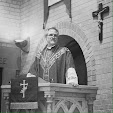
Sunday, May 29, 2011

Sermon: Rogate – 2011

29 May 2011 at Salem Lutheran Church, Gretna, LA

Text: John 16:23-33 (Num 21:4-9, 1 Tim 2:1-6)


In the name of + Jesus. Amen.


Christ is risen! He is risen indeed! Alleluia!

“The hour is coming,” says our Lord, “when I will no longer speak to you in figures of speech, but will tell you plainly about the Father.”

For much of His ministry, our Lord teaches in parables. He uses stories and examples and drops hints. He reveals who He is and what the Kingdom is like in a roundabout way. But now as the time is drawing near for Him to go to Jerusalem, to suffer, die, and be raised from death – He is starting to speak bluntly with the disciples. And He promises them that the time is coming when He will completely drop His guard and fully reveal the Kingdom to them.

Indeed, they will see the full revelation of the Lord’s glory when He dies on the cross. For when the sacrifice is offered and accepted, when “it is finished,” when they see the Lord “crowned as Lord of all” with thorns, with the power of Jesus’ name being hailed by mocking soldiers, and with the wormwood and the gall – there they will see the Lord “speaking plainly” from the cross, taking our punishment so that we might be pardoned, and dying so that we might live.

This revelation is why St. Paul can say that the “Word of the cross is the power of God.” The Word of the cross is the Word of the Law: of confession and repentance. The Word of the cross is the Word of the Gospel: of forgiveness and new life. The Holy Spirit guides us, the Church, sinful and yet beloved of the Father – into “speaking plainly” our confession of sin, of guilt, of unworthiness, and even of our helplessness to help ourselves out of our predicament. There is nothing for us to do other than to “speak plainly” the same confession as the snake-bitten children of Israel: “We have sinned, for we have spoken against the Lord and against you. Pray to the Lord that He take away the serpents from us.”

The serpent has been tormenting us since the Garden of Eden. The Lord permits him to tempt us, but not to separate us from the Christ’s love. The serpents can bite and the serpents can even take our lives – but no serpent can take away our salvation and eternal life. And in fact, Moses was instructed to nullify the power of the serpent by means of a serpent, raised high on a pole, a sign of the love and healing power of God, raised up so as to draw ailing sinners to healing righteousness.

But the serpent’s days are numbered. Indeed, the Seed of the woman was promised to come and crush his head. The serpent continues to tempt us, but the Lord’s love has fallen upon the serpent in the form of the heel of the Son of man. The serpent can torment us and even kill the body with its venom – but no serpent, no malignant being, no manifestation of evil, can destroy body and soul in hell. And in fact, our Lord Jesus Christ was sent to nullify the power of death by means of death, raised high upon a cross, a sign of the love and healing power of God, raised up so as to draw ailing sinners to healing righteousness.

And yet, we still live in a world broken by sin and corrupted by evil. The final encounter between the serpent and the Son is yet to come – even though our Lord has already triumphed over the old evil foe, taking all of us as prisoners of war, as trophies won in battle, spread at His feet, not to be imprisoned as captives, but rather as captives to be liberated.

And in every war there are casualties, there is combat, there is struggle, uncertainty, and there are those who do not come back from the front lines alive. “In the world you will have tribulation” says our Lord to His beloved Church militant. We are at war, dear brothers and sisters, we are in constant battle against the fiery serpent Satan and in mortal combat against the venom of evil that courses our veins, seeking our destruction. We struggle, we fight, we win battles, we lose battles, we grow weary, we take our lumps, we regroup and rejoice to see reinforcements on the horizon, and in the final analysis, we look to the cross, knowing that it is in that battle, won by our Lord, that we too are “more than conquerors through Him who loved us and gave Himself for us.”

To be a follower of Jesus Christ is to be a warrior, to follow Him into battle, not knowing where we will be led other than knowing that we will be led to victory. For He tells us “plainly and not using figurative speech” that we shall “have peace.” For again, dear friends, our Lord speaks plainly to us the comforting revelation in the midst of our warfare that “In the world you will have tribulation. But take heart; I have overcome the world.”

Take heart, dear Christians, take courage, be brave, hang in there, fight the good fight – for the Lord has already won: “I have overcome the world.”

This is how it is that our Lord can exhort and promise us: “Ask, and you will receive, that your joy may be full.”

For the one thing that a warrior values and appreciates more than anything else is peace. He knows the cost of warfare, and he knows the blessings of peace. He knows that peace is not merely the absence of war, but rather the benefit of having conquered the foe. The enemy of the church is the serpent, and the Lord, lifted high on the cross for all mankind to see, has “overcome the world” and its serpentine prince.

As a result of this victory, we can indeed pray as St. Paul urged St. Timothy, “that we may lead a peaceful and quiet life, godly and dignified in every way.” When the war is concluded in victory, it is indeed the peace itself that has been won and secured. Jesus is the almighty Prince of Peace, and He has won eternal and living peace over and against the wretched prince of this temporal and dying world. For our Lord “gave Himself as a ransom for all.”

And the Lord tells us plainly, without figurative language, that He “desires all people to be saved and to come to a knowledge of the truth.” And we look upon this truth, this incarnate truth, this eternal truth, and we live: forever, abundantly, and in peace. Amen.

Christ is risen! He is risen indeed! Alleluia!

In the name of the Father and of the + Son and of the Holy Spirit. Amen.

Friday, May 27, 2011

True Love and Christian Marriage


This news report of a heroic husband in Joplin is a modern-day example of Christian marriage as laid out by St. Paul in Ephesians 5.

Sadly, the part of this passage that implores wives to submit to their husbands is often mocked, omitted from the wedding vows, or even deliberately censored from the reading at the wedding service.  However, what woman would not want her husband to heed the apostle's exhortation for husbands to love their wives and give up everything for them - even to the point of giving his life for his beloved?

The two go hand in hand; a godly wife submits to her husband and a godly husband places his wife's (and family's) well-being before everything else in his life.  When each is so wrapped up in love for the other, the selfishness and self-centeredness that threatens marriage (both in the form of selfish women who want to assume headship of the family and selfish men whose hobbies and toys are more important than serving his family) are overcome by mutual love for one another - as taught to us by O Henry in his 1906 short story The Gift of the Magi.  Indeed, I believe that what is missing in the modern view of marriage is love itself.

And, as St. Paul concludes: godly Christian marriage gives us a picture of our Lord Jesus - who both lays down his very life for His bride, the Church, and who submits selflessly to His Father's will - all out of love.

Let us pray for the victims of the rash of tornadoes and let us be inspired by the heroic deeds of men like Don Lansaw.  And let us reflect on the wisdom of Christian marriage and the timeliness of the Holy Scriptures.

Why we still need seminaries...


If this is a joke, they fooled CNN.

Sunday, May 22, 2011

Sermon: Cantate – 2011

22 May 2011 at Salem Lutheran Church, Gretna, LA

Text: John 16:5-15 (Isa 12:1-6, Jas 1:16-21)

In the name of + Jesus. Amen.


Christ is risen! He is risen indeed! Alleluia!

Our Lord did not return yesterday. Some Christians are today confused. Some will lose their faith. The world mocks. The Church looks foolish. This happens every time one of these predictions fails to materialize, even though our Lord clearly said to us: “But concerning that day or that hour, no one knows, not even the angels in heaven, nor the Son, but only the Father.”

On this day, our Lord Jesus repeats to us: “But now, I am going to Him who sent me, and none of you asks Me, ‘Where are you going?’ But because I have said these things to you, sorrow has filled your heart. Nevertheless, I tell you the truth: it is to your advantage that I go away.”

Our Lord ascended to the Father, and the disciples were sorrowful. They loved their Master, their Savior, their Redeemer. Being separated from Him caused them grief. And yet Jesus tells them it is for their good.

How can the Lord use grief to bring us blessing? How can suffering be beneficial to us? How can a cross be used for good?

How can a cross be used for good? There, dear brothers and sisters is the beating heart of our faith. The Lord indeed uses the cross, the suffering, passion, and death of His innocent Son – He who knew no sin to become sin for us – to turn bad to good, to conquer evil with righteousness, to discipline His children and to make them strong.

The cross is where the Law and the Gospel intersect, where the vertical and the horizontal combine into one, where sin meets atonement, where suffering meets joy, and where death meets life. For the evils of our fallen world are pasted over even as the bloodied body of our Lord covered the cross and absorbed God’s wrath in our place.

And even as the Lord bore a cross for the sake of us poor miserable sinners, the Lord tells us that we too must take up our cross and follow Him who has atoned for us and made us saints by virtue of the cross.

The crosses we bear in this life – sadness, sorrow, disappointment; anger, frustration, physical sickness; temptations, trials, and death itself – only exist because of sin, and yet the Lord turns these crosses into crowns even as He draws life from death and pulls Easter out the stingy and seemingly impenetrable fingers of Good Friday.

“Do not be deceived, my beloved brothers,” says our brother St. James, “Every good gift and every perfect gift is from above, coming down from the Father of lights.” Even our crosses are a gift, an opportunity to overcome sin through Christ’s righteousness, a time to demonstrate mercy instead of vengeance, and even to show love where one is shown hatred.

“Let every person be quick to hear, slow to speak, slow to anger…. Put away all filthiness and rampant wickedness and receive with meekness the implanted word, which is able to save your souls.”

Our crosses give us the opportunity to focus on the Word. Our struggles encourage us to depend on the Lord above. Our sorrows turn us to Him in ways that we don’t when all is well.

And when we are being chastened, we can pray with Isaiah: “I will give thanks to You, O Lord, for though You were angry with me, Your anger turned away, that You might comfort me.”

The Lord Jesus ascended to His Father, but did not leave us as orphans. He sent us “the Helper,” literally, a “comforter” or an “advocate” – one who is fighting for us when we are too weak or overwhelmed to defend ourselves. He is the “Spirit of Truth” who guides us into all truth.

And what’s more, the Lord has promised to remain with us to the end of the age – be it the year 2011 or 20,011. He is with us in His Word, in His Sacraments, in His forgiveness, in those who bring comfort and service to us, in those who speak the Word of God to us, in those who show mercy, in those who teach the Word, in those who support us in good times and bad, and yes, the Lord is even hidden in those crosses sent to us that we cannot figure out.

For just as we are not given to know the day or the hour of the Lord’s return – even as the Word of God tells us not to bother trying to figure it out – so too are our crosses a mystery. We do not know why we must endure them, why they have been sent to us, nor what is the ultimate purpose. In many cases, our crosses seem almost arbitrary and of no purpose at all. But one thing is for sure: crosses and sorrows will come in this fallen world – and we do well to ask the Lord to strengthen our faith for when they do.

In the words of the ancient prayer, may we “bear all crosses, sickness, and trials with patience and trust until You grant us deliverance, peace, and health.” And, dear friends, an even older prayer of the Church comes from one of the last words of the Holy Scriptures: “Come, Lord Jesus.” This is not just a children’s table prayer, it is also the eternal prayer of the Church Militant who bears her cross, who suffers in this world, who struggles against sin, death, and the devil, and indeed who has conquered in Christ, but yet awaits the final coming of the Lord.

Let those who see the Bible as a book of secret clues continue to chase around the trees and miss the forest. Let the world laugh and mock. Let Satan continue to accuse us and abuse us. But come what may, let us remain faithful to the end, with the prayer ever on our lips as we wait expectantly the for Lord’s return: “Come, Lord Jesus.” For “He who testifies to these things says, ‘Surely I am coming soon.” Amen.

Christ is risen! He is risen indeed! Alleluia!


In the name of the Father and of the + Son and of the Holy Spirit. Amen.

Sunday, May 15, 2011

Sermon: Jubilate – 2011

15 May 2011 at Salem Lutheran Church, Gretna, LA

Text: John 16:16-22 (Lam 3:22-33, 1 Pet 2:11-20)

In the name of + Jesus. Amen.


Christ is risen! He is risen indeed! Alleluia!

“Make a joyful shout to God, all the earth! Alleluia. Sing out the honor of His name; make His praise glorious. Alleluia.”

So begins the worship of millions of Christians around the world on this Sunday known as “Jubilate” – which means: “Rejoice.”

And yet, we dwell in a world of suffering, sadness, sickness, uncertainty, depression, disappointment, broken homes, broken lives, broken hopes and dreams, and death itself. It seems as though our rejoicing in this world is temporary and tied to shortly-lived joys: a birthday party, a vacation, a victory for the home team, a new car, a new love in one’s life, a new electronic gadget. But our jubilation over such things often fades away quickly. The new car smell gives way to the stifling air breathed out by the prince of this world. The thrill of something new becomes boredom with just another gadget on the heap. And there is no-one exempt from the ravages of an aging body and of death itself.

And yet, we are invited and even exhorted to “rejoice.” Indeed, the kind of rejoicing called for by the Psalmist has nothing to do with short-lived thrills in this world. We are called upon to make our “joyful shout to God” and to “sing out the honor of His name” and to “make His praise glorious.” We rejoice not in ourselves, but in the One who made us. We rejoice not in what we can do for ourselves, but in the One who has redeemed us. We rejoice not in our own spirit, but in the One who has sanctified us. Our rejoicing even in the midst of trials and tribulations is an act of faith, dear friends. And that kind of rejoicing looks ahead to the great joys to come in eternity, when all of our suffering will be so far in the rearview mirror that it won’t even qualify as a memory. For we know that that day approaches, and that each passing second brings us yet another click nearer to that final, eternal, glory-filled victory won for us by Jesus – in spite of the sins we still cling to that bring us so much heartache.

“A little while, and you will see Me no longer, and again a little while, and you will see Me.” Like the disciples who saw our blessed Lord die, rise, and ascend to the heavens, we too await His return. We too live and struggle and lament and suffer – and yet find our rejoicing in Him and in His promise. We rejoice because we believe, and we believe because He has promised that we shall rejoice.

“Truly, truly I say to you, you will weep and lament, but the world will rejoice. You will be sorrowful, but your sorrow will turn to joy. When a woman is giving birth, she has sorrow because her hour has come, but when she has delivered the baby, she no longer remembers the anguish, for joy that a human being has been born into the world.”

Dear brothers and sisters in Christ, it is only in this promise of our Lord that we can rejoice, that we can have contentment, joy, peace, and happiness. For the world hates us, persecutes us, disbelieves us, tries to tear down the work of the Church in bringing people to Christ – and the world gloats over its illusion of victory. And we are sorrowful upon looking at our wretched state. But when we focus not on ourselves but upon the Word, the promise, the joy of redemption, the liberty of forgiveness, the victory of communion with God and the defeat of sin, death, and Satan – then we can have true, lasting joy down to the marrow of our bones and into the depths of our very souls – a joy that no amount of money or prestige or material possession in this world can rival.

You are baptized. You are forgiven. You are a child of God. You are promised a place of glory in eternity. You have a share in the resurrection glory of our resurrected Lord.

For we have the promise: “The steadfast love of the Lord never ceases; His mercies never come to an end; they are new every morning… therefore I will hope in Him.”

“It is good that one should wait quietly for the salvation of the Lord.”

Meanwhile, while giving the “cheek to the one who strikes,” the follower of our Lord Jesus Christ can look to His Master and Savior, “as sojourners and exiles to abstain from the passions of the flesh,” to hold back the temptation to retaliate in the way of the world, to always maintain our peaceful demeanor for the sake of the Gospel, and to accept that we will be mistreated, “so that when they speak against you as evildoers, they may see your good deeds and glorify God on the day of visitation.”

Dear friends, “the day of visitation” is where we find our glory, our happiness, our hope, and the cause for our rejoicing. For we know that come what may: floods, hurricanes, tornadoes; cancer, heart disease, accidents; family struggles, employment uncertainties, anxieties; temptations, trials, testing; rumors, false accusations, betrayals; pain, aging, and mortality itself – we can still rejoice in our Lord, in His victory, in His redemption of us, in His re-creation of the world, in His Word and promise.

There is no pain, suffering, anxiety, temptation, fear, anger, depression, or agony that we suffer that our crucified Lord did not suffer for us and with us. He is no absentee landlord, but shares our flesh even as he shared in our suffering beyond what any of us could ever know. He knows what we are going through, and He has perfect compassion. And He Himself suffered to bring our suffering to an end.

And even if we are crippled with pain and devastated by the sufferings of life in this fallen world, we yet come to this rail to partake of Him who has promised us: “So also you have sorrow now, but I will see you again, and your hearts will rejoice, and no one will take your joy from you.” No one will take your joy from you.

Therefore, in any stage of life – in plenty or in want, in health or in infirmity, in happiness or in sorrow – we join each other and Christians around the world in every time and place and in every possible circumstance, singing: “Make a joyful shout to God, all the earth! Alleluia. Sing out the honor of His name; make His praise glorious. Alleluia.”

Christ is risen! He is risen indeed! Alleluia!


In the name of the Father and of the + Son and of the Holy Spirit. Amen.

Saturday, May 14, 2011

Gold Standard and Secession in the News

How times have changed! 

Just a couple years ago, any talk of returning the United States to the gold standard was dismissed and even scoffed at as some kind of crackpot tin-foil-hat theory.  However, having seen the results of allowing the Federal Reserve to print money at will and pay the government's bills in increasingly devalued paper - thus stealing from the citizens and putting us at risk of Zimbabwe-style hyperinflation - the idea of restraining the government suddenly sounds good - even among more mainstream economists.

Also, secession was, until recently, a discredited idea as a means to restore home rule and local control to people.  In this case, we're seeing a left-wing secession movement - which flies in the face of the stereotype that secession is some kind of right-wing code word. 

Hopefully, we're seeing an awakening of Americans from the left and the right who understand that liberty and fiscal responsibility are not things that belong to one side or the other, and that neither the left nor the right should place their cherished freedom in the hands of politicians and bureaucrats.  In these terribly divided times, the things that should unite all Americans are the facts that we want to be left alone, we want to raise our families as we see fit, we do not want people sitting in marbled halls hundreds of miles away telling us how to live, taking our hard-earned money from us, and printing money to systematically destroy the value of that which we work so hard to save. 

Smaller and more responsible government is a better way to go.  Staying out of debt and actually encouraging savings and investment instead of mindless borrowing, printing, and consuming is a better way to go.  And it doesn't matter whether one is a left-winger, right-winger, something in between, or neither!

If you want to see the real-world effect of allowing the Federal Reserve to print paper money, click here.

Friday, May 13, 2011

Leo the Apprentice...


... gettin' the job done with Uncle Ron.

Josh: Jesus comes to Hollywood


Hollywood (California, that is, not me) addresses the story of our Lord Jesus Christ - not perfect, mind you, but I think quite well done (even with the attendant postmodernism) in the aptly named episode "Josh" from the 1998 Outer Limits episode.

The above-linked Wikipedia article amazingly makes no mention of Jesus - even though the parallels in the story are (as a friend of mine likes to say) so obvious that even Stevie Wonder could see it.  In fact, without the backdrop of the Gospels, the story makes no sense.  Even the name (Josh) is a clue, as Yeshua (Joshua) is the original Hebrew form of the Greek name Iesous (Jesus).

An Interview with Leo the Hero


Another harrowing exploit of explorer and animal rescuer, Leonidas Beane in his own words in an exclusive Father Hollywood interview on the heels of his expedition to save Vicar.

Salem Parishioner Helping Keep New Orleans Dry


Mrs. Susan Maclay
is the president of the Southeast Louisiana Flood Protection Authority West.

It seems that the Feds are going to open the Morganza Spillway, thus sparing (God willing) New Orleans of the Army Corps' worst-case scenario of New Orleans (and much of Gretna) being under 25 feet of water.

"From lightning and tempest; from all calamity by fire and water; and from everlasting death; Good Lord, deliver us." (The Litany, LSB 288)

Issues, Etc. Interview


I was interviewed by the good folks of the world's greatest Lutheran talk radio program, Issues, Etc. Wednesday afternoon regarding the topic of my May 3 Gottesdienst Chicaco presentation in Brookfield, Illinois (which I have yet to blog about): Are the Lutheran Confessions Prescriptive or Descriptive?

Click here to listen.

Wednesday, May 11, 2011

Sermon: Sts. Cyril and Methodius – 2011

11 May 2011 at Salem Lutheran Church, Gretna, LA

Text: Ps 119:89-105


In the name of + Jesus. Amen.


Christ is risen! He is risen indeed! Alleluia!

Missionary.

The word stirs up romantic notions of far off lands, of adventure, of heroically converting cannibals into Christians and living among exotic plants and animals that one typically only finds in zoos.

Sometimes the mission field is a far away land, but what makes a mission a mission is that one is sent to a place and to a people that are in need of Jesus.

Sts. Cyril and Methodius were two brothers – both priests and preachers, both evangelists and missionaries. In order to preach the Gospel to the Slavic peoples to whom they were sent, they had to invent a new alphabet.

The Slavs were in need of an alphabet, but what they really needed was Jesus. The system of writing simply facilitated communication. What the Slavs of Eastern Europe really needed to have communicated to them was Jesus.

For Jesus is the Lamb of God that takes away the sin of the world, the whole world, even the world of the non-Roman peoples of Eastern Europe – often considered Barbarians by those who had already been enlightened by the Gospel. For “Your word is a lamp to my feet and a light to my path.”

The Lord called these two faithful brothers, men of skill and talent, men under holy orders, men with a zeal to preach the Gospel of our Lord and of His cross to peoples still stuck in the darkness of Paganism and superstition. Cyril and Methodius invented the alphabet used to this very day by our Russian brothers and sisters in Christ in their continued use of the Holy Scriptures of the Word of God and the Holy Liturgy of the Church of God.

“How sweet are your words to my taste, sweeter than honey to my mouth! Through your precepts I get understanding; therefore I hate every false way.”

And not even the brutality and totalitarianism of Communism could turn those ancient letters completely away from Christ and the Gospel. For today, Christians again confess the truth of God’s Word using the Cyrillic alphabet invented in the ninth century by these brothers to each other and fathers to the Slavic Christians.

“Oh how I love your law! It is my meditation all the day. Your commandment makes me wiser than my enemies, for it is ever with me.”

Dear friends, you may never be called upon to invent an alphabet. You may never receive holy orders to serve in the ministry and preach the Gospel. You may never be called upon to leave your home to proclaim Christ to people of another language and climate. But you are missionaries of a sort.

For a missionary is one who goes out. And every Christian exits the sacred portals of the Church and goes out into the fallen world – bearing Christ in His baptized body, in his catechized mind, in his very soul imbued with the true body and blood of Jesus, given to strengthen us for those times when we must give a witness to the hope that is within us.

Not every Christian is called to preach, but all are called to confess. Not every Christian is called to teach, but all are called to believe. Not every Christian is called to proclaim Christ in a foreign land, but all are called to be Christs to one’s neighbor – whether that neighbor lives in Marrero or Moscow, Lafitte or Liberia.

“Forever, O LORD, Your Word is firmly fixed in the heavens. Your faithfulness endures to all generations; You have established the earth, and it stands fast.”

Missionary.

The word is not so much about where one is sent, but what one is sent with. And whether we are preachers or hearers of the Word, we are all called upon to be confessors and doers of the Word. We Christians have been sent into the world, to bear Christ with us according to our individual callings and to bring the love of God to our neighbors by loving our neighbors as ourselves.

For people around the globe still need Jesus. They still crave the forgiveness of sins and the glorious proclamation of the truth that God has been reconciled to us by Christ’s ministry of the cross, and we have been given this ministry of reconciliation even as ministers of Word and Sacrament, like the sainted Cyril and Methodius, have been sent with a mission to “make disciples of all nations.”

Dear brothers and sisters in Christ, that missionary work continues! It began with the apostles and with Sts. Stephen and Paul. It continued with St. Gregory the Great, with Sts. Cyril and Methodius, and with St. Boniface whose missionary preaching brought Christ to the German people, the ancestors of the Lutheran reformation itself.

And it continues with us, with every prayer for our brethren around the world, with every hymnal donated to Africa and every dollar given to Siberia. It continues with every child taught the catechism and every cup of cool water given to one of the least of the Lord’s brethren in need of a drink. It continues with baptism and forgiveness, with the Holy Eucharist and with preaching, with Bibles translated and the Scriptures read and taken to heart. And it begins in our own homes, dear friends.

Missionary.

The greatest missionaries of all are godly parents who read the Bible to their children, bring them to the services of the Lord’s House, carry them to the life-giving waters of baptism, who pray at home, forgive at home, sing at home, and constantly invoke the sacred name of Jesus at home. We continue to teach the children for the same reason and with the same zeal as Sts. Cyril and Methodius bringing Christ to the Slavs – because they need Jesus!

And we join anew with the Psalmist: “If Your law had not been my delight, I would have perished in my affliction. I will never forget Your precepts, for by them You have given me life. I am Yours; save me, for I have sought Your precepts.”

Thanks be to God for Sts. Cyril and Methodius and all missionaries who bring Christ to the world, now and until the Lord returns! Amen.

Christ is risen! He is risen indeed! Alleluia!


In the name of the Father and of the + Son and of the Holy Spirit. Amen.

Sunday, May 08, 2011

Happy Mother's Day!

Sermon: Misericordias Domini– 2011

8 May 2011 at Salem Lutheran Church, Gretna, LA

Text: John 10:11-16 (Ez 34:11-16, 1 Pet 2:21-25)


In the name of + Jesus. Amen.


Christ is risen! He is risen indeed! Alleluia!

One might be tempted to think of a shepherd as a less-than-manly occupation. Taking care of fluffy animals, giving them each a name, and feeding and watering them just doesn’t sound like something a boy would daydream about becoming when he grows up.

And most of the time, being a shepherd is tedious, spending countless hours walking around with bleating sheep under the stars, often in dull isolation. It isn’t exactly the kind of thing that young people aspire to, not the kind of work that would inspire action figures.

But then there are those times when the shepherd must be a soldier, a warrior, a protector. There are indeed those times when the sheep are under attack by predators who not only consider the sheep to be dinner, but who have no qualms about killing the shepherd as well. In such times, the shepherd is a fighter. And a good shepherd will not run from danger. A good shepherd will stay and fight. A good shepherd will turn and face the foe. A good shepherd will battle the enemy of the sheep to the very death if necessary.

By contrast, a hired hand is only there to get a paycheck. A hired hand, when confronted by a ravening wolf will say: “This is above my pay grade,” and he will flee. And woe to the flock of sheep who are under the leadership of such a phony and shallow shepherd.

Sheep need a shepherd because of their tendency to wander, to stray, to get themselves into trouble by losing their way from the safety of the flock. And when the sheep are thus scattered, they are as good as dead.

That is, unless their shepherd will “seek out” his sheep that have been scattered, and “rescue them from all the places where they have been scattered.”

Such a shepherd is no ordinary keeper of flocks, but is a heroic mighty-man, a warrior who defends the lives of the weak not merely for pay, but because of the principle that defending the weak is the right thing to do, according to his calling and according to the will of God.

Jesus is our Good Shepherd, dear friends, Jesus is the Good Shepherd!

The prophet spoke the Word of God: “Behold I, I myself will search for My sheep and I will seek them out.” Our Lord Jesus, the Word made flesh, fulfilled this Word when He Himself proclaimed this Word of truth: “I am the good shepherd. I know My own and My own know Me, just as the Father knows Me and I know the Father; and I lay down My life for the sheep.”

And while much of the artwork that depicts our Lord Jesus focuses on His gentleness and tenderness – often showing Him sweetly tending to little lambs or young children – there is an aspect of the Good Shepherd that is anything but meek and mild. For as a shepherd carries a crook to deliver blows against the enemy, our Lord Jesus Christ wields His Holy Word, His passion and death, and His bloody cross itself to crush the head of the vile predator Satan who seeks to devour the sheep – especially the weak and the wandering, the ailing and the lonely.

Our Good Shepherd is not afraid to get dirty and bloody, to jump into the fray and interpose Himself between the devil and us, His sheep, His people, His beloved whom He has come to save.

Unlike a hired hand who is only in it for money, our Lord Jesus Himself spends all that He has – His very lifeblood – to protect, defend, and redeem us from sin, death, our flesh, the devil, and from hell itself. For like a soldier falling on a grenade to save his comrades, our Lord Jesus heroically withstands and absorbs the excruciating pain and suffering that we deserve by our willful wandering from the path of righteousness, suffering and dying heroically to save us from the wrath that we deserve.

And instead of being decorated for His militant heroism with a Purple Heart, His own heart was pierced by a Roman soldier’s sword, issuing forth the water that reminds us of baptism and the blood that reminds us of the Eucharist.

For our Good Shepherd isn’t just a smiling face in a fictional painting. No indeed! Our Good Shepherd is a mighty-man, a warrior who defends the lives of the weak. He is the God Man. Our Good Shepherd saved us at the cross and continues to come to us as our Savior in His Holy Supper, in His Word, in the forgiveness of sins, and in the proclamation of the Good News of the Good Shepherd’s Good Friday triumph. “He Himself bore our sins in His body on the tree, that we might die to sin and live to righteousness,” says St. Peter, to whom the Lord commanded “Feed my sheep.”

Dear friends, let us never forget that we are sheep. We wander carelessly and recklessly when we sin, and we do so repeatedly and without excuse. We deserve to be eaten by the wolf. And yet we wandering sheep have a Good Shepherd, the one who “lays down His life for His sheep.”

Indeed, our Lord is the pinnacle of manhood, the mightiest of all men who is also God in the flesh. He is the Good Shepherd who does not flee, but who turns to face the evil one, conquers Him, and rescues us.

Let us ponder anew the reality that “He Himself bore our sins in His body on the tree that we might die to sin and live to righteousness. By His wounds you have been healed. For you were straying like sheep, but have now returned to the Shepherd and Overseer of your souls.” Amen.

Christ is risen! He is risen indeed! Alleluia!


In the name of the Father and of the + Son and of the Holy Spirit. Amen.

Sunday, May 01, 2011

Sermon: Quasimodo Geniti – 2011

1 May 2011 at Salem Lutheran Church, Gretna, LA

Text: John 20:19-31

In the name of + Jesus. Amen.


Christ is risen! He is risen indeed! Alleluia!

Often our first reaction to something shocking, something out of the ordinary, something life-changing – is denial. “This can’t be happening!” we may even say out loud as our brains scramble to process something that makes no sense. In fact, when a person is told that he is dying, this is such a common first reaction that it is considered the normal course of beginning to come to grips with the reality that we are passing from life to death.

And yet, here we see this same denial, the “This can’t be happening!” reaction by St. Thomas as he comes to grips with the reality that the Lord has passed from death to life. For Thomas was told something shocking, something out of the ordinary, something life-changing: Jesus had not only come back to life, but had appeared to the disciples – and did so at a time when Thomas was absent.

The resurrection of the dead is so far beyond our comprehension, our reason, our normal life experience, that we should not be so hard on Doubting Thomas for his initial refusal to believe the word of his fellow apostles. Perhaps he may have thought that they were playing a cruel joke on him. People do such things. Or maybe he believed that they saw someone who looked like Jesus, and in their grief, were so eager to believe He was alive, that their imaginations concocted the story. People make such claims all the time.

St. Thomas was clearly devastated by the death of His Teacher, His Lord, His Master, His God – and you can hear the pain between the lines of his great “unless” statement: “Unless I see in His hands the mark of the nails, and place my finger into the mark of the nails, and place my hand into His side, I will never believe.”

What greater expression of the sinful, stubborn, faith-defying fallen flesh than the statement: “I will never believe”? But thanks be to God that the Lord Jesus comes to take away Thomas’s doubts, to restore his faith, and to bless him with not only a blessing of peace, but also a Word of life that overcomes not only doubt, but death itself. Jesus has come to take away Thomas’s sins!

“My Lord and My God!” Thomas exclaimed when confronted with the mind-boggling reality that Jesus Christ had risen from the dead!

Jesus had mercy on Thomas. He did not condemn His weak faith, but commended him to His Father as a forgiven and redeemed sinner. Our Lord did not scold him for his stubbornness, but softened his heart by presenting Himself to Thomas in His flesh and blood, in a way that Thomas could perceive bodily, even in Thomas’s own sinful flesh.

For our Lord appeared “eight days later,” also on another Sunday, the second Sunday of that first Easter season, and “although the doors were locked,” our Lord appeared. For no bolted human portal can keep our Lord out: not the sealed entrance of His tomb, and certainly not the closed gate of the hardness of St. Thomas’s grieving heart. For Jesus burst forth from the grave, even as He appears gloriously among His disciples.

Our Lord invites Thomas to come, to see, to touch. He urges Thomas to receive the Lord’s blessing of “peace” – peace between God and man, peace between men of a fallen world, a peace secured by the defeat of Satan. The Lord bids St. Thomas to step forward and examine the evidence. “Put your finger here,” He beckons, “and see My hands; and put out your hand, and place it in My side. Do not disbelieve, but believe.”

“Believe” dear friends. “Believe!” That is the message of Easter, the Good News of the resurrection, the life-changing reality that death has been overcome by life, that sin has been vanquished by righteousness, that the darkness has been banished by the Light of the World. It is the Word of the cross and the Good News of the sepulcher.

“My Lord and My God!” we confess today with St. Thomas. For we not only know that there is an empty tomb in Jerusalem that stands as a witness of the resurrection, and we not only know the irrefutable evidence of so many witnesses of Jesus’s resurrection – even the testimony of hostile witnesses of that time and place who were at a loss to explain it – we also confess with St. Thomas that this risen Man is the risen God. With St. Thomas, we believe, we worship, and we confess.

Some disbelieve. Some claim that St. Thomas was merely using the Lord’s name in vain, just blurting out the divine name to no-one in particular, that he was not confessing Jesus as God. Some claim that the account of our Lord’s appearance that Second Sunday of Easter was just a mythical story to make us feel good about ourselves. Some even go so far as to claim that Jesus never lived. Our Lord bids us to examine the evidence. Look at the historical testimony. Read the accounts of that time and place. Pore over the Scriptures. Consider the words of the friends and foes of Christianity alike! Those who do so honestly will indeed come to the same conclusion as some of the greatest minds in history: Jesus truly rose from the dead. This is an irrefutable fact of history. And this undeniable fact is something shocking and something out of the ordinary.

But what’s more, dear brothers and sisters of our risen Lord, this miracle was done not only to get our attention, but to secure our salvation. It is something life-changing as well. For Jesus not only conquers death and claims victory for Himself over the devil, but He also shares that victory with us, presenting the marks upon His hands, feet, and side before the Father, interceding for us as the one all-availing sacrifice for our salvation.

And Jesus speaks of us, and to us, when He breathes out this benediction upon His beloved disciples: “Blessed are those who have not seen and yet have believed.”

The Lord does not appear to us and invite us to place our fingers in His wounded hands and side as He did with St. Thomas. But He has left the empty tomb, He has risen to the Father, and He continues to come to us in His chosen means: being present for us as His Word: His mighty and merciful Gospel is preached around the world, and in His sacrament of the altar, in which we experience the flesh and blood of our Lord just as surely as St. Thomas did on that first Second Sunday of Easter.

And though we are tempted to ponder this reality and protest: “This can’t be happening!”, we hear the Lord’s proclaimed Word of invitation: “Do not disbelieve, but believe,” and we receive this faith as a free and full gift, offered up by Him who was offered up for us.

We confess with believing joy the little creed: “My Lord and My God!” and our risen Savior blesses us, His joyful believers with the great benediction: “Peace be with you,” promising that we “may have life in His name.” Amen.


Christ is risen! He is risen indeed! Alleluia!


In the name of the Father and of the + Son and of the Holy Spirit. Amen.

Sunday, April 24, 2011

Sermon: Easter – 2011


23 April 2011 at Salem Lutheran Church, Gretna, LA

Text: Mark 16:1-8 (Job 19:23-27, 1 Cor 15:51-57)

In the name of + Jesus. Amen.


Christ is risen! He is risen indeed! Alleluia!

“Death is swallowed up in victory. O death, where is your victory? O death, where is your sting?”

The reason St. Paul can taunt death with these words is because of our Lord’s victory over death and the grave on that Easter morning that Christians around the world remember joyfully on this great and glorious day. But make no mistake – the Lord was the victor on Good Friday, at the cross. For in dying, He defeated death and outwitted the craftiest of all God’s creatures – the devil. This was clear from His victory cry from the cross just before He surrendered His Spirit: “It is finished!” This is a curious thing for a man dying by execution for a supposed crime to say: a military term for “Mission accomplished!” Even though the world saw the image of a humiliated man being conquered by death, what really happened is that the exalted God defeated the death intended for us men by dying Himself as a Man. Even the centurion at the foot of the cross recognized the Lord’s victory when he realized that what Jesus accomplished was in fact a classic ambush.

Jesus defeated both sin and the death at the cross. For “behold, the curtain of the temple was torn in two, from top to bottom. And the earth shook, and the rocks were split. The tombs also were opened. And many bodies of the saints who had fallen asleep were raised, and coming out of the tombs after his resurrection they went into the holy city and appeared to many.”

In response to these clear signs of divine intervention, the centurion, himself a military officer, declared: “Truly this was the Son of God.”

Death itself was to be routed. The “saints who had fallen asleep” walking around Jerusalem were the preview of the resurrection to come. But the real declaration of victory came in Jesus’ own rising from the dead. For in His Easter resurrection, our Lord swept away the final enemy of mankind, one that seemed so immune from defeat.

Death is our common ancient and most cruel enemy. It nips at our heels our whole lives long. It eventually catches up with everyone, people of every tribe and tongue, rich and poor, believers and unbelievers alike. Death is the wages of sin, and indeed, “the sting of death is sin.” Dear friends, one way or another, our lives will end in this world. It is very likely that a preacher somewhere in this fallen world and at some point in time will recite this very passage of Scripture as your body lies in a casket: “O death, where is your victory? O death, where is your sting?”

And the reason Christian preachers of the Word and Christian hearers of the Word can join St. Paul in his taunt of death – even at the sad time of a funeral – is the same reason St. Paul invites us to offer thanks to God: “who gives us the victory through our Lord Jesus Christ.”

Victory!

This is what the centurion recognized when he confessed the Crucified One to be the Son of God. This is what St. Paul reveals to us, that which was revealed to him. For it is indeed a mystery: “We shall not all sleep, but we shall all be changed.” For “the dead will be raised imperishable, and we shall be changed.” And it is “when the perishable puts on the imperishable, and the mortal puts on immortality, then shall come to pass the saying that is written: ‘Death is swallowed up in victory.”

Victory!

Dear friends, Easter is about victory: our Risen Lord’s triumph over sin, death and the devil, His victory over the grave and guilt, His conquest over everything that impedes full communion between sinful men and the righteous God. Jesus has defeated them all, and moreover, He hands this victory over to us as a free gift, giving us a full share in His victory through being baptized into His death and resurrection, being given the gift of faith that can look death in its cold and cruel eyes and reply with a taunt: “Where is your victory?”

In the resurrection of Jesus, the words of Job came to pass. Job: the man who suffered the most horrible things a person can experience in this life, all the while clinging, even if barely, against all hope and against all odds, to the promise that he has engraved forever in the inscribed and inspired Word of God: “I know that my Redeemer lives…. And after my skin has been thus destroyed, yet in my flesh I shall see God.”

The cross is a victory for life over death, and it is also a victory for faith over unbelief. Job held on to the promise for dear life, and without seeing evidence for it, was able to confess and write the words: “I know….”

And we know as well, dear friends, because the tomb is empty! The Marys found the stone rolled away! The angels announced it! Jesus appeared to hundreds of people! The Church has borne witness and confessed this reality for two millennia! And we continue to sing with Job – whose faith was vindicated, whose life was restored, whose sins were forgiven, and who will indeed join us at our own resurrection: “I know that my Redeemer lives.”

And like the Marys, the Church continues to bear witness, to tell the truth, often with trembling, always with astonishment, at times even while afraid: the truth, the life-changing truth, the history-altering-truth, the death-defying truth, that Jesus has died for us sinners to give us His righteousness, and He has risen from the dead to give us life. His victory is our victory. And we join ourselves to Him, proclaiming His death in a holy communion with Him in His body and blood, until He comes, saying, singing, confessing, and proclaiming: “Death is swallowed up in victory. O death, where is your victory? O death, where is your sting?”

Christ is risen! He is risen indeed! Alleluia!


In the name of the Father and of the + Son and of the Holy Spirit. Amen.

Friday, April 22, 2011

Sermon: Good Friday – 2011


22 April 2011 at Salem Lutheran Church, Gretna, LA

Text: John 18:1 – 19:42 (Isa 52:13-53:12, 2 Cor 5:14-21)


In the name of + Jesus. Amen.

“The old has passed away; behold, the new has come.”

There are great milestones in history that mark a passing away of an old order and the entrance of a new order. Sometimes, the living witnesses to these milestones realize the significance of what their eyes behold, and other times, it falls to people in the future to see the change.

In world history, there were many examples of such irrevocable changes in history, things that happen that simply make going back impossible, such as when Caesar crossed the Rubicon, when Charlemagne was crowned emperor, when Martin Luther nailed the 95 theses to the church door, when the Berlin Wall was torn down, or when planes flew into the World Trade Center.

Once these historic events happened, there was no return to the former order of things.

And as significant as all of these events are, none of them is as history-changing as two closely related events having to do with wood: one at the beginning of creation, and one involving the restoration of creation. For in the beginning, the Lord created a perfect habitat for humanity and placed the first perfect man and the first perfect woman in a perfect garden. They were given a perfect existence without sin or death. They were even granted the privilege to stand face to face with God, and were surrounded with trees heavy-laden with edible fruits, the sweet taste of which our fallen senses cannot even begin to imagine. But our once-perfect ancestors chose to eat from a tree that was off-limits. That fateful decision changed the world forever. There was no going back to the garden.

We have struggled with sin and death and the devil ever since. The trees that sustained us gave way to weeds that strangle out our food and create hard labor for us. Thorns injure us. We suffer and we die. There is no going back to the garden. Sadly, “The old has passed away, behold the new has come.” And in this present world order, “new” does not mean “improved,” but rather corrupted and fallen.

But, dear brothers and sisters in Christ, the “love of Christ controls us.” God, in His infinite love and mercy, does not leave us stranded from the garden forever. There is a hopeful coming of the “new” and a joyful passing away of the “old.”

In another universe-altering event, God took the form of a man, Jesus of Nazareth. The baby Jesus was laid in a manger of wood, constructed out of a fallen and dead tree from the fallen and dead world by a fallen and dead man.

But this perfect Man grew in stature and revealed Himself to be God – but what’s more, He revealed Himself to be our Savior. And His destiny was to mark a milestone in the history of creation that dwarfs everything that has come before: including the fall in the garden.

Our agony in the Garden of Eden gave way to His agony in the Garden of Gethsemane. He took on our sin and death, He surrendered His privilege to stand before God (crying out in the words of the Psalm, “My God, My God, why have you forsaken Me?). And He submitted Himself, heavy laden to the fruits of His passion, and was nailed to the cross, constructed out of a fallen and dead tree from the fallen and dead world by a fallen and dead man. He was given sour wine to drink, the decaying fruit from a corrupted earth. “Stricken, smitten, and afflicted, see Him dying on the tree!” And bringing the old order forever to a close, He proclaimed: “It is finished.” And “He bowed His head and gave up His Spirit.”

Our blessed Lord struggled with sin and death and the devil because of our sins, and He, the sinless One, was victorious for us. The tree upon which He was crucified became for us a Tree of Life. Thorns injured Him on our account, but He overcame them in our place. He was to suffer and to die to take away our suffering and give us life. There is no going back to the garden of sin and death. Indeed, this is a Good Friday in which “The old has passed away, behold the new has come.” By virtue of the cross, “new” means immortal and incorruptible. For He was not to remain in the garden tomb, dear friends, but following His Sabbath rest, He has given the universe a new and equally wondrous milestone – one in which death is replaced by life, grief with hope, mourning with rejoicing, and alienation with “the ministry of reconciliation.”


“For the love of Christ controls us, because we have concluded this: that one has died for all, therefore all have died; and He died for all, that those who live might no longer live for themselves but for Him who for their sake died and was raised.”

There is no turning back, dear friends. By means of the cross of dead wood descended from the fallen trees of the corrupted old garden, our Lord is creating for us a new garden, freed from sin, death, and the devil, teeming instead with forgiveness, life, and salvation. Our Lord’s cross of death is our Tree of Life, bearing perfect fruits for all eternity.

“The old has passed away; behold, the new has come.” Amen.

In the name of the Father and of the + Son and of the Holy Spirit. Amen.

Thursday, April 21, 2011

Sermon: Maundy Thursday – 2011

21 April 2011 at Salem Lutheran Church, Gretna, LA

Text: John 13:1-15, 34-35


In the name of + Jesus. Amen.

“A new commandment I give to you, that you love one another: just as I have loved you.”

Our Lord has given us a new commandment, a new mandate – which is why this day is known as Maundy Thursday. Love is mandatory. It isn’t an option. It isn’t an add-on. It isn’t a warm fuzzy feeling. It isn’t only for our family, friends, and those who love us. We are to love our enemies, love our neighbors as ourselves, and love God with all our heart, soul, strength, and mind. We are to love to the point of laying down our lives. We are to love as Jesus loved, taking on the role of a lowly foot-washing slave.

In our sinful nature, we don’t even know what love is. We throw the term around in vain. We love TV shows, we love the local team, we love ice cream. We sometimes substitute “lust” for love and confuse hormones, impulses, and temptations for this new commandment of Jesus.

And so, our Lord and Savior also acts as our teacher. We need to be taught not only how to love, but what love is itself: “Jesus, knowing that the Father had given all things into His hands, and that He was going back to God, rose from supper. He laid aside His outer garments, and taking a towel, tied it to His waist. Then He poured water into a basin and began to wash the disciples’ feet.”

There is love, dear friends. God Himself, the Creator, the King of the universe, having taken the form of a man, acting as a lowly slave, sloshing the filth off of the feet of the men who will be abandoning Him to His cross in just a few hours. There is Love. And He says: “I have given you an example, that you should do just as I have done to you.”

Love is a giving of the self, an emptying of the self, a sacrifice of the self – all for the sake of the beloved. And it is done without thought of reward. There is Love.

Our Lord did some other extraordinary things on the night in which He taught us what love means. He took bread. He gave thanks. He said: “This is My body, given for you.” He took a cup after supper. He said: “This cup is the new testament in My blood.” He said this was for the forgiveness of sins. He said: “This do in remembrance of Me.” He gave His body and blood to His beloved, and to all of us. He also allowed Himself to be betrayed, arrested, accused, tortured, condemned, and crucified.

There is Love.

And as the Good Teacher, He teaches not merely with words but with deeds. For His Word is God’s Word, and God’s Word has the power to create reality. When our Lord says: “This is My body… This is My blood… for the forgiveness of sins… This do…”, He makes that miracle happen.

For, dear friends, it was on Maundy Thursday that the Lord gave us His Holy Supper, the Sacrament of the Altar. It is a sacrament because it is a mystery. It is given at the altar because our Lord’s flesh and blood is the one all availing sacrifice for the sins of the world, offered as a pure oblation to the Father out of love for both us and the Father. Our Lord’s death on the cross is a sin offering, and what’s more, it is a love offering. For no man has greater love than this, that He would lay down His life for His friends. And our Lord even offers Himself to His enemies, His betrayer, His denier, His cowardly disciples, His attackers, His executioners, and His countrymen who acted as the lynch mob. In fact, our Lord is the Lamb of God that takest away the sin of the world.

There is love.

That kind of love is indeed a mystery, a sacrament. No-one can explain it, make it make sense, or appeal to reason for an explanation. No-one can rationalize love or put it in intellectual terms. Our Lord’s sacrifice on the cross was indeed irrational and unexplainable – even as it is the greatest act of love in the history of the universe.

Dear brothers and sisters, love is not something we can choose to do or choose not to do. It is indeed a mandate. It is why we have been created. And we lost the very presence of God that empowered us to love when we chose the love of the lie over the love of our Creator back in the Garden of Eden. That Garden brought us death and alienation from God. But in another Garden, on the night in which He was betrayed, our Lord prepared to receive our death and our alienation from God. Our Lord loves us enough to take the blows we have earned, to absorb them in our place, to suffer in our place, to die in our place.

There is love.

Dear friends, our Lord commands us to do something we cannot do in our sinful state. But He gives us forgiveness, an example to follow, a second chance. He gives us life and salvation and hope. He gives us the bread of His body and the wine of His blood, miraculously present in the mystery of love known as Holy Communion. He washes us body and soul with baptismal water, taking the humble estate of a servant.

Our Lord does not just give us the mandate. Indeed, He only asks of us what He has given us first: love. There is love: on His cross, upon His altar, at His font, in His Word, implanted in His people: “just as I have loved you.” There is love. Amen.

In the name of the Father and of the + Son and of the Holy Spirit. Amen.

Monday, April 18, 2011

Atlas Shrugged

There is a new movie out: Atlas Shrugged

I have not seen the movie.  I have read the book.

The author of the book, Ayn Rand, was a refugee from Communism.  Seeing first hand as a child the destruction of freedom through government collectivism and coercion during the Russian revolution, she became an advocate of human liberty.  She found Communism to violate the rules of logic.  She delved into a philosophy of objective reality - which she called simply "Objectivism" - which stood out like a sore thumb in the 20th century world of Subjectivism.  As a novelist, essayist, and philosopher, she opposed Big Government at every turn in her adopted country, the United States.


Ayn Rand was a complicated, if not convoluted, figure, whose legacy is even more complex.  In her lifetime, she was a rather unlikeable tyrannical grumpy self-centered and morally-challenged Atheist who is today often quoted by tea-partying Fundamentalist Christian political activists.  She heroically opposed Communism, but also berated any act of love to another person as morally evil.  One of her close disciples was Alan Greenspan, who though at one time was a champion of the Randian notion of a hands-off government (which included a separation of currency and state through the gold standard) was to become the chairman of the Federal Reserve - the very institution devoted to the destruction of hard currency and the very motor behind Big Government itself.  The Fed is the American version of central economic planning and the state control of capital.  The continued legacy of Ayn Rand is filled with such ironies.

Karen De Coster has a balanced and nuanced consideration of Ayn Rand and her lasting legacy here.


Here is an Issues, Etc. podcast about Ayn Rand and Atlas Shrugged, an interview with Dr. Clay Jones of Biola University.  I think Dr. Jones does a very good job of showing the good, the bad, and ugly - and even more ugly (the latter "ugly" I disagree with him) - about Ayn Rand and her philosophy (of which the novel Atlas Shrugged is a manifesto).  I do take exception with a couple of his statements, however, first his assertion that U.S. senator Dr. Rand Paul (the son of U.S. representative Dr. Ron Paul) was named after Ayn Rand.  This is not true.  He also criticizes Alan Greenspan for not proposing enough regulation.  I think that is a fantasy.  Alan Greenspan held the levers of Big Government in ways utterly contrary to the principles of small government and sound money.

One excellent point that Jones makes - which is another Randian irony - is the fact that one of the reasons Communism fell is that it did not consider original sin.  Like most Utopian schemes, it falls flat because it is based on a flawed view of humanity.  Communism fails (as Rand points out) because it does not account for human selfishness.  The great irony is that Rand also denied original sin - thus sowing the seeds of her own Utopia's demise.


In spite of all of this, I think the book is a good read.  It is tedious, plodding in plot, and often plastic in its characters.  The dialogue is wooden and at times reads like a philosophy tome.  But the premise is brilliant, and the overall story is clever.  Besdies, it's an important work for many reasons.  It will make you think about the role of government intervention in the free economy, innovation, capitalism and capital, labor and markets, and what the limits of freedom are.  It is a thought-provoking work that has - for good and bad - made a huge impact on our modern life and political discourse in the western world.

I'll probably check out the film when it gets to Netflix. 

Sunday, April 17, 2011

Sermon: Palmarum – 2011

17 April 2011 at Salem Lutheran Church, Gretna, LA

Text: Matt 21:1-11, Matt 27:11-54


In the name of + Jesus. Amen.

“Hosanna to the Son of David! Blessed is He who comes in the name of the Lord! Hosanna in the highest!” Amen.

As our Lord “drew near to Jerusalem,” He was given a welcome fit for a king. In fact, He was received and acclaimed as a king. He did not walk through the city gate, but was “mounted on a donkey,” a beast of burden. And though such a mount was humble, it reflected the same ride into David’s Royal City by David’s son (and our Lord’s ancestor) Solomon when he was also received as a king.

The crowds cheered. They waved branches from the trees and spread them on the road. “Hosanna! Blessed is He!” they cry out with excitement. They know the kingdom is indeed at hand, and that their King has drawn near in fulfillment of the prophets.

And watching this scene unfold, the people begin to write the rest of the story in their minds. Even the disciples think they know what is to come – even arguing among themselves who will sit at the King’s right and the King’s left. As with any transfer of power, there is a gathering of the ambitious, of flatterers, of hangers-on, and of those seeking to ride behind the king in majesty.

But the story was to take a shocking and unpredictable turn.

For our Lord’s triumphal entry into Jerusalem on Sunday was to yield to His shameful expulsion on Friday. His Sunday parade was to become His Friday passion. The acclamations of “Hosanna!” on the first day of the week were to give way to cries of “Crucify!” as the sixth day waned into the Sabbath.

For the kingdom was not what the people wanted, and nor was the King. Instead of a mighty mover of men, they saw a submissive Savior of sinners. Instead of driving out the Romans, the people of Judea heard Jesus preach about a kingdom not of this world. Instead of a commander of an army of vengeance armed with firepower, they saw a Rabbi teaching a fickle assembly of disciples bearing only the Word of God.

And just as now, when what you have received is not what you wanted, you return the merchandise for a refund. “Give us Barabbas!” they demand. “Crucify Jesus!” instead is their desire.

And so the Lord’s departure from Jerusalem did not have the air of a triumph. He was given a send-off fit for a criminal. In fact, He was mocked and accused of being a false king. He did not ride out of the city gate as a hero, but was himself forced to bear the beam of his own cross in the manner of a beast of burden, pushed, shoved, whipped, and made sport of. Nothing of the Kingdom of David and Solomon was to be seen on this procession save the scarlet robe, the crown of thorns, and the mockery of a scepter-like reed with which He was beaten by soldiers who bent the knee in order to humiliate him who “humbled Himself by becoming obedient to the point of death, even death on a cross.”

The crowds jeered. They waved their fists and spat at Him along the road. “Save yourself!” they were to shout at Him at the Place of the Skull. “Let Him come down now from the cross, and we will believe in Him!” they mock and cry out with excitement. They know not what they do, and they mistakenly believe that He whom the prophets foretold is now calling for help to one of the prophets.

Gone are the ambitious, the flatterers, the hangers on. There is no-one left to cheer. No-one waving palms. Of His followers, only His mother and the disciple whom He loved are there to Him in His agony. They remain to watch the man declared by the acolyte of Caesar to be the “King of the Jews” take His humble throne. For this King’s ride is one of lowly pomp, as He rides on to die.

Even the singing of the children has been silenced for the time being, as the enemies of Jesus sought. The Pharisees and the Sadducees, the Sanhedrin and the Romans all gather like vultures waiting for this King to close His eyes in defeat. As they gloat, He suffers. As they shout and celebrate the seeming victory over their enemy, He struggles to breathe. As they drink merrily and carry on, He thirsts while His bones pop out of joint. And hearing Him sigh heavenward, “My God, My God, why have You forsaken Me?” before yielding up His spirit, the enemies of the kingdom of God believe that it is back to business as usual: might makes right, money and power defeat goodness and mercy, Satan is the ruler of this world and the king of this fallen creation.

After a frightening three years for those in power, it seems like everything is back to normal. The Sanhedrin is back in charge over the “little people.” The High Priest can once again carry on like a demi-god. Herod has no more rival claims to His puppet-throne. The Pharisees can go back to lording over the tax collectors and other sinners. The Sadducees can continue in their oh-so-sophisticated disbelief. The Romans can go on with their rapacious and murderous empire-building. Satan can get on with his business of driving men to despair and destroying God’s good creation.

Or so it seemed. But again, the story was to take a shocking and unpredictable turn.

For when our Lord, the Son of God died, the sacrifice was offered and accepted by the Father. When the Lord yielded up His spirit, the Spirit was unleashed upon the forces of evil. In seeming defeat, the cross’s hatred was conquered by Jesus in the true victory of divine love. The Victim was in fact, the Victor. The devil had been swindled. Four millennia of enmity between God and man had suddenly been reconciled on the cross. The blood of the Passover Lamb was spilled upon the doorpost of the entire world.

“And behold, the curtain of the temple was torn in two…. The earth shook…. The tombs were also opened. And many bodies of the saints who had fallen asleep were raised.”

And when these children of the grave made their entrance into the holy city, they caused many to sing “Hosanna!” anew to the King who rules a kingdom in which the dead are raised, sinners are forgiven, and the powerful and mighty are toppled. And the Church has repeated the refrain that came originally from the lips of children ever since.

From his vantage point at the foot of the cross on Calvary’s hill, the Roman centurion saw all that had happened. He and his soldiers who served Caesar were compelled to shift their allegiance from the kingdom of this world to the Kingdom of God. As a witness to the victory of the King and the consummation of the kingdom, the hardened officer of a hundred confesses the reality of the Lord’s victory with the matter-of-fact bluntness of a man under orders filling out a postmortem battle report: “Truly this was the Son of God.”

And so we sing anew: “Hosanna to the Son of David! Blessed is He who comes in the name of the Lord! Hosanna in the highest!” Amen.


In the name of the Father and of the + Son and of the Holy Spirit. Amen.

Sunday, April 10, 2011

Sermon: Judica – 2011

10 April 2011 at Salem Lutheran Church, Gretna, LA

Text: John 8:42-59


In the name of + Jesus. Amen.


We’ve walked in on Jesus in the middle of an argument. This is the kind of conversation in which nervous parents might scoot the curious children out of the room, and where people shift around and look at their shoes in embarrassment.

Jesus and His opponents are trading barbs. Speaking to the crowds, Jesus calls into question whether or not God is their father. In fact, He comes right out and tells them that their father is actually the devil, and that they too are liars just like him. Not the kind of language one might condone in Sunday School.

And for their part, our Lord’s opponents likewise question His ancestry. “Are we not right,” they ask, “in saying that you are a Samaritan and have a demon?” The crack about being a “Samaritan” is an ethnic slur, for the Jews took pride in their racial purity. Samaritans were considered impure because of their mixed-race background. And this may well be a snipe at our Lord on account of His mother, who was not married at the time of His conception, and who may well have been the subject of rumors and ugliness.

They also deny that our Lord is the Son of God. They try to contradict Jesus by saying that He is the one who is actually the son of the devil.

At the end of the day, the mob resorts to the only thing it has in its bag of tricks: force and violence. “So they picked up stones to throw at Him, but Jesus hid Himself and went out of the temple.” The lynch mob was cheated on this occasion, as it was not yet time for the Lord to carry out the will of His Father by going to the cross to conquer sin, by dying to defeat death, and by rising incorruptible to reign victorious over the sinful flesh by means of His sinless flesh. This time, Jesus just vanishes, leaving the stone-wielders to scratch their heads and plot for another day.

The reason our Lord’s listeners were so angry is, as He told them: “You cannot bear to hear My Word.” For we know that God’s Word is a two-edged sword, a spiritual weapon that, as Dr. Luther pointed out, is a Word “that kills and makes alive.” Jesus preached the Gospel of who He is: their Savior. And this is indeed Good News! But what they heard was not the Good News that they were rescued, but rather the “insulting” news that they needed to be rescued. For these were proud people, Abraham’s children, God’s chosen, and who did this preacher think He was to call them to repentance anyway. Haven’t we all heard the rumors about His ancestry?

And actually, some of those rumors are true. Jesus does indeed come from questionable ancestry, a long line of sinners and rebels, people who died in the flood, murderers, adulterers, idol-worshipers, liars, and cheats – as is truthfully recorded by the evangelists Matthew and Luke. For His ancestry is our ancestry, and we are every bit as sinful as our forbears – unlike our Savior who came from the same place as we, according to His flesh, though without sin, and yet who is also God. And this is the real mixed ancestry of Jesus that is most resented by His opponents. They do not want to believe that this Man is also God. For this God-Man is calling them to repent. If He is God, then what He speaks must be true. But they don’t want it to be true, dear friends. They want Jesus to tell them what they want to hear. They want flattery. They want fluff. They want no talk of repentance. And in light of such preaching, they would rather believe that He is a devil.

And likewise, there is some truth to the intended insult that Jesus is a Samaritan. For Jesus told the story of the Good Samaritan, who finds a broken and bleeding man, symbolic of sinful mankind beaten about by Satan. Jesus is the merciful Samaritan who is the Rescuer of mankind, who puts upon the injured man’s wounds the medicinal oil of Holy Baptism and the healing wine of Holy Communion, and who carries the broken man to the innkeeper – though there was no room for Him at the inn at His own humble birth. And the Good Samaritan even pays for the victim’s lodging, even as our Lord Jesus has paid for our place in the kingdom “not with gold or silver, but with His holy, precious blood and with His innocent suffering and death.”

Indeed, Jesus is a “Samaritan” of sorts, a Good Samaritan who, though stricken, smitten, and afflicted, does not waver in His mission to save, to rescue, to forgive, and to make alive.

The Lord Jesus prayed for His enemies even as He died by their own blood-stained hands, balled up in fists of rage, spitting insults upon Him as His life ebbed away: “Father, forgive them. They know not what they do.” He is the truly Good Samaritan, even though the Jews meant the name to sting, to hurt, to wound. Indeed, Jesus knows what it is to be wounded. He knows what it is to pray with us: “Deliver me, O Lord… from the violent man.”

Our Lord leaves no room for doubt about who He is. For the most offensive thing that the Lord says is the good confession that He is indeed the Lord. “Truly, truly, I say to you,” He says, for His Word is always truth, “before Abraham was, I am.”

I am.

This is the divine name, the name that is not to be pronounced, for it is the name that is above every name, the name before which every knee shall bow. It is the name into which we are baptized, the name by which we must be saved. His name is “Jesus” and He is the Almighty God, the great I AM, the Creator, the Redeemer, the Sanctifier, the Holy and Mighty Lord, who is also the merciful Savior.

And His good confession is our good confession, dear friends. And this confession still causes men to take up stones in their hands seeking to kill, seeking to silence the Word, seeking to do to the Good Samaritan what the Good Samaritan seeks to save mankind from. Jesus still causes grown men to argue, to debate, and even to commit and suffer violence. Jesus continues to stir up controversy wherever His Word goes forth.

For Jesus has Good News for all who will swallow their pride, admit that they are in need of a Savior, and will humble themselves before the Lord. Jesus has Good News to those who will hear the Word and bear with it, even when it exposes things about ourselves that we do not like. Jesus has Good News for sinners who know they are sinners and who know that they need to repent. Jesus has Good News for us today, dear brothers and sisters, for He not only calls us to repent and to believe, but also to receive Him for who He truly is, and to receive Him as divine charity: God in the flesh, sent to the cross to redeem us in our flesh, given to us in His Word and His flesh and blood.

For here is the very same Good News proclaimed by our Lord Himself to friend and foe alike: He is our Redeemer. He is our Savior. He is our Life. Now and forevermore. Amen.


In the name of the Father and of the + Son and of the Holy Spirit. Amen.

Saturday, April 09, 2011

Lutheran Satire


Funny stuff! More can be found here. And to answer the question of "some people," no, I am not Hans Fiene and no, I didn't write this. :-)

Thursday, April 07, 2011

Fifty Years Ago...


While leafing through an antique book that belonged to my great-grandfather as a school boy, I ran across a relic from my parents: two attached drive-in movie coupons from 1961 - the year before they were married.  These tickets have sat dormant in that old book for exactly fifty years. 

Just what the significance of the discovery is - if there is any significance - I don't know.  But I think it's nifty just the same.

Sunday, April 03, 2011

Sermon: Laetare - 2011


3 April 2011 at Salem Lutheran Church, Gretna, LA

Text: John 6:1-15 


In the name of + Jesus. Amen.

Our Lord teaches us many things today. For we see Him not only performing a grand and glorious miracle, but providing for the ordinary needs of common people. We see not only the Man Jesus, who is God in the flesh, flexing His divine muscles and showing the world who He truly is, but we also witness the Almighty God, who is a fleshly Man, gently displaying compassion and teaching the world about divine mercy.

Our blessed Lord also teaches us about “providence.”

We often think about divine providence as being an unexplained coincidence or turn of events that can only be explained as the work of God in the execution of His plan for the ages. And that is indeed what divine providence is. But providence has a deeply personal and individual side as well. For the word “providence” is based on the verb “to provide.” And we all know what it means to provide. It means to give us the things we need: our daily bread in both the earthly and spiritual sense.

And the word “provide” is based on the Latin word that means “to look ahead.” You might see it more clearly when you think about the related word “provision.” The Lord’s providence is his providing for us, provisioning us because He sees what we need even before we need it. In fact, the Lord has known what we need right at this moment before the foundation of the world.

And as a loving father provides for his family, and a loving mother provides her infant with food, so too does our loving Lord provide for all of our needs.

Jesus saw ahead of time the need of the people to be fed. He provides them with what they hunger for. Our Lord is almighty and yet compassionate, willing to display inexplicable signs and wonders, and even more willing to show unbounded love and mercy.

The Lord provides daily bread – even as He has taught us to pray for the same in the Lord’s Prayer. Without food for the body, we will die. And so, in response to the hunger of the crowd, Jesus accepted the meager offering of the young man of five loaves of bread and two fish, and He said, “‘Have the people sit down.’ Now there was much grass in the place. So the men sat down, about five thousand in number. Jesus then took the loaves, and when he had given thanks, he distributed them to those who were seated. So also the fish, as much as they wanted.”

While no-one else was thinking about how to feed five thousand people who had come to hear the Lord preach, the Lord was already practicing what He preached regarding mercy. He knew what these people needed before they did, before they woke up in the morning, and even before the dawn of the first day in creation itself.

That, dear brothers and sisters, is providence, divine providence, divine love for us poor miserable sinners, whose stomachs rumble as a result of the first sin in the garden of Eden, a sin involving the eating of that which God did not provide for us.

And ultimately, the Lord’s providence goes far beyond bread for the belly. For the really providential food served on the mountainside on that day was not the bread itself. For man does not live by bread alone. Indeed, the bread that came down from Heaven, the manna, the bread that is broken and eaten among prayers and Eucharistic joy, is given to us as the Word. For we also live by every Word that comes from the mouth of God, the Word by whom all things were made, the Word made flesh who dwelt among us, the Word that declares unto us today yet again, “Your sins are forgiven, and you have everlasting life for My sake.”

The children of Israel understood the hunger of the belly, and they did indeed rejoice in the manna that fed their bodies. And yet a Greater Manna was yet to come, the Bread from heaven broken on the cross to win forgiveness for us, and broken into pieces at the altar to deliver salvation to us.

And even as the five thousand of that day bore witness to the lavishness of God’s grace and providence in the form of twelve baskets of leftovers, we two billion of the Lord’s followers in our own day continue to bear witness of the lavishness of God’s Grace and providence in the form of the faith transmitted to us by the twelve apostles and the manna of the Lord’s Supper that never runs out.

The Lord has foreseen the needs of all of His children, and before time began, He had resolved to save and redeem us, and to use bread: providential bread, life-saving bread, miraculous bread, the bread of His body and the wine of His blood, given and shed for us for the forgiveness of sins – all in order to provide for us out of His love and our need, out of His mercy and our hunger.

For our Lord Jesus Christ is the living fulfillment of that which we sang: “Rejoice with Jerusalem, and be glad with her… that you may feed and be satisfied.”

Our rejoicing is caused by nothing less than the Lord’s providing, His provision for us out of not only His foresight, but also (and more importantly) by virtue of His grace and mercy.

Our Lord has taught us not only with words, but also with deeds, that “He richly and daily provides me with all that I need to support this body and life.” He truly does bless those who “hunger and thirst for righteousness.” “He has filled the hungry with good things.”

Lord Jesus Christ, life-giving bread,
May I in grace possess You.
Let me with holy food be fed,
In hunger I address You.
Prepare me well for you, O Lord,
And, humbly by my prayer implored,
Give me Your grace and mercy.

Amen.

In the name of the Father and of the + Son and of the Holy Spirit. Amen.