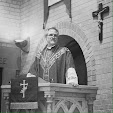
Sunday, September 22, 2019

Sermon: Trinity 14 - 2019


22 September 2019

Text: Luke 17:11-19

In the name of + Jesus.  Amen.

Last week’s Gospel was our Lord’s Parable of the Good Samaritan.  And it was a fictional story in which the hero was a Samaritan, that is, a man of mixed ethnic heritage that the Jews hated and looked down upon. 

This week’s Gospel is the Lord’s healing of the ten lepers, and once again, the hero of this account is a Samaritan.  But unlike last week’s Gospel, this is not one of Jesus’s parables.  This is an actual account.  This really happened – and even Jesus is amazed by it.

While He was traveling – and doing so in an area populated by Gentiles and Samaritans, Jesus is spotted by a small group of lepers.  Lepers are people suffering with a horrible, deadly disease called “leprosy.”  Today we call it Hansen’s Disease, and it can be treated.  But in the first century, it was a slow and painful death sentence.  And worst of all, since it was contagious, lepers had to be sent away to live in leper colonies.  Their faces and their body parts became disfigured as the flesh died on their bones and fell off. 

So this one day, while Jesus was passing through, ten lepers “stood at a distance and lifted up their voices, saying, ‘Jesus, Master, have mercy on us.’”

In case this isn’t clear, this cry for help is a prayer.  These men who are dying, whose flesh is rotting because of our fallen and sinful world, cry out to the God who can cure them.  Maybe they don’t yet know that Jesus is God, but they have heard of His miracles, and they cry out together for help: “Lord, have mercy upon us,” as we sang together to the same God today.

Dear friends, this is why Jesus came into our world.  He came to cure, to fix, to heal, to raise from death.  He came to roll back the effects of sin.  He has come to rescue us and to re-create the heavens and the earth anew.

He did not come to teach people how to live a moral life (Moses and the Prophets had already done this).  He did not come to scold and punish (the Law does this already).  He did not come to encourage us to take charge of our lives, pull ourselves up by our bootstraps, and fix ourselves (in a very real sense, dear friends, we are all lepers: aging and dying day by day, and unable to stop the decay).  Jesus came to save.  Jesus has mercy, and He takes away their leprosy.  He encourages them, saying, “go and show yourselves to the priests,” – for the priests have the authority to declare them to be healed, so that they could return to their communities and reclaim their lives again.

Our Lord has given them their lives back!

Notice that Jesus did not tell them to start attending temple.  Jesus did not order them to read the Bible.  Jesus did not command them to pray.  He simply healed them, motivated by what the lepers’ prayer calls “mercy.” 

Sadly, when the ten left, they didn’t so much as say, “thank you.”  However, one of the lepers, “when he saw that he was healed, turned back, praising God with a loud voice; and he fell on his face at Jesus’ feet, giving Him thanks.”

And this only grateful healed leper of the bunch “was a Samaritan.”

What is the Samaritan doing, dear friends?  He is thanking Jesus, of course, but this is not how we might thank a doctor or nurse or inventor of a cure for a disease.  Falling at Jesus’ feet is an act of worship.  The Samaritan is grateful, and He literally worships at the feet of Jesus, on his face, in the posture of humility before God.

Of course, the irony is that this man, the only one who was grateful, the only one who is worshiping Jesus, is a Samaritan – one who does not worship the true God.  Of course, He is now the only one who is worshiping the true God – the other nine have moved on to other things and chose not to worship the true God who healed them.

The Samaritan is worshiping Jesus, not because he wants something, but because he has already received something.  He is grateful, and because of this grace shown to him, he is motivated to worship.  Jesus did not command him to worship, rather he worships because he appreciates what Jesus has done for him.

His worship is not compelled.  He is not guilted into it.  He is not doing it to please someone else, or because it is expected.  In fact, the Samaritan’s worship is unexpected!  He is a Samaritan, after all.  But it is genuine worship, because it is motivated by the Gospel. 

Our Lord blesses this former leper, saying: “Rise and go your way.  Your faith has made you well.”

There is a close relationship between faith (which is belief) and gratitude (which is thankfulness for a grace received).  Jesus has saved this man by grace, through faith.  And this, dear friends, is Christianity.

Every Sunday and Wednesday, this congregation opens its doors to all who hunger and thirst for righteousness.  There are countless people who have been baptized at this font, and many more who have come here to this congregation to worship over the course of their lives.  But sadly, there are way more ungrateful people who do not “turn back” and return to this place to kneel before Christ our Lord – who is here physically and miraculously, curing us from the leprosy of our sins, and raising us from death and hell.  Jesus is here, and He has saved you, dear brother, dear sister!  So why are there so many empty pews?  Where are the nine?  Were not ten cleansed? 

Why is worship the first thing to go when we get busy or tired or other things pop up? 

Too often, the Lord’s beloved, whom He has saved by baptism and the Word, all by grace and through faith, carry on like the nine ungrateful lepers.  And often it is only when we are sick or terrified or in some kind of dire need that we turn back and cry out, “Lord, have mercy upon us.”

Because of our sinful nature, in a very real sense, it is more of a danger to be well than to be sick, to be wealthy rather than poor, to be secure rather than be filled with anxiety, because that, dear friends, is when we go our merry way and forget about the Lord who saved us by dying on the cross, by seeing to it that we were baptized, by providing for our pastoral care through an ongoing ministry of Word and Sacraments, by giving you the freedom and the opportunity to worship.

Thanks be to God for this saint whose name we don’t even know, for he has taught us how to be a Christian – which is, how to worship.  The Athanasian Creed puts it bluntly: the faith is “that we worship.”  That’s what we do.  We Christians are the tenth leper.  Christians gather and pray, “Lord, have mercy upon us.  Christ, have mercy upon us.  Lord, have mercy upon us.”  And He hears our prayer.  He creates in us a clean heart, and renews a right spirit within us – a spirit of gratitude, a spirit of worship, a spirit like that of the tenth leper.

Let us never take our Lord’s mercy for granted, or cease praying to be cleansed.  Let us never cease praising the Lord, hearing His holy words of absolution, kneeling before His very flesh with grateful hearts, and continuing to receive His body and blood in a renewal of our own bodies and souls.

Dear friends, “rise and go your way.  Your faith has made you well.”  Amen.

In the name of the Father and of the + Son and of the Holy Spirit.  Amen.

Tuesday, September 17, 2019

Sermon: Wittenberg Academy – Sept 17


17 September 2019

Text: 2 Chron 36:1-23

In the name of + Jesus.  Amen.

This one reading captures the decline and fall of Judah – but also brings us to her redemption by God’s mercy.

This is painful to read.  We want to shout through the ages and beg these kings to heed the Word of the Lord!  Think of how much unnecessary suffering there is because we don’t listen to God’s Word!  Good King Josiah was the last faithful ruler of Judah.  He reigned 31 years – and even he died because he foolishly ignored the Word of God.  His son Jehoahaz reigned only three months before being deposed by Egypt.  His brother Eliakim (also known as Jehoiakim) ruled 11 years, but “did what was evil in the sight of the Lord.”  He was taken into exile by Babylon in chains.  His son Jehoichin was evil and ruled only three months, and was also removed in chains.  His brother Zedekiah was the last of this rotten dynasty.  He mocked the preaching of Jeremiah, and make stupid political decisions.  The people mocked the prophets “until there was no remedy.”

Babylon invaded, slaughtered the young men of Judah, and captured the king.  They destroyed the temple and all of Jerusalem.  And this exile was to last 70 years, making up for the seventy years that Judah ignored God’s command to give the land a Sabbath rest every seven years. 

But even in the midst of this gloom, dear friends, the Lord did not forsake His people.  The Persians defeated the Babylonians, and King Cyrus, fulfilling the prophecy of Jeremiah, allowed the people to return, saying, “The Lord, the God of heaven, has given me all the kingdoms of the earth, and has charged me to build Him a house at Jerusalem, which is in Judah.  Whoever is among you of all His people, may the Lord his God be with him.  Let him go up.”

The Lord has mercy on His people, dear brothers and sisters.  And in that rebuilt temple, our Lord Jesus Christ would preach and teach, and not far from that sacred mound, He would be crucified for our salvation.  We are much like Judah, to our dismay.  We take the Word of the Lord for granted.  Let us confess, let us repent, let us receive the Lord’s forgiveness, and may we learn from history, particularly that which the Holy Spirit causes us to hear and ponder.  And thanks be to our merciful Lord and God for treating us not as we deserve, but according to His grace.  Amen.

In the name of the Father and of the + Son and of the Holy Spirit.  Amen.

Sunday, September 15, 2019

Sermon: Trinity 13 - 2019


15 September 2019

Text: Luke 10:23-37

In the name of + Jesus.  Amen.

Our Lord’s Parable of the Good Samaritan is one of the most recognized stories in history.  

In response to a dishonest question from a lawyer who was trying to trick Jesus over the definition of the word “neighbor,” Jesus tells the famous story.  To really mix it up, He makes the main character a Samaritan – an ethnic group that was hated by the Jews.  And the Samaritan is not just the main character, but the hero.  The Samaritan encounters a crime victim, who “fell among robbers, who stripped him and beat him and departed, leaving him half dead.”  

Next Jesus introduces two characters who would normally be “good guys” – but not in this story.  For the priest and the Levite pretend not to see the crime victim.  But in contrast to the priest and Levite, the Samaritan has “compassion.” 

He goes overboard to help the victim, treating him with first aid, transportation, and even housing until he can heal up.  And he promises to come back.

And Jesus asks the lawyer for his judgment of the case: “Which of the three, do you think, proved to be a neighbor to the man who fell among the robbers?”  What could the lawyer say?  The hunter has become the hunted.  The lawyer who sought to snare Jesus fell into the trap himself.  There was no way to get out of admitting the correct answer: “The one who showed him mercy,” says the lawyer.  He cannot even bring himself to use the distasteful word “Samaritan.”

And Jesus acknowledges the correct answer, and as a rebuke to the lawyer’s trickery and self-justification, our Lord tells him: “You go, and do likewise.”

Of course, there is a lot to this story, and there are two main ways to understand it.

The first is that the parable is about us, that it is a morality fable.  “You go, and do likewise,” is, after all, the last word of the story, not unlike the “moral” of a fable.  Jesus is telling us to be merciful, to “do likewise.”  We are to be doers of the word and not merely hearers.  We are to get our hands dirty helping those in need.  We are to be compassionate workers in the kingdom, and not be hypocritical religious people like the terrible examples of the priest and the Levite who refused to lift a finger.

The second is that this parable is actually about Jesus (who was actually denounced by the Jewish priestly and Levitical elites and called a “Samaritan”).  For the Good Samaritan in the story is a savior.  He shows selfless compassion to one in need and rescues him from sin and from death.  And whereas the priest and the Levite, representing the Law, could not save the man who had been beaten down by sin in our fallen world, what could help him?  Compassion, that is, the Gospel.  And so the Samaritan heals by means of elements: oil and wine.  The Samaritan brings the victim where he needs to be, provides shelter for him, ransoms him at his own cost, and promises to return.

The crime victim was helpless to do anything for himself, and in his half-dead state, the Old Testament was of no use to him.  He needed to be saved by the merciful outcast who has compassion.

And so there is a bit of a debate about this parable.  Is it about us, or about Jesus?  What does it mean?  Those who believe that it is about calling us to practice a godly life and to be doers of good deeds look at the second interpretation, and see excuses to be lazy.  For if the parable is all about Jesus, and if Jesus does everything, how are we any different than the priest and the Levite who don’t do anything?  So they deny that Jesus is the Samaritan, arguing rather that we are called to be the Good Samaritan in our own lives.

Others look at the parable as stressing God’s mercy (not ours), God’s grace (not ours), and our helplessness to save ourselves.  They look at the unmerited forgiveness won by the One who administers the oil used in Holy Baptism as we are sealed by the Holy Spirit, and the wine use in Holy Communion: the blood of Christ that cures us of even death itself – and they ask how this parable can possibly be about us and not the Lord Jesus Christ.

But, dear friends, why must it be one or the other?  Isn’t our Lord Jesus Christ both God and man?  Aren’t the Scriptures both written by men and by God?  Aren’t we both saints and sinners?  Aren’t the elements of Holy Communion both bread and wine and also body and blood?  

Our Lord is indeed teaching us about Himself.  He is revealing Himself as the Good Samaritan, the despised and hated one whose love is infinite – even to the point of the cross.  He is the Savior who rescues the victim of the devil, the world, and of his own sinful flesh.  And He does show compassion where the Law shows none, and He does save where priests and Levites can at best only point forward to the coming of Christ.  For where they fail, Jesus succeeds.  And unlike the exclusive nature of the Old Covenant, in the New Covenant, both Jews and Gentiles are given new life.  

But why must the interpretation stop here, dear friends?  For our Lord is calling the lawyer to repent.  He is telling him to reorient his heart and mind away from sin and toward loving God and neighbor.  And indeed, he calls him to repent of his lack of compassion – for the lawyer is not unlike the sinful priest and Levite.  Jesus calls the lawyer to task for his lack of compassion and bids him to amend his ways – and not merely in word, but in deed: “You go, and do likewise.”  “You” he says, using the singular personal pronoun, “You go, and do likewise.”

When we acknowledge this parable as being a call to repentance and an exhortation to live a godly life, we are not denying that the parable is about Jesus.  Of course it is.  But it is also about why Jesus has to have compassion on us in the first place: because we are sinners: poor, miserable sinners bloated with pride, always seeking to put the Word of God to the test, always looking to do something to inherit eternal life (as if there were something that we could do).  Like the lawyer, we want to justify ourselves and play games with the definitions of words, looking for loopholes.  

Dear friends, our Lord isn’t playing games here.  You bet that he is calling us to repent.  He is telling us to “go and do likewise.”  And think of the many ways we behave like the priest and the Levite.  Our failures are mainly not as spectacular as avoiding a bloodied crime victim.  We are the priest and the Levite when we turn aside and refuse to financially support our church.  We are the priest and the Levite when we choose not to come to church (for we are letting our neighbors down who greatly benefit from well-attended services, as there is indeed strength in numbers).  We are the priest and the Levite when we don’t pray, don’t study God’s Word, don’t lead our children in devotions, and when we are too ashamed to admit to our friends and colleagues that we are Christians.  We are the priest and the Levite when we sit next to people in the church year after year and don’t even know their names – avoiding the blessings of Christian fellowship and love, and seeking our own selfish ends.  

Being a Good Samaritan is to be inconvenienced.  It is to put others before ourselves.  It is to be merciful to our neighbor without looking for a loophole.

And indeed, our Lord Jesus Christ is the ultimate Good Samaritan.  For when we are beaten up by the Law, when we look at the bloody mess that is ourselves being self-centered and uncompassionate, when we fail to love and serve our neighbor, and when we are beaten up by the devil, the world, our sinful flesh, and by God’s law itself, it is our Lord who comes to rescue us.

Yes, he calls us to repent.  Yes, He commands us to “go and do likewise.”  But He does not leave us as orphans.  He sends the Holy Spirit to work in and through us.  He sends us His mercy so that we can be merciful to others.  He forgives us so that we can go and do likewise and forgive others.  He provides the wine and the oil of the sacraments to comfort and strengthen us.

For the Good Samaritan is not either/or, but rather both/and.  It is both Law and Gospel.  Thanks be to God for our Good Samaritan who has come to rescue us, to save our lives – even unto eternity!  

You go and do likewise, dear brothers and sisters, for He has done likewise to, and for, you!  Amen.

In the name of the Father and of the + Son and of the Holy Spirit.  Amen.

Tuesday, September 10, 2019

Sermon: Wittenberg Academy – Sept 10


10 September 2019

Text: Phil 2:12-30

In the name of + Jesus.  Amen.

“Work out your own salvation with fear and trembling, for it is God who works in you, both to will and to work for His good pleasure,” says St. Paul.  Our old Adam might be tempted to take credit for “working out” our own salvation through our own will, our own righteousness, and our own works.  But what does the apostle say?  We should work out of salvation with “fear and trembling,” that is, in the fear of the Lord, in humility, knowing that we cannot earn our salvation by our works.  St. Paul goes on to explain that the working out of our salvation is actually done by “God who works in you, both to will and to work.”  And so this “working out” of our salvation is really best understood that we allow the Lord to work in us, and this is the result of His gift of salvation.

And this is truly an empowering and comforting thought!  For salvation is not up to us, to our will, to our discipline, and to our own righteousness.  And yet, we do work, with fear and trembling, submitting to the Lord’s “good pleasure.” 

And from this reality, St. Paul can exhort us to keep life in perspective, so that we can “do all things without grumbling or questioning.”  And this also enables us to being people to Christ, living in stark contrast to this “crooked and twisted generation” since we “shine as lights in the world.”  For in this culture of death and of nihilism (the belief that life has no real purpose), we are “holding fast to the Word of life,” demonstrating to the world by our own faith and life that our lives are not “in vain.”  There is a purpose for our existence!  We Christians, even in our frailty and struggles with sin, serve as lanterns guiding people out of darkness into the light: the light of Christ.

And it is this sense of divine purpose and the expression of the Lord’s will that enables St. Paul, and all of us, to “be glad and rejoice” – for even when our lives are “poured out as a drink offering,” we rejoice that Christ Himself was poured out as a drink offering on the cross, giving us forgiveness, life, and salvation.  So let us rejoice, dear brothers and sisters, and let us pray for those who sit in darkness and in the shadow of death, for we bear the Light that works out salvation for all who seek it in humility by our merciful Lord’s grace!  Amen.

In the name of the Father and of the + Son and of the Holy Spirit.  Amen.

Sunday, September 08, 2019

Sermon: Trinity 12 - 2019


8 September 2019

Text: Mark 7:31-37

In the name of + Jesus.  Amen.

Deafness deprives people of a full participation in many things that most of us take for granted: verbal communication, music, audio books, movies, and even things like hearing one’s children snoring, or a bolt of lightning, or someone calling for help.  The deaf are deprived of hearing laughter and things like rain hitting the ground.  

The worst part for people in the ancient world was being deprived of hearing the Word of God.  Most people were illiterate and almost nobody had scrolls containing the Bible.  There was no American Sign Language, and communication was frustrating.  Deaf people were typically reduced to begging on the streets.

And this is why the deaf man in our Gospel “begged [Jesus] to lay His hand on Him.”  More than anything, he wanted to have his hearing restored.  

In our day and age, the deaf have many options that did not exist in the first century.  We do have standard sign language, not to mention access to books and captioned movies and videos.  We even have medical breakthroughs that can cure many kinds of deafness.

But one thing that hasn’t changed is sin.  

For example, when the cochlear implant first came out, offering deaf children the ability to hear by means of a surgical procedure, there were deaf parents that opposed getting their deaf children the surgery.  There was concern about what this would mean for the “deaf community,” and there was a discussion about whether or not deafness should be treated like something to be “cured.”  Some parents (whose children inherited deafness from a genetic condition) chose not to get the implant for their children, choosing instead to keep them in a world of silence for the sake of their “culture.”

But, dear friends, something else has also remained unchanged: the power of the Word of God to restore that which is broken, and to open that which is closed!

For in response to the prayer of the deaf man, our Lord took him “aside from the crowd privately, He put His fingers into his ears, and after spitting touched his tongue.”  The action of touch was accompanied by the Word, as Jesus, the living and incarnate Word of God in the flesh, spoke a miraculous command: “Ephphatha,” which means, “Be opened.”

Jesus speaks the Word, and He makes use of a physical element and action – and as a result, the deaf man is healed.  The Word that Jesus speaks becomes reality: “And his ears were opened, his tongue was loosed, and he spoke plainly.”

Our Book of Concord quotes St. Augustine’s famous explanation of a sacrament: “The Word is joined to an element, and it becomes a sacrament.”

Sacraments heal.  They cure us of what ails us.  The Sacrament of Holy Baptism heals us, as Christ Himself gives us His cruciform life as our sins are washed away by the element of water.  The Sacrament of Holy Absolution heals us, as Christ Himself forgives us by means of the element of the pastor’s voice speaking words by Christ’s authority, and the sins that weigh us down even to hell itself are released from us (the same word St. Mark uses to explain the healing of the deaf man’s tongue: “released” – which is to say, set free from bondage).  The Sacrament of Holy Communion heals us, as Christ shares His very sacrificial body and blood with us to eat and to drink, fortifying us against Satan and sanctifying us by His own holiness and righteousness in the flesh as the “medicine of immortality.”

Sacraments heal, because Christ heals us by means of the sacraments.  A sacrament apart from Christ is no sacrament at all.  A sacrament not received in faith is no sacrament at all.  But when Jesus touches us and speaks His Words upon us and over us, and we believe His Word – we are truly healed.  And in the Greek language of the New Testament, the word “healed” is the same word as “saved.”  Salvation and healing are the very same thing.  To be healed is to be saved from death.  And when the deaf man was healed, Jesus gave him his life back.  That part of himself that had died had been resurrected – that is, his ability to hear and to speak.

And in fact, even though Jesus told him to “tell no one,” the man with the newly released tongue could not help but tell what Jesus had done for him.  For the more that Jesus urged everyone  not to speak about this (as the time was not yet right for Him to be revealed), “the more zealously they proclaimed it.”

In spite of our medical technology, our literacy, our ability to hear God’s Word in many and various ways, there is a real sense in which we suffer deafness, dear friends.  We have so many entertainment options, that almost nobody reads or listens to the Holy Scriptures.  It is as though we are deaf, and our children are deaf, and we are content not to do anything about it, because we like our culture.

We are surrounded by movies and sports and entertainment.  Our children are busy with every kind of extracurricular activity that the Word of God is just sort of pushed to the side.  We don’t hear, because we don’t want to hear.  But nevertheless, Jesus still comes to us.  He still patiently baptizes our children, still pronounces absolution and offers us a clean slate, and He still communes physically with us in the miracle of the Holy Eucharist.  

Jesus speaks to us, and begs us to listen to Him.  Jesus wants to open the heavens to us, even as He promises to open our grave on the last day: a greater “Ephphatha” that will herald the opening of the new heavens and the new earth, as well as our release from death and the grave!  And this reality of what Jesus does for us is too good for us to keep to ourselves, as we have been healed from death itself, and our pathway to eternal life has been opened, and our bondage to sin, death, and the devil has been released.  We too ought to be zealously proclaiming what Jesus has done for us!

Jesus is still speaking to us, dear friends.  He still heals us by means of His Word.  He still uses physical elements to save us.  Indeed, “He has done all things well.  He even makes the deaf hear and the mute speak.”  Amen.

In the name of the Father and of the + Son and of the Holy Spirit.  Amen.

Tuesday, September 03, 2019

Sermon: Wittenberg Academy – St. Gregory the Great (Sept 3)


3 September 2019

Text: 1 Kings 19:1-21

In the name of + Jesus.  Amen.

Dear brothers and sisters in Christ, welcome to the 2019-2020 school year!  With each passing year of our Lord, it seems that things get more and more difficult for us Christians.  Our numbers diminish, our culture becomes more hostile, and we watch our brothers and sisters all around the world fall away from the faith.

And yet, we are encouraged.  We are the ultimate optimists.  For Christ has won the victory for us at the cross.  This triumph has been delivered to us at the baptismal font.  We participate in the feast of victory every time we partake in Christ’s body and blood.  And even when we are placed into a grave, we celebrate with the host of heaven, our eternal victory over sin, death, and the devil.

But still, in this fallen world, it is easy to get discouraged.

Elijah the prophet sure was when Queen Jezebel made it her mission to destroy him.  On top of that, Elijah recognized that he was “no better” than his “fathers.”  As a prophet, Elijah felt himself to be a failure, “For the people of Israel,” he said to God, “have thrown down your altars, and killed your prophets with the sword, and I, even I only am left, and they seek my life, to take it away.”

But the Lord sent an angel to feed and sustain Elijah with bread, and with water.  And the Lord also sent a sign to Elijah: a bombastic sign of wind, and an earthquake, and a fire – none of which bore the Word of God.  But what did have the power of God’s Word?  A “low whisper.”  For the power is in the Word, however humbly delivered – not in the appearance of might.  A true Word of God preached is more powerful than any force in nature, mightier than any monarch or government. 

And no matter how bad things looked, there were thousands of faithful Israelites that have not bowed to idols or kissed them.  And there would be men, successors of Elijah, anointed to carry the Word and will of God to the faithful remnant.  And God sent Elisha to follow Elijah and to carry on this prophetic ministry.

Dear friends, no matter how grim things seem, let us remember Elijah, his successors, his preaching of the Word, and the ultimate anointed successor of Elijah: our Lord Jesus Christ, true God and true Man, who has overcome the world, conquered the devil, and has forgiven all of our sins by His sacrifice upon the cross!

Let us not lose heart, but let us boldly live in our confession and life – in good times and in bad, whether we are called to teach, or to learn.  Let us read, study, and grow intellectually and spiritually in this blessed new school year, in the Year of our Lord 2019 and 2020.

This is the day that the Lord has made.  Let us rejoice and be glad in it!  Amen.

In the name of the Father and of the + Son and of the Holy Spirit.  Amen.

Monday, September 02, 2019

Thank you, Facebook...


... for protecting our safety (click the link for the details)!


Community Standards and Safety


Community Standards and Safety are the new buzzwords of tyranny.  Well, not so new.  During France's Reign of Terror, the Jacobins referred to their efforts to crush free speech as "safety."  And of course their ideological offspring of a century later, the Bolsheviks, embraced the term "communist."

The People of the Guillotine redefined safety as public hysteria and blood in the streets, and the People of the Gulag actually destroyed community by destroying family and fostering fear and repression.

The latest incarnation of this same libido dominandi is Facebook.

Like all tyrannical political movements, this one does not yet have the power to send dissenters to camps or chop off their heads.  But it does have the ability to stifle the free exchange of ideas, and they have defined "safety" and "community standards" to be any political or economic expression of which they disapprove.

I'm currently serving a 30 day "facebook jail" sentence for a private message to a small group of friends in a secret group for using the term "white trash" to describe a physical tussle that I observed in a Walmart.  It seems that this is "hate speech" - at least when I use the term.  Others seem to have immunity and impunity.  Since I am one of the moderators of the group, I was able to see that nobody in the group registered a complaint.  Our private group is being monitored by either humans or bots to make sure we behave ourselves and don't say things like "white trash" - or say things like climate change is a hoax; or there are only two human genders; or that marriage is between one man and one woman; or that abortion is murder; or that guns save lives; or that Communism and Nazism are two shades of Socialism; or that Antifa is a domestic terrorist group; or to criticize Islamic terrorists, Democratic political candidates, and drag queen reading hour for children; or for expressing dissent against a disturbing little Northern European girl in pigtails being used by eco-fascists as their symbol (just like their Nazi forbears who likewise sought to control free speech and a free economy by means of hysteria and unscientific political propaganda).

I set up an alternate Facebook account and have continued to express my opinions - and now that account has just had a post removed for violating the "Community Standards" that are there to keep us all "Safe."

The notification is for a picture of the latest artificial corporate phenomenon, the "activist" Greta Tunberg, a 16-year old "expert" in climate change who spent two weeks on a luxury solar powered yacht to come to the United States to scold us and teach us that we don't need airplanes.  Other people had to be flown across the Atlantic to retrieve the vessel, but that's okay, important people are exempt from their own rules - just as they were in Revolutionary France and Russia.  Revolutionaries often become the very aristos whose heads they chopped off, living lives of luxury and flaunting a "let them eat cake" attitude."  Plus ça change...

Here is the unsafe picture that violates community values:


And here is the announcement by the Committee for Public Safety:


Meanwhile, it goes without saying what kinds of expressions of violence, sexuality, hatred for traditionalism, capitalism, and Christianity are all permitted, along with vulgarity and profanity.  Free speech against Republicans, libertarians, Christians, and capitalists are all considered "safe" and within the boundaries of "community standards."  What upsets our Lords and Masters in Silicon Valley is cultural rebellion.  We are expected to fall in line and think like they do.  And at very least if we don't, we are to keep our religion, our values, our economics, and our politics to ourselves.

It has gotten so bad that an openly satirical site like the Babylon Bee is now being tagged as "fake news" - a precursor to deplatforming.

This is the time when we need to push back.  The right to protest and freely express political opinions, to dissent, to mock, and to publish are the only defense of a free people against the guillotine and gulag.

Our youthful new generation of the enforcers of "safety" would do well to heed the wise words of one of the French Revolution's opponents, Jacques Mallet du Pan: "A l'exemple de Saturne, la révolution dévore ses enfants."  This is borne out by the fate of Robespierre and many of the Russian Communist leaders.

Our millennial soylords are woefully ignorant of history.  They will continue to repeat it.  But let them pay the price for it, not us, our posterity, our civilization, or our liberties.


Sunday, September 01, 2019

Sermon: Trinity 11 - 2019


1 September 2019

Text: Luke 18:9-14

In the name of + Jesus.  Amen.

Some of our Lord’s parables are a little hard to understand.  This one isn’t.  This is a straightforward comparison of two ways of life, two approaches to faith, two different worldviews.  The first one is the obvious one.  It makes the most sense.  But to hear Jesus tell the story, it sounds awful.  And it is.

The second approach is not what we would consider to be the most natural approach to faith and life – but Jesus explains it in such a way that we can make sense of it.

The first approach to Christianity, and to religion in general, is the belief that salvation is based on good works.  And there is some underlying truth to this.  For if you live a perfect life, without sin, and you rack up a lot of good works, you will have salvation by virtue of being perfect.  And of course, since we aren’t perfect, we have to make a case.  We have to convince ourselves.  We have to create a network of loopholes.  And then we have to somehow convince God.

But it just never really works.  Why?  Because we are broken and sinful even from our conception.  We have inherited our mortal, sinful state.  And we are not capable of living a perfect life no matter what.  So the best we can do is to fake it.

Here we see the example of the Pharisee in our Lord’s story.  Now just so you know, Pharisees were very religious people.  They always went to temple.  They followed the rules.  They went way above and beyond what was expected.  They were the type of people who became pastors and elders and members of committees.  They gave generously, and were always seen at worship and other expected functions.  But, as Jesus said, they “trusted in themselves that they were righteous, and treated others with contempt.”

So one day, a Pharisee “went up to the temple to pray.”  And, “standing by himself,” he prayed: “God, I thank you that I am not like other men, extortioners, unjust, adulterers, or even like this tax collector.  I fast twice a week; I give tithes of all that I get.”  Amen.

That’s the Pharisee’s prayer.  It sounds more like a resume or a job interview.  It sounds like he is making a case for God to open the gates of glory to him.  And it sounds like he is doing God a favor to allow him to increase the property values in heaven.  Why, God should practically be begging this great and noble man to join him for eternity.

But as Jesus said, his trust is in himself, in his own righteousness.  There is a lot of detail about himself that he is not putting on his resume.  His contempt for other people (demonstrated in his “thanking” of God for making him ‘better’ than the tax collector), his wicked thoughts, his overlooked evil deeds, and the original sin that he has inherited.

There is no confession of sin, because our Pharisee thinks that he has no sin to confess.  He is actually better at confessing the sins of others.  And yes, I hear confessions like that.

And when you look at him through this lens, suddenly our bright shining star kind of looks like a dud.

“But the tax collector,” says Jesus, is different.  He represents a radically different approach to how we human beings relate to God.  And just so that you know, tax collectors were really, really hated in first century Jewish culture.  They were shunned.  They were seen as traitors and thieves – and often they were.  

But listen to our tax collector’s prayer, offered while he was “standing far off.”  He “would not even lift his eyes to heaven, but beat his breast, saying, ‘God, be merciful to me, a sinner!’”

Our tax collector also shows up at the interview with a resume.  He does not boast of tithing or fasting or comparing himself to others to look good.  Instead, he “beats his breast” (which is a gesture of humility) and he offers his sinfulness – but he offers something else: his desire to be forgiven.  He prays to God to be “merciful.”

So, dear brothers and sisters, which character is authentic?  Which one is telling the truth?  Which one actually asks for something of God in his prayer?  Which one should we emulate?  Which one is pleasing to God?  Which one “went down to his house justified?” is the question our Lord asks.

For remember, the Pharisee sought to justify himself.  Did he succeed?  Can you ever justify yourself?  Do your good works even begin to cover for your sins?  

Our Lord asks his listeners – which includes us – which man went home justified?  Which one of the two had the heavens opened to him?  Jesus tells us that it is “this man,” the tax collector.  Any person who is honest with himself already knows the answer.  And just in case you need a hint, our merciful Lord even provides one:

“Everyone who exalts himself will be humbled, but the one who humbles himself will be exalted.”

So what does this humbling and exalting look like for us in our world?  

If you look down on other people who don’t attend church as much as you, or who don’t serve on boards, or who don’t work around the church, or don’t give as much money as you, or don’t participate in the activities of the church as much as you do, and if you think you are more righteous before God for any of these reasons – congratulations, you are the Pharisee in the story.

If you think that God would never send you, your friends, or your family to hell because you’re a good person, or your kids are good kids, or your friends are morally upright; if you judge yourself to be a good person because you have never killed anyone or robbed a bank – you are also the Pharisee in the story.

If you think you’re good to skip few church services because you’ve already got a good number in, or if you think you don’t need to go to Bible class because you “get enough religion already,” and if you think God is impressed by this – you are also the Pharisee.

If you think even for a moment that God is so lucky and must be thrilled to have you on His side, in His church, doing His work – well, you know exactly what this means.

But, dear friends, even though we all have an inner Pharisee begging for attention, we also have the Ten Commandments that smack us right back into reality.  We have sinned against God in thought, word, and deed.  We are “poor miserable sinners.”  Our prayer is not “Hey God, check out my resume!” but rather, “O dear God, look at my resume, and be merciful to me, a sinner.”

We began this Divine Service by confessing together, each one of us, that we are poor miserable sinners.  In the nighttime service known as Compline (LSB page 253), we pray, “I have sinned in thought, word, and deed, by my fault, by my own fault, by my own most grievous fault,” and it is customary to touch your fist to your heart three times.

Who does this sound like, dear friends?  

In our humility and brokenness, the Lord exalts us and makes us whole.  In our emptiness, we are filled.  In our sickness and mortality, we are healed and given everlasting life.  That is why the tax collector prays, “be merciful,” and that is why we pray, “Lord, have mercy.”

And so when we come to our Lord in His Divine Service, where He is present to forgive our sins, and we do so with a contrite and humble heart, begging for mercy, who goes to his home justified?  We do, dear friends.  For we are justified by His mercy alone.  Amen.

In the name of the Father and of the + Son and of the Holy Spirit.  Amen.

Wednesday, August 28, 2019

Sermon: St. Augustine - 2019


28 August 2019

Text: 2 Tim 4:1-8 (Matt 5:13-19)

In the name of + Jesus.  Amen.

Today, dear brothers and sisters, we remember a beloved brother in Christ, Augustine of Hippo Regius in Northern Africa.  He was one of the most extraordinary theologians and preachers in the history of the Church.  He died on this date 1,589 years ago.  But what’s a few centuries for us Christians?  We are the people of eternity.

And we are also people of gratitude.  We are grateful for the heroes in the faith who came before us.  This word “grateful” is based on the Latin word for “grace,” and when we think of St. Augustine’s preaching, that is what we think about.  Augustine understood that the Christian faith is all about grace.  He understood original sin.  He understood why the Trinity is so important, and why the cross is central to everything in our day to day lives.  

Bishop Augustine knew this not just as an intellectual or as a churchman.  He understood it as a sinner who was redeemed by Christ.  As a young man, he departed from both the Pagan faith of his father Patrick, and the Christian faith of his mother Monica.  He was involved in a religious cult, and lived a life of selfish pleasure and hedonistic sexuality.  But Monica prayed every day for her son.  And ultimately, it was the preaching of Monica’s pastor, Bishop Ambrose, who proclaimed the Gospel with the clarity of any Lutheran pastor who would follow in his train a thousand years later.  And by the way, St. Monica’s prayers were answered concerning her husband Patrick, who converted to Christianity before his death.

It was the preaching of Christ the crucified one, the preaching of the Gospel of forgiveness, that won over Augustine.  It was the Word of God – as it always is – that converted him.  He would enter the holy ministry himself, and his sermons are still studied to this day.  He became a bishop and world-famous theologian.

Augustine took heed of the Holy Scriptures, especially our epistle lesson in which St. Paul exhorts all preachers: “I charge you in the presence of God and of Christ Jesus, who is to judge the living and the dead, and by His appearing and His kingdom: preach the Word; we ready in season and out of season; reprove, rebuke, and exhort, with complete patience and teaching.”

And did Augustine ever preach (and teach and write and speak) God’s Word!  Augustine’s clarity gave us a vocabulary to talk about original sin, the idea of the “just war,” and how we should behave as Christians when our country and culture seem to be coming apart.  Augustine lived in the days of the fall of Rome.  People were in despair.  And they turned to their pastor and his proclamation of Jesus for comfort. 

For it is just in such times, dear friends, that we need solid preaching.  “For,” St. Paul says, “the time is coming when people will not endure sound teaching, but having itching ears they will accumulate for themselves teachers to suit their own passions, and will turn away from listening to the truth and wander off into myths.”

Augustine was a former Manichaean.  This was an ancient cult that appealed to the intellect.  Because of his former belief in such things, and now able to see through them, Augustine wrote many books to defend the Christian faith against heresies.  These books are still used in seminaries today.

Augustine was an expert in philosophy, but his true gift was understanding the Holy Scriptures.  He took St. Paul’s exhortation to heart, and preached the Word of God, in season and out of season.  He would debate anyone.  He was honest about his former life.  His preaching focused on Christ and His work of atoning for our sins.  Augustine’s sermons were so important that some 350 of them were preserved, copied by hand throughout the centuries, and are still read today.

In good times and in bad, we Christians are to be the “salt of the earth.”  We must never lose our zest.  We are not called to get along with the world, but rather to speak the truth and give the world hope.  We are called to be the “light of the world.”  We are surrounded by darkness, dear friends, even as Rome was collapsing in Augustine’s day.  Today, our western civilization seems to be crumbling in an ungodly implosion of ignorance and the loss of a moral compass.  It is just for this time that we need to let our light shine, looking to those like Augustine, who courageously took on the challenges to the Christian faith of his day.

This is not to say, dear friends, that we all must be theologians.  Far from it!  We are called to many vocations.  God places us into many and various callings and contact with people who need to hear the good news, with people who desperately want the hope that is ours by grace.  We are surrounded by darkness and a culture of death, and we, dear brothers and sisters, have the antidote.  We have the cure to death itself!

The people around us will not find hope in politics or hedonism or false religions.  Their hope is not to be found in technology or escapism.  Their hope is in the name of the Lord.  Their hope is found in the preaching and teaching of Augustine, because Augustine was a faithful preacher of Christ and Him crucified!

And in times of darkness, the Lord will raise up great prophetic voices like Malachi and Paul, like Ambrose and Augustine, like Luther and the many proclaimers of Christ in our own day.  The Lord will not suffer His Word to lay fallow.  For even when the darkness seems to be choking us to death, remember, dear friends, that the Word of God cannot be extinguished.  The Word of God has free rein.  The Word of God does not return void!  

And the Word of God is preached, proclaimed by men who have themselves been called out of darkness, man who know what it is to be forgiven, men who have lived according to hedonism and false religiosity and have found them wanting.

Let us pray that the Lord of the Church raise up more Augustines in our day, dear brothers and sisters.  We need faithful preachers who will indeed proclaim Christ courageously and soundly, who will be sober-minded in their teaching, who will endure suffering in their confession, who will do the work of an evangelist in their love for the lost, and who will fulfill their ministry by the grace of God.

Let us thank God for St. Augustine and his sound teaching, for St. Monica his mother for her tireless prayers, for St. Ambrose, whose own faithful preaching in season and out of season was used by God to bring Augustine into the Christian faith, and of course, let us thank Jesus Christ our Lord, who lives and reigns with the Father and the Holy Spirit, one God, now and forever.  Amen.

In the name of the Father and of the + Son and of the Holy Spirit.  Amen.

Sunday, August 25, 2019

Sermon: Trinity 10 - 201


25 August 2019

Text: Luke 19:41-48 (Jer 8:4-12, Rom 9:30-10:4)

In the name of + Jesus.  Amen.

The philosopher George Santayana famously remarked, “Those who cannot remember the past are condemned to repeat it.”  In our readings, Jeremiah, Paul, and our Lord Jesus Christ, are each warning Israel, and us, not to make history repeat itself.  Some people will listen, but most will not.  Some people will hang on every word, others won’t pay any attention.  Some will benefit from the warning, and others will pay dearly for stopping up their ears.

Dear brothers and sisters, please listen.

Our Lord Jesus Christ wept over Jerusalem as He approached it on the way to His passion and death.  He doesn’t weep for Himself, but for the city – the stubborn people who refuse to hear the warnings of the prophets, and of Himself (as the fulfillment of the prophets).  The people are arrogant, and they rely on everything except the mercy of God.  And they will soon be destroyed: “Would that you, even you, had known on this day the things that make for peace!  But now are hidden from your eyes.”

This makes better sense if you understand that the word “Jerusalem” means “City of Peace.”  The latter part of the word: “Salem” is the part that means peace.  And, dear friends, just as Jesus speaks to and about Jerusalem, He is speaking to, and about, you, as Salem Lutheran Church!  

So, dear brothers and sisters, please listen.

Jesus speaks of a coming disaster for Jerusalem, describing a military siege, one that would result in the destruction of men, women, and children.  He prophesies that the temple would be flattened, and all because “you did not know the time of your visitation.”

And this makes better sense if you know your history, that in the year 70 AD – forty years after Jesus spoke these words – the Roman government would crush a Jewish rebellion by means of a long military siege.  It was cruel, and it was complete.

If you don’t know that this is what Jesus is talking about, why not?  This is important.  You need to know this history, for “Those who cannot remember the past are condemned to repeat it.”  

So, dear brothers and sisters, please listen.

Why did God allow this to happen to Jerusalem?  Because “you did not know the time of your visitation.”  They rejected the Messiah who had come to redeem them.  But what about you?  Do you know the time of your visitation?  Do you give any thought at all to your baptism?  Is this one hour on Sunday and on Wednesday in which the Lord visits us in Word and Sacrament the single most important hour in your week, in your life?  Would you rather miss anything in the world rather than miss receiving the Gospel and the Lord’s Supper?  And if not, why not?  Is Jesus weeping over you because you do not know the time of your visitation?  Do you even care?

So, dear brothers and sisters, please listen.

The prophet Jeremiah, who was known as the “weeping prophet” because the Lord burdened him with preaching warnings to the people – and the people didn’t care – Jeremiah preached the same message to the same people who did not know their visitation, who did not remember their past.  At the end of his life, Jeremiah would witness Judah – the remnant of the people of Israel – being militarily defeated by the Babylonians and taken into captivity into what is today Iraq.  If you don’t know this, or if you don’t understand why this is significant, why not?  “Those who cannot remember the past are condemned to repeat it.”  And just as the people of Judah and Jerusalem were doomed to suffer the consequences of not knowing the time of their visitation, so too are the people of Salem if they do not know their history.

So, dear brothers and sisters, please listen.

St. Paul speaks to the Romans about his own people who did not know the time of their visitation, who cared more about worldly things than what was truly important.  And as a result, God replaced them.  Just as Jesus said it would happen in several parables, the ignorant and disobedient were ultimately rejected, and others who would listen, who knew their history, who truly understood the time of their visitation – became the chosen people of God: the Church.

Those who lost their salvation did not understand why God chose them in the first place.  It was not because they were lovable, but because God is love.  It was not because they deserved it, but rather because God showed them mercy.  They were rejected “because they did not pursue it by faith.”

St. Paul sums up the problem: “For, being ignorant of the righteousness that comes from God, and seeking to establish their own, they did not submit to God’s righteousness.  For Christ is the end of the law for righteousness to everyone who believes.”

This sounds important.  This sounds more important than sleeping a little later, than risking a little bad weather, than enjoying a little good weather, than the game, than the social gathering – this sounds like it matters eternally.  This sounds like history that repeats itself again and again because the people chosen by God do not remember the past, have grown indifferent to God’s blessings, have forgotten what they learned as children, and to whom the Word of God makes no difference.  This sounds like a people who did not know the time of their visitation.

So, dear brothers and sisters, please listen.

Don’t let Salem repeat the history of Jerusalem.  For you should know the time of your visitation: every Sunday at 10 am, every Wednesday at 7 pm, and whenever we gather around the Word of God, such as at 9 am on Sunday mornings as we open up the most precious things that we have in this life: the Scriptures, and we open our ears, our hearts, our minds, and our souls to the Holy Spirit, who teaches us when our visitation is, and more importantly, teaches us to know who that visitation is, even Jesus Christ our Lord.

So, dear brothers and sisters, please listen.

Please listen to the Word: the Law and the Gospel, the warnings of the prophets and the triumph of our Lord.  Please listen to the readings as if your life depended upon them, for it does.  Please listen to the liturgy, for it is God’s Word placed into an eternal song that assures us that we will not be doomed to repeat history – if we listen and embrace the Word of God.  Pease allow the prophets to call you to repentance, for they do not warn us in vain.  They call us, rather, to the cross, where the blood of the Lamb atones for us, cries out to the Father for our pardon, and gives us peace.

For that is what our church is named after: Salem, which means peace.  The Lord wept over the original Salem.  But what’s more, He went into Salem to take up His cross for you.  And that is the most important history of all.  He offers His body and His blood for our sins, and He offers them again to us here and now, in this Salem, and wherever two or three gather in His name.  

So, dear brothers and sisters, please listen. This is the time of your visitation!

Amen.

In the name of the Father and of the + Son and of the Holy Spirit.  Amen.

Sunday, August 18, 2019

Sermon: Trinity 9 - 2019


18 August 2019

Text: Luke 16:1-13

In the name of + Jesus.  Amen.

Our Lord’s story of the Dishonest Manager is sometimes difficult for people to understand.  For why would Jesus seem to be praising a crook, a dishonest manager who is ripping off his employer to save his own skin?

Well, that doesn’t seem right!

But, of course, Jesus is not praising dishonesty or shoddy management.  He is praising the idea of “shrewdness.”  To be shrewd is to be wise, to think outside the box.  In our story, the dishonest manager is a deal-maker, a negotiator.  He understands his clients; he knows their psychology.  He quickly sizes up what makes them tick.

Now, the manager could have been using his brilliance as a negotiator to faithfully serve his master all along, but instead he was wasteful with what the master trusted him with.  He was probably lazy in his work.  Serving his master just wasn’t a priority.  He was not motivated to do the best job that he could do.  And perhaps this slack attitude led to his downfall.  Maybe he thought too highly of himself to even think that his boss would dare fire him.

But this is just what happened.  He found out that he was being laid off.  “Turn in the account of your management,” says the master, “for you can no longer be manager.”  

This is a very serious matter.  He was looking at financial ruin.  “What shall I do, since my master is taking the management away from me?  I am not strong enough to dig, and I am ashamed to beg.”

And so now that the chips are down, the manager suddenly finds his motivation and energy.  He becomes a wheeling and dealing superman, offering incentives to his clients to get them to close the deals and put money in the master’s account.

The manager isn’t suddenly honest, but he is suddenly acting in his own self-interest instead of simply squandering his gifts and talents.  And even though he is ripping off the business owner, the boss is amazed. Our Lord’s listener can practically see the master shaking his head in disbelief at the sheer audacity of his employee.

For the dishonest manager took the initiative to renegotiate a flurry of contracts with his master’s debtors.  And in so doing, the dishonest manager believed that he was making valuable business contacts so that when he did get laid off, he could lean on his new friends, and hopefully everything would turn out right.  Maybe one of his new friends would give him a job.

He is brash and bold, and the boss watching this play out in amazement.

Of course, had our dishonest manager just been honest all along, had he been diligent and hard-working in the first place, had he not taken his job for granted, had he not been wasteful - he may not have been in this desperate situation at all.

Indeed, the best solution to getting fired is to not get fired in the first place.  And while the master commends the dishonest manager for his shrewdness, he could have been still more shrewd by combining his talents with integrity.  And in making his boss a lot of money, he would have made a good living, and made himself indispensable in the process.

This is indeed a great lesson.  But our Lord is not giving work tips or life-skills advice.  This parable is not a crash-course in marketing or business administration or negotiation.  

Think about when you are the most spiritually motivated, dear brothers and sisters.  When are you eager to pray, to come to church to hear God’s Word, to receive the holy sacraments?  Is it when things are going well, or when the chips are down?  Are you serving your Lord and your neighbor in times of prosperity, or are you rather on your knees in prayer when you are worried, or afraid, or when you have gotten bad news.

We are all like the dishonest manager because we are motivated best when we are in some kind of danger.  And sometimes the Lord gets our attention, not to scare us, but rather to draw us closer to Him.  It is our sinful nature to take the Gospel for granted, to squander what the Lord gives us, to be poor stewards of what we have been entrusted with.  And that sinful nature is why Jesus took flesh, and it is why we are here.

But thanks be to God that Jesus is not lazy.  Jesus is truly shrewd, for he lures in our enemy the devil at the cross, and there, our Lord renegotiates our debts with God Himself.  Jesus is audacious and shrewd beyond measure – not as a dishonest manager, but rather as a faithful Savior.  And when it comes to the debt of our sins, He pays it with His own blood.  The bill is torn up.  He doesn’t merely have us pay half or knock twenty percent off, but rather cancels our debt entirely.  And He is authorized to do so by the Father.

Our Lord encourages us to be shrewd for the sake of the kingdom.  He tells us: “Make friends for yourselves by means of unrighteous wealth.”  We should be shrewdly looking for ways to serve the kingdom, to draw people into the faith for the sake of salvation, to serve the Lord and His kingdom in good times and in bad times – not ignoring Him in the good times, and not making promises that we can’t keep in the bad times.

If we are grateful, we will be eager to serve the kingdom – with our time, our talent, and our treasure.  If we are shrewd, we will wisely receive the Lord’s gifts whenever they are offered, and not try to cut a better deal.  For the deal that the Lord offers us is already perfect: He exchanges our sins for his righteousness.

Dear brothers and sisters, let us be grateful!  Let us be shrewd!  Let us not take the gift of eternal life for granted.  Let us thank our Triune God for His undeserved mercy and grace.  Let us never serve two masters, but rather let us be eager to serve the Lord in His kingdom, in season and out of season.  For even when unrighteous wealth fails, our Lord’s blood does not.  And by His blood, we are received into eternal dwellings!  Amen.

In the name of the Father and of the + Son and of the Holy Spirit.  Amen.