Sunday, October 20, 2019

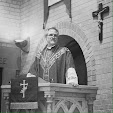
Sermon: Trinity 18 - 2019


20 October 2019

Text: Matt 22:34-46 (Deut 10:12-21, 1 Cor 1:1-9)

In the name of + Jesus.  Amen.

The Pharisees are always missing the point.  They are very good at being keepers of a law that has been watered down and filled with loopholes.  And of course, their favorite topic is the Law.  They’re not particularly interested in Jesus, in who He is or what He is doing.  They don’t want to talk about the prophecies that He fulfills, or the miracles that He performs, or even His preaching and teaching.

So when they gather around Jesus to ask questions, they ask Him questions about the Law – hoping that He will justify their delusion that they actually keep it.

On this occasion, they especially like Jesus because He “had silenced” their rivals, “the Sadducees.”  So they assume that Jesus is on their side, and will join in their word games and legal trickery.

One of the Pharisees, a lawyer, “asked Him a question to test Him.”  Notice that He isn’t there to learn.  He is there to “test” Jesus, to see if He is good enough to be around them.

His question is: “Teacher, which is the great commandment in the Law.”  Of course, this is an easy one.  We just heard it read from our Old Testament lesson.  “You shall love the Lord your God with all your heart and with all your soul and with all your mind” and “You shall love your neighbor as yourself.”

Jesus says that these commandments are the pegs upon which the entire Law hangs.  We sometimes speak of the command to love God as the “First Table of the Law” – being Commandments One through Three, whereas the “Second Table of the Law” has to do with how we love our neighbors, in Commandments Four through Ten. 

So, of course, the lawyer was not able to trip Jesus up.  And now it is His turn to pose a question.  And instead of asking them about the Law (what more is there to say, dear friends, then the reality that we don’t love God with all our heart, soul, and mind, and we don’t love our neighbors as ourselves?), Jesus asks them about Himself, about the Messiah.

He wants to know what they believe, teach, and confess about Him.  And since Jesus is the fulfillment of the prophets, He asks a question concerning a prophecy that He fulfills from the Book of Psalms, written by His own ancestor, King David.

And since this has nothing to do with the Law or trying to make people think they are good at keeping it, the Pharisees, and especially the Lawyers, are just not that interested. 

Jesus poses them a kind of riddle about Himself as the fulfillment of the Old Testament.  He asks them about the Messiah: “Whose Son is He?”  Well, everybody knows that the Messiah will be the male descendant of King David, in other words, the Son of David.  But in the Psalm, King David refers to the Messiah referring to Him as “my Lord.”

And as the Lawyers and the Pharisees know full well, this use of the word “Lord” has nothing to do with an aristocratic title or politeness.  When “Lord” is used in this way, it means “God.”  And so, King David speaks of his own human descendant as “God” – so the Messiah will be God and man at the same time.  And presumably, a man who is at the same time God, must be able to work miracles, forgive sins, and preach and teach with authority that nobody else has.  Jesus is presenting Himself to them as the Messiah, and He uses the Scriptures to prove it.

But look at their reaction, dear friends: “And no one was able to answer Him a word.”  They are dumbfounded.  They cannot answer the question.  Their entire world has been stood on its head.  But instead of looking at this situation and saying, “Is Jesus the Messiah?” and instead of examining themselves to see if maybe they have been teaching in error with their legalistic shortcuts, instead of asking this rabbi for more information – they simply refuse to talk to Him anymore, “nor from that day did anyone dare to ask Him any more questions.”

For these are lawyers.  They don’t ask questions to learn, they ask questions to show off.  Jesus has outsmarted them and outwitted them – and they will never forgive Him for that.  This is why the lawyers and the Pharisees will soon join forces with their rivals, the Sadducees, their sworn enemies, the Romans - not to mention Judas and false witnesses – to send Jesus to the cross – knowing full well that He is innocent.

In all of their expertise of the Law, they have forgotten that murder and the bearing of false witness are infractions of the Ten Commandments – along with their refusal to confess Him as God, as the “Lord [that] said to my Lord” as King David speaks of Jesus, his descendant. 

Dear friends, the Law is important, for it is the Word of God.  The Law has several uses.  And when we don’t look for workarounds and loopholes, the law indeed teaches us about ethics, about the behavior that God expects and demands of His creatures, and most importantly of all, that we are left without excuse for our failure to keep the Law – even as we confessed together: “We have not loved You with our whole heart; we have not loved our neighbors as ourselves.”  Indeed, the Law is there for us to honestly compare with our own thoughts, words, and deeds, so that we might come to the conclusion that we, in fact, do need David’s Son to rescue us.

And the Man that the Pharisees and Sadducees and lawyers and scribes and priests and Romans and Judas Iscariot would conspire to crucify, would, by means of the cross and His atoning blood shed upon it, would bring about the forgiveness of sins that is the only answer to our failure to obey the Law.  For by virtue of His blood, and by His authority, the pastor speaks on His behalf when he says: “I therefore forgive you all your sins.”  It is not the pastor who has the power to forgive sins, but rather it is the pastor who has the authority from Christ, from the Son of David, from the Lord who said to David’s Lord: it is He who has the power to forgive your sins, commute your sentence, and cleanse you white as snow in the blood of the Lamb.

Dear friends, let’s not get bogged down in whether or not this or that is a sin, or whether this sin is worse than that sin, or whether our sins are somehow justified.  Again, as we confessed together, praying to God: “We justly deserve Your present and eternal punishment.”  And when we truly make that confession, dear brothers and sisters, the Law has done its work.  We are in need of a Savior, and it is David’s Son who has come to rescue us.

And as St. Paul says, we are “sanctified in Christ Jesus.”  We are “called to be saints together with all those who in every place call upon the name of our Lord Jesus Christ, both their Lord and ours.”  The apostle speaks of the “grace of God that was given you in Christ Jesus,” about whose “testimony… was confirmed among you.” 

This is not what the proud Pharisees and cleaver lawyers want to talk about, dear friends, but it is what Jesus talks about, and it is what we poor, miserable sinners live to talk about!  For Jesus is our life and salvation!

And in Him, “you are not lacking in any spiritual gift, as you wait for the revealing of our Lord Jesus Christ, who will sustain you to the end, guiltless in the day of our Lord Jesus Christ.” 

This is the point that the Pharisees missed.  Let us not miss the point like they did, dear friends.  For Christ is the point.  He is our life and salvation.  He is the fulfillment of the Law and the Prophets.  He is the one King David calls “Lord” – and so do we, dear friends, so do we – even unto eternity.  Amen.

In the name of the Father and of the + Son and of the Holy Spirit.  Amen.

Posting a Mark Dice video...


... is now "against community standards."

I posted a link to this video on Facebook without comment.

Facebook removed it and said that this post violates community standards.


When I clicked for more information, to my surprise, it didn't say that this was a thoughtcrime or wrongthink or not in lockstep with the goosestepping anti-Christian and anti-science worldview of Facebook - but rather because this post somehow violated their policy on "Spam."


How is posting a YouTube video to my own account considered "Spam"?

Let's call it what it is.  This is tyranny.  And it is only going to increase as Big Tech tries to interfere in the upcoming presidential election.  This is part of a larger coup.

As are all tyrants, from Nero, to George III to Hitler to Stalin to Mao, the Hard Commie Left in this country - with their allies in Big Media, Big Government, Big Tech, and Big Entertainment - do not respect our God-given rights - and they especially fear the pen even more than the sword.  And they want to overthrow our republic.  They want to destroy our civilization grounded in private property and the right to hold and express thoughts freely.

They want to enslave our minds.

They are diabolical.

And they have already been defeated at the cross.


Tuesday, October 15, 2019

Wittenberg Academy Sermons


I've been teaching at Wittenberg Academy since 2014.  We are an accredited online classical Lutheran High School (grades 7-12) - and we also offer a free homeschool curriculum for K-6 Grammar School as well.

This year, I was also appointed to serve as chaplain.  One of my joyful duties is to lead the weekly online Vespers service on Tuesday afternoons.  I decided to start posting my short sermons here.

Here are the links since the beginning of the year:

For the rest of the year, I'll be posting them here.

Sermon: Wittenberg Academy – Oct 15


15 October 2019

Text: Matt 13:1-23

In the name of + Jesus.  Amen.

The Parable of the Sower is a text that preachers preach on, and hearers hear, year after year.  And there is always more to be said, and more to hear!

And with our Lord explaining the parable, there is no way that it can be misunderstood.  The sower casts the seed everywhere, and whether or not it takes root, grows, matures, and produces fruit – depends on the receptivity of the soil. 

In this one parable, our Lord teaches us about preaching, hearing, faith, justification, sanctification, and how the church actually grows.  He teaches us about the Word of God, which is to say, dear friends, he teaches us about Himself. 

One aspect that I find interesting is the sower’s indifference about where he sows.  The Rev. Dr. Martin Franzmann, the professor, poet, and hymnwriter, uses the word “reckless” to describe how the sower sows: “his reckless love scatters abroad the goodly seed.”  Modern scientific agriculture would consider this a waste, knowing full well that casting seeds on bad soil will just result in dead seeds.  Nevertheless, the sower sows.

There is an old farming term for this kind of sowing: “broadcasting.”  It is funny how words are adapted to each new generation.  To broadcast is to sow seeds recklessly, without a central plan.  It means to “cast,” that is to “throw,” broadly.  The farmer doesn’t make judgments about which soil is worthy of his attention, he just broadcasts it everywhere.  He figures God will take care of the rest.  The term “broadcast” was appropriated in the early days of radio, as programs were “broadcast” over the airwaves.  In our day, we have altered the word to “podcast” – as these audio broadcasts can be accessed individually on demand, like “pods” of words.

And so we preachers broadcast – sometimes over radio, sometimes over the internet, though most often in a church sanctuary.  But in any case, we cast the Word of God abroad, not knowing or caring where the seeds land.  For though the soil may appear to us to be a hardened pathway, or a thorny ground, or a place of shallowness – often the grit and tenacity of the little seed’s embedded DNA of life can be shocking.  We’ve all seen stubborn little plants pushing up through the cracks between sidewalks, or even growing out of the sides of brick buildings. 

The Word of God takes root wherever and whenever the Holy Spirit wills.  Luther said that the Word did everything in Wittenberg, while he and Melanchthon were drinking beer.  And that is the beauty of the Word of God, dear friends.  Its effectiveness, or as we say in theology, its “efficaciousness” isn’t about the skill of the preacher, the piety of the lay people, the wealth of the congregation, or the beauty of the church’s architecture.  It’s not dependent upon the quality of the sound system or the beauty of the vestments.  Preaching the Word is not like selling or marketing. 

It’s a simple seed: the Word bearing the DNA of Jesus that God Himself created.  The seed is sown in our hearts, and by faith, it grows.  Its fate is in God’s hands, not ours.  As the poet said: “The Harvest Lord Who gave the sower seed to sow Will watch and tend His planted Word.”  Amen.

In the name of the Father and of the + Son and of the Holy Spirit.  Amen.

Sunday, October 13, 2019

Sermon: Trinity 17 - 2019


13 October 2019

Text: Luke 14:1-11

In the name of + Jesus.  Amen.

“Is it lawful to heal on the Sabbath or not?”

Our sinful flesh just loves rules and regulations.  We can use them to boss others around.  We can use them to make ourselves look good.  We can use them to claim that we are righteous by our works.  We can use them to tear others down.

But what our sinful flesh doesn’t understand is that God made the law for our good.

For when we keep the Law – even in a superficial manner – things go better for us and for our life in a community of people.  When we break the law, the opposite is true.  And so every group of people from the tiniest village to the mightiest empire has had some kind of rules, regulations, and laws.

When God created the universe in six days, and then rested, He set a precedent for all of creation: a Sabbath Day of rest.  And God commanded this rest for all people – and even for the animals who work for mankind.  This rest is a joy, not a burden.  It is for our good, not for our manipulation and control.  As Jesus said, “The Sabbath was created for man, not man for the Sabbath.”

But what does our sinful flesh do, dear friends?  We figure out how to take the gift of God and turn it into a curse.  We creatively find ways to pervert something beneficial into a burden.  And those who seek power over others use the Law to leash others rather than to liberate them.

Our Lord had to deal with this from the Pharisees and the scribes and the lawyers all the time. Instead of using the Law as a curb, a mirror, and a guide – as we Lutherans are taught are the godly purposes of the Law – the lawyers and Pharisees were using it as a snare to try to trick Jesus into breaking a law so that they could arrest Him, discredit Him, and, of course, to do what they really wanted to do: kill Him.

This is why, dear friends, they “were watching Him carefully.”  And they got their wish to see Jesus fall into the trap, for a man was very sick.  Now this was the Sabbath Day, and the Law says that a man may not work, but must rest, on this Seventh Day of the week.  This sick man had a disease called dropsy. 

Jesus knew that He was under constant surveillance and that the lawyers and the Pharisees were trying to trick Him.  Jesus wastes no time in turning the tables on them.  They are the ones who fall into the trap.

Seeing the man with dropsy, our Lord poses a question to the lawyers (and as every lawyer knows, you never ask a question in court that you don’t know the answer to).  Jesus throws the lawyers a curve ball: “Is it lawful to heal on the Sabbath or not?”  

“But they remained silent.”

They already know where this is headed.  The Law says that work is prohibited on the Sabbath.  But does this mean that doctors may not cure someone?  Does this mean that an emergency worker must sit idle when a person is in distress?  Does this mean that pastors must not preach and parents must not feed their children?  For we all know what the spirit of the law is, and we also know how the lawyers and the Pharisees – just like lawyers and politicians and others do today – play fast and loose with the meanings of words to get the outcome that they want.

But not today, dear friends.  Not on this day.

Our Lord has cut right to the chase: “Is it lawful to heal on the Sabbath or not?”

They refuse to answer because they are lawyers and they know that the rabbis have all addressed this question.

Jesus shows compassion for the sick man, heals him, and sends him away.  Then Rabbi Jesus addresses the legal question as have teachers of the law for centuries: “Which of you,” He asks, “having a son or an ox that has fallen into a well on a Sabbath day, will not immediately pull him out?”

And once again, the cat has got the tongue of this proud cadre of Pharisees and lawyers.  Jesus has made them look foolish by means of their own beloved Law.

Dear friends, we are not under the various Old Testament regulations that applied to the Sabbath Day – which was from Sundown Friday to Sundown Saturday.  We are free from these ceremonial laws.  But we are still subject to the principle of the seventh-day rest, as well as setting aside a day as holy to the Lord in order to allow Jesus to come and heal us, just as He did this man with dropsy.

For we suffer with something far worse: sin.  Jesus died on the cross on Good Friday, and His body was removed before sundown as the Sabbath Day approached.  He was laid in the tomb and enjoyed His Sabbath rest.  But on the first day of the week, Sunday, the Lord’s Day, the visitors to the tomb found that He had risen.  His death and resurrection is our cure.

We Christians have sanctified the Lord’s Day ever since, and this is, for us Christians, a new and greater Sabbath – not one of rules and regulations, but one of liberation, one in which we are free to worship the Lord, free to hear the Word of God, and free to partake of His body and blood!  And we are indeed free regarding this Sabbath, for if necessity prevents our worship on the first day of the week, we may well worship on another day, such as Wednesday night, as has been the custom of our own congregation for more than a century.

The Law does not exist to enslave us, but to free us.  And though we fail to keep the Law, our Lord cures us of the dropsy of our sins.  For as hard as we try to keep the Law, we fail.  For we are like the son or the ox that has fallen, and we are rescued, we are pulled out of the well by our Lord.  

And this is what the Sabbath of the Lord’s day is all about, dear brothers and sisters.  We don’t come to church to show how holy we are, but rather because we aren’t.  We come to where Jesus is because only He can cure us.  We come on this day of rest because it is indeed lawful for Jesus to heal us.  

And this is no cause for boasting.  Indeed, we have been invited to this wedding feast, and yet we “go and sit in the lowest place,” right here in the pews of this sanctuary – which are reserved for sinners only.  This sanctuary is like the waiting room of a hospital.  We are all here because we suffer affliction and are looking to be healed.  And while lawyers and Pharisees may mock us for being here, we know where we need to be in order to be healed.  We are not too proud to take a seat here in this waiting room.

For our Lord Jesus Himself comes to us, right here, and He says to us: “Friend, move up higher.”  And we take our seats with angels and archangels and all the company of heaven.  We join in their unending praise, their Hosannas, and their joyful celebration of eternal life.

For it is when the Lord declares us worthy to eat at His table, to come to this altar, to kneel and feast with Him and upon Him, and we are “honored in the presence of all who sit at table with” us.  

So let us come to the table, unworthy of ourselves, but made worthy by the blood of the Lamb, by His never-ending Sabbath, and through His mercy in healing us from all that ails us.

“For everyone who exalts himself will be humbled, and he who humbles himself will be exalted.”  Amen.

In the name of the Father and of the + Son and of the Holy Spirit.  Amen.

Friday, October 11, 2019

The Intention of the Mass


Note: This article was published in the Trinity 2017 edition of Gottesdienst.

The intention of the Mass was to uplift and honor black culture.
~ College Student Natavia Mitchell

On February 12, 2017, Loyola University of New Orleans, a Roman Catholic institution run
by the Jesuit order, held what they call their Black History Mass. The planned celebrant, as
well as two alternative celebrants – the three of whom are black – were unable to attend. It
was a kind of perfect storm. The only available celebrant for this Divine Service was a soft-
spoken Jesuit priest from the faculty named the Rev. Ed Vacek, SJ, who is white.

The old adage “Nullum beneficium impunitum” won the day, as indeed, no good deed goes
unpunished.

The article in the student newspaper, The Maroon, never once mentions Jesus, the
forgiveness of sins, the miracle of Christ’s presence with us, nor the eternal blessings of the
mystical communion the Church has with the Most Holy Trinity in this Holy Sacrament.
Indeed, the title of the February 16, 2017 piece is: “Black History Mass sparks controversy”

The priest’s homily, in his own words, sought to convey the fact that “the Gospel [text] is
about having a heart that is not good, a heart that is full of anger, needless anger, and a
heart that is full of needless lust. And our hearts are not good.” This is certainly a laudable
proclamation of Law, accounting of our need for a Savior. Father Vacek, however, seems to
have misfired when it came to proclaiming the Gospel that Jesus has come to bear our sins,
to atone for us by the blood of His cross, is coming again to recreate the world anew, and
that He comes to us in His body and blood for the forgiveness of sins and to deliver to us
the gift of eternal life.

That is the intention of the Mass as established by the First Celebrant, who has not come to
uplift this culture or that ethnic group, but to uplift universally sinful men to sainthood
and everlasting life through the forgiveness of sins that He won for us upon the cross.

Instead of such a proclamation of the Gospel, it seems that Father Vacek opted to confess
his own sins of racism, and to use himself as a sermon illustration, while claiming that, in
his own words, “Over time, I have developed and, I think, gotten better, and I think better,
but I still find some racism in me.” His mea culpa and claim of improvement was not well
received by his hearers.

“The intention of the Mass was to uplift and honor black culture, and Fr. Vacek’s message
did not meet the intended expectation to encourage our black community. I personally left
the Mass feeling disappointed that a member of the Loyola community would degrade my
culture in such a public setting,” said Natavia Mitchell. She also stated that Father Vacek,
“degraded the black community.”

As of the article’s writing, Father Vacek was in the process of planning a meeting between
himself and the offended students.

The real lesson of this incident – one that has very little chance of being learned – is that
in Holy Communion, Christ transcends all of our worldly tribalism by offering us
something eternal and transcendent. As the baptized gather around Word and Sacrament,
there is no Jew or Greek, slave or free, male or female. In Christ, there is no black
community or white community. Instead, there is the community of the Church, the
gathering of all nations: every tribe and tongue, race and culture. To reduce the Mass to a
celebration of this culture or that ethnic group is to degrade our Lord Himself by missing
the entire point of His coming.

Sadly, this is common among Lutherans as well, as our own sinful flesh is often distracted
by special occasions, so that we are quick to downgrade or even forget that the Mass is not
about us and stroking our egos about who we are. It is not about racial pride or national
patriotism. It is not about commemorating civic holidays. It’s not about family and church
organizations. It is about Christ and His presence among us.

The faculty and students of Loyola would do well to abolish the Black History Mass and any
other celebrations of special Divine Services of ethnic pride. There should be no White
History Mass, no Black History Mass, and no Mass that serves any other purpose than to
serve Christ to forgiven sinners: holy things for holy people.

The Divine Service is a celebration of Jesus: gratefully receiving the gifts that He freely
offers in the proclamation of the Gospel and in the celebration of Holy Communion.

That is the true Intention of the Mass.


Tuesday, October 08, 2019

Sermon: Wittenberg Academy – Oct 8


8 October 2019

Text: Matt 10:1-23

In the name of + Jesus.  Amen.

“Be wise as serpents and innocent as doves,” says our Lord.  This is remarkably practical advice for just about any station in life.  Wisdom is a constant theme throughout Scripture, but this serpentine wisdom might be better understood as “shrewdness.”  The last thing we Christians need to be is naïve.  For while the world builds its worldview on the belief that there is good in everybody, and that mankind has the ability to evolve and, and that “day by day in every way, I am getting better and better,” we Christians, who believe that the fear of the Lord is the beginning of wisdom, know too well the effects and ravages of sin.

Mankind is not getting better, not evolving, and no amount of education, programming or threats of being sent to the Gulag labor camp will transform us into something we are not.  Not even the Chinese-style social credit system can transform the hearts of man.  We human beings are what we are: creatures created in the image of God, who have fallen, but who are given the free gift of redemption that can be received in faith.

Knowing this helps us to make sense of our world. 

But we are also to be innocent as doves.  Being wise in the worldly sense doesn’t mean we embrace the world’s ways, for we renounced all of that at our baptism: the devil and his works and ways.  We are followers of Jesus, and we are led to Him by the Holy Spirit, who descended in the form of a dove.  The dove is the symbol of peace and reconciliation, even from the time of the ark of Noah, when the dove returned with an olive branch, and the Lord painted the rainbow on the canvas of the sky to remind us of the covenant of His grace.

Interestingly, dear brothers and sisters, the immediate context of our Lord’s advice is for the persecuted church.  Our Blessed Lord is sending the apostles out into a world of hatred and persecution – not unlike the world we are living in today – even as the days grow darker and our culture becomes more and more unhinged, repressive, and violent.   “Behold,” says our Lord, “I am sending you out as sheep in the midst of wolves.”  He elaborates that those who preach and confess the Gospel will be dragged into court, punished, threatened, and remanded to the tender mercies of a hostile government.  And when this happens, dear friends, we are to become instruments through which the Holy Spirit will testify of Jesus.

And our Lord assures us of His presence and invites us to be free of anxiety, for what we will say will be “given to [us] in that hour.”  Yes, we will be betrayed by our families and we will be hated.  “But the one who endures to the end will be saved.” 

Let us comfort one another by these words, and may our Blessed Lord fortify us in Word and Sacrament, according to the Spirit’s conviction and in the Father’s mercy. 

Amen.

In the name of the Father and of the + Son and of the Holy Spirit.  Amen.

Sunday, October 06, 2019

Sermon: Trinity 16 - 2019

6 October 2019

Text: Luke 7:11-17

In the name of + Jesus.  Amen.

Death is the one thing that nobody wants to talk about, and everybody wants to talk about.  

The secular world doesn’t believe in the resurrection of Jesus or of our Lord’s promise to raise us from the dead – but they believe in a whole spectrum of weirdness: from reincarnation, to ghosts, to the idea that we’ll achieve immortality by uploading ourselves into computers where we will all Facebook, Instagram, and Tweet into eternity.

The secular world loves the theme of death, as movies and TV shows wallow in it like pigs in slop.  Halloween is no longer kids with sheets on their heads; it is now grown-ups making themselves look like grotesque, disfigured corpses.  

And, of course, the world sees death as a solution to its problems.  For unwanted children, we have abortion on demand.  For the elderly, we have euthanasia.  Respected scientists tell us that we need to drastically reduce the world’s population and that we should take up cannibalism instead of eating hamburgers because of global warming.  A hysterical young woman was recently shrieking that we need to “eat babies” to save the environment while a popular congressman and those around her hardly blinked at the suggestion.  Hopefully that was just a stunt. These days, it’s hard to tell.  Planned Parenthood is suing a heroic journalist for exposing their illegal market in dead baby parts, propped up by wealthy people who are in the market for young cells and organs to try to keep themselves from dying.

While the world is confused about death, we Christians aren’t.  We know what it is.  Just two days ago, we buried our dear sister in Christ, Myra Thalheim.  Her confirmation verse sums up the entire problem, and the answer, in one sentence from St. Paul’s Letter to the Romans: “For the wages of sin is death, but the free gift of God is eternal life in Christ Jesus our Lord.”

Death is not a solution or a hobby or a problem that can be mastered by medicine or technology.  Death is the wages of sin.  It is the tragic result of our rebellion against God’s will.  Mortality is a universal human dysfunction that is a result of the Fall.  And because we all suffer from it, the world considers it to be natural and normal – when it is neither.

Death is always lurking around in the shadows, and when it strikes, it affects everyone.  Consider the widow of Nain.  Being a widow in the first century was much different than it is today.  Widows were entirely dependent upon the family and on the religious community for even the most basic support of life.  The widow in Nain was doubly cursed by death, for not only had she lost her husband, but also her only son.

Not only must this mother carry the horrific grief of seeing her only son in an open casket being carried out of the town gate to be buried, she is likely facing an uncertain life of begging for the rest of her life.  Death has been devastating to this poor woman. 

Jesus, who is also an only Son, who will also soon die, whose own mother was very likely also a widow, comes across the funeral procession.  “And when the Lord saw her, He had compassion on her.”

God Himself has compassion upon all of us who suffer the ravages of death and its many bitter consequences.  Even though we die precisely because we betray the God who made us and gave us life, nevertheless, God has compassion, and comes to save us.

“For the wages if sin is death, but the free gift of God…”

On this day, the widow of Nain and her son were to receive the greatest of all free gifts of God: life itself.  And this is not the gift of life from the womb, but rather the gift of life from the tomb.  Jesus comforted the widow, saying, “Do not weep.”  But rather than simply comfort her with words, the Word of God made flesh speaks a command to the body of the widow’s son: “Young man, I say to you, arise.”

Literally, he tells him to wake up and to stand up.  

“And the dead man sat up and began to speak.”  There is to be no burial on this day.  The Word of God spoke a word, and then the breath of the man’s spirit returned to the body, and he in turn spoke.  The grim silence of death has been shattered by the Word and by words – and those who witnessed this glorious manifestation of life defeating the ancient enemy of death, likewise had words.  

They had fear (and we know that the fear of the Lord is the beginning of wisdom), and they began to formulate a confession of Jesus (“A great Prophet has arisen among us!” and “God has visited His people”).  The word about what the Word had done to death “spread through the whole of Judea and all the surrounding country.”

And what’s more, dear friends, this report did not stop at the borders of Judea.  For we know that as Jesus sent out the apostles, and as they sent out their own disciples whom they ordained as preachers – this Word of God, this Good News that death has surrendered to life according to the will and compassion and Word of God, by means of the cross and through the resurrection of Jesus – this report traveled beyond Judea into Samaria, throughout the empire, to Rome itself – even Caesar’s household – to all of Asia and Europe and Africa, and even to the ends of the earth.  

This Good News that death has been defeated by the death and resurrection of Jesus has never stopped being spread by word of mouth, and even when the forces loyal to death and hell have tried to silence this Good News, they have failed at every turn.

For once again, this is the reality that the devil, the world, and our sinful nature itself are impotent to stifle: “For the wages of sin is death, but the free gift of God is eternal life in Christ Jesus our Lord.”

Eternal life is a free gift granted by the Word, through the cross, by means of Holy Baptism, and continuously fed to you by the preaching of the Gospel and by your receiving of the very same body and blood of Jesus, who raised the widow’s son on that glorious day when Jesus “ruined” a perfectly good funeral.

Dear brothers and sisters, death is not our friend, but neither is death our conqueror.  Death has been defeated.  The wages of sin has been paid by our great Benefactor, by His own sacrificial and atoning death.  And just as He spoke to the widow’s son with the command, “Arise,” so too will you hear this command and invitation on the Last Day.”  

So don’t be deceived by the deceiver, and don’t allow your faith to die on account of the evil one who wants you to “fear, love, and trust” in death, instead of the God who gave you life, gives you life, and will give you life.

Remember the compassion of Jesus.  Remember the cross and the resurrection.  Remember your baptism.  Remember to hear the proclamation of the Gospel and to praise the God who “has visited His people.”  Remember to rejoice that life has conquered death.

And remember, dear brothers and sisters, remember and speak these words of life: “For the wages of sin is death, but the free gift of God is eternal life in Christ Jesus our Lord.”  Amen.

In the name of the Father and of the + Son and of the Holy Spirit.  Amen.

Note: This sermon was videoed by Gene Wilken at Flaneur Record:


Saturday, October 05, 2019

Sermon: Holy Matrimony of Barry and Elizabeth Spahr


5 October 2019

Text: Matt 19:4-6 (Gen 2:7, 18-24; Eph 5:1-2, 22-33)

In the name of + Jesus.  Amen.

Dear Barry and Liz, family and friends, brothers and sisters in Christ, and honored guests: we are here to witness and to bless an event that is at the same time solemn and joyful.  

In the middle of a whirlwind of planning and coordinating, of pictures and double-checking the details, getting from this place to that place, and a lot of crossing off items off of a list – we are here for just a brief moment in this sanctuary, gathering as the Church, as the Bride of Christ, gathering around Christ, our Bridegroom – to solemnize and to acknowledge this union, and to reflect upon God’s Word and the blessings He bestows upon all of us through this mystery of Holy Matrimony.

As our reading from Genesis reminds us, marriage is not something that we decided to do, or invented.  Marriage is not the creation of the state or of any culture.  It is a unique part of being human, for we are created in God’s image, male and female, and we are completed by joining with one other of the opposite sex.  In Holy Matrimony, we don’t lose our autonomy or freedom, but rather we gain it.  We gain a second brain, a second set of eyes, and another consciousness – another person to take care of us in good times and bad.  And this diversity of male and female is how God intended it to be.

Some people have the gift of living a complete life as a single person.  But most of us are truly incomplete apart from Holy Matrimony.  Barry and Liz are each gaining another person created in the image of God, by means of their vows and obedience to God’s will – and their families likewise join together.

And because Holy Matrimony is grounded in who we are as human beings, and because it is a reflection of Christ and the Church, Holy Matrimony is based on love.  This is not the kind of love we see on TV or in the movies.  It is a love that gives of itself.  It isn’t a flash in the pan emotion, but is rather grounded in commitment.  It is a thinking of the other person first.

St. Paul teaches us how it is supposed to work, and when it works best: when the wife submits to her husband and respects him, and when the husband lays down his life for his wife and loves her as his own flesh.  Marriages fail today because of selfishness, because of husbands who love themselves more than their wives, and refuse to sacrifice for her, and because of wives who respect themselves more than their husbands, and refuse to submit to him.  

Our popular culture is filled with depictions of bossy wives dominating their husbands and telling their friends how stupid he is, as well as immature husbands playing with toys and shirking their responsibilities, and then telling their friends that their wives are nags.  Of course, this is a formula for disaster.  A much better model for a successful marriage is found in the Bible, in the politically-incorrect words of St. Paul.

Our Lord Jesus Christ blesses marriage.  He quoted the very same passage from Genesis to the Pharisees when they were trying to trick him into denigrating marriage.  And Jesus speaks to all of us when He reiterates the words of Genesis with His own commentary: “What therefore God has joined together, let not man separate.”

Barry and Liz, this Holy Matrimony into which you are entering is God’s work.  When you remain steadfast to one another, when you love and respect each other, when you remain committed to one other day in and day out, you are doing God’s work.  It is a holy work, and by it, you, your family, your culture, and the entire world are blessed.

And likewise all of us gathered here have a responsibility: to encourage Barry and Liz to be faithful to one another, to encourage them in their holy married estate, and to not make their lives difficult through sinful actions like gossip or interference in their new life.  

And may the two of you find joy not only in each other, but in the God who has joined you together, in the Bridegroom who lays down His life for the Church, and in the Bride who submits to our Lord Jesus Christ.  And may you enjoy many years of blessedness, happiness, and steadfastness as one flesh.  Amen.

In the name of the Father and of the + Son and of the Holy Spirit.  Amen.

Friday, October 04, 2019

Sermon: Funeral of Myra Thalheim


4 October 2019

Text: Luke 2:25-32 (Job 19:23-27a, Phil 1:21-23)

In the name of + Jesus.  Amen.

Dear Ruth, Margaret, Richard, Mark, family, friends, brothers and sisters in Christ, and honored guests: Peace be with you!  This word “peace” is the first word that Jesus spoke to His disciples after His resurrection.

When a person has been an integral part of your life for nearly a century – as Myra has been to you, Ruth, in your case, inseparable –the sense of loss is beyond words.  To lose a dear mother, grandmother, aunt, friend, parishioner, colleague, or a beloved teacher who changed the course of one’s life – to lose someone of that importance to death is truly a profound sense of loss.  It is common to console people with the words, “I’m sorry for your loss.”

Indeed, upon the death of a person with a footprint as large as Myra’s on our entire community, the sense of loss is immeasurable.  

We Christians experience this loss, though in a different way than the unbelieving world.  St. Paul says that we grieve, but not as unbelievers – because we have “hope.”  And that hope is grounded in the cross and resurrection of our Lord Jesus Christ.

This is why St. Paul says to us in our epistle lesson: “For to me, to live is Christ, and to die is gain.”  The word Paul uses here, translated as “gain,” is literally the opposite of “loss.”  It’s actually a business word that can be translated as “profit.”  

But we Christians see a Christian death as “gain” far differently than the world sees death, dear friends.  Our degraded culture treats death as a solution.  Twenty-five years ago, Pope John Paul said that we live in a culture of death.  The unbelieving world sees death as a solution to everything from an unexpected pregnancy, to political dissent, to curbing healthcare costs, to saving the environment.  Our popular culture has a strange fascination with death because the world does not appreciate what it means to be human, to be created in God’s image, and to have a divine purpose.

But Myra understood this, dear friends, and she wants her funeral to be about that.  If you came here for a celebration of Myra’s life, or a tribute to her and her works – you have come to the wrong place.  Myra’s handwritten instructions said, “No eulogy… Praise to God only.”  Myra was well-catechized, for according to our faith, a funeral is not about what she has done in her life, but rather what Christ has done for her by His life, death, and resurrection.

Myra’s specific and beautiful instructions for her funeral also say that people should sit quietly in place, and no loud talking.  We teachers understand.  You can take the teacher out of the classroom, but you cannot take the classroom out of the teacher.  And boy, does Myra still have much to teach us, dear friends!

Myra was well-catechized and well-prepared for her death – starting when she was just 25 days old, and was baptized by Pastor Eugene Schmid in that very baptismal font 92 years ago.  She was taught the faith and confirmed by Pastor Schmid in 1940.  Her confirmation verse is Romans 6:23, in which the Apostle Paul says: “For the wages of sin is death, but the free gift of God is eternal life in Christ Jesus our Lord.”

This, dear friends, is why we have funerals.  It is because of sin.  It goes back to the garden of Eden, to opposition from the devil, the world, and our sinful flesh.  This is why Myra chose the hymn: “Chief of sinners though I be” as the opening hymn of her funeral.  

Our sister in Christ Myra would return week after week to this church, to this holy place, in the presence of this font, this pulpit, and this altar, where she was absolved of her sins, where she heard the Scriptures read and the Good News preached, and where she took the Lord’s very body and blood from Pastor Schmid and from eight of his successors in the office of the holy ministry here in this parish.

And this is precisely why Myra wants you to hear about Jesus.  She understood what death is: it is the enemy.  It is not a solution to a problem, but is rather a symptom of the problem.  But it is also a symptom that goes away when the ailment is cured.  Sin is the ailment, dear friends, and the cross of our Lord Jesus Christ is the cure.  His death atones for the world.  And as our Lord said, “Whoever believes and is baptized will be saved.”  Our Lord also said, “I am the bread of life.... I am the living bread that came down from heaven.  If anyone eats of this bread, he will live forever… Whoever feeds on My flesh and drinks My blood has eternal life, and I will raise him up on the last day.”  That offended a lot of people at the time, and still does, but this is what Jesus says.  This is Myra’s confession.

Myra received the true body and blood of Christ her whole life long.  This is why she was prepared last Friday when she breathed her last on this side of glory.  She was prepared, for to her, to live is Christ and to die is gain.  Not because death is good, but rather because death has been conquered.  Death has been defanged and declawed and defeated – by Christ.  As the ancient prayer of the church says, “By His death, He has destroyed the power of death, and by His resurrection, He opened the kingdom of heaven to all believers.”  We Christians can even mock death with St. Paul, saying, “O death, where is your victory?  O death, where is your sting?”  We can say that because Christ defeated death.

Myra, ever the teacher, wants you to know that.

I prayed our Gospel reading with Myra last Friday – which is the canticle we Lutherans sing week in and week out after receiving the body and blood of our Lord: “Lord, now you are letting Your servant depart in peace, according to Your Word.”  Note that word “peace.”  Again, this is the first word Jesus spoke to His disciples after His resurrection.  Myra departed peacefully last Friday in the comfort of Good Friday, knowing the joy that is to come on Easter Sunday.  We who believe and are baptized, who eat the flesh and drink the blood of Christ, we are prepared to depart in peace, waiting with joyful anticipation of Myra’s resurrection, and the resurrection of all who die covered by the blood of the Lamb.  She is with our Lord, and she waits – with us and with all of creation – for the glorious “resurrection of the body and the life everlasting.”

For Myra knows that her redeemer lives – even as blessed Job in our Old Testament lesson confessed: “For I know that my redeemer lives, and at the last, He will stand upon the earth.  And after my skin has been thus destroyed, yet in my flesh I shall see God, whom I shall see for myself, and my eyes shall behold, and not another.”

Yes, dear friends, this is Job’s confession of Christ.  It is the church’s confession, and it is Myra’s confession.  And it is why though we Christians do grieve and feel loss, we Christians are also comforted – even to the point of defiance, of seeing death as “gain” – for we are with Christ.  

Myra, the teacher, the Christian, the beloved and redeemed of Jesus – wants you all to know all of this.  She wants me to preach this Good News to you.  She wants you to know that she loves you, and more importantly, that Christ loves you, that He died to destroy death, and that He lives so that you too might have eternal life in His name.  We will see blessed Myra again, in the flesh, and we will behold her and her Lord for ourselves, with our own eyes.  “For to me, to live is Christ, and to die is gain.”

“For the wages of sin is death, but the free gift of God is eternal life in Christ Jesus our Lord.”  Peace be with you.  Amen.

In the name of the Father and of the + Son and of the Holy Spirit.  Amen.

Tuesday, October 01, 2019

Sermon: Wittenberg Academy – Oct 1


1 October 2019

Text: Matt 6:16-34

In the name of + Jesus.  Amen.

“Do not be anxious,” says Jesus.  His words are often distorted into a stern command.  Sadly, I have heard people who are worried about the health of a loved one, or someone who is struggling with very real terrifying concerns, being scolded, because worry is a sin.

Dear brothers and sisters, is this what you take away from our Lord’s sermon on the mount?  Should we beat down people who are hurting or struggling with threats from God’s law?  What is our Lord teaching us about His kingdom?

When He says not to be anxious, He is catechizing us.  He is guiding us to understand the kingdom of God – which does not work like the secular world.  To an unbeliever, a financial crisis needs money, a sick person needs health care, and when it comes to death, well, there is nothing to be done.  But God’s kingdom is different.

Listen to the comfort that the Lord gives us: “Is not life more than food and the body more than clothing?  Look at the birds of the air: they neither sow nor reap nor gather into barns, and yet your heavenly Father feeds them.  Are you not of more value than they?”

Similarly, He points us to the plants in the field which God “clothes” with beauty.  And He asks us rhetorically if we are worth more to God than grass.

Jesus doesn’t scold us for worrying, but rather gives us comfort and teaches us that the Father loves us.  He encourages us to pray.  And He teaches us how we can move away from worry and trust Him more: “Seek first the kingdom of God and His righteousness, and all these things will be added to you.”  And He even gives us a little ironic humor: “Tomorrow will be anxious for itself.” 

Dear brothers and sisters, our Lord invites us to leave behind the world’s fixation on passing things and to focus on that which is eternal – the love and care of our heavenly Father, the Son who not only instructs us, but dies for us, and the Holy Spirit who calls us into the eternal safety of the kingdom. 

Amen.

In the name of the Father and of the + Son and of the Holy Spirit.  Amen.

Sunday, September 29, 2019

Sermon: Michaelmas - 2019


29 September 2019

Text: Matt 18:1-11 (Dan 10:10-14, 12:1-3; Rev 12:7-12)

In the name of + Jesus.  Amen.

Today is the Feast of St. Michael and All Angels.  It is also known as Michaelmas.  Unfortunately, it’s not one of the most popular feasts of the Church, but in our day, it needs to be.

First of all, we don’t consider the angels enough.  These spirits minister to us and to our churches without ceasing, and are yet almost always unseen.  Maybe we’re a little embarrassed to admit to our unbelieving friends that we believe in angels.  

There are other unfortunate things about our relationship to the angels.  One is that we sometimes hear people describe our dead relatives as becoming angels, like the schmaltzy Christmas movie “It’s a Wonderful Life.”  When a child dies, we sometimes describe the little one whom has been called home “an angel” – unintentionally degrading him as something less than a human being created in God’s image.

Then there are the depictions of angels as little naked babies or pale womanish beings who look weak.  Clearly, such artists have never cracked open a bible.  A more accurate depiction of the angels and their works is the famous statue of St. Michael the Archangel as a muscular warrior holding a spear to the throat of the ugly dragon (representing Satan) at his feet.

We have things so easy in our country that we forget that we are at war.  We forget that there are demons that are seeking to devour us by separating us from Jesus.  Our World War II era ancestors were tough.  Our grandfathers and great-grandfathers stormed the beaches while they were teenagers.  Our grandmothers and great-grandmothers temporarily gave up their scarves and gloves and took up power tools in factories working long hours to contribute to the war effort.  Today, our young people need safe spaces because someone might disagree with them in a college classroom.

Spiritually, we have become similarly weak.  But worse yet, dear friends, we don’t even know it.  When we let other things take priority over the Word of God and the Sacrament of the Altar, we are becoming spiritually weak, ripe for the temptation of the devil and his evil angels.  When we stop praying, stop reading and studying the scriptures, and when we allow the world to shape us and mold us through hours and hours of devouring entertainment, we are taking the bait.  As the famous book title says, we are entertaining ourselves to death.

Michaelmas reminds us that we are at war.  And this war is largely unseen except through the eyes of faith.  And the stakes of this war are eternal – for us and for our children.  

And children are special targets of the evil one.  In our Gospel, our Lord Jesus Christ reminds us that the “greatest in the kingdom of heaven” are little children.  For they humble themselves and are willing to be dependent.  We are instructed to “turn and become like children.”  And children are especially beloved by our Father in heaven.  Jesus says: “See to it that you do not despise one of these little ones.  For I tell you that in heaven their angels always see the face of My Father who is in heaven.  For the Son of Man came to save the lost.”

We live in a culture that hates children and hates families.  People with large families are especially hated.  They are seen as selfish destroyers of the planet.  Abortion clinics are praised by politicians and celebrities for cutting back the surplus population (which is supposedly good for the environment and mother earth).  It is also good for feminism, for motherhood is seen as a curse upon womanhood.  Men are trained to see children as a nuisance, as infringements on the ability to buy motorcycles and beer and to pour money into the man-cave.

And children are being trafficked and enslaved around the world.  There are many, many global elites – loved and admired even by Christian people – who are part of this worldwide movement to abuse children.  It is diabolical and the height of evil.  Jesus Himself says the most vile of our human race are such as these: “Whoever causes one of these little ones who believe in Me to sin, it would be better for him to have a great millstone fastened around his neck and to be drowned in the depth of the sea.”  Even churches are willing to protect such predators.  It is a sobering and frightening thought.

I was recently debating someone who argued that Jesus was the villain for making the millstone comment, since He was apparently advocating “murder” of such people.

Dear friends, we are very far along in this war.  The contempt for children – as well as for God’s children – is in the open.  Even in our public libraries, places where children were once protected, and books were available to educate and edify these little ones – now these places are being used by perverts to sexualize and groom our little ones, even as some of these people are convicted sexual predators.  And this behavior is not just tolerated, dear friends, it is celebrated and encouraged by our debased and degraded culture.

If you and your family are not rushing to the altar each and every week to be strengthened, you are setting yourself up to be victims of the devil, the world, and our sinful nature.  Like our great-grandfathers and –grandmothers, we need to face this war head on and not pretend that it isn’t there.

And forwarding sentimental Jesus-stories on Facebook is only making you weaker and giving you a false sense of security.  You need Christ – not a cartoon parody.  You need the warrior Christ, the one whose blood was splattered by the nails and spear at the cross, for this is where Satan was defeated.  The cross is what empowers St. Michael to slay the dragon, and empowers you, dear brothers and sisters, to resist the relentless assaults of the evil one.

You need to adopt the mindset of the warrior.  You worship a God who took flesh so as to make war on the devil.  Jesus is not a Precious Moments figurine, but rather the epic and heroic figure of the Crucified King who lays down His life defeating the enemy of His people.  And we who follow Jesus, do just that, dear friends: we follow Him.  We take up our cross.  As our Epistle speaks of Christians: “And they have conquered [Satan] by the blood of the Lamb and by the Word of their testimony, for they loved not their lives even unto death.

Which of you parents would not die for your children?  That is not difficult.  What is difficult is living for your children: making them go to Church, leading them in prayer, seeing to it that they are equipped for battle, teaching them, setting the example.  Warriors are made through discipline, training, and learning to serve their brothers and sisters in battle instead of thinking only of themselves and their comfort.  

We live in times of trial, not unlike the early Christians who had to choose between the world and their faith – and sometimes had to prove those decisions by laying down their lives.  St. John speaks to us, dear friends, to us today when he says: “But woe to you, O earth and sea, for the devil has come down to you in great wrath, because he knows that his time is short.”

Similarly, Daniel speaks to us concerning what the angel spoke to him: “And there shall be a time of trouble, such as never has been since there was a nation till that time.”

Dear friends, we need to pray that the Lord will defend us by His grace and through the ministry of the angels.  It is not an accident that our Small Catechism includes the two little morning and evening prayers that Lutheran families have prayed together and parents have taught their children to pray in the morning and evening.  Both of these prayers include the line: “Let Your holy angel be with me, that the evil foe may have no power over me,” and these prayers are to be prayed twice daily.

Let us look to Jesus and the cross, and let us pray for our Father in heaven to defend His little ones by means of St. Michael and the holy angels.  Let us come to grips with who these angels are, and why they are fighting.  Let us adopt their warrior mindset, just as our heroic ancestors rose to the occasion in times of war and in times of peace.  

Let us steel ourselves for battle by Word and Sacrament, and by prayer.  Let us continually pray, “Let Your holy angel be with us, that the evil foe may have no power over us.”  Amen.

In the name of the Father and of the + Son and of the Holy Spirit.  Amen.

Tuesday, September 24, 2019

Sermon: Wittenberg Academy – Sept 24


24 September 2019

Text: 1 Tim 6:3-21

In the name of + Jesus.  Amen.

People have all sorts of opinions and points of view.  And we are encouraged to be tolerant of those who believe differently than we do.  And certainly, there is a time and place for this.  In order to live in a community of people with different beliefs, we need to get along.  But there is one context where this is exactly what we are told not to do by the Holy Scriptures.

St. Paul writes, “If anyone teaches a different doctrine and does not agree with the sound words of our Lord Jesus Christ and the teaching that accords with godliness, he is puffed up with conceit and understands nothing.”

In other words, when it comes to preaching and teaching in our churches, we are not to be tolerant and accepting of other points of view.  For in that context, preaching a different Gospel is a sinful act of defiance.  For we submit to the Word of God – both the Word that is recorded in Scripture, and the Word who is our Lord Jesus Christ. 

False teachers are “puffed up with conceit,” says St. Paul, much like the serpent in the garden who said, “Did God actually say…?”  And nothing good comes from false teachings in the church: “controversy, quarrels…, envy, dissention, slander, evil suspicions, and constant friction among people who are depraved in mind and deprived of the truth.”  And St. Paul points out a possible motive for a false teacher – not that he is honestly mistaken, but rather that he is in it for the money.

We certainly see this among the false teachers of the “prosperity Gospel” and the TV preachers who teach a “theology of glory” promising riches and wealth and your best life now if you do things their way (and often, if you send them money). 

The apostle goes on to say what the opposite is, what we Christians ought to strive for, and that is “contentment, for we brought nothing into the world, and we cannot take anything out of the world.  But if we have food and clothing, with these we will be content.”  St. Paul explains that the desire for riches is a “temptation” and a “snare…. For the love of money is a root of all kinds of evil.”

But preachers and teachers of Jesus Christ proclaim our Lord’s sound teaching, and we are all instructed to “flee these things” that tempt us.  For lusting after money isn’t merely a sin of lack of self-control, it leads to the Word of God being distorted – and this is like tampering with medicine.  False doctrine and love of money lead people to hell.  And we who are rich (and if we look at how we live compared to the rest of the world, that includes us) are warned not to be haughty, or to put our trust in our wealth, but rather to be “rich in good works, to be generous and ready to share… so that [we] may take hold of that which is truly life.”

Let us be content, dear friends, content with the Lord’s grace that promises us unlimited riches and a life that never ends!  Amen.

In the name of the Father and of the + Son and of the Holy Spirit.  Amen.