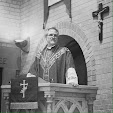
Tuesday, January 08, 2008

Emerging Luther?

The latest trend in the American religious scene is the Emerging Church Movement. It is largely a reaction against the phoniness of the Church Growth Movement and a bucking of the trend toward the megachurch.

Missouri Synod leaders - especially those engaged in youth ministry - are intrigued by the movement, and are not only trying to co-opt Emerging approaches to evangelism and worship, they are actively seeking leaders of this movement from outside Lutheran circles to instruct LCMS pastors and laity as to how to implement these methods in a Lutheran context. This is happening at the synodical, district, and local levels of our church body.

The LCMS sponsored a Youth Ministry symposia featuring noted Emergent Church Movement guru Dan Kimball:

“EMERGING FROM WHAT? EXPLORING MINISTRY WITH YOUNG ADULTS.” This year’s symposium will take a serious look at how the church can be in ministry with the post-high school, twenty-something young adult. Why do we lose so many? And why does no one seem to care? How can we engage them in the life of a congregation? And what is this “thing” that has come to be known as the “emerging church?” Dan Kimball, author of “The Emerging Church,” “Emerging Worship,” and “They Like Jesus But Not the Church,” will be the featured speaker for the conference. Dr. Joel Lehenbauer, Associate Director for the LCMS Commission on Theology and Church Relations will lend his theological expertise. The conference is slated for January 4-6, 2008 at the J.W. Marriott Hotel at the Galleria in Houston, Texas. Conference registration is just $200 and includes three meals. Housing is available at the J.W. Marriott for only $89 per night. A registration brochure mailing will arrive in congregations the first week in September.

Rev. Dan Kimball's wrap-up of the event can be found here.

Kimball's "What Would Luther Do?" ponderings are really very interesting, especially in light of the fact that the early Lutherans had an Emerging Church Movement of its own during Luther's reformation - and it wasn't Luther. Rather it was Luther's friend and colleague at the University of Wittenberg, Andreas Karlstadt.

During Luther's 1521 exile to the Wartburg Castle, Karlstadt took temporary leadership of the reformation movement, and implemented many Emergent methods nearly five centuries before the current Emerging movement.

Karlstadt made radical changes to the cultural landscape of worship. He abolished the traditional vestments in favor of casual attire - which he wore while officiating over worship. He distanced himself from academic life, stressing his lived-out life among the ordinary people. He rejected being called "Reverend Father" and instead sought to be addressed more casually as "Brother Andreas." He made radical changes to the liturgy and music of the church. He removed the Apocryphal books from the Bible. He also rejected both infant baptism and a belief in the Real Presence in Holy Communion (both of which mirror the beliefs of the vast majority of modern day Emergents). Furthermore, Karlstadt certainly had his finger on the pulse of youth, given his marriage at the age of 38 to a 15-year old girl.

Karlstadt was really the father of the Emerging Church Movement in Lutheranism. So, What Did Luther Do?

Luther was so outraged, he returned from exile and removed Karlstadt from the ministry. Martin Luther was no radical, no revolutionary, no Emergent Leader.

Luther (and those who were later pinned with the name Lutheran) never abolished the Mass. They believe Jesus is physically present in the elements, that when the pastor consecrates the bread and wine, they are truly changed into the body and blood of Jesus. In fact, Luther condemned those who did not believe this as heretics - refusing even to consider them Christians! I don't agree with Luther on this, but I don't think Luther should be misrepresented by those he himself would have not considered to be fellow Christians.

Luther retained the traditional priestly vestments. He retained the traditional address of the pastor as "Father." In areas where it was politically and ecclesiastically possible, the Lutherans retained the bishop-priest-deacon division of the Office of the Holy Ministry - including the apostolic succession of bishops (as is the case to this day in Lutheran Scandinavia, Russia, the Baltics, and Africa). Luther (and Lutherans) believe in baptismal regeneration (and thus infant baptism) and the pastor's authority to hear confessions and forgive sins by delegated authority of Jesus Himself.

Whereas Karlstadt eliminated the elevation of the consecrated host in the Mass, Luther restored it. Whereas Karlstadt called for the abolition of statues and traditional art and music in the church, Luther restored them. True enough, Luther translated the Mass into German (as well as the Bible) and wrote hymnody, but these hymns were not (as is often asserted by urban legend) drinking tunes or bawdy pop songs. Luther's hymnody is dignified and rich, to the point where Johann Sebastian Bach arranged many of his melodies.

And while Luther translated the Mass into German, Latin Masses were still being sung in Lutheran territories into the 18th century. Until American Lutherans began to speak English, Lutheran Bibles contained the Apocrypha. Lutherans (following Luther's example) were not anti-tradition. In fact, the Lutheran default position on tradition was to retain it wherever possible. The only time tradition was jettisoned was when such traditions were contrary to scripture and the Gospel. The Lutheran Mass was virtually identical to the Roman Mass - with the exception being the part of the Roman Mass known as the canon. Luther greatly simplified the canon for the sake of the Gospel. other than that, Luther retained the sign of the cross, genuflecting, bowing, and nearly every other traditional ceremony. The early Lutherans also retained the Hail Mary prayer, the Feast of the Assumption of Mary, belief in the perpetual virginity of Mary, and even belief in the immaculate conception. While these did not have the force of canon law among the Lutherans, it's simply a fact that the Lutheran fathers believed in these doctrines and taught them. Early portraits of Lutheran leaders show them clutching rosaries.

Finally, the very heart of the Emerging movement is an accommodation of postmodern epistemology. In other words, there is a great deal of subjectivity in the Emerging movement. It is often hostile to "denominationalism." Lutheranism, by definition, draws an objective boundary around the faith in terms of specific confessed doctrine. Lutherans, by definition, confess a particular collection of historic creeds and confessions known as the Book of Concord, and do so without reservation. Such confession is seen as terribly constraining by the Emerging movement, and we are told again and again that such "denominationalism" is a stumbling block to "reaching the youth."

In my own experience as a high school campus pastor, I was admonished by a school board member: "The kids don't need all that Book of Concord stuff. They just need to know that Jesus loves them." There is an increasing belief among Lutherans that confession and doctrine are antithetical to evangelizing young people.

For all of the current LCMS "Ablaze" rhetoric about "saving the lost" and the need to use innovations for the sake of people who are going to hell, there is a rather obvious elephant in the parlor. Many LCMS leaders (at synod and district levels) are almost panic stricken at the decline in numbers within the LCMS. Kimball cites that Terry Ditmer (the Youth Ministry leader of the Missouri Synod) opened the symposia by presenting numbers and statistics about teens in the LCMS. I believe the real underlying panic is not so much hellfire as it is a "brand loyalty" and "shrinking market" approach to Lutheranism, specifically the corporate entity known as the Missouri Synod. The LCMS is treated as though it were a corporation with a product to sell, and is in need of some serious changes in marketing philosophy in order to retain its place, let alone expand, in the market. This explains the increasing reliance on corporate strategies and the constant citations and endorsements of books about business marketing and CEO-style leadership being endorsed by LCMS officials. I believe this shows a lack of faith in the Holy Spirit as well as a flawed ecclesiology. The "market share" approach to evangelism always appeals to the whims and vagaries of the current culture.

But Christianity has always been counter-cultural. The early martyrs of the Christian faith were willing to die for their confession, their objective confession of Jesus Christ. They did not seek rapprochement with the larger culture - not even for the sake of making the Christian faith appeal to outsiders. They did not try to change the nature of Christian worship to appeal to Pagan teens, nor did they strive to reinvent the terrible and horrendous image of Christianity for the sake of marketing the faith to non-believers. Instead, they went to the stake and the arena singing countercultural hymns and dying faithfully to the bafflement of the non-believer. But look what happened. The Holy Spirit worked through these countercultural "martyral" Christians. Mission work was done by standing against the anti-Christian culture, not by making the Church look more and more Pagan, nor by watering down doctrine and practice into a subjective mush for the sake of marketing and appeal to youth.

I believe the Emerging Church Movement is completely contrary to the Lutheran tradition and confession of the catholic faith. The two are like oil and water. Lutheran leaders who see the "success" of the Emerging movement and strive to do the same things in our context will ultimately follow Karlstadt's path. What did Karlstadt do? He left the Lutheran confession of the faith and served as a Reformed minister who was quite open to many Anabaptist doctrines (Luther condemned the Reformed as not even Christian, while the Lutheran confessions explicitly condemn many Anabaptist doctrines as false).

I don't agree with Luther's position that those who confess Christ and yet deny the Real Presence in the Holy Sacrament of the Altar are not Christians. However, I do think a lot of Christians - including many in the Emerging Church Movement - are deluding themselves when they try to wrap themselves in the mantle of Martin Luther. I also believe Lutheran dabblers in Emergism are on a path away from the confession of the faith per our confessional symbols, and have chosen to embrace Karlstadt over Luther. I believe the Lutheran path is to stand for the Gospel, to cling to tradition where it does not contradict the Gospel, and to avoid the ebb and flow of an ever changing cultural landscape, instead clinging to the unchanging confession of the immutable Triune God, into whose name we have been regenerated through Baptism, and by whose grace we have communion with Him in the Mass.

Anything else is, by definition, not Lutheran.

Sunday, January 06, 2008

Sermon: Epiphany


6 January 2007 at Salem Lutheran Church, Gretna, LA
Text: Matt 2:1-12 (Isa 60:1-6, Eph 3:1-12)

In the name of + Jesus. Amen.

Today, the thirteenth day after the Festival of our Lord’s nativity, the day after the Twelfth Day of Christmas, is called “Epiphany.” Today begins our Carnival season, in which we feast with joy, celebrate, proclaim anew the joys of the Lord with parades and festivals – even as we prepare to bid “farewell to the flesh” (which is what the Latin behind “Carnival” means) with the coming of the fasting of Lent.

In the midst of this world’s cycles of feasting and fasting, in the ebb and flow of this existence of joy and sorrow, of life and death, of the pulsing rhythm of celebration and somberness – this day and season of Epiphany is a time of joy.

“Epiphany” is a Greek word that means a shining of light, a revealing, a manifestation, or a showing. For when we are in darkness, we can’t see anything. Nothing can be shown to us. We are lost and don’t even know where to go to get out of the darkness. But once the light shines, the truth is revealed to us in the blink of an eye, and we can be shown where to go.

In His creation of heaven and earth, on the first day, the first thing God created was light. The primordial darkness of chaos and disorder gave way to the Creator’s plan of revelation and order. Light is something to be shared, for God doesn’t need light to see, but we, His humble creatures, do. The Lord God gives His creatures light so He can reveal Himself and His good and glorious creation to them.

But we sinners, we who have corrupted that creation, prefer darkness to light. Why? Because our sinful deeds can be hidden in darkness. The true distorted image of the monsters we have become thanks to sin is exposed by light. But in His mercy and grace, the Light of the World, God of God, Light of Light, has come to take away our ugliness, to restore our beauty, to replace chaos with order, and to bring us once again happily into the light.

“Arise, shine, for your light has come!” proclaims Isaiah. This is good news. God’s glory has come, not to burn out our eyes, not to destroy us with His brightness, but rather to bring us out of our lonely darkness, “then you shall see and become radiant, and your heart will swell with joy.” For the promised Light to come into our midst doesn’t merely expose our sin, but rather burns it away in a radiant blast of restoration and healing, so that we creatures, originally made in the image and likeness of God, may once more shine with His glory as His icons and children.

This prophecy of Isaiah concerning the Light was set into motion when the Light of the Word was ignited in the lamp of the Blessed Virgin Mary’s womb. This glorious Light could not be suppressed, as even the creation itself shone, manifested by a star that led the magi to the Christ child, who was to become a beacon of hope in a dark and dismal world.

But once more, there are those who thrive on darkness, whose deeds are wicked, they who see light as a threat of exposure of their evil. King Herod was one such friend of darkness. The star which shone upon our Lord Jesus Christ, the King of Kings, also illuminated the false claims to the throne by the tyrant Herod and his parasitic family. This Light was no friend of Herod’s, and Herod sought to extinguish the Light.

But the Light was the hope of the world – not merely the hope of Israel. For as Isaiah preaches: “The wealth of the Gentiles shall come to you… gold and incense, and they shall proclaim the praises of the Lord.” The magi, Gentiles from far away, brought these royal and priestly gifts, created things of beauty to be laid at the feet of the almighty Creator who has come to His creation as an all-humble Child. Gold, the precious metal of royalty, and incense, the beautiful aroma of priestly sacrifice and worship of Him who is surrounded in the smoky clouds of holy prayer, along with myrrh, a perfume of anointing, a symbol that this boy King and Priest is also the Christ, the promised Messiah, the “Light to Lighten the Gentiles and the glory of the people of Israel.”

On this day when the Magi came to worship before the King, the false king and his master Satan would not succeed in bringing about the darkness. The Light has been manifested in a glorious epiphany to Jew and Gentile alike, uncreated Light beaming within a newly enlightened creation. Thirty years later, the darkness would make a grab at this Light, and would even cover the earth for three hours while Light and darkness would make battle – but darkness will be forever destroyed, as the Book of Revelation, itself an epiphany of the Light of the World, reveals to us that in the New Creation, we, those redeemed by water and the Word, those enlightened by the Lamb: “will see His face, and His name will be on their foreheads. And night will be no more. They will need no light of lamp or sun, for the Lord God will be their light, and they will reign forever and ever.”

This is what Paul means when he proclaims: “it has now been revealed by the Spirit to His holy apostles and prophets, that the Gentiles should be fellow heirs, of the same body, and partakers of His promise in Christ through the Gospel.”

The magi, wise men who did not belong to the race of Israel, were nonetheless given a revelation of the Light, and their darkness was removed by the shining of the Christ child’s face, by the epiphany of “the manifold wisdom of God.” The Light of the World has come for all, for Jew and Gentile, “for us men and for our salvation” – “according to the eternal purpose which He accomplished in Christ Jesus our Lord, in whom we have boldness and access with confidence through faith in Him.”

Dear brothers and sisters, let us glory in this light. Let us not fear the light, and God forbid that we should revel in darkness and seek to extinguish this Light. When the light reveals our sin, let us use this light to examine ourselves, to confess our sins, to repent, and to once more glory in the warm, radiant light of our Lord.

Let the Word of the Lord continue to bring us to the Word made flesh, even as the glorious star led the wise men in their pilgrimage. Anything that leads us away from Christ only leads to darkness, to the cold, lonely, and frightening prison of our broken and distorted sinful nature. But when we are led to where our Lord Jesus is present – in the epiphany of Holy Communion, in the manifestation of His preached Word, in the bosom of our Mother the Church, which cradles our dear Lord’s body just as His virginal mother cradled Him when the magi followed His star and presented Him gifts – we can bask in the glow and warmth of His holy light, without fear of the ugliness of our sins – for they have been taken away.

And though we still observe the epic struggle between good and evil, the constant back and forth of night and day, of sin and repentance, of the glory of goodness and the terror of evil, the cycle alternating between feast and fast – we know that the time of this up and down, back and forth, is coming to an end.

The epiphany of our Lord Jesus, His glorious manifestation of light to the magi, and to us, in this vale of tears, is but a glimpse into the eternity to come when darkness will forever be extinguished, when daylight will never yield to the night, when the “Morningstar… fair and bright” will “transport us to that happy place beyond all tears and sinning.”

To You, O Lord, all glory be
For this Your blest epiphany;
To God, whom all His hosts adore,
And Holy Spirit evermore. Amen.

In the name of the Father and of the + Son and of the Holy Spirit.” Amen.

Friday, January 04, 2008

High Def, Low Quality

The day had finally come for the old Hollywood Family television to go into retirement. A relic from the last millennium, the old faithful set was beginning to dim, its heavy glass cathode-ray tube not quite what it once was back in the days of Grunge Rock and the first George Bush.

Father and Mrs. Hollywood resolved to abstain from swapping any Christmas gifts in lieu of buying a flat screen TV this year. Our congregation, in a very sneaky fashion, right under my nose, took up a secret collection during the Divine Service to give the Hollywoods a monetary gift for Christmas. And my goodness! How generous the people of Salem Evangelical Lutheran Church truly are! We were absolutely stunned. And knowing that some of my parishioners are reading, thank you so much!

We bought a brand new Westinghouse 26-inch LCD High Definition TV from Target (as we call it in these parts: Chez Tar-ZHAY).

Oh my goodness!

Not only is the picture beyond belief, but we get more channels! We don't have cable, but the trusty rabbit ears draw in a lot of TV stations. It's like "poor man's cable". We even get Telemundo - and it is every bit as melodramatic and cheesy as the SNL parodies with Horatio Sanz.

I now get three channels of Religious Wacko TV (a must for Lutheran pastors - we all seem entranced by this stuff). I can watch Benny Hinn pretty much on demand. I also saw a Pentecostal preacher preaching a "sermon" about paying bills and relying on ourselves to get out of debt and not seek co-signers for loans. Good advice. What it has to do with Jesus, the Church, the Christian faith etc. is beyond me. Lot's of Ay-MANs and raised hands, though. One lady started literally running in place and making funny faces. And no, this was not a commercial for a new exercise gadget. This kind of thing never happens in congregations that use the Nineteen By God Forty One Lutheran Hymnal - I can tell you that!

Hey, what's up with Benny Hinn's new outfit? When he's on camera, he wears this black Nehru jacket with a white shirt underneath. It has a set of buttons down the center. On first glance, it looks like a traditional Roman cassock! Gads! And when he is "preaching," the "cassock" is all white - like the one worn by the pope. I was disappointed, however, that this time there was no blowing on crowds of people turning them into a quivering mass of flesh. That trick is always good for a few laughs. However, this time he was in Latin America and had an interpreter prancing along with him, step for step, in a sort-of Pentecostal tango. He even managed to translate Benny's "speaking in tongues" gibberish into his own non-Spanish gibberish. Now there's a trick that not even the Holy Ghost has pulled off - English "tongues" to Spanish "tongues" that nobody can interpret anyway. Impressive! Even better than Telemundo!

There is also a woman "preacher" named "Pastor" Melissa Scott, who actually wears a clerical collar and lectures using the Greek text of the Bible. I came to learn that she is the widow of the famous Dr. Gene Scott of California. The Granola State, of course.

I was introduced to her dead husband Dr. Gene Scott's TV antics by one of my professors - an aficionado of wacky religious television programming (as nearly every Lutheran seminary professor is, whether he admits it or not). It seems that the late Dr. Scott had a legitimate Ph.D. and was an ordained minister of the Assemblies of God. He had a TV ministry in which his eccentric personality was front and center. He would drink "adult beverages" and smoke cigars on camera. He would use mild profanity and threaten to stop the show unless donations be phoned in right then and there. He wore funny hats and glasses and would engage in irreverent banter with the staff. He was a little like the late-night movie hosts, and often "preached" about UFOs and the Great Pyramid as having relevance to end-times prophecies. Deliciously wacky!

It seems that at some point, he brought in bikini girls to put in the front row of the studio as "eye candy." One of them, a porn star who used the pseudonym Barbi Bridges (whose real name was Melissa), became quite friendly with the preacher who was old enough to be her father. She ended up becoming his fourth wife, and inherited the "ministry" from him upon his death. To quote the Church father Tertullian: "I believe it because it is absurd." You can't make stuff like this up.

Anyway, this is where "Pastor" Melissa Scott comes in. Upon her husband's death, she declared herself a "pastor" and took control of all the "church's" assets (the congregation claims to be downtown Los Angeles' largest Protestant church). She apparently leads a pretty extravagant life and has some of her husband's quirky traits when teaching - though she seems to lack his brilliance.

An Anglican deacon from Tulsa has a blog article about her "prowess" with the Greek language that you can read here. What he observes is absolutely correct, and exposes "Pastor" Melissa as a fraud, a phony intellectual, a false prophet, and a scam artist.

Later on in my surf through religious TV-land, a well-heeled Oral Roberts, Jr. was lecturing about (what else?) money, offerings, and "first fruit giving" to his ministry. A flashing "$100" appeared at the bottom of the screen. On the new TV, this looked like a Las Vegas marquee. Anyway, the Reverend Roberts was exegetically explaining a passage from Genesis (4:3ff) in which Cain's grain offering is not accepted by God, whereas Abel's offering of blood was accepted. Roberts opined that Cain's offering was refused because he dragged his feet about it, instead of giving promptly. He argued that the text which reads "In the course of time..." (Gen 4:3) could be interpreted as "Whenever he got around to it..." Of course, if God is to accept our donations to Oral Roberts, we need to be quick about it. Otherwise, God might not bribe us with blessings, and Roberts might miss a Mercedes payment. Did I just type that last part out loud?

Interesting exegesis. The Hebrew word used here is a form of the verb HYH, translated as "to come to pass" or "to become." My Hebrew is very rusty, so I did the "Old Iowa Trick" (thank you Dr. Scaer) and checked the LXX (Septuagint Greek) translation for a little help. Lo and behold, the Greek text of Gen 4:3 reads: "kai egeneto..." - a common New Testament expression that is often translated: "And it came to pass that..." or "And it happened that..." and so forth. This is just the narrator's way of moving the story along and has nothing to do with Cain's lack of speed in "showing God the money."

Bunch of liars, charlatans and thieves! And then there are the secular shows which are about as heathen as the "Christian" programs!

I was flipping through the channels and caught a few minutes of Boston Legal. I have never seen this show before. There was a nun serving as a courtroom interpreter (which would never happen in the real world). The witness is speaking Spanish. The nun translates his testimony using words that can be interpreted in a sexual way. She goes on and on using a word that is often applied to male genitalia. It would have been very funny if I were in fourth grade, I suppose. Do adults really laugh at stuff like that? Later in the program, a lawyer gives a passionate monologue about how abstinence education kills people, how the condom is the greatest invention in the last 2,000 years (Mr. Edison, please pick up the white courtesy phone...), and how schools need to distribute condoms - all the while the camera was focusing on a 15 year old girl while the word "condom" was repeated ad infinitum. The judge was a stereotypical comic prude. This was pure, unadulterated political advocacy and - especially when combined with the earlier scene with the nun - an explicit attack on conservative Catholic Christianity and traditional Christian values. I can only wonder if Nancy Pelosi will be calling for the "Fairness Doctrine" in response. But I won't hold my breath for Congress to act.

During the program, I continued to surf the channels. I landed on a Family Guy episode that was using the very same word used by the nun in Boston Legal that is a double entendre for male sex organs. It was even more un-funny the second time around. Now, we can't blame this lack of creativity on the writers' strike, since these were already written before. This is all they've got, I guess. I guess that's the price we pay for rampant illiteracy and hands-off parenting.

Then there was the visit of pop singer Justin Timberlake on Jay Leno's Tonight Show that featured a skit in which Timberlake cuts a hole in a box, puts in his male genitalia, and gives the box as a present. Leno presented Timberlake with a long list of various slang terms for the male organ that he could get away with on network TV. Again, do adults really find this funny? (And what's that sound coming from Johnny Carson's grave?).

There is a lot of low quality in high def. And just think, if I had cable, I could actually pay for even more crap!

However, football really looks good in high definition. Really. I expect overthrown passes to fly right through the screen and knock out my window! Wow! The news is also now broadcast in high def - and it is impressive to the eye. I can actually see what the New Orleans fugitives look like when Crime-stoppers shows their mugs. Our movies (including Lion Boy's Spiderman and Blue's Clues DVDs) all look a lot better than on the old ever-dimmer CRT-based television from the last century. And the HBO Rome series - again, wow! Not for children though - especially in high def. Severed heads and full-frontal nudity are much more explicit in the new format. But so are the magnificent costumes, sets, and intense acting. Phenomenal!

Like anything else, technology can be both good and bad. But if you're going to watch TV, you might as well see it in its full glory - especially when Benny Hinn is doing his magic tricks and the porn-star preacher is messing up the Greek alphabet. Besides, next year, the old TV won't work anyway.

Just don't expect televangelists to get any more orthodox and less fraudulent in the new format.

Do we sleep in our Clericals?

While attending seminary at Concordia - Fort Wayne, I learned about our school's "high church" reputation - which gave rise to a lot of silly stereotypes. One of them is that we sleep in our "clericals" (black shirts with white collars).

On one occasion, we had some fellow seminarians from our sister seminary in St. Louis visiting us at Fort Wayne. One of them was sincerely stunned to see seminarians who were not wearing collars. He was very pleasantly surprised to see this stereotype was not true. Of course, I was wearing my clericals during his visit, and was puzzled why he thought clericals were a bad thing.

The clerical collar is the pastor's best "evangelism tool." When I walk around my neighborhood, everybody knows that I am one of Jesus's Guys. If they want prayer, if the have a question regarding the faith, if they need spiritual care - they know exactly where to go. I get stopped at the gas station, at the grocery store, at restaurants, at the airport - anywhere I may be found in clerical attire - and they know I am a Christian clergyman.

They also know that I am some kind of priest. There is a sense of gravitas associated with the clerical uniform. They know I'm not a televangelist, nor a screaming stereotype of an entertainment-style preacher. I don't preside over a coffee-shop "church," but rather I'm the type who hears confessions and gives Last Rites. They would not know this if I were in "mufti" or wearing a trendy golf shirt with the Corporate Logo of the Lutheran Church - Missouri Synod and the Ablaze!(tm) trademark on the front pocket.

By virtue of the public nature of clerical attire, they also know I'm not ashamed of Jesus, nor of the Gospel, nor of the vocation I - unworthy as I am - hold. If they encounter me near my home and church, I can let them know where I serve and when our services are. And if an emergency happens, I can generally pass through hospitals, and can have access with police, military, and other emergency personnel.

Do we sleep in our clericals? Not usually, but I did on Christmas day. After five sermons in five days (four Masses, one funeral, as well as several hospital and shut-in calls, as well as a death-bed visit), I was pretty tired come Christmas. After Christmas morning Divine Service, the Hollywood family visited with a neighbor (who is not a parishioner of mine) for Christmas lunch, after which, we went home.

After assisting Lion Boy with the opening of presents, I flopped into bed - still clad in my clerical attire. I awoke after three hours. Furthermore, I was not wearing the "tab" collar, but rather the very constraining Anglican "dog collar." But I slept like a baby.

I guess some stereotypes are true after all!

Anyway, some of Fr. Hollywood's readers might enjoy a satirical blog out there called "Priestmanship". Here is a post regarding clerical dress.

And, no, I do not write this blog. I have nothing to do with it. I have to say that because, for some reason, every time a blog associated with Lutheranism that is satirical or is some kind parody appears, I'm accused of being the author. I think I may know who the Priestman is, but my lips are sealed. But it isn't me, so stop the gossip right now!

I would point out, however, that the typical rules regarding clerical attire don't apply in New Orleans. First of all, we are Southerners - with all the baggage that carries. Secondly, we are Louisianans - in the francophone "biretta belt" of the South. Third, we're New Orleanians. We have to drive many miles north to get the the southernmost point of Mississippi. We live in a city known for a strange and seemingly contradictory mix of traditionalism and individual eccentricity.

It is perfectly acceptable for a Lutheran pastor to walk around the neighborhood (or even ride a bicycle) clad in a Roman cassock with a rope cincture tied around his waist. The response will either be 1) nobody will bat an eye - this is New Orleans, or 2) one will be greeted (in the utterly unique "Yat" accent) with a "How ya doin', fawthuh?"

I would also add that the rope cincture is helpful in New Orleans as a handy aid for twisting off bottle tops.

"But You're Smart!"

More evidence of our culture's hatred of motherhood, family, marriage, children, and (especially) the holy and honorable vocation of wife.

This was written by a 19-year old Christian girl. Notice that even setting one's sights on becoming a nurse is considered menial and demeaning! Can you just imagine a world where all children become doctors and lawyers? Scary!

This young lady's anecdote calls to mind a similar story from our Traditionalist Roman Catholic friends who live on a Texas farm. One of their very bright, educated, cultured daughters - who was a pre-teen at the time - was asked by someone about what she wanted to do when she grew up. Her reply was something to the effect of "get married, have children, and raise horses." The interrogator was taken aback and asked: "Don't you want to be a doctor or lawyer?" The girl's answer was brilliant and reflected the family's confident counterculturalism: "No, that's what YOU want me to be."

Wednesday, January 02, 2008

Hollywood baby goes Hollywood?

A little girl baptized by Father Hollywood (a Beanie baby?) "went Hollywood" last year as the 2007 spokesmodel and cover girl for Graco (she was selected by an internet poll).

Little Grace is shown at left with her mother Carole, a former teacher at Salem Lutheran School.

I had neglected to mention this before, but was reminded today when I ran across a thank you card from Carole for officiating at Grace's baptism. Hey, any excuse to brag on my parishioners will do!

Unfortunately, Mom, dad, and baby moved a good distance away after Hurricane Katrina - which was a huge blow to our parish as they were such a big part of our Salem community. They live so far away that they really can't be part of our community as they were before. So, I don't know how long I will ultimately get to brag about having them as my parishioners - but we all know such glory is fleeting anyway. However, the glory of Holy Baptism is eternal, for Baby Grace has been given eternal life by Divine Grace.

Grace and her parents will reign not just for a year as representatives of a company, but will rule unto the ages of ages as children of the King of the universe!

Tuesday, January 01, 2008

A Culty New Year?

For the time will come when they will not endure sound doctrine, but according to their own desires, because they have itching ears, they will heap up for themselves teachers; and they will turn their ears away from the truth, and be turned aside to fables. - 2 Tim 4:3-4

This evening, I received a sales call from "Bridge Publications" - which is the publishing company of the Scientology cult. This, in spite of the fact that my home phone number is registered with the National Do Not Call Registry - with whom I promptly filed a complaint.

Yesterday, followers of a cult leader named Yisrayl Hawkins (real name "Bill" - which is somehow just too bourgeois for a cult leader, not nearly as sexy as "Yisrayl") left a newsletter under the wipers of my car (which seems to be a violation of the seventh commandment to me, messing around with parts of my automobile without my consent). The Hawkins cult ("The House of Yahweh", so-called) is one of the many groups trying to predict the date of the end of the world. Yawn. Like other cults and sects - such as the Jehovah's Witnesses - Hawkins has failed in several predictions already, and yet amazingly, still has devotees. An article on Wikipedia has all the details. Pathetic, really.

Interestingly, both Scientology and the Hawkins cult are both forms of Gnosticism - based on the Greek word "gnosis" meaning "knowledge."

The Scientologists claim to have knowledge not revealed to anyone else - other than the science fiction author L. Ron Hubbard. Interestingly, "science" (and Scientology) is a derivative of the Latin word "scio" meaning "I know."

Hawkins' "House of Yahweh" cult is also Gnostic - relying on a kind of "decoding" of biblical texts. Hawkins claims to have found scriptural evidence regarding "global warming" as a payment for human sins. In the newsletter left on my car, there is no mention of Jesus's crucifixion as payment for human sins.

Hawkins' technique is clearly Gnostic. He cites Scripture in a piecemeal fashion, while insisting that God is only to be called "Yahweh" and Jesus is only to be called "Yahshua." By using a sort-of lexicon of code-words, he is implying that he "knows" something that the rest of the world doesn't. He also uses altered names of some (but not all!) biblical books. For instance, He refers to Isaiah as "Isayah"; Matthew is "Mattithyah"; James as "Yaaqob"; John as "Yahchanan" - while other books inexplicably retain their traditional English names, e.g. Revelation, Luke, and Hebrews. In other words, although New Testament books are written in Greek - Hawkins renames some of the books with Hebraicized names, while retaining the English names for the others. Why he changes the name of Isaiah isn't clear - nor is the spelling of his adopted name "Yisrayl" (if we transliterate the Hebrew into English, it would look like "Yisrael." I don't know where he gets the second "Y").

Hawkins also reveals the shocking (shocking, I tell you!) revelation that December 25 is not Jesus's birthday, and that Jesus actually rose some time in the middle of the night before Easter Sunday morning (of course, we historic, traditionalist Christians have been celebrating Easter Vigil after Sundown Saturday night since the earliest centuries of the Church, and never refer to December 25 as "Jesus's Birthday" but rather the Festival of the Nativity).

The argument over how to spell our blessed Lord's name and the use of God's sacred Hebrew name is absolutely silly - since neither "Yahweh" nor "Yashua" are Hebrew. These letters do not exist in the Hebrew alphabet. These are transliterations, not the original Hebrew. Furthermore, the proper transliteration into English of the Divine Name is YHWH - since the Hebrew of the Old Testament lacks vowels. Nobody knows which vowels come before the two H's. Finally, we speak English. The New Testament was written in Greek. The Greek name transliterated as "Iesous" (or perhaps as "IHSOUC") is translated into modern English as "Jesus." This is no different than my name being "Larry" in English, "Lars" in Swedish, "Laurent" in French, and "Larrius" or "Laurentius" in Latin. I can't even imagine what my name would be in Japanese! There is nothing to be gained by refusing to use the English translation and standard transliteration of the New Testament's Greek and substituting an invention of one's own. This is a red herring. This has nothing to do with the Christian faith. This is part of the Gnostic appeal.

What is more interesting about Hawkins' newsletter is not so much what is there, but rather what is not there. There is nothing about the cross, the atonement, the forgiveness of sins, faith, nor anything incarnational or sacramental. There is no "we preach Christ crucified" to be found. There is nothing at all about faith. There is a lot of law - much of which has to be wrung out of the texts by clever hermeneutics.

Cults - be they Scientology, the House of Yahweh, the Bible Codes, the various Messianic sects and cults, or any other claim to "secret knowledge" - all focus on one very narrow part of Christian doctrine and go off on a tangent. They become bogged down in details while missing the overarching biblical narrative.

Christian doctrine is biblical doctrine - and the Bible is not a collection of data, of proof texts, of unrelated factoids. Rather it is a unified narrative, a "story." It has an overarching structure. It begins in paradise, ends in paradise, and has a middle that involves a journey. The journey is a struggle to "get back home." This is mankind's story. There is the struggle between good and evil, and a Hero. The Bible is the classic template for all literature. Not because the Bible is just another story, but rather from this biblical history of fallen man in search of Paradise Restored comes the template for all literature! I discovered this from our friends in Toronto who originated New Moves - the approach to literacy being used by Salem Lutheran School. All epics, all mythology, all really good fiction, involve (at least on some level) this universal human theme.

Without seeing the "big picture" - the overarching theme of Holy Scripture, a person is left with a myriad of unrelated facts that make no sense at all. But in seeing the big picture, in treating the Word of God as an organic whole, there is a unifying principle - a thesis that ties together sin, death, sacrifice, incarnation, redemption, re-creation, and life. In relating Genesis to Revelation, a cogent picture emerges - a picture of our Lord Jesus Christ, His mission, His ministry, and His kingdom.

That overarching theme of the biblical narrative is known as "the Gospel" - the Good News of redemption. This is the thing the cults lack, being sadly bogged down in minutia designed to imply that the cult leader has some secret knowledge (gnosis) - when in fact, he has no knowledge of the Good News at all. He is a pathetic "man behind the curtain" seeking the unquestioning loyalty of personal devotees.

There is nothing hidden in the Bible - unless you consider something "hidden in plain sight" to be hidden. The words of Scripture are right there. The Gospel is not locked into codes or lurking about in mysterious Greek or Hebrew. The Gospel can (and most certainly is) translatable into every human tongue. There is much (very much!) to be gained by reading the Bible in the original languages (just as any other translated work is best read in the original) - but there are no lurking secrets. Any ambitious, disciplined, and reasonably intelligent person can study Biblical Greek and Hebrew, either in a classroom or on one's own, and can certainly benefit greatly. No biblical teacher or theologian has any secret revelation - neither from God nor from a Gnostic reading of the Bible. Any person can learn the original languages and read, just as any literate person can benefit from reading the Word of God.

Our Lord Jesus is called in John 1:1 "the Word." Words convey a message. Words mean things. Words are not secret codes and ciphers only known to those with special gnosis or scientia. This is what separates the Christian faith from cults. The Christian faith is laid out (revealed, revelatus) before you in the revelation of Holy Scripture - not hidden in secret codes only to be unlocked by some self-declared prophet with secret knowledge.

Well, I guess we've been warned:

For false christs and false prophets will rise and show great signs and wonders to deceive, if possible, even the elect. (Matt 24:24).

Even so, come, Lord Jesus! (Rev 22:20).

Sunday, December 30, 2007

Sermon: Sunday after Christmas


30 December 2007 at Salem Lutheran Church, Gretna, LA
Text: Luke 2:22-40 92 Sam 7:1-16, Gal 4:1-7)

In the name of + Jesus. Amen.

The Creator of the universe doesn’t need a house to live in. He doesn’t need to dwell in a body of flesh and bones. He is not obligated to live in the prison of space and time, like we are. The cartoonist lives outside of his drawings. The software programmer lives apart from his instructions to the computer. The sculptor lives beyond the block of marble he transforms into something beautiful.

Human imagination has long wondered what it would be like for an author to step inside of his own story, or a painter to suddenly find himself stuck on his own canvass, or a computer gamer to find himself trapped in a video world with fantasy weapons, animated monsters, and the looming threat of “game over.”

And yet, we have just celebrated the incarnation and birth of God into the world He created from nothing. Our God is not merely a figment of our imagination, like a genie that lives inside a lamp, or a spirit that dwells in a stone idol. For our God, the eternal God, the Triune God, is the One who has always been, who created all matter, and who set time itself into motion “in the beginning.” And yet, according to His plan to repair the damage we have done to His creation, He humbles Himself to step inside His creation, to enrobe Himself with flesh and to bind Himself to time. He meets us where we are in order to rescue us.

In our Old Testament lesson, King David is upset that God dwells in a tent while the king lives in a palace. He wants to surround the Lord’s Presence among the people with dignity and beauty – and God tells the prophet Nathan to express His approval of David’s desire.

For ugliness is of the devil. Beauty is of God. Ugliness results from chaos, breakdown, and violence, while beauty is the result of order, building up, and peace. Beauty inspires and calls us to cry out to our Creator. Furthermore, as the people of Israel were ceasing to be nomads and were becoming permanent inhabitants of the Promised Land, their God could now establish a permanent Temple in which to dwell, a place of beauty, awe, and majesty.

And yet, the real House of the Lord is the Eternal Kingdom to be established by the Seed of David – “who will come from [David’s] body.” The Temple would be built by David’s son Solomon – whose name is derived from “Shalom” (meaning “peace”). And this Temple was to foreshadow the New and Greater Temple: the Greater Seed of David, the Prince of Peace, in whose flesh the fullness of the Godhead was to dwell.

Jesus Christ is this Temple, the Temple that was destroyed and rebuilt in three days, the Temple in which the glory of the Lord shines with uncreated light, the One whose very flesh and blood give eternal life.

Though God is everywhere, like the radio waves and television radiation that bombard our bodies 24 hours a day, we only receive His gifts, hear Him, see Him, experience Him when He chooses to reveal Himself to us in space and time – in the same way that without an antenna and a receiver, radio and TV signals are part of the unrevealed “all things invisible” as opposed to the revelation of the “visible.”

By His grace, God becomes visible, He is able to speak to us, He is able to be heard, He is able to be understood, and He has wonderful news for us!

Notice how God emphasizes His Real Presence in space and time in our Gospel. First, we are in the holy city of Jerusalem – a name also derived from “Shalom” or “Salem” (which means “Peace”). And not just in David’s City, but we find ourselves in Solomon’s Temple, where Mary is meeting her obligations under the law. For her priestly Son Jesus is the firstborn – “holy to the Lord.” Under the law, there is to be a sacrifice.

Mary is herself a temple, for God was conceived and dwelt for nine months within her body. Her flesh was genetically transmitted to her Son, her milk nursed God, and her maternal protection gave our Lord Jesus a safe home in which to dwell with mankind.

God and the fleshly temple from which He came venture to the Temple of Jerusalem, the place where God dwells, where God forgives sins by means of sacrificial acts carried out by the priesthood. And there is another temple of sorts – a prophet in whose body the Word of God dwells. And this Word uttered by Simeon declares that the boy Jesus is “salvation” in the flesh. Another of the Lord’s “temples,” the prophetess Anna, is also there to “give thanks to the Lord” and to speak to those who came to the temple where the Real Presence of the Lord was to be found.

“And the Child grew and became strong in spirit, filled with wisdom. and the grace of God was upon Him.” For this Christ Child, this Emmanuel, this God whose mother calls Him her Savior is where God dwells in space and time for His people.

This Temple isn’t made of cedar or stone. This Temple is not a building with rooms and furniture. This Temple doesn’t contain symbolic representations of God. Rather, this Temple is made of flesh and blood. This Temple is a Man. This Temple is no idol, but is rather the living Icon of the living God. The Author has jumped into His story. The Artist has become part of his own handiwork.

Mankind can now look upon the face of God and live. Mankind can now make statues and paint pictures of God and not be committing idolatry. Mankind can hear God speak, because God has a mouth. Mankind can feel the healing and forgiving touch of God, because God has hands. Mankind can look into the eyes of God and see that God looks back at Him – not with vindictive eyes of wrath, but with gentle eyes of mercy.

But the dwelling of God doesn’t stop with the incarnation of Jesus. For God doesn’t merely want to look at us, speak to us, and touch us – as wonderful and mysterious as that is. He wants us to partake in His divine nature. He wants to become part of us – not in a symbolic way, not in a sentimental way, but in the way of physical communion. God wants every person – designed in His image – to be a Temple of the Holy Spirit. The Sonship of Jesus, through which Jesus calls God his “Abba” – His Father, is to be our sonship. For when we pray the Lord’s Prayer, we don’t address God as “Jesus’s Father,” but rather as “Our Father!” Because Jesus is the only-begotten Son of God, we are adopted Sons of God. For we are baptized into Christ Jesus, united with Him in His death and resurrection, sealed by the Holy Spirit, and given the right to be children of God (just like little Madelyn was made into an eternal temple of the Holy Spirit a few moments ago).

We baptized Christians can pray “Our Father” and mean it in a real sense. God isn’t a symbolic Father, God is not a metaphor, God is not some philosophical construction or faraway cosmic force, but rather He dwells with us, tabernacles with us, temples with us. He is as real as the baptismal water that pours over our heads, water that has been united by God’s Word to become a holy water, water that is a Temple of the living God.

God dwells with us in His eternal Word that is proclaimed by His preachers, a Word that is miraculously templed within human language. God dwells with us when He uses His ministers to speak forgiveness to us. And He dwells with us, lives in our bodies which have become a physical Temple, when His flesh and blood are placed into our bodies. Like the temple Mary, our bodies become holy shrines in which the Real physical Presence of God dwells.

And though our senses see only the flimsy tent of our bodies, only the ragged, sin-drenched canvas of our tainted flesh, the Lord God gives His promise that we are being transformed stone by stone into a living Temple. God is a God of beauty, and by faith, we do not see merely a frail and tottering tabernacle, but rather a magnificent and eternal Temple, a place where the Holy Spirit dwells in His fullness, a body that carries within it the very body of Christ, a person made in the image of God the Father, whom we, as His dear children, can call upon as our own “Abba,” to whom we can pray “Our Father,” and with St. Simeon we can sing: “Lettest now Thy Servant depart in peace… for mine eyes have seen Thy salvation which Thou hast prepared before the face of all people.”

And as sons, as heirs, the kingdom belongs to us – not by conquest or by our purchase of it, but by the free gift of God’s grace. For we are indeed heirs! For “when the fullness of time had come, God sent forth His Son, born of a woman, born under the law, to redeem those who were under the law, that we might receive adoption as sons.” And, as St. Paul continues, we have become holy temples in our very flesh, for “because you are sons, God has sent forth the Spirit of His Son into your hearts, crying out ‘Abba, Father.’”

No, God doesn’t need to live in a house – neither a palace of gold nor in a body of flesh – but he freely chooses to do so. God doesn’t need to come in the humble forms of water, bread and wine, and human speech – and yet this is just what He does. He comes to save you, to redeem you, to dwell in and with you out of love, out of mercy, out of a burning desire to be at one, to be in communion, with you. He is not driven by our being lovable – for we know and confess the truth that we are not. But rather, He loves us because He is love. And greater love has no man than this: that He would die for His friends. And He who dies among us, lives among us, dwells in us, and works through us.

“The body of God’s Lamb we eat, / A priestly food and priestly meat; / On sin-parched lips the chalice pours / His quenching blood / that life restores.” Amen.

In the name of the Father and of the + Son and of the Holy Spirit.” Amen.

Saturday, December 29, 2007

The War Against Satan

I'm glad someone is taking the war against evil seriously - while the hierarchy of the LCMS is busying itself with Ablaze, pushing contemporary worship and church marketing, selling bobbleheads of Martin Luther, and finding ways to ordain pastors with barely any education at all.

... sed libera nos + a malo. Amen.

Thursday, December 27, 2007

Sermon: Funeral of Thelma Ruth Baudean


27 December 2007 at Westside/Leitz-Eagan Funeral Home, Marrero, LA
Text: Mark 5:21-24, 35-43 (Isa 46:3-4, 2 Cor 4:7-18)

In the name of + Jesus. Amen.

Today’s Gospel reading is not only comforting, but it also demonstrates why Jesus came into the world, and why we are here today. As Christians, we aren’t here merely to mourn, but to celebrate the victory Jesus won for Ruth and wins for all those who are baptized and believe in Him.

In our reading, a heartbroken man named Jairus implores Jesus to come and heal his sick daughter. While on the way, Jairus receives the worst news any family member could receive – she has died. All hope seems lost. And yet Jesus does not turn away. In fact, He says to Jairus: “Do not be afraid; only believe.”

Our Lord Jesus continues to the house. When he tells the mourners that the little girl is merely asleep, they laugh at Him. Undeterred, Jesus puts everyone outside, tenderly takes the girl’s hand, and speaks two beautiful Aramaic words to her lifeless body: “Talitha cumi.” He tells her to wake up. And she does. Jesus’s concern for the girl’s wellbeing is even shown after He has restored her life by His suggestion that she be given food.

This powerful miracle shows us Jesus at His mightiest, and yet also at His tenderest. He loves the little girl. He uses His power to raise her from the dead. St. Mark recorded this miracle to show us what our Lord will do for us. And especially on this day as this Gospel is proclaimed anew, He wants you to know that this will happen also to our beloved sister Ruth.

Although the girl was only twelve, and Ruth was ninety, let us not fall for the false belief that Ruth’s death is normal, or somehow more acceptable to our Lord and God. Yes, Ruth led a full life by human standards, but death is anything but normal – whether for twelve-year-old daughters or ninety-year-old grandmothers. We feel profound loss when anyone is taken from us. We mourn for old and young alike. For it is not God’s will for any of us to die. He created us to be eternal.

But we, in our stubborn rebellion, in our sinfulness, have chosen death over life. We have done so since the fall in Eden. No-one is without sin, nor without the wages of sin – which is death. For “all have sinned and come short of the glory of God” as the apostle Paul testifies. And yet, Jesus is there to die for us, to pay the price for our sins, to baptize us, to take our hands, and say “child, arise.” This promise of eternal life is for all believers, old and young. For Isaiah has proclaimed to us anew today: “Even to your old age, I am He, and even to gray hairs I will carry you! I have made, and I will bear; even I will carry, and will deliver you.” This is a promise of God given to you, me, Ruth, and all of His dear children, we who are baptized and believe in Him for our salvation and life.

And as St. Paul proclaims: “We have this treasure in earthen vessels” – which are our mortal bodies that will return to clay. “We are hard-pressed on every side, yet not crushed; we are perplexed, but not in despair… always carrying about in the body the dying of the Lord Jesus, that the life of Jesus also may be manifested in our mortal flesh.”

In other words, dear friends, even in our dying bodies, our Lord is working in us – just as he worked in Jairus’s daughter and restored her life. Just as He worked through Ruth in the many ways she touched your lives in motherly and grandmotherly love. And though to our eyes, her life has ended, let us not trust our eyes (the way those who made fun of Jesus did) – rather let us trust the promise of our Lord Jesus Christ, God in the flesh, the one with the power to raise the dead.

Heed the comforting words of St. Paul: “Therefore we do not lose heart. Even though our outward man is perishing, yet the inward man is being renewed day by day… we do not look at the things which are seen, but at the things which are not seen. For the things which are seen are temporary, but the things which are not seen are eternal.”

Ruth is part of that divine plan of reconstruction. She has been called and set apart, made holy through baptism. And she was called to a life of faith – a faith validated by the Lord Jesus Himself – the One who rose from the dead, and who promises to raise all of us.

Dear friends, our mourning and sorrow are very real, but they are also temporary. Let us look forward to that day when we will be reunited. Let us follow in Ruth’s saintly example as the Lord’s baptized and redeemed. Let us fix our eyes on Jesus, the author and perfecter of our faith, the one who takes Ruth by the hands and treats her as His dear child, saying: “Talitha cumi – My little one, I say to you, arise!” Amen.

In the name of the Father and of the + Son and of the Holy Spirit. Amen.

Tuesday, December 25, 2007

Sermon: Nativity of our Lord

25 December 2007 at Salem Lutheran Church, Gretna, LA
Text: John 1:1-18 (Ex 40:17-21, 34-38; Titus 3:4-7)

In the name of + Jesus. Amen.

God was with His people, His beloved people, in the tabernacle – which was basically a tent in which God chose to be present in a special way. The Israelites knew when the Lord was present because of the cloud that served to let them know that the glory of the Lord was inside. At night, this cloud took the form of a fire. Inside the tabernacle was the Ark of the Covenant, with its special lid called the mercy seat. Under the mercy seat, inside the Ark, was the Testimony, the written record of the Law.

And while such a sight of pillars of cloud and of fire sounds frightening, the Israelites of old must have taken great comfort in knowing that their God was there for them, that He was present in their coming in and in their going out, in war and in peace, night and day – tabernacled with them.

Aside from the bright lights, this tabernacle doesn’t sound much like Christmas – but it truly is!

The same word – “tabernacle” – is used in our Gospel. “The Word became flesh and dwelt” – literally: “tabernacled” – “among us.”

But unlike the cloud in the Old Testament tabernacle, this Presence of God shows His face in the New and Greater Tabernacle: the face of a Man – Jesus Christ. The face of a baby born of a virgin mother. The face with a mouth that speaks the Word of God from the Word of God in the flesh.

And like the ancient tabernacle, He is “the light [that] shines in the darkness.” Not a pillar of fire glowing in the dark, but rather a beacon of light, of uncreated light, “God of God, Light of Light,” the Light through which men might believe, the Light that confounds the darkness, the Light that is not comprehended by the darkness.

The light of this New and Greater Tabernacle shines from His face at His transfiguration – unlike the temporary light that reflected from the face of Moses. For the Light of Christ is not simply created energy bouncing off of matter, but rather is the very Creator, the One through whose Word “Let there be light” created all other light in the universe.

Within the New and Greater Tablernacle, within the Babe of Bethlehem, is the Testimony, the law, that is upheld by Him and Him alone. For “the law was given through Moses, but grace and truth came through Jesus Christ.” He did not come to abolish the law, but to fulfill it. He fulfills it for us. Where fallen man only breaks the law, the New and Greater Man, the Second Adam, keeps the law – not with technicalities and loopholes, but with perfect love.

And just as the ancient tabernacle boasted of a “mercy seat,” the lid that kept the Law inside, and above which the Presence of God hovered, the New and Greater tabernacle, the Lord Jesus Christ born on the very first Christmas, contains God’s wrath with a lid of mercy, a seat that is for Him a throne of a New and Greater Kingdom, a Kingdom not of law, but of grace, a Kingdom not typified by power, but by restraint, a throne not made of the gold of the false God Caesar, but rather a throne of the wooden cross of the slave who is truly divine.

Our Lord Jesus rules from a throne of mercy, not a seat of judgment. For He did not come into the world to condemn, but rather so that “as many as received Him, to them He gave the right to become children of God.”

The Ark of the Covenant, cradled within the old Tabernacle of God’s presence also contained a bit of heavenly bread, the manna that miraculously sustained the Israelites in their pilgrimage from slavery to freedom. And the New and Greater Tabernacle is the very Bread of Life whose flesh is given for the life of the world. The manna in the tabernacle, whose name is literally a question: “What is it?” is answered by the New and Greater Tabernacle Himself when He replies: “This is my body.”

For the Israelites ate the manna in the wilderness, and yet they died. But He who eats the flesh of the Son of Man, the Bread of Life, will live forever.

And this New and Greater Tabernacle was born to us in a placed called Bethlehem, (whose name means “House of Bread”), and was placed in a trough to feed animals used by the Israelites for sacrifices. For He is the very sacrifice to end all sacrifices, the Bread of Life from Heaven.

Our Lord Jesus is not merely a fulfillment of the Old Tabernacle, but rather the pinnacle of “the kindness and the love of God” – for as a result of that love toward man, “our Savior… appeared.” And not by the “works of righteousness which we have done” – not by the testimony of the law – but rather “according to His mercy He saved us through the washing of regeneration and renewing of the Holy Spirit.” This baptismal grace is “poured out on us abundantly” as Paul writes to Titus.

As wonderful and miraculous as the tabernacle and the Ark of the Covenant were, they were merely foreshadowings of the glory to come when the “Word became flesh and dwelt among us.” For the New and Greater Tabernacle, the living Tabernacle, the Tabernacle of Jesus Christ, God in the flesh, was to be miraculously born to Mary by the Father through the coming of the Holy Spirit upon her. Jesus is not merely a collection of boards and bars and sockets and pillars, but rather the flesh-and-blood incarnation of God Himself.

That incarnate God, dear brothers and sisters, is much better than a tent. For the Body of Jesus isn’t merely a shell to contain God’s glory, rather He is God’s glory: “This is my beloved Son.” The New and Greater Tabernacle is not merely a container, but is salvation Himself.

Through Him, we not only see the power of God, but we can also receive Him in His Word and in His sacramental Presence – a presence that in turn “tabernacles” with us as we eat His body and drink His blood, as we receive His forgiveness, as we are given that “washing of regeneration,” and as the Word is proclaimed by John and all preachers who “bear witness” and who “cry out.” For in this New and Greater Tabernacle, we are indeed “justified by His grace” so that we “should become heirs according to the hope of eternal life.”

That hope took the form of the Christ Child, and He continues to tabernacle among us, continues to shine in the darkness, and continues to give us the greatest gifts of all: eternal life, victory over death, and eternal communion with God. Amen.

In the name of the Father and of the + Son and of the Holy Spirit.” Amen.

Sermon: Christmas Eve (at Midnight Mass)


24 December 2007 at Salem Lutheran Church, Gretna, LA
Text: Matt 1:18-25 (Isa 7:10-14, 1 John 4:7-16)

In the name of + Jesus. Amen.

People break laws for basically two reasons. First, because they want something that the law prevents them from having. So, in rebellion against the rules, they break the rules. They assert their own selfish desires against the authority that says they must obey the law. This kind of lawbreaking is sin. And it always gets us into trouble and creates unintended consequences that come back to haunt us or hurt others.

But there is a second kind of lawbreaking, the kind that is done out of love, out of mercy, out of a concern with human life. The classic example from the movies is the husband heroically running red lights to get his pregnant wife to the hospital. In fact, he may even get a police escort to break the speed limit and disregard traffic signs. Of course, in today’s world, you might get tasered instead. But nonetheless, there are good and noble reasons to break the law.

You may need to hurt another person to protect someone else. You may need to give an emergency tracheotomy to a choking person, even though you’re not a licensed medical doctor. Such lawbreaking is not sinful, is not selfish, and in fact is done out of love for someone else.

In addition to traffic regulations and criminal codes, there are other kinds of laws: laws of nature. There is the law of gravity that keeps us from flying off the planet. There is the law of identity that says a thing is what a thing is. There are biological laws by which a child receives DNA from his father and mother and becomes a separate living being.

Again, we can try to circumvent the laws of nature for either selfish purposes, or out of love. For the most part, we humans are stuck with the laws of nature – but God isn’t. As the author of the laws of nature, God certainly has the power to break those laws – or at least temporarily suspend them.

If God were selfish, hateful, violent, and twisted, it would indeed be terrifying if he were to suddenly suspend the law of gravity, the law of identity, and the law of reproduction. But if God were to take extraordinary measures out of love, it would be a different story.

We call such suspensions of natural law “miracles”. These serve as signs, things designed to get our attention and to help us. God doesn’t do miracles to toy with us, or because He’s bored, or even to impress us. He breaks natural laws in order to save us, motivated by love for His creation.

In our Old Testament lesson, a promise is made that God will break one of the most basic laws of nature. Seven hundred years after Isaiah made the startling statement that a virgin would give birth, it happened. We commemorate that act of God’s lawbreaking here today, as we celebrate Christmas, the incarnation of God by being born of a virgin woman without a human father. The laws of physics were put on hold that day, not for divine revenge or retribution, not as a parlor trick, not to introduce chaos into an otherwise orderly world, but rather because God took an extraordinary measure out of love.

The Lord Himself has given us a sign: “Behold, the virgin shall conceive and bear a Son, and shall call His name Immanuel” – which means “God with us.” Not only does God make a virgin have a baby, but that baby is the very presence of the eternal God placed into space and time. Out of love, God has rewritten the laws of the universe. Like the heroic father running red lights to get to the hospital, God Himself overrides the normal rules that govern existence for the purpose of bringing a baby safely into the world.

For just as Isaiah prophesied, a virgin did conceive and bear a Son. This child Immanuel was named Jesus – which means “God saves.” This “God with us” is also “God saves us.” He is not simply here in space and time, He is here with a purpose: salvation. “For that which is conceived in her is of the Holy Spirit.” And “He will save the people from their sins.”

For as our Lord’s beloved apostle John confesses: “in this the love of God was manifested toward us, that God sent His only begotten Son into the world, that we might live through Him. In this love, not that we loved God, but that He loved us and sent His Son to be the propitiation for our sins.”

Indeed, God is a lawbreaker. He breaks the laws He Himself created. He performs miracles as a testimony not only of His power, but of His mercy. The coming of God among us is not a display of “shock and awe” but rather a display of mercy and forgiveness. For the real “shock and awe” of Christmas is that God became a baby, a meek and mild infant cradled by His mother and under the protection of a stepfather. He would grow up not only to teach us the way of the Kingdom of God, but would also die as the very Way, the Truth, and the Life, through whom our sins are paid for by an act of propitiation, by a sacrifice. And even after this greatest of all miracles, the most extraordinary breaking of the laws of nature imaginable – the death of God on a cross – the miracles, the signs of His love, are far from over. For the God who died also rose. Thus death was defeated by death. The second law of thermodynamics that ultimately means that everything in creation, including us, must die and decay – has been repealed. The law of mortality has been replaced by the law of mercy. The decree of death and darkness has been overturned by the proclamation of peace and the law of light.

For by the Light of the world, our darkness is dispelled. And by that Light “we have seen and testify that the Father has sent the Son as Savior of the world.” For “whoever confesses that Jesus is the Son of God, God abides in Him and He in God. And we have known and believed the love God has for us. God is love, and He who abides in love abides in God, and God in Him.”

God loves us, God is with us, God saves us, and God abides in us – even if it means God has to break every law to make it happen.

God continues to break the rules out of love for His people. For even though the laws of physics prevent water from becoming wine, yet out of mercy for an embarrassed wedding host, Jesus breaks that law and performs the miracle, turning water into wine. And just as the laws of the universe do not permit bread to be multiplied so that a couple of loaves can feed five thousand, yet out of mercy for the hungry, Jesus breaks that law as well and performs the miraculous sign that provides bread to those in need, Jesus continues to break the laws for us today.

For we all “know” that bread cannot become the flesh of Jesus, the man who is at the same time God, the same literal body born to Mary on that first Christmas. We also “know” that wine cannot become the blood of our Lord Jesus Christ, the very same literal blood shed on the cross as a propitiation for our sins, blood shed on Good Friday, and blood that would again flow on Easter Sunday. And yet, our Lord suspends these laws of the cosmos for His beloved. Just as God said: “Let there be light” and there was light, and just as God said: “The virgin will conceive” and the virgin conceived, so too God says: “This is my body… This is my blood… for the forgiveness of sins.

Dear brothers and sisters in Christ, God breaks the laws of the universe every Sunday and Wednesday in this place and in Christian churches around the world every day. For every time the Lord’s Supper is celebrated, the miracle of Christmas is repeated – “God with us” in the body born to Mary. Every time we partake of Holy Communion, the miracle of Easter is repeated – the Risen One coming to us in the very blood shed on the cross for the forgiveness of sins.

And thanks be to God that we can partake in this miracle! For just as the laws of the universe are suspended by Him who is love, the law that condemns us is set aside by Him who “loved us and gave Himself for us.”

Every Sunday is Easter. Every Sunday is Christmas. And like the shepherds that first Christmas, let us come to this holy place at every opportunity to “see this thing that has come to pass,” to not only witness, but also to partake anew in the loving lawbreaking of our mighty Lord and merciful Savior – Immanuel, the Babe of Bethlehem.

“God is love, and he who abides in love abides in God, and God in Him.

In the name of the Father and of the + Son and of the Holy Spirit.” Amen.