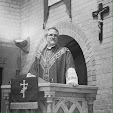
Sunday, April 24, 2011

Sermon: Easter – 2011


23 April 2011 at Salem Lutheran Church, Gretna, LA

Text: Mark 16:1-8 (Job 19:23-27, 1 Cor 15:51-57)

In the name of + Jesus. Amen.


Christ is risen! He is risen indeed! Alleluia!

“Death is swallowed up in victory. O death, where is your victory? O death, where is your sting?”

The reason St. Paul can taunt death with these words is because of our Lord’s victory over death and the grave on that Easter morning that Christians around the world remember joyfully on this great and glorious day. But make no mistake – the Lord was the victor on Good Friday, at the cross. For in dying, He defeated death and outwitted the craftiest of all God’s creatures – the devil. This was clear from His victory cry from the cross just before He surrendered His Spirit: “It is finished!” This is a curious thing for a man dying by execution for a supposed crime to say: a military term for “Mission accomplished!” Even though the world saw the image of a humiliated man being conquered by death, what really happened is that the exalted God defeated the death intended for us men by dying Himself as a Man. Even the centurion at the foot of the cross recognized the Lord’s victory when he realized that what Jesus accomplished was in fact a classic ambush.

Jesus defeated both sin and the death at the cross. For “behold, the curtain of the temple was torn in two, from top to bottom. And the earth shook, and the rocks were split. The tombs also were opened. And many bodies of the saints who had fallen asleep were raised, and coming out of the tombs after his resurrection they went into the holy city and appeared to many.”

In response to these clear signs of divine intervention, the centurion, himself a military officer, declared: “Truly this was the Son of God.”

Death itself was to be routed. The “saints who had fallen asleep” walking around Jerusalem were the preview of the resurrection to come. But the real declaration of victory came in Jesus’ own rising from the dead. For in His Easter resurrection, our Lord swept away the final enemy of mankind, one that seemed so immune from defeat.

Death is our common ancient and most cruel enemy. It nips at our heels our whole lives long. It eventually catches up with everyone, people of every tribe and tongue, rich and poor, believers and unbelievers alike. Death is the wages of sin, and indeed, “the sting of death is sin.” Dear friends, one way or another, our lives will end in this world. It is very likely that a preacher somewhere in this fallen world and at some point in time will recite this very passage of Scripture as your body lies in a casket: “O death, where is your victory? O death, where is your sting?”

And the reason Christian preachers of the Word and Christian hearers of the Word can join St. Paul in his taunt of death – even at the sad time of a funeral – is the same reason St. Paul invites us to offer thanks to God: “who gives us the victory through our Lord Jesus Christ.”

Victory!

This is what the centurion recognized when he confessed the Crucified One to be the Son of God. This is what St. Paul reveals to us, that which was revealed to him. For it is indeed a mystery: “We shall not all sleep, but we shall all be changed.” For “the dead will be raised imperishable, and we shall be changed.” And it is “when the perishable puts on the imperishable, and the mortal puts on immortality, then shall come to pass the saying that is written: ‘Death is swallowed up in victory.”

Victory!

Dear friends, Easter is about victory: our Risen Lord’s triumph over sin, death and the devil, His victory over the grave and guilt, His conquest over everything that impedes full communion between sinful men and the righteous God. Jesus has defeated them all, and moreover, He hands this victory over to us as a free gift, giving us a full share in His victory through being baptized into His death and resurrection, being given the gift of faith that can look death in its cold and cruel eyes and reply with a taunt: “Where is your victory?”

In the resurrection of Jesus, the words of Job came to pass. Job: the man who suffered the most horrible things a person can experience in this life, all the while clinging, even if barely, against all hope and against all odds, to the promise that he has engraved forever in the inscribed and inspired Word of God: “I know that my Redeemer lives…. And after my skin has been thus destroyed, yet in my flesh I shall see God.”

The cross is a victory for life over death, and it is also a victory for faith over unbelief. Job held on to the promise for dear life, and without seeing evidence for it, was able to confess and write the words: “I know….”

And we know as well, dear friends, because the tomb is empty! The Marys found the stone rolled away! The angels announced it! Jesus appeared to hundreds of people! The Church has borne witness and confessed this reality for two millennia! And we continue to sing with Job – whose faith was vindicated, whose life was restored, whose sins were forgiven, and who will indeed join us at our own resurrection: “I know that my Redeemer lives.”

And like the Marys, the Church continues to bear witness, to tell the truth, often with trembling, always with astonishment, at times even while afraid: the truth, the life-changing truth, the history-altering-truth, the death-defying truth, that Jesus has died for us sinners to give us His righteousness, and He has risen from the dead to give us life. His victory is our victory. And we join ourselves to Him, proclaiming His death in a holy communion with Him in His body and blood, until He comes, saying, singing, confessing, and proclaiming: “Death is swallowed up in victory. O death, where is your victory? O death, where is your sting?”

Christ is risen! He is risen indeed! Alleluia!


In the name of the Father and of the + Son and of the Holy Spirit. Amen.

Friday, April 22, 2011

Sermon: Good Friday – 2011


22 April 2011 at Salem Lutheran Church, Gretna, LA

Text: John 18:1 – 19:42 (Isa 52:13-53:12, 2 Cor 5:14-21)


In the name of + Jesus. Amen.

“The old has passed away; behold, the new has come.”

There are great milestones in history that mark a passing away of an old order and the entrance of a new order. Sometimes, the living witnesses to these milestones realize the significance of what their eyes behold, and other times, it falls to people in the future to see the change.

In world history, there were many examples of such irrevocable changes in history, things that happen that simply make going back impossible, such as when Caesar crossed the Rubicon, when Charlemagne was crowned emperor, when Martin Luther nailed the 95 theses to the church door, when the Berlin Wall was torn down, or when planes flew into the World Trade Center.

Once these historic events happened, there was no return to the former order of things.

And as significant as all of these events are, none of them is as history-changing as two closely related events having to do with wood: one at the beginning of creation, and one involving the restoration of creation. For in the beginning, the Lord created a perfect habitat for humanity and placed the first perfect man and the first perfect woman in a perfect garden. They were given a perfect existence without sin or death. They were even granted the privilege to stand face to face with God, and were surrounded with trees heavy-laden with edible fruits, the sweet taste of which our fallen senses cannot even begin to imagine. But our once-perfect ancestors chose to eat from a tree that was off-limits. That fateful decision changed the world forever. There was no going back to the garden.

We have struggled with sin and death and the devil ever since. The trees that sustained us gave way to weeds that strangle out our food and create hard labor for us. Thorns injure us. We suffer and we die. There is no going back to the garden. Sadly, “The old has passed away, behold the new has come.” And in this present world order, “new” does not mean “improved,” but rather corrupted and fallen.

But, dear brothers and sisters in Christ, the “love of Christ controls us.” God, in His infinite love and mercy, does not leave us stranded from the garden forever. There is a hopeful coming of the “new” and a joyful passing away of the “old.”

In another universe-altering event, God took the form of a man, Jesus of Nazareth. The baby Jesus was laid in a manger of wood, constructed out of a fallen and dead tree from the fallen and dead world by a fallen and dead man.

But this perfect Man grew in stature and revealed Himself to be God – but what’s more, He revealed Himself to be our Savior. And His destiny was to mark a milestone in the history of creation that dwarfs everything that has come before: including the fall in the garden.

Our agony in the Garden of Eden gave way to His agony in the Garden of Gethsemane. He took on our sin and death, He surrendered His privilege to stand before God (crying out in the words of the Psalm, “My God, My God, why have you forsaken Me?). And He submitted Himself, heavy laden to the fruits of His passion, and was nailed to the cross, constructed out of a fallen and dead tree from the fallen and dead world by a fallen and dead man. He was given sour wine to drink, the decaying fruit from a corrupted earth. “Stricken, smitten, and afflicted, see Him dying on the tree!” And bringing the old order forever to a close, He proclaimed: “It is finished.” And “He bowed His head and gave up His Spirit.”

Our blessed Lord struggled with sin and death and the devil because of our sins, and He, the sinless One, was victorious for us. The tree upon which He was crucified became for us a Tree of Life. Thorns injured Him on our account, but He overcame them in our place. He was to suffer and to die to take away our suffering and give us life. There is no going back to the garden of sin and death. Indeed, this is a Good Friday in which “The old has passed away, behold the new has come.” By virtue of the cross, “new” means immortal and incorruptible. For He was not to remain in the garden tomb, dear friends, but following His Sabbath rest, He has given the universe a new and equally wondrous milestone – one in which death is replaced by life, grief with hope, mourning with rejoicing, and alienation with “the ministry of reconciliation.”


“For the love of Christ controls us, because we have concluded this: that one has died for all, therefore all have died; and He died for all, that those who live might no longer live for themselves but for Him who for their sake died and was raised.”

There is no turning back, dear friends. By means of the cross of dead wood descended from the fallen trees of the corrupted old garden, our Lord is creating for us a new garden, freed from sin, death, and the devil, teeming instead with forgiveness, life, and salvation. Our Lord’s cross of death is our Tree of Life, bearing perfect fruits for all eternity.

“The old has passed away; behold, the new has come.” Amen.

In the name of the Father and of the + Son and of the Holy Spirit. Amen.

Thursday, April 21, 2011

Sermon: Maundy Thursday – 2011

21 April 2011 at Salem Lutheran Church, Gretna, LA

Text: John 13:1-15, 34-35


In the name of + Jesus. Amen.

“A new commandment I give to you, that you love one another: just as I have loved you.”

Our Lord has given us a new commandment, a new mandate – which is why this day is known as Maundy Thursday. Love is mandatory. It isn’t an option. It isn’t an add-on. It isn’t a warm fuzzy feeling. It isn’t only for our family, friends, and those who love us. We are to love our enemies, love our neighbors as ourselves, and love God with all our heart, soul, strength, and mind. We are to love to the point of laying down our lives. We are to love as Jesus loved, taking on the role of a lowly foot-washing slave.

In our sinful nature, we don’t even know what love is. We throw the term around in vain. We love TV shows, we love the local team, we love ice cream. We sometimes substitute “lust” for love and confuse hormones, impulses, and temptations for this new commandment of Jesus.

And so, our Lord and Savior also acts as our teacher. We need to be taught not only how to love, but what love is itself: “Jesus, knowing that the Father had given all things into His hands, and that He was going back to God, rose from supper. He laid aside His outer garments, and taking a towel, tied it to His waist. Then He poured water into a basin and began to wash the disciples’ feet.”

There is love, dear friends. God Himself, the Creator, the King of the universe, having taken the form of a man, acting as a lowly slave, sloshing the filth off of the feet of the men who will be abandoning Him to His cross in just a few hours. There is Love. And He says: “I have given you an example, that you should do just as I have done to you.”

Love is a giving of the self, an emptying of the self, a sacrifice of the self – all for the sake of the beloved. And it is done without thought of reward. There is Love.

Our Lord did some other extraordinary things on the night in which He taught us what love means. He took bread. He gave thanks. He said: “This is My body, given for you.” He took a cup after supper. He said: “This cup is the new testament in My blood.” He said this was for the forgiveness of sins. He said: “This do in remembrance of Me.” He gave His body and blood to His beloved, and to all of us. He also allowed Himself to be betrayed, arrested, accused, tortured, condemned, and crucified.

There is Love.

And as the Good Teacher, He teaches not merely with words but with deeds. For His Word is God’s Word, and God’s Word has the power to create reality. When our Lord says: “This is My body… This is My blood… for the forgiveness of sins… This do…”, He makes that miracle happen.

For, dear friends, it was on Maundy Thursday that the Lord gave us His Holy Supper, the Sacrament of the Altar. It is a sacrament because it is a mystery. It is given at the altar because our Lord’s flesh and blood is the one all availing sacrifice for the sins of the world, offered as a pure oblation to the Father out of love for both us and the Father. Our Lord’s death on the cross is a sin offering, and what’s more, it is a love offering. For no man has greater love than this, that He would lay down His life for His friends. And our Lord even offers Himself to His enemies, His betrayer, His denier, His cowardly disciples, His attackers, His executioners, and His countrymen who acted as the lynch mob. In fact, our Lord is the Lamb of God that takest away the sin of the world.

There is love.

That kind of love is indeed a mystery, a sacrament. No-one can explain it, make it make sense, or appeal to reason for an explanation. No-one can rationalize love or put it in intellectual terms. Our Lord’s sacrifice on the cross was indeed irrational and unexplainable – even as it is the greatest act of love in the history of the universe.

Dear brothers and sisters, love is not something we can choose to do or choose not to do. It is indeed a mandate. It is why we have been created. And we lost the very presence of God that empowered us to love when we chose the love of the lie over the love of our Creator back in the Garden of Eden. That Garden brought us death and alienation from God. But in another Garden, on the night in which He was betrayed, our Lord prepared to receive our death and our alienation from God. Our Lord loves us enough to take the blows we have earned, to absorb them in our place, to suffer in our place, to die in our place.

There is love.

Dear friends, our Lord commands us to do something we cannot do in our sinful state. But He gives us forgiveness, an example to follow, a second chance. He gives us life and salvation and hope. He gives us the bread of His body and the wine of His blood, miraculously present in the mystery of love known as Holy Communion. He washes us body and soul with baptismal water, taking the humble estate of a servant.

Our Lord does not just give us the mandate. Indeed, He only asks of us what He has given us first: love. There is love: on His cross, upon His altar, at His font, in His Word, implanted in His people: “just as I have loved you.” There is love. Amen.

In the name of the Father and of the + Son and of the Holy Spirit. Amen.

Monday, April 18, 2011

Atlas Shrugged

There is a new movie out: Atlas Shrugged. 

I have not seen the movie.  I have read the book.

The author of the book, Ayn Rand, was a refugee from Communism.  Seeing first hand as a child the destruction of freedom through government collectivism and coercion during the Russian revolution, she became an advocate of human liberty.  She found Communism to violate the rules of logic.  She delved into a philosophy of objective reality - which she called simply "Objectivism" - which stood out like a sore thumb in the 20th century world of Subjectivism.  As a novelist, essayist, and philosopher, she opposed Big Government at every turn in her adopted country, the United States.


Ayn Rand was a complicated, if not convoluted, figure, whose legacy is even more complex.  In her lifetime, she was a rather unlikeable tyrannical grumpy self-centered and morally-challenged Atheist who is today often quoted by tea-partying Fundamentalist Christian political activists.  She heroically opposed Communism, but also berated any act of love to another person as morally evil.  One of her close disciples was Alan Greenspan, who though at one time was a champion of the Randian notion of a hands-off government (which included a separation of currency and state through the gold standard) was to become the chairman of the Federal Reserve - the very institution devoted to the destruction of hard currency and the very motor behind Big Government itself.  The Fed is the American version of central economic planning and the state control of capital.  The continued legacy of Ayn Rand is filled with such ironies.

Karen De Coster has a balanced and nuanced consideration of Ayn Rand and her lasting legacy here.


Here is an Issues, Etc. podcast about Ayn Rand and Atlas Shrugged, an interview with Dr. Clay Jones of Biola University.  I think Dr. Jones does a very good job of showing the good, the bad, and ugly - and even more ugly (the latter "ugly" I disagree with him) - about Ayn Rand and her philosophy (of which the novel Atlas Shrugged is a manifesto).  I do take exception with a couple of his statements, however, first his assertion that U.S. senator Dr. Rand Paul (the son of U.S. representative Dr. Ron Paul) was named after Ayn Rand.  This is not true.  He also criticizes Alan Greenspan for not proposing enough regulation.  I think that is a fantasy.  Alan Greenspan held the levers of Big Government in ways utterly contrary to the principles of small government and sound money.

One excellent point that Jones makes - which is another Randian irony - is the fact that one of the reasons Communism fell is that it did not consider original sin.  Like most Utopian schemes, it falls flat because it is based on a flawed view of humanity.  Communism fails (as Rand points out) because it does not account for human selfishness.  The great irony is that Rand also denied original sin - thus sowing the seeds of her own Utopia's demise.


In spite of all of this, I think the book is a good read.  It is tedious, plodding in plot, and often plastic in its characters.  The dialogue is wooden and at times reads like a philosophy tome.  But the premise is brilliant, and the overall story is clever.  Besdies, it's an important work for many reasons.  It will make you think about the role of government intervention in the free economy, innovation, capitalism and capital, labor and markets, and what the limits of freedom are.  It is a thought-provoking work that has - for good and bad - made a huge impact on our modern life and political discourse in the western world.

I'll probably check out the film when it gets to Netflix. 

Sunday, April 17, 2011

Sermon: Palmarum – 2011

17 April 2011 at Salem Lutheran Church, Gretna, LA

Text: Matt 21:1-11, Matt 27:11-54


In the name of + Jesus. Amen.

“Hosanna to the Son of David! Blessed is He who comes in the name of the Lord! Hosanna in the highest!” Amen.

As our Lord “drew near to Jerusalem,” He was given a welcome fit for a king. In fact, He was received and acclaimed as a king. He did not walk through the city gate, but was “mounted on a donkey,” a beast of burden. And though such a mount was humble, it reflected the same ride into David’s Royal City by David’s son (and our Lord’s ancestor) Solomon when he was also received as a king.

The crowds cheered. They waved branches from the trees and spread them on the road. “Hosanna! Blessed is He!” they cry out with excitement. They know the kingdom is indeed at hand, and that their King has drawn near in fulfillment of the prophets.

And watching this scene unfold, the people begin to write the rest of the story in their minds. Even the disciples think they know what is to come – even arguing among themselves who will sit at the King’s right and the King’s left. As with any transfer of power, there is a gathering of the ambitious, of flatterers, of hangers-on, and of those seeking to ride behind the king in majesty.

But the story was to take a shocking and unpredictable turn.

For our Lord’s triumphal entry into Jerusalem on Sunday was to yield to His shameful expulsion on Friday. His Sunday parade was to become His Friday passion. The acclamations of “Hosanna!” on the first day of the week were to give way to cries of “Crucify!” as the sixth day waned into the Sabbath.

For the kingdom was not what the people wanted, and nor was the King. Instead of a mighty mover of men, they saw a submissive Savior of sinners. Instead of driving out the Romans, the people of Judea heard Jesus preach about a kingdom not of this world. Instead of a commander of an army of vengeance armed with firepower, they saw a Rabbi teaching a fickle assembly of disciples bearing only the Word of God.

And just as now, when what you have received is not what you wanted, you return the merchandise for a refund. “Give us Barabbas!” they demand. “Crucify Jesus!” instead is their desire.

And so the Lord’s departure from Jerusalem did not have the air of a triumph. He was given a send-off fit for a criminal. In fact, He was mocked and accused of being a false king. He did not ride out of the city gate as a hero, but was himself forced to bear the beam of his own cross in the manner of a beast of burden, pushed, shoved, whipped, and made sport of. Nothing of the Kingdom of David and Solomon was to be seen on this procession save the scarlet robe, the crown of thorns, and the mockery of a scepter-like reed with which He was beaten by soldiers who bent the knee in order to humiliate him who “humbled Himself by becoming obedient to the point of death, even death on a cross.”

The crowds jeered. They waved their fists and spat at Him along the road. “Save yourself!” they were to shout at Him at the Place of the Skull. “Let Him come down now from the cross, and we will believe in Him!” they mock and cry out with excitement. They know not what they do, and they mistakenly believe that He whom the prophets foretold is now calling for help to one of the prophets.

Gone are the ambitious, the flatterers, the hangers on. There is no-one left to cheer. No-one waving palms. Of His followers, only His mother and the disciple whom He loved are there to Him in His agony. They remain to watch the man declared by the acolyte of Caesar to be the “King of the Jews” take His humble throne. For this King’s ride is one of lowly pomp, as He rides on to die.

Even the singing of the children has been silenced for the time being, as the enemies of Jesus sought. The Pharisees and the Sadducees, the Sanhedrin and the Romans all gather like vultures waiting for this King to close His eyes in defeat. As they gloat, He suffers. As they shout and celebrate the seeming victory over their enemy, He struggles to breathe. As they drink merrily and carry on, He thirsts while His bones pop out of joint. And hearing Him sigh heavenward, “My God, My God, why have You forsaken Me?” before yielding up His spirit, the enemies of the kingdom of God believe that it is back to business as usual: might makes right, money and power defeat goodness and mercy, Satan is the ruler of this world and the king of this fallen creation.

After a frightening three years for those in power, it seems like everything is back to normal. The Sanhedrin is back in charge over the “little people.” The High Priest can once again carry on like a demi-god. Herod has no more rival claims to His puppet-throne. The Pharisees can go back to lording over the tax collectors and other sinners. The Sadducees can continue in their oh-so-sophisticated disbelief. The Romans can go on with their rapacious and murderous empire-building. Satan can get on with his business of driving men to despair and destroying God’s good creation.

Or so it seemed. But again, the story was to take a shocking and unpredictable turn.

For when our Lord, the Son of God died, the sacrifice was offered and accepted by the Father. When the Lord yielded up His spirit, the Spirit was unleashed upon the forces of evil. In seeming defeat, the cross’s hatred was conquered by Jesus in the true victory of divine love. The Victim was in fact, the Victor. The devil had been swindled. Four millennia of enmity between God and man had suddenly been reconciled on the cross. The blood of the Passover Lamb was spilled upon the doorpost of the entire world.

“And behold, the curtain of the temple was torn in two…. The earth shook…. The tombs were also opened. And many bodies of the saints who had fallen asleep were raised.”

And when these children of the grave made their entrance into the holy city, they caused many to sing “Hosanna!” anew to the King who rules a kingdom in which the dead are raised, sinners are forgiven, and the powerful and mighty are toppled. And the Church has repeated the refrain that came originally from the lips of children ever since.

From his vantage point at the foot of the cross on Calvary’s hill, the Roman centurion saw all that had happened. He and his soldiers who served Caesar were compelled to shift their allegiance from the kingdom of this world to the Kingdom of God. As a witness to the victory of the King and the consummation of the kingdom, the hardened officer of a hundred confesses the reality of the Lord’s victory with the matter-of-fact bluntness of a man under orders filling out a postmortem battle report: “Truly this was the Son of God.”

And so we sing anew: “Hosanna to the Son of David! Blessed is He who comes in the name of the Lord! Hosanna in the highest!” Amen.


In the name of the Father and of the + Son and of the Holy Spirit. Amen.

Sunday, April 10, 2011

Sermon: Judica – 2011

10 April 2011 at Salem Lutheran Church, Gretna, LA

Text: John 8:42-59


In the name of + Jesus. Amen.


We’ve walked in on Jesus in the middle of an argument. This is the kind of conversation in which nervous parents might scoot the curious children out of the room, and where people shift around and look at their shoes in embarrassment.

Jesus and His opponents are trading barbs. Speaking to the crowds, Jesus calls into question whether or not God is their father. In fact, He comes right out and tells them that their father is actually the devil, and that they too are liars just like him. Not the kind of language one might condone in Sunday School.

And for their part, our Lord’s opponents likewise question His ancestry. “Are we not right,” they ask, “in saying that you are a Samaritan and have a demon?” The crack about being a “Samaritan” is an ethnic slur, for the Jews took pride in their racial purity. Samaritans were considered impure because of their mixed-race background. And this may well be a snipe at our Lord on account of His mother, who was not married at the time of His conception, and who may well have been the subject of rumors and ugliness.

They also deny that our Lord is the Son of God. They try to contradict Jesus by saying that He is the one who is actually the son of the devil.

At the end of the day, the mob resorts to the only thing it has in its bag of tricks: force and violence. “So they picked up stones to throw at Him, but Jesus hid Himself and went out of the temple.” The lynch mob was cheated on this occasion, as it was not yet time for the Lord to carry out the will of His Father by going to the cross to conquer sin, by dying to defeat death, and by rising incorruptible to reign victorious over the sinful flesh by means of His sinless flesh. This time, Jesus just vanishes, leaving the stone-wielders to scratch their heads and plot for another day.

The reason our Lord’s listeners were so angry is, as He told them: “You cannot bear to hear My Word.” For we know that God’s Word is a two-edged sword, a spiritual weapon that, as Dr. Luther pointed out, is a Word “that kills and makes alive.” Jesus preached the Gospel of who He is: their Savior. And this is indeed Good News! But what they heard was not the Good News that they were rescued, but rather the “insulting” news that they needed to be rescued. For these were proud people, Abraham’s children, God’s chosen, and who did this preacher think He was to call them to repentance anyway. Haven’t we all heard the rumors about His ancestry?

And actually, some of those rumors are true. Jesus does indeed come from questionable ancestry, a long line of sinners and rebels, people who died in the flood, murderers, adulterers, idol-worshipers, liars, and cheats – as is truthfully recorded by the evangelists Matthew and Luke. For His ancestry is our ancestry, and we are every bit as sinful as our forbears – unlike our Savior who came from the same place as we, according to His flesh, though without sin, and yet who is also God. And this is the real mixed ancestry of Jesus that is most resented by His opponents. They do not want to believe that this Man is also God. For this God-Man is calling them to repent. If He is God, then what He speaks must be true. But they don’t want it to be true, dear friends. They want Jesus to tell them what they want to hear. They want flattery. They want fluff. They want no talk of repentance. And in light of such preaching, they would rather believe that He is a devil.

And likewise, there is some truth to the intended insult that Jesus is a Samaritan. For Jesus told the story of the Good Samaritan, who finds a broken and bleeding man, symbolic of sinful mankind beaten about by Satan. Jesus is the merciful Samaritan who is the Rescuer of mankind, who puts upon the injured man’s wounds the medicinal oil of Holy Baptism and the healing wine of Holy Communion, and who carries the broken man to the innkeeper – though there was no room for Him at the inn at His own humble birth. And the Good Samaritan even pays for the victim’s lodging, even as our Lord Jesus has paid for our place in the kingdom “not with gold or silver, but with His holy, precious blood and with His innocent suffering and death.”

Indeed, Jesus is a “Samaritan” of sorts, a Good Samaritan who, though stricken, smitten, and afflicted, does not waver in His mission to save, to rescue, to forgive, and to make alive.

The Lord Jesus prayed for His enemies even as He died by their own blood-stained hands, balled up in fists of rage, spitting insults upon Him as His life ebbed away: “Father, forgive them. They know not what they do.” He is the truly Good Samaritan, even though the Jews meant the name to sting, to hurt, to wound. Indeed, Jesus knows what it is to be wounded. He knows what it is to pray with us: “Deliver me, O Lord… from the violent man.”

Our Lord leaves no room for doubt about who He is. For the most offensive thing that the Lord says is the good confession that He is indeed the Lord. “Truly, truly, I say to you,” He says, for His Word is always truth, “before Abraham was, I am.”

I am.

This is the divine name, the name that is not to be pronounced, for it is the name that is above every name, the name before which every knee shall bow. It is the name into which we are baptized, the name by which we must be saved. His name is “Jesus” and He is the Almighty God, the great I AM, the Creator, the Redeemer, the Sanctifier, the Holy and Mighty Lord, who is also the merciful Savior.

And His good confession is our good confession, dear friends. And this confession still causes men to take up stones in their hands seeking to kill, seeking to silence the Word, seeking to do to the Good Samaritan what the Good Samaritan seeks to save mankind from. Jesus still causes grown men to argue, to debate, and even to commit and suffer violence. Jesus continues to stir up controversy wherever His Word goes forth.

For Jesus has Good News for all who will swallow their pride, admit that they are in need of a Savior, and will humble themselves before the Lord. Jesus has Good News to those who will hear the Word and bear with it, even when it exposes things about ourselves that we do not like. Jesus has Good News for sinners who know they are sinners and who know that they need to repent. Jesus has Good News for us today, dear brothers and sisters, for He not only calls us to repent and to believe, but also to receive Him for who He truly is, and to receive Him as divine charity: God in the flesh, sent to the cross to redeem us in our flesh, given to us in His Word and His flesh and blood.

For here is the very same Good News proclaimed by our Lord Himself to friend and foe alike: He is our Redeemer. He is our Savior. He is our Life. Now and forevermore. Amen.


In the name of the Father and of the + Son and of the Holy Spirit. Amen.

Saturday, April 09, 2011

Lutheran Satire


Funny stuff! More can be found here. And to answer the question of "some people," no, I am not Hans Fiene and no, I didn't write this. :-)

Thursday, April 07, 2011

Fifty Years Ago...


While leafing through an antique book that belonged to my great-grandfather as a school boy, I ran across a relic from my parents: two attached drive-in movie coupons from 1961 - the year before they were married.  These tickets have sat dormant in that old book for exactly fifty years. 

Just what the significance of the discovery is - if there is any significance - I don't know.  But I think it's nifty just the same.

Sunday, April 03, 2011

Sermon: Laetare - 2011


3 April 2011 at Salem Lutheran Church, Gretna, LA

Text: John 6:1-15 


In the name of + Jesus. Amen.

Our Lord teaches us many things today. For we see Him not only performing a grand and glorious miracle, but providing for the ordinary needs of common people. We see not only the Man Jesus, who is God in the flesh, flexing His divine muscles and showing the world who He truly is, but we also witness the Almighty God, who is a fleshly Man, gently displaying compassion and teaching the world about divine mercy.

Our blessed Lord also teaches us about “providence.”

We often think about divine providence as being an unexplained coincidence or turn of events that can only be explained as the work of God in the execution of His plan for the ages. And that is indeed what divine providence is. But providence has a deeply personal and individual side as well. For the word “providence” is based on the verb “to provide.” And we all know what it means to provide. It means to give us the things we need: our daily bread in both the earthly and spiritual sense.

And the word “provide” is based on the Latin word that means “to look ahead.” You might see it more clearly when you think about the related word “provision.” The Lord’s providence is his providing for us, provisioning us because He sees what we need even before we need it. In fact, the Lord has known what we need right at this moment before the foundation of the world.

And as a loving father provides for his family, and a loving mother provides her infant with food, so too does our loving Lord provide for all of our needs.

Jesus saw ahead of time the need of the people to be fed. He provides them with what they hunger for. Our Lord is almighty and yet compassionate, willing to display inexplicable signs and wonders, and even more willing to show unbounded love and mercy.

The Lord provides daily bread – even as He has taught us to pray for the same in the Lord’s Prayer. Without food for the body, we will die. And so, in response to the hunger of the crowd, Jesus accepted the meager offering of the young man of five loaves of bread and two fish, and He said, “‘Have the people sit down.’ Now there was much grass in the place. So the men sat down, about five thousand in number. Jesus then took the loaves, and when he had given thanks, he distributed them to those who were seated. So also the fish, as much as they wanted.”

While no-one else was thinking about how to feed five thousand people who had come to hear the Lord preach, the Lord was already practicing what He preached regarding mercy. He knew what these people needed before they did, before they woke up in the morning, and even before the dawn of the first day in creation itself.

That, dear brothers and sisters, is providence, divine providence, divine love for us poor miserable sinners, whose stomachs rumble as a result of the first sin in the garden of Eden, a sin involving the eating of that which God did not provide for us.

And ultimately, the Lord’s providence goes far beyond bread for the belly. For the really providential food served on the mountainside on that day was not the bread itself. For man does not live by bread alone. Indeed, the bread that came down from Heaven, the manna, the bread that is broken and eaten among prayers and Eucharistic joy, is given to us as the Word. For we also live by every Word that comes from the mouth of God, the Word by whom all things were made, the Word made flesh who dwelt among us, the Word that declares unto us today yet again, “Your sins are forgiven, and you have everlasting life for My sake.”

The children of Israel understood the hunger of the belly, and they did indeed rejoice in the manna that fed their bodies. And yet a Greater Manna was yet to come, the Bread from heaven broken on the cross to win forgiveness for us, and broken into pieces at the altar to deliver salvation to us.

And even as the five thousand of that day bore witness to the lavishness of God’s grace and providence in the form of twelve baskets of leftovers, we two billion of the Lord’s followers in our own day continue to bear witness of the lavishness of God’s Grace and providence in the form of the faith transmitted to us by the twelve apostles and the manna of the Lord’s Supper that never runs out.

The Lord has foreseen the needs of all of His children, and before time began, He had resolved to save and redeem us, and to use bread: providential bread, life-saving bread, miraculous bread, the bread of His body and the wine of His blood, given and shed for us for the forgiveness of sins – all in order to provide for us out of His love and our need, out of His mercy and our hunger.

For our Lord Jesus Christ is the living fulfillment of that which we sang: “Rejoice with Jerusalem, and be glad with her… that you may feed and be satisfied.”

Our rejoicing is caused by nothing less than the Lord’s providing, His provision for us out of not only His foresight, but also (and more importantly) by virtue of His grace and mercy.

Our Lord has taught us not only with words, but also with deeds, that “He richly and daily provides me with all that I need to support this body and life.” He truly does bless those who “hunger and thirst for righteousness.” “He has filled the hungry with good things.”

Lord Jesus Christ, life-giving bread,
May I in grace possess You.
Let me with holy food be fed,
In hunger I address You.
Prepare me well for you, O Lord,
And, humbly by my prayer implored,
Give me Your grace and mercy.

Amen.

In the name of the Father and of the + Son and of the Holy Spirit. Amen.

Sunday, March 27, 2011

Sermon: Oculi - 2011

27 March 2011 at Salem Lutheran Church, Gretna, LA

Text: Luke 11:14-28 (Jer 26:1-15, Eph 5:1-9)


In the name of + Jesus. Amen.


The prophet Jeremiah had a big problem. God told him to speak. That wasn’t the problem. Jeremiah was a prophet, and that’s what prophets do. The problem was in what God wanted Jeremiah to speak. God told Jeremiah to say something unpopular, something that would make the people mad, something that ran afoul of political correctness in the new Jehoiakim administration.

And to top it all off, Jeremiah was not even permitted to be tactful, gentle, or pastoral about it. He wasn’t allowed to consider the feelings of his listeners, or even his own safety. For God explicitly told him: “Do not hold back a word,” knowing what was in store for the prophet. For this is the message Jeremiah was sent to preach: “‘Thus says the LORD: If you will not listen to me, to walk in my law that I have set before you, and to listen to the words of my servants the prophets whom I send to you urgently, though you have not listened, then I will make this house like Shiloh, and I will make this city a curse for all the nations of the earth.’”

In other words, Jeremiah was sent to call the people to repentance: bluntly, clearly, and unequivocally. And there is nothing that angers people more than this. The people responded by laying hold of him saying: “You shall die!” The call to repent often arouses such a replay, even as it brought a beheading to John the Baptist, a stoning to Stephen, and a cross for our Lord Himself. Indeed, this is often the fate of a faithful prophet.

Jeremiah would be spared a martyr’s death, but several times in his ministry, he came close. For instead of hearing God’s Word, instead of repenting, instead of submitting to the prophetic message and the warnings of the Lord, the people arrogantly demanded that the prophet recall his words, change his message, and tell them what they wanted to hear – or else.

The Word of God – especially the call to repent of our sins and to seek a holy life of obedience and submission to the Lord’s will – has been mocked since the Garden of Eden, and will be a stench in the nostrils of every Old Adam – believer and unbeliever alike – until the Lord returns in glory to vindicate Jeremiah’s proclamation to, and lamentations over, the people to whom he was sent.

Following Jeremiah, St. Paul also preached the unpopular Word of God, and many times found himself at the business end of a lynch mob: pelted with rocks, beaten with sticks, arrested, and persecuted. For listen to what St. Paul preaches to the Ephesian Christians – not pagans, mind you, but to pious church members. After telling them to “be imitators of God,” the holy apostle gives specific pastoral counsel in his call to repentance: “sexual immorality and all impurity or covetousness must not even be named among you, as is proper among saints. Let there be no filthiness nor foolish talk nor crude joking, which are out of place, but instead let there be thanksgiving.”

For Ephesian Christians of the first century were surrounded by a lowest-common-denominator culture of sexuality and crude joking. Twenty-first century Americans have the added complication of television and the internet, as well as their children being indoctrinated in false religion and atheism from sources thought to be wholesome because they cater to children’s entertainment.

For modern American Christians, we have the option of attending church on Sunday morning and watching cartoons on Sunday evening that not only include “sexual immorality” and “impurity” and “filthiness” and “crude joking,” but also outright mockery of our Lord Jesus Christ and the Word of God. We Americans can offer an “Amen” to the Word in the morning, and serve up giggles at jokes about the Word in the evening. And since many of these shows are animated, children can get a head start on this religious and cultural schizophrenia at an increasingly younger age.

And to our sinful flesh’s impulsive claim that we can enjoy such things that “everyone else” participates in without spiritual damage, St. Paul retorts: “Let no one deceive you with empty words, for because of these things the wrath of God comes upon the sons of disobedience. Therefore do not become partners with them; for at one time you were darkness, but now you are light in the Lord. Walk as children of light.”

As for our forays into darkness, St. Paul says to stop it! Jeremiah says: “walk in my law… and to listen to the words of my servants the prophets whom I send to you urgently, though you have not listened.” For just maybe, “it may be they will listen, and every one turn from his evil way, that [God] may relent of the disaster that [He intends] to do to them because of their evil deeds.”

For the Old Adam always excuses sin, blocks his ears to correction, and finds a way to shoot the messenger rather than heed the message. Dear friends, the call to repentance from Jeremiah and Paul are as relevant today as ever. Listen to them! Heed their words! For their words are God’s Word, their call to repentance is God’s call to repentance. He is speaking to you now, pleading with you to hear Him, to really and truly listen, to resist the urge to be defensive and to lash out at the messenger. He is calling each one of us to turn from our evil ways and live. And God does not want to hear us go on about our good works or how well we know our doctrine. God is not impressed, and He is calling us to repent – not because He hates us, dear friends, no indeed! But rather because He loves us beyond what we can ever conceive.

He backs up His warnings in His own blood. He beckons you to follow Him to the cross, to the atonement, to forgiveness, to redemption, and to everlasting life! And that good news follows the call to repent. So hear it anew, dear brothers and sisters, hear it again, hear it fresh, and hear it with all the seriousness of the prophet Jeremiah being threatened with execution for speaking the Word of God: “repent!”

For our Lord wants to heal you, forgive you, save you, and restore you. He has come to you to redeem you, to revive you, and to remove every trace of the Old Adam from you. He continues to come to you to exorcise you, to call you to repent, to declare you to be forgiven and righteous, and to offer Himself to you in His Word and in His most holy body and blood, to comfort and to strengthen.

He has not come to condemn, but to save. But dear friends, if you refuse to be saved by your hardness of heart, all He can do for you is to continue to call you to repent. He will not abandon you to the devil, and so He continues to plead over and against all of our Old Adams: “Blessed rather are those who hear the word of God and keep it!”

Dear brothers and sisters, our Lord is telling us that repentance is not child’s play, not something to be taken for granted. For like Jeremiah before Him, our Lord is demonized for calling the people to repent, for not telling the people what they want to hear, for not heaping praise upon those who think more highly of themselves than they ought. So deluded are they in their hardness of heart that they think His casting out of demons is evidence that He does so by the devil’s help. Sin can cause people to be so warped that even their logic and reason – let alone common sense – is perverted by the evil one.

Our Lord warns us that a demon once cast out, if courted back, “goes and brings seven other spirits more evil than itself, and they enter and dwell there. And the last state of that person is worse than the first.”

Dear brethren, let your repentance be repentance. Hear this good news that Jesus casts out the demons on our behalf, not by Beelzebul, but instead by the “finger of God.” He has the authority to reach out to you; He has the will to save you; He has the power to redeem you; He has the love to forgive you. He is merciful in His call to repent, and He is gracious in His response to our cries for mercy.

For Jeremiah was a precursor of the Lord Jesus who overcame the Old Adam by being the New Adam, the one who not only calls us to repent, but who delivers salvation to us in proclamation and preaching and the promise that is signed, sealed, and delivered by His crucified body and shed blood itself.

And St. Paul tells us what is yet to come for those who remain in the Word and do not turn from the Lord. Though we cannot do it perfectly in this life, we are called upon to strive against sin and struggle against evil and anticipate the time when we will indeed by God’s grace: “Walk as children of light (for the fruit of light is found in all that is good and right and true).”

“Return to the Lord your God,” dear brothers and sisters, “For He is gracious and merciful, slow to anger and abounding in steadfast love, and abounding in steadfast love.” Amen.

In the name of the Father and of the + Son and of the Holy Spirit. Amen.

Sunday, March 20, 2011

Sermon: Reminiscere - 2011

20 March 2011 at Salem Lutheran Church, Gretna, LA

Text: Matt 15:21-28


In the name of + Jesus. Amen.

At the Introit of the service, we sang: “Remember, O Lord.”

Of course, to a bystander, this could seem like an odd prayer. We are praying, after all, to God Almighty, who has no need of tying a red yarn around His finger, or covering everything with Post-It notes, or sending Himself reminder e-mails. And to someone unfamiliar with the Christian faith, it might seem bizarre, if not downright disrespectful, to give God an order – especially a command to “remember” as if we were a frustrated boss telling a sloppy subordinate not to mess up at work.

In the Gospel, we see a subordinate likewise demanding God’s remembrance, and we see God’s reaction to being spoken to in such a fashion. And like everything else in God’s kingdom – it isn’t what we might expect!

The Canaanite woman is even lower than a subordinate. Not only is she a woman living in a time and culture when polite women did not initiate speech with a man, but she is also a Gentile, a descendant of the enemies of God. She lives in the hinterlands of Tyre and Sidon – regions not inhabited by God’s chosen people, but rather populated by those whose religion was, at best, a mix of truth and error. And to top it all off, the Canaanite woman has a demon living under her roof oppressing her troubled daughter.

This is the last person who should be telling God what to do and debating Him. Which is exactly the point. God’s kingdom is made up of the humble, the weak, the unworthy, the despised, the lowly, those of little education, those who are looked down upon by people who think they are their betters. And yet, what is the ultimate cause of this poor woman’s misery? Sin. And the same sin infests all of Adam’s descendants. And in her lowliness and humility, she has as much right to stand before God and make demands as anyone: which is to say, she has no right to do so at all.

And yet she does indeed stand before God. And she speaks to God. And she gives a command to God. And God listens. And God praises the woman and blesses her!

For, dear friends, God’s kingdom is not about worthiness, but unworthiness; not about personal rights, but about imputed righteousness. God’s kingdom is not who you are, but rather, whom you know – or more importantly, who knows you, in spite of who you are.

Jesus knows this woman and her plight even before she asks. And yet she does ask for help. More accurately, she demands help: “Have mercy on me, O Lord, Son of David.” She does more than ask; she orders. And while her prayer is also a form of begging, it is an aggressive plea that takes the form of a command – much like our prayer that God “remember.” The Canaanite woman calls Jesus to remember as well – not to remember the ancient history of the Gentile people, not to remember her sins and the sins of her daughter, not to remember the old covenant that excluded her – but rather, she prays essentially what we have prayed: “Remember, O Lord, Your tender mercies and Your loving-kindnesses, for they are from of old.”

In invoking mercy, the Canaanite woman reminds Jesus that He is God, and she also reminds God that He is merciful. But along with reminding God, she is confessing to herself and to those within earshot just why it is that she can “await from the Lord great and abundant mercy” in answer to her prayers. For she is not so much reminding God as she is reminding herself, calling to mind God’s mercy, and doing so in faith in the promise that God has come to save not only the children of Jacob, but ultimately, all of His creation racked by sin and rent by death.

Jacob wrestled with the God-Man to a draw, and had a sore hip to show for it, but the God-Man defeated Satan at the cross, crushing His head and Himself suffering the bruised heel as a result. Jesus was not only crucified for the sins of the sons of Israel, but also for the sins of the daughters of Canaan. In His passion, our Blessed Lord feels the suffering of the Canaanite woman, her anguish over her daughter’s lost soul and possessed body. He has compassion on her struggle and depression, her desperation, her lovesick cry for help for her daughter. Jesus feels it along with us. And He is there with us in our family problems, our health issues, our anxieties, and our mortality.

And yet, how hard it must have been for the Canaanite woman to hear Jesus respond at first with silence. She has cried out for help, and God is silent. She suffers and God is silent. And the disciples even try to send her away empty-handed. But she patiently continues with her litany of “Lord, have mercy!” and she kneels where Jesus is to be found. She prays again: “Lord, help me!” And yet again, what disappointment she must have experienced as the Lord coldly brushed her off with something that must have hit her like a blow from a sledgehammer: “It is not right to take the children’s bread and throw it to the dogs.”

How her heart must have ached, and how her head must have pounded. And yet, undaunted, she disputed with Jesus, turning His metaphor on its head and throwing it back in His face: “Yes, Lord, yet even the dogs eat the crumbs that fall from their masters’ table.”

The Canaanite woman’s retort is not impertinence, but rather faith. She is not showing disrespect to Jesus, but rather demonstrating respect for God’s promise. She refuses to take “no” for an answer because she knows that the answer is already “yes.” The Lord remembers His promise, and Jesus gladly hears the woman’s strong plea for Him to “remember,” to call to mind, and to act on the Word of God – which is powerful, effective, and always true.

“O woman,” our Lord pronounces, “great is your faith! Be it done for you as you desire.” And “her daughter was healed instantly.” The demons cannot abide God’s Word, and God’s Word cannot fail when it comes to faith. The demon flees, sin is forgiven, health is restored, and prayers are answered. This, dear friends, is the Christian faith and life in a nutshell.

For as the apostle reminds us: “Through Him we have also obtained access by faith into this grace.” For even as the Canaanite woman held on to faith in the midst of her sufferings, we are reminded that “we rejoice in our sufferings, knowing that suffering produces endurance, and endurance produces character, and character produces hope, and hope does not put us to shame, because God’s love has been poured into our hearts through the Holy Spirit who has been given to us.”

“Have mercy on us, O Lord, Son of David.” “Remember, O Lord.” Remember! Amen.

In the name of the Father and of the + Son and of the Holy Spirit. Amen.

Sunday, March 13, 2011

Sermon: Invocabit - 2011

13 March 2011 at Salem Lutheran Church, Gretna, LA

Text: Matt 4:1-11 (Gen 3:1-21, 2 Cor 6:1-10)


In the name of + Jesus. Amen.

God created the first man, Adam, out of the dust of the earth, the Adamah. For in those days, even the dirt from which God made our first ancestor was clean. The universe was perfect. Adam was flawless, created without sin, living in an unspoiled creation – and there was no death to be found anywhere.

“Now the serpent was more crafty…” The serpent was the manifestation of the rebellious angel known to us by the title “Satan” – also known as “the tempter.”

The tempter was also a liar, drawing Adam’s helpmate Eve into doubting God’s Word and God’s truthfulness. “Did God actually say…?” inquired the tempter. He appealed to the woman’s vanity, and she appealed to the man’s weakness. They both sinned, and the perfect became flawed, the saints became sinners, and the immortal became mortal. We became dead men walking.

The old evil foe
Now means deadly woe; 
Deep guile and great might
Are his dread arms in fight; 
On earth is not his equal.

In their temptation by the serpent, our first parents failed. They sinned, they died, and they left us all with the mess – and no possible way to clean it up.

With might of ours can naught be done
Soon were our loss effected.

This, dear friends, is why, to this very day, we live with sin, with evil, with struggles and sorrows of all kinds, and with death. God’s good creation has been corrupted. God’s beloved people have turned on him. And today we hear in God’s Word the same sobering message Christians around the world heard Wednesday night, as the dust from which we were made, now dirty and menacing, reminders of death, were smeared on our own sinful foreheads: “You are dust, and to dust you shall return.”

Man 1.0 was a dismal failure. God gave him a will, freedom to obey or disobey, a mind to be able to interact with other beings – and in encountering the serpent, he believed the word of the creature over and above the word of the Creator. Seeking to be greater than God, he became worse than the dust from which he had been fashioned.

And yet, dear friends, even as we sang today the words of the Creator: “He shall call upon Me, and I will answer him; I will deliver him and honor him. With long life I will satisfy him, and show him my salvation,” our Creator did not give up on us. Though He gave Adam and Eve the sad news of their punishment, the worst was given to the tempter. For a promised future man, a Man 2.0, would be born of a woman to get even, to put things right, as God told the serpent: “[The Seed of the woman] shall bruise your head, and you shall bruise His heel.”

Meanwhile, the tempter still tempts, death comes to all, and sin rules this corrupted and broken world. Power and avarice still tempt starry-eyed human beings as they plunge headlong into destruction. And yet, we are not without help and without hope.


Though devils all the world should fill,
All eager to devour us,
We tremble not, we fear no ill;
They shall not overpower us.

For we do indeed call upon God, and He answers us. He hears our cry for pity, for mercy, for forgiveness, and for life. He sends Man 2.0, Jesus of Nazareth, the Christ, God’s very Son in the flesh, the promised Seed of the woman, to crush the tempter’s head.

But for us fights the Valiant One
Whom God Himself elected.
Ask ye, Who is this? Jesus Christ it is.

Our Lord Jesus Christ, Man 2.0, the New and Greater Adam, the immortal God who puts on mortal human flesh, our Champion and Redeemer, defeats the tempter and avenges all mankind, living sinlessly to defeat sin, dying and rising to defeat death, and shedding His blood as an atonement for all the sins committed from Adam until this very moment and beyond.

Our Lord not only defeats the tempter, crushing his head at the cross, defying our death by leaving behind an empty tomb, but also demonstrates to us how to repel the serpent, how to beat back temptation, how to fight back against evil. Three times, the tempter repeats his tactic that defeated Adam, and three times our blessed Lord says: “It is written.” For it is written in God’s Word that the Word of God is mightier than a two-edged sword.

In the face of hunger and want (a fate unknown to Adam before the fall, but known to Jesus in His fasting), the devil taunts Him to turn stones into bread. “It is written,” says our Lord by way of reply, “Man shall not live by bread alone, but by every Word that comes from the mouth of God.”


The Word they still shall let remain
Nor any thanks have for it;
He’s by our side upon the plain
With His good gifts and Spirit.

For the Word is not only written, but made flesh; not only given to us as a book to read and recite, but in the form of the God-Man to be shared and proclaimed. The Word of God is with God and is God, the Word by whom all things are made offers re-creation, renewal, and renaissance, holy rebirth and a second chance, the opportunity to likewise join Him as Man 2.0 in repentance and forgiveness, all offered as a free gift, dear friends, a free gift received in faith – faith in the words of God, and faith in the very Word of God.

In Christ, the tempter, the old evil foe, the serpent, the one who brought ruination to creation, is himself ruined. For Christ’s victory is our victory – even as Christ’s life is our life – come what may in this broken world that, in spite of it all, is being remade anew.

And take they our life,
Goods, fame, child, and wife
Though these all be gone,
Our victory has been won;/The Kingdom ours remaineth.

“Behold,” dear friends, “now is the favorable time. Now is the day of salvation.” For even in God’s kingdom, we servants of the Word, servants of Him who defeated the serpent, often endure the fallout of the fall: “hardships, calamities, beatings, imprisonments, riots, labors, sleepless nights, hunger,” and yet, in the Word made flesh, all of these are overcome.

Do not be discouraged, brothers and sisters. The tempter’s days are few. The serpent’s time is limited. The power of sin has already been broken. The world corrupted by the devil is already on the mend through the Word. And so we cling to the Word, we lay claim to salvation, we hold onto the gift given to us by God’s mercy, and through the clouds and the gloom we see hope and life! He has won salvation for us, dear friends, and now is the day of salvation; now is the day to hold onto the gift, and by the strength only He can give to us, refuse to turn loose. Our Lord Jesus Christ, Man 2.0, is restoring paradise by means of the cross and by the power of the Word, and our Old Adams are being remade back into His image, even as creation itself will be made anew.

This world’s prince may still,
Scowl fierce as he will,/He can harm us none.
He’s judged; the deed is done;
One little word can fell him.

“It is written.” Amen.

In the name of the Father and of the + Son and of the Holy Spirit. Amen.

Wednesday, March 09, 2011

Sermon: Ash Wednesday - 2011

9 March 2011 at Salem Lutheran Church, Gretna, LA

Text: Matt 6:1-6, 16-21 (Joel 2:12-19, 2 Pet 1:2-11)


In the name of + Jesus. Amen.


“Do not lay up for yourselves treasures on earth,” cautions our Lord Jesus Christ, “where moth and rust destroy and where thieves break in and steal, but lay up for yourselves treasures in heaven, where neither moth nor rust destroys and where thieves do not break in and steal. For where your treasure is, there your heart will be also.”

Our Lord tells us to treasure that which is incorruptible, not the stuff that is only eaten by moths, rusts, decays when exposed to the elements, falls apart over time, and runs down. For we have all been reminded of the ultimate corruption, decay, and falling apart: death.

You have been bodily marked with a cross of ashes, and in the words that call to mind the Lord’s sad pronouncement to Adam, through whom all men have fallen into sin and by whom death came into our once-perfect world: “Remember, O man, that you are dust, and to dust you shall return.”

We need to be reminded of this. We push it to the back of our minds. We live like we will never die. We don’t even like to talk about making preparations for death. And we have every kind of lotion and pill and surgery and gimmick imaginable to mask the reality that we are indeed dust and that we shall surely and certainly return to dust.

And that is why we hear again the imperative: “Remember.” Remember, dear friends. Don’t forget! Don’t fool yourself into thinking that you can escape death, that you will not age, that your body will not wear out over time. “Remember, O man,” for you are a mortal human being whose sinful nature not only needs to be reminded of its mortality, but also needs to be called to repentance.

The point of the ashes is not to drive us to despair; God is not taunting us by reminding us that we will die. Rather, He is reminding us why we die, and what’s more, promising us that we will live! He is calling us out of the ashes of death, inviting us to wash our faces in the fresh waters of baptism, to rise anew with clean souls to a second chance, a life that will never end. He is calling us here and now, to acknowledge our wretchedness, to remember the Garden of Eden, to confess our sins of thought, word, and deed, those of omission and those of commission, those we know and those of which we are ignorant, those we have committed in weakness, and those we have committed willfully.

Remember those sins! Remember the wages of sin. And remember the somber proclamation given to Adam: “You are dust, and to dust you shall return.” And yet this is not the only talk of returning that we hear on this day of sackcloth and ashes. He also says “return to me with all your heart, with fasting, with weeping, and with mourning; and rend your hearts and not your garments.” He bids us, “return to the Lord Your God,” dearly beloved. “Return” to Him! Come back to Him with all your heart! Restore your communion with Him. Renew your friendship with Him. Revive your place at His table, your openness to His Word. For we not only remember that we are dust, but we also remember that our Lord Jesus Christ returned to the dust of the grave, and yet He returned anew as the victor over sin and death and the devil. Remember the resurrection! Remember the promise!

This is what it means to “lay up for yourselves treasures in heaven.” Our treasure is the forgiveness of sins and eternal life, proclaimed in the Word and proffered in the Sacraments. And such treasure is not to be found in the decaying material things of this world, the things that distract us, deceive us, and if allowed, will destroy us.

As those marked by the cross of death, we bear the cross of our own sinfulness. We live in a world of death that we have inherited, but we have contributed to the world of sin that we have committed.

“Remember, O man…” For you are not called upon to remember someone else’s mortality, nor to confess another’s sin. The Lord calls you to remember. The Lord calls you to repent. This call to repent is issued to you, on this day, delivered to you by your God, the one who created you, redeemed you, sanctified you, and who now calls you to “remember.”

For our Creator has chosen to save us from ourselves and our sins. He abhors nothing He has made. By His mercy, He forgives us and offers us new life. By His Son He saves us and offers us eternal life. By the cross He redeems us and in dying on the cross, our Blessed Lord restores us to abundant life.

This is what repentance is about, dear brothers and sisters. It isn’t about fear and condemnation, but rather comfort and forgiveness. “Return to the Lord, your God, for He is gracious and merciful, slow to anger and abounding in steadfast love.” It is not a brutish command but a gracious invitation!

Repentance is part of that remembrance, the remembrance that we are mortal, that we are sinners, but also that He is immortal and that He defeated death to save sinners.

For even as we are reminded today of our corruption, of our sin, and, yes, of our mortality, we are also reminded that in Christ, we have “escaped from the corruption that is in the world because of sinful desire.” Though we die, we will live. Though we are sinners, we are forgiven. And though we are corruptible, we shall put on incorruptible bodies by the grace, mercy, and “divine power” which “has granted to us all things that pertain to life and godliness... by which he has granted to us his precious and very great promises, so that through them you may become partakers of the divine nature.”

We are not only marked with an ashen cross of death, but also marked with a watery cross of life!

Ash Wednesday is about remembrance: the calling to mind of our sins and our sinfulness, as well as the calling to mind of our Savior and our salvation.

“Be merciful to me, O God, be merciful to me! For my soul trusts in You; He shall send from heaven and save me; He reproaches the one who would swallow me up.”

“Remember, O man!” Remember, and live! Amen.

In the name of the Father and of the + Son and of the Holy Spirit. Amen.

Sunday, March 06, 2011

Sermon: Quinquagesima - 2011

6 March 2011 at Salem Lutheran Church, Gretna, LA

Text: Luke 18:31-43

In the name of + Jesus. Amen.

God’s kingdom is filled with contrasts, with unexpected twists, with surprises. In God’s kingdom, the lame walk, the deaf hear, and the blind see. In God’s kingdom the proudly religious are condemned, the mighty are weak, and those with eyes to see and ears to hear are spiritually blind and deaf.

For the third time, Jesus has explained to the twelve – His chosen students who have been with Him for three years – just what was going to happen: “See, we are going up to Jerusalem, and everything that is written about the Son of Man by the prophets will be accomplished. For he will be delivered over to the Gentiles and will be mocked and shamefully treated and spit upon. And after flogging him, they will kill him, and on the third day he will rise.”

He tells this to them plainly, without figures of speech, without using a parable, and without any accompanying sign. And yet, they didn’t get it. “They understood none of these things.” Their ears heard Him say it, but they did not truly “hear” Him. Their eyes saw Him explain this to them in person, yet they didn’t “see” the reality right before their eyes. They didn’t believe Him because they didn’t want to believe Him. His kingdom was not what they expected, not what they hoped for, not what they desired. They wanted no talk of suffering and of the cross.

And that, dear brothers and sisters, their desire, is what gets in the way of their faith. Their own will (that is contrary to God’s will) interferes with their belief – even something so simple and direct as the Lord’s clear and unequivocal explanation of what was going to happen in Jerusalem.

The foundation of the Church, the apostles, the Lord’s first wave of preachers, these twelve men who would first receive the Lord’s Supper and first be commissioned to administer it to others, eleven of whom who would be filled by the Holy Spirit on Pentecost, these men destined for greatness in spreading the Gospel through preaching and signs and wonders under great hardship, even unto martyrdom, who saw Jesus perform three years worth of miracles with their very eyes – were on this day, blind as bats.

Their own expectations and desires made them so.

How different is the blind man! He had not walked with Jesus for three years. His eyes have never beheld even a single miracle. His crippling debilitation had made it necessary for him to beg for a living. He knew no sense of pride, no identity as part of the inner circle. In fact, he was shunned by polite company, by the establishment. And that, dear friends, is a beautiful picture of God’s kingdom. For what better explanation is there of prayer and God’s grace and the Christian life than to confess before God and man that we beg for a living? That is all we can do. We are shunned and scorned by the world, and all that we can do is hold our empty hands heavenward and humbly plead for divine grace and mercy. Unlike the apostles who have their sight but do not see, this blind beggar sees the reality of the kingdom.

In his faith and in his reliance on the grace of God, he cries out: “Jesus, Son of David, have mercy on me!” He knows who Jesus is. He is the Son of David, “written about… by the prophets.” He is the Messiah, the One who comes in hope to usher in a new kingdom, a kingdom in which “the eyes of the blind shall be opened, and the ears of the deaf unstopped; then shall the lame man leap like a deer, and the tongue of the mute sing for joy.” In His blindness, he sees, and in his faith, he cries out for mercy. And in His mercy, the Lord comes to him, hears his prayer, and delivers his sight back to him.

“And Jesus said to him, ‘Recover your sight; your faith has made you well.’”

Who could have predicted or imagined that the holy apostles, the men upon whose ministry the Lord would build His Church, would be so lacking in faith after three years of seeing miracles and hearing the Gospel, while the real example of faith, the one who truly understands the kingdom of God, would be this beggar that the world holds with condescension and contempt.

Indeed, God’s kingdom is filled with contrasts, with unexpected twists, with surprises. In God’s kingdom, the lost are found, the confident are brought to self-doubt, the blind see, the proud are humbled, the lowly are lifted up, the deaf are serenaded with the sweet music of forgiveness, the mute are empowered to sing and pray and praise God with a loud voice, the sinner is forgiven and made righteous, given a new life and a fresh start, the haughty are brought down a peg and the despicable one who repents finds everlasting life and salvation.

Dear friends, let us give thanks and praise to God for raising up this blind beggar, for he is our teacher in the faith as surely as Sts. Peter and Paul and the whole lot of the apostles, the Church fathers, the theologians, and the doctors of the faith. This simple blind beggar has given the Church a part of her liturgy that she has sung for century upon century – even as we continue to sing today: “Lord, have mercy upon us. Christ, have mercy upon us. Lord, have mercy upon us.” This is our greatest prayer in our time of trouble and distress. For this prayer identifies the cause of our misery – our need for God’s mercy. Only a sinner is in need of mercy. And only from a world of sin do we seek refuge.

And this is why the blind beggar’s prayer is not only a liturgical prayer of the Divine Service, it is also a deeply personal meditation prayed by Christians around the world, an individual cry for mercy from a soul in distress. It is fittingly known as “the Jesus prayer,” and it is often prayed as follows: “Lord Jesus Christ, Son of God, have mercy on me, a sinner.”

It acknowledges our own sin. It does not try to cover up our need for a Savior. It makes no boasts or haughty claims. It is a cry of a beggar. It is a cry for pity. But most important of all, it is a cry to the Lord Jesus Christ, God in the flesh, the fleshly God, the One who has mercy, the One who is mercy, the One who gives mercy. Ironically uttered by a blind man with the faith to see with spiritual eyes, in contrast to those who see, who accept the world on reason alone, who can see creation’s beautiful sunsets but cannot see the need for the Creator to die on the cross to become our Savior, whose desires get in the way of spiritual sight – even the twelve.

And yet, thanks be to God, the Lord doesn’t give up on His apostles. He gives them the same mercy sought by the beggar. He gives them the same heavenly vision that He had already delivered to the blind beggar. And though we do not know his name, the Lord does, the Lord who hears his prayer and answers his cry for mercy with healing and blessing. And though his name is lost to history, his prayer rings out in churches of every time and place and by Christians seeking divine help in every corner of the globe: “Lord, have mercy. Christ, have mercy. Lord, have mercy.” Amen.


In the name of the Father and of the + Son and of the Holy Spirit. Amen.

Wednesday, March 02, 2011

Sermon: Funeral of Anne Rhodes


2 March 2011 at Salem Lutheran Church, Gretna, LA

Text: John 14:1-6 (Isa 46:3-4, 1 Cor 15:51-57)

In the name of + Jesus. Amen.

Dear family, friends, brothers and sisters in Christ, and honored guests. Peace be with you.

It was a joy to cross paths in life with Anne and with several members of her family. The Lord in His mercy brought Anne into the fellowship of this congregation and gave me the privilege to visit with her, to deliver the Gospel to her, to celebrate the Lord’s Supper with her, and to give her pastoral care in her time of struggle. And now her struggle is over. She has won the victory. She has finished the race. She has gone home to her merciful Father. Thanks be to God!

And yet we are left behind to continue in this valley of tears where we suffer many temptations in this life – even temptations that have good intentions. In our mourning and suffering, we sometimes seek comfort where it can’t be found. Sometimes with very good intentions, people will say that “death is a part of life” or “death is natural” or even that “death is a blessing.”

None of this is true.

Dear friends, death is a terrible thing. That is why we mourn. That’s why we miss our loved ones who pass away. Death is not a part of life, not natural, and not a blessing. Scripture teaches us that death is the wages of sin. Death is the penalty for the transgressions of our ancestors from Adam and Eve right down to babies born this very moment. We die because of sin – which we have inherited and which we have committed. And we’re all in this mess together. Our world is broken, and we are broken. And death is the worst expression of that brokenness. There is no good to it at all, dear friends.

For in the beginning, God created a perfect world free from sin. He declared it “good.” He created all living things to live forever, and He created mankind in His own image to manage all of this perfect creation. It was beautiful beyond what we can even imagine. But our ancestors rebelled against God, and so do we. We sin every day, every hour, every moment. We are surrounded and imbedded with sin.

And this is why we have funerals.

But, dear friends, God takes that which is bad, that which we deserve, and He uses it for good. God redeems us, He reclaims us, He recreates us, as His own dear children. God washes away our sins at Holy Baptism, forgives us by Holy Absolution, and restores us in the Holy Supper – even as He promises: “Listen to Me… even to your old age I am He, and to gray hairs I will carry you. I have made, and I will bear; I will carry and will save.”

As awful as death is, our Heavenly Father is greater. As evil as death is, our Lord Jesus Christ rose from it to save us. As final as death seems, the Holy Spirit comes to us as the Lord and Giver of life, who calls us out of the perishable body of sin and death and resurrects our body imperishable, to new and everlasting life through forgiveness – all because of the cross of Christ. God could have simply given up on us, but instead He saves us. He became one of us, and He transforms us. That promise is for our dear sister in Christ, Anne, and it is for you who believe and grasp the promise, we who have the gift of faith in the Christ who died for us to save us.

Listen to the promise from the lips of our dear Savior Jesus Christ, our Lord and Redeemer Himself: “Let not your hearts be troubled. Believe in God; believe also in Me. In My Father’s house are many rooms. If it were not so, would I have told you that I go to prepare a place for you?”

Dear brothers and sisters, what a joy to hear that Jesus has prepared a place for us. We are not destined to become spirits floating around in the clouds. No indeed! Spirits don’t have to live in a house with rooms. The Lord has promised that Anne’s body – though it has returned to the dust of our creation, will live again, as we confessed in the creed: “I believe in… the resurrection of the body, and the life everlasting.” Just as our blessed Lord walked bodily out of His own tomb, so will Anne, so will all the saints, and so will each one of us who confesses Christ, having received the free and full gift of forgiveness and new life.

And this, dear friends, is of more comfort than any talk about death being natural. For what kind of a God would create us simply to die? No, our Creator has made us to live; He is the God of the living, and our Redeemer has defeated death, even as the Holy Spirit draws us to the one God who gives us life.

That is how even in our sorrow and grief, even as we miss Anne, our mother, our grandmother, our sister in Christ, our relative, and our friend, we can still proclaim with joy along with St. Paul and with Christians of every time and place: “Death is swallowed up in victory. O death, where is your victory? O death, where is your sting?” Anne is the victor! She has been adorned with Christ’s righteousness and crowned with eternal life. She bears the sign of Christ’s cross by virtue of her baptism, and she lays hold of the resurrection by virtue of the unbreakable and sure Word and promise of the living God.

Dear friends, we miss Anne. We grieve for ourselves and our loss. Though death is not natural, our mourning is. Healing will take time, and it won’t be complete until we are all reunited in eternity. And so we grieve, but not as the unbelievers. For we have hope. We have cause for joy. We have the promise! We know that death has been defeated at the cross by our Lord, who has risen to give us His righteousness and His life and a free and gracious gift.

And we pray with St. Paul, with the entire Church triumphant, and yes even with Anne herself, who now sees Christ face to face in glory unveiled and beauty unlimited, as we pray together: “Thanks be to God, who gives us the victory through our Lord Jesus Christ,” now and forever! Amen.

In the name of the Father and of the + Son and of the Holy Spirit. Amen.

Sunday, February 27, 2011

Sermon: Sexagesima - 2011


27 February 2011 at Salem Lutheran Church, Gretna, LA

Text: Luke 8:4-15 (Isa 55:10-13, Heb 4:9-13)

In the name of + Jesus. Amen.

“As for the good soil,” explains our blessed Lord, “they are those who, hearing the word, hold it fast in an honest and good heart, and bear fruit with patience.”

Patience is the hardest thing in the world. Patience is also the easiest thing in the world. Our Lord teaches us that we are good soil when we receive the seed and it sprouts and grows and bears fruit, when we not only hear the Word and hold onto the Word, but when we are patient with the Word.

Again, that is both hard and easy.

The hard part is the waiting. We live in a culture of instant gratification. We are used to getting things right now. As hard as it is for young people to fathom, there was a time when people used to travel to places called “record stores.” They had to shop for music, hope that the store had what they wanted in stock, wait in line, and then go back home to listen to their purchases played on big bulky equipment. Now, we can browse, purchase, download, install, and listen to music directly into our ears in a matter of seconds. Who has time to wait? And books are becoming this way too.

And just because books are made up of words, we should not think that God’s Word works the same way, even as a seed hitting the ground doesn’t mature and bear fruit in a matter of seconds – though it would be surprising indeed if there isn’t an agribusiness research company working on it. Such planting, growing, maturing, and bearing fruit takes time. Even eating a fruit that is not yet ripe defeats the whole process. There is a waiting period. God determines how much time is to pass. There is a need for patience. There comes a time when time itself has reached its fullness. And it simply isn’t our decision.

God’s Word comes to us according to His will: by hearing, by our being surrounded by His Word read and proclaimed, by His Word of the Gospel sounding forth, and by His Sacraments administered. The Word is implanted and watered at Holy Baptism, is protected from harm by Holy Absolution, and is nourished by Holy Communion. And in the course of a life of faithful care by the Holy Spirit and by being surrounded by the Word, we grow into the creatures we were meant to be – even though we will not reach full maturity until after death itself. For even as Jesus taught us: “unless a grain of wheat falls into the earth and dies, it remains alone; but if it dies, it bears much fruit. Whoever loves his life loses it, and whoever hates his life in this world will keep it for eternal life.”

There will come a time, actually when time is no more, in eternity, when we will be fully ripened and matured to perfection. But until that day, we must contend with worldly assaults on the seed of God’s Word.

First, the devil lunges at us, hoping that we are like the path, where the seed can be easily snatched away from us. Second, our own shallowness threatens the Word of God, for if we have no root in the heavenly things, instead investing ourselves in the fallen world that is passing away, we may experience temporary growth – but all for naught as our own shallowness causes us to fall away at the first sign of trouble. Third, the “cares and riches and pleasures of life” also distract us and draw us away from maturity, threatening to kill us by choking out the Lord’s life-giving, life-bearing, and life-saving Word. Like thorns and weeds choking out a struggling seedling, such things that take our hearts and minds off of the kingdom of God threaten to extinguish our lives that were given to us at baptism.

And yet, we cannot make God’s Word grow. We cannot force ourselves to become good soil. We are unable to compel God’s Word to do anything. We cannot speed up the process. We cannot control where or if the Word takes root. We cannot earn God’s favor or buy His grace.

And this is where the easy part of patience comes in. We need not worry about that which we cannot control. God’s Word is a gift, and it comes to us when and how God Himself chooses. The easy part of patience is acknowledging that we cannot force God to do our bidding. What makes patience bearable is that God is in control and He has promised to bless us.

But, dear friends, surrendering to God’s will is not an invitation to become idle or lazy. For the writer to the Hebrews warns us: “Let us strive to enter that rest, so that no one may fall by the same sort of disobedience.” We can pray for the Lord’s Word to be effective among us, even as a “two-edged sword,” rejecting neither the Law which calls us to repent, nor the Gospel which gives us the promise without strings attached. We are indeed “naked and exposed to the eyes of Him to whom we must give account.” We cannot fool God, and we should not try to fool ourselves. Patience with God’s Word doesn’t mean license to sin nor taking the gift for granted, but rather the patience expounded by Jesus calls for us to wait upon the Lord with expectant eyes, fixing our gaze on Him, regardless of what the world hurls at us, in spite of what we see with our eyes of fallen flesh in this broken world. Our patience is a prayerful patience, a hopeful surrender to the Lord’s mercy, an active faith that indeed produces fruit – even if imperfect and unripe. We trust in the Lord and the riches of His Word. And in that light, we can afford to be patient.

For we have the ancient promise from the prophet Isaiah, the promise fulfilled by Jesus, the Seed of the woman Himself, who not only gives us the Parable of the Sower, but who is the Sower and who is the Word: “So shall My Word be that goes out from My mouth; it shall not return to me empty, but it shall succeed in the thing for which I sent it.”

“For you shall go out in joy and be led forth in peace; the mountains and the hills before you shall break forth into singing, and all the trees of the field shall clap their hands.”

Dear brothers and sisters, that is the glorious promise given to God’s people, the promise fulfilled in Christ, the promise received by the world, and the promise that we Christians shall see brought to maturity in us by the miracle of God’s Word.

This is how it is that we can wait patiently, while not waiting idly. We wait expectantly, because the Word has power: power to give life, power to bring to repentance, power to save, and power to bear fruit that never ends. Amen.

In the name of the Father and of the + Son and of the Holy Spirit. Amen.