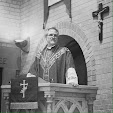
Sunday, June 30, 2019

Sermon: Trinity 2 - 2019


30 June 2019

Text: Luke 14:15-24 (Prov 9:1-10, 1 John 3:13-18)

In the name of + Jesus.  Amen.

“Blessed is everyone who will eat bread in the kingdom of God!”

That’s how the kingdom is, dear friends.  It’s going to table together.  It’s sharing a meal.  It’s joining together as a family.  

The Christian faith assumes the right doctrine.  But it is more than doctrine.  The Christian faith assumes good works that grow out of God’s grace.  But it is more than good works.  The Christian faith is about truth.  But it is more than simply knowing and speaking the truth.

The Christian faith is about love.  For God is love.  And love covers a multitude of sins.  Love is God giving His only begotten Son.  Love is our Lord on the cross saying, “Father, forgive them.”  Love is the risen Lord appearing to His apostles and sending them into all the world to preach the Gospel.

And nothing demonstrates love, dear brothers and sisters, like sharing a table at a banquet.  In His earthly ministry, our Lord ate and drank so often with the people that He loved, that those who hated Him accused Him of being a drunk and a glutton.

We are followers of the One who eats bread with us in the kingdom of God.  We are followers of the One who is love, and who takes flesh in our world.  We are followers of the One who was born in Bethlehem, the city whose name means “the House of Bread.”

“Blessed is everyone who will eat bread in the kingdom of God.”

And this is why St. John, the Lord’s beloved apostle, warns us: “Do not be surprised, brothers, that the world hates you.”

We should not bat an eye when the world gangs up on Christian people who mind their own business, who want nothing more than to peacefully live out their Christian faith by using their arts according to their consciences.  It should not shock us when Islamic radicals persecute Christian men, women, and children.  We should consider it normal when Christian students in universities are humiliated or expelled for their beliefs.  Not that we should avoid fighting for justice, not that we should be content with these things – but it should not shock us that evil is evil.

For this is why Jesus came in the first place – to rescue all of us from the evil that infests us all.  The evil is not only out there, but also in here.  Jesus has come to invite us out of this fallen world with its messed up priorities into the kingdom, to a great banquet table, where we shall eat bread in the kingdom of God.

“By this we know love,” says St. John, “that he laid down His life for us.”  Jesus did not prioritize His own time, His own possessions, or even His own life.  He gave them all to us out of love, to save us, to bring us to the banquet table of eternal life.  

The importance of “eating bread in the kingdom” and of all of our Lord’s parables about banquets was made clear “on the night when He was betrayed.”  For our Lord “took bread, and when He had given thanks, He broke it and gave it to His disciples and said, ‘Take, eat; this is My body, which is given for you.’”

“In the same way also He took the cup after supper...: ‘Drink of it, all of you; this cup is the new testament in My blood, which is shed for you for the forgiveness of sins.’”

As the Lord speaks to us in the Book of Proverbs, Wisdom invites us to the table: “Come, eat of my bread and drink of the wine I have mixed.”  

This, dear friends, is the kingdom of heaven.  It is God providing a banquet for us.  The feast is Christ Himself: the bread that is His body; the wine that is His blood.  We come to the banquet.  We eat.  We drink.  And indeed, “Blessed is everyone who will eat bread in the kingdom of God.”

But there is a warning, dear friends.  Just because we are invited doesn’t mean that we benefit.  For a guest can refuse the invitation.  A guest can take the Lord’s hospitality for granted.  A guest can lose his privileged position at table.

Our Lord tells a story, as He so often does when He teaches us about the kingdom.  In this story, a generous man decides to give a huge banquet, and “invites many.”  He sends a message to the invitees: “Come, for everything is now ready.”  But “they all alike began to make excuses.”  They decide not to come to the banquet – even after the food and drink have been prepared and are ready to be brought to the table.  The excuses don’t seem  unreasonable.  One guy just bought some real estate.  Another guy just bought farm equipment.  Another guy just got married.  

But the master’s kindness is being taken for granted.  The people can’t even come to the table for a meal, to share in the love of the master.  They can’t even spare an hour on Sunday to thank God for the blessings of home and possessions and family.  They are too busy. 

Jesus says, “Then the master of the house became angry.”  The guests are uninvited, and others are brought in instead.  “Go out quickly to the streets and lanes of the city and bring in the poor and crippled and blind and lame.”  In other words, go find people who will appreciate the kindness of the master.

If you think you’re too good to come to church to have your sins forgiven, the Lord will find other people who know that they need forgiveness, and your place at the table will be given to them.  If you think you have better things to do than to take the Lord up on His gracious invitation to eat His body and drink His blood for the forgiveness of sins, the Lord will find other people who aren’t so busy, and your place at the table will be given to them.  If you’re bored, or if you think you have nothing to learn, or if you think you can “get more out of” a TV sermon or looking at a facebook meme with some Jesusy words, well, the Lord will find someone who appreciates His sacrifice on the cross, who hungers and thirsts for righteousness, and who trusts that the Lord knows that He is doing by calling you here, to this sanctuary, to this altar, to partake in this bread and this wine, that are His body and blood, and your place at the table will be given to them, to someone who will say, “Blessed is everyone who will eat bread in the kingdom of God.”

The Lord will fill the banquet hall.  He is not looking for perfect and respectable people.  That’s the point of the story.  He is looking for sinners in need of forgiveness, for broken people in need of healing, for those who are grateful to be invited to the table and seated with brothers and sisters who love them, because God loved them first.  The Lord’s kingdom, the Lord’s Church, is filled with the poor, the crippled, the blind, and the lame, with people who have doubts and fears, with men and women who struggle with sin and sorrow, with those who are rejected by the world that rewards selfishness and ruthlessness.  The Lord’s Church is filled with people who struggle from Sunday to Sunday to once more “eat bread in the kingdom of God,” who would overcome any obstacle and make any sacrifice to hear the pastor speak the Lord’s absolution: “I forgive you all your sins,” to join brothers and sisters in hearing the powerful Word of God, and to hear it preached so that they might see their need to repent, and also hear the glorious Gospel that our crucified and risen Lord loves us and forgives us and offers us everlasting life as a free gift by grace!

For what could possibly be more important than that, dear friends?  What could possibly get in the way and drive a wedge between you and the Lord who loves you?  Jesus isn’t telling this story about someone else; He is telling it about you, dear friends.  He calls you to repent, and He forgives you and offers you your seat at the banquet.  “Come, for everything is now ready.”

For indeed, “Blessed is everyone who will eat bread in the kingdom of God!”  Amen.

In the name of the Father and of the + Son and of the Holy Spirit.  Amen.

Friday, June 28, 2019

The Lincoln Blind-Spot

Lincoln Unmasked by Thomas J. DiLorenzo is an excellent analysis
I attended the Acton Institute's annual conference Acton University for the second year in a row.  It was an impressive conference with nearly a thousand attendees from over ninety countries. 

The Acton Institute is a think tank whose mission is "to promote a free and virtuous society characterized by individual liberty and sustained by religious principles."  Acton promotes free market economics as the proven economic path to human dignity and flourishing, one that offers the best hope for elevating the poor out of poverty.

The speakers at Acton events are impressive.

The opening plenary session for 2019 was a remarkable woman named Mari-Ann Kelam, a freedom-fighter for Estonian independence, as well as an advocate for political prisoners during Soviet rule of Estonia.  Mrs. Kelam went on to serve in the Estonian Parliament, and her husband continues to serve there.

She gave an impassioned speech for human rights - especially over and against Communism.

She was raised and educated in the US, and so she speaks flawless American English.  She attended schools in Ohio, and thus received education in American History.

Several times in her strongly anti-Communist speech, she quoted Abraham Lincoln.  This was ironic for several reasons:

1) Estonia was seeking to secede from the Union of Soviet Socialist Republics.  Mrs. Kelam and her associates were secessionists.  The UN recognizes the right of "self-determination of peoples" and international law supports secession as an expression of self-determination.  In the case of Estonia in 1990 and 1991, had USSR President Gorbachev likewise lionized US President Abraham Lincoln (as did Karl Marx and Adolph Hitler), he would have sent in tanks and ruthlessly put down the "rebellion."  He could have also followed Lincoln's precedent by suspending habeas corpus, shutting down critical newspapers, arresting opposition legislators, jailing or exiling political prisoners, and turning a blind eye to war crimes carried out against civilians.  Thank God that President Gorbachev was no Lincoln, and Estonia was permitted to leave the Union peacefully.

2) Abraham Lincoln's Republican Party was Communist-friendly, and many of the early Republicans (including those serving in the Union war effort and in the government) were communist refugees from the failed European revolutions of 1848.  This is explored in the book Red Republicans and Lincoln's Marxists: Marxism in the Civil War by Walter Kennedy and Al Benson (2007).

3) Lord John Dalberg-Acton, 1st Baron Acton (1834-1902), for whom the Acton Institute was named, was a friend of Confederate General Robert E. Lee and a supporter of the secession of the Southern states and their War for Independence, writing in a letter of November 4, 1866:
I saw in State Rights the only availing check upon the absolutism of the sovereign will, and secession filled me with hope, not as the destruction but as the redemption of Democracy. The institutions of your Republic have not exercised on the old world the salutary and liberating influence which ought to have belonged to them, by reason of those defects and abuses of principle which the Confederate Constitution was expressly and wisely calculated to remedy. I believed that the example of that great Reform would have blessed all the races of mankind by establishing true freedom purged of the native dangers and disorders of Republics. Therefore I deemed that you were fighting the battles of our liberty, our progress, and our civilization; and I mourn for the stake which was lost at Richmond more deeply than I rejoice over that which was saved at Waterloo.

Mrs. Kelam is a true heroine of liberty and took a heroic stand for human dignity against the Communist totalitarian menace.  She and her colleagues played a valuable role in the liberation of Estonia from the USSR.  But her education in the United States - which clearly was incomplete with regard to Lincoln, Marx, and Acton - led her into a blind spot.

As a sort-of fourth irony is this quote from Mari-Ann Kelam: "Education is the most important thing, and children are not being taught the truth today."  The Lincoln Blind-Spot - of which so many in the United States suffer - is one such area.

Sunday, June 23, 2019

Sermon: Trinity 1 - 2019

23 June 2019

Text: Luke 16:19-31

In the name of + Jesus.  Amen.

Today’s Gospel from the lips of Jesus is a story.  Its theme is a reversal of fortune.  It involves a rich man who loses everything, and a poor man who gains everything.  It is a cautionary tale.  And the punch line, the conclusion, the pinnacle of the story is the resurrection of Jesus.

The key to understanding the meaning behind this story involves the audience that Jesus is speaking to.  After having completed the Parable of the Dishonest manager, with the moral of the story that you cannot serve two masters, that you cannot serve God and money, the Pharisees, who were both the audience and the target (for they “were lovers of money”), were mocking Jesus.  Our Lord shot back at them, “You are those who justify yourselves before men, but God knows your hearts.  For what is exalted among men is an abomination in the sight of God.”

In other words, the Pharisees are full of themselves.  Because of their wealth and the respect of men, they don’t think they need God.  They don’t think the Law applies to them.  They don’t think they need the Gospel.  And they certainly don’t think they need Jesus to keep them from hell and give them eternal life through the shedding of His blood. “It is easier,” He tells them, “for heaven and earth to pass away than for one dot of the Law to become void.”  And he reminds them of the sixth commandment, of true marriage and sexual purity.  It seems like some of them did not think that applied to them either.

And then, our Lord tells them a story in which they are represented by a character: an unnamed “rich man.”  The other character is a poor man named “Lazarus” – whose name means, “God has helped.”

The rich man lives like a king, whereas Lazarus is a beggar.  Lazarus would love the table scraps from the rich man’s table, but they are not shared.  Lazarus dies, and God helps him by bringing him to heaven, to Abraham’s side.  The rich man, however, dies and goes to Hades, where he suffers.

And now it is the rich man who becomes the beggar, seeking relief from Lazarus: “Send Lazarus to dip the end of his finger in water and cool my tongue, for I am in anguish in this flame.”

The rich man is told that what occurred in life is the cause of what is happening in death.  And the irony is that the rich man, who lived a carefree and self-centered life, is in torment, but Lazarus, who suffered, is now helped by God in heaven.  The rich man is also told that there is a chasm separating heaven from hell.

At this point, Jesus brilliantly uses the story to teach the Pharisees about the Law and the Prophets, and about Himself.  The rich man asks to warn his brothers to repent, but he is told, “They have Moses and the prophets, let them hear them.”  In other words, dear friends, we are being warned right now by the words of Holy Scripture.  We need to repent of our sins.  We don’t need some supernatural sign.  We don’t need some kind of mystical appearance from our dead relatives.  And in fact, Jesus prevents our dead relatives from appearing to us, and He forbids us from even trying to contact them through mediums and séances and praying to them.

If you want to know God’s will, dear friends, if you want to hear Him speak to you: you have the Bible.  You have the Word of God.  You have a church where the Scriptures are read and proclaimed.  You have a pastor whom the Holy Spirit has sent you to preach and teach the Word to you.  These are the kinds of gifts that the Pharisees rejected, because they were wealthy.  They had their material things in this life, their “good things,” that made them love money.  They did not spend their time in God’s Word, because it wasn’t important to them.

Jesus is warning us not to be like them.

The rich man protests that Moses and the prophets aren’t enough: “if someone goes to them from the dead, they will repent.”

The rich man now understands what is needed, and what he lacked in his earthly life: repentance.  We need to have a change of heart, we need to turn from our sins, we need to stop loving money and material things more than the Word of God.  We need to stop worshiping idols and turning ourselves into false gods.  Our Lord has given us His very flesh for the life of the world.  He gives us His name at Holy Baptism, and He gives us His body and blood in Holy Communion.  He gives us forgiveness in Holy Absolution.  He invites all of us to be a “Lazarus,” one helped by God – God in the flesh, God who broke into our world to rescue us, God who has indeed come back from the dead.

For the rich man asking for someone to come back from the dead is actually fulfilled in our Lord’s resurrection.  Jesus died for the sake of our sins, and rose from the dead to conquer the death that we deserve, to give us a share in His life that has no end.  But Jesus doesn’t rise from the dead to make us repent.  For as our Lord says, “If they do not hear Moses and the Prophets, neither will they be convinced if someone should rise from the dead.”

Dear friends, hear Moses and the Prophets!  Listen and read and study the Holy Scriptures!  These living words are the means by which the Lord helps us, speaks words of comfort to us, and delivers everlasting life to us.  We gather in the Divine Service week in and week out, because we need help.  The proud Pharisee came to the synagogue and temple not to beg for help, as did Lazarus, but rather to flaunt himself in front of the Lazaruses of the world.  And this proud attitude continues to this day.  This is why it is necessary to repent.  This is why the Holy Spirit caused this parable to be recorded in Scripture, and read to us this very day, dear brothers and sisters.

Dr. Luther described the day to day life of the Christian as repentance.  It is not done once, but daily, continually, in prayer, in praying and reading the Scriptures, in gathering around Word and Sacrament, and in being forgiven our sins when we fail.

For what condemned the rich man was not his money, but his love of money – for it was a love that pushed away the love of God, a love that got in the way of Moses and the prophets, a love that spurned the greatest love of all: the love of Christ who goes to the cross to suffer for us (to help us Lazaruses), and to beg to the Father on our behalf.  And thanks be to God that the Father is not callous and uncaring like the rich man.  The Father is infinitely rich, but also infinitely merciful.  His grace is without measure, and He continues to speak to us in Word and Sacrament.  Instead of merely dipping his finger in water to cool our tongues, Jesus allows His entire body to be sacrificed in a holocaust, even as blood and water flowed from His pierced side, so as to keep us out of hell, to help us, and to welcome us to the side of Abraham.

That warning that the rich man sought for his brothers, we are hearing today, dear friends: today, while it can still make a difference.  Now is the time to repent.  Now is the time to receive the help of God. Now is the time to reject the false gods of money and self, and turn to the one true God, the God of Abraham, the God who helps us, the God who preaches to the Pharisees and the beggars alike, bringing the good news of salvation to those who are baptized and who repent and who believe the Gospel!

For unlike those who reject Moses and the Prophets, we are indeed convinced because One has truly risen from the dead – even Jesus Christ our Lord.  And by His compassion, we are led to compassion.  By His humility, we are led to humility.  By His help, we are helped.  And like another Lazarus, whom Jesus was to summon forth from the grave, we too will be raised – not merely to Abraham’s side, but even in the flesh.

God has indeed helped us, healed us, given us our “good things” even as a life that has no end.  Thanks be to God, now and even unto eternity!  Amen.

In the name of the Father and of the + Son and of the Holy Spirit.  Amen.

Sunday, June 16, 2019

Sermon: Holy Trinity - 2019


16 June 2019

Text: John 3:1-17 (Isa 6:1-7, Rom 11:33-36)

In the name of + Jesus.  Amen.

Today, dear friends, we ponder a great mystery: the Holy Trinity.  God is one, and God is three: “We worship one God in Trinity and Trinity in Unity.”  And why is this important?  Because this is how God reveals Himself to us.  Scripture teaches us that God is love, and love requires the love itself, a lover, and a beloved.  How all this works is not just a mystery to us, but a mystery that is beyond our understanding.  For in our world, three is never equal to one.  But God is not confined to our rules of logic and math, for He created logic and math.

God is who He is, just as He told Moses: “I am who I am.”  

We don’t understand everything about God.  But we do know certain things that he has revealed.  He created us.  He loves us.  And though we don’t understand Him, as His creatures, we love Him, we trust Him, and we seek to know what He has given us to know, and to do what He has given us to do.  For in God, our lives have meaning.  Apart from God, there is no meaning.  And this explains why so many people in our unbelieving age are confused, depressed, and seem to have no purpose in life.

In his beautiful expression of appreciation for “the depth of the riches and wisdom and knowledge of God,” there is a word that St. Paul uses in our epistle reading to the Romans: “inscrutable” – “How unsearchable are His judgments and how inscrutable His ways!” This word “inscrutable” is only used this one time in the Bible.  It basically means “unknowable.”  But it doesn’t mean this in the sense that we just lack certain information, that if God would simply tell us, we would know.  This word means something more like “God’s ways are beyond the capacity of the human mind.”  And there is great comfort here, dear friends, for to live the Christian life doesn’t mean that one has to be an expert theologian or a master of the formal study of philosophy.  One does not have to be able to explain the Trinity to be a disciple of Jesus Christ.  Nobody understands God, because we can’t.  And this is comforting because it takes the pressure off of us.  Our job is not to know everything about God, but to trust God.  And why should we trust in Someone that we cannot know?  Because we know this much, dear friends: God is love.

Moments after a baby is born, he trusts his mother.  He is wired to do so.  In time, he will get to know her, and will develop mentally to be able to speak with her.  Over the course of life, he may even change places with her and become her caretaker, when she becomes again like a child, incapable of understanding, but still able to love and trust her son.

Our relationship with God is different than our relationship with our earthly parents because we will never grow up into equality with God.  He will always be our Father, and His ways will always be inscrutable.

And though the angels in heaven know more than we do, and though they stand in the Lord’s eternal presence, the Lord is still inscrutable to them as well.  They are not the equal of God, but serve Him and carry out His will.  They too sing to the Lord in humility: “Holy, holy, holy is the Lord of hosts; the whole earth is full of His glory!”  The seraphim cover their face in the presence of Almighty God – even though they are not sinful.  And notice Isaiah’s reaction to being in God’s presence: “Woe is me!  For I am lost; for I am a man of unclean lips, and I dwell in the midst of a people of unclean lips; for my eyes have seen the King, the Lord of hosts!”  

Isaiah knows that His sin makes him unworthy to stand in the mighty presence of God.  He has no wings with which to cover his face.  Isaiah knows that God’s ways are inscrutable, and his judgments are “unsearchable.”  He finds himself in a terrifying place: kneeling as a sinner before the altar of God.

This discomfort is precisely because God’s judgments are “unsearchable” and His ways are “inscrutable.”  We like to know what’s going on.  We like to be in control.  But when it comes to God, dear friends, we are most certainly not in control.  And this is a humbling thing. 

Nicodemus, the great teacher of Israel, was likewise humbled in the face of God.  This “ruler of the Jews” to whom the nation looked up to as a master and instructor was so discomforted that he snuck out in the middle of the night to see Jesus.  And here Jesus lays out the Christian faith in its simplicity, and also in its inscrutability, to Nicodemus.  Jesus the rabbi – Jesus who is God and who was with God in the beginning – teaches Rabbi Nicodemus (and us): “Truly, truly, I say to you, unless one is born again he cannot see the kingdom of God.”

This is a mystery to Nicodemus, for he has not yet learned what salvation truly is.  It is a complete regeneration by the grace of God, a rebirth.  This second birth is not accomplished at the womb of one’s earthly mother, but at the font of Mother Church, being “born of water and the Spirit.”  And Jesus would further teach the apostles what this mystery meant when He commissioned them to make disciples by baptizing them “in the name of the Father and of the Son and of the Holy Spirit.”

And again, we don’t demand understanding of God when we baptize a person: whether one day old or a century old.  The job of the person being baptized is to “fear, love, and trust in God above all things,” and the Lord washes him of his sins, and places His own divine name – the name of the Most Holy Trinity upon him: the Father, the Son, and the Holy Spirit.  The baptized person is born again, beloved of the Father, redeemed by the Son, and regenerated by the Holy Spirit – born again by water and the Spirit.  

But what about Isaiah.  We left him kneeling at the altar in agony on account of his sins.  But remember that God is love.  Even Isaiah’s sins do not remove the love of God from him, dear friends.  For while he is at the holy altar, he says, “one of the seraphim flew to me, having in his hand a burning coal that he had taken with tongs from the altar.”  Imagine the fear that Isaiah suffers – a poor, miserable sinner staring down a burning coal from the holy altar.  This sacred element is brought to his lips.  And instead of more agony, instead of wrath and punishment, Isaiah finds love.  He finds mercy.  He finds forgiveness.  He finds acceptance.  For Isaiah recounts that the angel: “touched my mouth and said: Behold, this has touched your lips; your guilt is taken away, and your sin atoned for.”

Isaiah deserved the wrath of God, but instead received forgiveness and mercy.  God is love.  Nicodemus came in shame, but instead of wrath, received mercy.  Nicodemus was the very first person to ever hear these comforting words concerning Christ: “For God so loved the world, that He gave His only Son, that whoever believes in Him should not perish but have eternal life.”

We cannot possibly understand how God is three and one at the same time.  It is beyond our mind’s ability to know how Jesus is eternal and yet the Son of God, how He is infinite and yet contained in a finite body.  We do not understand the relationship between the Father, the Son, and the Holy Spirit – but we can and we do confess the Holy Trinity.  And better still, our confession is not some kind of metal exercise, but rather the Trinity is placed upon us as His name is seared onto our foreheads like the burning coal on Isaiah’s lips, taking away our sin, and atoning our guilt, giving us a new birth, and bearing upon our bodies the name of the Father and of the Son and of the Holy Spirit.  And in this baptism, in this Word, in this reception of the Lord’s mercy on our lips at the holy altar – we receive the Lord’s love, and we trust Him – even though we cannot possibly understand His unsearchable judgments and inscrutable ways.

For this, dear friends, is what the doctrine of the Holy Trinity means to us: “God did not send His Son into the world to condemn the world, but in order that the world might be saved through Him.”

We worship one God in Trinity and Trinity in Unity.  We worship the God who is love, who takes away our guilt, and who atones for our sins.  And though His ways are inscrutable, He so loved the world that He gave His only Son, that whoever believes in Him should not perish but have eternal life.  For the Son of Man was lifted up, and whoever believes in Him has eternal life by being born again by water and the Spirit:

In the name of the Father and of the + Son and of the Holy Spirit.  Amen.

Sunday, June 09, 2019

Sermon: Pentecost - 2019

9 June 2019

Text: John 14:23-31 (Gen 11:1-9, Acts 2:1-21)

In the name of + Jesus.  Amen.

In the beginning, God made a perfect world.  God made man in His image.  God gave the man and the woman dominion over all the earth.  Having been entrusted with this stewardship, they foolishly misused their dominion, by seeking dominion over God.  Of course, this was at the behest of the serpent.  

Things degenerated after Adam and Eve’s expulsion, with the first murder, with the shocking increase in violence, and with the flood.  Noah and his family started over after the flood, and God rebooted creation.  Mankind was given a second chance, and told to spread around the world and multiply.

Once again, mankind abused the Lord’s trust.  Being creatures of the creator, mankind created things from the fertile soil of his imagination.  And one day, a new technology was born: the brick.  And on the plain of Shinar, “they said to one another, “Come, let us make bricks…. Come, let us build ourselves a city and a tower with its top in the heavens.”  Technology could create new opportunities for mankind to obey God’s command to rule the earth.  But instead, sinful man in a sinful world used this technology sinfully, to disobey God’s commandment.  

And so God punished the people in this city of Babel by confusing their languages.  The project ended in failure.  The people disbursed, now bearing a curse of frustrated communications.  Mankind became divided and tribal, and the many tongues became a cause of hatred and warfare.

There is a powerful lesson for us today, dear friends.  For no generation has had such a blessing – and such a curse – as we have with our technology.  Technology has raised people out of poverty.  It has saved countless lives.  It has fostered communication, and has provided people around the planet with access to the greatest creations of mankind: art, texts, science, and even mastery of the languages that cursed mankind at Babel.

But the worst thing, dear brothers and sisters, is that technology makes us proud. “We can be like God,” thought Adam and Eve.  “We can disobey God and settle together in the city and build our way to heaven,” thought the Babelites.  “We do not need God, we have science and technology,” so many think today.  And even Christians are tempted to push God out of their lives because we have our technology.  

The lesson of Babel has not been learned.  The founders of the European Union even adopted the Tower of Babel as one of their proud symbols, thinking that they can outsmart God this time around, and bridge the gap of the division between nations through politics.  And how foolish can they be?  How foolish can we all be, dear friends?

The division between nations was healed by the cross of our Lord Jesus Christ, whose death saves men and women of every tribe and tongue, uniting them into one holy Christian and apostolic church.  His resurrection delivered victory over death and the grave to all people, doing what technology could never do, even as politicians like Lenin and Stalin had their bodies preserved in hopes that one day technology would resurrect them.  The coming of the Holy Spirit ended Babel’s curse, as the apostles miraculously preached in the tongues of their hearers: Parthians, Medes, Elamites, Mesopotamians; in the languages of Africa and Asia, and those who would follow in their train would proclaim the Gospel to the ends of the earth in languages that didn’t even exist when the Holy Spirit came.  

The solution to death is not technology, not blood transfusions from teenagers, not cloning parts from aborted babies, not microchipping our brains or trying to upload our consciousness into computers.  The solution to death is Christ, the conqueror of death and the giver of life.

Technology is a wonderful thing, but it can be used in service of our neighbors, or to enslave our neighbors.  Technology can serve life, or technology can serve up death.  Whether technology is good or evil depends upon one’s prayer.  When it is: “Thy will be done,” then technology is used for the glory of God.  But when the prayer is “My will be done,” technology becomes a tool of the devil.  And the whole of human history has been the misuse of the Lord’s gifts, our desire to “be like God” – not in His love and righteousness, but rather in His power and dominion to be lusted after and seized.

And it is all the more ironic because mankind was already given dominion “over the fish of the sea and over the birds of the heavens and over every living thing that moves on the earth.”  The tragedy is that we poor miserable sinners seek to steal from God what He has already given us by grace and out of love.

But nevertheless, the Lord continues to forgive, renew, and strengthen His creatures.  It is not through technology, but through the sacrifice of His Son upon the cross, that the Lord takes away the curse of sin: of Adam and Eve, of the flood, of Babel, and of every sin that we commit in thought, word, and deed to the present day and beyond.  For in Christ, by means of the Spirit, and anticipating the day of the Lord, the prophecy is fulfilled: “And it shall come to pass that everyone who calls upon the name of the Lord shall be saved.”

Our Lord Jesus Christ delivers what we need, dear friends: “peace.”  “Peace I leave with you; My peace I give to you.  Let not your hearts be troubled, neither let them be afraid.”  

Technology has many more wonders to deliver.  The youth of today will see and experience remarkable things that we can only imagine.  Lives will be saved, and poverty will be diminished.  But they will also see the ugly underbelly.  Deaths will occur, and war and want will be unleashed using technology.  Men will continue to think that technology will make them like God, when all the while, they become more like the serpent who deceives them.  For there will be “wonders in the heavens above and signs on the earth below.”  

Through it all, our salvation will not be technology, but the Word.  Jesus said, “If anyone loves Me, he will keep My Word, and the Father will love him, and We will come to him and make our home with him.

In the end, God will remake a perfect world.  In Christ, God has restored His image in us.  God will once more entrust the man and the woman with dominion over all the earth.  The serpent will be no more.  There will be no need for towers and technology and translators.  For heaven descends to us, dear friends, even as the Holy Spirit has descended upon us, and taught us a new and more excellent tongue: the language of the Good News of Jesus Christ.  God will once again reboot creation.  And this will truly be only the beginning of what we will do, in Christ, and unto eternity.  Amen.

In the name of the Father and of the + Son and of the Holy Spirit.  Amen.

Monday, June 03, 2019

Confederate Memorial Day 2019

Confederate Memorial Day is June 3 in Louisiana.  This year we gathered at Metairie Cemetery on Sunday, June 2 to honor our ancestors who fought for Southern independence.

I was honored to give a prayer at the monument dedicated to the men of the Washington Artillery. This storied regiment was founded in 1838 as a Louisiana militia unit, served the CSA from 1861-1865, went back into federal service in 1865, was renamed the 141st Field Artillery in 1917, and continues to serve as part of the US Army to this very day.

A Roman Catholic priest (whose name I didn't get) said the prayers at the beginning of the procession (at the Tumulus of the Army of Northern Virginia) and at the end (at the Tumulus of the Army of Tennessee).  The former was the first burial place of President Davis; the latter is the former resting place of General Albert Sydney Johnston (whose equestrian statue sits atop the tumulus) and the current grave of General P.G.T. Beauregard.  Volleys were fired at each of the three locations along the procession, and a color guard marched along.

We were honored to have my old friend, the 75th Commander in Chief of the Sons of Confederate Veterans, Paul Gramling, and his lovely wife Lynda present for the ceremony.  The CIC graciously took the above picture of me.

At the conclusion of the event, we were invited to ring a memorial bell in memory of our Confederate ancestors.  I honored two uncles: Private Richard Johnson McLaughlin, and his brother, Private James Buchanan McLaughlin - both of the 25th Virginia Infantry, both POWs.  The former died at Point Lookout POW prison, while the latter survived both Point Lookout and Elmira Prisons, dying in 1940 at the age of 97.

After singing Dixie, we met at the Metairie Cemetery funeral home for fellowship. 

Thank you to the P. G. T. Beauregard Camp 130, Sons of Confederate Veterans for their sponsorship of this great annual event, and for inviting me to take part in it.  Our ancestors are not forgotten!  Deo vindice!

At the Tumulus of the Army of Northern Virginia


At the Monument of the Washington Artillery


At the Tumulus of the Army of Tennessee


Here is the prayer I offered at the Washington Artillery Monument:


Lord God, Heavenly Father, we thank You for the service and sacrifice of the men of the Washington Artillery, especially those who served in the Army of the Confederate States of America.

We thank You for their manly and heroic legacy of laying down their lives in defense of liberty, independence, defiance of tyranny, and resistance against invasion.

We pray that we may be worthy of their sacrifices, and that we may be blessed with the gift of remembrance of their valor, their deeds, and their example of courage and devotion to that which is just, right, and honorable.

Bless their memories and their legacy, O Lord, and bless us that we may continue to honor their memories, for our sakes, and for the sakes of generations yet unborn.  May we continue to live in liberty, ever vigilant to resist aggression, and to stand up for what is good, true, and beautiful.

We pray through Christ our Lord.  Deo vindice.  Amen.


The Washington Artillery Monument

With CIC Paul Gramling

Sunday, June 02, 2019

Sermon: Exaudi (Easter 7) - 2019


2 June 2019

Text: John 15:26-16:4 (Ezek 36:22-28, 1 Pet 4:7-14)

In the name of + Jesus.  Amen.

Christ is risen!  He is risen indeed!  Alleluia!

We find ourselves much like the apostles after our Lord ascended into heaven.  He remains with us in His Word and Sacraments, but we can’t see Him face to face.  And so we pray: “Hear, O Lord, when I cry with my voice!  Alleluia.  Your face, Lord, I will seek.  Do not hide Your face from me.  Alleluia.”

The Apostles were warned of the dark days that lie ahead.  But they were also promised the coming of “the Helper… the Spirit of truth, who proceeds from the Father.”  The Holy Spirit would indeed come and “bear witness about” our Lord.  The Holy Spirit would embolden and empower the apostles to preach the Gospel in an intolerant culture that claimed to be tolerant.  Our fathers and mothers in the faith suffered persecution for their confession of Christ.  Jesus warned all of us Christians of the coming of the time “when whoever kills you will think he is offering service to God.”  This was true in their day, and this is true today, as radical Islamists are slaughtering Christians in numbers even greater than the Roman Empire.

St. Peter was one of those apostles, their leader, in fact.  And we all know of Peter’s failures and weaknesses.  And we also know what happened to Peter when the Holy Spirit came – he became courageous in his preaching and fearless in his confession of Christ.

Peter wrote to us, dear friends, in the epistle that we heard again today, “The end of all things is at hand; therefore be self-controlled and sober-minded for the sake of your prayers.”  No matter how crazy the world becomes, no matter how much we are hated, we must “keep loving one another earnestly, since love covers a multitude of sins.”  We are to show hospitality to other Christians, for they are our family.  And all of this is so that “in everything God may be glorified through Jesus Christ.”

And so St. Peter reminds us not to be “surprised at the fiery trial when it comes upon you to test you, as though something strange were happening to you.”  Instead, in these dark days when everyone around us seems to be going mad, “rejoice insofar as you share Christ’s sufferings, that you may also rejoice and be glad when His glory is revealed.  If you are insulted for the name of Christ, you are blessed, because the Spirit of glory and of God rests upon you.”

What this means, dear friends, is that when we are abused by people who hate us, when we are insulted by people who are warped by the ways of the world, we should be honored – just as a soldier is honored to be placed in the front lines of battle.  He may not enjoy the fight, but to be placed in the front line means that he has been judged to be a true warrior.  It is a matter of honor to be given the privilege to wage war upon the enemy.

And we have, dear friends.  We have been born into such a time.  Our culture and country are going mad.  They are filled with rage at the Church because she has the courage to say what marriage is, what a man is, what a woman is, and that all lives matter – no matter the color of the skin, or whether the human being is suffering from dementia on his death bed, or if he is vulnerably living inside his mother’s womb.  We are loathed and hated for saying what is obvious and what the Church has said from the beginning.  

And why do they do this, dear friends?  Why are they so deluded and enraged?  Our Lord says it is “because they have not known the Father, nor Me.”  But He tells us these things, dear friends, so “that when their hour comes, you may remember that I told them to you.”

It has been given to us to figuratively storm the beaches and take up our weapons to repel the invader.  We have been entrusted with the Gospel and given the honor to defend that which is good, true, and beautiful in an age that celebrates the evil, the distorted, the ugly, and even the dead.  We are the bearers of light and life in this dark world, and we will push back against the darkness, even as the apostles did – even if it means a cross for us, as it did for St. Peter.

We are not alone in this fight, dear friends.  We have the Holy Spirit that was poured out upon us in Holy Baptism.  We come here to where the Word of God strengthens us for battle, and where the body and blood of the Lord hardens us for the fight.

God the Father speaks to us through the prophet Ezekiel, here and now, by means of the Holy Spirit, when He says: “And I will put My Spirit within you, and cause you to walk in My statutes and be careful to obey My just decrees.  You shall dwell in the land that I gave to your fathers, and you shall be My people, and I will be your God.”

We have been given a monumental task to bear the torch of truth and the sword of the Word of God in perilous times.  But this is where we are, dear friends.  This is the task we are called to undertake, and what the Lord in His wisdom entrusts us to carry out.  And just as He emboldened and empowered the apostles and the men, women, and children who stood up defiantly against the enemy in the earliest days of the Church, so too does He embolden and empower us, dear brothers and sisters.

In the late 1940s, a college professor (who was also an Episcopal priest), Dr. Chad Walsh, wrote an insightful little book called Early Christians of the 21st Century.  He believed that as the culture was decaying (even in those days) that Christians living in the year 2000 and beyond would face similar challenges as the early Church.  We live in a culture that no longer values life, that no longer believes in God, that no longer thinks that there is absolute truth.  Popular music is rotten, the theater (which for us includes movies and TV) are pornographic, and things have decayed in politics and law to the point where calling a man a man or a woman a woman can get you fined or fired or even jailed in some places.  

We live in a culture of idolatry and selfishness, of narcissism, of license, and a rejection of tradition.  And it is our task to wage a peculiar kind of war, not in which we kill our enemies, but rather love our enemies, by showing them a “more excellent way.”  And in this day and age, telling someone that he is wrong is a good way to make you an outcast.

But when we do so, dear friends, we are loving our neighbor.  For some of them will repent.  Some of them will see the truth, pursue it, and will find Jesus and His atoning blood, and will come to eternal life.  That’s the Gospel that we are called to share.

This is our task.  This is our battle.  This is our D-Day and our Lexington and Concord.  We are called to courageously confess Jesus Christ and the truth – even truths that are unpopular.  We are called to repudiate untruth, even as we all renounced the devil, his works and his ways, at our baptism.  Those vows mean something.  They are not idle ritual.  And the vows that the Lord makes to us are likewise powerful.  For the Word of God is sharper than a two edged sword, and His Word never returns void.  

Remember, dear brother, dear sister, you are baptized!  You have been claimed by Christ.  You have been fortified by the Holy Spirit.  You have been called and approved by the Father.  This is not your doing, but rather by grace.  It is by His doing, and by the mysterious working of the Spirit.  “You are blessed,” says St. Peter, “because the Spirit of glory and of God rests upon you.”

We Christians know the truth – even as the world around us teeters on complete insanity.  We understand that God created an orderly universe, even as the world descends into chaos.  We know that there is a right and a wrong, and we know when we fall into sin, and we know when we need forgiveness and mercy – even as the world cannot conceive of either sin or mercy.

And we are called to give glory to God, in word and in deed, in our confession and in our courage, in our love for our enemies and our desire that they come to a knowledge of the truth, and in the love that we have for our brothers and sisters in the household of faith, in our hospitality and mutual support.

And so, we pray yet again for strength: “Hear, O Lord, when I cry with my voice!  Alleluia.  Your face, Lord, I will seek.  Do not hide Your face from me.  Alleluia.  The Lord is my light and my salvation; whom shall I fear?  The Lord is the strength of my life; of whom shall I be afraid?”  Amen.

Christ is risen!  He is risen indeed!  Alleluia!

In the name of the Father and of the + Son and of the Holy Spirit.  Amen.

Wednesday, May 29, 2019

Sermon: Ascension (transferred) - 2019


29 May 2019

Text: Mark 16:14-20 (2 Kings 2:5-15, Acts 1:1-11)

In the name of + Jesus.  Amen.

Christ is risen!  He is risen indeed!  Alleluia!

It is not our job to fix the world.  Don’t get me wrong – we have work to do.  There are things that God calls each one of us to do in the kingdom, to serve the church, to serve the world, and to serve Him.  And if we look at how messed up the world is, we might get discouraged.  But if we keep our eyes on the small tasks that the Lord assigns to us, day in and day out, we can find joy – joy in being a part of something that transcends our own lifetime.  

As great as the prophet Elijah was, it was not his job to fix the world.  It was Elijah’s job to preach the Word of God, calling sinners to repentance, and teaching them of the mercy of God when they repented.  Elijah preached Christ without even fully realizing it.  Elijah suffered and at times felt like a failure.  But it was not Elijah’s job to fix the world, but rather to proclaim and serve the One whose job it is to fix the world.

For there came a time when Elijah was taken from the earth, not in death, but rather in some kind of wormhole in the space-time continuum: “behold chariots of fire and horses of fire separated” Elijah from his student Elisha.  “And Elijah went up by a whirlwind into heaven.”  Prophecies in the New Testament suggest that Elijah’s work will be completed on earth when our Lord returns.  And Elisha was left literally bearing Elijah’s mantle: “My father, my father!” he cried.   “The chariots of Israel and its horsemen!”  And he saw him no more.”

Elisha took up the mantle of Elijah, and he too preached the Word of God.  But it was not Elisha’s job to fix the world either.

This ascension of Elijah into the heavens prefigures our Lord’s ascension.  Our Lord has returned to the Father with the intention of coming again at the end of time.  It’s not our job to fix the world, but it is His job to do so.  And so He does, and He will.

Our Lord prepared those who were to wear His mantle as apostles (whom He had chosen) by explaining what was to come following His ascension.  For like Elisha, they were to see their master taken into heaven.  The apostles wanted to know what was going to happen next, as St. Luke reports: “‘Lord, will You restore the kingdom to Israel?  He said to them, ‘It is not for you to know times or seasons that the Father has fixed by His own authority.  But you will receive power when the Holy Spirit has come upon you.  And you will be My witnesses.” 

Our Lord tells them that they will be witnesses of the resurrection, giving testimony beginning with their own city, their own region and beyond, “and to the end of the earth.”

St. Mark also records the Lord giving the apostles their marching orders: “Go into all the world and proclaim the gospel to the whole creation.  Whoever believes and is baptized will be saved, but whoever does not believe will be condemned.”

And even as the prophets Elijah and Elisha would carry out their ministry accompanied by miraculous signs, so too would the apostles: “In My name,” says our Lord, “they will cast out demons, they will speak in new tongues; they will pick up serpents with their hands; and if they drink any deadly poison, it will not hurt them; they will lay their hands on the sick, and they will recover.”

It was not the job of the apostles to fix the world.  Rather it was their job to proclaim the gospel, to be witnesses of Christ, to teach and preach and baptize and absolve – to celebrate the Lord’s Supper, and to evangelize the world come what may – even demons, language barriers, deadly animals, even the poison of enemies, and sickness.  Their vocation is to be witnesses of the One who has come into the world to fix it: to die for the sins of each one of its inhabitants; to destroy sin, death, and the devil; and to recreate the universe anew.

The apostles bear the mantle of their Lord, whom they preach.  And they are not carrying out their ministry alone.  For even though they saw the Lord ascend from them, not unlike Elisha who cried out “My father, my father!” our Lord has taught them to pray to God the Father, to rely on His providence, to proclaim the gospel, and to do so filled with the Holy Spirit through whom our Lord has “given commands” to them.  For Jesus continues to work through the apostles, as St. Mark says, “And they went out and preached everywhere while the Lord worked with them and confirmed the message by accompanying signs.”

Dear friends, the apostolic ministry continues through us.  We preachers of the Word, and hearers of the Word, in our own day and age bear the mantle of the apostles.  We continue their work in proclaiming “the gospel to the whole creation.”  We continue this ministry in spite of demons and cultural barriers, natural and man-made hardships, through sickness and mortality.  Age upon age, the church’s ministry goes on, bolstered by the Holy Spirit, centered on the Word and Sacraments of the Son, and to the glory of the Father.  

It is not our job to fix the world, but we certainly have work to do.  There are things that God calls each one of us to do in the kingdom, to serve the church, to serve the world, and to serve Him.  We each have a vocation, a calling, whether we are preachers of the Word or hearers of the Word.  We have the vocation to receive the sacraments, and to be the Lord’s witnesses, whether in Jerusalem, Judea, Samaria, or the ends of the earth.  

With the passing of each day, each week, each year, and each generation, the time of the Lord’s return draws closer.  And so we, like the “Men of Galilee” have work to do.  There is no time for us to stand gawking into the sky.  For “this Jesus, who was taken up from you into heaven, will come in the same way as you saw Him go into heaven.”

It is not our job to fix the world.  But we have the joy to confess and proclaim the One who has come to fix the world – even Jesus Christ our Lord – now and even unto eternity.  Amen.

Christ is risen!  He is risen indeed!  Alleluia!

In the name of the Father and of the + Son and of the Holy Spirit.  Amen.

Monday, May 27, 2019

From a Brother in Arms Under the Cross

One of the great and wondrous things about being in the Office of the Holy Ministry is the collegiality of the fathers and brothers.  I am blessed with brothers in arms under the cross who come from every walk of life, scattered around the globe, of every tribe and tongue, engaged in the common warfare against sin, death, and the devil as servants of Jesus Christ.

The Rev. Fr. Wesley Tetsuji Kan is one such brother in the office. 

He is, as the kids say, if you'll pardon the expression, a "badass."  He is now a retired second career pastor, a former district attorney from Hawaii, and a man of Japanese heritage who knows and revels in his culture's warrior history.

I am glad to count him a friend and not a foe.

He has heroically driven more than six hours each way from his home in Florida to fill in for me at Salem when I needed help.

My dear brother wrote to me today, and said:
Earlier, I told you I refuse to provide you with a hanko (Chinese ideogram seal) for fear that you would use it in a stole orphrey or chasuble vesica.  Since then, it dawned on me that as cultured academic, you should have a hanko even though you don’t have a name that can be honestly rendered in kanji (ideogram).  However, your surname, “Beane,” means “life,” “enochi” in Japanese.  Larry is Laurentius in the original Latin, “man from Laurentum,” a Roman town that is associated with the laurel wreath, and in Japanese, that is “Gekkeikan,” that is also the name of the internationally popular saké.  I could render your name in Japanese but it would be unbalanced in a traditional hanko and it sounds really weird. 
The kanji is for “nanban,” literally “southern barbarian.”  Its first usage was in China when the tiny Han Chinese kingdom fought off the ancestors of Cantonese Chinese of what is now Guandong to Yunnan Provinces.  In Japan, it was used to refer to the Portuguese explorers of the late sixteenth century.  This was expanded to include the Dutch and English.  The term is now used mostly by non-Asian Europeans and Americans to sarcastically refer to themselves in the same way I call myself a “Jap” (as opposed to JAP–Jewish American Princess). 
The capsule cartouche is called an “inkan.”  The vermilion color is traditional.  I have given you the kanji in both the simpler modern and more complex traditional.  Abuse them to the glory of Christ (if possible).
And here are the two finished products.  I am honored, Father Wesley.  This is right up there with being made an honorary Marine by a Marine, and an honorary Seal by a Seal.  I suppose I can add honorary Japanese aristocrat to my list of bucket-list items completed.

どうもありがとう!


Sunday, May 26, 2019

Sermon: Rogate (Easter 6) - 2019

26 May 2019

Text: John 16:23-33

In the name of + Jesus.  Amen.

Christ is risen!  He is risen indeed!  Alleluia!

Our Lord Jesus Christ is our Teacher.  And this is typically what the disciples call Him: “Rabbi, Teacher.”  And this is no mere title of respect.  Our Lord Jesus Christ is our Savior, who has come to rescue us from sin, death, and the devil.  He is the God who comes in the flesh to redeem us.  He is the perfect Human who comes to die as the perfect sacrificial Lamb for us men and for our salvation.  But He is also Jesus, the Teacher, the One who comes to reveal the truth to us.

Last week, we heard our Lord teaching us about the ministry of the Holy Spirit, who guides us into all truth.  And Jesus is Himself the Truth!  He is the Word by whom all things were made: the design, the Logos, the logic that governs the universe, the order that overcomes chaos, the light that overcomes darkness, the life that overcomes death.  He is the love that drives out all fear, and overcomes evil.

As a teacher, our Lord knows that there are times when it is best to let one’s students figure things out.  Our Lord understands the Socratic Method, as He often guides His hearers into an encounter with the truth by leading them, for example, when He speaks in figures of speech, such as parables – with or without further explanation.  We sometimes learn by struggle.

But there are also times when a good teacher foregoes the Socratic Method and, as the saying goes, “talks turkey,” by telling it like it is.  There are some things that Jesus must tell us outright that we cannot discern by reason, things that we cannot be guided into by clever instruction.  There are times when our Lord is brutally blunt and to the point as He reveals things that we must know.

Our Gospel today is one of those times.  “I have said these things to you in figures of speech,” says our Lord and Teacher.  “The hour is coming when I will no longer speak to you in figures of speech but will tell you plainly about the Father.”

Jesus has come to reveal to mankind, to us, to His creatures, the truth about God the Father.  And to do so requires plain speech, not a guided Socratic walk along a primrose path, but rather direct and clear, unmistakable plain talk.

“For the Father Himself loves you,” He says.

The Father loves you, dear friends.  This is blunt and to the point.  It cannot be misconstrued.  Now Jesus had previously explained this figuratively by means of the Parable of the Prodigal Son, but now He comes right out and says it.  In case the parable wasn’t clear, in case you think that the parable doesn’t apply to you, in case you have interpreted it all wrong, here it is: “The Father loves you.”  And because of this love that the Father has for you, He sent His Son, who plainly says: “I came from God.  I came from the Father and have come into the world.”  This is all plain speech.  There is nothing figurative or symbolic here.  Jesus is not a prophet, not a do-gooder, not a literary figure, not a super-hero.  He is the Son of God sent by the Father out of love, to teach us about the Kingdom and to redeem us by His blood shed upon the cross.  And contrary to modern theologians who think they’re so sophisticated by trying to separate the “Historical Jesus” from the “Cosmic Christ,” and all of that other blather, Jesus puts it out there without figurative speech, plain as day.  He came from the Father who loves us; He goes to the cross to save us; and He is leaving the world to go to the Father.  And indeed, “He will come again with glory to judge both the living and the dead.” 

“His disciples said, ‘Ah, now You are speaking plainly and not using figurative speech!  Now we know that you know all things and You do not need anyone to question You; this is why we believe that you came from God.”

Jesus came from God the Father, because the Father loves us.  Jesus knows all things, because He is God; He is the Son, the Word Made Flesh.  He is above questioning and interrogation.  And when He says: “Let there be light,” there is light.  And when He says, “Your sins are forgiven,” our sins are forgiven.  And when He says, “This is My body,” it is His body.  For He is not speaking in figures of speech, but plainly.  

Our Lord is talking turkey with us because He knows that we will need to know this truth for what is yet to come.  The disciples will have to endure the Lord’s passion, death, and resurrection.  And in their ministry, they will suffer, and many of them will die for the sake of the Gospel that they will preach plainly: the Good News that the Father loves us, and that Jesus has come from the Father for the forgiveness of sins, unto eternal life.  

And we too, dear friends, must bear our own crosses in this fallen world.  For these words of Jesus apply to us as well: “Behold, the hour is coming, indeed it has come, when you will be scattered, each to his own home.”  For our Lord says to us as well: “In the world you will have tribulation.  But take heart; I have overcome the world.”

Jesus is speaking plainly to us, dear brothers and sisters, telling it like it is without figures of speech.  The life of the Christian is the life of the cross.  But take heart, He says.  Literally, this word means “Be courageous, be brave.”  How can we be brave, dear friends, how can we have this courage?  Because Jesus has already overcome the world.  The Greek word that our Lord uses is the word for the Greek god of victory, which our silly world thinks of as merely a brand of tennis shoe: “Nike.”  We can be courageous because Jesus has conquered the world.  He is victorious.  He has vanquished evil.  And why?  Because the Father loves us!  It is just that plain, dear friends!

Our Teacher is revealing all of this to us plainly, and without figures of speech: the Father’s love, the Son’s victory, and our courage.  And He says, “I have said these things to you, that in Me you may have peace.”

The Christian faith is all about peace, that is, the harmonious working together of the entire created order.  That peace was shattered by our sin, but it has been restored by Christ, who came from the Father, because the Father loves us.  He rescues us, even in the midst of the tribulation of this fallen and hostile world.  And so, take courage, dear friends, because in Jesus you have peace.  For He has indeed overcome the world.

And because He is victorious, you are victorious.  And you have peace: the peace that passes all understanding, the peace of Christ.  He says this plainly, and we receive it plainly with our hearty: “Amen.”

Christ is risen!  He is risen indeed!  Alleluia!

In the name of the Father and of the + Son and of the Holy Spirit.  Amen.