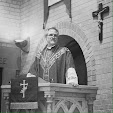
Sunday, September 01, 2024

Sermon: Pentecost 15 (Trinity Lutheran Church) – 2024


1 September 2024

Text: Mark 7:14-23 (Deut 4:1-2; 6-9; Eph 6:10-20)

In the name of + Jesus.  Amen.

Dear friends, we are a nation at war.  And what is our nation?  God says that if we hear the Word of God and keep it, with “wisdom and understanding,” we will say, “Surely this great nation is a wise and understanding people.”  For “what great nation is there that has a god so near it as the Lord our God is to us whenever we call on Him?”  Part of our problem, dear friends is that we don’t know what nation God is speaking of.  When we hear the word, “our great nation,” we usually think of America: our flag, our history, our ancestors.  It’s good to be patriotic and love our country, but America is not our nation, dear brothers and sisters.  It is not our identity.  Our identity is to be baptized into Christ.  Our nation has a King, not a president.  Our nation is Israel, and not what the world thinks Israel is: a modern country halfway around the world.  We, the one holy Christian and apostolic church; we, the baptized; we the confessors of the Most Holy Trinity and our Lord Jesus Christ are the nation.

And we also forget, dear friends, that we are a nation at war. 

We forget because of God’s mercy.  We go about our lives without seeing the warfare all around us.  We think we’re at peace, when there is no peace.  For Satan is like a roaring lion, seeking whom he may devour. 

St. Paul reminds us that we are a nation at war in the famous passage of Ephesians that we heard yet again: “For we do not wrestle against flesh and blood, but against the rulers, against the authorities, against the cosmic powers over this present darkness, against the spiritual forces of evil in the heavenly places.”  St. Paul urges us Christians to “take up the whole armor of God.”  It is spiritual armor for a spiritual war.

How often we forget what our nation is, and what war is.  We get lulled into making peace with the fallen world, and we forget that we are but strangers here.  We think this temporary country is “one nation indivisible,” as though all countries don’t eventually fade or fall away like the Roman Empire.  Rome fell.  The rulers that replaced Rome fell.  The kings who ruled the ruins of the empire fell.  All countries fall.  But the nation, the people of God, the church, has the promise that not even the gates of hell will conquer it.  Our nation the church is truly “one nation indivisible,” for it is one, holy, Christian, and apostolic – and it is grounded in the Word of God that endures forever. 

We are the baptized, and we can never be unbaptized.  We are the redeemed of the Lord, and our demonic enemies can never overcome that reality.  But there is a danger, dear friends.  The danger is that we forget that we are at war, making peace with the devil, the world, and our sinful flesh.  And there is a danger that we forget that we are a nation: a holy nation and a royal priesthood, instead just seeing our temporary country as our national identity.

When the flag replaces the cross, when the Pledge of Allegiance replaces the Creed, when the military replaces the church militant, we need to repent.  And I say this, dear friends, as a military chaplain and seventh generation American.  We need to remind ourselves of what it means to be a nation at war. 

Our Lord’s hearers thought of their nationality in terms of their ancestry.  To them, being an Israelite was being descended from Abraham, Isaac, and Jacob.  And they thought their war was against the Romans and the Samaritans and the other people who were not descended from Jacob.  They thought that what made them the people of God was external religious observance, obeying the ceremonial law.  They too did not realize they were at war.  They too had made peace with the enemy: sin, Satan, and death.  They went through the motions.  They lived a fake life of obedience based on obeying rules and regulations that – apart from faith – were meaningless.  They took more pride in not being a filthy Samaritan or Gentile or Roman rather than seeing their identity as recipients of God’s grace.  They saw their country as their nation, and they were filled with pride.  And then along comes Jesus to turn over their tables, to call them whitewashed tombs and hypocrites, eating with Gentiles and Samaritans and sinners, even praising the faith of a Roman soldier as being greater than anything that He saw among the people who boasted in their being Israelites.

Jesus reminds us that externally following rules is not what it means to be part of the nation.  We need to be reminded of this today.  We need to be reminded that we are a nation at war, that our nationality is rooted in our baptism, and we are not friends with this world.  We hold to the Holy Scriptures, and we hold ourselves to the standard that God has set for us.  It’s not about external compliance, but internal righteousness, and we only have that in Christ, by His cross.  We have that righteousness by grace, through faith, and it comes to us in Word and Sacrament.  We are at war with the forces of darkness, and our weapons are spiritual, dear friends. 

In times of war, we cannot be complacent.  But too often, we are.  Too often we let down our guard and take off our armor.  Paul tells us to put on the “belt of truth.”  For there is objective truth, dear brothers and sisters.  There is not your truth and my truth.  And if there is truth, there is also falsehood.  We stand for that which is true, and the truth is found in God’s Word, and not in human wisdom or our feelings.  The truth can be hard to abide.  The truth may turn us away even from our own families, our neighbors, and from others in our country.  The early Christians were forced to choose between honoring the emperor and honoring Jesus.  We stand with our countryman Polycarp, the 86-year old bishop who was burned at the stake for refusing to worship Caesar.  St. Polycarp understood what it meant to be a nation at war.  He said simply, “I am a Christian.”  He was joyfully defiant as he served His King.

St. Paul tells us to put on the “breastplate of righteousness.”  We protect our heart by protecting that which is righteous – not our own, but the gift of God given to us in Holy Baptism, won for us by Jesus, by His blood shed at the cross.  We rejoice in righteousness, and we do not join with the world in mocking it. 

Our shoes are “the readiness given by the gospel of peace.”  We are at war with the world, but we are at peace with God.  The first word from the mouth of Jesus when He appeared to the disciples after His resurrection was “Peace.”  He gives us not the phony peace of this world, but the true peace of reconciliation with the Father.  And this Good News of peace with God is like shoes for our feet allowing us to walk out into the world – even a world that hates us – and bring this Good News to people who need to hear it. 

St. Paul urges us to take up the “shield of faith” which protects us against the devil’s flaming arrows.  For we are a nation at war, dear friends.  We cannot see the enemy drawing back the bow and aiming at us.  That’s why the shield has to be in place at all times.  It is faith: confidence in your Lord to protect you. 

Paul implores us to put on our helmet, to protect our minds with salvation itself.  For without our being saved by grace, our heads are exposed to the enemy’s thoughts and ideas that expose us to a mortal wound. 

Paul offers us one offensive weapon, dear friends: a sword: the sword of the Spirit, “which is the Word of God.”  Take up the Word, dear friends, and go on the offense.  For we are a nation at war. 

Because we are a nation at war, we pray “at all times in the Spirit.”  And we “keep alert with all perseverance, making supplication for all the saints.”  We are a nation at war, and St. Paul is an “ambassador.”  Our pastors speak on behalf of the King.  And this holy place is an embassy, dear friends.  This sanctuary is dominated by an altar and a font and a pulpit, for it  is an embassy of heaven.  In this place, we don’t have a president, but rather we have a King.  In this nation, we don’t stand for an anthem, but we stand for the Gospel.

Let us fight, dear friends.  Let us serve our nation and King, for it is one nation, indivisible, holy, Christian, and apostolic.  And by grace, the kingdom ours remaineth.   Amen.

In the name of the Father and of the + Son and of the Holy Spirit.  Amen.

Sermon: Trinity 14 (Salem) – 2024

1 September 2024

Text: Luke 17:11-19 

In the name of + Jesus.  Amen.

St. Luke records an incident in the life of Jesus that sounds like a parable.  Although it is an actual event, Jesus uses it to teach us about what it means to be a Christian.

Ten men suffered with leprosy.  It is a terrible disease.  It is painful.  Parts of your body fall off.  Your skin rots away.  For face becomes disfigured.  Worst of all, people can catch it from you, and there is no cure.  The Old Testament laws of Israel protect the people by requiring lepers to be cast out of the cities, to live apart from their families, to cover themselves and yell “unclean” if a healthy person comes near. 

You can see why they pray to Jesus for mercy.  They have faith that He has the power to heal them.  They pray, just as we do: “Lord, have mercy!”  And by means of His Word, Jesus shows them mercy and heals them.  Now, all that they need to do is to be examined by the priests (also from the Old Testament Law) to be declared clean, so they can return home.

Of the ten, only one: a Samaritan, a foreigner, “saw that he was healed” and “turned back, praising God with a loud voice, and he fell on his face at Jesus’ feet, giving Him thanks.”

Jesus asks: “Where are the nine?”  It’s not an actual question.  Jesus isn’t asking the crowd to tell Him what cities or towns these men have gone to.  He is asking His hearers – which includes us – to reflect on the fact that they aren’t here with Jesus.  They are not here with the grateful Samaritan, not praising God and worshiping Jesus with thanksgiving.  “Where are the nine?” Jesus asks. 

Being in my twentieth year at this parish, I’ve seen a lot of people experience the grace of God, but leave.  I’ve seen faithful grandparents replaced by lukewarm children, followed up by indifferent grandchildren, whose own children will probably never be baptized.  Instead, they’ll cheer for the right college team and they’ll learn all of the world’s rituals.  Where are the nine?  There they are.

I’ve seen faithful people, even in the church’s leadership, be lured away from the church because there is something they want more than living in fellowship with the Lord Jesus Christ who healed them from the leprosy of sin.  But usually, falling away is less dramatic.  It’s more often gradual, as other things just become more and more important over time.  Where are the nine?  There they are.

I encounter people in our community who will boast about their grandparents who “built that church” or how they are related to this famous Gretna name or that, people who once filled these pews, maybe even just a few years ago - but now those names are just memories carved on plaques and recorded in the old records written in German.  Where are the nine?  There they are.

There have been many young people that I confirmed, communed once, and never saw again.  Judas Iscariot also communed once, dear friends.  Sometimes people who have long since quit the church will be sure to tell me, “I made my communion there!”  What they really mean is, “I was healed of the leprosy of sin, cleansed by Holy Baptism, and sustained by the Word of God in Christ Jesus, I was made well by my faith, but I decided to not come back and give praise to God.”  That’s really what they are telling me.  “Where are the nine?”  There they are.

Sometimes the “nine” are like our Lord’s most vocal opponents, who thought their ethnicity or their superficial dedication to the Law was enough.  They didn’t need Jesus, because they were children of Abraham, because they were seen as “good people.”  Jesus told them God could raise up children of Abraham from the stones.  He also called them hypocrites and tombs full of dead men’s bones.  Often it was the outsider, the “Samaritan,” who heard the Word of God, the leper who was cleansed, the tax collector, the prostitute, and the “sinner,” who followed our Lord, while the “lifelong Lutherans” whose grandfathers “built that church,” whose names are prominent at the cemetery – who have long since left and never returned.  Where are the nine?  There they are.

Dear friends, today’s Gospel is both a warning and encouragement.  It is a warning not to become ungrateful, like the nine: to take the grace of God for granted, to forget just how bad leprosy is.  When we confess that we are “poor, miserable sinners,” these aren’t just words in a book.  It is the reality that we are falling apart and disfigured.  We are dying.  We desperately need Jesus.  That’s why we pray “Lord, have mercy” at every Divine Service.  That’s why we keep coming back here.  It has nothing to do with your ancestry or what your grandfathers did.  God doesn’t care about that.  He cares, rather, about you, about all of humanity for whom Christ died: saving, healing, and calling to a life of humility, of joy, and of gratitude.

When we are suffering, we call upon the name of the Lord.  We aren’t proud.  We aren’t living as if God doesn’t exist, as if Jesus never suffered on the cross for us, as if the true body and blood of Jesus weren’t here for you, as if the Gospel weren’t proclaimed for your benefit each and every week in this sacred space.  When we are in need of healing, we don’t forget to pray.  When meals are hard to come by, we don’t just eat them without giving thanks.  When we know the danger of sin to our bodies and minds and souls, we don’t just do whatever feels good at the moment.  Where are the nine?  Often, we are the nine.

But there is good news, dear friends.  Jesus invites us to turn back, to praise God with a loud voice, to fall down at Jesus’ feet, to give thanks.  It’s not just about going to church; it’s about being the church.  We worship together here, and we worship with our families at home.  We worship when we wake and when we go to sleep.  We pray, praise, and give thanks.  We don’t boast to God about our grandfathers or even our own deeds.  Rather, we see ourselves as lepers, as poor, miserable sinners in light of the Holy Scriptures.  We pray for mercy.  We are given healing and restoration by Jesus.  And we hear Jesus say, “Your faith has made you well.”

For this lesson from Jesus isn’t just about what we do on Sunday, but how we live every day: living as cured lepers, grateful for the sacrifice of Jesus and for His Word, filled with gratitude for our baptisms, and for the opportunity to hear the Gospel, be forgiven, and give praise to the one who “breaks the darkness.”

Let us pray as Jesus taught is to pray: “Lead us not into temptation.”  Let us also pray “deliver us from evil.”  Let us not become complacent and entitled.  Let us not become bratty children who have been given everything but show no gratitude to our Father.  Let us not push Jesus to the margins while we pursue things in life that we have learned to prioritize: sports, entertainment, teaching our families that other things are more important than learning and living the faith.  Let us hold one another accountable, encouraging our family members to keep coming back to fall at Jesus’ feet. 

For Jesus keeps coming back to give us His gifts, to forgive us again and again, to restore us to health and wholeness and to give us the faith that makes us well: faith that will sustain us forever.

It makes no difference if you are a “life-long Lutheran” or a recent convert.  It makes no difference whether or not you are German or French, or if your ancestors came from somewhere else.  It doesn’t even matter if you have been a member of the nine for many years.  All that matters is the grace and mercy of Jesus.  He welcomes all of us to just come back.  Just come back, dear friends, every day, every week, your whole life, and even unto eternity.

“Rise and go your way,” says our Lord.  “Your faith has made you well.”  That indeed is what it means to be a Christian.

Amen.

In the name of the Father and of the + Son and of the Holy Spirit.  Amen.

Wednesday, August 28, 2024

Sermon: St. Augustine – 2024

28 August 2024

Text: Matt 5:13-18 (Mic 2:7-13, 2 Tim 4:1-8)

In the name of + Jesus.  Amen.

St. Augustine lived in the fourth and fifth centuries, but he was quite a modern man.  In fact, young Augustine would be right at home today, with his parents cheering him on.  For he was an  intelligent kid, he hit the books, he was a remarkably successful student who studied at university, and became a successful professor himself while still young.

Parents today dream of such happiness and success for their children.  Augustine was not hindered by getting married young and having a large family.  He had a girlfriend, and one child – but they didn’t get in the way of his success in his career.  He followed a religion that didn’t interfere with his success.  Augustine was the kind of modern man that most parents dream of.  He was most certainly going to be rich and famous. 

But Augustine’s mother, whose name was Monica, wasn’t happy.  She was a pious Christian.  She did not approve of his live-in girlfriend.  She wanted him to join her church.  Our culture today would see her as narrow-minded and backward.  I imagine there were those in her own day who saw her that same way.  But still she prayed every day for her son’s conversion.

Monica’s prayers were answered when Augustine became a Christian, thanks to the preaching and teaching and pastoral care of her own pastor, Bishop Ambrose, the famous pastor of Milan, Italy, where Augustine was working as a teacher.  In time, St. Augustine himself became a pastor and preacher and bishop and theologian, who became even more famous and beloved to the church than St. Ambrose. 

We could go on and on singing the praises of Augustine, calling to mind his debates against heretics, his massive output of writing, his brilliant sermons, and his insights into the Scriptures.  But what made St. Augustine great was not his abilities in and of themselves.  It was rather his confession of Christ, no matter what was happening in the world.  Augustine lived in a time of great change, as the Roman Empire was crumbling, and ordinary people were afraid of the future.  But we Christians have assurances of the future in Christ, no matter what happens in the cities and countries of men, no matter what is happening politically.

Augustine took seriously our Lord’s words: “You are the salt of the earth.”  For Augustine salted his words with the Gospel, preaching the words of the Bible concerning God’s grace in Jesus, who also said, “You are the light of the world.”  For in Augustine’s day, things were becoming dark for the people of Northern Africa – and in the entire empire – as barbaric tribes were invading and overwhelming the empire and threatening their way of life.  But as Augustine pointed out, the City of Man is temporary, but the City of God endures forever.  He let the light of Christ “shine before others” and implored the people under his pastoral care to give the barbarians good works to see, that they might “give glory to your Father who is in heaven.”

Augustine stood firm for the doctrines of the faith that were under attack, especially the Holy Trinity, and the divinity of Jesus.  Augustine fought against the belief that salvation is by works rather than by grace.  He preached Paul’s words that we Lutherans hold dear, such as this: “For by grace you have been saved through faith. And this is not your own doing; it is the gift of God, not a result of works, so that no one may boast.”  A thousand years after Augustine defeated the heretic Pelagius on this point, an Augustinian monk named Martin Luther would make the same argument to a church that had distanced itself from Augustine and from Paul.  We Lutherans could just as easily be called “Augustinians.”

Augustine took seriously what St. Paul wrote to St. Timothy in our epistle reading: “Preach the Word, be ready in season and out of season; reprove, rebuke, and exhort, with complete patience and teaching.  For the time is coming when people will not endure sound teaching, but having itching ears they will accumulate for themselves teachers to suit their own passions, and will turn away from listening to the truth and wander off into myths.”

Indeed, this was happening in Augustine’s day, and it is happening today, dear friends.  People want to hear only things that make them feel good, things that affirm them, things that are not true, but are rather ear-itching myths.  Augustine’s pious mother Monica rejected all of those things.  It didn’t matter that her son was rich and successful.  It didn’t matter that he was educated.  She did not tell him, “I just want you to be happy.”  She did not tell him to “pick whatever religion tickles your ears, because we all worship the same God anyway.”  She did not tell him to follow his heart in matters of sexuality.  Instead, Monica prayed for her son to come to faith and see the light.  And God heard her prayer.

St. Augustine pointed out that following our heart is foolish, for “our hearts are restless, until they find their rest” in the one true God of biblical Christianity.  St. Augustine was a brilliant defender of our Christian faith because he had earlier opposed Christianity.  He was a defender of biblical morality because he lived without it as a young man, and saw how shallow such a life was.  He used his skills at rhetoric and debate to defend the biblical faith against those who would turn grace into works of the Law, and focus on the self instead of on Christ alone.

St. Augustine taught us Christians about original sin.  He knew it not only from Scripture, but from his own life.  His writings shape our Christian thought to this very day.  He taught us Christians about how to properly wage war in such a way as not to dehumanize our enemies or ourselves.  He also wrote about natural law, and the relationship between the church and the state. 

We could, of course, go on and on.  But the point is that the church goes on and on: she goes on no matter what empires rise or fall, no matter who wins elections, no matter how popular or unpopular Christianity is. She goes on no matter what divisions exist within her, no matter what heresies re-emerge.  The church goes on because, as is engraved above the tabernacle containing Christ’s true body and blood in this Augustinian church: “Verbum Dei manet in aeternum” – “the Word of the Lord endures forever,” just as the Word of the Lord itself, as penned by St. Peter in his first epistle, teaches us.

And first and foremost Augustine was a preacher of the Word, of Christ, of the cross, and of grace.  We remember him because he caused us to remember Christ.  All Christian pastors are sent out with these words of St. Paul: “Preach the Word.”  We preachers preach, dear friends, and you confessors confess.  We preach and confess in season and out of season, whether people like it or not, whether their itching ears want something else, or if they are ready to hear the Word of God and be transformed by it, or not.  We pray like Monica for the unconverted.

“As for you,” says the Lord, “always be sober-minded, endure suffering, do the work of an evangelist, fulfill your ministry.”  Bishop St. Augustine is a saintly role model for the clergy and the laity alike, for he preached the Word, and did not waver.  Like St. Paul, Augustine “fought the good fight,” “finished the race,” and “kept the faith.” 

Let us praise God for the witness of St. Augustine, and may the Lord continue to raise up men of his caliber to preach and teach and lead the flock of God until the Lord returns, until the City of Man gives way to the City of God, and the prophecy of Micah is fulfilled as Augustine and all Christian preachers have proclaimed: “I will surely assemble all of you, O Jacob; I will gather the remnant of Israel; I will set them together like sheep in a fold.”  Let us give thanks to the Lord of the flock for raising shepherds like Augustine to lead us to Jesus and His grace.  Amen.

In the name of the Father and of the + Son and of the Holy Spirit.  Amen.

Sunday, August 25, 2024

Sermon: Trinity 13 – 2024

25 August 2024

Text: Luke 10:23-37 (2 Chron 28:8-15)

In the name of + Jesus.  Amen.

One of our Lord’s most famous parables began with a question from the audience: “Teacher, what must I do to inherit eternal life?”  It was posed by a lawyer and was asked dishonestly, “to put Him to the test.”  In spite of the bad motivation question, it is an important question.  We could rephrase it in a way that a lot of people today might say it: “What do I have to do to get to heaven?” 

Jesus the Teacher asks the lawyer to recite the Law.  The lawyer correctly sums up the Ten Commandments: to love God and love the neighbor.  Jesus replies, “You have answered correctly; do this and you will live.” 

At this point, the correct answer is to say, “But I can’t do that.  I always try to keep the Law but I fail.  I don’t love God with all my heart, soul, strength, and mind when I serve other gods, when I misuse His name, and when I do not honor the Sabbath day.  I don’t love God when I love myself instead, and when I commit any sin, it really is a sin against God.  And I am terrible at loving my neighbor.  Even when I was a child, I didn’t honor my parents.  I wish harm on others, I have impure thoughts, I think I’m entitled to others’ things, I think and speak ill of others, I covet things and people that God has not given to me.  What do I do about this, Teacher?”

But this was not the lawyer’s response.  For he was “desiring to justify himself.”  He needed to find a loophole: some way to make the law manageable.  And his attempt was really pretty weak: “And who is my neighbor?”  For think about it, dear friends, if we only have to keep the commandments with a very few people, that might make easier.  After all, it is easier to love people we already love than total strangers, or even our enemies.  Our lawyer – as lawyers often do – is seeking to focus on the definition of a word to limit the scope of the law, to make it easier somehow (as if that were even possible). 

So who is my neighbor?  We use the word to mean different things in different contexts.  Is it the person living on your left and your right?  Is it someone in your neighborhood?  Someone who is of your same ethnicity or tribe?  Is it your countryman?  Is it someone who has the same citizenship as you, even if that person lives in a foreign country? 

Jesus connects the idea of showing love as a way of keeping the Ten Commandments to the idea of mercy.  For when we are merciful in our minds, our acts of love will follow.  And, of course, it is easier to show mercy to someone we have a connection with than to a stranger, or even an enemy. 

We see this in our everyday lives.  When our own family members suffer, it consumes our lives: an elderly parent, a sick child, a handicapped brother or sister, a spouse that is suddenly in distress.  The closer our connection, the greater our mercy.  Our best friend is in need of help.  A co-worker falls on hard times.  We notice that the homeless person claims to be a military veteran of our country.  There is a crime victim who looks like us.  One of our countrymen is traveling abroad and is arrested by a corrupt foreign government official.  If we have something in common with another person, we are more likely to have a soft spot for him or her. 

But what about a random person who has no connection to us?  Or worse yet, what about someone that I consider to be an enemy? 

Our Old Testament reading is a passage from Second Chronicles.  It was during a time of civil war when the northern ten tribes of Israel won a military victory over the two southern tribes.  The victorious Israelites captured 200,000 of their enemy relatives.  They were enslaving them and taking their property as the spoils of war.  But the prophet Oded spoke God’s Word to them, and ordered them to show mercy: to return the captives, to feed them, to clothe them, and even to use donkeys to convey the weak to their “kinsfolk at Jericho.”

For though these people were their enemies, they were also their neighbors.  And they justified their murder and enslavement and theft of their neighbors because they had been at war.  But God now commanded them to show mercy.

So knowing this Word of God, Jesus tells the lawyer a story about a man who shows mercy to an enemy.  Our Lord even cleverly points the lawyer’s mind to this passage by making the hero a Samaritan – a descendant of those northern tribes of Israel and an enemy of the descendants of Judah.  And Jesus also mentions Jericho in the story.  This was designed to trigger the lawyer’s memory, as it should trigger ours.  For we just heard this reading about showing mercy even to our enemies.

In Jesus’ story, a man “fell among robbers” on the way to Jericho.  He is beaten up and robbed.  He is bleeding out on the side of the road.  And nobody shows him mercy: not even his countrymen: not a priest, not even a Levite.  They both pretend not to notice.  For they have important religious matters to attend to under the Law.  “But a Samaritan” shows up: a natural enemy of this man.  And he had “compassion” even on this stranger whom he isn’t supposed to associate with, let alone get involved with.  He applies first aid.  And like our Old Testament lesson, he places the enfeebled victim on his own donkey and transports him to where he can get help.

The Samaritan even goes out of pocket to help this enemy stranger whom he treats as his neighbor.  Jesus then stops the story and asks the lawyer to go ahead and define the word “neighbor” now.  The neighbor was not the priest, nor the Levite, but rather “the one who showed him mercy.” 

So God teaches us what a neighbor is.  The Samaritan came upon this victim, and this victim was his neighbor.  The neighbor is someone God places before you.  It doesn’t matter where the person lives or even if the person is of your tribe or nationality.  The person might even be your enemy.  The point is that the person is in distress, and has crossed paths with you.  If you are merciful, if you love God and your neighbor as the Law commands, you will be merciful.

Jesus is teaching us how to apply the Law, dear friends.  But He is also teaching us about Himself, about God’s mercy.  For in His mercy, God comes to all of us who have rebelled against Him.  All of us poor, miserable sinners have essentially rejected God.  We don’t want to live by the Ten Commandments.  And even if we know them, we find excuses and loopholes and workarounds to justify ourselves.  We divide our neighbors up into those we love and those we hate, those on our side and those on the other side, those of our tribe and those of the other tribe.  Our compassion is conditional, and we justify ourselves based on defining someone as not being our neighbor.

But in spite of our rebellion against God, God is still merciful to us.  He sends us prophets.  He gives us His Word.  He guides us to show mercy to our neighbors, and for them to show us mercy.  And He even takes the form of a man, suffering the evil of every sort of enemy, teaching us the Word of God, and keeping the Law for us.  And instead of being shown mercy, Jesus is stripped and beaten and left for dead upon the cross.  He is attacked and killed by His own people, His own relatives, His own neighbors: by the very people He came to save, to bind up their wounds, to show them mercy, and to transport them to heaven.

Jesus is the Good Samaritan, whose mercy to His enemies even extends to the cross: “Father, forgive them, for they know not what they do.”  Jesus comes to forgive us when we do not love the Lord our God with all our heart, soul, strength, and mind, and when we don’t love our neighbors as ourselves.  He comes to forgive us when we try to justify ourselves.  He comes to give us forgiveness when we are attacked and beaten and left half dead by the devil.

And indeed, Jesus tells us, “You go, and do likewise.”  He calls us to repent of our self-justification and our lack of love and mercy.  For we also need to hear the Law.  That little lawyer in each of us wants to justify himself.  So let us repent, dear friends.  Let us imitate the Good Samaritan.  And the only way to live a life of mercy to our neighbors is to receive the mercy of Jesus, knowing that we cannot justify ourselves, knowing that we fail, but also knowing that Jesus has come to bind up our wounds by means of His wounds, to clothe us with His righteousness, to pay our debt with His own blood as a ransom, and to transport us to heaven even though we are too weak to get there on our own.

The priest and the Levite can’t save us, that is, the law and our twisted interpretations and self-justifications won’t heal us and save us from death.  Only the Good Samaritan, the God who shows us mercy, can do that.  And He does it, dear friends.  He is here for you today with the bread to revive you and wine to cleanse your wounds.  He offers you His true body and blood. 

Instead of asking “who is my neighbor?” in order to justify ourselves, we should be asking “Who is my Good Samaritan?” in order to be justified by grace through faith.  And the answer, dear friends, is “Jesus.”  Lord, have mercy!  Amen.

In the name of the Father and of the + Son and of the Holy Spirit.  Amen.