Wednesday, July 22, 2009

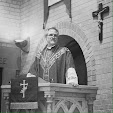
Sermon: St. Mary Magdalene

22 July 2009 at Salem Lutheran Church, Gretna, LA

Text: John 20:1-2, 10-18 and Prov 31:10-31


In the name of + Jesus. Amen.


Satan was really interested in Mary Magdalene. And in retrospect, we can see why.

Mary was the first witness of our Lord Jesus after His resurrection. Mary was the reporter who broke the news, the good news, the gospel itself – to the world. Mary was not an apostle, but is sometimes called the “apostle to the apostles” – for though she was not sent to preach, she was sent to “announce to the disciples” commanded by the Lord to “go to My brothers” and tell them what she saw and heard.

It should hardly be shocking to us that such an important disciple and a godly example of Christian womanhood should come under attack by Satan. In fact, this beloved saint was at one time demon possessed and under the persecution of seven devils.

Satan hates womanhood – for it was through a woman that God took flesh. Satan strove in vain to attack the woman, also named Mary, in whose womb God became human. And it was through the woman Eve that Satan first lured mankind away from God and wrought chaos and death upon the Lord’s good creation.

It should be no surprise that Satan continues to target womanhood, seeking to make a mockery of the distinction between the sexes by distorting this physical status of creation into something of our choosing: “gender.” For the Lord created us in His image, male and female – he did not give us a choice or a preference to adopt any “gender” we desire. For we are creatures who have been created with a body of the Lord’s choosing. We are not gods with the ability to create alternative realities. We creatures are to submit to the will of Him who has been placed over us. We the Body of Christ are to submit to the Head that is our Lord. We, the Church, the Bride of Christ, are to submit to our Bridegoom, our Husband, who has been placed in a position of dominion over us.

All of this talk of submission is most unpopular today. Satan has convinced us that we are masters rather than servants. The devil has redefined womanhood not in terms of wife, but of partner. In some cases, Christian wedding ceremonies deliberately edit out the part of Holy Scripture in which wives are told to submit to their husbands.

But notice that Mary Magdalene, from whom the devil was cast, does exactly as her Lord bids her to do. She runs back to Peter and the other apostles. She tells them what she has been given to say. She even endures their lack of belief.

Notice that Mary does not push her way into the ministry. She does not establish a church. She does not seek out a pulpit and disciples of her own – even though she was chosen – above all the other disciples – to have the honor of seeing the risen Lord first, of being the primary messenger and witness of the Gospel of the Lord’s rising from the dead.

Modern feminists have tried to co-opt Mary as a symbol of their ungodly desire to be ordained ministers. A certain novelist has become a millionaire by slandering our dear sister in Christ, by lying about her as a bride of Jesus rather than properly confessing her as a member of the Bride of Christ, the Church.

Satan continues to lie to women about their role in the family, and lie to the world concerning what Scripture and the Church confess about womanhood.

For though Scripture teaches women to be submissive wives, it in no way diminishes or demeans womanhood. Far from it! Woman is an exalted vocation, the giver of life, the nurturer of children, the one who establishes the Christian home, the one whose service makes the work of the Church possible.

As Solomon’s proverb asks: “An excellent wife, who can find?” For “she is far more precious than jewels. The heart of her husband trusts in her, and he will have no lack of gain. She does him good, and not harm, all the days of her life.”

How different this is from the secular world’s view of the wisecracking wife who is always running down her husband to her friends, and even in front of her own children.

Solomon writes of the godly woman: “She seeks wool and flax, and works with willing hands. She is like the ships of the merchant; she brings her food from afar. She rises while it is yet night and provides food for her household and portions for her maidens. She considers a field and buys it; with the fruit of her hands she plants a vineyard.”

Far from being treated as an object, the godly wife labors for the household. She provides food. She runs the home. Her value is not in running a business or working for another man, but in serving her own family and household.

“She dresses herself with strength and makes her arms strong. She perceives that her merchandise is profitable. Her lamp does not go out at night. She puts her hands to the distaff, and her hands hold the spindle. She opens her hand to the poor and reaches out her hands to the needy.
She is not afraid of snow for her household, for all her household are clothed in scarlet. She makes bed coverings for herself; her clothing is fine linen and purple.”

The godly wife sees to it that the home is a self-sufficient business. That is hard to do these days when all young girls are encouraged to seek outside careers and compete with men. For how many women in modern marriages can say that their “lamp does not go out at night” because they are making clothes for their families? Typically, women are so tired after working all day that they collapse in exhaustion, barely able to perform even the most basic tasks of keeping a home. In fact, even suggesting that the keeping of the home is the sphere of the wife – and not of two equal partners of opposite sexes – tends to make people angry. And yet, Scripture says what it says. Our job is to submit, not to let the devil whisper into our ears and convince us that we know better, or that God’s Word is no longer relevant today.

“Her husband is known in the gates when he sits among the elders of the land.”

How “politically incorrect” such a notion is, that the godly wife’s duty is to serve her husband to increase his reputation rather than seeking fame for herself! In our current culture, men are actually a minority among university students. Women are often the heads of households and the chief breadwinners. And in this setting, children are sent to daycare in growing numbers and at increasingly younger ages. Some schools now take children as young as two months old, and in most cases, this is not because of necessity – unless one considers a luxury car, a “fulfilling career,” or a cavernous house items that one cannot live without. The modern divorce rate shows how well the new paradigm is working.

For the woman of Proverbs 31 is clothed with “strength and dignity.” She “opens her mouth with wisdom, and the teaching of kindness is on her tongue…. Her children rise up and call her blessed; her husband also, and he praises her” with the following words: “Many women have done excellently, but you surpass them all.” For as the Lord teaches us: “Charm is deceitful, and beauty is vain, but a woman who fears the Lord is to be praised. Give her of the fruit of her hands, and let her works praise her in the gates.”

The godly Christian woman is epitomized by St. Mary Magdalene. For as much as Satan hates her, tries to possess her, seeks to mislead and deceive her, and even savages her reputation – she is a servant, a steadfast witness to her Lord, and a servant to those whom she has been placed in submission.

St. Mary is “far more precious than jewels” as our dear sister in the faith, as a godly example of womanhood, as a blessed pattern of service to all Christians, men and women alike, whose lives are to be lived in godly submission to our Bridegroom, our Husband who lays down His life for us, giving Himself completely to His bride, and sharing with us, His Church, the good news that He has risen and that the cunning devil has been defeated.

In death, Jesus has conquered death. By taking our sins, he has paid for our sins. And in His life born of a woman and in His death arranged by sinful men, the Lord has not only redeemed all sinful men and women, but has defeated the lying Serpent who wishes to destroy all men and women, created in the image of God, male and female.

It is fitting that the first bearer of this good news, the one who carried the Gospel to the preachers, enabling them to proclaim the good news to all nations, is the holy woman whose life still stands not only as an example of the godly woman of Proverbs 31, but of the faithful and submissive Christian of both sexes of every time and place, bearing witness to our Lord Jesus Christ.

All praise for Mary Magdalene,
Whose wholeness was restored
By You, her faithful Master,
Her Savior and her Lord.
On Easter morning early
A word from You sufficed;
For she was first to see You,
Her Lord, the risen Christ.

Amen.

In the name of the Father and of the + Son and of the Holy Spirit.” Amen.

Canadian Prime Minister Communion Controversy


Here is a new story that riled Roman Catholics in Canada, as the Prime Minister, Stephen Harper, a Protestant, received communion at a Catholic funeral.

The video of the event shows Mr. Harper taking the consecrated host with his hand, but does not show him eating the host, leading to speculation that the Prime Minister, whose religious beliefs would consider the Catholic Mass to be idolatry, pocketed the Body of Christ.

The Prime Minister's office claims he ate the host after fumbling around with the church bulletin - something that does not seem to be happening in the video.

Of course, politicians say a lot of things. Who knows what the truth is?

But the story has a few lessons of practical theology:

1) If you are a guest at a church that is not your own, it would be best to refrain from participating in any sacramental rites, unless: you know what you are doing, it does not violate your own religious beliefs, and is being done by express invitation of your hosts. Figure all this out ahead of time. It would help to know what everyone believes beforehand.

2) If you are a pastor, make it clear what your church's policy is, and if a guest shows up for communion and you know they ought not be receiving it, have a clear back-up plan, such as a blessing to be given in such a situation - even if the person is a powerful politician.

3) Any hint of scandal that the Lord's Body went into someone's pocket could easily be avoided by the traditional practice of receiving Holy Communion on the tongue.

Lessons 1 and 2 both involve what is commonly called "closed communion." Church visitors need to respect their host churches, and officials in those churches need to make sure visitors respect the religious doctrines held by the hosts - lest others be scandalized.

Lesson 3 addresses the role of tradition in theological practice.

There is nothing inherently wrong or sinful about taking the host in the hand. And doing so has almost become a "law" in the Roman Church over the last 40 years or do. It has also become the norm among modern American Lutherans, as the old adage: "When the pope gets a cold, the Lutherans sneeze" is yet again shown to be true. What's done is done. Taking the host in the hand in no way invalidates the sacrament or does damage to our Lord's holiness. And lest the unscrupulous attempt to put words in my mouth, I am by no means saying that communing on the tongue makes one a "better Lutheran" or communing in the hand is in any way banned in my parish. Most of my parishioners commune the traditional way as they always have, but many also prefer the more modern method. It is the choice of the communicant. We have no canon law on the matter.

However, there was a reason why the medieval practice (continued by Luther and the reformers for centuries) of distributing on the tongue was initially put into place, and why it had such staying power: to avoid this very kind of scandal. In the centuries before the Reformation, some people, pious but ill-advised, would pocket the host to take it home and use it in a superstitious way as a talisman. This negates the benefit of the sacramental mandate: "Take, eat." Similarly, some non-believers (perhaps including witches or even Satanists) would pocket the host in order to show contempt to Jesus, the Church, and the sacrament, or even to use the pilfered consecrated host in desecratory rituals.

Both problems were solved by having the celebrant distribute the Body of Christ directly onto the tongue of the communicant.

There was simply no good reason to change this practice in the 1960s - not even the romantic idea of returning to the primitive church, or making the laity feel good about themselves that they were now free to touch the host with their hands - a practice previously reserved to the clergy.

In spite of whatever good intentions the Vatican II reformers had, the net result is that the Lord's Body is now much easier to desecrate - whether by intent or accident. And if the Lord's Body is desecrated even one time, was the change worth it?

This entire scandal could have been avoided - had the priest and the prime minister behaved with integrity, and had the hierarchy of the Roman Catholic Church not been so eager to throw out a church tradition that came into being centuries ago to prevent this very thing from happening.

Tuesday, July 21, 2009

State Sovereignty

Now that the Federal Leviathan is approaching the monstrous point of no return as it gobbles up and consumes everything in its juggernaut path - even as it is simultaneously going bankrupt - it seems that many of the states in the Union are waking up and once more asserting the historical and legal truths that:

1) the federal government did not create the states, but vice versa,
2) the federal government is the servant of the states, not the master
3) the federal government does not represent the people in the aggregate, but rather by delegation of authority from the people represented by the states through the Constitution,
4) the federal government's power is strictly limited and enumerated by the Constitution,
5) the federal government is, in many cases, operating entirely outside of the law - often through a collusion of the branches, sometimes empowered by the major political parties
6) sovereignty resides with the states, who delegate limited powers to the federal government in certain specific matters (enumerated by the Constitution),
7) the current federalist model is too expensive and too unresponsive to the people.

One of the stumbling blocks standing in the way of curtailing the monster is the mythology that includes the "one nation, indivisible," the outlandish untruth that the federal government created the states and that federal law supersedes state law, and that the states are subservient entities to a superior federal government - all shameless lies told to the American people by Abraham Lincoln in order to justify his illegal aggression against the seceded South for the purpose of conquering and colonizing the states - which incidentally includes all states, north and south.

Not only was there no "civil war," there was no winner - unless one wants to count the bloated federal bureaucracy. The losers of the war were the states and the people, north and south. That's the wrong that the Tenth Amendment movement is trying to right.

All of the states today, who are bearing the brunt of this historical and political falsehood, are now starting to tell the truth - an inconvenient truth for Big Government, for federal hangers-on, and for academicians who have made a career out of divinizing the dishonest and, in the interest of honesty, war criminal president who set in motion the current malaise and the contemporary consequences of the out-of-control federal monster that is threatening the union with ruination.

Will it be a little too late? Can the American people give up their notion that, when it comes to government, "bigger is better"? Will the defenders of Lincoln finally admit what this reprobate has done to our country? Can the union be saved?

Personally, I think the monster is too big. I believe it will break up as the Soviet empire did. I believe the only way to avoid this fate lies in the states asserting their sovereignty, and in the hope that the federal government will yield back to the states and not simply send in the tanks and warplanes. Hopefully, if American soldiers are ever again ordered to invade fellow Americans, commanded to lay waste homes, businesses, and churches in a rampage of rape and pillage - they will simply refuse such immoral orders and join the militias of their own states.

But just maybe if the state sovereignty movement gains enough steam, such violence can be completely averted, and peace and prosperity will once again be the hallmarks of a decentralized, freedom-loving, constitutional America. Maybe we can have our liberty by wielding the pen this time instead of the sword. The Soviet Union was disbanded peaceably. If the Russians could do it, how can we say the Americans can't?

In short, to restore the republic, we must first restore the republics.

Stranger than fiction - Secular Edition


No, this isn't one of those really goofy stories where the church and state are trying to figure out how to bless yet another form of "non-traditional marriage" (such as a person marrying himself), this is actually a pretty funny story that involves the shocking situation of people of the opposite sex getting married.

Monday, July 20, 2009

Not the Onion...

...or Truth is Stranger than Fiction, Ecclesiastical Edition:

Here is an article that would have been funny had it appeared word-for-word in The Onion (which, by the way, some people accuse me of writing), but is actually from the newspaper of a certain very large American Lutheran demonization, er, I mean "denomination."

Joseph Heller could not have done better.

Sunday, July 19, 2009

Zion Liturgical Conference

Bp. Stechholz and Fr. Braden

Here is a conference that I would love to attend. I had made it to a couple of the annual St. Michael Liturgical conferences at historic Zion Evangelical-Lutheran Church of Detroit while living in the tundra of Fort Wayne as a seminarian.

And in spite of Zion's reputation for "high" liturgy and unabashed devotion to the Western Catholic tradition, she remains not only firmly within the confessional heritage and theological moorings of Lutheranism, but also enjoys a surprising level of respect from rather mainstream folks within the Missouri Synod. This includes professors from both seminaries who have attended and spoke at the annual conference, as well as the Rev. Al Barry, the now sainted president of Synod, who was videotaped officiating liturgically at Zion's altar, vested in a cope and carrying a traditional bishop's crosier, while incense wafted its way heavenward and as votive candles flickered before the statues of our Blessed Lord and His virgin mother.

Zion's devotion to reverence and tradition stands in stark contrast to the frenetically hyped youth-driven approaches to worship often touted by those in positions of power in Synod. Traditional liturgy is driven by the confession that Jesus is physically present in our midst in a physical and miraculous way, as opposed to the more Protestant notion that worship is primarily information to be conveyed, often using secular techniques and gimmicks to do so.

This year (as in years past), the District President will not only participate in the conference, but will be giving the benediction at Mass at the event. He is pictured above on the left (The Rt. Rev. David Stechholz, District President and Bishop of the English District) along with Zion's new parish priest, the Rev. Fr. Mark Braden - a classmate of mine at seminary, who is not only one heck of a Greek scholar, but a highly respected pastor and colleague in the ministerium of the Lutheran Church - Missouri Synod.

Note also that the keynote speaker this year is the Dean of the Chapel of Concordia Seminary - St. Louis, the Rev. Dr. Kent Burreson.

I highly recommend this conference, and I also recommend a visit to Zion for anyone who can get there. Zion is living proof that American Lutheranism doesn't have to jettison its Catholic heritage, can unabashedly use traditional churchly terminology and ritual, and still be within the mainstream of the Missouri Synod and hold steadfastly to the Evangelical doctrine of the Lutheran Church.

Soli Deo gloria!

"We are all beggars..."

These words are among the final written notes of Dr. Martin Luther. They are a theological commentary on our own spiritual impotence to save ourselves. They are another way of saying with St. Paul that salvation is a matter of God's grace alone.

But there seems to be a new kind of begging going on in the LCMS.

A few months ago, I received a beg letter from an LCMS congregation in another state. In 1998, at the height of the real-estate bubble, this congregation took an unwise risk. They sold their original church property and with the proceeds bought a "glorious 40-acre parcel of land" with the intention of selling off 27 acres to a developer and making a lot of money on the deal. Why a church needs even 13 acres of "glorious" land is beyond me. I can't help but think of the proverbial bone-bearing dog seeing own reflection in the river according to Aesop's fable. But these were the days when the profit spigot was spewing almost uncontrollably in a seemingly unlimited cash flow. Fortunes were being made all around.

Fast forward to bursting of the real estate bubble.

Bottom line: this congregation is now asking my congregation for help. We don't have a "glorious 40-acre parcel of land." Let's just say that money is tight around here, and leave it at that. I know this is just a form letter, and it probably went to everyone, but it strikes me as terribly insensitive to ask a congregation still struggling from Katrina losses augmented by the current economic downturn to subsidize their poor financial decision-making now that the bubble has burst. This is the ecclesiastical manifestation of "bailout fever."

I can't help but think of the movie poster for Arthur 2 of Dudley Moore holding the sign: "Hey brother, can you spare $750,000,000?"

I know of one congregation in another state that a few years ago spent a million dollars for a building project that essentially gave the pastor a bigger office and made a bigger narthex. The sanctuary was not improved at all. They still sport a roll-away altar with chairs. One has to have priorities, I suppose.

Another congregation that I was familiar with in former times got dollar signs in their eyes, sold their land to a big box store, and relocated up the road thinking they would make a killing. But instead, they underestimated their expenses, ran out of money before the new sanctuary could be built, went way into debt, and had to worship in the school's gym before an altar on wheels, surrounded by tape on the floor and folded up basketball hoops. Every now and then during school sports events, volleyballs would pelt the holy altar. But hey, at least they never asked me to write them a check.

But it seems that another recent beg letter is making the rounds.

This one is from one of these new trendy "churches" that won't use the name Lutheran, shuns the liturgy, and is essentially a pop-music entertainment center. Their beg letter says that they "were led by what [they] believe was the miraculous and Divine hand of the Lord to plant a mission" in one of their state's "fastest growing communities." Isn't it funny how "the Lord" seems to be at times a little too interested in evangelizing the "fastest growing communities"? I think it was Al Capone who said he robbed banks because "that's where the money is."

And so, this 75 year old LCMS congregation with a normal name took a chance. They sold everything and moved. They adopted a hip and happening "Community Church" mission format with a new and funky name. They rolled the dice in the bubble economy, borrowed hundreds of thousands of dollars, spent over a million dollars of their own, and bought 26 acres of land (my goodness!). But when the reality kicked in, they could not afford the payments. It seems that the generation raised on entertainment resented the church talking about money. That's for "organized religion" chumps. The bottom line: they failed to pay their bills and their property was foreclosed. It seems that the Miraculous and Divine Hand of the Lord is no more reliable than Lady Luck at the roulette wheel.

Now they want other LCMS congregations to send them money so they can buy a new facility.

Interestingly, the website of this "mission" mocked the practices of many of the very churches they are now asking for money, with allusions to "stodgy" worship, "dead rituals," and "14th century classical music." The congregation (which describes itself as "exciting" and "passionate") is also saying that its relationship with the synod is "cloudy" at this point. Of course, none of this information is included in the beg letter - which unlike the church's website and sign, identify it as a Lutheran congregation.

This is the sad reality. For all of the promise of endlessly flipping houses and wheeling and dealing in real estate to achieve overnight millionaire status, it was all hot air inflating a bubble. The real estate boom was nothing more than a grand ponzi-scheme that could not sustain its own propaganda.

And this same kind of hot air is behind the bubble of the "relevant" gimmicky churches championed by some in the LCMS hierarchy - and even marketed to us as a kind-of successful turn-key franchise model, sometimes bearing the same names and formats as "churches" across many denominations. Amid all the promise and excitement of rock music, of the "come as you are" mindset where selfishness trumps sacrifice, of the shallowness and vapidity of chasing after ever-changing tastes in a fickle "religious marketplace" - the reality is that this growth-oriented model of "ministry" is unsustainable.

And when the church bubble merges with the real estate bubble, it becomes a "perfect bubble." I can only imagine that we will see more of these implosions, and a lot more begging. And what is pushed to the back seat in all of this desperate financial water-treading in the aftermath of the bubbles bursting is the genuine Gospel, the authentic proclamation of Christ in His Church. "Stodgy" stuff indeed.

We are all beggars to be sure.

Sermon: Trinity 6

19 July 2009 at Salem Lutheran Church, Gretna, LA

Text: Matt 5:17-26 (Ex 20: 1-17, Rom 6:1-11)


In the name of + Jesus. Amen.

“Come to terms quickly with your accuser while you are going with him to court, lest your accuser hand you over to the judge, and the judge to the guard, and you be put in prison. Truly I say to you, you will never get out until you have paid the last penny.”

After proclaiming this Gospel to you, I announced, according to our liturgy, “This is the Gospel of the Lord.”

The Gospel is not the threat that you will remain in hell until you have paid for your sins (which means that you would never get out). For that is not good news at all, dear brothers and sisters. In fact, that is a horrific and terrifying thought. What is the gospel is that this dreadful fate can be avoided. For now is the time to repent. Now is the day of salvation. Now is the time to receive God’s grace and live forever.

The Gospel is not in the threat of punishment, but rather in the promise of deliverance. Our Lord tells us exactly how to avoid the recompense for our sins which we so richly deserve: “the hell of fire.”

Our Blessed Lord, our Advocate, advises us to settle out of court. Don’t let your sins be brought to the bar of justice. No indeed! Confess your sins! Plead with the judge for mercy, even as we pray: “Lord, have mercy!” For our Lord has not come into the world to condemn, but to save. He is truly the “Lamb of God that taketh away the sin of the world.” He most certainly hears us when we pray: “Forgive us our trespasses” and indeed He responds with: “I forgive you all your sins.” And what’s more, He forgives our sins “in the name of the Father and of the Son and of the Holy Spirit” – in His own holy name, sealed by His own Word, backed by His own divine authority, and given to us by the promissory waters of Holy Baptism. “Do you not know,” dear friends, “that all of us who have been baptized into Christ Jesus were baptized into His death?”

We settle out of court when we come to the sanctuary instead of the courtroom, to the pew instead of the prison. We come to this place of freedom to be liberated from our sins rather than go to a place of confinement to be bound to them.

That is how we Christians “come to terms quickly.” Instead of being dragged into a court of judgment, we joyfully take refuge in the courts of the Lord’s House. Instead of being forced to our knees in a dungeon and being placed on a subsistence diet of bread and water, rather we kneel in adoration and in praise in this place where the Lord dwells, participating in a glorious banquet of bread and wine, body and blood, quickened by every word that proceeds from the mouth of God, born again by the waters of Holy Baptism. And instead of a terrifying sentence of condemnation, we hear consoling words of absolution, pardon, and release.

“Come to terms quickly with your accuser.”

God is not our accuser, dear brothers and sisters. The name “Satan” means accuser, and our Blessed Lord Jesus has indeed “come to terms quickly” with the serpent, dealing him a mortal blow even as He died on the cross. We came to terms quickly with Satan when we were baptized into the Lord’s death, even as we sing to the Lord: “Baptized into Your name most holy.”

We settle out of court when we plead our watery rebirth before the Judge, remembering our baptism, marking ourselves with the sign of the cross, that ancient emblem of victory over our accuser, the sign by which we are sealed and delivered. For “we know that our old self was crucified with Him in order that the body of sin might be brought to nothing, so that we would no longer be enslaved to sin.”

And it is in this freedom, secured by the death of our Lord on the cross, given to us in Holy Baptism, laid hold of in Holy Absolution, proclaimed to us in the Word, and physically placed into our mouths in the Holy Sacrament of the Altar, that we sinners settle out of court, are pardoned by the King of the Universe and are paroled by the power of the Lord’s Word, promise, and command.

That, dear friends, is the Gospel. That is the Good News. For indeed, the last penny has been paid for us – “not with gold or silver, but with His holy, precious blood and with His innocent suffering and death.”

This is the true joy of the Christian faith: we have been liberated. Though we still live in the valley of tears, and though we still struggle in this body of death, we are no more prisoners to our Old Adam, to our flesh, to sin, to death, nor to the devil. We have settled out of court. We have been pardoned. Our debt has been paid. Our freedom has been given by order of the King. We have cheated the hangman, the doors of our cell have been opened by a turn of the key, and we are free to put all of that behind us, to walk away and never look back.

We have not been freed to return to our cell, to repeat the crimes for which justice would demand our blood, to fall again into the folly of the Old Adam. For that kind of “freedom” is truly slavery – as St. Paul proclaims, we have been crucified with Him “so that we would no longer be enslaved to sin.”

We have been emancipated not so that we can transgress the law, but rather that the law might be fulfilled by Christ Jesus through us, through His body, the Church. “Are we to continue in sin that grace may abound?” asks the Apostle. And he answers His own question: “By no means!” For we are baptized Christians. We are liberated captives. We are pardoned prisoners.

For does our Lord not say: “Do not think that I have come to abolish the Law or the Prophets; I have not come to abolish them but fulfill them”? For truly he has proclaimed to us anew: “Until heaven and earth pass away, not an iota, not a dot, will pass from the law until all is accomplished.”

The Law is powerless to condemn the one who repents not because the Law has been changed, but rather because the man who repents has been. We are a new creation at baptism, and we are being conformed into the Lord’s image.

This, dear brothers and sisters, is why our Lord implores us to seek an out of court settlement. This is why we are all here today. We have come to petition the King for pardon, for clemency, and for mercy. We have come to throw ourselves on the mercy of the court – for we have the Lord’s promise that our judge is “gracious and merciful, slow to anger, and abounding in steadfast love.” We have the Word of Jesus that He has come to fulfill the Law and the Prophets.

Heed our Blessed Lord’s counsel, dear friends! “Come to terms quickly.”

The fact that we are forgiven empowers us to forgive. The reality that we have been reconciled to our Father makes us able to be reconciled to our brother. The truth that our Lord’s “righteousness exceeds that of the scribes and Pharisees” is what enables us to “enter the kingdom of heaven.”

For this is what it means to “Come to terms quickly with [our] accuser.” This is what it means to settle out of court. This is what it means to repent, to forgive, to live a life of service in the kingdom as pardoned sinners with a new lease on life. “So you also must consider yourselves dead to sin and alive to Christ.”

“Alive to Christ,” dear friends. This is the state of those who “come to terms quickly,” who settle out of court. This is why we are here. This is why we pray: “Lord, have mercy.” This is the Gospel of the Lord! Praise be to Thee O Christ! Amen.

In the name of the Father and of the + Son and of the Holy Spirit. Amen.

Saturday, July 18, 2009

"I'm still here, me."

Holy Ordination, July 18, 2004 (Photo: Martin Fonda)

Ego tamen hic sum, gratia Dei.

Sunday, July 12, 2009

Sermon: Trinity 5


12 July 2009 at Salem Lutheran Church, Gretna, LA

Text: Luke 5:1-11 (1 Kings 19:11-21, 1 Cor 1:18-25)


In the name of + Jesus. Amen.

Jesus calls his disciples in a strange and supernatural way. He doesn’t rely on a human resources expert to tell Him who will make a good disciple, someone who can assist Him and stand in His place to preach the Word of God. Jesus makes no use of any synodical programs, psychological analysis, or spiritual gifts inventory forms.

Instead, He goes to a small group of fisherman who have failed to catch anything all night, tells them to try again, and miraculously fills the nets to the point of breakage.

He then observes Simon Peter’s reaction.

Is Peter so impressed that he signs up for a one-year trial membership to the Jesus Organization, so he too can learn to be a self-actualized and confident fisherman? Does Peter grab Jesus’s coattails hoping to rise up the ladder of success, maybe even starting a franchise of his own one day? No indeed.

Peter is shocked and horrified – not with the mysterious Rabbi’s miracle, but with his own sinfulness: “Depart from me,” he says, “for I am a sinful man, O Lord.” This is because, as the Evangelist reports, Peter and his cohorts were “astonished.” These were seasoned fishermen, and they knew that this was not a natural phenomenon. This Jesus had lordship over the forces of nature itself. There is something divine about this Man, something holy and otherworldly – which serves to remind Peter of his own uncleanness which stands out by contrast.

And notice that far from disqualifying Peter from the apostolic ministry, it results in our Lord dismissing his fears, removing his reproach, and calling him into service: “Do not be afraid,” He says, “from now on you will be catching men.”

Peter’s recognition of his sinful state is just what Jesus was looking for in a “fisher of men.” Peter, for all of his faults, is honest. He can see his own unworthiness based on his own merit and power. He can see his own weakness, and in his sincerity, bids the Lord to leave rather than allow his own uncleanness to defile this holy Man.

There is a candor about Peter’s plea, a humility and a melancholy acknowledgment of exactly what the Lord Jesus has come to fix: sin. And in his failure to be perfect, Peter passes the test. For had he claimed to be perfect, he would have been a liar, deluding himself about the very issue Jesus has come to fix. Coming to grips with the destruction of sin is something that will make Peter a good “fisher of men.”

Our Lord dismisses Peter’s sins and forgives him with one little word: “Do not be afraid.” For Peter, the forgiven sinner, the follower of Christ, no longer has anything to fear as a result of his sins. The powerful Word of the Lord has spoken, and has done far more here than make a lot of fish jump into a net. This is why there is no reason for Peter to shrink from Jesus in horror. For the Son of Man has come not to condemn, but to save. And He has come to save by the “word of the cross” – which is “folly to those who are perishing, but to us who are being saved it is the power of God.”

The Lord has come to die on the cross, to forgive us all our sins, and to reanimate us. This new life comes from the same source of power as the miraculous catch of fish – the very Word of God.

We are told that just before this miracle, just before calling the disciples, our Lord stood at the side of the lake, and “the crowd was pressing in on Him.” And the reason they were doing this was “to hear the Word of God.” They were hungry to hear this Word of life.

For this Jesus taught with authority, unlike their lawyers and preachers of self-righteousness. This Man’s Word was different. It had power. It could work miracles. It could indeed catch men in righteousness with the ease by which great numbers of fish can become entangled in a fisherman’s net.

The Word of Jesus is indeed powerful, and it does what it was sent to do – to forgive us, draw us into itself like a net, drawing us to our loving Father, all in order to forgive us, make us new, and give us everlasting life. But this Word, the mighty “Word of the cross” needs mouths so that the Word may take flight, may be proclaimed, may be heard, and may win men to the gospel even as a net ensnares its prey. And this is why the Lord calls ministers and preachers – to “catch men” by this preaching of “Christ crucified…. Christ the power of God and the wisdom of God.”

Preaching is not the transmission of information. It is not a message. It is “the power of God.” It is the Church’s holy vocation to proclaim the Gospel to all the world. For we do not preach our own opinions, our own sorry attempts at wisdom. We do not preach a wealth and prosperity cult. We do not preach a political utopia or a “social gospel.” We do not preach in order to be clever, controversial, famous, or loved. We do not preach to win the favor of men or the approval of the government.

We preach, rather, the Word of God, the Word of the cross. “We preach Christ crucified” – and that preaching is seem by some as an offense, and by others as stupidity. This kind of preaching is mocked, discouraged, treated as of little consequence, and ignored. But this is the preaching the Lord calls his ministers to do. “For the foolishness of God is wiser than men, and the weakness of God is stronger than men.”

St. Peter and his band of fishermen-turned-preachers would see far greater miracles than a strange and mysterious catch of fish. They would likewise look at their own sinfulness in horror again and again, as they lived out their lives in the flesh in the fallen world. And yet, through it all, their Lord was with them, preaching to them, and through them, telling them not to fear, urging them to resist the devil, imploring them to continue preaching that Word that is both hated and loved by the world, the Word through which we are saved and have eternal life.

And this Word is sufficient for us in this life, dear brothers and sisters. For even as St. Peter and the apostles gave up everything to follow Jesus, all for the sake of the Word, we too are called to be disciples.

Some of us are called to preach the Word, some are called to hear the Word – but we are all called to be drawn into the evangelical net of the Word of God, the Word of the cross, the Word of Christ – “the power of God and the wisdom of God.”

For this Word is our very life. All else is worthless when set next to this mighty and life-giving Word. For Peter and the disciples “left everything and followed Him.”

Then let us follow Christ our Lord,
And take the cross appointed
And firmly clinging to His Word,
In suff’ring be undaunted.
For those who bear the battle’s strain
The crown of heav’nly life obtain.

Amen.

In the name of the Father and of the + Son and of the Holy Spirit.” Amen.

Saturday, July 11, 2009

Priesthood, Pastor, and People

The Lutheran Church - Canada (LCC) has published a doctrinal paper called Pastor and People Together in Christ's Church. It addresses the nagging question among LCMS Lutherans (and their descendants, such as the LCC) as to the relationship between the clergy and the laity.

Overall, the paper is excellent. It weaves together Scripture, the Lutheran confessions, and historical practice - especially in the more recent Lutheran experience of North America - and draws conclusions, offers criticisms, and points forward to a proper corrective against both clericalism and anticlericalism.

There is one aspect of the paper, however, where the authors adopt a peculiar way of speaking about the clergy/laity relationship that is, I believe, sectarian and unhelpful. This has to do with the use of the word "priest."

In the Old Testament, the priesthood was a hereditary office held by men from the tribe of Levi. Their job was to minister in the tabernacle/temple mainly through the offering of sacrifices. Of course, those priestly sacrifices were rendered obsolete, or more accurately perhaps, fulfilled, by the oblation of our Lord Jesus Christ on the cross. That all-availing sacrifice marked the end of the Levitical priesthood.

And yet, the Christian Church traditionally uses the term "priest" to describe the New Testament office of the ministry. The vast majority of Christians on the planet today employ the term "priest" in this fashion: Roman Catholics, Eastern Orthodox, Anglicans, and many Lutherans around the world.

In fact, the term "priest" is the most common term for office of the holy ministry in the Lutheran confessions, and is commonly used by Lutherans outside of Germany and the United States - particularly in those Lutheran church bodies that were able (unlike the Germans) to retain or recover traditional church polity (such as the Scandinavian, Baltic, and Russian Lutherans, as well as African Lutherans who were initially evangelized by the Scandinavians). Unlike in Germany, the early Swedish Lutherans were able to retain the traditional church structure of consecrated bishops and ordained priests (which is, incidentally, the preferred form of polity as expressed by the Book of Concord).

So, it is simply Germano- and/or North Americano-centrism to say "Today [pastor] has become our favourite term." The "our" must be understood as "Canadian Lutheran" or "North American Lutheran" or "Protestant" rather than speaking for all Lutherans. Indeed, the LCMS and the LCC are both in full fellowship with Lutheran bodies that shamelessly use the word "priest" in their hymnals and service books.

In fact, German and North American Lutherans have drunk so deeply from this well that one will often read theological writings by English- and German-speaking Lutherans where the term "priesthood" is used to mean the laity alone! Lutherans will speak about the office of the ministry as opposed to the priesthood and vice versa. This is a sectarian, if not ghettoizing vocabulary. It would be confusing (at best) if it were read by Christians of any other historic confession, not to mention by many Lutherans around the world.

Part of the justification of this use of "priesthood" to apply to the laity as opposed to the clergy stems from a narrow reading of 1 Peter 2:9:
"But you are a chosen race, a royal priesthood, a holy nation, a people for his own possession, that you may proclaim the excellencies of him who called you out of darkness into his marvelous light."
The line of reasoning is that in the Old Testament, the priests were only the hereditary temple priests, and the laypeople had no priesthood. But by virtue of the New Testament, since Christ is our High Priest, and since all have direct access to God the Father, now all baptized Christians are "royal priests" (Greek: basileion hierateuma). Hence the old restrictive "clerical" priesthood has given way to a universal priesthood of believers.

And since this priesthood is a priesthood of the laity, so the line of reasoning goes, the clergy no longer have a priesthood. It is as though their priesthood as baptized Christians is sucked out of them through the laying on of hands at ordination - hence the use of the term "priesthood" among many Lutherans to the exclusion of the ordained ministry!

Now, there is some truth in the above. All Christians are indeed priests. They are to offer themselves as sacrifices, to pray for others, and they indeed have direct access to God and are welcome in the sanctuary of the Lord's Presence.

But this is not an Old Testament/New Testament distinction as many seem to assume. Were the laypeople in Old Testament times also priests? According to Exodus 19:6, yes:
"and you shall be to me a kingdom of priests (Greek: basileion hierateuma) and a holy nation."
Notice that the Greek Septuagint of the Old Testament for Exodus 19:6 uses the same words as the 1 Peter 2:9. The "priesthood of believers" existed in the Old Testament even as it does in the New - even side-by-side with the clerical priesthood.

Even though the laity of the Old Testament did not share in the ordained ministry of the Levitical priests, they still had a priesthood by virtue of being God's holy people, beholden to gather in a congregation, pray, and offer their own lives sacrificially - through their service, their tithes, and their leading of holy lives.

Another myth concerning the priesthood of believers is that this was a rediscovery of Martin Luther, that the Roman Catholic Church did not, and does not, recognize the priesthood of the laity. This is simply not true. The Catechism of the Catholic Church speaks of the priesthood of the laity. No traditional church body denies that all Christians bear a priestly office. And furthermore, the use of 1 Peter 2:9 as a theological linchpin to undermine the priestly role of ministers is just not done in the Lutheran confessions. In fact, 1 Peter 2:9 is only invoked once in the Book of Concord (Tr 69) which is addressed well in the LCC's paper.

The word "priest" is the most commonly-employed term in the Book of Concord for the office of the holy ministry. To call the use of the term "improper" is to condemn the Lutheran confessions themselves - not to mention centuries of pious Christian writings. It is important for laypeople to know, for example, if they read a copy of John Chrysostom's On the Priesthood, it is about ministers, not laypeople. It is equally important that they understand that the word "priest" used in the Augsburg Confession does not refer to the laity. We do no favors by introducing sectarian terminology. Of course, we English-speaking Lutherans have done much to confuse the laity with misused terms - such as "elder" - a term that is used Biblically as ordained pastor as opposed to lay assistants.

For there is a priestly component to the pastoral ministry - one that works with, not against, the priestly component to the laity. This is confirmed by St. Paul in Romans 15:16, where he refers to himself as:

"a minister of Christ Jesus to the Gentiles in the priestly service (Greek: hierourgounta) of the gospel of God."

Interestingly, the LCC paper makes no mention of this scriptural passage in which St. Paul explicitly applies the word "priest" to the work of the pastoral ministry! The King James Version (and its updated descendant, the NKJV) translate this passage with no mention to "priestly service" - opting instead for "ministry" - perhaps owing to the battle between Catholic and Puritan factions in England in the 17th century.

I believe it is helpful to retain the use of the word "priest" for the pastoral office - not in order to displace other fine descriptive (and also Biblical) words like pastor and minister, and certainly not in any desire to diminish the priestly office of the laity. Rather, it befits pastors to see themselves in a priestly office. They are not hirelings, not functionaries - but like St. Paul, are offering "priestly service" to the people. They offer their lives in a sacrificial way. They handle holy things at the altar. They offer a sacrifice liturgically as well - not a propitious sacrifice to forgive sins, but rather leading the people in a sacrifice of praise and in offering the incense of prayer before the throne-room of heaven.

In this sense, the Levitical priesthood has changed forms, and a part of it does live on in the apostolic ministry.

In Isaiah 40:1-2, the prophet is writing to the people of Judah in the future, in their time of exile. He opens this part of his preaching with a call to preachers to proclaim the Gospel:
"Comfort, comfort my people, says your God. Speak tenderly to Jerusalem, and cry to her that her warfare is ended, that her iniquity is pardoned, that she has received from the Lord's hand double for all her sins."
The Septuagint clarifies to whom God is giving these instructions, beginning in verse 2: "Priests (Greek: hiereis), speak..." And notice that in the time of exile, even though there was no temple and no temple sacrifices, the priesthood was not abolished. Rather their ministry changed from one of sacrificial offering to one of preaching the Gospel. They were to "speak" (Greek: lalesate, a word typically interpreted in the New Testament not merely as ordinary conversation, but as preaching) to the "people" (Greek: laon, from which we get the word "laity") that her "warfare is ended" and that her "iniquity is pardoned." The forgiveness of sins in this case was not something carried out by the hands of the priest, but by his mouth. And it was not effected through an offered lamb, but rather through the divine pardon of The Offered Lamb to be communicated by the priest to the people.

This preaching priesthood prefigures the New Testament office of pastor. For he doesn't offer a lamb as an oblation at the altar, but rather distributes the once-for-all sacrifice of the Lamb to the people at the altar. The post-temple priest also "speaks" a proclamation of "comfort" to the laity, to the people.

The Ancient Christian Commentary has several entries in which the church fathers understood the word "priest" in the Septuagint's rendering of Isaiah 40:2 to be applicable to Christian preachers of the Gospel: bishops and priests in the pastoral office.

The vast majority of Christians since, and today, understand the priestly role of the pastor. It isn't something to be discarded because of alleged confusion with the Levitical priesthood any more than we ought to cease using the term "priesthood" to apply to the laity for this same reason.

In giving pastoral care to my flock, I sometimes refer to myself as the parish priest. I have episcopal oversight and eldership over my congregation. I also tell the laypeople - especially the fathers - that they too are priests - exercising spiritual oversight and eldership over their families. The two priesthoods are similar, and yet they are distinct in many ways. And, as the LCC paper makes clear, Christ is ultimately the Head of both orders of priesthood.

Rather than speak of "the ministry" vs. "the priesthood," maybe a more healthy and less sectarian manner of speaking would be to speak about the "priesthood of the baptized" and the "priesthood of the ministry" working together under the Priesthood of Christ.

Thursday, July 09, 2009

Community Prayer Events


I love my community and city, Gretna, Louisiana. We are, for the most part, well-governed and small enough to have access to the city council, chief of police, etc.

I get a lot of invitations to "prayer breakfasts" and "prayer dinners" put on by the city - which always strike me as odd, a weird admixture of church and state, and ultimately, a denigration of prayer. These events turn the privilege of addressing our heavenly Father into a kind-of political gala showcasing area movers-and-shakers - which a lot of clergy seem to want to be a part of. I believe our humble petitions in the Divine Service for our elected officials is a far more effective use of prayer than these spectacles.

Prayer is not about access to the mayor, but access to the Creator.

There's always something phony and cheap about these kind of things. Even the flippancy about the LSU tigers baseball team being a cause for prayer showcases the lack of profound belief at work - as though prayer is all just one big joke. And if the Christians don't take their faith seriously, why should anyone else? I don't know if it is more a Southern thing or not, but sports is truly a god to many people. Some of the same folks who think nothing of spending hours in a stadium (not to mention hundreds of dollars) cheering on a bunch of millionaires will gripe and moan if the Sunday service goes on for more than an hour and would think it ridiculous to put anything more than a couple bucks in the plate.

But what's worse, here is an example of the local Roman Catholic parish hosting a woman "pastor" to be the keynote speaker, and the local Roman Catholic pastor giving the benediction. The function was funded by the Knights of Columbus.

What a coup for Satan! How else could he get a priestess to lead a bunch of Catholics in prayer?

But, of course, to publicly object (or even to decline the invitation) runs the risk of alienating oneself and one's church from the community and from the local government. Christians who actually believe the Bible can expect to be increasingly marginalized in our own communities - even as other church bodies that don't ordain women see no problem with inviting them to lead prayers in the context of unionistic worship services.

This is a sad situation.

Here is the article from the West Bank Beacon, July 2009, page 35:


Gretna “Dares to Believe” at annual prayer dinner by Blair C. Constant

The 16th annual Gretna Prayer Dinner was held on Tuesday, June 23, at the St. Joseph gymnasium in Gretna. Those in attendance were entertained by Grammy award winner and local singer Irma Thomas, and were challenged to “Dare to Believe” by the event’s guest speaker, Rev. Kathy Radke Storey, who is the chaplain at the Jefferson Parish Correctional Center and Rivarde Detention Center. Food was cooked and provided by the St. Cletus Knights of Columbus.

Belinda Constant, a councilwoman for the city of Gretna who chaired the event for the second year, and Ms. Jo Duhe, co-chair, enjoyed a record number of attendees at just over 550 people. “This was the largest crowd since the event began, and it was very exciting for me to see the community come together in such a meaningful way,” says Constant. “I was invited to be the chairperson two years ago and commit to chair the event for two years. I was incredibly pleased with the turnout despite of our competition that night,” says Constant. The competition referred to was the second game in the final series of the College World Series. While attendees later learned that LSU lost that night, the Tigers answered the prayers of many spectators by winning their sixth national title.

The Gretna Prayer Dinner was started by the Gretna Community Association under the direction of the Gretna Prayer Dinner cofounder, Ms. Jo Duhe. “Ms. Duhe is the only original volunteer still actively involved in the event, and much of the success of the prayer dinner is because of her commitment to her community and her efforts as a volunteer,” says Constant.

After Rev. Storey’s inspirational message, which resonated with many dealing with trials of the current economy, the Gretna Community Association recognized with awards two local community non-profit groups who have been serving on the West Bank: the Boys & Girls Club of the West Bank and the Community Center for Life, which is an non-profit group that cares for the needs of women involved in unplanned motherhood. With a final performance by Irma Thomas and benediction by Fr. James R. Day, the new pastor at St. Joseph Church in Gretna, attendees may have daring to believe for an LSU championship, but hopefully were inspired to believe in better days to come.

Language Learning Online


Check out LiveMocha! It is an online approach to learning languages that works along the "social networking" model like Facebook and MySpace - only this international community is filled with people learning foreign languages.

There are online courses offered in several languages (a free version as well as very inexpensive "premium" versions that offer a few extra benefits, such as help from professional tutors) that make use of multimedia and instant feedback for learning (along the lines of the popular and expensive Rosetta Stone). And, your exercises (written and spoken) are critiqued by native speakers in the community. Also, you can help others learn by critiquing their English (or whatever language you speak).

You can "friend" people based native language or based on whatever other languages they are studying (as well as the level of their expertise).

If you are interested in taking a course, you can take a little quiz in the language of your choice just to assess where you are. I was placed in intermediate French (based on a short reading quiz). However, upon starting the free French 201 course, I realized my writing and speaking were rusty. So, I actually re-enrolled in the French 101 course for practice and review. And when I submitted exercises for peer review, I was asked to help out a couple people with their English.

LiveMocha is looking to expand the language courses offered, and there are many optional helps available, such as flashcards you can download and additional exercises for practice.

Here is a write-up on Wikipedia, also a review at VentureBeat, and here is the help page from LiveMocha itself.

Language is ultimately about communication, and it makes great sense to exploit the World Wide Web to share language learning and practice with people around the world. It is stunning how many people around the world are fluent or advanced in multiple languages - and are still interested in learning new ones.

The little I have used LiveMocha so far, I'm impressed.

Wednesday, July 08, 2009

News Reports in Latin


HT: Chris Jones at LatinLanguage.us

If you've ever wanted outstanding audio and video news reports in exquisite classical Latin (and who wouldn't?), your search is over!

Check out Scorpio Martianus. You can even subscribe to the RSS feed. Bene facta!

Tuesday, July 07, 2009

Lutheran Gregorian Chant in St. Louis


The Rev. Dr. Ben Mayes (a classmate of mine who is currently called to Concordia Publishing House working on the project to translate additional volumes of Luther's Works into English) writes:

Gregorian Chant Workshop with Vespers on the eve of St. Luke’s Day will be held on Saturday, October 17, starting at 1:00 p.m. at

Emmaus Evangelical Lutheran Church, U.A.C.,

2241 S. Jefferson Ave.,

St. Louis, Mo.


The event will include choir practices, a practical presentation aimed at parish work, supper, and Vespers. More information to come later...

Although I won't be there, I highly recommend this workshop to anyone interested in traditional church music and/or the prayer offices of the Church.

Dr. Mayes is a co-author (along with the Rev. Michael Frese) of the Brotherhood Prayer Book, which is a Lutheran breviary or prayer book (very similar to those available in Germany) making use of the traditional prayer offices set in Gregorian chant tones - translated into English. Not only are Mayes and Frese outstanding liturgical and historical scholars, both are fluent in German and well equipped musically and in Latin as well.

I attended a couple of the Lutheran Liturgical Prayer Brotherhood retreats when I lived up north, and it was an edifying experience - not only for the learning experience of reading Gregorian music notation (which is actually much easier than it looks), but also for the spiritual formation of participating in traditional prayer and hymnody - much of which dates back more than a thousand years.

Thanks to Ben and Michael (as well as to my colleague the Rev. Paul Beisel who has also led this workshop) for their fine work in bringing this dignified and flexible approach to praying the sacred texts of Holy Scripture into the 21st century world of English-speaking Lutherans.

Well done, gentlemen!

The Best "God" Billboard Ever

You've probably seen them on the interstate - those "God Speaks" billboards. They are short citations attributed to God. Of course, they are never actual quotes from Scripture, but rather fantasy wise-cracks that make God sound like a gum-chomping character on a sitcom backed by a laugh track.

Yawn.

But here is a variation that actually made me laugh:

Sunday, July 05, 2009

More Louisiana Food (and Music) Fun


A hilarious article in Offbeat: "In the Kitchen with Sunpie" (and when you click on "Sunpie" make sure the speakers are up).

Here's a little taste:
I used to be allergic to shrimp, made me deathly ill. The first time it hit me so hard it put me down on the ground. Thought I was going to die. Cramps, and I couldn't breathe. I'm allergic to the iodine. King crabs and stuff like that put the hurt on me. Hurt my feelings too. I had these friends when I was working at Jean Lafitte and they loved me and they had this restaurant. All they served was gumbo and po-boys, basically all shrimp. They served this big ol' bowl of gumbo that was nothing but shrimp and I couldn't get it across. "Huh?" So I was sitting there. "You want some more gumbo?" Finally, I had to say, "Look, I have to tell you, I think I'm allergic to shrimp." They said, "Huh? Huh?" He said, "Mama, come here!" She came out the kitchen. "What is it?" He said, "Mama, he's allergic to shrimps!" She said, "Huh? Oh, oh..." and she sat down as if somebody had died. "Oh, no... You're allergic to shrimp, how could that happen to you?" And she looked at me and she said. "Boo, what are you going to eat?!"
And, at no extra charge, here's a little lagniappe: a great video of Sunpie Barnes (who is also a National Park Ranger)...

Louisiana Breakfast!


From my Facebook page...
"This is the perfect South Louisiana way to break the fast on a lazy, ninety degree Sunday afternoon after church, just as the explosive (but blessedly brief) downpour baptizes the steamy pavement anew: Two scrambled eggs, grits, spicy hash browns, ham, toast, and an Abita Amber.

I think this should become a tradition to be enjoyed every 4th Sunday after Trinity."
This breakfast was enjoyed by Fr. H. at Common Grounds, just a couple blocks from home. If you're really hungry, you can enjoy my Trinity 4 Special vicariously in supersize by clicking on the picture.

This was almost as much fun as my Canadian Breakfast: French toast, ham, coffee, Coke, and chocolate shake.

Sermon: Trinity 4


5 July 2009 at Salem Lutheran Church, Gretna, LA

Text: Luke 6:36-42 (Gen 50:15-21, Rom 8:18-23)


In the name of + Jesus. Amen.

“Judge not, and you will not be judged.”

Most of us do not work in the judicial branch of government – though some of us do. Most of us are not employed in the business of detaining, trying, and punishing people accused of crimes – though some of us are. But all of us break the Lord’s commandment to be merciful, not to be judgmental. We all deserve to be detained, tried, and punished.

Of course, there are those whose vocations, whose callings from God, require them to judge others. One cannot live in a civilized society without not only due process, but also the threat of punishment and the containment of the violent.

This is not the kind of judgment our Lord is warning against.

Nor is our Lord telling us to adopt an anything goes attitude toward what is practiced in our society, church, and homes. In some ways, all people have to exercise judgment. In your job, you may have to assess a person’s claim to some benefit or entitlement, you might have to judge whether a person should receive a loan, you may have to judge whether or not a person deserves a raise, you could be placed into the situation of judging which student is telling the truth in a classroom conflict.

Parents certainly judge the behavior of their children, rewarding that which is honorable and punishing that which needs correction. Pastors too must judge whether or not a person is sinning and in need of the law, or whether a member of the Church actually needs a word of forgiveness. In fact, much of pastoral work is a judgment call.

But again, this is not what our Lord is warning against. Rather He is urging us not to be self-righteous. He is teaching us that to live in this fallen world, we need to cut people a lot of slack. We need to be merciful “even as your Father is merciful.” For it is easy to be impatient with people, to be slow to forgive and quick to condemn. But our Lord asks us to see ourselves on the receiving end of the same kind of attitude: “For with the same measure you use it will be measured back to you.”

Do you want your Father in heaven to treat you with mercy and patience, or with stern rebuke and righteous indignation? Does God have the right to judge you harshly? Do you wish God to be merciful with you, or judge you as you deserve?

We all wish to be treated mercifully – especially by God. We want our own shortcomings and failures, our own sins and errors to be overlooked by our merciful Lord. And we are not disappointed, dear brothers and sisters. Your Father is merciful! He does overlook our sins and refrain from the judgment that we deserve.

And how can we be above our teacher? How can we expect mercy from our master and yet be judgmental against our brethren? How can we complain of the speck in our brother’s eye when we have a log in our own?

This is the real meaning of living in forgiveness. It is not the failure to call others to repentance, but rather to call ourselves to repentance first. It is not the overlooking of the sins of others, but rather it is addressing our own sins first.

It is in this spirit of repentance that we learn what mercy is. Having been forgiven, we can forgive. Having been shown mercy, we can show mercy.

This is the lesson of Joseph. For is anyone had a valid issue due to the sins of others, it would be Joseph’s complaint against his brothers. And furthermore, God placed him in an actual position of judgment over them. Joseph could have avenged the wrong done to him with the wave of a hand. His brothers, who kidnapped him, sold him into slavery, lied to their father about the incident, and continued the falsehood and crime for many years – could have been beheaded, or hanged, or thrown to lions, or subjected to whatever judgment their brother desired.

But Joseph did not desire retribution, but rather repentance. He wanted them to acknowledge their sin, confess it, be forgiven it, and move beyond it – all in love and mercy, all under the reality that he too was a forgiven sinner.

As a result of his brothers’ jealously and hatred, Joseph suffered many years of slavery, imprisonment, and being falsely accused. And yet, he can with St. Paul confess that “the sufferings of this present time are not worth comparing with the glory that is to be revealed to us.”

Joseph knew that glory did not lie in his position of power, in his ability to extract revenge, or in his wealth – but rather in his being in a position to show mercy, to forgive, to reconcile, to bring life out of death and righteousness out of sin. Joseph knew that his “sufferings of this present time” were something that “God meant for good, to bring it about that many people should be kept alive.” For from their forgiven flesh was to come the Savior, the one for whom “creation has been groaning together,” eagerly waiting “for adoption as sons.”

And without Joseph’s mercy to his brother Judah, Joseph himself would be without the mercy won for him by Judah’s descendant, our Lord Jesus Christ, the one who implores us to “be merciful, even as your Father is merciful.”

Mercy is not just a slogan or a nice name for a hospital. Mercy is the very embodiment of the Christian faith. Mercy is love in action, it is forgiveness given to the undeserving solely by grace. Mercy is what gives us the hope of eternal life. Mercy is that which is given to us in “good measure” and “running over,” so that we might in turn share this abundance with others. Mercy is what separates the hypocrite from the saint, the judgmental from the joyful, the condemned from the redeemed.

In the face of our own sins, we pray in the liturgy: “Lord, have mercy.” In the face of those who sin against us, we are to show mercy. And because our Father is indeed merciful, because the Son has promised us “adoption as Sons,” and because we “have the firstfruits of the Spirit,” we can live a life not only of receiving mercy, but showing it – not only seeking it, but eager to dispense it.

And the sweetest words we can hear from our merciful Lord Jesus are wrapped up in this life of mercy received and given: “Your Father is merciful…. You will not be condemned….You will be forgiven….it will be given to you.”

Amen.

In the name of the Father and of the + Son and of the Holy Spirit.” Amen.

Saturday, July 04, 2009

"God Save our American States!"


HT: The Rev. James McDonald.

A blessed day in honor of secession to y'all.

Friday, July 03, 2009

Possum Friends

The Saint Francis Rescue Mission (i.e. the Hollywood residence) has some new friends: a family of possums - a mother and her four (grown) children.

I apologize for the poor quality of the pictures, but the possums (possumi?) only come out at dusk, and I'm shooting through the window with no flash. Under the circs, this is the best I can do. (Brother Latif, I know you are laughing now at the obvious pun on the Latin word "possum" - we students of Latin are known for such knee-slapping jocularity).

Possums (which in the Blue States, as opposed to the Gray states, are known as opossums), are the only marsupials native to America. They are more intelligent than dogs, and have thumbs on their hind feet. They are very clean, and perform a valuable non-chemical pest control service - all for free.

We have a colony of about five "feral" cats (they're all tame now) that Mrs. H. feeds. The didelphimorphic visitors to Saint Francis have formed fast friendships with the felines, and sometimes can even be seen hanging out nose to nose. The possums are more skittish than the cats, but there are times where they don't mind the presence of humans at all.

Mother possum was limping and bleeding a couple weeks back, but she seems to have made a full recovery.

All things bright and beautiful,
All creatures great and small,

All things wise and wonderful:

The Lord God made them all.


Fr. & Mrs. H., Ottawa, 1992

In a spontaneous act of silliness in 1992, we had our picture put on a couple of coffee mugs at the Rideau Centre in Ottawa. We each kept one, as this was the days of our "long distance relationship". As you can see, it was winter - which narrows the time of year down to a six month window. Just kidding. Yes, those are fur hats, not 'fros.

I just used this mug yesterday. The other one is still in Ottawa (at least we think it is) in the custody of Grace's brother Bryan.

We don't have that many pictures of us together (as I'm usually the one taking the pictures). Unfortunately, the curve of the mug (the coffee mug, not my face, that is...) makes it difficult for my little Nikon Coolpix to process. So, the picture is blurry and a bit distorted. But it's still cool.

Maybe one of FH's readers can suggest a technique to better transfer the image from three dimensions into two without glare and blur.

Rev. Paul Beisel on the Idols of our Age


The Rev. Paul Beisel was a classmate of mine at seminary. Take it from me, he is a top-notch theologian. I always find his blog posts thought-provoking and well worth a read.

Pr. Beisel has the gift to apply theology to life in the world and culture we find ourselves. Here is an example.

We may be tempted to think of idolatry as the stuff of the little stone gods of ancient primitives and grotesque wooden tiki carvings spoofed on TV sitcoms - things unrelated to real life in 21st century America. But as my colleague points out, our secular culture is defined by idolatry. Furthermore, it bleeds over into our church life as well.

How often I hear faithful pastors of struggling churches complain that people run off adter the siren call of "more attractive" churches (often outside of our own communion) for the "sake of the children" (a "vibrant youth group" or some such). It is also why a lot of pastors are under intense pressure to offer a pinch of incense to the god Entertainment by changing the worship services of the church into a variety show.

This is why the Old Testament is filled with warnings and judgment regarding idolatry, and why the First Commandment is what it is.

Thanks for this latest thoughtful post, Paul!

I commend One Lutheran Ablog(tm) to FH readers.

Wednesday, July 01, 2009

Gangster Government


HT: the Rev. James McDonald

The above Republican Congressman from Minnesota makes a few very good points. She quotes a columnist who describes the new business paradigm, post-nationalization of General Motors, as "gangster government." It reeks of the old Soviet system where the free market took a back seat to central planning and bureaucratic connections. We saw how well that worked in Russia.

Her observations about the "imperial executive branch" using a series of "czars" to bypass the Congress is correct in many respects.

The word "czar" is a Russified version of "Caesar."

The reason the ambitious Gaius Julius Caesar was assassinated in the Roman Senate on the Ides (the 15th) of March 44 BC was the fear that Caesar was plotting to seize power and bypass the Senate, attempting to turn the republic (res publica) into an empire (imperium), thus shifting power from the elected legislature to a one-man autocratic executive.

The assassination did not prevent the empire. For Julius Caesar had posthumously adopted his equally ambitious grand-nephew, Gaius Octavius Thurinus as his "son" in his will. Octavius would later be legally renamed Gaius Julius Caesar Augustus. Largely due to his command of the military, Caesar Augustus succeeded in turning the Senate into largely an advisory body to rubber stamp his own commands (imperia). Thus, while the people of Rome had all the trappings of a republic (a legislature, voting, etc.), the government had become, in fact, an empire.

Subsequent rulers of Rome were likewise given the name "Caesar." The title, synonymous with "Emperor", was to take various forms throughout history and in numerous languages, such as the Russian form Czar (or Tsar), and the German variant Kaiser.

The fact that Americans have been so gulled by the unconstitutional and imperial practice of the executive branch appointing "Caesars" to bypass the legislative branch would have appalled the founders. They would have urged a revolution against such an abomination. And the brazen use of a term related to "Caesar" is a testament to the ignorance of the American people, and indicates what amounts to an overthrow of our republic right under the noses of the people and the Congress. It is the stuff of dystopic fiction.

The Congressman is right to point out the imperial and "gangster" elements of this kind of governance. But where she drops the ball is in her myopia concerning the Congress's own role in meekly surrendering these powers to the executive branch. Congress routinely allows the executive branch to exercise imperial powers not granted by the Constitution - especially when the presidency is controlled by the same party as Congress. For example, following the precedent of President Truman's prosecution of the Korean War without a declaration of war by Congress, Republican and Democratic Congresses have routinely surrendered this authority given only to them by the Constitution, with the result that since World War II, presidents of both parties have sent troops into hundreds of combat situations all without a single congressional declaration of war!

And this is the Congressman's other shortcoming: her analysis is hopelessly partisan. While she is correct that the appointment of czars is imperialistic and contrary to the nature of republican government (not to mention the Constitution), and she is also correct that the Obama administration has vastly expanded the use of czars - she conveniently forgets that Republicans have likewise appointed czars of their own when it came to matters of their own agendas. For example, the Nixon and Ford administrations created the "drug czar," and the George W. Bush administration created the "war czar" and the "terrorism czar,"- but now, the very precedents they set in the use of these unconstitutional imperial "czars" are coming home to roost.

The problem with either granting, or surrendering, power to another branch of government while that other branch is controlled by one's own party, is (and this ought to be obvious) that when the political worm turns, all you've done is arm your opponent. Instead of being content with the powers delegated by the Constitution, Democrats and Republicans are eager to seize more and more power - all the while complaining bitterly when their political opponents make use of the same usurped authority.

The Republicans have gleefully pushed an imperial presidency - especially in the interest of bypassing Democrat Congresses. The Congress and the Republican Party have created the imperial monster through their own short-sidedness and cavalier attitude toward the Constitution. It's a little late to complain about it now.

If we are ever to restore our republic (something the Romans were never able to do), there will have to be a revolution of sorts that will see Democrats and Republicans in Congress standing up together to challenge the executive branch - regardless of party - and working together to roll back the imperial powers that have arisen in the American presidency. This is not likely, for the presidency is a prize that both Democrats and Republicans covet - precisely because of the executive branch's centralization of power.

Conservatives who are interested in restoring the republic need to stop giving the Republican Party a free pass, and stop laying the blame for this explosion of executive power exclusively at the feet of Obama, Clinton, Carter, and Johnson, all the while overlooking the imperial power-grabs of Nixon, Ford, Reagan, and the two Bush administrations.

I fear that the Congressman's objections are not so much that the President has this kind of power so much as her concern is that the Democrats have this kind of power. And as long as this kind of partisanship continues, the imperial nature of the executive branch will simply grow as Congress becomes increasingly irrelevant.