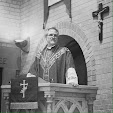
Sunday, September 03, 2017

Sermon: St. Gregory the Great - 2017

3 September 2017

Text: Luke 4:31-37 (Ps 116:1-9, 1 Thess 5:1-6, 9-11)

In the name of + Jesus.  Amen.

Dear brothers and sisters in Christ, we are living in a time of iconoclasm.  This means that literally or figuratively, people are toppling statues and redefining how we remember our ancestors.  In the past couple years, historic statues in America have been removed by governments or by mobs.  It has just been announced that the Jefferson Memorial in Washington, DC will be retrofitted with plaques confessing Thomas Jefferson’s sins.

Rather than honor our fathers and our mothers, we are smashing their images.  This iconoclasm happened at a couple of points in church history, as statues and icons of the saints were destroyed in the 8th century, and again during the reformation in the 16th century.  Once cooler heads prevailed, it was discovered just how many priceless works of art – and even the tomb and body of St. Thomas Becket in the Cathedral of Canterbury England – were destroyed and lost to us.

Just recently, a Roman Catholic parish and school in California has decided to get rid of statues of Jesus so as not to offend people.

Some iconoclasm is less literal, such as modern Lutherans cutting themselves off from their own history and tradition by refusing to honor our fathers and mothers of our own church history.  Some claim that honoring the saints is “too Catholic.”  This is not what our Book of Concord says.

We are not iconoclasts, dear friends.  When Luther himself was in hiding at the Wartburg Castle, iconoclasts began smashing statues in Wittenberg.  Luther came back and condemned such behavior. 

This is how it is that our Book of Concord and early Lutherans – not to mention our own Lutheran Service Book of today – honors Pope St. Gregory the Great, whose feast day is today.  St. Gregory was bishop of Rome from 590-604 AD.  He was a lawyer and politician who became a monk.  As bishop of Rome, he evangelized the British Isles and parts of Eastern Europe, he standardized the liturgy and the church year (some of our own short prayers known as collects date to his reforms), he brought what we call in his honor today Gregorian Chant to the liturgy, he was an able administrator, and true bishop to the people of Rome.  He was a writer and theologian and known for his advocacy of the poor.  But most of all, St. Gregory was a preacher and pastor.  His book on pastoral theology is till used in seminaries today.

What makes Christian saints great is not their own greatness, but in their confession of the greatness of Christ.  St. Gregory was just such a confessor – not because he could recite facts about Jesus, but because he trusted in and proclaimed Jesus.

In our Gospel text, a demon appears to be a confessor of Jesus, saying: “Ha!  What have You to do with us, Jesus of Nazareth?  Have You come to destroy us?  I know who You are – the Holy One of God.”

But there is a big difference between just knowing who and what Jesus is (even the devils know that much) and submitting to Jesus (the devils will not submit).  For it is one thing to confess Jesus as God, but quite something different to confess him as Lord.  To call Jesus “Lord” is to submit to Him, to be His servant, to acknowledge Him as one’s Sovereign.  It is to acknowledge one as a servant.

In fact, Pope Gregory was the first to describe his office as bishop of Rome to be “the servant of the servants of Christ.”  He saw the pastors of the church as Christ’s slaves, and he saw himself as their slave.  St. Gregory submitted to Christ, and that is the source of his greatness.

How do we submit to Jesus, dear friends?  Certainly, we don’t have to be bishops to do this?  We can and should submit to our Lord in all of our callings in this life.  It is not enough to simply say, “I believe in Jesus.”  For even the demons have that kind of belief.  Better to say instead, “I trust in Jesus for my salvation, and not in myself or in my works.  I submit in every manner of my life to Christ, for He is not just the Lord, but my Lord.”  This means that nothing in our lives is more important than Jesus, that hearing His Word, than being where He is present for us – in the sacraments.  It means being a servant of Jesus, and a servant of our fellow servants of Jesus.  It means more than just talk, dear friends.

It means the cross, it means the blood of Christ, it means confession and absolution, it means being washed in baptism and calling that baptism to mind often.  It means partaking of Holy Communion as if your life depended on it, because it does, dear friends.  And this explains the church’s urgency in mission work.  The world needs the Gospel.  We need the Gospel, dear friends!

This is why we honor St. Gregory.  He proclaimed Christ!  Gregory was not perfect.  If he were perfect, he would have no need of a savior.  He had his own flaws.  He made changes in the papacy that led to later corruptions.  He accepted some newer doctrines in the church that were essentially superstitions.  Who among us will cast the first stone?

And yet, dear friends, our Book of Concord treats St. Gregory with love and respect, as a father of the church, as an elder brother in Christ from whom we can learn.  Our saints are not perfect – which is the point.  We are all sinners made into saints by grace through faith.  And St. Gregory is a sinner-saint like the rest of us.

We are not iconoclasts.  We are grateful for our brother Gregory’s work and ministry, for his proclamation of Christ, for his tireless work for the kingdom.  We have no problem with statues in his likeness to remind us of God’s mercy in sending us faithful servants of the servants of God to look up to.  We are not going to tear down his statues or add lurid plaques to tarnish his image.  We are right to have his name mentioned in our hymnal and to honor his feast day today.

Let us all remember St. Paul’s words, words that St. Gregory knew well: “For God has not destined us for wrath, but to obtain salvation through our Lord Jesus Christ, who died for us so that whether we are awake or asleep we might live with him.”  And rather than tearing down as iconoclasts do, let us heed St. Paul’s further instruction: “Therefore encourage one another and build one another up, just as you are doing.”

St. Gregory built up the church by his faithful proclamation of the Gospel, by his missionary work, and by the importance he placed on the liturgy.  But most of all, St. Gregory was a pastor: a shepherd who fed his parishioners with the Word of God.

And thanks to St. Gregory’s proclamation of Christ and the preaching of other faithful servants of the Lord who followed in St. Gregory’s footsteps, we can to this very day join the Psalmist in singing: “Gracious is the Lord, and righteous, our God is merciful!” Amen.


In the name of the Father and of the + Son and of the Holy Spirit.  Amen.

Friday, September 01, 2017

Richard Weaver on the Entitlement Society


"The spoiled child has not been made to see the relationship between effort and reward. He wants things, but he regards payment as an imposition or as an expression of malice by those who withhold for it. His solution, as we shall see, is to abuse those who do not gratify him....

"In the final analysis this society is like the spoiled child in its incapacity to think. Anyone can observe in the pampered children of the rich a kind of irresponsibility of the mental process. It occurs simply because they do not have to think to survive. They never have to feel that definition must be clear and deduction correct if they are to escape the sharp penalties of deprivation. Therefore the typical thinking of such people is fragmentary, discursive, and expressive of a sort of contempt for realities. Their conclusions are not 'earned' in the sense of being logically valid but are seized in the face of facts. The young scion knows that, if he falls, there is a net below to catch him. Hardness of condition is wanting. Without work to do, especially without work that is related to our dearest aims, the mental sinews atrophy, as do the physical. There is evidence that the masses, spoiled by like conditions, incur a similar flabbiness and in crises will prove unable to think straight enough to save themselves."

~ Richard M. Weaver, 1948
Ideas Have Consequences, pp. 103, 116

Ludwig von Mises on Intellectual Battle


"Everyone carries a part of society on his shoulders; no one is relieved of his share of responsibility by others. And no one can find a safe way out for himself if society is sweeping towards destruction. Therefore everyone, in his own interests, must thrust himself vigorously into the intellectual battle. None can stand aside with unconcern; the interests of everyone hang on the result. Whether he chooses or not, every man is drawn into the great historical struggle, the decisive battle into which our epoch has plunged us."
~ Ludwig von Mises, 1922
Socialism: An Economic and Sociological Analysis, p. 515.

Sunday, August 27, 2017

Sermon: Trinity 11 - 2017

27 August 2017

Text: Luke 18:9-14

In the name of + Jesus.  Amen.

At first glance, it appears that there are many different religions in the world.  But in fact, there are only two: the right one, and all the rest.  But to be more specific, as our theologians put it, there is the religion of the Law, and there is also the religion of the Gospel.

Religion is all about how man is reconciled to God, how we overcome the brokenness of this world of death, and how we transcend the fallen world and restore communion with the Creator.  In other words, how we close the gap between man and God.

And so there are only two religions in the world: the one where mankind climbs his way up to God (the religion of the Law) and the one where God condescends his way down to man (the religion of the Gospel).

In the religion of the Law, you can have salvation by obeying the simple little verse: “be perfect even as your heavenly Father is perfect.”  Just don’t sin in thought, word, and deed, and be like God.  And every religion in the world, except for Christianity, teaches this.  Every other religion has a program of steps to climb the ladder to righteousness: you have to pray, make pilgrimages, do good works, give money, avoid sin, and so forth.  But if you fall off the ladder, well, you either start over after being punished, or are sent to hell, or you come back in the next life reincarnated as a toad or something.

But in the religion of the Gospel, that is, Christianity, God Himself comes down the ladder; He meets us where we are.  He takes human flesh; He fulfills the Law on our behalf; He pays the penalty of our sins; He makes a “happy exchange” between our unworthiness and His worthiness.  And this is “good news” – which is what the word “Gospel” means.  In Latin, “good news” is called “Evangelium.”  And it’s why we do “Evangelism,” and why our Lutheran churches in Germany are called “Evangelical.”  Recovering the Gospel that had become buried under the Law was a big part of the Lutheran reformation.  We Lutherans became known as “Evangelical Catholics.” 

Jesus teaches this very doctrine by means of one of His compelling stories: “The Pharisee and the Tax Collector.”

These two competing religions are personified by these two characters.  Listen to the Pharisee’s prayer, and consider whether he is proposing the religion of the Law or of the Gospel.  He prays: “God, I thank You that I am not like other men, extortioners, unjust, adulterers, or even like this tax collector.  I fast twice a week; I give tithes of all that I get.”

By contrast, listen to the tax collector’s prayer, and consider whether he is proposing the religion of the Law or of the Gospel.  “But the tax collector, standing far off, would not even lift up his eyes to heaven, but beat his breast, saying, ‘God, be merciful to me, a sinner.’”  Think of the contrast between these two men.

One of them is offering his works as payment to God, a sort-of admission price to the kingdom of heaven.  The other offers nothing, but instead, prays for God’s mercy.  And so only one of these men is a Christian, or as our Lord says in the story: only one of them “went down to his house justified, rather than the other.”

Most of the religions of the world would side with the Pharisee.  For just look at all of his good works!  It’s a pretty impressive resume. He avoids the sins of “other men,” and he fasts (actually twice as much as the law requires), and he gives tithes of everything (not just after taxes).  He is clearly a “good person.”  And this was the goal of the Pharisees in the first century: they strove to be good people, to obey the law perfectly so as to climb the ladder to God.  And these were the people who hated Jesus and often got into fights with Him.  For in spite of their high and mighty attitude, they were still poor, miserable sinners.  Even their good works were tainted by sin.  They needed a Savior just as much as anyone else – and Jesus was not shy about telling them as much.  But they were too proud to ask for, or even to accept, help.  And this is why Jesus says: “Everyone who exalts himself will be humbled, but the one who humbles himself will be exalted.”

The religion of the Law fails simply because we can’t keep the Law.  We’re too broken.  We need a Savior.

Of course, we are expected to strive to keep the Law, to really do the best we can.  The Law is good.  The Ten Commandments are the first thing we learn in our catechism.  Avoiding sin is good.  Fasting is good.  Giving tithes is good.  Showing mercy to one’s neighbor (like another of Jesus’ stories, “The Good Samaritan”) is good.  The Law keeps social order, shows us our need for a Savior, and gives us a guide to the good and virtuous life.  But the one thing the Law cannot do, dear friends, is save you.  It always accuses and always condemns.  And this is where the Gospel comes in: the Good News that our Lord shed His holy blood to redeem us from death and hell!  He keeps the Law where we fail.  He rescues us from our own wretchedness and helplessness.  And so we trust in Him rather than in ourselves.

The world (and even our own reason) recoils from the idea of a tax collector (which in that time and place essentially meant a crook and a thief), a man so convicted of his sinfulness that he cowers in the temple, and who has no good works to boast before God, but simply prays: “Lord, have mercy!”

And yet, there it is.  He is humble.  He confesses his sin.  He offers no works of his own to justify himself.  And because of his humility, he goes home justified, for Jesus has justified him!  That, dear friends, is the Christian faith, the faith of justification, the religion of the Gospel!

In receiving this Good News, our tax collector can now repent of his sins, joyfully confessing the Good News of Jesus Christ and Him crucified.  He can struggle against sin, fast, and tithe, all as an offering to the Lord – not the kind of offering that claims to forgive sin, but rather the kind of offering the Old Testament calls a “thank offering.”

We poor, miserable sinners pray just as this tax collector prays: “Lord, have mercy!”  We plead for forgiveness.  We are forgiven.  Our sins are washed away in Holy Baptism – pure Gospel.  We hear the words of absolution – pure Gospel.  We eat and drink His very body and blood for the forgiveness of sins – pure Gospel.  And we hear the proclamation of His Word, pure Gospel – and we believe – not in ourselves and our works, but in Him and His work on the cross, that is, in His Gospel!

And so, dear friends, let us never fall into the trap of the Pharisee.  Your good works don’t impress God or earn His salvation.  But having been justified, having been made holy by the blood of the Lamb, your good works are a “thank you” for what you have received from God as an answer to the prayer, the sinner’s prayer, the Christian’s prayer, the prayer that is answered by the Gospel: “God, be merciful to me, a sinner!”  

This is good news indeed!  Amen.


In the name of the Father and of the + Son and of the Holy Spirit.  Amen.

Sunday, August 20, 2017

Sermon: Trinity 10 - 2017

20 August 2017

Text: Luke 19:41-48 (Jer 8:4-12)

In the name of + Jesus.  Amen.

The name “Jerusalem” – from which our congregation gets its name “Salem” – means “City of Peace.”  And there is a very real sense in which it is.  For Jerusalem is the site chosen by God for the Temple, the place where God chose to dwell in space and time with man, the place where the blood of the sacrifices were shed in order to make peace between man and God, sacrifices to prefigure the blood of the “Lamb of God that takest away the sin of the world,” once and for all.

Jesus is Peace Incarnate, whose death on the cross is the cause of the peace that passes all understanding.  The first words spoken by the risen Lord to His disciples was: “Peace.”

But sadly, Jerusalem, the City of Peace, came to reject the Prince of Peace, and this causes our Lord to grieve deeply.  Jesus “wept over it saying, ‘Would that you, even you, had known on this day the things that make for peace!  But now they are hidden from your eyes.”

The beloved City, the Holy City, refused the peace that her Lord offered to her as a free gift.  Instead, she chose war: “For the days will come upon you, when your enemies will set up a barricade around you and surround you and hem you in on every side and tear you down to the ground, you and your children within you.  They will not leave one stone upon another in you.”

This prophecy was fulfilled in the year 70 AD after a long siege by the Romans.  Jerusalem was crushed.  The Temple was flattened.  And why?  “Because,” says our blessed Lord, “you did not know the time of your visitation.”

God visited His people, even as the holy prophets spoke for centuries of this very visitation.  The prophet Jeremiah called the people to repent, for they were saying, “‘Peace, peace,’ when there is no peace.  Were they ashamed,” he asked, “when they committed abomination?  No, they were not at all ashamed; they did not know how to blush.  Therefore, they shall fall among the fallen; when I punish them, they shall be overthrown, says the Lord.”

Not knowing how to blush sounds like our own culture, a culture, dear Christians, that we are all too quick to embrace.

To be clear, there were many people in Jerusalem who followed Jesus, for they were “hanging on His words,” but the leaders, the “chief priests and the scribes and the principal men of the people were seeking to destroy Him.”  And these “principal men” would become responsible for the shocking siege and ruthless destruction of the city forty years after these “principle men” thought they had destroyed Jesus upon a Roman cross.

“Peace, peace, when there is no peace.”

History repeats itself, dear friends, as young people often greet one another with the word “peace,” even as our cities in America have become war zones.  Politics and social media have brought about broken relationships and simmering hatreds in our country.  Many people with bumper stickers that say “COEXIST” want nothing of the sort – at least not with followers of Jesus.  There are many in our society who hate us and see us as their enemy.  They would demand that Christians be compelled to take artistic commissions that violate their consciences.  They are appalled that Christians teach their children that the Bible is literally true, that there is an objective right and wrong, that marriage is just as it has been defined in every human society for thousands of years, and that God created man in His image: “male and female” in a biologically binary way and ordered family life by His Word and by nature, and that all lives matter, even the yet to be born.

There is no peace for people who do not want peace.  

Christians are being persecuted this very day by Muslims, by Communists, and even by liberal democracies in Europe that have become intolerant and hateful of the Bride of Christ.  

And we should plead for them, dear friends, because they are playing with fire.  We should pray for their repentance lest they perish.  We should intercede for them lest they destroy our country and civilization and enslave our children in a totalitarian state.  For the enemies of Christ and the cross do not know the time of their visitation.

We know the time of our visitation, dear brothers and sisters, we know how and where and by whom this visitation occurred.  “The Word became flesh and dwelt among us.”  Our visitation came in the person of Jesus Christ, and our peace came through Christ and Him crucified.  And indeed, we know “the things that make for peace.”

Those “things that make for peace,” dear friends, are those means of the Lord’s visitation of us: Holy Baptism, through which peace is made through the washing away of sin; Holy Absolution, through which peaceful reconciliation is made by the forgiveness of sin; Holy Communion, through which the peace that passes all understand is given to us to literally become part of us through eating and drinking; and the Holy Gospel is the very proclamation of peace because it is the good news of the Lord’s visitation.

Let us not take the Lord’s visitation for granted, dear friends.  Let us receive this glorious peace that He has given to us!

Peace is so much more than the lack of war.  And visitation is so much more than a quick encounter.  In Christ, dear brothers and sisters, peace is eternal harmony with God, a restoration of the perfection of the Garden of Eden, the conquest over death and the devil, and the promise of the resurrection and everlasting life!  And visitation means the continuous and abiding presence of Christ with us in His Word and Sacrament, where the Prince of Peace has promised to be with us and for us.

And while Jerusalem is a place of strife, there are countless New Jerusalems, such as our Salem, the Lord’s house that is “a house of prayer,” where the Lord’s beloved people – who know the time of their visitation – gather to joyfully receive the Lord’s peace, true peace, the peace that passes all understanding, the peace won at the cross and delivered at the font, the peace of forgiveness, reconciliation, and everlasting life.  Peace be with you, dear brothers and sisters, peace be with you!  Amen.


In the name of the Father and of the + Son and of the Holy Spirit.  Amen.

Sunday, August 13, 2017

Sermon: Trinity 9 - 2017

13 August 2017

Text: Luke 16:1-13

In the name of + Jesus.  Amen.

One of my favorite passages of Scripture is not part of today’s Gospel, but it certainly helps us to understand it.  In Matthew 10:16, our Lord says: “be wise as serpents and innocent as doves.”  The word translated as “wise” can also be translated as “shrewd” – as it is in our Gospel reading.

We are to be both shrewd – even like the serpent that beguiled Eve – but not at the expense of innocence – like that of the dove, that since the days of the ark of Noah, has come to represent gentleness and peace.

Shrewd and innocent, dear friends, that is how our Lord instructed the apostles to carry out their work in proclaiming the Gospel.  It is great advice for anyone engaged in any kind of work: be honest but be smart; be innocent, but be clever; be good, but be wise.

In our Gospel, our Lord tells a story, the hero of which is a crook. Some people are scandalized by this – which is exactly what our Lord likes to do.  For in telling a story about the kingdom of God in which the hero is a crook, Jesus gets our attention and actually makes us think.

And if you were listening carefully, the crook is not commended for his crookedness.  He was not praised for his lack of being innocent as a dove, but rather for his being as wise as a serpent.  He was commended for his shrewdness.  And that is our Lord’s lesson for us today, dear friends.

Our Lord is scolding us for not being shrewd.  Hopefully, we are teaching our children to be innocent, to be honest, to be moral, and to upright.  But that is not enough!  Are we also teaching them worldly wisdom: how to navigate a world filled with crooks and liars and thieves, a culture filled with those who hate Christ and who hate Christians.  Are we teaching them to be shrewd – like this dishonest manager?  Or are we setting them up to be eaten alive by predators, like sitting ducks, or doves in this case?

In our text, the dishonest manager is about to be fired.  The jig is up.  The boss is onto him.  But before he gets fired, he shrewdly arranges a soft landing for himself.  He makes friends with his boss’s customers, cutting them special deals, so that when he does get fired, he can call in favors and land on his feet.

Now in order to carry out this plan, he had to be dishonest – which we already know that he is.  He is cheating his boss out of money that is rightfully his.

Of course, the boss is probably most unhappy about this when he finds out, but he is nevertheless amazed at the dishonest manager’s “shrewdness.”  Anyone has to admit that this is a bold and audacious act – or as we might say in the Deep South: “bodacious.”  Like a supervillain in a movie, we may not like him, but we cannot help but admire his ingenuity.

Our Lord tells us that we should be as ingenious, “For the sons of this world are more shrewd in dealing with their own generation than the sons of light.”  The dishonest manager acted with passion and motivation, with calculated intelligence, and with courage – as dishonest as it was.  We Christians ought to be equally passionate and motivated, intelligent and courageous as the enemies of the cross – without surrendering our dovelike innocence, of course.

We should “make friends” with “unrighteous wealth,” so that “when it fails, they may receive you into the eternal dwellings.”

We do not serve money, but money can serve the kingdom of God.  And if we aren’t dishonest and greedy, if we don’t serve money as a master, then we can indeed intelligently muster resources of all kinds for use in the kingdom.  

Shrewd, and innocent.  That is how we are to live the Christian faith, how we are to teach our children, and how we are to carry out our vocations in service of the church and of our fellow human beings.  

The greatest example of this shrewdness and innocence is our Lord Himself, dear friends.  For He is sinless, perfectly innocent, the very opposite of our dishonest manager.  And yet He is far more shrewd than the Serpent: the Devil.  As God Himself told Satan in the garden, the Seed of the woman would one day crush the Devil’s head even as this Seed of the woman’s own heel would be bruised in the process.

That came true in such a way that outsmarted the Devil.  For Satan struck the heel of the Lord Jesus on the cross.  He injected the venom of death into His body, shrewdly employing a conspiracy of Jewish priests and scribes and Pharisees, a Roman governor and soldiers, false witnesses, and a betrayer named Judas – in order to strike the heel of the Seed of the woman.  He brought about the death of Jesus on the cross, even as a spike pierced the heel of that Seed of the woman.  But God is more shrewd than the serpent.  In dying, Jesus paid the wages of sin and undid four thousand years of Satan’s evil corruption of mankind.  For by dying on the cross, Jesus shrewdly and sacrificially redeemed mankind from death and restored the communion with God that Satan had destroyed by his own shrewdness and his own wickedness.  In His own shrewdness and innocence, the Lord Jesus Christ defeated the Devil.  And by rising again, He destroyed the power of death, promising a resurrection to all who are baptized and who believe.

Wise as a serpent and innocent as a dove.  That is our Lord Jesus Christ, and that is how we, dear friends, are redeemed by the blood of Him who died upon the cross.  

The Father commends His honest Son for His faithful shrewdness, for the Son of God is more shrewd in dealing with our own lost generation than the sons of darkness.  The Holy Cross is our own symbol of innocence and shrewdness, the dove and the serpent, the bruised heel of the Lord and the crushed head of the Devil.  

And in carrying out this bold and audacious plan, the Lord Jesus tells you to take your bill – the wages of your sin – and He tells you to write “zero.”  For by the cross, He has given you a receipt, inscribed with His blood, that your debt is paid in full.  

For He, the Lord Jesus, is the shrewd and honest manager of the universe, the only one who is truly wise as serpents and innocent as doves, through whom we are entrusted with true riches, even unto eternity!

Amen.


In the name of the Father and of the + Son and of the Holy Spirit.  Amen.

Saturday, August 12, 2017

Prayer for the Birthday of Gov. Francis T. Nicholls


Gov. Francis T. Nicholls (1834-1912) was a remarkable man who served the State of Louisiana in many capacities, including as a West Point graduate, 2nd Lieutenant, and combat veteran of the United States Army in the Third Seminole War, and as a Brigadier General in the Army of the Confederate States of America during the War for Independence (thrice-wounded: losing an arm, a foot, and an eye, and yet who continued to serve), as well as two terms as the state's 28th Governor (during the challenging Reconstruction Era), and afterward, Chief Justice of the state Supreme Court.

I was honored to be invited by Cmdr. Steve Alvarez of the Lt. J.Y. Sanders Camp #2092, Louisiana Division, Sons of Confederate Veterans, of Morgan City, to give the invocation today at the annual ceremony held around the time of the governor's birthday (August 20) at St. John's Episcopal Church in Thibodaux, Louisiana, where he is buried along with other Confederate Veterans.

Here is my prayer:

In the name of the Father and of the + Son and of the Holy Spirit.  Amen.

Lord God, Heavenly Father, We thank You for the gift of memory: the power and the freedom to call to mind great people and heroic events from our past.  We thank You for the noble heritage of honorable men and women who took part in the maintenance of independence: our grandfathers courageously on the front lines of battle, and our grandmothers who stoically kept the fires of hearth and home aglow.

We thank You also, O Lord, for examples of manly leadership: for Your servant Francis Nicholls, a leader of his people in times of war and in times of peace.


We pray for ourselves and our descendants, O Merciful Father, that we may display a courage and fortitude worthy of our heritage, willing to sacrifice for that which is just and right and honorable, and also willing to defend liberty and independence, family and community, if and when they are imperiled.  

We implore Your defense, O Almighty God, of our monuments and memorials, landmarks of bronze and stone, and of the preservation of our history, recorded in pen and ink, and that we may be living monuments, memorials created in Your image, examples and guides to generations yet unborn, who will, according to Your will, take our place as defenders of civilization, liberty, and independence.

We humbly offer these petitions in the name of Jesus, with whom You reign in the unity of the Holy Spirit, one God, world without end.  Amen.

Sunday, August 06, 2017

Sermon: Trinity 8 - 2017


6 August 2017

Text: Matt 7:15-23 (Jer 23:16-29, Rom 8:12-17)

In the name of + Jesus.  Amen.

In today’s Gospel, our Lord says things that are so politically incorrect, that if this chapter were to be read in a university classroom, it would require a trigger warning.  Some college students would be so traumatized that they would have to report to the school’s official “safe space” for coloring books and hugs from the dean of diversity.

For in this one reading, Jesus says such shocking things as: there is an objective truth, some people are wrong, natural law is a guideline for judging morality, and people who lead other people away from that which is true and right and just, will be cast into the fires of hell.

But where is the nice, happy God of the New Testament?  This Jesus sounds like the mean old patriarchal God of the Old Testament!  Of course, we can hear the critics: “My Jesus would never judge, never condemn, never point to natural law as an arbiter of some objective truth” – so says the wisdom of our age.  For Christianity is about being nice.

Nice and happy, dear friends, that is what we want to be, what we want for our children, what we want for the world.  We want niceness and not conflict.  We want peaceful coexistence and not insistence upon divisive dogmas and religious intolerance.  We don’t want to be called “fundamentalists” or “religious fanatics.” And we certainly don’t want talk about hell and right and wrong and natural law.

Because think about what this means, dear friends: it means that the nice lady pastor (whether on TV or in the local church) is a fraud, a “false prophet,” a wolf in sheep’s clothing, and she needs to repent, in the words of a former lady Lutheran “pastor” from Sweden who repented, of “leading people to hell.”  For there is right and wrong, and Jesus was not, nor is not, wrong to exclude women from the holy ministry. 

It also means that there are two genders – even as science and nature, not to mention the Word of God – speak with one voice: there is male and female, for “God created man in His own image, in the image of God He created him; male and female He created them.”

Nature confesses what the Author of creation has designed.

“Are grapes gathered from thornbushes, or figs, or thistles?  So every healthy tree bears good fruit, but the diseased tree bears bad fruit.  A healthy tree cannot bear bad fruit, nor can a diseased tree bear good fruit.”

A boy is not a girl.  A girl is not a boy.  What is obvious to science and natural observation is today considered bigotry and hate.  Our culture truly has degraded to this point, dear friends, to a level of delusion not seen since the days of Communist Russia.  And speaking the obvious – as Jesus has done – can get you fired, fined, or in some places in the civilized western world, jailed.  Canadian parents who tell their children the obvious can actually lose custody of those children.  If that is not a diseased tree, dear friends…

In England, a once civilized Christian country, disabled babies may now be seized by the government and left to die rather than being placed in the hands of their loving parents in order to get treatment for disease.  And while little Charlie Gard’s diseased body bore the fruit of the sin of this fallen world, his murderers, the bureaucrats and lawyers and judges who lack respect for the created order, and for the Creator, had better repent, or these wolves in sheep’s clothing will be “cut down and thrown into the fire.”

Our Lord is not telling us this to be mean or to be politically incorrect.  He is telling us the truth, because we need to hear it.  Truth matters, and Jesus is the truth.  Pontius Pilate asked the question that many if not most in our society are too afraid to ask: “What is truth?”

In fact, many people who call themselves Christians, many who say to Jesus, “Lord, Lord,” many who claim gifts of prophesy and exorcism and miracles, many who boast of being teachers and prophets and experts, many who are powerful and respected in the eyes of the world, will find themselves on the blunt end of the Lord’s judgment when He declares to them: “I never knew you; depart from Me you workers of lawlessness.”

This is a frightening prospect, dear Christians.  It is a warning for us to always yield to the truth, to pay attention to the natural order, to call out the false prophet and rise up against them, chase them away, and make sure that it is clear where you stand, what you confess, and in whom you place your trust.

The true prophet Jeremiah warned us: “Do not listen to the words of the prophets who prophesy to you, filling you with vain hopes.  They speak visions of their own minds, not from the mouth of the Lord.”  Such prophets tell you what you want to hear: “It shall be well with you,” and “no disaster shall come upon you.”  He warns us – all of us – that “wrath has gone forth, a whirling tempest; it will burst upon the head of the wicked.”

We know who our Good Shepherd is.  We know what His Word is.  We know what nature teaches us.  We know what the objective truth is.  We know what a man is, what a woman is, what marriage is, what is moral and what is immoral.  We know that every human life is a life of dignity, created in the image of God.  We know also, dear friends, that we are sinners, that we deserve this wrath as well, but we also know that the truth is on our side, because Jesus is on our side!

For we know, dear friends, from the mouth of a true prophet, St. Paul, that “The Spirit Himself bears witness with our spirit that we are children of God, and if children, then heirs – heirs of God and fellow heirs with Christ.”

By virtue of the Spirit and the Word that He inspired to be written and proclaimed and placed into your hearts, you suffer with Christ – suffering the indignity of speaking truth to power and confessing what we know to be true, in the words of St, Paul, “in order that we may also be glorified with Him.”

And while the world is enamored of the lie, enamored of the liar, and enamored of the father of lies, we can refuse to believe them.  We can refuse to be intimidated by them.  We can scorn them and mock them and confess them to be nothing more than a diseased tree to be thrown in the fire.

For there was another tree, one that bore disease, for it bore sin – sin placed on the shoulders of the One who was nailed to that tree, the One who was and is the very Truth, the true prophet, the Good Shepherd, the Savior, the Atonement, the love of the Father incarnate.  For in Him, dear brothers and sisters, we can take heart and take courage.  In Him we can tell the truth, for He is the Truth.  In Him, in His cross, in His blood, and in His Word, we confess, we believe, and we receive the blessings of forgiveness and life and salvation.  That, dear friends, is the truth!

In Him, we have the true safe space of Truth itself and Truth Himself – a Truth that promises us redemption.  And as Jeremiah told us anew this morning by virtue of the Word of God: “In the latter days you will understand it clearly.”  Indeed, dear friends. Indeed.

Come, Lord Jesus!  Amen.


In the name of the Father and of the + Son and of the Holy Spirit.  Amen.

Thursday, August 03, 2017

Sermon: Funeral of Larry Medina

3 August 2017

Text: John 10:10b-15, 27-30

In the name of + Jesus.  Amen.

Dear friends and family, brothers and sisters in Christ, and honored guests.  Peace be with you!

That was how Jesus greeted his disciples after He rose from the dead and appeared to them.  And for Jesus it wasn’t just polite words or a way of saying hello.  When Jesus says something, it is a reality.

When someone dies, a lot of people are at a loss for words.  And that’s understandable.  What can we say?  Especially when someone dies young and suddenly – as Larry did.  There were so many things that needed to be said, but went unsaid.  There were things that should have been done, but went undone.  And words can’t bring someone back from the dead – or can they?

Dear friends, Christianity isn’t what most people think it is.  It’s not about Jesus the nice guy or the great teacher.  Nice guys and great teachers are a dime a dozen.  Christianity isn’t even about going to heaven when we die, floating around like a ghost with a harp for eternity.  Christianity is rooted in the life of Jesus: God in the flesh.  He came to fix what is broken with the world.  And who can deny that the world is terribly messed up?  It is not normal or natural or “for the best” that we die.  According to what God revealed about Himself in the Scriptures, God created us to live forever.  We die, however, because we are all sinful.  We are all broken.  And that brokenness shows up in our broken bodies, broken families, broken communities, broken politics, and broken dreams.

Worst of all, we can’t fix it any more than we can fix ourselves.  

But there is good news, dear friends.  Jesus came into our world to rescue us.  He says, “I came that they may have life and have it abundantly.  I am the good shepherd.  The good shepherd lays down His life for the sheep.”  He says, “My sheep hear My voice, and I know them, and they follow Me.  I give them eternal life, and they will never perish, and no one will snatch them out of My hand.”

Jesus died in our place, and rose again from death, so that we too might rise again – all according to His Word and His promise.  And we will not rise as a spirit or an angel, but as a flesh and blood person, made perfect, and united with all of those who “believe and are baptized” in a new heaven and a new earth.  It sounds like an offer too good to be true, but it is as true as the fact that Jesus has a tomb in Jerusalem, and it is empty.  Nobody else in history ever walked out of his own well-guarded grave.

We Christians are brought into the faith by baptism.  Jesus names us as His own when we are washed in the Name of the Father and of the Son and of the Holy Spirit.  Our sins are forgiven, and we have the promise that we are clothed with Christ’s righteousness, buried with Him in baptism, and “raised from the dead by the glory of the Father…. We shall certainly be united with Him in a resurrection like His,” dear friends.  This is what the Word of God says, the Word of the one who walked out of His own grave.

It is a great mystery why some people die young and unexpectedly, as did Larry.  They leave questions unanswered and loose threads hanging.  But rest assured, dear friends, in Christ, we have the promise to be reunited – bodily and in the flesh, in a new and greater world without sin, without suffering, without death – where time is not a burden and where the brokenness of our current existence won’t even be a memory.  We look forward to this joyful reunion, where everything will be made perfect and new!

All of this good news, this truly uplifting comfort, is packed into that greeting that Jesus had for His disciples after His own resurrection, a greeting that we Christians have been saying to one another for nearly two thousand years: “Peace be with you.”  Amen.


In the name of the Father and of the + Son and of the Holy Spirit.  Amen.

Monday, July 31, 2017

Sermon: Trinity 7 – 2017

30 July 2017

Text: Mark 8:1-9 (Gen 2:7-17, Rom 6:19-23)

In the name of + Jesus.  Amen.

In the Garden of Eden, before the Fall, our ancestors Adam and Eve did not know what it meant to be hungry.  They were surrounded by glorious trees bearing a superabundance of fruits so perfect that we can’t even imagine it.  But in eating of the one tree that was forbidden, our superabundance became deadly scarcity, and our perfect world became rotten with corruption.  We became mortal, and we learned the hard way what God meant when He said, “You shall surely die.”

Throughout the history of mankind since the Fall, the word “hunger” has been frightening.  It’s truly hard for us to relate to this, as even the vast majority of the poorest Americans have a refrigerator and access to cheap meals at fast food restaurants.  It has been a good 150 years since Americans were forced by circumstances of warfare to retreat into caves and eat rats to survive.  

Some of our older veterans living today knew true hunger in enemy prison camps.  Of course, some people here in America and in many other countries do know what it is to be truly hungry.  It’s not just the physical pangs, but the weakness and the helplessness, and the knowledge that death lurks just around the corner, even as other people are comfortably satisfied and are eating in great luxury, that is also vexing and horrific.

In our Gospel, great crowds followed Jesus, willing to make any sacrifice just to hear Him proclaim life-bearing words, so much so that even making provisions for this body and life became of secondary importance to being where He was, and listening to His Word.  

And our blessed Lord has “compassion” – literally a sympathetic reaction in His gut – with the crowds who have determined that there is nothing more important than the Word.  They even risk starvation so as to be fulfilled by the Bread of Life Himself.  

What faith, dear friends!  They don’t even plan to eat because they know that the Word of Christ is life itself.  

Their faith was not misdirected, because what does our blessed Lord do for them?  He feeds them by means of a miracle.  The Creator of the universe takes bread, and when He had given thanks, He broke it and gave it to them.  His ministers, the disciples, distributed this life-bread to the hungry people who had gathered to hear Jesus. “And they ate and were satisfied” – literally, they had eaten until they were full!  St. Jerome translates it into Latin using the word “saturated.”  This is the very opposite of hunger.  For this is a feast as opposed to a famine.

Dear friends, this is the Christian life!  It is a feast in the midst of famine; It is light in the midst of darkness; it is life in the midst of death.

The Fall brought shortages, suffering, and starvation.  This leads to fighting and theft and even warfare.  And in the midst of this want and deadly lack comes our Lord Jesus Christ, even He who is the Bread of Life in the flesh.  He has compassion.  Though the wages of our sin is death, He gives us the free gift of eternal life: He feeds us – not only with the daily bread of “food, drink, clothing, shoes, house, home,” and “everything that has to do with the support and needs of the body,” but even more!

Our Lord knows that in our sinful and fallen state, we are hungry, we suffer want and lack on account of our sins.  We are starving for Good News!  We are ravenous for reconciliation.  And He comes to us in His compassion, in His mercy, pouring out His guts on the cross, giving His body and blood to feed us in His mercy, even as He feeds us here and now in His compassion at the altar.

In the Lord’s prayer, we pray to our Father: “Give us this day our daily bread.”  And indeed, this daily bread includes all of those daily needs we have in this flesh and blood life.  But the original word for “daily” has a kind of double-meaning.  It also means that we are hungry for a kind of supernatural bread that comes to us from above on a continual basis, a bread that never runs out, and which sustains us even unto eternal life.

This kind of bread calls to mind the manna by which our Lord miraculously and mercifully fed the children of Israel in their vulnerability and want, and yes in their desperate and deadly hunger – in the desert.  It also calls to mind the flesh of the Passover lamb, as well as the blood that marked the door of the children of Israel.  The Passover is fulfilled in the Lamb of God that takest away the sin of the world, who told the astonished crowds: “And the bread that I will give for the life of the world is My flesh…. Whoever feeds on My flesh and drinks My blood has eternal life, and I will raise him up on the last day.”

Our Lord also said, “Blessed are those who hunger and thirst for righteousness, for they shall be satisfied.”

Dear friends, this feast in the middle of a desert is truly the Christian life.  This promise of life even as we are surrounded by death is the resurrection.  This conquest of righteousness over sin, death, and the devil is what it truly means to be satisfied.

Come to the feast, you who hunger and thirst for righteousness!  Come and enjoy the fruit of the Tree of Life from Him who has compassion upon us poor miserable sinners, upon us sons of Adam and daughters of Eve!  For you are no longer “slaves of sin” eating the fruit that leads to death.  No indeed, dear brothers and sisters!  For “you have been set free from sin, and have become slaves of God,” and “the fruit you get leads to sanctification and its end, eternal life.” Come and partake of this fruit!  Feast upon it!  No more are we terrified by our lack and our hunger, nor even by death itself.  “For the wages of sin is death, but the free gift of God is eternal life in Christ Jesus our Lord.”  Amen.


In the name of the Father and of the + Son and of the Holy Spirit.  Amen.

Sunday, July 23, 2017

Sermon: Trinity 6 – 2017


23 July 2017

Text: Matt 5:17-26 (Ex 20:1-17, Rom 6:1-11)

In the name of + Jesus.  Amen.

The Ten Commandments. 

Just recently, a display of the Ten Commandments was run over by an angry Atheist.  The Ten Commandments are depicted in the halls of Congress.  The Ten Commandments was the title of a hugely influential movie back in the days of the Hollywood Biblical epic.  And the Ten Commandments are one of the Six Chief Parts of the Christian faith that Luther insisted every Christian know as part of the Catechism.

Today, the Ten Commandments remain a subject of great debate, from whether they should be displayed on public property, to how they are properly numbered, and even today as a dispute among Lutherans who argue about the value of the Ten Commandments as a guide for holy living.

We Lutherans say that in the life of the Christian, there are three uses of the Law: First, the Curb, which describes the law as a civil code to keep social order, second, the Mirror by which we examine ourselves to see our sins and as well as our need for a Savior, and third as a Guide, by which we Christians are taught how to live a Christian life.

I do believe these are all correct ways of looking at the Law, but in the case of the Ten Commandments, I think there is still another way to understand  them: as a prophecy.  And I think that this understanding of our fulfilling the Law perfectly after the resurrection can be seen as the completion of the Third Use of the Law.

In other words, we know that we are not to have other gods.  We know that this is a sin.  We know that we are guilty of this sin and need a Savior to rescue us.  And we know that to lead a God-pleasing life, we must struggle to avoid this sin.  But think about the good news that St. Paul has preached anew to us in the epistle: “We were buried therefore with Him (Christ) by baptism into death, in order that, just as Christ was raised from the dead by the glory of the Father, we too might walk in newness of life” and that “we would no longer be enslaved to sin…. So you must consider yourselves dead to sin and alive to God in Christ Jesus.”

In baptism, our Old Adam is drowned.  We rise again to “newness of life.”  And in our own resurrection, we truly will not have other gods, nor misuse His name, nor defile preaching and His Word, nor rebel against authority, nor kill, nor misuse sexuality, nor steal, nor lie, nor covet that which was not given us.

For as St. Paul says, “We know that our old self was crucified with Him in order that the body of sin might be brought to nothing.”

Dear friends, after the resurrection, with the coming of a new heaven and earth, after we have been raised again incorruptible, when our course in this fallen and corrupted world is over and we have been restored to incorruptibility, we will live once more in a world where everyone keeps all the commandments.

Can you even imagine it?

The Book of Revelation tries to put the unspeakable into human words.  It is like the Garden of Eden all over again, only without the Fall.

I believe that this is the true message of the Ten Commandments, or maybe more accurately, the completed message – and it is Jesus who completes it.  

Yes, it is true that the civil law is still necessary in our fallen world to keep order.  And yes it is also true that we poor miserable sinners still need to be reminded of our sorry state, our need to repent and to be driven to the cross, to the blood of the Lamb, so that we can be rescued.  And yes it is true that we also still need to be guided to live the life the Lord has called us to live, even as we struggle against sin, death, and the devil in this world of darkness.  

But let us not forget our ultimate destination: being restored to our original glory, not as spirits floating around the sky, but as resurrected human beings, created in God’s image, designed to experience life through the senses in a physical existence in a physical world – one that will not wear out or run down, one that will never end!

Jesus said, “I have not come to abolish the Law or the Prophets; I have not come to abolish them but to fulfill them.

“To fulfill them,” dear brothers and sisters.  Yes indeed, we need civil law to keep social peace, and we need to be called to repent and look to our Savior, and indeed we need to be guided along our journey in this fallen and dangerous world.  But let us not forget that Jesus has fulfilled the Law – not only for us (not so we can ignore the Law and live any way we want “that grace may abound…. by no means!”), but He fulfills the Law for us and with us, redeeming us, and leading us to overcome sin and death, so that we will indeed live perfect lives for eternity.

Our Lord warns us not to be like the Pharisees, who “will never enter the kingdom of heaven.”  For our righteousness must exceed “that of the scribes and Pharisees.”  Our righteousness must be true, not merely a hypocritical show.  It must be real and genuine, in thought, word, and deed, in the heart, and expressed in good works.  And yet, we know that of our sinful selves, we cannot keep even one of the commandments, nor can we grow into mastery of them by trying harder. 

And yet, in Christ, we can “walk in newness of life” and we can “be perfect” as we have been commanded.  We can and we will be perfect, not only because Jesus is perfect, but also because He is merciful and He gives us His righteousness as a free gift, because He loves us, and we receive this gift by grace – even if we were baptized as infants, incapable of anything other than to receive that which is given to us in love.

And so, dear friends, the only way that our righteousness can exceed that of the scribes and Pharisees is if our righteousness is Christ’s righteousness.  And that is precisely what we celebrate this day, knowing that in baptism, we are given this gift, and in hearing His Word and receiving His body and blood, Christ’s righteousness becomes our righteousness – and that righteousness transcends space and time and even the grave, even unto eternity, when our Lord fulfills the Law and the Prophets in us, in our deathless bodies and sinless souls.

Yes, indeed, the Ten Commandments are a crucial part of God’s Word, for they are also God’s promise in Christ Jesus – by whose blood we have been redeemed, and by whose Word we shall arise to eternal life.  Thanks be to Him now and even unto eternity!  

Amen.


In the name of the Father and of the + Son and of the Holy Spirit.  Amen.

Sunday, July 16, 2017

Sermon: Trinity 5 – 2017

16 July 2017

Text: Luke 5:1-11

In the name of + Jesus.  Amen.

In today’s Gospel, we hear the very first prayer St. Peter offers to the Lord Jesus Christ.

Before we knew him as St. Peter, the world knew him as Simon.  Before we knew him as the leader of the apostles and the first bishop of Rome, the world knew him as a common fisherman.

And here, Jesus crosses paths with this Galilean fisherman, borrowing his boat as a sort of portable podium.  It is morning, and Simon has been fishing all night, but caught nothing.  And so he cleaned his nets while the rabbi preached.

After the sermon, the preacher Jesus suddenly tells Simon, “‘Put out into the deep and let down your nets for a catch.’  And Simon answered, ‘Master, we toiled all night and took nothing.  But at your word I will let down the nets.’”  And here is where something extraordinary and miraculous happened: not just the remarkable haul of fish, but the revelation of Jesus and the realization of Simon of just who Jesus is.  Simon has just learned that this rabbi with unusual fishing advice is none other than God. 

And so he kneels before God and prays.  And what is this prayer?  Is it a praise, a thanksgiving, a request for healing, or of some wish for a miracle?  No, Simon the fisherman’s first prayer is completely unexpected.  He makes his petition on His knees before Jesus, saying, “Ἔξελθε.”  The Latin translation of a form of this word is seen on the walls of this church.  It’s not a word that the church placed here, but rather the government.  You’ll see this word over the doors: “EXIT.”

The very first prayer uttered by Simon Peter to the Lord Jesus Christ is: “Exit.”  He prays for Jesus to “Go away.”  He is pushing God away from him.  That’s his prayer.

Now, many people do this very thing today: they push God away.  Some people reject God because they think belief in God is unscientific, that science has disproven God’s existence.  However, the scientific method involves hypotheses and proof through observable experimentation. What experiment in a laboratory disproves God?  To assert this is to miss the entire point about science.  And in fact, modern science was the creation of Christian men.

Other people push God away based on logic and reason.  Belief in God is not rational, they argue.  But it is actually the opposite.  For a painting logically requires a painter; a sculpture logically requires a sculptor; a book logically requires an author, and creation logically requires a Creator.  This kind of critical thinking and use of reason has been a hallmark of Christian wisdom and education for centuries. 

Others push God away because they are angry at Him.  Often it involves a prayer that was not answered the way the petitioner wanted, or a tragic event in life.  This often makes for a curious kind of atheist, not one that simply doesn’t think there is a God, but who rather refuses to believe in Him because the person is angry at Him.  This not only makes no sense, but it blames God for the mess that we poor miserable sinners have made of the world.  And as Scripture clearly teaches, God’s ways are not our ways.  We pray that His will be done, not ours. 

And so we see St. Peter pray for Jesus to leave Him.  This is his prayer, which Jesus answers with a firm “No!”

For St. Peter’s reason to pray to the Lord to “depart from me,” is not based on a belief in science or human reason or in a refusal to let God call the shots.  It’s actually for a good reason: “Depart from me,” says Simon Peter, “for I am a sinful man, O Lord.”

Simon realizes that Jesus is God, and that he, Simon, is sinful.  He understands that God is holy, and sinful men are not.  He understands that he is not worthy to be in the presence of God – like Isaiah, who, when he found himself before God, protested, “I am a man of unclean lips.”  For Simon knew the Ten Commandments, that he has not kept them.  He knew his unworthiness to look God in the face.  He knew that according to the righteousness of God, he had no right to be in the Lord’s presence. 

So He asks the Lord to leave.

Jesus answers his prayer, but not in the way Simon expected.  Instead of exiting, the Lord Jesus abides with him, and declares Simon to be worthy to be in the presence of God.  For He tells Simon Peter: “Do not be afraid.”  And he further tells the fisherman that he will be casting a different kind of net, and will be catching men instead of fish.  Thus Jesus does not exit, does not depart from Peter, and moreover, Simon “left everything and followed Him.”

The Lord Jesus would nickname Simon as “Peter,” which means “Rocky.” For Peter was to confess Jesus as Lord, and was to become an apostle, one sent to preach.  Jesus says that he was to build the church upon the rock of Rocky Peter’s confession and apostolic ministry.  This Simon the fisherman was to become Simon Peter the Apostle, Bishop Peter of Rome, and St. Peter the martyr.

And Peter’s life was to be a rocky road.  He was not always the Lord’s rock.  For he would deny Jesus three times as the Lord was led to the cross, only to be forgiven three times and restored to office after the Lord rose again.  And more than thirty years down the road, St. Peter was to be led and nailed to a cross of his own by the government who would demand Peter’s exit from life on this side of the grave. 

And though Peter will make that exit, he will rise again, as will we, even as the Lord Jesus made His own exit at the cross on Good Friday, but entered once more in the empty tomb on Easter Sunday.  Our Lord Jesus has exited this world at the ascension, but He will come again at the end of time, even as He continues to come to us in His Word and Sacraments!

And though we may feel the desire to push Jesus away because of our sin, even beginning our divine services with the acknowledgment that we too are sinful men, our Lord Jesus does not depart, does not exit, but rather absolves us, loves us, and says to us: “Do not be afraid.”  The Lord Jesus abides with us to the very end.

And Jesus calls all of us to follow Him, each in our own way. Our Blessed Lord has taken away our sins at the cross, and delivered this forgiveness to us at the font.  And no matter how rocky our own road, no matter what crosses we must bear, no matter how much our own sins grieve us, the Lord Jesus abides with us, refuses to depart from a sinner who confesses, like Peter, that “I am a sinful man, O Lord.” Our Lord answers the humble sinner’s prayer with these words of comfort: “Do not be afraid.”  The Lord Jesus abides.  Glory be to Jesus, now and evermore!

Amen.


In the name of the Father and of the + Son and of the Holy Spirit.  Amen.

Monday, July 10, 2017

Sermon: Monday of Trinity 4 – 2017


10 July 2017

Text: John 1:9-18

In the name of + Jesus.  Amen.

Dear brothers and sisters, it goes without saying that we live in dark times.  The light of our culture here in America is indeed a dimly burning wick, and around the world, the lamp of those who hold to goodness, truth, and beauty grows ever dimmer.  The holy Christian church on earth is surrounded by deep shadows of hatred and restlessness and resentment.

That which is good is called evil.  That which is evil is called good.  And any attempt to shine the light of the Gospel upon the darkness of this world is met by resistance, and in some cases, violence.

“In the beginning,” before there was light, there was the Word.  He was “with God, and the Word was God.”  And God said, “Let there be light, and there was light.”  And in Him, the Word, “by whom all things were made,” there “was life, and the life was the light of men.  The light shines in the darkness, and the darkness has not overcome it.”

“Jesus Christ is the Light of the world, the light no darkness can overcome.”

This struggle between light and darkness is more than just the cyclical rotation of the earth that brings us night and day.  Nor is it a struggle between two equals.  This contest that pits the chaos of darkness over and against the goodly order of light is the history of the universe.  It is the story of man.  And it is the victory of our Lord Jesus Christ over evil.  

For even in our fallen state of sin and of our dark night that seems to have no end, there is good news: “The true light, which enlightens everyone, was coming into the world.”  And this world, dear friends, was so smothered by the darkness, that “it knew Him not.”  His own people, darkened by sin and the specter of death, “did not receive Him.”  And yet, in spite of the rejection of the light by a people who “dwell in darkness and the shadow of death,” some did reach out in faith through the murky shade toward this Light, and to those who received Him, who “believed in His name, He gave the right to become children of God.”

God of God, Light of Light, very God of very God.  

And when light chases away the darkness, we see ourselves as we are: broken, sinful, in a state of decay, of ourselves with nothing to look forward to but the eternal darkness of death and hell.  Perhaps this is why our base instinct is to reject the Light and those who bear witness about the Light.

But something else happens, dear friends.  This illumination has not come only to expose our blemishes, and certainly not to use them to condemn us, but quite the opposite.  For “the Word became flesh and dwelt among us, and we have seen His glory, glory as of the only Son of the Father, full of grace and truth.”  And in the midst of this blazing Light, this eternal Light, this uncreated Light who created light, “from His fullness we have received grace upon grace.”

We are truly enlightened.  The darkness that clung to our souls to drag us down to the grave and to hell itself, has vanished, being vanquished by one single Light: for “Jesus Christ is the Light of the world, the light no darkness can overcome.”

We are transformed into being creatures of light ourselves, reflections of the Light who is Christ.  And our blessed Lord sends us into the darkness where He sees fit, to obliterate the darkness, bringing the light of Christ to those whom we find in this dark and dreary world.

His glory is His cross, and His cross illumines men’s souls and ignites them with forgiveness, life and salvation.

Yes indeed, we live in dark times.  We are surrounded by darkness.  But this just means that the darkness has nowhere to escape!  

For “Jesus Christ is the Light of the world, the light no darkness can overcome.  Stay with us Lord, for it is evening, and the day is almost over.  Let Your light scatter the darkness and illumine Your Church,” O “joyous Light of glory.” Amen.


In the name of the Father and of the + Son and of the Holy Spirit.  Amen.

Sunday, July 09, 2017

Sermon: Trinity 4 – 2017

8 July 2017

Text: Luke 6:36-42 (Rom 8:18-23)

In the name of + Jesus.  Amen.

I recently saw an internet cartoon that featured today’s text with all of the words crossed out, except for two: “Judge not.”

The reason this is so witty is that this is how a lot of people treat Scripture: they grab hold of two words and ignore the entire passage.  And the reason that “Judge not” is so popular is because we live in a society that refuses to use the Bible – or even nature and common sense – as a means of sorting out right from wrong.  Because to say that something is wrong is to “judge” – and didn’t Jesus just say, “Judge not?”

Didn’t Jesus just say not to exercise judgment in matters pertaining to life in this world?  Didn’t Jesus just say all lifestyles, thoughts, words, deeds, religions and worldviews are equal?”  Didn’t Jesus just encourage Supreme Court justices, circuit court judges, and justices of the peace to quit their jobs?

“Judge not.”

According to those who repeat these words of Jesus (without the rest of His words), we should not say that anything is wrong (well, except for being judgmental, that’s wrong, along with violations of political correctness, that’s wrong too).  But to make use of Dr. Luther’s question from the catechism, “What does this mean?”

Well, if the Judge-notters are correct, then what about religion?  We cannot distinguish between idolatry and the worship of the True God. So there goes the first commandment.  We can’t render a judgment concerning the appropriateness of cursing with the name of God or Jesus, as that would be to judge.  Number Two is gone.  And we shouldn’t judge the practice of avoiding weekly worship, despising preaching and His Word to binge-watch TV or stay on bed.  There goes the first table of the law.

Similarly, we should not judge those who dishonor parents and other authorities, or judge between the killing of a mosquito and a human being, judge between sexual practices, judge between stealing and not stealing, judge between telling the truth or lying, or judge the practice of coveting.

There goes the entire ten commandments, which is most convenient for those who wish to break them.  To those who cling to the Lord’s command to “judge not,” we are to look the other way when people are being bullied or robbed or raped or beaten.  We are to accept anything and everything – no matter how destructive, unnatural, or harmful to children – without criticism.

Do such people really think this is what our Lord Jesus is teaching us to do?

But if they were to read beyond these two words, they would see the context of “judge not.”  We are to be judicious when we do judge.  We are to “be merciful, even as your Father is merciful.”  And we are to forgive – which presumes that there is something to forgive, which presumes that there are sins, which presumes that we need to judge whether something is sinful or not.  Indeed, Jesus says we are to judge, but we are not to judge in such a way that indicts ourselves.

For a judge that sends a person to prison for being a crook, but is himself taking bribes, is not a good judge; he is a hypocrite.  Don’t judge like that!  A judge who makes a great show of wanting to “throw the book” at an unfaithful spouse, all the while he is himself unfaithful, is not a good judge; he is a hypocrite.  Don’t judge like that!

In fact, if it isn’t your job to pass sentence on someone, don’t.  But this is not to say that we are not to tell the difference between right and wrong, or that we are not to confess publicly that there are universally true morals, or that we should not teach our children to be upright and obedient to God’s Law.  But the Lord does say to be careful, very careful indeed: “For with the measure you use, it will be measured back to you.”

Jesus doesn’t say that we should all just throw our hands in the air and accept the secular worldview that all religions are equal, all systems of morality are the same, and that we should simply embrace immorality as a virtue.

But he does say that we have a primary responsibility of self-judgment.  “Why do you see the speck that is in your brother’s eye, but do not notice the log that is in your own eye?  How can you say to your brother, ‘Brother, let me take out the speck that is in your eye,’ when you yourself do not see the log that is in your own eye?”

And here is where Jesus Himself becomes very judgmental: “You hypocrite,” He says, “first take the log out of your own eye, and then you will see clearly to take out the speck that is in your brother’s eye.”

Our blessed Lord is in no way saying that every human action is morally equal.  Far from it.  And in fact, He wants us to help our brother with that speck in his eye, to serve him in love, not in hatred or mockery or smug self-righteousness, but out of a genuine desire to help bring our neighbor to healing and wholeness – the kind of help that comes from a life led as a struggle to keep the commandments and to strive for righteousness. And we can’t help our brother by pretending that he has no speck in his eye.

But we can’t look to others until we look to ourselves, until we repent, until we take the logs out of our own eyes.  This is the danger of hypocrisy, dear friends.  Hypocrisy chases people away from the church and repels people from the glorious Gospel by which Jesus has come to judge us “not guilty” and forgiven.

This brings us back to the beginning of our text: “Be merciful, even as your Father is merciful.”  For our Father was merciful to the point of sending His Son to the cross on our behalf, to rescue us from the judgment of death and hell.  Instead, by the only Man who is not a hypocrite, by the only Man who is sinless, by the only Man who is God, our merciful Father judges us, and that judgement is that we are freely forgiven and brought graciously to the blessing of eternal life, for by this judgment, “creation itself will be set free from its bondage to decay and obtain the freedom of the glory of the children of God.”

That is the Lord’s judgment, and it should be our desire that all men are so judged!

And so let the Lord’s words not be crossed out, but rather let them go forth and work the miracle of redemption.  And let us judge not as hypocrites, but as forgiven sinners, seeking to humbly and lovingly share the Lord’s favor with all others who, like us, “sin and fall short of the glory of God,” and yet, by God’s merciful judgment, have obtained that gift of God, which is “eternal life in Christ Jesus our Lord.”  Thanks be to our merciful Judge, now and forever.

Amen.


In the name of the Father and of the + Son and of the Holy Spirit.  Amen.