Showing posts with label Books. Show all posts

Friday, June 18, 2021

The Dangerous Language

I just read a two-volume work on the history of the Esperanto language in the 20th century: A Dangerous Language by Ulrich Lins.  It is in English translation from the original Esperanto.  The work, published in English in separate volumes Under Hitler and Stalin and the Decline of Stalinism is so scholarly and thorough that it reads like a well-written doctoral dissertation.

The two hardcover volumes sell for about $100.  I would never spring that kind of money for such a work, but it was in a catalog of books for which I had a credit for writing a peer review.  It was the only book that looked interesting to me at all.

And it was quite a ride!

The book isn't so much about the Esperanto language as it is about the reaction of the Nazis and Communists to its existence and use by people under their jurisdictions.  It is a window into the mind of the Socialist - whether National Socialists like Hitler and other Fascists, or International Socialists like Stalin and other Communists.  While the Fascists and Communists are often pitted against one another as though they are ideologically opposite, they are really both authoritarian systems that oppose personal and economic liberty.  Both are variants of Marxist Socialism that operate by economic central planning.  And given that Economics is really just the science of human action, to centrally plan "the economy" is really nothing more than planning the lives of people.  

And given that the nature of the human being is to be free and to act on his own personal values, tastes, aspirations, and goals, for a bureaucratic authority to take charge of these most intimate choices of individuals requires a draconian state and a society run by fear.

And this is exactly what happened to the speakers of Esperanto under both of these regimes.

Esperanto is a constructed or planned language.  It was intended to be a second or auxiliary language for everyone, thus eliminating the need for translators between every possible pair of languages.  It was designed from the ground up to be simple (there are only 16 grammatical rules), easily mastered (about a hundred hours of study is needed to become relatively fluent) consistent (there are no exceptions to the rules, and words are pronounced just as they are written), and neutral (it is not a world language based on conquest or colonial rule, but can be spoken by all as equals).  

The author of the language, L.L. Zamenhof, was a Jewish idealist living in a multilingual city in what is today part of Poland.  He went from being a Zionist to denouncing Zionism in favor of a form of universal humanism.  Zamenhof believed in a universal brotherhood of mankind, and even championed a universal religion.  Lins's thoroughly documented narrative regarding Zamenhof's life included details that I had not seen elsewhere regarding his political and spiritual journey.  Of course, though his asperations may have been noble, his thinking was deeply flawed.

Zamenhof invented the language in 1877, translated many great works into Esperanto - including the Old Testament - and he renounced all ownership and control, releasing Esperanto into what is essentially "open source" - allowing the language to grow and evolve while staying true to its rules and basic vocabulary.

As the political situation roiled Europe, a divide broke out between Esperantists: those who believed in political neutrality and the use of the language for practical reasons, vs. those with a Utopian, often Socialist idealism that could not separate the language from Zamenhof's almost cultish vision of humanism and world peace.

This divide often took shape in the form of competing Esperanto associations, even within the same country: the "neutralists" and the "workers" groups.

Lins covers the history of Esperanto's meteoric rise in the early 20th century, and the devastation caused to the language by World War I.  He also covers the interesting period between the two world wars, including in Germany's Weimar Republic, living under the punitive realities of the Treaty of Versailles.  

As Fascism grew in Europe, especially in Germany, Communism continued to take its shape in the newly-founded USSR.  Both the Nazis and the Commies initially saw Esperanto as a tool for spreading ideological propaganda around the world.  And both quickly spoiled on it.  Hitler mentions Esperanto in Mein Kampf, disparaging it as tool for Jewish world domination.  Esperanto was persecuted in Germany and in all of the German-occupied areas.  All three of Zamenhof's children were executed in 1942 in Treblinka.

While Esperantists in the USSR were likewise initially hopeful (the word "Esperanto" means "one who hopes"), the Soviets quickly soured on them as well.  The chapter on Esperanto and Stalin's Great Purge of 1937-38 is depressing reading, as Esperanto speakers across the Soviet Union were rounded up and sent to Gulags or executed.  They were, along with stamp collectors, feared as spies.  

For in spite of the rhetoric about communicating unhampered with "workers" around the world, this is the last thing authoritarian regimes ever want to happen.  Esperanto and its various organizations for speakers were virtually wiped out in Russia and the Eastern bloc.  

The most amazing thing to me is how many Esperantists are today Socialists and Communists.  They continue to hold onto the fantasy of Karl Marx, that following a period of massive state empowerment, control, and re-education, there would come a new Man living in a new Garden of Eden.  How many tens or hundreds of millions of corpses have to be piled up by world Marxism before this Utopia is discredited is beyond me. It is as unthinkable as modern Jews adopting Nazism.  

The only places where Esperanto was actually permitted to flourish into a rich spoken and literary culture, learned, taught, spoken, and published without fear of censorship, repression, or even punishment in death camps - were in the capitalist west.  In time, following the fall of the Berlin Wall, the USSR, and the liberation of Eastern Europe, Esperanto has made a modest comeback.

I'm sure many modern-day Communist Esperanto speakers will argue the usual: Stalin was a dictator, the USSR was not "real Communism," it was actually the fault of the United States, etc.  But the record is clear, and it is not sugarcoated in Lins's book.  It is chilling, and ought to make Esperantists rethink their premises about how much they want to empower the state.

There is no Utopia, but where people are the happiest, where poverty is diminished, where human rights and dignity are most respected is where there is freedom: both personal and economic.  And it is in such free countries, where the right to speak and publish is respected, that Esperanto can actually be a tool for fostering peace and brotherhood among free men.


Friday, May 17, 2019

A Tilley Trilogy

I'm often asked about where to find books that tell the story of the War Between the States from the Southern perspective.

As we all know, the winners write the history books, and there are always two sides (at least) to every story.  And given that the United States was victorious in the war, and given the increasing centralization of power in Washington, D.C. that resulted from the Union victory, and given that there is now a Federal Department of Education that oversees and standardizes the way public education is conductred, and given that History is no longer even a school subject in primary school (being replaced by Social Studies), and given that we live in a time of restrictive and conformist "political correctness" that chokes out diversity and examining history according to its human complexities - is it any wonder that the historiography taught in our schools is skewed, leaving generations of Americans in the dark about their own history?

At this juncture in our American experience, our young people are becoming increasingly dumbed-down and unable to dispassionately articulate the whys and wherefores of history from a diversity of perspectives.  At this point, we're lucky if our students know that the American Revolution did not happen after World War II.

John Shipley Tilley's three books are a great source of popular history from the Southern perspective.  Tilley was born in Conyers, Georgia in 1880, the grandson of a Confederate veteran.  He earned his  M.A. at Harvard, and had a successful career as an attorney in Alabama. Tilley died in Montgomery, Alabama in 1968.


Facts the Historians Leave Out

Facts the Historians Leave Out is the shortest work in this series.  It is a "small catechism" if you will, a series of questions and answers - and a few brief vignettes - fitting for children and adults alike: the very basics of the historical topic at hand.  It was first published in 1951, and has been through more than 20 printings, with the most recent impression being in 2015.  It is a mere 83 pages and addresses 28 various topics, including the birth of the United States, slavery, states' rights, secession, the beginning of the war, its conduct, and reconstruction.

Facts can be read in a few minutes.  It is a work that is written so as young children can understand the concepts - especially if they are familiar with U.S. history as it has traditionally been taught in our schools.

The book is available on Amazon both as a paperback ($5.49) and as a Kindle book ($3.49).  It is highly rated, racking up a 4.5 star average (out of 5) as averaged across 165 customer reviews - with 84% of ratings being either 5-star (72%) or 4-star (12%).

This book, in the genre of a small catechism, is not only a helpful way to begin to look at the history of the South (and its brief period of independence) from a homegrown perspective for children or beginning history students, it is also (like the Small Catechism) a helpful text to review from time to time for seasoned students of American history.


The Coming of the Glory

The Coming of the Glory is the second of Tilley's books that I would like to briefly discuss.  Unfortunately, it is out of print, but available in the form of used paperback copies for (as of this writing) about $20.

Coming is a comprehensive and scholarly analysis of the war's causes and aftermath: covering three main sections: slavery, secession, and reconstruction.  It is 290 pages and includes a footnoted bibliography and index.  Tilley published this book in 1949.

The author's focus on these three topics was prescient, as these are the most controversial, and subsequently the most biased in their modern treatment (or ill-treatment if not avoidance).  The effect of reconstruction upon the South and the entire United States - socially, economically, and politically - cannot be over-emphasized, and yet, very few people have even read more than a couple of pages about it in their history classes.  And even then, the current popular historiographical treatment is that of the self-described Marxist Eric Foner.

Tilley's treatment provides the balance missing from today's neo-Marxist and triumphalist accounts of slavery, secession, and reconstruction.


Lincoln Takes Command

The most detailed and focused work of the Tilley Trilogy is his 1941 magnum opus Lincoln Takes Command.  Unfortunately, Lincoln is out of print, and currently sells for about $200 for a used hardcover on Amazon.  I would recommend getting a copy through interlibrary loan, or keeping your eyes peeled on eBay.

Lincoln is a detailed analysis of something that is almost never taught in high school or university courses: the machinations that led to war between the time of secession and the hostilities at Fort Sumter.  Part I of the book (94 pages) deals with Fort Pickens, near Pensacola, Florida - the events of which predated Ft. Sumter, and which almost no modern American knows anything about.

Part II deals with Fort Sumter itself (171 pages).  Part III concludes the book with a brief overview of the confederate government's aims for peace.  There are also two appendices and an index.

What is most extraordinary about Lincoln is that it slows down the clock that is usually sped up, zooming in on overlooked intrigues that happened in that critical window of time that could have opened to peace, but was unfortunately slammed shut, leading to the most disastrous and bloody war in American history. 

If you read this book, you will never look at the War Between the States the same way again.

The importance of this work is attested to by the forward by the renowned northern "Civil War" historian Avery Craven of the University of Chicago in 1940, who praises the author:
Mr. Tilley has gone back to the sources, and his investigations have brought a new point of view.  He has searched the records diligently.  His legal training has led him to weigh and sift with unusual care the evidence found.  His findings are, therefore, worthy of serious consideration.  There may still be some room for honest difference of opinion, but the day for patriotic acceptance of inherited historical ideas is gone.  Americans all can view the War Between the States as a national calamity.  They can allow the Northerner and the Southerner alike to bear the responsibility as new investigations seem to place it.  The open-minded reader will find Mr. Tilley's work much that will both surprise and enlighten him.

Friday, May 03, 2019

Twice in a Lifetime

In between serious works, I enjoy reading rock star biographies.  Their lives are typically interesting, inspiring, tragic, shocking, triumphant, or some combination thereof.

For example, Freddie Mercury's biography was tragic and filled with paradoxes, Bruce Dickinson's career as a rock star is only one facet of an extraordinary life: pilot, fencer, polymath, and poet.  My latest rock and roll read is the autobiography of The Who's Roger Daltrey.  It is shockingly frank and at times eyebrow raising - running the gamut from madness to the mundane.

Interestingly, he calls to mind an event that I was at, in which, as Daltrey explains, a once in a lifetime event became a twice in a lifetime event: the New Orleans Jazz Fest 2015.  The emergence of the sun during "See Me, Feel Me," reprized the same remarkable thing happening in 1969 at Woodstock.

As I said, Daltrey is brutally honest in this book.  And he has always been open about his disgust about Woodstock - which is often marketed as this triumph of love, peace, and music, but was really a terrible event of bad drug trips and sub-par musical performances.

One pages 118-119, Daltrey (who avoids drugs as detrimental to his ability to perform) explains how he was served a cup of tea unknowingly laced with LSD, tells of technical glitches, recounts people being injured, and calls to mind the organizers trying to renege on their contract (money that was needed to fly back to England).  He recounts Woodstock and its New Orleans parallel occurrence:
After all the arrangements, the hallucinations, the mud, and the chaos, we were finally onstage, sometime after 5:00 a.m. 
About a month earlier, I'd woken up from a particularly vivid nightmare.  It was the kind you have when you're a kid.  I was looking out on some barren, smoke-filled landscape.  There were guard towers with searchlights scanning around and there were helicopters overhead.  It was a subconscious approximation of Vietnam.  Looking out into the pre-dawn gloom of Woodstock, making out the vague shape of half a million mud-caked people as the lights swept over them, I felt in my sleep-deprived, hallucinating state that this was my nightmare come true. 
The show didn't feel like it went well.  The monitors kept breaking.  The sound was shit.  We were all battling the elements and ourselves.  It didn't help when a political activist named Abbie Hoffman climbed onto the stage at the end of "Pinball Wizard," grabbed Pete's mic, and shouted, "I think this is a pile of shit while John Sinclair rots in prison.!"
Naturally, Pete booted him off the stage before threatening to kill the next person who tried to take his mic.  Music and peace.
 
Somehow, we kept going and every time we felt like we were losing it, we dug in a bit deeper.  Then, shortly after six, we got to "See Me, Feel Me" from Tommy and the bleeding sun came up.  Right on cue.  You couldn't have topped it.  After all the shit we'd been through, it was perfect.  It was extraordinary.  It was one of those moments you couldn't ever re-create if you tried.  Once in a lifetime. 

Except exactly the same thing happened again on April 25, 2015, a mere forty-six years later.  We were due to headline at the New Orleans Jazz Festival and it had been pissing rain all day.  A tropical storm had just been through and the whole place was drenched.  It's always chaos when it's so wet.  It plays havoc with the electrics and it's always disconcerting when you see an amp half-submerged in a foot of water.  I got to the trailer, looked out of the window, and told Mitch, my assistant, not to worry.  I'd sort it all out.  He said, doubtfully, "Okay, Roger."  Cynical young man.  And I started shouting at the sky, "Stop it!  Stop now!  We've had enough of this crap!"
And it did.  Right on cue.  Like someone had turned a tap off.  Mitch didn't say anything.  I didn't say anything but, to be honest, I was just as shocked as he was."
The sky was dark gray when we went onstage.  It stayed like that right until the end of "Pinball Wizard."  As I opened my mouth to sing "See Me, Feel Me," the sun broke through.  Absolute magic.  That's what I love about live shows.  Things can happen.  Some of those things are bad.  Some of them are good.  Occasionally, they're magic.  That was one of those twice in-a-lifetime moments.


As I said, I was at the show in New Orleans.  I stood in the rain and mud for a couple hours.  Grace and Leo wandered around the fairgrounds while I held our spot.  I was as close to the stage as possible without paying the premium to be in the roped-off section.  Grace and Leo joined me and humored my joy at seeing The Who perform.  It is no exaggeration to say that I knew every lyric from every song.

In the video above, I'm a few people to the left of the two Canadian flags that a lady was waving.  I'm wearing a white Concordia Theological Seminary sweatshirt.

And the sun breaking out at this time in the show was not lost on me, nor any of my other several thousand colleagues in attendance.  It was a great moment.

It made the impression on Roger Daltrey as well.

And this show was also a twice-in-a-lifetime event for me.  This was my second time seeing The Who.  The first time was at the Richfield Coloseum near Cleveland, December 13, 1982 - by this time, Keith Moon was deceased and Kenny Jones was the drummer.

We had what was known as "nosebleed seats."  But I was prepared.  I smuggled in my Nikon FM camera body, wrapped in a sock and bound to my ankle underneath my bell-bottom jeans.  Along with the camera body, I had a 300 mm telephoto lens, again wrapped in a sock, and placed in the small of my back under my leather jacket.  I smuggled in my equipment by opening my jacket for the cursory pat-down by security.  They did not check my back or my legs.  I ran to the men's room and assembled my camera, and we scurried to our seats.  It was, of course, a great show.  I got a few good pictures, developed them, and wrote the date on the back.

I was 18 years old.  Roger Daltrey was 38.

And so my twice-in-a-lifetime opportunity came on April 25, 2015, nearly 33 years later, as The Who (with Zak Starkey on drums, and Pino Pallodinoo on bass - as the legendary John Entwistle was also deceased by this time) appeared on stage in New Orleans. This time, I was close to the stage.  And this time, photography and video were not prohibited.

I was 51 years old.  Roger Daltrey was 71.

Here is a link to the complete 1969 performance at Woodstock.  And here is a link to the complete 2015 performance at New Orleans.

Monday, April 15, 2019

Erich Fromm's Hit and Miss on 1984


Beginning with the 1961 edition of George Orwell's iconic novel 1984, the Afterward is an essay by the German Social Scientist and Philosopher Dr. Erich Fromm (1900-1980).

Of course, Fromm's analysis is temporally pegged to the time at which he wrote (1961).  This was a time when the entire world was obsessed with the Cold War, the Arms Race, and the seeming inevitability of an imminent World War Three and the destruction of life on the planet as we know it.  This prevailing spirit of the postwar age dominates literary interpretation of that era, and understandably so.  This was the year of the construction of the Berlin Wall, and the year before the Cuban Missile Crisis.

But the fact that history took a different trajectory than the "inevitable" nuclear war between the USSR and the USA exposes some of the blind spots of writers of that time - including Fromm.  His Afterward betrays his Socialist and anti-capitalist bias and sense of the "big corporation" as the real contemporary Big Brother, with no input of the State (other than its involvement in the promotion of the Arms Race). 

Thus much of the societal and governmental and philosophical warnings of Orwell are drowned out by Fromm's overbearing fear of thermonuclear war.

However, one aspect that Fromm saw coming that was indeed borne out by history is his observation on Orwell's treatment of truth:
Another important aspect is Orwell's description of the nature of truth, which on the surface is a picture of Stalin's treatment of truth, especially in the thirties. But anyone who sees in Orwell's description only another denunciation of Stalinism is missing an essential element of Orwell's analysis. He is actually talking about a development which is taking place in the western industrial countries also, only at a slower pace than it is taking place in Russia and China. The basic question which Orwell raises is whether there is any such thing as "truth." "Reality," so the ruling party holds, "is not external. Reality exists in the human mind and nowhere else ... whatever the Party holds to be truth is truth." If this is so, then by controlling men's minds, the Party controls truth. In a dramatic conversation between the protagonist of the Party and the beaten rebel, a conversation which is a worthy analogy to Dostoyevsky's conversation between the Inquisitor and Jesus, the basic principles of the Party are explained. In contrast to the Inquisitor, however, the leaders of the Party do not even pretend that their system is intended to make man happier, because men, being frail and cowardly creatures, want to escape freedom and are unable to face the truth. The leaders are aware of, the fact that they themselves have only one aim, and that is power. To them "power is not a means; it is an end. And power means the capacity to inflict unlimited pain and suffering to another human being" [Cf. this definition of power in Erich Fromm, Escape from Freedom. New York: Rinehart & Co., Inc., 1941. Also Simone Weil's definition that power is the capacity to transform a living person into a corpse, that is to say, into a thing]. Power, then, for them creates reality, it creates truth. 
The idea that truth is subjective and malleable, that reality is a state of mind, and that control of the prevailing narrative is the epitome of power: power to create truth - has germinated and blossomed in the form of Postmodernism.  Postmodernism has made the transition from an arcane and eccentric literary theory to the dominant philosophy of our time. 

And Postmodernism led to the current "Social Justice" malaise and the rise of totalitarian "Intersectionality", following Orwell's trajectory about the control of language - known to us today as "Political Correctness" and expressed by Orwell as "Newspeak."

For a fast forward from Fromm's 1961 to 1984 as it truly exists in the present, I would recommend Dr. Michael Rectenwald's 2018 book Springtime for Snowflakes: 'Social Justice' and Its Postmodern Parentage.  Springtime is both a quick primer on Postmodernism (and its related literary theories) and how it led directly to the SJW "snowflake" culture that dominates the university, as well as how its Orwellian stranglehold on modern thought manifested itself in his own life and academic career as an actual Orwellian dystopia.

Dr. Fromm's Afterward is hit and miss - which is easy for me to say with nearly sixty years of hindsight that includes the rise of Postmodernism; the Fall of the Berlin Wall and the Soviet Union; the Socialist decimation of Zimbabwe and Venezuela; and the increasing cultural stranglehold of conformity, social and political language-policing, and the rise of Social Media in the enforcement of the Orwellian control of truth as a subjective and malleable tool in the hands of a powered elite rather than a transcendent and objective ideal of the human mind.


Tuesday, February 12, 2019

1984

George Orwell's Nineteen Eighty Four is one of the most important works of literature in the 20th century. 

It has shaped our view of totalitarianism and even provided a vocabulary, or more accurately, a shorthand for recognizing and articulating government overreach and abuse of our liberties.

If you have never read it, now is the time!

I have taught this book to my high school students at Wittenberg Academy since the 2013-2014 school year.

I'm sharing with you three videos: 1) a brief overview by me to my WA students, 2) a background of the alternative world of Orwell's creation (spoiler alert), and 3) a SparkNotes summary of the book (spoiler alert).

If you don't want spoilers, don't watch the latter two videos!

And if you want more information about Wittenberg Academy (a fully-accredited online classical Lutheran junior high and high school), feel free to contact me or WA directly: mrsbenson@wittenbergacademy.org!


Saturday, January 12, 2019

Seeds of Change

As a 1980s rocker and metal-head, I like reading rock and roll biographies when I have a little time for pleasure reading.  I just finished an interesting autobiographical work by the main songwriter and keyboard player for KansasKerry Livgren.

I've always liked Kansas, not only for their massive commercial hits like Carry On Wayward Son (1976), and Dust in the Wind (1977), but also for other pieces like Point of Know Return (1977) and the MTV classic Play the Game Tonight (1982).

This book, Seeds of Change: the Spiritual Quest of Kerry Livgren, (Crossway, 1983, paperback, 189 pages) focuses on the spiritual journey of Livgren and his conversion to Christianity and the end of a long quest for truth.

Actually, it was a re-conversion back to Christianity, as he was baptized and raised as a Christian from childhood.  He was confirmed by Pastor Nelson of Trinity Lutheran Church in Topeka, Kansas (which is today affiliated with the ELCA, and at the time of Livgren's childhood, before the formation of the ELCA, was either an LCA or an LCA parish).  Livgren also served as an acolyte.

As a young teen in the early 1960s, he discovered music, taught himself to play guitar, and formed a band (the Gimlets) with other teens.  Livgren loved classical music and he and his friends also studied philosophy.  Their band was interested in going beyond the usual pop-fare of the era.

Their study of philosophy led Livgren away from Christianity, which he didn't seem to find intellectually stimulating - although Livgren looks back upon his confirmation studies in amazement and can't explain why he wasn't interested at the time.  But the experience of the church's liturgy made an impact on him nevertheless:
[T]here were two things about church that sometimes captivated my mind: the organ music and the stained-glass window above the altar.  The music filled me with a sense of reverence and mystery, and while listening to it I would stare at the pastoral scene portrayed in the colored light beaming through the window.  It was a picture of Christ shepherding a flock of sheep in a valley.  I did not know how to direct these fleeting feelings of mystery and awe, but the sense of longing they produced became an important theme in my later life....  I felt privileged to have an active part in the liturgy (p. 6).
Livgren recalls learning doctrine, the Apostles and Nicene Creeds, church history, and of course, the catechism.

After playing with the same friends over many years, with various additions and subtractions, there would be three incarnations of the band Kansas.  They became wildly successful, with deep spiritual lyrics and complex music which reflected Livgren's fascination with bold and dramatic classical music.  This kind of music became known as Progressive or "Prog" Rock.

Meanwhile, Livgren's Christian faith lapsed and was replaced by studies of philosophy, Eastern religions, and finally, becoming involved in an esoteric cult based on a literary work called The Urantia Book - which claims to have been written by otherworldly spirits with the real insight on Jesus.  It is a syncretistic revival of Gnosticism - which Livgren acknowledges.  At this point, he became convinced of its truth.

Until he ran into Jeff Pollard, the singer of the Louisiana band, Le Roux.  Pollard was a deeply intelligent Christian, and he and Livgren had much in common.  They became fast friends.  Pollard patiently listened to Livgren's insights from the Urantia Book, but pointed out the many internal inconsistencies, as well as pointing Livgren back to the faith that he had rejected.  At this time, Kansas was "one of the most successful and respected rock bands in the country" (p. 127).  It was 1979.

After his (re)conversion, the first person Livgren called was Pastor Nelson.  His wife took time to get used to the idea, but gradually came to the Christian faith as well.  Livgren's bandmates weren't very thrilled with the idea.  His lyrics became openly Christian, and this caused some controversy within the band.

In time, the singer would quit, and was replaced by a singer who was also a Christian.  Kansas did not want to be a Christian rick band, but rather Livgren's vision was to be a quality rock band that happened to sing lyrics grounded in the Christian worldview.

As a outlet to his impulse to sing explicitly Christian material, Livgren put out a solo album (which I remember buying on vinyl) in 1980, called Seeds of Change (which became the name of this 1983 book).

Livgren called upon several friends to play on the project, and caused a few raised eyebrows by enlisting the great Ronnie James Dio to sing on two of the tracks.  Dio was singing for Black Sabbath at the time, and during this period, there was a lot of concern over Satanism in rock music.  Dio (who died in 2010) was no Satanist, but nor was he a Christian.  In fact, his understanding of Christianity was sadly superficial and mistaken.  I found it odd that he was completely clueless that these were Christian songs, one about Christ ("To Live For the King") and one about Satan ("The Mask of the Great Deceiver").


The two tracks turned out well, and Livgren knew that he had hired the right set of pipes for the job.


The book is interesting and thoughtful.  As a mild critique, I do think there is too much by way of lyrics.  Several runs of pages are simply lyrics of sings one after another.

Having said that, there is a quote from one song from 1972 (before his conversion back to Christianity) called "Drifting Silently Through Shimmering Days.  There is a line that caught my attention:
Surround me with your boundless grace,And take me to that holy place. (p. 51).
This sounds a good bit like a line from "O Morning Star How Fair and Bright" (LSB 395) by the 16th century Lutheran hymnist Philipp Nicolai (1556-1608):
He will one day, oh, glorious graceTransport us to that happy place (stanza 6).
These two motets have the same number of syllables (8-8) and both rhyme "grace" with "place."  I suspect that the church's hynody embedded itself deeply into Livgren's mind.  And there is much in common between Prog Rock's deep lyrics and powerful musical force and the deep theological verbiage combined with the potent classical gravitas of the traditional Lutheran chorale.

I would love to find an email address for Kerry Livgren and ask him about this.

(The other criticism that I have of the book isn't really about the book, but rather the fact that it is out of print and very expensive to buy.  A used copy goes for more than fifty dollars, at least at the time that I looked into it.  So, I borrowed the book through Interlibrary Loan.  I wonder if Livgren would consider re-releasing the book, or maybe updating it for a new generation.)

I was also struck by Livgren's attention to the importance of quality in music, and in art in general:
Instead of catering to the lowest common denominator, art should have a transcendent quality.  Unfortunately, Western art in the last two centuries has, in a general sense, been undergoing a tremendous downward trend.  The humanism of the Enlightenment gradually led to the loss of a Christian base in European and American culture, and this has been reflected in art, music, and literature.  In all too many cases, craftsmanship has been replaced by chaos in the arts.  An illustration of this in my own field is the trend toward minimalism in rock music.  The idea here is, the less thought, complexity and skill that goes into the music, the better.  This kind of approach is totally alien to my nature.  (Minimalism is not the same as simplicity; it is more of an attitude that results from a largely nihilistic world view.  There can be profound beauty in simplicity) (p. 178).
Also of note, upon his return to the Christian faith, Livgren became an evangelical Christian of some stripe.  He doesn't reveal what confession that he joined.  But it certainly seems that he did not rejoin the Lutheran Church, though he was baptized and catechized into the Christian faith within our Lutheran tradition, and for Livgren, it was within the Lutheran doctrine and practice that the Seed was sown in his heart, mind, body, and soul..

There was an interesting critique of his Christian childhood that I think is very important.  I surmise that Livgren's wandering from the faith was owing to the fact that his family did not seem to make the faith central to their lives:
Because of my church upbringing, I assumed that I had already tried Christianity and found it wanting.  I had long since shoved the Christian message into the back of my mind along with a lot of other childhood memories and had no intention of retrieving it for serious reconsideration.  I didn't know it at the time, but I had been inoculated with just enough Christianity to become immune to the real thing (pp. 116-117).
I was struck by this passage, that called to mind a line from Chad Walsh's remarkable 1949 work, Early Christians of the 21st Century, in which the author, an Episcopal priest and university English professor, wrote:
If a man travels far enough away from Christianity he is always in danger of seeing it in perspective and deciding that it is true.  It is much safer, from Satan's point of view, to vaccinate a man with a mild case of Christianity, so as to protect him from the real thing (p. 11).
The business about being inoculated by a weak does of Christianity sounded like something Lewis or Chesterton might have written.  In fact, this turn of phrase is often attributed to Leslie Weatherhead, though I cannot find a source for it.

Whoever originated the phrase, I believe it is a real danger when families limit the practice of their Christian faith to Sunday mornings, with meal prayers going unsaid, where the father of the house doesn't lead his children in prayer and the reading and studying of the Scriptures in the home.  Sadly, Livgren's developing piety did not gain traction, and the reverence and awe of the liturgy, the hymnody, the doctrine, and the preaching of Christ and Him Crucified unto forgiveness, life, and salvation was choked off by the cares and riches of this world.

But fortunately, the Seed was indeed sown, and it did eventually bear fruit.

Soli Deo gloria!


Thursday, June 28, 2018

The Simplification

"So it was that, after the Deluge, the Fallout, the plagues, the madness, the confusion of tongues, the rage, there began the bloodletting of the Simplification, when remnants of mankind had torn other remnants limb from limb, killing rulers, scientists, leaders, technicians, teachers, and whatever persons the leaders of the maddened mobs said deserved death for having helped make the Earth what it had become.  Nothing had been so hateful in the sight of these mobs as the man of learning, at first because they had served the princes, but then later because they refused to join in the bloodletting and opposed the mobs, calling the crowds 'bloodthirsty simpletons.'

"Joyfully the mobs accepted the name, took up the cry: Simpletons!  Yes, yes!  I'm a simpleton!  Are you a simpleton?  We'll build a town and we'll name it Simple Town, because by then all the smart bastards that caused all this, they'll be dead!  Simpletons!  Let's go!  This ought to show 'em!  Anybody here not a simpleton?  Get the bastard, if there is!

"To escape the fury of the simpleton packs, such learned people as still survived fled to any sanctuary that offered itself.  When Holy Church received them, she vested them in monks' robes and tried to hide them in such monasteries and convents as had survived and could be reoccupied, for the religious were less despised by the mob except when they openly defied it and accepted martyrdom.  Sometimes such sanctuary was effective, but more often it was not.  Monasteries were invaded, records and sacred books were burned, refugees were seized and summarily hanged or burned.  The Simplification ceased to have plan or purpose soon after it began, and became an insane frenzy of mass murder and destruction such as can occur only when the last traces of social order are gone.  The madness was transmitted to the children, taught as they were - not merely to forget - but to hate, and surges of mob fury recurred sporadically even through the fourth generation after the Deluge.  By then, the fury was directed not against the learned, for there were none, but against the merely illiterate."

~Walter M. Miller, 1959
A Canticle for Leibowitz

Friday, January 05, 2018

The more things change...

Charles Porterfield Krauth (1823-1883)
When error is admitted into the Church, it will be found that the stages of its progress are always three.  It begins by asking toleration.  Its friends say to the majority: You need not be afraid of us; we are few, and weak; only let us alone; we shall not disturb the faith of others.  The Church has her standards of doctrine; of course we shall never interfere with them; we only ask for ourselves to be spared interference with our private opinions.  Indulged in this for a time, error goes on to assert equal rights.  Truth and error are two balancing forces.  The Church shall do nothing which looks like deciding between them; that would be partiality.  It is bigotry to assert any superior right for the truth.  We are to agree to differ, and any favoring of the truth, because it is the truth, is partisanship.  What the friends of truth and error hold in common is fundamental.  Anything on which they differ is ipso facto non-essential.  Anybody who makes account of such a thing is a disturber of the peace of the church.  Truth and error are two co-ordinate powers, and the great secret of church-statesmanship is to preserve the balance between them.  From this point error soon goes on to its natural end, which is to assert supremacy.  Truth started with tolerating; it comes to be merely tolerated, and that only for a time.  Error claims a preference for its judgments on all disputed points.  It puts men into positions, not as at first in spite of their departure from the Church's faith, but in consequence of it.  Their recommendation is that they repudiate the faith, and position is given to them to teach others to repudiate it, and to make them skillful in combating it.
     ~ Charles Porterfield Krauth, (1871)

Saturday, December 30, 2017

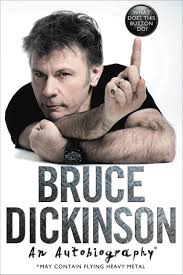
What Does This Button Do?

What Does This Button Do? is the newly released biography of rock singer, professional airline pilot, world-class fencer, author, poet, public speaker, television show host, and entrepreneur Bruce Dickinson.

It's a fast and fun read about an interesting polymath who is now on the verge of turning sixty years old.

The overall impression of Dickinson is that he is a man of curiosity (hence the title), almost possessed by the love of learning, the drive to succeed, to venture out into uncharted territory, and to push the limits of his abilities.

Like most rock and roll biographies, the book moves along at a fast pace, is not by any means a difficult read, but given Dickinson's quirky personality, the book is filled with humor, candor, surprises, and possibly a few words that might send you to the dictionary.

On the downside, the book at times could use stronger editing.  Given that the author is a do-it-yourself headstrong Alpha male, this probably explains the undeveloped and at times disconnected narrative - especially in the first couple chapters of the book.  Being Bruce Dickinson's editor is probably a matter of negotiation.  But as things get rolling, the prose becomes smoother and more fluent.

He also has an undeveloped fascination with the occult, including a long-term project to make a movie about the life of Satanist Alestair Crowley.  It is not clear in the text if his movie was ever made, or why this was one of Dickinson's passionate projects.

Another strange thing is that missing from this autobiography are any mentions of his own family life: nothing about marriage and children and life as a husband and father.  He does include an explanation for this at the end, but reading the narrative gives one the (false) impression that Dickinson was and is a confirmed bachelor with no interest in family life - much like the feeling that one gets watching a Charlie Brown cartoon in which there are no parents or adults inhabiting the planet. Such an omission makes Dickinson sound perhaps more self-centered than he probably is in real life.

This omission leaves a great void, an elephant in the parlor, as far as a life story goes.

But as a professional chronicle and journal of personal growth, this is a fun read.  The last chapter addresses his recent throat and tongue cancer.  Not only did he survive - but he managed to reignite his singing career, even claiming that his voice has actually improved since his aggressive treatment regimen.  His account of this period in his life is frank and yet humorous.  There is a seriousness conveyed, and yet he avoids being maudlin or melodramatic.

For me, the most interesting thing about Dickinson is his determination to do pursue his unusual passions at all costs - even seeking out fencing coaches and flight instructors during his "day job" of world tours performing theatrical heavy metal shows: both with Iron Maiden and for his solo projects.

Over the course of his years as an aviator, he has not only racked up stacks of pilot's licenses, he has had an entire career as a commercial airline captain - professionally flying 747s full of passengers.  He also collects and flies antique planes, even performing flying WW1 aircraft in airshows.  He is not a celebrity who was allowed to slip by.  He is a hard-working serious pilot with his nose to the grindstone, who has paid his dues and has managed to weave together multiple careers in one life.

A couple of interesting passages from the book:

At Munich I waited in uniform, by the bus stop for the crew bus to take me to the hotel. Out of the corner of my eye I spotted an Iron Maiden fan, and he spotted me.  Bedecked from head to foot in badges, cut-off biker denim and Maiden shirt, he made a bee-line for me.  
He stared at me and said, "excuse me... but is this the bus stop for Munich?" 
"Er, no.  Next one up."
He turned and walked away.  He never knew - nobody knew, except me - that I was an airline pilot.  Unbelievable.  (Page 287)

And:

I flew 300 hours in the 737 during the summer and autumn of 2002.  By now, Astraeus [Airlines] had added a pair of new-generation 737 aircraft to the fleet, and in the space of a year we had four aircraft.
Some of those aircraft were old, and equipment failures often meant that pilots had to actually hand-fly them.  One day I turned up for work, where Gatwick to Athens and back was the mission, except the plane was broken and all its autopilots were not working.  I expected to be back in my bed at home watching late-night TV around 1 a.m.  In fact, that was the time I eventually took off.  We hand-flew the aircraft to Athens and back overnight, finally landing at 9 a.m.  I was so tired I could hardly see the white lines on the road driving home.  I pulled over and slept for three hours.  Character-building stuff.
By contrast, going on tour with Iron Maiden was like going on holiday.


The book is filled with such reminiscences and anecdotes.

It is hardcover, 371 pages, and includes a color plate of photographs in the middle.  If you like heavy metal music, aviation, or inspiring biography of people who live their lives off the beaten track, you just might enjoy this book!

Bonus - here is a video of the first episode of Bruce Dickinson's TV series on aviation: Flying Heavy Metal

Fasten your seatbelts and enjoy your flight!

Thursday, October 05, 2017

Do the Dead and the Unborn Have a Say in our Society?

In his thoughtful work, Moral Matters: A Philosophy of Homecoming, Irish Roman Catholic writer and philosopher Dr. Mark Dooley makes an eloquent, nearly poetic case for cultural conservatism, based in part on a Chestertonian sense of a cultural and filial duty to the dead.

Dooley sees our lives in a great chain of continuity with our ancestors and with our future descendants rather than the way narcissistic post-moderns - with shockingly short time preferences - only see their immediate desires, with no gratitude and with no consideration of those yet to be born.

Conservatism (Latin: conservare, "to preserve") allows the dead, as it were, to have a say, as G.K. Chesterton famously quipped about tradition being a "democracy of the dead."

In the current battle between traditionalist conservatives who wish to preserve American and Western history - warts and all - versus the largely-socialist iconoclasts who tout grand Utopian dreams of a new "Socialist Man" liberated from so-called "oppression" at the hands of those very traditionalists seen as "oppressors," we are seeing this philosophical clash.  Even if conservatives and radicals can't themselves articulate why they seek to either keep monuments in place, or topple them, I believe Dr. Dooley is spot on about the cultural forces that are smashing into one another, like great tectonic plates, in the current seismic shifts in Western Culture. 

The following comes from Chapter Three ("Dealing with the dead") of his book Moral Matters (2015).  I'm still reading it, but find it not only illuminating but inspiring.  If you are looking for an apologetic for cultural conservatism, one that not only captures our current malaise by connecting it to the Great Tradition of Western thought, look no further.

The last word belongs to Mark Dooley:

"When [Edmund] Burke wrote that great book [Reflections on the Revolution in France], the Jacobins were laying siege to the cultural, religious, and political patrimony of France.  They were doing so in the name of 'liberty, equality, and fraternity', the guiding slogan of all subsequent liberalism.  However, in disconnecting France from her past, the Jacobins favoured the living above the dead and the unborn.  Their aim was to destroy those established institutions which conserved the social, spiritual and historical capital for what Burke called 'absent generations'.  This meant actively forgetting that ours is 'not a partnership in things subservient to the gross animal existence of a temporary and perishing nature', but a partnership 'not only between those who are living, but between those who are dead and those who are to be born'.  Burke called this 'the great primeval contract of eternal society'.

"Burke's essential point was that what we have, and who we are, is not something that we (the present trustees of society) make or choose.  Rather, it is a gift transmitted from the dead to be conserved in trust for future generations.  The gifts of the dead are embodied in our customs, values, institutions and cultural monuments, all of which pre-exist the individual and through which his sense of self is nurtured and formed.  It is though these monuments that the dead continue to dwell among the living, thus ensuring intergenerational continuity.  Deconstruct those monuments, however, and you sever the unborn from their 'canonised forefathers' and the world they created.  You silence the voice of the dead, silence their wisdom as it is transmitted through the ages....

"The world contains the consciousness, what Hegel again called the 'spirit' (Geist), of those who went before.  Everything, in other words, has a history which is manifest in and through the object.  If we can tell stories about our homes, belongings, and artefacts, it is because they contain the spirit (Geist) of previous generations.  They contain traces of the dead which animate them for the living.  The dead, as it were, live on through their work and possessions.

"A principal objective of the communist system, as indeed that of the Jacobins, was to exorcise the ghosts of the dead from the land of the living. It did so by attempting to scrape from the surface of the world all trace of the old order.  Art, architecture, and religious iconography were all drained of their character, smashed by the sickle until such time as the world could be redesigned in the image of the 'new socialist man.'  The purpose of this vandalism was to disconnect the living from the dead, to empty the world of its spiritual (Geist) significance.  In that way, or so the communists believed, the people would embrace the future instead of perpetually looking to the past as a guide to the present.  Rather than genuflect before 'canonised forefathers', they would now become subservient to the State and its hollow promises of socialist utopia.  By severing people from their heritage, they sought to deplete the storehouse of memory until such time as it no longer existed.  At its most diabolical, this took the form of Pol Pot's 'year 0', in which the Cambodian dictator sought to erase all vestiges of human history.

"As subsequent events proved, however, the spirit of the past is impossible to completely vanquish.  No matter how hard the advocates of of progress endeavour to silence the dead, we remain haunted by their ancestral voices.  We can, of course, pretend that the dead do not dwell among us.... [w]e can become convinced that we are what we make of ourselves, that we are fully self-sufficient.  That, however, leads only to alienation and a false sense of identity.  By contrast, when conservatives look at the world, they see an omnipresence of ghosts. For them, all objects bear witness to their creators.  Even the so-called 'natural world' is imbued with consciousness, with the signs, traces and marks of those who planned, settled and worked on the surrounding environment.  Understanding the world, and thus oneself, requires learning from the dead, incorporating their consciousness into one's own....  [T]he family and education provide children with their first glimpse of ghosts, their first encounter with a world shaped by absent generations and the debt they are owed.  Hence to undermine the family and traditional education is, once again, to detach from the dead....

"Liberalism has been often criticised for promoting a 'culture of death'.  I prefer to say that it fosters a culture of amnesia or one of denial, in as much as it actively strives to forget the dead by cutting its links to the past.  By driving the deceased out of our mind, we are thereby relieved of having to answer their summons to sacrifice.  We no longer have to undertake the hard work of mourning, memory or recollection.  And when that happens, we can simply ignore 'the great primeval contract of eternal society' between the living, the dead, and 'those who are to be born'.  We need only answer to ourselves, for life begins and ends with us.  But that, once again, is to live in a condition of self-deception.  For, it is only by recognising the dead and by honouring their sacrifices that we can establish who we are and where we came from.  It is only by acknowledging that... we are nothing without those who laboured hard so that we might live in relative ease.  It is only by giving new life to our ghosts, by following their direction and continuing their work, that we can find our way back home.  

"To conserve is to remember and cherish with 'the warmth of their combined and mutually reflected charities, our state, our hearths, our sepulchres, and our altars' (Burke). It is to gaze upon the world as one fashioned by our forbears, one abundantly imbued with their spirit and wisdom.  It is to recognise that the rootless, self-sustaining identity which liberalism advocates is an illusion predicated on a denial of dependence, dependence on those who nurtured and shaped us.  It is to foster a culture of thanksgiving in which we offer grace for all things, knowing that they bear the trace of those who sacrificed on our behalf.  However, it also involves the responsibility to ensure that we uphold and maintain existing monuments so that others may one day enjoy their benefits.  

"When looked at in this way, we see that the core message of genuine conservatism is this: standing, as Eliot put it, at the intersection of 'the timeless and time', we, the living, serve to unite, in Burke's majestic words, the 'visible and invisible world'.  That is why conservatism rejects rejection in favour of love: love of those absent others within oneself and of the world they bestowed to us: love of those others who depend on us for their survival and who, one day, will look upon us as their dead, love, in other words, of all those things which can never be made 'the object of choice', and which, when denied, lead not to 'progress' but to an 'antagonistic world of madness, discord, vice, confusion and unavailing sorrow'."

~ Mark Dooley, Moral Matters, pp. 49-56

Saturday, September 30, 2017

Mises on Communist and Fascist Varieties of Socialism


"The history of mankind is the history of ideas.  For it is ideas, theories and doctrines that guide human action, determine the ultimate ends men aim at, and the choice of the means employed for the attainment of these ends...

"Such people [anti-social individuals] condemn the formalism of the due process of law.  Why should the laws hinder the government from resorting to beneficial measures?  Is it not fetishism to make the laws supreme and not expediency?  They advocate the substitution of the welfare state (Wohlfahrsstaat) for the state governed by the rule of law (Rechtsstaat).  In this welfare state, paternal government should be free to accomplish all things it considers beneficial to the commonweal.  No 'scraps of paper' should restrain an enlightened ruler in his endeavors to promote the general welfare.  All opponents must be crushed mercilessly lest they frustrate the beneficial action of the government. No empty formalities must protect them any longer against their well-deserved punishment.

"It is customary to cal the point of view of the advocates of the welfare state the 'social' point of view as distinguished from the 'individualistic' and 'selfish' point of view of the champions of the rule of law.  In fact, however, the supporters of the welfare state are utterly anti-social and intolerant zealots.  For their ideology tacitly implies that the government will exactly execute what they themselves deem right and beneficial....  They want to exterminate all opponents, that is, all who disagree with them.  They are utterly intolerant and are not prepared to allow any dessension, Every advocate of the welfare state and of planning is a potential dictator.  What he plans is to deprive all other men of all their rights, and to establish his own and his friends' unrestricted omnipotence.  He refuses to convince his fellow-citizens.  He prefers to 'liquidate' them.  He scorns the 'bourgeois' society that worships law and legal procedure. H himself worships violence and bloodshed....

"This was the true meaning of the Lenin revolution.  All the traditional ideas of right and legality were overthrown.  The rule of unrestrained violence and usurpation was substituted for the rule of law.... They we free to kill ad libitum.  Man's innate impulses towards violent extermination of all whom he dislikes, repressed by a long and wearisome evolution, burst forth.  The demons were unfettered.  A new age, the age of the usurpers, dawned.  The gangsters were called to action, and they listened to the Voice....

"It is important to realize that Fascism and Nazism were socialist dictatorships.  The communists, both the registered members of the communist parties and the fellow-travelers, stigmatize Fasism and Nazism as the highest and last and most depraved stage of capitalism.  This is in perfect agreement with their habit of calling every party which does not unconditionally surrender to the dictates of Moscow - even the German Social Democrats, the classical party of Marxism - hirelings of capitalism....

"In recent years the communists' semantic innovations have gone even further.  They call everybody whom they dislike, every advocate of of the free enterprise system, a Fascist....

"Dictatorship and violent oppression of all dissenters are today exclusively socialist institutions.  This becomes clear as we take a closer look at Fascism and Nazism."

~ Ludwig von Mises, 1947
"Planned Chaos"
Published in the 1951 edition of Mises's Socialism: An Economic and Sociological Analysis, pp. 566-573

Mises on Nazi Germany: A Left Wing Socialist Ideology

"The philosophy of the Nazis, the German National Socialist Labour Party, is the purest and most consistent manifestation of the anti-capitalistic spirit of our age....

"These [Socialist] parties proclaim income equality as the main thing. The Nazis do the same....  They aim at a fairer distribution of the earth's natural resources.  As a 'have not' nation, they look at the wealth of the richer nations with the same feelings with which many people in the western countries look at the higher incomes of some of their countrymen.  The 'progressives' in the Anglo-Saxon countries assert that 'liberty is not worth having' for those who are wronged by the comparative smallness of their incomes.  The Nazis say the same with regard to international relations....

"For more than seventy years the German professors of political science, history, law, geography and philosophy eagerly imbued their disciples with a hysterical hatred of capitalism, and preached the war of 'liberation' against the capitalistic West....

"The Nazis were quick to adopt the Soviet methods.  They imported from Russia: the one-party system and the pre-eminence of this party in political life; the paramount position assigned to the secret police; the concentration camps; the administrative execution or imprisonment of all opponents; the extermination of the families of suspects and of exiles; the methods of propaganda; the organization of affiliated parties abroad and their employment for fighting their domestic governments and for espionage and sabotage; the use of the diplomatic and consular service for fomenting revolution; and many other things besides.  There were nowhere more docile disciples of Lenin, Trotsky and Stalin than the Nazis were."

~ Ludwig von Mises, 1947
"Planned Chaos"
Published in the 1951 edition of Mises's Socialism: An Economic and Sociological Analysis, pp. 578-580

Mises on Socialism: Common Sense and Moral Courage

"The intellectual leaders of the peoples have produced and propagated the fallacies which are on the point of destroying liberty and Western civilization.  The intellectuals alone are responsible for the mass slaughters which are the characteristic mark of our century.  They alone can reverse the trend and pave the way for a resurrection of freedom.

"Not mythical 'material productive forces', but reason and ideas determine the course of human affairs.  What is needed to stop the trend towards socialism and despotism is common sense and moral courage."

~ Ludwig von Mises, 1947
"Planned Chaos"
Published in the 1951 edition of Mises's Socialism: An Economic and Sociological Analysis, p. 592

Monday, September 04, 2017

G.K. Chesterton on Attitude

"Everything is in an attitude of mind.... The world will never starve for want of wonders; but only for want of wonder."
~ G.K. Chesterton, 1909
Tremendous Trifles

Friday, September 01, 2017

Richard Weaver on the Entitlement Society


"The spoiled child has not been made to see the relationship between effort and reward. He wants things, but he regards payment as an imposition or as an expression of malice by those who withhold for it. His solution, as we shall see, is to abuse those who do not gratify him....

"In the final analysis this society is like the spoiled child in its incapacity to think. Anyone can observe in the pampered children of the rich a kind of irresponsibility of the mental process. It occurs simply because they do not have to think to survive. They never have to feel that definition must be clear and deduction correct if they are to escape the sharp penalties of deprivation. Therefore the typical thinking of such people is fragmentary, discursive, and expressive of a sort of contempt for realities. Their conclusions are not 'earned' in the sense of being logically valid but are seized in the face of facts. The young scion knows that, if he falls, there is a net below to catch him. Hardness of condition is wanting. Without work to do, especially without work that is related to our dearest aims, the mental sinews atrophy, as do the physical. There is evidence that the masses, spoiled by like conditions, incur a similar flabbiness and in crises will prove unable to think straight enough to save themselves."

~ Richard M. Weaver, 1948
Ideas Have Consequences, pp. 103, 116

Friday, October 14, 2016

The Word Remains: a Review

The Word Remains is the kind of book that can be read quickly from cover to cover in one sitting, or opened to any random page and enjoyed.  But in fact, the book is best sipped like a fine glass of wine, taken in unhurriedly, and meditated upon.  This book is neither stuffy nor frivolous - but rather profound and yet accessible to the thinking Christian of any vocation.

Manfred Seitz describes the book as a "portal" to the writings of Wilhelm Löhe.  I prefer to think of it as a sample plate, a tapas repast of high delight that is neither filling nor unsatisfying.  Like an appetizer, it leaves the palate eager for more.  Seitz recommends reading the book in a "contemplative" way, "lingering" over the text in the way of the ancients (p. 3).  He elaborates on this kind of reading by appealing to St. Benedict, making a case for renewing this kind of meditation among modern Christians.  Blessed Wilhelm, who saw modern Lutherans in continuity with the ancient church, would most certainly approve.

My impression of Wilhelm Löhe is that he was a man ahead of his time.  He was fiercely devoted to the sacrament of the altar, private confession, the Book of Concord, and the richness of the church's traditional liturgy.  He understood the centrality of mission, and though he never set foot in America, his influence upon American Lutheranism is extraordinary.  He also suffered for the sake of his confession, opposing rationalism and enforcing church discipline, and for his steadfastness was rewarded by being temporarily suspended from office.  He also established and oversaw a deaconess institution, to which the modern LCMS deaconess program owes a debt and bears some similarity.  Löhe saw theology not as a theoretical academic subject, but rather as the living, breathing Gospel of Jesus Christ lived out in the community of flesh-and-blood people.

The Word Remains is inspiring and encouraging, bringing the writings of Wilhelm Löhe to life in our day and age, in our likewise controverted context, in which confessional Lutheranism is, in the words of another confessor, Herman Sasse, a "lonely way."  And yet it is a path of joy, concerning which Löhe writes, "should awaken from suffering, and joy should bloom and flourish despite suffering" (p. 90).

Without sharing too much, I offer a shining excerpt in a beautiful English rendering of Löhe's lyrical reflection on the Lord's glorious resurrection on the day of Easter:
"No other act done by God for the world is as praised and commended as the resurrection of our Lord.  The earth quaked, angels came down, saintly bodies arose, guards fled.  Pharisees and scribes could not conceal what happened with a lie; no veil of darkness could have hidden the splendor of Easter morning.  Where is your denial, O world?  He is risen!" (p. 22).
The Word Remains is a little treasure, a breviary, a portal, an introduction to Wilhelm Löhe's life and work, and an invitation, in the words of Manfred Seitz, "to linger, immerse, yourself in these words, and read with a listening heart" (p. 5).

Thursday, August 21, 2014

Fight the Stupids!

A lot of classic works of literature are proving to be prophetic in our day and age.  Our 21st century American culture and political life are growing more and more to resemble Orwell's 1984, Huxley's Brave New World, Rand's Atlas Shrugged, Bradbury's Fahrenheit 451, and other seminal works of art.

I would also include one that resonates with me as a Christian pastor trying to shepherd people in Christ's Church amid the decay and normalization of the rot, and that is the insightful apocalyptic novel Father Elijah by contemporary Canadian wordsmith and raconteur, the traditionalist Roman Catholic author Michael O'Brien.

And then there is Mike Judge's satirical film Idiocracy, which has become eerily prescient of our own breakneck cultural decay a mere eight years after its release.  Things that seemed over-the-top crazy in 2006 have nearly become downright quaint in 2014.

Today's Drudge Report headlines could have stepped right out of many of these works that predicted the unraveling of western civilization into a quivering ball of anti-intellectual animalistic mush.


These current headlines include:


  • Outrage over LAPD's state-of-the-art spy drone
  • BRAIN DRAIN: IQ scores decreasing
  • Mob tackles airline employees as ticket giveaway descends into chaos
  • Debut 'SPIDER-WOMAN' Cover Slammed as Sexist Due to Butt Shot
  • 'DATING NAKED' sued by cast member -- for showing her naked!
  • 'SEX BOX' Reality Show to Put Couples on Display
  • HBO defends scenes of violence and rape
  • 'Performance Artist' Vows To Have Sex With Someone New Every Day
  • Sex-Crazed Narcissist
  • CHENEY: Obama Would 'Rather Be On Golf Course' Than Situation Room
  • All Smiles And Fist Bumps
  • Doctors baffled by rise in penis birth defect
  • Spanish senator blames national debt on homosexuals
  • Hook-Up Culture at Harvard, Stanford Wanes Amid Assault Alarm

This is our Brave New World, where ignorance is strength, a sensationalistic (and yet bored) culture of casual orgies and mind-numbing pharmaceuticals and lack of interest in books and in thinking, a society that rewards sloth and mooching, where good is evil and evil is good.  We live in that culture in which plants are figuratively believed to crave electrolytes, and to suggest otherwise is to invite ridicule from one's mouth-breathing "superiors."

Having said all of that, I believe I'm going to apply the cure suggested by Mrs. Hollywood: a daily dose of Anthony Esolen.  Go here.  Read an essay every day.  And even if you are not Roman Catholic or not Christian, give Dr. Esolen a shot anyway.  Your mind will thank you.  He is eloquent, uses our language as an art form, and writes with his mind directed at that which is good, beautiful, true, transcendent, and uplifting. Even in matters of disagreement with him, what a delightful alternative to the incessant pipeline of cultural bilge that flows unabated (and in fact, invited) into our inboxes and news-feeds incessantly.  We do not have to yield to the forces of barbarianism.  We can choose to be civilized.

In the words of the slogan of a local bookstore: "Fight the stupids!"


Wednesday, January 22, 2014

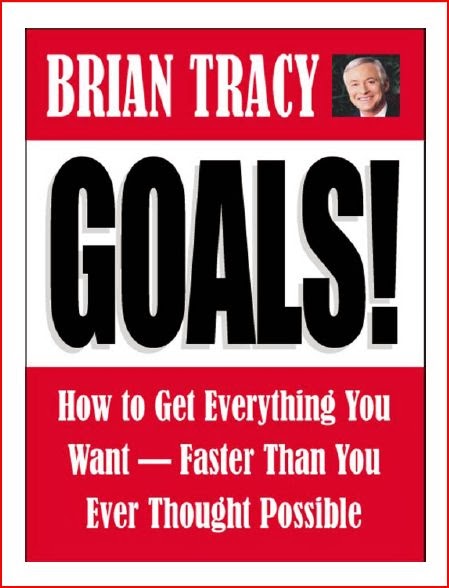
Goals! Devotional and Educational Reading for 2014, etc.

Last year, I read an article that mentioned a book by self-help guru Brian Tracy called Goals(also available in Kindle format).  I was intrigued enough to buy the e-copy and give it a read.

We Lutherans tend to be smugly skeptical of self-help books, programs, and speakers, because there is so much of this kind of stuff "playing church" out there - supposedly Christian books teaching you how Jesus can help you to have a whiter smile, better breath, bigger hair, a faster private jet, health, wealth, and fame in just seven easy steps - that I think we have a healthy (or sometimes not so healthy) cynicism toward any hint that we can improve ourselves.  We certainly don't want to be accused of denying original sin or not placing the Doctrine of Justification at the front and center, so we typically don't even try to improve ourselves (an endeavor with which the sinful flesh is ever eager to assist).

In fact, the Rev. William Weedon may be on the trajectory to canonization for taking slings and arrows from many of his Lutheran brethren who see his enthusiasm for being healthy and fit to be scandalously un-Lutheran, bordering on the worship of Baal or siding with the French in the Franco-Prussian war.

Well, that's the caricature, anyway.

In spite of my Lutheran scruples, I found the Tracy book (as well as another book of his called No Excuses!) to be intriguing.  The gist of the Goals! book can be found here.

Our own auto-educational program here at Chez Hollywood has included the One Year Bible for several years now, and it is the foundation of our home study and family devotions (along with the LSB family prayer cards from CPH).  We typically add another reading of some sort, before or after COSEMP (the Caffeinated Order of Scrambled Eggs and Morning Prayer) - and the nature of the lection has been wide and varied over the years, e.g. spiritual authors such as Augustine, Chesterton, Pascal, and Lewis, etc. along with the pursuit of academic interests, such as the Free Market newsletter and political, philosophical, and economic thinkers by way of articles, essays, and various other books and podcasts.

For this year's devotional readings, we decided to take up the bibliography given by the Rev. Dr. Joel D. Biermann of Concordia Seminary - St. Louis as part of his course called "Woman and Man According to God's Plan" (we attended an abbreviated version of the lecture series last year in Pensacola).  We also listened to the entire lecture series on a subsequent road trip (available free of charge at iTunes University as video and audio).

Disclaimer: I heartily endorse Dr. Biermann's treatment of the vocation of male and female according to the order of creation, but I completely disagree with his views of government.

Anyway, given that the issue of the roles of the sexes is "the" issue in society, in the Church at large, and even the source of great disagreement within the Lutheran Church - Missouri Synod (which I would refer to as the GMWO issue: gay 'marriage' - women's 'ordination'), we have decided to systematically read through all of the texts referenced in Dr. Biermann's lectures - some of which are theological, some secular.

Here is the list (dates refer to publication):

Since it was available electronically, we started with Eggerichs's Love and Respect right off the bat.  The author is a Ph.D. and an ordained Protestant minister who spent many years serving as a pastor.  We both found his book remarkably illuminating - even as we celebrate our 20th anniversary next month.  We would love to have had this book when we were first married.  Today's feminist culture virtually assures that men and women go into marriage brainwashed that there are no fundamental differences between the sexes other than the obvious plumbing, and to the really radical, perhaps admitting some very slight difference in upper body strength (although TV shows and movies have largely taught us that women and men are even identical in regards to physical strength, Girl Power and all that).

We highly recommend Dr. Eggerich's book for married people, engaged couples, and anyone who might want to be married.  I recommend the book also to pastors.  It is a scriptural treatment of how husbands and wives can better communicate with one another, and avoid the communication breakdown the author calls "the crazy cycle."  It is a very practical work, fun to read, based on both scripture and years of seminars given by the author and his wife.

We have bought Grudem, Rhodes, and Sax in non-digital form, and they are patiently waiting their turns.  We will buy the others as the time gets closer, though the Fritz book is out of print and may prove more of a challenge.  We are working through Dr. Sax's book (Why Gender Matters) now.  The author is both an M.D. and a Ph.D.  His book is culturally iconoclastic, arguing from a purely clinical and biological secular perspective that the sexes are wired differently.  He cites a lot of research and presents it in an engaging way.  It is funny, though, how often he tries to weasel out of the obvious conclusions to be drawn.  We're just shy of being a quarter of the way through the book, and find it fascinating.  The egalitarian and feminist foundations of our entire culture - which is driving the current debate about marriage, sex vs. "gender," the role of women in the church, women in combat, etc. - are really laid bare for the fraud that they are.

Another project - which actually takes about five minutes a day - which Grace and I are pursuing separately, is the reading of St. Augustine's epic The City of God over the course of this year.  We joined a facebook group dedicated to that goal and have joined up with more than a thousand people on the moderator's reading schedule.  I am also taking a more disciplined approach to reading literature that I should have read in school, but didn't.  I began reading Fyodor Dostoevsky's Crime and Punishment while in Russia two years ago, but got busy and stopped reading.  I restarted, made an overall goal and reading plan, and am now more than halfway done with the book.  This is especially good reading at bedtime (I'm reading this one without the electronic screen, as it seems that e-reading interferes with the production of melatonin which helps the body sleep).  The chapters are not long, and as long as I don't "stall" again, I should be able to complete it within a few weeks with just a short bit of reading each day.  We're also finishing up a delightful book about books, given to us as a Christmas gift by a friend: Howard's End is On the Landing by Susan Hill.  It makes for good reading in the car while running errands.  We'll have that one done in a few days.

Along the suggestions of Brian Tracy's Goals! book, I am tracking our reading and various projects using a planning Moleskine.  So far, I like the way this keeps us focused.  I'm using this same Moley to work on other projects that I have let slip because of not writing things down.

For example, I am working on the Pimsleur Russian course, which is an outstanding audio based series.  I own all 90 half-hour lessons broken down into three courses.  I have never gotten past about lesson 17 or so.  I am going to see if Tracy's premise that writing things down is the key to getting things done really works.  So far, it is helping!  I started back at the beginning with Unit 1 and and trying to get through 5 units or so a week (more if I am able).  I'm currently on Unit 10.  And since this course is audio, I listen while walking (which I am doing now), jogging (which will be a transition), and running (which I'm looking forward to doing regularly again, once more using the journal to keep myself in line).  I am also figuring out how to work in some more ambitious fitness goals, but at age 49, running a marathon by just showing up the morning of the race isn't an option the way it was when I was in my 20s (though even then that wasn't my brightest, shining moment, not that I regret doing it, for like most crazy things we do in life, I got a story out of the deal).  So I'm taking it a little slower these days.  We also eat paleo, though we need to tighten up after loosening the reins a bit during the holidays.

Another goal I've set for myself this year is to work on my Latin in a more disciplined way.  I have never completed the entire book Lingua Latina Per Se Illustrata: Pars I Familia Romana by Hans Oerberg (which is the natural method Latin course I taught to Junior High students for many years).  I want to not only complete all 35 chapters (I restarted with Chapter 1, and am currently on Chapter 9), but also want to read the sequel, Roma Aeterna.  Once those are done, I might like to tackle the two volumes of ecclesiastical Latin in Latin Grammar and Second Latin by Cora and Charles Scanlon.  Of course, elephants are eaten one bite at a time.

FH readers will note that I have not been keeping up with posting my sermons nor have I done much blogging.  I hope to be more diligent on both counts.

I also have other projects that need to be done bit by bit, and I am journalling those as well.  I adopted this Circle System for project management, and here is how it works, as explained below by Sara Caputo at Radiant Organizing (note: some of the links are dead):


The Circle System is another that was developed out of pure need and logic by another gentleman from Amsterdam.  Simply put, it’s a blending of his own to-do list with a series of circles that he devised and gave meaning to — here’s a picture of what it looks like:
Cool, huh?
Here’s the jist from his site:
Ok, this was about the bones and now it’s the meat. The Cir­cle.
We now have projects with its actions, all with cir­cles in front. And we surely have indi­vid­ual actions that are not part of any project, like Pay this bill and so on. Put every­thing in, every action you need to exe­cute at home or work. Don’t try to remem­ber every­thing — except one thing: The note­book remem­bers.
As things progress I add few things to the cir­cles. Here a list that explains in words and the pic­tures should be help­ful guides too.
  • Cir­cle : Project or an action
  • Stroke, a diag­o­nal line across the cir­cle : Work has started
  • Filled lower part of the cir­cle : Work is half done (or wait­ing for some other step)
  • Filled cir­cle : Work on the project or action is fin­ished or off my hand (delegated)
  • Cross over the cir­cle, sec­ond stroke : Can­celled
This makes up the basic Cir­cle sys­tem and is a great starter. I also use a few extras for empha­sis In addi­tion to this you could also use:
  • Num­bers to note in which order I need to execute
  • Excla­ma­tion mark in front of the cir­cle for an impor­tant action
  • Arrow or > after any cir­cle tells that a project or an action has been del­e­gated or moved to my GTD appli­ca­tion. Don’t for­get to fill the cir­cle at the same time. And also write down who is con­tin­u­ing the work if that is impor­tant. It usu­ally is.
  • Dot in the mid­dle of the cir­cle is a sub­tle atten­tion mark.
I like them both because they were created around NEED and the system was devised around the individual’s workflow. Very often, task management systems that we try to plug into that others have created don’t work well because it is not a system that follows our individual needs.  When we devise our own system, as the gentlemen above have done, we are better able to follow it and have it be sustainable.  Just my own 2 cents.  More to come next Tuesday as we review 2 more systems…. have a great week of getting stuff done!

I don't carry my planning book around with me, but I do keep a personal notebook on me at all times.  In it, I have made my own calendars for several months, a to-do list for day-to-day tasks using the Circle System, a section for quick incidental notes, and I use the rest of the notebook for taking notes for all other meetings or other situations requiring note-taking.  At the first of the year, I completed my pocket Moleskine that I used for July through December 2013, and am now trying a notebook that I hope will be more robust: a German-made Leuchtturm 1917 pocket ruled notebook.  So far, I'm quite impressed with it.  I used my Leuchty to take notes at the 2014 Mises Circle in Houston, where we heard lectures by Jeff Deist, Tom Woods, Lew Rockwell, and Ron Paul (note: Dr. Woods's lecture is linked, the rest are on the way!).  The Leuchtturm is slightly larger than the Moleskine, and has very nice cream-colored high quality pages that are pre-numbered!  I'm hoping that it is more robust than its Chinese-made Italian cousin.

In terms of economics self-education and personal development, we attend the unique and delightful  Dr. Walter Block's Human Action seminars held at Loyola University twice per month (which restared this month after a long Christmas break).  In that ongoing seminar, we are reading, discussing, and debating Murray N. Rothbard's Economic Controversies (available as a free download here).  These seminars and the discussions that come afterwards really keep the brain running in overdrive!  

While at the Mises Circle, we picked up the following which we also look forward to working into the reading program:
Since we were on a road trip, we started reading together aloud Dr. Paul's The School Revolution.  We're more than halfway through, and it is an insightful read!  

I know someone is going to respond: "You have too much time on your hands."  (I used to get that a lot when I was more prolific at writing and when I used to post funny broadsides at seminary). Actually, we all have the same amount of time. Well, here is what Grace and I have found helps us to get things accomplished.  These work for us, and I'm sure other people have great techniques as well for reclaiming time:
  1. Get up early (last year, we set the alarm for 4:45 but got out of the habit later in the year when we were swamped with work that caused us to stay up too late - but are working our way back). 
  2. Don't watch TV.  Aside from an occasional Netflix movie, we don't watch anything on the television: we don't have cable, we don't watch network broadcasting, no football, no news - no nothing. 
  3. Eat at home.  We used to go to restaurants a lot, but now eat almost exclusively at home.  Not only does this save a ton of money, it buys us loads of time not spent getting ready, waiting for a table, dining, waiting for the check, and driving back.  During food preparation at home, we have additional time to read aloud to one another.
  4. Turn the car into a 4-wheeled university.  Road trips are perfect for podcasts or long stretches of reading.  Running local errands is great for reading a chapter here and there aloud to one another.
  5. Take Advantage of supermarket lines with a book, e-reader, or books on the iPhone.  Instead of complaining about the long line, turn it into a class, an opportunity to learn!
There is actually a lot of time for reading, studying, thinking, and writing - if it is a priority.   In spite of the time it takes to be a parish pastor and high school teacher; in spite of the time it takes to homeschool a third-grader, run a home, and serve the church as a volunteer - there is time to continue to learn and grow if we make the time and have the self-discipline to stick with it.

I hope Brian Tracy is right.