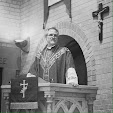
One of the great and wondrous things about being in the Office of the Holy Ministry is the collegiality of the fathers and brothers. I am blessed with brothers in arms under the cross who come from every walk of life, scattered around the globe, of every tribe and tongue, engaged in the common warfare against sin, death, and the devil as servants of Jesus Christ.
He is, as the kids say, if you'll pardon the expression, a "badass." He is now a retired second career pastor, a former district attorney from Hawaii, and a man of Japanese heritage who knows and revels in his culture's warrior history.
I am glad to count him a friend and not a foe.
He has heroically driven more than six hours each way from his home in Florida to fill in for me at Salem when I needed help.
My dear brother wrote to me today, and said:
Earlier, I told you I refuse to provide you with a hanko (Chinese ideogram seal) for fear that you would use it in a stole orphrey or chasuble vesica. Since then, it dawned on me that as cultured academic, you should have a hanko even though you don’t have a name that can be honestly rendered in kanji (ideogram). However, your surname, “Beane,” means “life,” “enochi” in Japanese. Larry is Laurentius in the original Latin, “man from Laurentum,” a Roman town that is associated with the laurel wreath, and in Japanese, that is “Gekkeikan,” that is also the name of the internationally popular saké. I could render your name in Japanese but it would be unbalanced in a traditional hanko and it sounds really weird.
The kanji is for “nanban,” literally “southern barbarian.” Its first usage was in China when the tiny Han Chinese kingdom fought off the ancestors of Cantonese Chinese of what is now Guandong to Yunnan Provinces. In Japan, it was used to refer to the Portuguese explorers of the late sixteenth century. This was expanded to include the Dutch and English. The term is now used mostly by non-Asian Europeans and Americans to sarcastically refer to themselves in the same way I call myself a “Jap” (as opposed to JAP–Jewish American Princess).
The capsule cartouche is called an “inkan.” The vermilion color is traditional. I have given you the kanji in both the simpler modern and more complex traditional. Abuse them to the glory of Christ (if possible).
And here are the two finished products. I am honored, Father Wesley. This is right up there with being made an honorary Marine by a Marine, and an honorary Seal by a Seal. I suppose I can add honorary Japanese aristocrat to my list of bucket-list items completed. どうもありがとう!
In between serious works, I enjoy reading rock star biographies. Their lives are typically interesting, inspiring, tragic, shocking, triumphant, or some combination thereof.
For example, Freddie Mercury's biography was tragic and filled with paradoxes, Bruce Dickinson's career as a rock star is only one facet of an extraordinary life: pilot, fencer, polymath, and poet. My latest rock and roll read is the autobiography of The Who's Roger Daltrey. It is shockingly frank and at times eyebrow raising - running the gamut from madness to the mundane.
Interestingly, he calls to mind an event that I was at, in which, as Daltrey explains, a once in a lifetime event became a twice in a lifetime event: the New Orleans Jazz Fest 2015. The emergence of the sun during "See Me, Feel Me," reprized the same remarkable thing happening in 1969 at Woodstock.
As I said, Daltrey is brutally honest in this book. And he has always been open about his disgust about Woodstock - which is often marketed as this triumph of love, peace, and music, but was really a terrible event of bad drug trips and sub-par musical performances.
One pages 118-119, Daltrey (who avoids drugs as detrimental to his ability to perform) explains how he was served a cup of tea unknowingly laced with LSD, tells of technical glitches, recounts people being injured, and calls to mind the organizers trying to renege on their contract (money that was needed to fly back to England). He recounts Woodstock and its New Orleans parallel occurrence:
After all the arrangements, the hallucinations, the mud, and the chaos, we were finally onstage, sometime after 5:00 a.m.
About a month earlier, I'd woken up from a particularly vivid nightmare. It was the kind you have when you're a kid. I was looking out on some barren, smoke-filled landscape. There were guard towers with searchlights scanning around and there were helicopters overhead. It was a subconscious approximation of Vietnam. Looking out into the pre-dawn gloom of Woodstock, making out the vague shape of half a million mud-caked people as the lights swept over them, I felt in my sleep-deprived, hallucinating state that this was my nightmare come true.
The show didn't feel like it went well. The monitors kept breaking. The sound was shit. We were all battling the elements and ourselves. It didn't help when a political activist named Abbie Hoffman climbed onto the stage at the end of "Pinball Wizard," grabbed Pete's mic, and shouted, "I think this is a pile of shit while John Sinclair rots in prison.!" Naturally, Pete booted him off the stage before threatening to kill the next person who tried to take his mic. Music and peace.
Somehow, we kept going and every time we felt like we were losing it, we dug in a bit deeper. Then, shortly after six, we got to "See Me, Feel Me" from Tommy and the bleeding sun came up. Right on cue. You couldn't have topped it. After all the shit we'd been through, it was perfect. It was extraordinary. It was one of those moments you couldn't ever re-create if you tried. Once in a lifetime.
Except exactly the same thing happened again on April 25, 2015, a mere forty-six years later. We were due to headline at the New Orleans Jazz Festival and it had been pissing rain all day. A tropical storm had just been through and the whole place was drenched. It's always chaos when it's so wet. It plays havoc with the electrics and it's always disconcerting when you see an amp half-submerged in a foot of water. I got to the trailer, looked out of the window, and told Mitch, my assistant, not to worry. I'd sort it all out. He said, doubtfully, "Okay, Roger." Cynical young man. And I started shouting at the sky, "Stop it! Stop now! We've had enough of this crap!"
And it did. Right on cue. Like someone had turned a tap off. Mitch didn't say anything. I didn't say anything but, to be honest, I was just as shocked as he was."
The sky was dark gray when we went onstage. It stayed like that right until the end of "Pinball Wizard." As I opened my mouth to sing "See Me, Feel Me," the sun broke through. Absolute magic. That's what I love about live shows. Things can happen. Some of those things are bad. Some of them are good. Occasionally, they're magic. That was one of those twice in-a-lifetime moments.
As I said, I was at the show in New Orleans. I stood in the rain and mud for a couple hours. Grace and Leo wandered around the fairgrounds while I held our spot. I was as close to the stage as possible without paying the premium to be in the roped-off section. Grace and Leo joined me and humored my joy at seeing The Who perform. It is no exaggeration to say that I knew every lyric from every song.
In the video above, I'm a few people to the left of the two Canadian flags that a lady was waving. I'm wearing a white Concordia Theological Seminary sweatshirt.
And the sun breaking out at this time in the show was not lost on me, nor any of my other several thousand colleagues in attendance. It was a great moment.
It made the impression on Roger Daltrey as well.
And this show was also a twice-in-a-lifetime event for me. This was my second time seeing The Who. The first time was at the Richfield Coloseum near Cleveland, December 13, 1982 - by this time, Keith Moon was deceased and Kenny Jones was the drummer.
We had what was known as "nosebleed seats." But I was prepared. I smuggled in my Nikon FM camera body, wrapped in a sock and bound to my ankle underneath my bell-bottom jeans. Along with the camera body, I had a 300 mm telephoto lens, again wrapped in a sock, and placed in the small of my back under my leather jacket. I smuggled in my equipment by opening my jacket for the cursory pat-down by security. They did not check my back or my legs. I ran to the men's room and assembled my camera, and we scurried to our seats. It was, of course, a great show. I got a few good pictures, developed them, and wrote the date on the back.
I was 18 years old. Roger Daltrey was 38.
And so my twice-in-a-lifetime opportunity came on April 25, 2015, nearly 33 years later, as The Who (with Zak Starkey on drums, and Pino Pallodinoo on bass - as the legendary John Entwistle was also deceased by this time) appeared on stage in New Orleans. This time, I was close to the stage. And this time, photography and video were not prohibited.
I was 51 years old. Roger Daltrey was 71.
Here is a link to the complete 1969 performance at Woodstock. And here is a link to the complete 2015 performance at New Orleans.
(The above YouTube has the soundtrack edited out, probably because of a copyright issue. But you can find the original here on Vimeo).
Well done, Taco Bell!
This delightful ad campaign works on many levels.
It's a jab at the ubiquity and uniformity of McDonald's, drawing a comparison between the fast food giant and the drab, uninspiring, staid life of Iron Curtain Eastern Europe and the Soviet Union. The commercial is cheeky and awash in 1980s imagery. Even the use of the punk-retro Ramones tune "Blitzkrieg Bop" (1976) during the Keystone Cops-like chase scene is a bit of nostalgia to people who remember the fall of the Berlin Wall and the collapse of European Communism.
The commercial pays homage to dystopic literature, in particular, George Orwell's 1984, especially with the throwback cathode-ray TVs blaring out mind-numbing technologically-backward propaganda. We see a contrast between the dreary East-Berlinish skyline of Soviet-era concrete apartment blocks in stressful uniform rigidity over and against the beautiful, colorful, relaxed European scene of freedom and vibrancy at the end of the short. And yet, the commercial manages to invoke dystopia in a lighthearted way, with the dictators and apparatchiks appropriately portrayed as Ronald McDonaldesque clowns, with frequent humorous visual references to Mickey Dee's culture as the little story progresses.
Brilliant!
Dystopia is an important genre. 1984, Brave New World, Fahrenheit 451, Atlas Shrugged, and others promote a worldview of liberty in describing a futuristic world of repression. These novels serve us as Jacob Marley's ghost to Ebeneezer Scrooge, a warning of what is to come unless we recover the "eternal vigilance" that Jefferson taught us is the price of liberty. And in addition to these classics, a good bit of modern literature aimed at young people falls within the realm of dystopia. These works have much in common, holding up for our examination the reality of original sin, manifest as the desire of one person to control another, and of this "lust for domination" (per St. Augustine) to magnify itself in groups, hence the inherent danger of government and of the state. These novels also typically show the contrast between the classical liberal and libertarian respect for individual life and spontaneous liberty, as opposed to the totalitarian collectivist impulse toward Marxist economics and top-down thought-control. The latter promotes a worldview that sees individual human beings as cogs in a wheel without rights, without purpose other than to aggrandize the state and serve party masters.
The commercial depicts these themes, even to the point of the heroes of the story, the defecting rebels, being a young man and a young woman. This is a common theme of dystopia, as hope of beating back the seemingly invincible apparatus of the totalitarian state lies in youth, in those willing to recklessly risk all for the sake of freedom and love, and it is the love between a man and a woman that leads to children, to new generations of those who will join the generational fight for freedom. Love is the antithesis of the totalitarian state. Love provides the impetus for freedom of association, which in turn drives the rebels to seek ways to outsmart the monolithic oppressive dinosaur by using whatever means necessary: technology, low-tech covert communication, tying up the state in bureaucracy (as heroic Soviet dissidents like Vladimir Bukovsky did - see his must-read To Build a Castle), and voluntarily working together as a team in order to promote the individual (which is anathema to the totalitarian state).
The climax of the story takes place at a wall, very much like the seemingly permanent structure that rent Berlin into two - into a free West and a captive East - from 1961-1989. There is a hole in this wall, a portal to freedom. It is covered by propaganda in the form of posters lauding the philosophy of the state. But there is a hole in the wall, indicated by a piece of graffiti, a spray-painted hexagon on one of the state's posters, that has become the symbol of rebellion against the Routine Republic. And as the couple rushes through the opening, they find freedom and humane civilization.
On the other side, they find color and youth and happiness and spontaneity. They find diversity and joy and life apart from the stifling and stultifying cradle-to-grave Big Brother.
Another theme of this three minute mini-movie is propaganda. Every oppressive regime relies heavily on propaganda, on controlling access to information, be it the printing press, radio broadcasting, television news, or the Internet. People of every time and place do well to always be suspicious of any government that would seek to regulate any aspect of the press and communications.
Part of what makes the commercial work is the idea of breaking free of a routine. Of course, in real life, nobody is forced to eat at McDonald's or to submit to an every-day same-same routine of an Egg McMuffin. But in the dystopian real-world economics of Marxist regimes, centrally-planned by bureaucrats and party functionaries, people are left with soul-crushing imposed sameness and drab routine. A centrally-planned economy in which people are not free to start businesses, invest capital, take risks, and go off the economic grid results in gluts and shortages, food lines, dependency on state welfare, devaluation of currency and hyperinflation, and possibly even starvation. Such economies lack the incentive of the profit motive, the production feedback of the price system, and the flexibility required to keep production going in a dynamic world of rapidly changing supply and demand paradigms. History has clearly shown the results of the warfare-welfare state, of cradle to grave "security," and the Orwellian surveillance state that falsely promises safety at the dear expense of liberty.
Life under Marxism is the motive lurking behind most dystopia. This commercial captures it. In a nod to the spirit of the age, the final frame shows a website URL made to look like it has been spray painted. It says: "Breakfast Defectors . com." The "R" in "breakfast" is reversed to look like the Russian letter Я. The word "defect" conjures up images of people escaping from the Soviet Union and Eastern Europe to start new lives in the west. Great attention to detail.
Some of this detail is, however, lost on people who were not around in the 1980s, and who are not conversant with the historical era and unique circumstances of the fall of Communism,
For example, this critique misses the connection to Orwell's 1984 and the remarkable events of the real life 1980s. I believe her critique could have been better had she acknowledged the commercial's tongue-in-cheek homage to this unique epoch in western history and the literary tradition of dystopia.
Yes, it's a commercial for Taco Bell to sell breakfast thingamabobs. But it is a commercial rife with ideas - clever ideas, humorous ideas, profound ideas, and even ideas that are grand enough to be called ideals.
I'm not a fan of breakfast sandwiches, but I just might have to make a run for the border and try a hexagon in gratitude for a commercial like that.
Part of being free means not being told what language to speak. Countries and regional governments that mandate and micromanage the use of language in private homes, schools, and in commerce inevitably become tyrannical, and often resort to language police. I knew of a middle-eastern restaurant in Hull (on the Quebec side of the river from Ottawa) who had an ongoing battle with the Quebec language police over the spelling of "donaire" on his wall. After being threatened with fines, after repeated harassment over it, he tore the "e" off the end of the word to be in compliance - and left the torn poster on the wall.
Tax dollars at work...
Language is fluid, and it changes based on natural linguistic shifts and progressions, as well as changing demographics in any given place. English itself is an amalgamation of Anglo-Saxon and French (following the 1066 Norman invasion). French itself is a modified Gallic dialect of Latin seasoned with centuries of local and regional usage. The American English we speak today is considerably different than the English spoken in England at the time of the King James Bible, and is an entirely different language than the Old English of the time of Beowulf. It has changed through both slow evolution and rapid revolution. And these natural processes simply can't be regulated or attenuated by government fiat.
But it never seems to prevent legislators from trying.
In the 1920s, Louisiana francophones had state-sanctioned cultural genocide that strove to impose English on Cajuns and Creoles - many of whose ancestors predated Louisiana's membership in the American union itself. Children were punished for speaking French on the playground; schools were compelled to use English only, and French-Louisianians were shamed and humiliated. Eventually, parents stopped teaching their children to speak French as they felt being bilingual would have impaired them.
What a terrible mistake now that we live in a global economy! Look at what natural advantages Louisiana lost in world trade on account of small-minded people who wanted to control others.
A few years ago, Louisiana realized how detrimental this abuse of state power was to the cultural and economic landscape, and backed off of the English Only bandwagon. Thus there are many public schools offering French immersion classes, and they are quite popular. French is being re-cultivated in Louisiana, and being a Cajun is no longer something to be ashamed of.
I saw something yesterday that I did not know existed: a French language licence plate that includes the name of our state written in French. I am somewhat surprised that the federal government permits states to have non-English plates (since the federal government micromanages everything from local education to toilet bowl sizes).
You can read more about the plates, about the legal hassle involved in their approval, and how to get one here.
At least until someone who doesn't value freedom but who likes to tell everyone else how to live complains about it, and until some black-robed villain arbitrarily outlaws them, Lousianians can indeed have French license plates on their cars. Vive La Différence: chez nous autres!
Moleskine quality is in a tailspin - which is a shame because I was very pleased with my first couple Moleys. This is a strong consensus among users - and I have to concur. I got a free replacement for my last one that fell apart, and this one is only slightly better.
The local Scriptura store was out of the highly recommended French Rhodia pocket sized notebooks, but I was told they are all hardcover (I prefer the softcover). I was also intrigued by the Guildhall notebooks, but they do not seem to be available. However, I ran across some very good reviews recently of Leuchtturm 1917 notebooks - so I've ordered a couple (good price, and readily available online).
Then I ran across this video review comparing the two notebooks by British author Joe Craig.
So, we shall see!
Here is an interesting blog dedicated to all things notebook.
This is a series of six trailers from a really cool cinematic project to retell some of our Lord's parables in the current age. They have gone over so well that the company is fundraising to tell even more of our Lord's parables in modern cinematic form.
Hamilton Jewelry is located at 113 Lapalco Blvd, Suite 105, Gretna, LA 70056
It is easy to be cynical when dealing with businesses. It seems like they are all dishonest and eager to get over on their customers. And while that is certainly true in some instances, there are also some really outstanding businesses and owners, managers, and workers out there who are honest and upright, who still see their work as craftsmanship.
A couple years ago, I had meant to blog about Hamilton Jewelry at the intersection of Lapalco and Belle Chasse Highway. I'm sorry that I didn't at the time - better late than never! This began because I have a pocket watch that is a gift from my dad (of more than 20 years ago), a quartz-driven Jules Jurgensen that had developed a problem with the date display. I braced myself for a very bad prognosis. I figured it would cost me a hundred bucks (maybe more!) to get it fixed (parts from Europe, labor, etc.). And given the sentimental value of the watch, I would have paid it. What choice did I have? I'm not going to throw it in the garbage.
So I brought it to Mr. Hamilton.
It turns out that the watch just needed a minor lubrication. In fact, I think he did it for free and only charged me for a new battery that it needed. I was absolutely blown away. This says to me that this business is reputable and honest. And when it comes to things like watches and jewelry, that's pretty important. He could have easily ripped me off and I would not have known the difference. Instead, he took the high road, and that has won my loyalty. I ended up buying a watch chain from him.
So, fast forward to about three weeks ago. I looked down at my hand, and was horrified to see that my wedding band had cracked completely through. I have no idea how or why. I had not banged it against anything. I leave it on my finger all the time. How do such things happen? So, once again I was thinking I was in for a really expensive repair job - even if it were possible. I mean, how do you fix a broken wedding ring, especially one that has intricate scrollwork on it?
Ouch!
Well, given my last experience, I knew exactly where to go.
And once again, it was Mr. Hamilton and his wonderful staff to the rescue! It was also time for a new battery in the pocket watch. Both repair jobs were done in a week for $50 out the door. Even upon close examination of the ring, I can't even find evidence of the former break. Mr. Hamilton is a true craftsman. He soldered the ring with gold. He even gave it a good cleaning. How he made the repair "invisible" I don't know. That's why he is a master at fixing jewelry and I can only look upon his work with wonder.
After Mr. Hamilton's expertise
As a funny side note, I just had to wear something on my left hand during the interim. After 19 years, my wedding-ring finger felt downright indecent being publicly unclad. So I brought out my old class ring from Walsh Jesuit High School and placed it on my wedding finger. This turned into a display of the divine sense of humor. While I was saying Mass at the altar with my hands held up in the "orans" (praying) position, I saw, out of the corner of my eye to the left, the coat of arms of St. Ignatius of Loyola, the founder of the Society of Jesus (the Jesuits) on my left hand. In my right periphery, I espied the statue of Bl. Martin Luther, the leader of the Evangelical Catholic reform movement (the Lutherans) on my Concordia Theological Seminary class ring on the other hand.
This called to mind the old joke:
A Roman Catholic boy asked his pastor the difference between the Dominicans and the Jesuits. The priest replied: "The Dominicans were founded to get rid of the Albigensians. The Jesuits were founded to get rid of the Lutherans." The boy asked: "Which order is better?" "Well," retorted the priest with a sly grin, "how many Albigensians have you met?"
Ignatius of Loyola
Martin Luther
At any rate, "Thank you" to Hamilton Jewelry! If any FH readers are looking to buy jewelry or have something repaired (or even designed from scratch!), I think their honesty and integrity speaks volumes! There are indeed more quality jewelers with integrity and top-notch customer service in the Gretna area than there are Albigensians.
There is a local shoe repair business in Gretna that Mrs. H. and I have been frequenting for many years: Moran's, located at 301 Westbank Expressway.
It is a husband and wife business run by C.J. and Mary Moran. They always give prompt, courteous and professional service. They have facilitated the near-miraculous reincarnation of my loafers many times beyond their normal lifespan with sole and heel replacements - as well as repairs to the stitching. They have also provided Mrs. H. with countless heel tips for her boots and shoes.
I want to give C.J. and Mary a public pat on the back for going "above and beyond." I have a pocket-sized leather-bound ESV Bible that I bought while I was still a seminarian. It has given me years of excellent service. There is, however, a weak link: the leather strap that holds the bible closed. It had frayed to the point of wearing out.
The bible really needs a way to hold it closed. I could not find a good solution. I certainly did not want to discard the Bible. I'm always loathe to do so as this is God's Word. Moreover, I like it. It is "comfortable." It is also well-made. Aside from the Achilles Heel of the strap, it could last for decades more. It has already been with me my entire ministry, from my vicarage in South Carolina, to teaching and pastoral work in New Orleans, and on planes, trains, and automobiles across North America for private meditation and public lecture. It even went with me to Russia two years ago - from Moscow to the mountainous Republic of Khakassia in Siberia just north of Mongolia. In fact, my colleague, the Rev. Dan Johnson, made use of it in the pulpit of St. James Lutheran Church in Novokuznetsk where he preached a sermon. This proclamation of the Word of God and the open carrying of an English Bible by an American clergyman would have been unthinkable only twenty years ago. My little globetrotting ESV has quite a story, and it is clearly not finished yet!
Looking for a solution, I took the Bible to Moran's. Mary looked it over, and said that she could replace the leather strap and have it for me within a week. It would cost me the princely ransom of $8.95 plus tax. I was thrilled!
She actually called me back about an hour later to let me know the job was done. I picked it up right away, and it looks great! She has breathed new life into this little Bible. I wonder how many other shoe repair businesses would have just automatically said "no." Mary Moran didn't! She thought outside the box and found a way to meet her customer's needs. That, to me, is the greatest argument for a free market: everybody wins and the standard of living improves for all involved. And it also gives us the opportunity to serve our neighbor and glorify God by our life and work.
So way to go C.J. and Mary! You will certainly see us the next time our loafers and heels need to be born again. If you live in the area and are looking for prompt and quality shoe repair service, I heartily recommend Moran's!
Heath is a 35 year old self-described former "doughnut eating cop" who, in six months, went from 299 pounds, wearing size 42 pants, carrying 40% body fat, to 206 pounds, size 32 pants, and 17% body fat.
Heath explains how two of his friends lost a combined 70 pounds in two months - which mirrors my own timeframe and weight loss. Anyone can do this. And it is worth it!
With Lent starting tomorrow, a person could be looking at a virtually new body in the mirror, with more energy and greater overall health by Easter.
For the fireman whose phone rang during the David Crockett Steam Fire Company No. 1 ("the oldest continually active volunteer fire company in the United States") monthly meeting, and it was this ringtone: you are the best, my friend and brother!
It is an honor to serve you and the men who serve their community by laying their lives on the line "all along the watchtower."
This employee will succeed where ever she goes. I'd hire her in a heartbeat because she was resourceful, took initiative, and was responsive to the customer. These are traits that can't be "trained."
I could tell she really listened to the problem and had a deep understanding of her systems and processes. I would wager that if someone else asked her for it today, she would have a better solution. I bet she thought about a better, more elegant solution all night.
So many people would have just said, "No. It's not my job." and then go and complain that they never get promoted and are stuck in a dead-end job. Not her, though. She took ownership of the problem and devised a solution. Great job, girl!
It reminds me of a cashier at a Fort Wayne (Indiana) Meier grocery store, a young pony-tailed Russian immigrant named Igor. The guy was so good at his job, fast and efficient, such a go-getter, so eager to provide good customer service - I figure he probably owns a few businesses by now and is a millionaire. It would not surprise me a bit.
A few years ago, I ran across a wonderfully quirky autobiographical book set in New Orleans, written by a New Orleanian, about a side of New Orleans life that can only be experienced from the inside. The book is called Managing Ignatius: The Lunacy of Lucky Dogs and Life in New Orleans by Jerry E. Strahan.
Strahan's reference to "Ignatius" is an oblique nod to a fictional character, the beloved antihero from John Kennedy Toole's Pulitzer-winning A Confederacy of Dunces, the megalomaniac Ignatius J. Reilly. In Confederacy, Ignatius was unable to hold a job, always seeing himself as larger than life and better than everyone around him. He was filled with drama (and insanity). One of Ignatius's jobs was selling hot dogs out of a cart in the French Quarter - making reference to the iconic Lucky Dog carts and their colorful vendors. His mother considered this the height of shame.
In real life, Jerry Strahan began working for Lucky Dogs after dropping out of Tulane's doctoral program in history. It was a temporary job that he has now held for more than 25 years. His book is blunt about the shortcomings of many of the vendors who have worked for him these many years, and yet Strahan's treatment is affectionate and non-judgmental. One gets the impression that if his employees were "normal" he would not really enjoy his job. He finds a way to make things work out as best he can.
The book is funny, touching, and impossible to put down. It received 4.3 stars out of 5 in 23 customer reviews on Amazon.
Now here is the cool part: I met Jerry Strahan Friday night!
I was helping set up for the annual Junior Achievement City Stars Soiree, stirring a pot of crab soup and a pot of gumbo - praying fervently not to screw it up (I am no cook!). I saw two men wheeling a Lucky Dog cart nearby - one dressed in the ubiquitous striped vendor "uniform," the other dressed casually. The latter man looked familiar. I suspected he might be Jerry Strahan, but could not be sure. I walked up and asked him: "Do you know Jerry Strahan?" He replied in a very low key manner, "I'm Jerry Strahan" and kept up with his work. I smiled and pumped his hand, thanking him for his book Managing Ignatius. Strahan was most gracious, taking it in stride, and allowed me take the above picture with him.
We had a wonderful, very brief chat in which we discussed the book - and then I let him get back to work. Although my meeting with him was short, he struck me as a really good guy, genuine and compassionate, with a sense of humor and joie de vivre. And that is exactly the impression I got of him when I read the book.
If you enjoy quirky reads, if you like laughing out loud, if you've read A Confederacy of Dunces, or if you have a place in your heart for the City of New Orleans, pick up a copy of Managing Ignatius.
And if you find yourself in the French Quarter (or anywhere else the hotdog-shaped carts may be found), order up "eight inches of fun on a bun." You might run into Jerry Strahan working with one of the vendors. And if you do, you will also want to shake his hand and thank him for writing the book.
"All the Young Dudes", as performed by Bruce Dickinson
My friends and I owe a debt of gratitude to Tim "Ripper" Owens, former front-man of the British heavy metal superband Judas Priest (among other well-known metal acts).
Before he became a world famous rock star, he was an ordinary kid from Akron, Ohio who delivered office supplies by day and sang in local heavy metal bands by night - including our hometown heroes U.S. Metal - crafting an epic stage persona and cultivating his resonant mega-voice.
My friends and I met Tim a few times, but never really got to know him. He replaced our old buddy Jimmy Williams as the lead singer for U.S. Metal when Jim headed out to California in search of stardom (he became a co-founder of Graven Image and became a local heavy metal institution in his own right in L.A.).
But in spite of his success, Ripper did not develop an ego problem and put Akron, Ohio (and his old friends) in the rear view mirror (and I know who my northeast Ohio friends are thinking about just now...). By every account, Tim remains a nice guy, a family man, one who often looks for ways to support worthy causes, who can still belt it out with his big bombastic, even operatic, vocal apparatus. Although he tours around the world in various heavy metal music projects, Ripper owns a local bar and restaurant in Akron. He has not turned his back on his old friends - including Jimmy Williams, his predecessor in U.S. Metal who was a kind of voice coach and mentor for him as a young singer.
In fact, Tim recently did something very cool.
U.S. Metal Coming Back?
He set up a reunion of his old bandmates in U.S. Metal to sing at the local Rockin' on the River in Cuyahoga Falls (the Akron suburb where I grew up). Word spread like wildfire thanks to facebook. Back in the 1980s, U.S. Metal developed a fanatical following of young northeast Ohio rock and rollers - including myself and my three friends: Rick, Ron, and Tim.
At that time, I was working as a software consultant in New York. I would fly or drive back to Ohio every other weekend. My friends Rick and Ron Gjurkovitsch (brothers and fellow alumni from Walsh Jesuit High School) and Tim Cerepak (who worked with me at my aunt's restaurant when we were teenagers) would converge on Friday nights wherever the guys were playing: the venue I most remember being Ramon's Nightclub - though there were a few others, such as the Temple Tavern (Akron), Genesis and Filthy McNasty's (Kent) or even at a rollerskating rink in New Philadelphia (which for me was a cold ride in the back of a pickup truck, though I earned a warm spot in the driver's seat on the way back by virtue of abstinence).
On Friday nights, it was off with the silk ties, jackets, dress slacks, pencil protectors, and away from the computer terminals, and on with the tattered jeans, leather jackets, bandannas, and chains. We would stand right in front of the stage (probably having scarred eardrums to this day) and "mosh" with the band. As they played, we would mess with them mercilessly. We would grab their feet, their instruments, and try to crack them up. It's a wonder they didn't hate our guts. But they seemed to like having us around. We were backstage before the show and after the show. One of the guys' girlfriends once sniffed, "He likes being around you guys more than me!"
U.S. Metal sang all the well-known covers of metal tunes from the late sixties up until the contemporary standards of the period - with a few originals thrown in. Jimmy Williams fronted the act either bare-footed, in socks, or wearing over-the-top fuzzy slippers - providing an interesting contrast to his leather and chains. He played the lead role as a true showman. He shrieked, growled, grinned, and strutted around with his long locks trailing behind - typically downing beers between songs - which must have provided and interesting flavor clash with his ubiquitous cherry Halls lozenges. Scott Jones had tightly-curled tresses down his back, always a smile on his face, and played his guitar with energy, precision, and sheer joy. Chris Jones (Scott's brother) was more reserved (as bass players often seem to be), sporting a full-blown 80s mullet and laying down the intricate bass lines like a walk in the park. Rick Shore played the drums like a madman, on one occasion leaping over his drum kit and brandishing his sticks like nunchaku as a fight was about to break out in the audience.
On one occasion, a couple of us spent the day with the band on one of the beautiful lakes near Akron. It was relaxing and crazy at the same time. We almost sank the boat twice. It's a wonder it was able to float at all with so much beer aboard. I hope the statute of limitations has passed.
Rick, Ron, Tim, and I even had a collective nickname: the Joe Dudes. This was because we called everyone "Joe." Jimmy (being the singer) was "Joe Singer." Chris (the bass player) was (you guessed it) "Joe Bass." Scott was "Joe Guitar." Rick was "Joe Drums" - although we sometimes called him "Mantis" because that was his previous nickname. We knew "Mantis" from prior pickup basketball games. I don't know if anyone remembers this little bit of Joe Dudiana or not, but I nicknamed Tim "Joe Throat" because of his remarkable set of pipes (of course, "Ripper" is a far cooler appellation). Similarly, other guys got "Joe" monikers. The guy who sold U.S. Metal t-shirts became known as "Joe Shirt." One of the guys who used to sing with the band from time to time showed up in a tuxedo one day, hence: "Joe Tux." There were a few non-Joe nicknames as well: Brother George, Shake n Bake, the Shrunken Head, Pan Head, Gums and Roses, the Toe Tappers, the Soap Brothers, etc. They all have their stories.
There was even a remarkable 88-year old fan who treasured his time at the nightclubs. Harry wore a leather jacket (gift from the band) and sported a button that said: "Not too old to rock and roll"). He was proud of the leather, and always wore it to the shows. All the patrons loved him. When he was tragically murdered, several band members and Joe Dudes attended his funeral. His son was the pastor who presided over the funeral, and he was quite touched to see us there for the service. It turns out that Harry was a deeply devoted husband who attended his ill wife for many years. When she passed, he began going to the rock and roll clubs and spending time with young people. It made him feel alive. His enthusiasm was infectious. He was an institution. He is missed to this very day.
The band would sometimes invite us Dudes up on stage to open a song or two with them. It makes me laugh to think that today I sing the ancient western Mass twice a week in public as part of my liturgical duties, and even recorded a CD with a choir while at seminary. But before all that, I had just the tiniest taste of being on stage as a heavy metal singer. And even that little taste was awesome. The guys were really good to us.
For added craziness, on Halloween, the Dudes we would put on wigs, spandex, leather, and other heavy metal gear and we would "become" the band for a day. We referred to that activity as being in "full regalia" - and hence the name of our mythical band: Full Regalia. We knew we were posers, but it didn't matter. We had a lot of fun.
A typical Friday night out went like this for me: I would work at the Kraft General Foods office in Rye, New York (aka the Taj Mahal) writing the order-entry system for one of the largest corporations on the planet using a not-so-well-known software package (called SYNON) which enabled me to be a hotshot consultant commanding a huge hourly rate - at least for my employer - the consulting company. I was admittedly paid pretty well for a twenty-something, but the consulting company actually made out like bandits on the deal. But they did give me flights and a company car and a decent per diem. And I still got to have my second life as an Akron metal-head. So I shouldn't complain.
At four o'clock pm Friday, I would leave the Taj Mahal, drive my tiny Ford Escort eight hours across I-80, traversing the entire states of New Jersey and Pennsylvania. I would roll into Akron about midnight, and join the Dudes and the band for a couple hours of ear-splitting rock and roll, flashing colored lights, occasional pyrotechnics, and the smell of stale beer and cigarette smoke. Afterwards, at 2 a.m., the Joe Dudes would head to the local (and now-defunct) Bob's Big Boy for the breakfast buffet. We ended up getting to know all of the workers so well that we typically glommed our food for free. Our craziness carried on for about another hour or so. I would then slip exhausted over to my parents' place and catch a few hours sleep. I'd spend Saturday getting caught up with family and friends. I would attend Divine Service at Redeemer Lutheran Church Sunday morning, and then I would return to New York, leaving about 4:00 and arriving back at my digs at about midnight.
This went on for a few years.
And this is the kind of thing you can do when you're a young Dude.
But over time, we kind of drifted apart. My visits home became less frequent. We all got married, had children, advanced in our jobs, bought homes, etc. Eventually, I went to seminary. The rest of the Dudes moved up in the world. Jimmy went to California. Ripper made the pinnacle of rock stardom. U.S. Metal (and the Joe Dudes) came to an end.
Until August 17, 2012, that is.
This is why I want to thank Tim Owens for remembering his old friends and not turning his back on his roots. Tim had arranged the reunion with U.S. Metal at Rockin' on the River. He paid for Jimmy to fly in from California. I arranged to fly in for a quick visit - only my second time back in The Falls in nearly a decade.
But the reunion almost didn't happen. Tim's schedule suddenly changed (he was on tour in Europe with the Dio Disciples, a Ronnie James Dio tribute band), and he could not make it back to Akron.
I couldn't get out of my airplane ticket, so although I was disappointed, I decided to come up anyway and enjoy a visit with my folks. I would hopefully also see the Joe Dudes - whom I have now known for more than 30 years. Scott Jones (the U.S. Metal guitarist) and I swapped a couple facebook messages, and he wanted to join us as well.
But it got even better!
The U.S. Metal show was going to happen after all (though without Ripper) at Tim's restaurant: "Ripper Owens Tap House" as part of a show featuring the local band Fractured.
My friends picked me up, and it was like old times. Rick wore his mint condition U.S. Metal shirt (25 years old?) and Ron was so metaled-up that my dad didn't recognize him. For my part, I donned my 1986 Aerosmith concert tee. Three of the four Joe Dudes got to Ripper's in the late afternoon and enjoyed wings and beers. Tim joined us shortly. It was all laughs after that. The Tap House is a kind-of Heavy Metal version of T.G.I. Fridays or Hard Rock Cafe combined with a sports bar. There is, of course, metal memorabilia on the walls. There is also an intimate stage for live bands - and Ripper often has top-names roll into Akron for shows. Needless to say, there was a lot of reminiscence, teasing, and laughter. Aside from grayer (and shorter) hair, we all really look pretty much the same. By the way, the food at Ripper's is excellent! If I still lived in N.E. Ohio, I would be a regular. It would be a great place to write sermons. And the days of the stale beer and smoke smell are over.
Anyway, a couple hours later, Jimmy and Scott rolled in. They recognized us immediately. They moved us to their table, and we took pictures and recalled the old days. We saw people we had not seen in a quarter century. It was a grand reunion!
We are still posers, and Jimmy took advantage of my being there to get himself a halo
Fractured played a few songs, and then at about 11:00 pm, invited Jimmy and Scott to come up. Tim Zuver (who played drums and sang with U.S. Metal before Rick Shore's tenure) also mounted the stage. It really was like the old days - except for two things: 1) There were no thick clouds of tobacco (and other kinds of) smoke, and 2) people had their camera phones and were shooting stills and video.
The guys played a short but intense set, and it was nothing short of magical. It was like going back in time. We all became 25 again and moshed with the band. Hopefully, none of the middle-aged throng needed chiropractic adjustments the next day.
In the course of the evening, we met Jimmy's wife and Scott's wife and son (who is a newly-minted police officer). Chris had a family obligation and could not make this reunion - but he did contact me by text message and we were able to catch up a little bit. Scott (now a fit fifty years old, whose locks are today closely-cropped) told me that he played some Christian rock music with his church - and was a bit surprised by my disapproval. I'm more of a traditionalist when it comes to worship. As much as I love my rock and roll, I won't surrender my chorales and Gregorian chant. He promised further discussion with me on the topic - and I hope it happens!
The Dudes and U.S. Metal have all gone on to lead productive lives. And yet we all still love our heavy metal. It was a great joy to see my old friends again. We always got along well with one another, went through good times and bad together, and are once again in touch after a too-long hiatus.
Thanks again to Ripper Owens (a real class act) and to Jimmy and Scott for putting on a great show and re-uniting the Joe Dudes and our U.S. Metal friends. Joe Tim, Joe Ron, Joe Rick, and I are all looking forward to our next reunion.
So, what do you say, guys? A.D. 2022 at Ripper's? By the way, here are all of my pictures from the Reunion. As Harry reminded us all those years ago, we are "not too old to rock and roll!"
Not Bob's Big Boy, but close enough for rock 'n roll
Bonus: For hanging in there and reading this whole blog post, here is Ripper Owens covering Iron Maiden's "Flight of Icarus" (the singer of Iron Maiden was, and is, Bruce Dickinson). "Icarus" was often covered by U.S. Metal. Enjoy, and don't fly too close to the sun!
The Moleskine is a seemingly anachronistic product in this day and age of smartphones. But the company is doing well and they are expanding into related markets other than the simple pocket notebook with which its name has become synonymous. Moleskine claims descent from the little notebooks used throughout history by famous writers and artists - even the brand name was the creation of a writer (Bruce Chatwin) who relied on them before they disappeared briefly from the market - even though detractors accuse Moleskine of stretching the truth on this.
The above video shows the "correct" pronunciation of Moleskine - the point of which is that there is no correct pronunciation.
Since last year's trip to Russia, I carry one with me everywhere I go. It stays in my back pocket, and I use it to take notes in meetings, write prayers, make to-do lists, jot down numbers, websites, ideas - anything and everything. I then copy important notes to the Internet (I'm trying out Evernote now) and/or to other journals (such as my edited travel journal I kept in Russia).
The little 192-page notebook (in all its various formats and sizes) has become so popular that there is a sort-of Moleskine community of people who share artwork, ideas, and even hacks to make the Moleskine even more useful. I recently submitted my own hack-that-isn't-reall-a-hack: rather an idea as to how to keep a pen and Moleskine together in the back pocket, using the Fisher Space Pen.
I'm at the tail end of my current notebook - which I have been using since September last year. It is actually a Moleskine knockoff called a Picadilly. It's not quite as nice, but it did hold up pretty well. I had previously blogged a link to a review comparing the two.
After I complete this notebook (about ten more blank pages left), I'm going back to Moleskine. It's one thing to read reviews, it's something else to use the products oneself. Just on personal examination, the Moleskine is simply more robust with a cover that feels more like leather than cardboard. Besides, the Picadilly is no longer available at Border's for five bucks. They can still be gotten online, but at just a smidge less than the Moley. And considering that it may last for the better part of a year, the extra couple bucks in cost is worth it to have the better quality.
Even in this day and age of the iPad and iPhone, the Moleskine has a few advantages: You can use it any time on a plane, it doesn't have to be charged up, you can keep it tucked away in a pocket without worrying about sensitive electronics being damaged, it only costs about twelve bucks, it can be coordinated with digital data storage, and writing with pen on paper has some distinct advantages in terms of creativity.
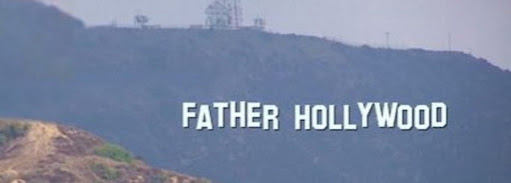
While serving in a previous ministerial call, I had to moonlight at the local Hollywood Video to pay for health insurance for the family. It took one of my coworkers a couple weeks before she stopped addressing me as "Father" and started using my first name.
It was a fun job. My co-workers were the best. I got free rentals too. You can click here to see a picture. Now you know the rest of the story...


.JPG)

.JPG)
.JPG)
.JPG)
.JPG)