Showing posts with label Music. Show all posts

Friday, May 03, 2019

Twice in a Lifetime

In between serious works, I enjoy reading rock star biographies.  Their lives are typically interesting, inspiring, tragic, shocking, triumphant, or some combination thereof.

For example, Freddie Mercury's biography was tragic and filled with paradoxes, Bruce Dickinson's career as a rock star is only one facet of an extraordinary life: pilot, fencer, polymath, and poet.  My latest rock and roll read is the autobiography of The Who's Roger Daltrey.  It is shockingly frank and at times eyebrow raising - running the gamut from madness to the mundane.

Interestingly, he calls to mind an event that I was at, in which, as Daltrey explains, a once in a lifetime event became a twice in a lifetime event: the New Orleans Jazz Fest 2015.  The emergence of the sun during "See Me, Feel Me," reprized the same remarkable thing happening in 1969 at Woodstock.

As I said, Daltrey is brutally honest in this book.  And he has always been open about his disgust about Woodstock - which is often marketed as this triumph of love, peace, and music, but was really a terrible event of bad drug trips and sub-par musical performances.

One pages 118-119, Daltrey (who avoids drugs as detrimental to his ability to perform) explains how he was served a cup of tea unknowingly laced with LSD, tells of technical glitches, recounts people being injured, and calls to mind the organizers trying to renege on their contract (money that was needed to fly back to England).  He recounts Woodstock and its New Orleans parallel occurrence:
After all the arrangements, the hallucinations, the mud, and the chaos, we were finally onstage, sometime after 5:00 a.m. 
About a month earlier, I'd woken up from a particularly vivid nightmare.  It was the kind you have when you're a kid.  I was looking out on some barren, smoke-filled landscape.  There were guard towers with searchlights scanning around and there were helicopters overhead.  It was a subconscious approximation of Vietnam.  Looking out into the pre-dawn gloom of Woodstock, making out the vague shape of half a million mud-caked people as the lights swept over them, I felt in my sleep-deprived, hallucinating state that this was my nightmare come true. 
The show didn't feel like it went well.  The monitors kept breaking.  The sound was shit.  We were all battling the elements and ourselves.  It didn't help when a political activist named Abbie Hoffman climbed onto the stage at the end of "Pinball Wizard," grabbed Pete's mic, and shouted, "I think this is a pile of shit while John Sinclair rots in prison.!"
Naturally, Pete booted him off the stage before threatening to kill the next person who tried to take his mic.  Music and peace.
 
Somehow, we kept going and every time we felt like we were losing it, we dug in a bit deeper.  Then, shortly after six, we got to "See Me, Feel Me" from Tommy and the bleeding sun came up.  Right on cue.  You couldn't have topped it.  After all the shit we'd been through, it was perfect.  It was extraordinary.  It was one of those moments you couldn't ever re-create if you tried.  Once in a lifetime. 

Except exactly the same thing happened again on April 25, 2015, a mere forty-six years later.  We were due to headline at the New Orleans Jazz Festival and it had been pissing rain all day.  A tropical storm had just been through and the whole place was drenched.  It's always chaos when it's so wet.  It plays havoc with the electrics and it's always disconcerting when you see an amp half-submerged in a foot of water.  I got to the trailer, looked out of the window, and told Mitch, my assistant, not to worry.  I'd sort it all out.  He said, doubtfully, "Okay, Roger."  Cynical young man.  And I started shouting at the sky, "Stop it!  Stop now!  We've had enough of this crap!"
And it did.  Right on cue.  Like someone had turned a tap off.  Mitch didn't say anything.  I didn't say anything but, to be honest, I was just as shocked as he was."
The sky was dark gray when we went onstage.  It stayed like that right until the end of "Pinball Wizard."  As I opened my mouth to sing "See Me, Feel Me," the sun broke through.  Absolute magic.  That's what I love about live shows.  Things can happen.  Some of those things are bad.  Some of them are good.  Occasionally, they're magic.  That was one of those twice in-a-lifetime moments.


As I said, I was at the show in New Orleans.  I stood in the rain and mud for a couple hours.  Grace and Leo wandered around the fairgrounds while I held our spot.  I was as close to the stage as possible without paying the premium to be in the roped-off section.  Grace and Leo joined me and humored my joy at seeing The Who perform.  It is no exaggeration to say that I knew every lyric from every song.

In the video above, I'm a few people to the left of the two Canadian flags that a lady was waving.  I'm wearing a white Concordia Theological Seminary sweatshirt.

And the sun breaking out at this time in the show was not lost on me, nor any of my other several thousand colleagues in attendance.  It was a great moment.

It made the impression on Roger Daltrey as well.

And this show was also a twice-in-a-lifetime event for me.  This was my second time seeing The Who.  The first time was at the Richfield Coloseum near Cleveland, December 13, 1982 - by this time, Keith Moon was deceased and Kenny Jones was the drummer.

We had what was known as "nosebleed seats."  But I was prepared.  I smuggled in my Nikon FM camera body, wrapped in a sock and bound to my ankle underneath my bell-bottom jeans.  Along with the camera body, I had a 300 mm telephoto lens, again wrapped in a sock, and placed in the small of my back under my leather jacket.  I smuggled in my equipment by opening my jacket for the cursory pat-down by security.  They did not check my back or my legs.  I ran to the men's room and assembled my camera, and we scurried to our seats.  It was, of course, a great show.  I got a few good pictures, developed them, and wrote the date on the back.

I was 18 years old.  Roger Daltrey was 38.

And so my twice-in-a-lifetime opportunity came on April 25, 2015, nearly 33 years later, as The Who (with Zak Starkey on drums, and Pino Pallodinoo on bass - as the legendary John Entwistle was also deceased by this time) appeared on stage in New Orleans. This time, I was close to the stage.  And this time, photography and video were not prohibited.

I was 51 years old.  Roger Daltrey was 71.

Here is a link to the complete 1969 performance at Woodstock.  And here is a link to the complete 2015 performance at New Orleans.

Saturday, January 12, 2019

Seeds of Change

As a 1980s rocker and metal-head, I like reading rock and roll biographies when I have a little time for pleasure reading.  I just finished an interesting autobiographical work by the main songwriter and keyboard player for KansasKerry Livgren.

I've always liked Kansas, not only for their massive commercial hits like Carry On Wayward Son (1976), and Dust in the Wind (1977), but also for other pieces like Point of Know Return (1977) and the MTV classic Play the Game Tonight (1982).

This book, Seeds of Change: the Spiritual Quest of Kerry Livgren, (Crossway, 1983, paperback, 189 pages) focuses on the spiritual journey of Livgren and his conversion to Christianity and the end of a long quest for truth.

Actually, it was a re-conversion back to Christianity, as he was baptized and raised as a Christian from childhood.  He was confirmed by Pastor Nelson of Trinity Lutheran Church in Topeka, Kansas (which is today affiliated with the ELCA, and at the time of Livgren's childhood, before the formation of the ELCA, was either an LCA or an LCA parish).  Livgren also served as an acolyte.

As a young teen in the early 1960s, he discovered music, taught himself to play guitar, and formed a band (the Gimlets) with other teens.  Livgren loved classical music and he and his friends also studied philosophy.  Their band was interested in going beyond the usual pop-fare of the era.

Their study of philosophy led Livgren away from Christianity, which he didn't seem to find intellectually stimulating - although Livgren looks back upon his confirmation studies in amazement and can't explain why he wasn't interested at the time.  But the experience of the church's liturgy made an impact on him nevertheless:
[T]here were two things about church that sometimes captivated my mind: the organ music and the stained-glass window above the altar.  The music filled me with a sense of reverence and mystery, and while listening to it I would stare at the pastoral scene portrayed in the colored light beaming through the window.  It was a picture of Christ shepherding a flock of sheep in a valley.  I did not know how to direct these fleeting feelings of mystery and awe, but the sense of longing they produced became an important theme in my later life....  I felt privileged to have an active part in the liturgy (p. 6).
Livgren recalls learning doctrine, the Apostles and Nicene Creeds, church history, and of course, the catechism.

After playing with the same friends over many years, with various additions and subtractions, there would be three incarnations of the band Kansas.  They became wildly successful, with deep spiritual lyrics and complex music which reflected Livgren's fascination with bold and dramatic classical music.  This kind of music became known as Progressive or "Prog" Rock.

Meanwhile, Livgren's Christian faith lapsed and was replaced by studies of philosophy, Eastern religions, and finally, becoming involved in an esoteric cult based on a literary work called The Urantia Book - which claims to have been written by otherworldly spirits with the real insight on Jesus.  It is a syncretistic revival of Gnosticism - which Livgren acknowledges.  At this point, he became convinced of its truth.

Until he ran into Jeff Pollard, the singer of the Louisiana band, Le Roux.  Pollard was a deeply intelligent Christian, and he and Livgren had much in common.  They became fast friends.  Pollard patiently listened to Livgren's insights from the Urantia Book, but pointed out the many internal inconsistencies, as well as pointing Livgren back to the faith that he had rejected.  At this time, Kansas was "one of the most successful and respected rock bands in the country" (p. 127).  It was 1979.

After his (re)conversion, the first person Livgren called was Pastor Nelson.  His wife took time to get used to the idea, but gradually came to the Christian faith as well.  Livgren's bandmates weren't very thrilled with the idea.  His lyrics became openly Christian, and this caused some controversy within the band.

In time, the singer would quit, and was replaced by a singer who was also a Christian.  Kansas did not want to be a Christian rick band, but rather Livgren's vision was to be a quality rock band that happened to sing lyrics grounded in the Christian worldview.

As a outlet to his impulse to sing explicitly Christian material, Livgren put out a solo album (which I remember buying on vinyl) in 1980, called Seeds of Change (which became the name of this 1983 book).

Livgren called upon several friends to play on the project, and caused a few raised eyebrows by enlisting the great Ronnie James Dio to sing on two of the tracks.  Dio was singing for Black Sabbath at the time, and during this period, there was a lot of concern over Satanism in rock music.  Dio (who died in 2010) was no Satanist, but nor was he a Christian.  In fact, his understanding of Christianity was sadly superficial and mistaken.  I found it odd that he was completely clueless that these were Christian songs, one about Christ ("To Live For the King") and one about Satan ("The Mask of the Great Deceiver").


The two tracks turned out well, and Livgren knew that he had hired the right set of pipes for the job.


The book is interesting and thoughtful.  As a mild critique, I do think there is too much by way of lyrics.  Several runs of pages are simply lyrics of sings one after another.

Having said that, there is a quote from one song from 1972 (before his conversion back to Christianity) called "Drifting Silently Through Shimmering Days.  There is a line that caught my attention:
Surround me with your boundless grace,And take me to that holy place. (p. 51).
This sounds a good bit like a line from "O Morning Star How Fair and Bright" (LSB 395) by the 16th century Lutheran hymnist Philipp Nicolai (1556-1608):
He will one day, oh, glorious graceTransport us to that happy place (stanza 6).
These two motets have the same number of syllables (8-8) and both rhyme "grace" with "place."  I suspect that the church's hynody embedded itself deeply into Livgren's mind.  And there is much in common between Prog Rock's deep lyrics and powerful musical force and the deep theological verbiage combined with the potent classical gravitas of the traditional Lutheran chorale.

I would love to find an email address for Kerry Livgren and ask him about this.

(The other criticism that I have of the book isn't really about the book, but rather the fact that it is out of print and very expensive to buy.  A used copy goes for more than fifty dollars, at least at the time that I looked into it.  So, I borrowed the book through Interlibrary Loan.  I wonder if Livgren would consider re-releasing the book, or maybe updating it for a new generation.)

I was also struck by Livgren's attention to the importance of quality in music, and in art in general:
Instead of catering to the lowest common denominator, art should have a transcendent quality.  Unfortunately, Western art in the last two centuries has, in a general sense, been undergoing a tremendous downward trend.  The humanism of the Enlightenment gradually led to the loss of a Christian base in European and American culture, and this has been reflected in art, music, and literature.  In all too many cases, craftsmanship has been replaced by chaos in the arts.  An illustration of this in my own field is the trend toward minimalism in rock music.  The idea here is, the less thought, complexity and skill that goes into the music, the better.  This kind of approach is totally alien to my nature.  (Minimalism is not the same as simplicity; it is more of an attitude that results from a largely nihilistic world view.  There can be profound beauty in simplicity) (p. 178).
Also of note, upon his return to the Christian faith, Livgren became an evangelical Christian of some stripe.  He doesn't reveal what confession that he joined.  But it certainly seems that he did not rejoin the Lutheran Church, though he was baptized and catechized into the Christian faith within our Lutheran tradition, and for Livgren, it was within the Lutheran doctrine and practice that the Seed was sown in his heart, mind, body, and soul..

There was an interesting critique of his Christian childhood that I think is very important.  I surmise that Livgren's wandering from the faith was owing to the fact that his family did not seem to make the faith central to their lives:
Because of my church upbringing, I assumed that I had already tried Christianity and found it wanting.  I had long since shoved the Christian message into the back of my mind along with a lot of other childhood memories and had no intention of retrieving it for serious reconsideration.  I didn't know it at the time, but I had been inoculated with just enough Christianity to become immune to the real thing (pp. 116-117).
I was struck by this passage, that called to mind a line from Chad Walsh's remarkable 1949 work, Early Christians of the 21st Century, in which the author, an Episcopal priest and university English professor, wrote:
If a man travels far enough away from Christianity he is always in danger of seeing it in perspective and deciding that it is true.  It is much safer, from Satan's point of view, to vaccinate a man with a mild case of Christianity, so as to protect him from the real thing (p. 11).
The business about being inoculated by a weak does of Christianity sounded like something Lewis or Chesterton might have written.  In fact, this turn of phrase is often attributed to Leslie Weatherhead, though I cannot find a source for it.

Whoever originated the phrase, I believe it is a real danger when families limit the practice of their Christian faith to Sunday mornings, with meal prayers going unsaid, where the father of the house doesn't lead his children in prayer and the reading and studying of the Scriptures in the home.  Sadly, Livgren's developing piety did not gain traction, and the reverence and awe of the liturgy, the hymnody, the doctrine, and the preaching of Christ and Him Crucified unto forgiveness, life, and salvation was choked off by the cares and riches of this world.

But fortunately, the Seed was indeed sown, and it did eventually bear fruit.

Soli Deo gloria!


Thursday, September 27, 2018

Avril vs. Pia

Sometimes the cover is better than the original.

The original by Avril Lavigne:


The cover by Pia Ashley (8,600 views in 6 days!):


I think Pia's voice is richer. Full disclosure: her husband Bryan (playing guitar) is Miz Grace's brother.


Saturday, December 30, 2017

What Does This Button Do?

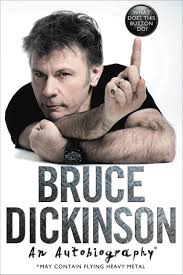
What Does This Button Do? is the newly released biography of rock singer, professional airline pilot, world-class fencer, author, poet, public speaker, television show host, and entrepreneur Bruce Dickinson.

It's a fast and fun read about an interesting polymath who is now on the verge of turning sixty years old.

The overall impression of Dickinson is that he is a man of curiosity (hence the title), almost possessed by the love of learning, the drive to succeed, to venture out into uncharted territory, and to push the limits of his abilities.

Like most rock and roll biographies, the book moves along at a fast pace, is not by any means a difficult read, but given Dickinson's quirky personality, the book is filled with humor, candor, surprises, and possibly a few words that might send you to the dictionary.

On the downside, the book at times could use stronger editing.  Given that the author is a do-it-yourself headstrong Alpha male, this probably explains the undeveloped and at times disconnected narrative - especially in the first couple chapters of the book.  Being Bruce Dickinson's editor is probably a matter of negotiation.  But as things get rolling, the prose becomes smoother and more fluent.

He also has an undeveloped fascination with the occult, including a long-term project to make a movie about the life of Satanist Alestair Crowley.  It is not clear in the text if his movie was ever made, or why this was one of Dickinson's passionate projects.

Another strange thing is that missing from this autobiography are any mentions of his own family life: nothing about marriage and children and life as a husband and father.  He does include an explanation for this at the end, but reading the narrative gives one the (false) impression that Dickinson was and is a confirmed bachelor with no interest in family life - much like the feeling that one gets watching a Charlie Brown cartoon in which there are no parents or adults inhabiting the planet. Such an omission makes Dickinson sound perhaps more self-centered than he probably is in real life.

This omission leaves a great void, an elephant in the parlor, as far as a life story goes.

But as a professional chronicle and journal of personal growth, this is a fun read.  The last chapter addresses his recent throat and tongue cancer.  Not only did he survive - but he managed to reignite his singing career, even claiming that his voice has actually improved since his aggressive treatment regimen.  His account of this period in his life is frank and yet humorous.  There is a seriousness conveyed, and yet he avoids being maudlin or melodramatic.

For me, the most interesting thing about Dickinson is his determination to do pursue his unusual passions at all costs - even seeking out fencing coaches and flight instructors during his "day job" of world tours performing theatrical heavy metal shows: both with Iron Maiden and for his solo projects.

Over the course of his years as an aviator, he has not only racked up stacks of pilot's licenses, he has had an entire career as a commercial airline captain - professionally flying 747s full of passengers.  He also collects and flies antique planes, even performing flying WW1 aircraft in airshows.  He is not a celebrity who was allowed to slip by.  He is a hard-working serious pilot with his nose to the grindstone, who has paid his dues and has managed to weave together multiple careers in one life.

A couple of interesting passages from the book:

At Munich I waited in uniform, by the bus stop for the crew bus to take me to the hotel. Out of the corner of my eye I spotted an Iron Maiden fan, and he spotted me.  Bedecked from head to foot in badges, cut-off biker denim and Maiden shirt, he made a bee-line for me.  
He stared at me and said, "excuse me... but is this the bus stop for Munich?" 
"Er, no.  Next one up."
He turned and walked away.  He never knew - nobody knew, except me - that I was an airline pilot.  Unbelievable.  (Page 287)

And:

I flew 300 hours in the 737 during the summer and autumn of 2002.  By now, Astraeus [Airlines] had added a pair of new-generation 737 aircraft to the fleet, and in the space of a year we had four aircraft.
Some of those aircraft were old, and equipment failures often meant that pilots had to actually hand-fly them.  One day I turned up for work, where Gatwick to Athens and back was the mission, except the plane was broken and all its autopilots were not working.  I expected to be back in my bed at home watching late-night TV around 1 a.m.  In fact, that was the time I eventually took off.  We hand-flew the aircraft to Athens and back overnight, finally landing at 9 a.m.  I was so tired I could hardly see the white lines on the road driving home.  I pulled over and slept for three hours.  Character-building stuff.
By contrast, going on tour with Iron Maiden was like going on holiday.


The book is filled with such reminiscences and anecdotes.

It is hardcover, 371 pages, and includes a color plate of photographs in the middle.  If you like heavy metal music, aviation, or inspiring biography of people who live their lives off the beaten track, you just might enjoy this book!

Bonus - here is a video of the first episode of Bruce Dickinson's TV series on aviation: Flying Heavy Metal

Fasten your seatbelts and enjoy your flight!

Friday, September 15, 2017

The Key to the Hypocrisy of Socialism


I was recently listening to Sirius XM 's The Beatles Channel.  The song that was playing at that time was not one of the Fab Four's, but rather one that reflected one of their musical influences: Woody Guthrie's 1940 tune: "This Land is Your Land."

Like most people my age, I remember being taught this song in school as a young child.  It is a modern-day folk song that cheerfully celebrates the vastness and diversity of the American landscape.  It opens:

This land is your land, this land is my land
From California to the New York island
From the Redwood forest to the Gulf Stream waters
This land was made for you and me

It's a rather innocuous patriotic ditty.  Only it isn't.

In this version of Woody Guthrie's anthem, I heard a verse that I had not heard before:

As I went walking, I saw a sign there
On the sign it said 'No Trespassing'
But on the other side it didn't say nothing
That side was made for you and me!

This is obviously a swipe at the concept of private property. Its use as a patriotic children's song is a bit of Trojan-horse irony.

And this anti-property sentiment makes sense, given that Woodie Guthrie was a himself Communist (and a Stalinist at that).  Most versions of "This Land" are bowdlerized by removing this Marxist verse, along with another controversial stanza bemoaning hungry Americans relying on the government "relief office" for sustenance - ostensibly because the capitalist system rooted in private property is the cause of poverty.

At the end of the song's performance on The Beatles Channel, the announcer, Peter Asher, addressed the usually missing verse, and praised it for its positive expression of Socialism. He used the adjective "powerful."


Peter Asher was a bit before my time.  He was part of the early sixties folk duo Peter and Gordon. After his band's split in 1968, Asher went into the business side of music, worked with the Beatles, and eventually had a stellar career as an executive.  In 1995, he was appointed senior vice president of Sony Music Entertainment - a multi-billion dollar subsidiary of the Sony Corporation (whose revenue in 2016 amounted to $67.9 billion).  Asher was made president of Sony Music Entertainment group in 2005, and resigned in 2006 when he co-founded his own company, Stretegic Artist Management.  Asher's whole executive career is founded on contracts and the enforcement of copyright law.  Music is a commodity for which one pays money.

It's curious that an entrepreneur, executive, and former president of one of the richest and most powerful corporations would praise Socialism and trespassing.

The song itself has an interesting history.  Guthrie often performed it without the two controversial stanzas.  It has been covered many times over the decades by numerous other folk artists and rock musicians - both with and without the Marxist sentiments.  Guthrie's son, Arlo Guthrie, was roundly criticized by the Socialist Workers' Party not only for performing the "clean" version of his father's song, but also for registering as a Republican and supporting libertarian private property advocate Ron Paul for president in 2008, as well as for sympathizing with the anti-Marxist Tea Party movement.

"This Land" was performed at the Obama Inaugural celebration in 2009 at the Lincoln Memorial by Bruce Springsteen, Pete Seeger (who was a friend of Guthrie and also himself a Communist, publicly embracing the term as late as 1995), and others.  This performance chillingly included the anti-private property stanza (see between minute 3:00 and 3:30):


There are other pop songs that likewise denounce private property and embrace Marxist economics and politics.  John Lennon's "Imagine" (1971) comes to mind:

Imagine no possessions
I wonder if you can
No need for greed or hunger
A brotherhood of man
Imagine all the people
Sharing all the world

But again, there is a note of dissonance in this otherwise euphonic composition, insofar as John Lennon was one of the richest musicians in the world.  One of his "possessions" that he wanted the world to "imagine" not existing was his own Rolls Royce.  Lennon's net worth at the time of his tragic death at the age of 40 was $800,000,000.  

Another pop song in this vein is the 1970 hit "Signs" by the Canadian Five Man Electrical Band.  It was written by Ottawa, Ontario rocker Les Emmerson, and was covered by the American heavy-metal band Tesla in an acoustic "unplugged" version in 1990 (and I like Tesla, so I'm embedding the video)...


The song includes the stanza:

And the sign says, "Anybody caught trespassing will be shot on sight"
So I jumped the fence and I yelled at the house,
"Hey! What gives you the right... 
To put up a fence to keep me out,
"Or to keep Mother Nature in?
"If God was here, He'd tell it to your face. 'Man, you're some kind of sinner.'"

Again, the song suggests that private property is immoral, that fences are to be jumped and disregarded, that it is wrong to keep people out of one's property, even in the proximity of one's house (which also got "yelled at" in the song's narrative.

Now, I don't know anything about Emmerson, his bandmates in Electrical Band, or the guys in Tesla.  But I suspect they live in houses, may even live in "gated communities" complete with fences - and maybe even signs!

But there is one little thing that almost every person has in his pocket that blows away all Socialist pretensions about private property: a tiny common object rooted in a primitive technology that exposes the hypocrisy of all such popular song lyrics and Socialist pontifications of corporate executives: the key.

John Lennon's Rolls Royce, Peter Asher's automobile(s) (probably not a 15-year old Chevy with a broken air conditioner and bald tires, if you catch my drift), and even the homes of people like Les Emmerson and the guys in the Five Man Electrical Band and Tesla - all make use of the simple key.  Woody Guthrie and Pete Seeger probably had sets of keys in their pockets as well.  Bruce Springsteen probably still does.  Moreover, something tells me that if he came home and found me in his house, he would probably not join me in a chorus of : "As I went walking I saw a sign there/ And on the sign it said "No Trespassing."/But on the other side it didn't say nothing,/That side was made for you and me."  In fact, I would suspect that he'd call the police.  But that would never happen, because he probably has quite the security system to exclude other people from his house and property.  

Keys today may be sophisticated or simple.  They may operate by means of microwaves or primitive notches designed to turn manual tumblers.  But the purpose of the key that nearly every Socialist has in his pocket is not to open the door of the house or to start the engine of the car.  A knob or a button can do that.  The key's actual purpose is to keep other people out.  The ubiquitous key is a tool of exclusion, a means to enforce the rule of "no trespassing" and is the very antithesis of inclusivity, equality, and Marxism.  The key is a symbol of capitalism, trade, and individual liberty.  The key is a confession of the sanctity of private property, in thought, word, and deed.

Keys speak louder than lyrics.

Saturday, April 04, 2015

Awaiting the Joy of Man's Desiring


The Holy Easter Vigil is occurring now in the Eastern Hemisphere, as the good news that the tomb was unable to contain our Lord Jesus Christ is yet again repeated, as the Good News resounds around the globe yet again.

The risen Christ is indeed the Joy of man's desiring, as confessed and sung for centuries in the magnificent strains of Johann Sebastian Bach's Cantata Herz und Mund und Tat und Leben.

The Christian faith is nothing other than sanctified defiance: a defiant refusal to bow down to the gods of this world, be they Caesars or secularism; a defiant refusal to accept the finality of death; a defiant refusal to capitulate to hatred and evil; a defiant confession of the need for forgiveness; a defiant acceptance of the reality that we are rescued by grace alone; a defiant reliance upon Christ's Word and sacraments for life's ultimate meaning and joy; a defiant faith in the sure and certain hope of everlasting life - just as sure as He walked out of His own tomb.

So, we in the Western Hemisphere wait, but we know it is coming, and we cannot contain our expectant joy, even as we await His final return in glory.

Our Lord said (John 16:22): "So also you have sorrow now, but I will see you again, and your hearts will rejoice, and no one will take your joy from you."

Our Christian brother J.S. Bach understood this joyful reality in his transcendent and ebullient confession that we continue to sing with him, with angels, archangels, and all the company of heaven, here in time, and even unto eternity!  Amen.


Jesu, joy of man's desiring,
Holy wisdom, love most bright;
Drawn by Thee, our souls aspiring
Soar to uncreated light.

Word of God, our flesh that fashioned,
With the fire of life impassioned,
Striving still to truth unknown,
Soaring, dying round Thy throne.

Through the way where hope is guiding,
Hark, what peaceful music rings;
Where the flock, in Thee confiding,
Drink of joy from deathless springs.

Theirs is beauty's fairest pleasure;
Theirs is wisdom's holiest treasure.
Thou dost ever lead Thine own
In the love of joys unknown.

Tuesday, July 30, 2013

Tuesday, February 05, 2013

Bye Bye Babylon


The perfect rock anthem for 8-year old Legomaniacs (and Russian priests...).

Monday, December 31, 2012

Monday, December 24, 2012

Of the Father's Love Begotten!


In response to my earlier post about Christmas and the Kantorei, I got the glorious news from my colleague in the Holy Ministry and fellow Kantorei alumnus the Rev. Aaron Kangas that he has just made "Of the Father's Love Begotten" available on his YouTube channel!

Deo gratias!

In 1998, after I met with CTS Fort Wayne recruiter the Rev. Scott Klemsz (who after patiently listening to me complain about the sorry state of the churches in our area and how hard it was to find a liturgical LCMS congregation, dropped the line, "We don't have praise bands at CTS - Fort Wayne," looking like the cat who ate the canary), I went home and played the Kantorei CD he gave me (With Angels and Archangels). 

This ("Of the Father's Love Begotten") was the first cut on the CD, and that pretty much closed the deal for me. In just a couple years, I was a seminarian at CTS - Fort Wayne, and a year later, I found myself part of the Kantorei itself - and it was one of the most rewarding experiences of my life.

Thank you, Father Aaron, for sharing our treasure with the world through YouTube!

Merry Christmas, y'all, "evermore and evermore."  Amen.

Merry Christmas with the Kantorei!

Not all of these pieces are Christmas hymns, but most of them are. I had the privilege to sing with the Kantorei for two years while at seminary. And it was every bit as sublime and glorious as I imagined it would be! I wish there were a YouTube of my favorite piece that we sang: Of The Father's Love Begotten. Maybe there will be in the future! Merry Christ's Mass to one and all!

Tuesday, December 18, 2012

A Fireman's Ringtone Experience?


For the fireman whose phone rang during the David Crockett Steam Fire Company No. 1 ("the oldest continually active volunteer fire company in the United States") monthly meeting, and it was this ringtone: you are the best, my friend and brother!

 It is an honor to serve you and the men who serve their community by laying their lives on the line "all along the watchtower."

Friday, December 07, 2012

Some "Queen" for the Day


Dr. Pepper not included...

Thursday, December 06, 2012

Birthday of Randy Rhodes, Lutheran Guitarist


HT: Rev. Tony Bolen, my seminary classmate, brother in the ministry, rock guitarist, and defender of liberty, for pointing out that today, December 6, is the birthday of the late Randy Rhodes, LCMS Lutheran and guitarist for Ozzy Osbourne, who died tragically at the age of 25 on March 19, 1982 in a plane crash.

Note how this little video begins...

Requiescat in Pace Christi!

Karen De Coster on Christmas Music and the American Airwaves


Please enjoy the above traditional carol "The Angel Gabriel" as recorded by the Concordia Theological Seminary (Fort Wayne) Kantorei.

And here is what the mighty Karen De Coster has to say about the state of Christmas music in America.

'via Blog this'

Sunday, December 02, 2012

Veni! Veni!

A traditional vocal rendition with only six (!) male voices (how do they do it?):


A more modern arrangement for one female voice - with the lyrics:

Monday, November 12, 2012

What Happens When LCMS Churchmen Rap


I'm not sure, but Father Eckardt's hip may have been inspired by Bishop Behnke's hop:
This is what happens when Oktoberfest abandons the oom-pah. You should see what happens in our churches when they ditch the organs! Lor or ord have mer er cy! (Wait a minute, that's in the hymnal, yo!).

Saturday, November 10, 2012

Epic Live Phil Collins


Even if you're not a Phil Collins fan, this is an awesome performance. Watch how "casually" he strolls to the drum kit and hits the beats precisely. What a pro! HT: Mrs. Hollywood

Thursday, November 08, 2012

Today's Walgreen's Musical Selection


From today's trip to Walgreen's: Living Colour's "Cult of Personality" (1988).

Saturday, October 20, 2012

"Truth in the Coin Shop" by Jeffrey Tucker

Here is an insightful little essay by Jeffrey Tucker, written just a couple months before the Big Crash in 2008, when this essay would have been denounced and scoffed at by Respectable Economists and Politicians Who Know Best - even though Tucker's logic is unassailable.  But when it comes to The State, logic doesn't matter.  Statism is a kind of competing religion, which makes the "IN GOD WE TRUST" motto on American tokens and paper currency very clever.  Faith in The State has been shaken since the Big Crash, but its priests in Washington continue to exhort the faithful to bow down and pray the Keynesian rosary.

You can download two collections of Tucker's lively and thoughtful columns free of charge from the Mises Institute: the delightfully titled Bourbon for Breakfast: Living Outside the Statist Quo (in which Truth in the Coin Shop is found), and It's a Jetsons World: Private Miracles and Public Crimes.  His latest work, A Beautiful Anarchy: How to Create Your Own Civilation in the Digital Age is not available for free, but can be had here at a very reasonable price, both in digital and in paperback formats.  I have not read it yet, but look forward to doing so.  He also speaks on this short video analyzing Ayn Rand's 1937 novella Anthem.

Not only is Mr. Tucker a great writer and free-market economist of the Austrian School, he is also a Christian of the Roman Catholic tradition and a defender of traditional music and liturgy.  He is the editor of The Chant Cafe.

So enjoy this taste of "Truth in the Coin Shop" and feel free (indeed, feel free, dear reader!  Don't you love the sound of that?) to follow the link to read all of it:

You are uptown in a shopping district of a small community, and you pass by the meat shop, the wine shop, the coffee shop, two churches side by side, a coin shop, an antique store … and hold it right there.

A coin shop? This is irresistible, because, as implausible as this may sound, all political truth can be found in a coin shop. And not just political truth: you find in here the story of the whole of modern life on exhibit, and learn more from looking than you find in a multivolume history.
There they are on display: coins from all lands. Why are they worth more than the coins in your pocket? Because they are old? That's part of it but not the essence of it. There are some new coins here that are also just as valuable as the old ones.
What is critical is that they are made of gold and silver. You can pick them up and tell the difference. They are heavy. Stack them and let them fall on each other, and they make a different sound from the coins that usually rattle around in your pocket.
It strikes everyone and anyone immediately. Somehow these coins are "real"; the coins we use today are not. But what does this really mean? And what does it imply?  Continue here.