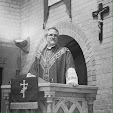
Sunday, August 22, 2021

Sermon: Trinity 12 - 2021


22 August 2021

Text: Mark 7:31-37 (Isa 29:17-24, 2 Cor 3:4-11)

In the name of + Jesus.  Amen.

Our Lord was wandering through Gentile territory, a place known as the Decapolis, the Ten Cities.  These little city-states were under Roman control, populated by various pagan peoples.  They didn’t worship the true God.  They didn’t have the Scriptures.  But on this day, they had Jesus.

One thing this region had, as did everyone else, was sickness, not to mention brokenness, sin, death, dysfunction, violence, oppression, and hopelessness.  Indeed, such things are part of the whole world.  We are all plagued by such things.

Of course, our Lord came to His own people, the children of Israel, being the Messiah prophesied for thousands of years.  Jesus is, in the words of Isaiah, spoken seven centuries earlier, “the Holy One of Israel.”  The prophet declares the Word of the Lord that “the deaf shall hear the words of a book… the eyes of the blind shall see.  The meek shall obtain fresh joy in the Lord, and the poor among mankind shall exult in the Holy One of Israel.”

Israel will expand to cover the whole earth, not as a conquering superpower, but because Israel is being expanded to include the Gentile peoples of the entire world.  The chosen people are not a single ethnicity, because all have been blessed and redeemed and healed and forgiven and made new by the Holy One of Jacob.  God’s promise, spoken through Isaiah, is that “they will sanctify My name, they will sanctify the Holy One of Jacob and will stand in awe of the God of Israel.”

And so Jesus opens that which was previously closed.  He opens the kingdom to sinners, to Gentiles, to those of low estate, to those who suffer debilitating disease.  He has come to fix the broken world and to put it all aright.  And in His earthly ministry, we see little previews of what is to come for the entire world.

And on this day in the Decapolis, “they brought to Him a man who was deaf and had a speech impediment, and they begged Him to lay His hand on him.”  They may or may not have known anything about the prophet Isaiah.  But there is no reason to think that they did.  They weren’t looking for a Messiah, but they found one anyway.  More accurately, the Messiah found them.  They weren’t looking for forgiveness, life, and salvation, but that’s just what came to them that day.  They just wanted their friend to be healed.

Clearly, they heard that Jesus could do it, and they had faith – at least faith enough to give it a shot.  And they begged Jesus.  Another word for “to beg” is “to pray.”  When we pray, we are not technically just “talking to God.”  We come to God not as a conversation partner, but as a beggar.  In fact, this was one of the last written words of Dr. Luther before he died.  He said, “We are all beggars.”

We bring nothing to God other than our prayers, our needs, our crosses, and our pleas for mercy.  Just like this Gentile man from the Decapolis who could not hear.

And, dear friends, not hearing is more than an annoyance.  It is more than a debilitating condition of life.  St. Paul teaches us that faith comes by hearing.  We need to hear to be able to hear the preaching of the Word, to be able to hear the forgiveness of sins.  To be deaf is to be isolated and left without comfort.  And this man also suffered from not being able to speak clearly.  It made it hard to even communicate what he wanted and needed.

Deafness can also be spiritual, by refusing to hear, by avoiding the Word of God, by staying away from where it is proclaimed.  And when we never hear God’s Word, how can we speak it?

But this man’s friends pray to Jesus on his behalf – just like we do when we pray for those in need.  This list of names that I read every Sunday during the prayers is just that.  Each of those people on that list has some serious need.  And we are interceding for them to Jesus.  We believe that He is merciful and He hears our prayers, dear brothers and sisters.  He has come into our world to fix it, and to restore us to what God created us to be. 

And we get a little glimpse of it here in this Gospel reading, calling to mind that glorious day in the pagan land of the Decapolis. 

Jesus uses His own saliva and His own hands – even as He will use His own body and His own blood to save us at the cross.  And our Lord looks up to heaven, and “He sighed and said to him, ‘Ephphatha,’ that is, ‘Be opened.’”

Isn’t it interesting that He looked to heaven before saying “Be opened.”  Jesus not only opens the man’s ears, but opens the heavens to people to whom it was formerly closed.  “Be opened,” says Jesus.  He “opens the kingdom of heaven to all believers,” as goes the ancient hymn known as the Te Deum.  And this man was a believer, dear friends.  He witnessed the miracle with his own eyes, heard it with his own formerly closed ears, and he became able to tell what had happened to him, and for him – all because of Jesus.

For “his ears were opened, his tongue was released, and he spoke plainly.”  And even when our Lord tried to keep a lid on things for the time being, the people could not help but tell the good news, “zealously they proclaimed it.” 

Jesus also opens our ears, dear friends, filling them with the Good News of forgiveness, life, and salvation, and the promise of the resurrection, of a new world freed from sin, death, and evil.  He opens our hearts to hear that we have been grafted into Israel.  The former division of people into ethnic groups that are chosen and unchosen has gone away.  For the Church is Israel.  The Church is the chosen people.  There is no racial favoritism in the kingdom of the Holy One of Israel.

Jesus has opened the kingdom to all believers!  And he releases our tongues to speak, to confess, to rejoice, and to proclaim.  He charges the church to zealously proclaim it.  For the time has come for the whole world to hear the Good News. 

“Such is the confidence that we have through Christ toward God,” as St. Paul proclaims.  “Our sufficiency is from God.”  For as the people who witnessed this miracle zealously proclaimed, “He has done all things well.  He even makes the deaf hear and the mute speak.” 

And this is only the beginning, dear friends.  He has come to open up a new world.  He has come to open the hearts of all believers, and to open the graves of the fallen.  He opens our ears and our mouths, and he has opened heaven to all of us.  And so we zealously proclaim: “To Him be the glory, now and forever.”

Amen.

In the name of the Father and of the + Son and of the Holy Spirit.  Amen.

Sunday, August 15, 2021

Sermon: The Feast of the Blessed Virgin Mary - 2021


15 August 2021

Text: Luke 1:39-55

 In the name of + Jesus.  Amen.

The world doesn’t know Jesus.  A couple days ago, I saw an internet meme that was intended to be serious that said, “If Jesus were alive today, He would not be a…” followed by the name of a political party, as well as things that our Lord apparently wouldn’t do (things the author doesn’t like, of course), that is, if He were alive today.  The worst part is that people who claim to be Christians shared this.  “If Jesus were alive today.”  It beggars belief. 

While loathing Christians with a seething hatred, the secular world wants to claim Jesus as their own.  They miss the point entirely.  They obsess over His skin color (which is irrelevant).  Their self-made narrative of Him is an illusion of Him as being perpetually “nice” (Are you kidding me?  Clearly, they have never read the Gospels).  With straight faces, they claim that Jesus would be tolerant of every manner of sin and vice, and that He is apparently everything that they are, and that they approve of.  Thus they create God in their own image.  Well, if He were still alive, anyway.

The Scriptures are emphatic that Jesus is completely God and completely man.  And nearly every heresy and false doctrine denies one or the other of these realities of who Jesus is.  Some deny His divinity, reducing Him to a happy Mister Rogers Yogi of Niceness, or to a first Century Che Guevara-style revolutionary Communist long before Karl Marx and Fidel Castro were ever born.  Some deny His humanity, usually reducing Him to a kind of literary figure, or a legendary or mythological teacher whose followers turned Him into a religious figure centuries later.

No matter what crazy theories the world puts forth, dear friends, the real Jesus is to be found in the Scriptures, on our altars, and from the womb of the Blessed Virgin Mary.  And that’s why this feast of the church celebrated today is so important, dear friends. 

Jesus is the Son of Mary.  He is human, and completely so.  He came into our world as a fertilized egg inside His mother.  But His mother was a virgin.  He has no earthly biological father.  God is His Father.  Jesus is a Man.  Jesus is God.  In His humanity, he can die on our behalf, shedding His perfect blood as a sacrificial atonement for the sins of the world.  In His divinity, He is that Lamb without blemish, the one who neither inherited nor committed sin.  He created us, and He redeems us.  He is God in the flesh.  And He comes to our fallen world to rescue us.

He died on the cross, rose again from the dead, and then empowered the apostles with the Holy Spirit, ordaining them into the Holy Ministry, authorizing them to absolve sins, to make disciples by baptizing and teaching, and to consecrate bread and wine, by His Word and by His command, giving this miraculous Eucharist to Christians of every time and place.  For Jesus has promised to be with us to the very end of the age.

But before there was the church and the ministry, there was the resurrection of Jesus.  And before there was the resurrection, there was His death on the cross.  And before His death, He lived thirty-some years as a boy and as a man.  And in order for Him to take flesh as a preborn baby, He had to have a mother.

It is the unwritten tradition of the church that St. Mary - the Blessed Virgin, in the words of the hymns, our “most highly favored lady,” who is “higher than the cherubim, more glorious than the seraphim,” in the words of the early church fathers and of our Lutheran confessions, the “mother of God,” and in the words of Holy Scripture, the one who is “blessed among women” - died on August 15 in Ephesus, at the home of the apostle John. 

But different churches honor Blessed Mary differently, even celebrating this holy day with different emphases.  Unfortunately, ignoring her own instructions to listen to her Son, some Christians have turned her into an idol, a kind-of goddess or genie that hears and answers prayers by means of her mighty superhuman power.  Other Christians, reacting to this Pagan emphasis on Mary, reduce her to being no different than any other Christian.

But what does Scripture teach us, dear friends?  Holy Scripture teaches us that Jesus is God, and Mary is His mother.  She is truly the mother of God, unless you want to be like the world and reduce Jesus to a mythical teacher who isn’t really God at all.  The Blessed Virgin Mary is a saint of the church to be emulated and loved, for when the “Angel Gabriel from heaven came,” he announced to Mary that she was selected to be the mother of the incarnate God.  “Then gentle Mary meekly bowed her head, ‘To me be as it pleaseth God,’ she said.”

For St. Mary is not a genie in a lamp granting us wishes.  The Blessed Virgin is not a goddess to be worshiped and prayed to seeking salvation “in the hour of our death.”  Our “most highly favored lady” is even greater than this: she is the mother of our Lord.  She is a mother, dear friends.  That is a sacred vocation by which God creates life.  And it is a vocation hated by the devil.  In nearly every language, the foulest curses involve the use of the word “mother.”  The most vile of insults given to men involve their mothers.  And the most deadly holocaust in history is the ongoing slaughter of the innocents in their mother’s wombs by mothers, who falling for the devil’s lies, unlike the mother of God, bring forth new life, but refuse to meekly bow their heads in awe of this miracle, who refuse to accept the holy vocation of mother that “pleaseth God,” and instead sacrifice the life for which our Lord died.  And in a parody of Holy Communion, some women actually celebrate abortion as a virtue, saying, “This is my body.”

Dear friends, the devil loathes motherhood, for through this particular mother, God took on flesh.  And this man who is God resisted Satan’s temptations.  And this God in human form died as an innocent sacrificial Lamb, shedding His blood to save mankind from Satan, death, and hell.  For it was on the cross that this Descendant of Eve (whom the devil had tricked), that this Jesus tricked the serpent and crushed his head.  And this God in human flesh, this Christ child, came into the world in Mary’s womb. By tempting Eve, the mother of all men, Satan brought death into the world.  But by means of the mother of our Lord, Satan was defeated at the cross by the Son of Mary, the daughter of Eve.  If you were Satan, could you think of many things more repugnant than motherhood, or this particular mother, dear brothers and sisters?

So we love Mary, but we do not worship her.  We look to her as a saintly example of faith and submission to our Lord, but we do not pray to her.  But nor do we reduce her to just another person.  She isn’t.  She is unique in all of history.  She is our Lord’s mother, and every good man loves His mother.  And so should we, dear friends.

And Mary’s song is our song, the Magnificat: “My soul magnifies the Lord, and my spirit rejoices in God my Savior.”  For Mary’s Son is also God, Mary’s Savior.  He died on the cross to forgive her sins.  And because of this cleansing of Mary by the blood of her divine Son, it is right and fitting that we call her “holy” – even as all Christians are made holy by the blood of the Lamb, by the waters of baptism, and by hearing the words of Jesus that give us life.

And through Mary’s humility, mankind is raised up.  Through her meekness comes the “strength of [God’s] arm.”  Through her humble submission, the proud are “scattered.”  Through her comes the Lord’s “mercy,” fulfilling that which God “spoke to our fathers, to Abraham, and to His offspring forever.”

And because of the humble obedience of the Blessed Virgin Mary, we can sing, “Joy to the world, the Lord is come.”  Indeed on this feast of Mary, let us rejoice in Mary’s Son.  The world doesn’t know Jesus, but Mary does, and we do also, dear friends!  “Joy to the earth, the Savior reigns,” now and even unto eternity.  Amen.

In the name of the Father and of the + Son and of the Holy Spirit.  Amen.


Sunday, August 08, 2021

Sermon: Trinity 10 and the 40th Wedding Anniversary of the Iversons - 2021


8 August 2021

Text: Luke 19:41-48 (Jer 8:4-12, Rom 9:30-10:4)

In the name of + Jesus.  Amen.

Jesus wept over Jerusalem, and He prophesied what would happen: the city would be conquered, and the temple flattened.  This happened forty years after Jesus said that it would.  It was a terrible time of bloodshed and destruction.  Our Lord said that it happened because they “did not know the time of [their] visitation,” that is, they did not realize that God has visited them.  Instead of focusing on God in the Temple, they turned it into a “den of robbers.”

And so what happens next is commonly called our Lord’s “cleansing of the temple.”  Jesus drove out the merchants and moneychangers.  He said, “My house shall be a house of prayer, but you have turned it into a den of robbers.”  Their minds were set on the wrong things.  Our Lord reminded them of what was important.

And this defiling of God’s house continues to happen, dear friends.  There are “Lutherans” in the world because the Church was running a money-racket in the sixteenth century by selling “indulgences.”  This was a scandal.  It came about because the Vatican was overextended to the bankers in borrowing vast sums of money to build St. Peter’s Cathedral in Rome.  So the pope needed money, and fast.  He turned churches into dens of robbers, convincing people to pay money for the forgiveness of sins – when all the while, God’s grace is free, having been purchased by Christ’s blood.  The moneymaking scheme of indulgences was a scam. And it confused people about how salvation happens, as though it is by works, or that it can be bought with money – instead of being pursued by faith.

There are still such money scams: TV preachers and celebrity wannabe “pastors” who bilk gullible people out of millions of dollars with false doctrine and carnival-like shows featuring fake healings.  Some indeed continue to turn His house into a den of robbers, as well as a den of crooks and swindlers.

But we turn God’s house into other things as well.  As Christianity becomes less popular, especially among young people, some pastors and congregations resort to entertainment.  They turn divine worship into a show: rock music and dancing girls, flashing screens and preachers walking around cracking jokes.  They use gimmicks and turn the Divine Service into a parody of worship.  They turn His house into a house of entertainment.

Others want to soften the hard edges of Christianity and reduce it to being nice, getting along, and conforming to the world’s ways and ideas.  They push the world’s politically-correct ideas of society, selling it as Christianity.  They turn His house into a house of conformity.

Still others focus only on cultural issues and politics, ignoring the central theme of the Lord’s cross, that is, the Good News of the forgiveness of sin and the promise of everlasting life.  They trade this away for rules and regulations and looking holier than thou.  They turn His house into a house of legalism.

And all of these examples are based on what St. Paul criticized the Israelites for, as they “pursued a law that would lead to righteousness” and “they did not succeed.”  Why?  “Because they did not pursue it by faith, but as if it were based on works.”

Our Lord’s house is a house of prayer, for we pray for this saving faith, and here in the church, in our prayers, we remind God of His promises.  And these promises, dear friends, are made and delivered in His house – especially when we keep it as a house of prayer and not defile it for some worldly purpose. 

What happens in the sanctuary of the church?  We are baptized here, as Jesus comes to us in this house of cleansing and salvation.  We are confirmed here, as Jesus comes to us in this house of learning His Word.  We are married here, as Jesus comes to us in this house of His will, “what He has put together let no one put asunder.”  We hear the proclamation of the Gospel here, as Jesus comes to us in this house of Good News.  We receive Holy Communion here, as Jesus comes to us in this house of His sacrificial body and blood.  We are consecrated and installed to various offices here, as Jesus comes to us in this house of service and worship.  And when we die, our bodies are brought here, as Jesus joins us in this house of the resurrection!

Of course, this is what it means to be a “house of prayer.”  It is God’s house, a place for Jesus to come to us again and again.

Forty years ago today, our deacon Richard and his wife Lisa, came to this house of prayer to have their marriage blessed and consecrated by Pastor Friedrich, to stand before this holy altar, to make their vows to each other, before God and before the congregation.  Holy Matrimony is a sacred rite, and it is fitting that it happens in the sacred space of this holy house.  For the pastor and the people offered prayers for them in this very house of prayer.

And Deacon Richard pointed out that he was baptized here, confirmed here, married here, and was consecrated as a deacon here.  This is a house of prayer, dear friends.  This is God’s house! 

And it is fitting that we “know the time of [our] visitation.”  Jesus comes to us in Word and Sacrament.  It is not symbolic.  It is not merely spiritual.  Jesus says, “This is My body” and “This is My blood.”  And He also says, “For you, for the forgiveness of sins.”  For this is the house of the Gospel.

But St. Paul warns us, dear friends, not to base our faith on our works, on pursuing a law.  For if you think that you have earned your salvation or God’s favor because of your works: whether because you are a pastor or a pastor’s wife, a deacon, or a deacon’s wife, because you serve on a board or committee or do work in the church, or because you attend every Sunday or give money to the church – you have missed the point.  You are saved by grace, through faith.  Your good works come after the fact, and flow from love.  You cannot earn God’s favor, because it is His favor.  And this is why Jesus is such a scandal.  You cannot earn your salvation, and if you try to, Jesus will drive you out.  Instead, we come here empty handed and we pray for His grace by faith, “and whoever believes in Him will not be put to shame.”

For this is a house of prayer.  And it is our prayer that we be forgiven, that we be given the grace to repent, that we come here week after week not because we are righteous, but because we are not.  We need forgiveness, and we need it every week.  We need God’s love as if our lives depend on it – because they do, dear friends.  It is a matter of life and death, of eternity, that we come to this house of prayer for the strengthening of our faith through miraculous contact with our Lord Jesus Christ.

Let us not fall into the trap of the children of Israel who said, “Peace, peace, when there is no peace.”  Let us confess that our peace is in Christ alone, and that peace comes through faith alone, and that faith comes by hearing the Word alone proclaimed and preached, by means of preaching, Holy Baptism, and Holy Communion.  Let us pray for the grace to make the church central in our lives, hanging on His every word week in and week out, being strengthened for life in the increasingly hostile world.

This house of prayer is a place of rest and refreshment, where we are fed and nourished and strengthened and renewed.  Let us see how important it is to gather in this house of prayer, to make it a priority, and to submit all things to our Lord and to His gracious visitation here, where He has promised to be with us, even to the end of the age.

And let us rejoice with Deacon Richard and Lisa in this house of prayer, praying for them, for many more years of happy and holy matrimony, and let us pray for all married couples to remain faithful unto death – even as our Lord is faithful unto death and unto the resurrection.

Amen.

In the name of the Father and of the + Son and of the Holy Spirit.  Amen.

Sunday, August 01, 2021

Sermon: Trinity 9 - 2021


1 August 2021

Text: Luke 16:1-13

In the name of + Jesus.  Amen.

An attorney friend of mine liked to say, “This is chess, not checkers.”  If we were to retell the Parable of the Dishonest Manager in modern terms, this expression about chess and checkers might well be something that he would say.

The dishonest manager is a fictional character created by Jesus for the purpose of gently goading Christians, the “sons of light,” into being wise stewards of the kingdom of God.

For God’s kingdom works differently than the world.  The kingdom of heaven operates by different rules than the world works, and yet, Jesus manages to explain how the kingdom works by means of his own stories, like this one today.

And the “hero” (if you can call him that) of this tale is a bad employee, a dishonest manager who is being fired.  The manager is “wasting” the “possessions” of the business owner.  He has not been a good steward of that which has been entrusted to him.  And so, the “rich man” who is the business owner, calls him in to tell him that he is being fired: “What is this that I hear about you?  Turn in the account of your management, for you can no longer be manager.”

And this is where the manager must think strategically, like a chess player.  He is “not strong enough to dig,” so he can’t just take a day laborer’s job like he might have been able to do as a younger man.  He is “ashamed to beg,” and so standing on the street asking for money is not a viable alternative.  He has to think his way out of this jam.

And this is where the dishonest manager comes up with a strategy to make friends in high places, to wheel and deal and buy the favor of other people who can help him.  It’s a pretty remarkable plan – as dishonest as it is.  And it is a bold strategy, like a chess-player taking the ultimate risk and sacrificing his queen hoping to score a knock-out punch.  The stakes are high, and as the old saying goes, desperate times call for desperate measures. 

Here is what our dishonest manager does: he meets “his master’s debtors one by one.”  And without consulting the boss who has just told him to clean out his desk and finish his paperwork because he is fired, he takes it upon himself to rewrite the bills that his boss’s customers owe. 

He rewrites the contracts and offers favorable terms.  He forgives debts and makes friends with people who can help him.  So in the first example, he asks about the contract: “a hundred measures of oil.”  The dishonest manager rewrites the contract as fifty.  In other words, he slashes the price by fifty percent.

The second customer owes “a hundred measures of wheat.”  The dishonest manager rewrites the bill as eighty.

Why did he do this?  Because he is going to need a job.  He can come to these two important men, clients of his original boss, and he can ask for a favor to pay back his own favor.  Of course, the original contracts have been rewritten without the owner’s approval.  But a contract is a contract, and he is – for the time being – the owner’s representative.  So the business owner has to accept less from his customers because of the dishonest manager. 

Think about how audacious this is, dear friends!  In our Lord’s story, the business owner is amazed.  He “commended the dishonest manager for his shrewdness.”  Of course he is losing money, but he is stunned by the boldness of his former employee.  He describes this kind of dishonesty as being “shrewd.” 

Jesus tells us the moral of the story: “The sons of this world are more shrewd in dealing with their own generation than the sons of light.”  In other words, while the world plays chess, we Christians often play checkers.  While the world resorts to boldness and thinking outside of the box to advance its agenda, we Christians often act naively, or at very least, not shrewdly.  For the Lord has given us a job: to be stewards of the kingdom of God.  But we’re too timid, too afraid to take bold action.

We Christians provide hope for the world, light in the midst of darkness, life in the midst of death.  We have Good News for the world!  We are the Lord’s managers entrusted with “the account of our management.”  Do we spend time in prayer for the sake of our neighbors in need of salvation?  Do we invite people, as did Phillip, the disciple of our Lord, to “Come and see!”, to bring them to Jesus in the Divine Service?  Do we put offerings in the plate – even a little if that’s all we can afford – for the sake of advancing the kingdom of God?  Do we think about how our congregation can have an impact on people in our community?  Do we look for ways to be better stewards with our resources for the sake of seeking and saving the lost? 

Are we playing checkers when we should be playing chess?

Our Lord has another lesson from this story as well.  He says, “Make friends for yourselves by means of unrighteous wealth, so that when it fails they may receive you into eternal dwellings.”

This is along the same lines.  We should look for ways to fund the kingdom of God by means of “unrighteous wealth,” while we ourselves retain our righteousness.  We need to think outside the box for the sake of the kingdom, for people are dying, and they need the Good News.  So how can we bring that Good News to them?  How can we get people inside the “ark of the church” – as we say in the baptismal liturgy, here, where the Word of God is proclaimed, here, where the sacraments are administered, here, where God is miraculously present for us by means of the Lord’s Supper, forgiving our sins and giving us the free gift of everlasting life?  How do we draw men into the nets of the Gospel the way that a wise and experienced fisherman knows how to use the best techniques and strategies?

That is our task, dear friends, as the church.  We are not here to simply think about ourselves, but rather to love and serve our neighbors by bringing them to the kingdom.  We are fishers of men.

But unlike the dishonest manager, we are to be honest.  As our Lord says, “One who is faithful in a very little is also faithful in much, and one who is dishonest in a very little is also dishonest in much.”  He says that we must use worldly wealth wisely to store up the “true riches.”  And “no servant can serve two masters.”  We cannot be like the world and serve money. 

For God is our master, and money is to be put into His service.  Money is to serve us, not the other way around.  This calls for wisdom and discernment, dear friends.  It calls for shrewdness.  The stakes are high.  And it is ultimately Jesus who slashes our bill, actually reducing it to zero.  For He has paid it all with the blessing of the Father.  And that is the life-giving Good News that we have to share with the world!

This is chess, not checkers. 

Amen.

In the name of the Father and of the + Son and of the Holy Spirit.  Amen.

Tuesday, July 27, 2021

You Lost, Get Over It!

The opponents of Southern heritage often repeat the trope: “You lost, get over it.” One of them told me that it was “ironic” that we honor both the US and CS flags.

But of course, the postbellum states of the CSA were annexed into the reunited USA. They were forced back into the Union. Therefore, thirteen of the stars on today’s Old Glory represent Confederate states.

American history is incredibly inclusive as well as intricate.
And to this day, when there is a war to be fought, the South is always over-represented. And when Yankees retire or go on vacation, they usually go South rather than North. I don’t blame them.
There's no actual irony in honoring the past. History is complicated. We embrace our ancestry and heritage. This is how normal people in the real world live. That’s why there are statues of the defeated Scottish rebel Sir William Wallace, not only in Scotland, but also in England (he is a UK hero today). That’s why there is a statue of the rebel General George Washington at Trafalgar Square in London. That’s why there are statues to the defeated Hawaiian Queen Liliuokalani (and other pre-American royals) in Hawaii (and their state flag includes the symbol of the defeated mother country of the United States: Great Britain). The state flags of New Mexico and Oklahoma contain symbols of defeated native peoples (“You lost, get over it,” right?) - many of whom are veterans of the United States - even though their ancestors took up arms against the US.

Is that ‘ironic’ as well?

Another talking point about Confederate heritage is that they "took up arms against the United States!" As the kids say, "Well, duh!" In fact, some of the most honored American Indians fought against, and even slaughtered, a lot of American soldiers - including the famed veteran of the War for Southern Independence, (Brevet) Major General George Custer and 267 other members of the US 7th Cavalry, at the Battle of Little Bighorn, while wounding 55 more. They stripped, scalped, and dismembered the bodies of the American dead. And yet, these Indian warriors are also part of our common American heritage, honored on coins and stamps and in museums, and they hold a special place of honor among American Indians to this very day. And we, as a nation, erect statues and monuments in their honor. In 1993, Hollywood made a movie honoring the Indian warrior and combatant against the United States, Geronimo, as an "American Legend."
Our modern USA is a complex tapestry of many heritages. And that includes our Confederate heritage.
And as for losing in battle, our fathers and uncles were defeated in Vietnam. There are many who believe the Vietnam War was not a good cause or an appropriate use of American military force. But of course, we honor these men as our countrymen, our relatives, and as part of the tapestry of American history and heritage. And we especially honor the fallen with a memorial wall in DC. The surviving veterans and family members of the dead - even those who believe the cause was less than righteous - reverently visit that memorial. What kind of person would tell the family members who honor these men, “You lost, get over it”? Would they say that to visitors to Auschwitz? Would they say that to the descendants of slaves? Would they say that to a mother whose children were killed in the line of duty as first responders? Perhaps so. Our country has not only lost its history and its heritage, it has lost its soul.


What a Coincidence!

Hat tip to Tom Woods for posting this: 

I'm sure there will be people out there who will argue that this really is just a coincidence, that these are all real people who "just left the ER" and just so happened to word their tweet identically to the others.  And that is because of the success of the American maleducation system in its quest for a dumber, fatter, more ignorant, less logical, statistically-stultified, fake-news-imbibing, and historically destroyed America.

Idiocracy is here.  Brawndo has what plants crave.


Sunday, July 25, 2021

Sermon: Feast of St. James the Elder - 2021

25 July 2021

Text: Mark 10:35-45 (Acts 11:27-12:5, Rom 8:28-39)

 In the name of + Jesus.  Amen.

 When young people are polled about what they want out of life, a large number of them want to be famous.  And the world of social media has certainly encouraged this by creating an environment of friends, likes, and followers.  People dream of making a living by being a “content producer” or “influencer.”  We may be tempted to think this is something new, but we see it in the Scriptures – even in the Gospel reading for this feast day of St. James the Elder.

 James and his brother John were among the first to follow Jesus.  They were fishermen.  Their colleague Peter became the leader of the apostles. The three of them, Peter, James, and John, were our Lord’s “inner circle” among the twelve, and saw Him transfigured on the mountain. 

 Our Gospel does not paint a very flattering picture of St. James and his brother John.  They come to Jesus asking to be placed on His right hand and His left in His glory.  In other words, they are bucking for the top spots among Jesus’ followers.  And in fact, Matthew’s account gives us an even more embarrassing detail: their mother comes with them to talk to Jesus about getting the top jobs.  Can you imagine?  Grown men bring their mother to Jesus to ask for positions of prominence. 

 This desire for worldly accolades is not something unique to our own day and age.  It is as old as sin itself.  And this is the Gospel reading to celebrate St. James.  It’s clear that the Scriptures were not cleaned up or edited to paint a rosy picture about our Lord’s disciples, nor does the kingdom of God work like the world.

 For indeed, James and John were prominent among the disciples.  John would write the fourth Gospel, three epistles, and the final book of Scripture.  And James would achieve glory in a different way: by being among the first to be killed by the government for the sake of Jesus and the Gospel.

 And this is why our Lord said to James and John – within earshot of their ambitious mother: “You do not know what you are asking.  Are you able to drink the cup that I drink, or to be baptized with the baptism with which I am baptized?”  Jesus was referring to His crucifixion.  James and John reply, “We are able.”  Like St. Peter, their ambition blinds them to what it means to be great in the kingdom of God.  There is no fame and fortune, no admiration from the world, no moneybags and fine houses, no palaces and soft clothing, no gourmet foods and limousines for the disciples of Jesus.  Rather, for John, there was exile to a hostile island by order of Caesar.  For Peter there was a crucifixion likewise ordered by the Roman government.  For James, a sword ordered by King Herod. 

 Historically speaking, to be a Christian makes one an enemy of the state – at some points in history more than others.  To be a Christian puts one at odds with the world, with high society, with those in power, and with the very people whom the world admires and rewards with fame.

 When the other disciples heard about James and John – and Mrs. Zebedee – seeking favors from Jesus, they were “indignant.”  Our Lord used this incident as a teaching moment: “You know that those who are considered rulers of the Gentiles lord it over them, and their great ones exercise authority over them.  But it shall not be so among you.  But whoever would be great among you must be your servant, and whoever would be first among you must be slave of all.  For even the Son of Man came not to be served but to serve, and to give His life as a ransom for many.”

 So to be great in God’s kingdom is to be a slave – both to other people and to God.  This is the opposite of what the world seeks after.  Each and every one of you sitting here in this sanctuary is called to slavery, to be a servant of our Lord Jesus Christ, and to serve your neighbor.  You are called to carry out your vocation in the kingdom, whatever it is.  But you are not called to be praised in this world, to be famous, and to have people serve you.

St. James learned what Jesus meant when he saw this “baptism” that our Lord was referring to, when He saw His Master being crucified.  And this martyrdom is what awaited James as well.  Like Christians throughout the ages, James’s faithfulness was tested by the government, which demanded his loyalty to them to be placed above his loyalty to Christ.  In his own desire for fame and the approval of the world, the phony king Herod Agrippa “pleased the Jews” by laying “violent hands on some who belonged to the church” – including St. James. 

The spot where James was beheaded is today a church named for St. James.  His head is buried under the altar, where the sacrament was, and is, celebrated, and where Christ has come to His disciples of every age for centuries.  That, dear friends, is what it means to be great in the kingdom of God.

In the eyes of the world, it seems strange that Christians don’t just do as we are told by kings and presidents and secretaries general.  We are hated by the world precisely because we don’t care what they think.  We don’t worship fame and fortune and the possibility of wearing soft clothing and living in a palace.  And when the powers that be threaten us with the sword, we still won’t serve them nor bow down to them.  And that is why we are enemies of the state.  That is why St. James was beheaded.  That is why Christians around the world continue to be persecuted, whether in a soft form (for the time being) in the west, or by imprisonment and beheading in other less civilized countries. 

We are slaves of Christ, not slaves of the state.  “Who shall separate us from the love of Christ?” asks St. Paul (who himself, along with St. Peter, would die as a martyr at the hands of the Roman government).  “Shall tribulation, or distress, or persecution, or famine, or nakedness, or danger, or sword?”  And even though we are seen by our enemies as sheep to be slaughtered, being killed at every turn, “we are more than conquerors through Him who loved us.”  And though kings and presidents and secretaries general can separate our heads from our bodies, “neither death nor life, nor angels nor rulers, nor things present nor things to come, nor powers, nor height nor depth, nor anything else in all creation, will be able to separate us from the love of God in Christ Jesus our Lord.”

 We Christians do not seek fame and fortune and likes and followers.  We seek to be faithful and to serve our Lord, whether that means a long and peaceful life, or a concentration camp, a sword, or a cross.  We look to Jesus, whose own sacrificial death on the cross is our ransom from sin and death, whose service to us models our own service of Him and of our neighbor.  And we, like James, grow in our faith, so as to disregard, and even scorn the world’s fame and approval in exchange for the “love of God in Christ Jesus our Lord.”

 And we honor our Lord by honoring St. James, by our constant presence at the altar, in this life and in eternity, worshiping our Lord instead of this world, being faithful subjects of our King even if it comes at the expense of being faithful citizens of a monstrous government that puts people to the sword for political favor.  We follow Jesus knowing that the cup on this altar may well lead to the cup that our Lord Himself drank.  We are the people of the cross, the “ransomed number.”  We are slaves of Christ.  And if that means a sword, so be it.

 O Lord, for James we praise You
Who fell to Herod’s sword;
He drank the cup of suff’ring
And thus fulfilled Your word.
Lord, curb our vain impatience
For glory and for fame,
Equip us for such suff’rings
As glorify Your name.

Amen.

In the name of the Father and of the + Son and of the Holy Spirit.  Amen.

Sunday, July 18, 2021

Sermon: Trinity 7 and Baptism of Paula Koenig - 2021


18 July 2021

Text: Mark 8:1-9 (Gen 2:7-17, Rom 6:19-23)

In the name of + Jesus.  Amen.

What a contrast between where Jesus is preaching (a “desolate place”) vs. the garden that the Lord God placed mankind in the first place: “a garden in Eden.”

In the original creation, “every tree” sprang up and was “pleasant to the sight” and “good for food.”  The garden was so lush that it didn’t even require the removal of thorns and thistles by the sweat of one’s brow.  There was a river that watered the garden, which “divided and became four rivers.”  God had made a paradise for man to multiply into, to enjoy the perfection and abundance of creation.  And He even provided beautiful gold and onyx stones for the man to craft into luxurious jewelry.

How different than the “desolate place,” the desert, the wilderness, arid, dry land where hardly anything grows.  For in time, the world became filled with desolate places, and even the most fertile of our gardens pale in comparison with the beauty of the paradise lost.  Farmers must spend all day contending with weeds and blight and wild animals and trying weather conditions in order to get crops to grow.  And compared to the fruits of the garden of Eden, they are scrawny and bland.

But we live in the “desolate place” of this fallen world, in which we all must labor, and even the bearing of children and raising of families are painful.  We have strife in our families, communities, countries, and in the world.  We have food and water shortages, and people suffer desolate conditions.

We see a picture of this as great crowds came to hear our Lord preach, but “they had nothing to eat.”  They were a long way from the fields where grain and fruit trees provided food.  There were no merchants close by to sustain them in their hunger.  And our Lord said, “I have compassion on the crowd, because they have been with Me now three days and have nothing to eat.”

And given the long stretch of time without food, and the fact that they must walk for days, there will most certainly be a toll of human suffering, and certainly those who will even die.  This is how much people hungered for the Word of God.  And the disciples ask: “How can one feed these people with bread here in this desolate place?”

But the Lord who created the universe and planted the original  garden of paradise is with them, and He is with us as well.  Our Lord “took the seven loaves” and gave thanks.  He broke them, and “gave them to His disciples to set before the people.”  He also took a few small fish and performed the same miracle to provide for the needs of the people who had come to Him in faith to hear His Word.

The desolation became a little window of paradise.  The desert became a garden – for Jesus was there to transform it.  And this is His mission for the world, dear friends: to transform it.  He has come to take the desolate places and restore paradise.  He has come to take us, we who also are desolate in sin and death, and to restore us to the original glory of creation before we sinned and turned Eden into a wasteland.

Jesus has come to take the shortages and human suffering – and even death itself – which we simply accept as being part of life – and He turns back the corruption and repairs the damage.  He gives us not only bread for the body, but He gives us the Bread of Life, that is His very body, for our bodies and souls in eternity.  He sheds His blood on the cross in the desolate place known as Golgotha, but He rises again in the tomb that was placed in the garden.  And just as the miraculous bread was multiplied, and it fed and satisfied the thousands in that desolate place that turned into a place of abundance, so also does our Lord Jesus Christ continue to multiply His flesh by means of His Word, turning the desolate places of our sinful and death-ridden lives into the paradise of His promise of everlasting life.

This abundance is doled out in the Divine Service, where we not only eat and drink our Lord’s miraculously multiplied body and blood for the forgiveness of sins, but we are also absolved and set free by His Word, by the Gospel, by His promise that He made good on at the cross and at the tomb.  And this gift is given to us in Holy Baptism, even as you, Paula, can now say unequivocally that you are part of the kingdom of God.  For in baptismal water, the desolation of the wilderness yields to the lushness of the garden.  But this is “not just plain water, but it is the water included in God’s command and combined with God’s Word.”  For that is where the transformative power of Holy Baptism is to be found – in the Word combined with the water.

And we are indeed transformed from desolate sinner to saints abounding in righteousness: by God’s grace, by His compassion, and by His miraculous Word.

For He sets us free from what St. Paul refers to as our previous condition of being “slaves to impurity and to lawlessness leading to more lawlessness” – the kind of lawlessness that caused our ancestors to be removed from Eden, but now we “present [our] members as slaves to righteousness leading to sanctification.” 

We have gone from the bitter fruit of sin – whose end is nothing but death, decay, and eternal damnation – and we have been transformed by being “set free from sin,” and now the “fruit [we] get leads to sanctification and its end, eternal life.”

We are just like the people who came to Jesus, who heard His preaching, who believed His promise, who came in faith knowing that He would provide, who ate of the miraculous bread, who were sustained in body and soul by the compassion and the work and ministry of our Lord Jesus Christ.  For we too come to Him to hear of His mercy, His compassion, His life-giving miraculous presence, the bread of His flesh, the wine of His blood, the promise of life given in Holy Baptism: sanctification and its end of eternal life!

And just as the crowds “ate and were satisfied,” and just as the abundance was so great that there were “seven baskets full” of “broken pieces left over,” so too does the store of God’s grace continue to multiply, unlimited, freely distributed to people across all boundaries, in every city and hamlet in the world, to people of every nation and tongue, and across the span of century after century.  This promise is for you and your children, and your children’s children, until that day when the Lord returns, and there will be a new heaven and a new earth, and there will never again be a desolate place nor a person who is hungry.

For although the wages of sin is the desolate place of death, the free gift of God is the everlasting paradise of eternal life in Christ Jesus our Lord!

Amen.

In the name of the Father and of the + Son and of the Holy Spirit.  Amen.