
"A republic, if you can keep it."
~ Benjamin Franklin, 1787
Our founders looked to the old Roman Republic and its various mechanisms of checks and balances to assure that power was not centralized into the hands of one or of a few. They were not in favor of either monarchy or democracy, and looked to history to determine the optimal form of governance for the prospect of liberty.
Liberty was the central theme of the newly-independent United States, one that was to be a challenge to establish and maintain - requiring eternal vigilance. A republic was seen as the most libertarian of the various models.
Our founders had a real-world example of republican government in Switzerland - the world's third oldest republic. Even to this day, Switzerland maintains many of the ideals of the American founders: it is republican, it is highly decentralized, the people are well-armed, and it avoids entangling alliances. Until the Swiss Franc was taken off of the gold standard, Swiss money and banking were the envy of the world. Switzerland also has a commitment to political independence, rejecting membership in the EU and maintaining sovereignty over its borders.
I don't know if the founders looked to Switerland, (or the Netherlands or San Marino) for inspiration, but certainly Switzerland has much in common with the political philosophy of the American people even today.
Interestingly, in this age when print media is all but gone, in a democratized culture of writing and publishing in which the gates have all been crashed and the gatekeepers desperately cling to power through attempts to control the internet, there is an experiment being tried in Switzerland: an online magazine that, while paperless, attempts to maintain the culture of the genre of the magazine and of good magazine writing, hard-hitting journalism, and interesting narrative.
The name of this project is "Republik."
Magazines were more than just glossy pictures and gossip columns in the 19th century. In fact, many of our great English language novels, such as those by Charles Dickens, were serials published in magazines. In the age before radio and television, print media was king.
But instead of a king, today we have a Republik... if we can keep it.
A few months ago, I found out that some reporters from Republik were in South Louisiana, and it was at a time when we were undergoing a great deal of controversy about historical monuments in our 300-year old City of New Orleans. My many friends around the world were shocked and appalled at the advance of political correctness in our country that resulted in four monuments, all over a century old, two of which are priceless, world-class sculptures by the renowned artist Alexander Doyle (1857-1922) being removed in the middle of the night by masked men at the behest of the mayor and the seven-member city council - with no vote of the people.
My European and Russian friends - no matter where they stand politically - look upon such iconoclasm with alarm. Anyone who has read Orwell's 1984 must get a chill up the spine to read the articles written in 2017 in New Orleans - which had become an epicenter of sorts regarding the dispute between those who advocate the preservation of historical monuments and public art vs. those who wish to see historical landmarks - and even history itself - changed.
I found the American media to be overwhelmingly biased and dishonest regarding this issue, and I declined to be interviewed by local and national media about what was happening. I wrote in great detail about my experiences during the vigils and protests at our monuments in an article published by Chronicles Magazine. For a few weeks, it was a tense situation with great potential for violence. My article is here, unfortunately behind a pay-wall for the time being. But the link does show a picture that I took of a prominent local monument defender: Kanjaksha Katta, known as KK, waving a Confederate battle flag at the ruins of the Jefferson Davis monument.

KK, an army veteran and patriotic American, is the son of Indian immigrants. He is passionate about preserving our history and our liberty. I met him at the monument vigils. He told me that a couple of Swiss reporters had interviewed him regarding the monument controversy. He gave them my name, since they were interested in interviewing more locals about the issue. One of the reporters, Anja Conzett, writing for Republik, contacted me by Facebook Messenger on September 10, 2017 at 7:49 pm:
Dear Pater Larry Beane
Kanjaksha Kummar [sic] Katta gave me your contact. I am traveling journalist doing a coast to coast piece about this wonderful country of yours for the Swiss magazine Republik. Me and my colleague wanted to attend your service to day, but we were feeling a little bit under the weather so we took the day off. we still would love to meet you and talk about your views. Do you have any other services or bible study planned this week that we could attend? Tomorrow on Patriot Day maybe?
I'm looking forward to hear from you and hope you have a wonderful sunday evening!
Kind regards
Anja Conzett
Note: "Pater" is the Latin word for "Father" - Facebook disallows the titles "Pastor" or "Reverend" or "Father" - so I used the Latin title "Pater" which means "Father" but looks a good bit like "Pastor."


I replied at 9:21 pm:
Dear Ms. Conzett:
I'm sorry you weren't able to make it to our service!
There is a 9/11 memorial service tomorrow morning at nearby St. Joseph's Roman Catholic Church in Gretna. I'm sending you a copy of the invite.
My family and I will be there for the 8:30 am Mass. I'll be wearing a clerical collar and my fire chaplain uniform. My wife and son will be in their Civil Air Patrol uniforms.
We should be easy to pick out in the crowd. 🙂
I hope you are enjoying your sojourn in our country! I have always wanted to visit Switzerland, but it hasn't been God's will so far.
Blessings on your travels and your writing!
~ Rev. Larry Beane
The next day, Grace, Leo, and I - in our uniforms of first responders - attended the Mass. During the service, Anya and her colleague, whom I later learned was named Yvonne Kunz, entered and sat near the back. After the service, local media came to take pictures. They asked me to take some photos with the priest of St. Joseph's, Father Gary Copping - whom I count as a friend, and who serves with me as a chaplain of the David Crockett Fire Company here in Gretna.
After the photos, we caught up with Anya and Yvonne outside.
Here is Anya's official recollection of our first meeting, which she records in her article (which is part of a larger German language series called "Race, Class, Guns, and God"), the subset about me being entitled Der Superchrist (The Extreme Christian):
An diesem Montag jährt sich der Anschlag auf das World Trade Center. Überall in der Stadt finden Gedenkgottesdienste statt, und so ersetzen wir die von mir verschlafene Messe vom Sonntag mit einem Memorial. Wir fahren zu einer katholischen Kirche etwas ausserhalb der Stadt, wo eine Andacht für die Opfer von 9/11 und alle First Responders abgehalten wird, für Nothelfer, Feuerwehrfrauen, Polizisten, Helden in Zivil. In der Kirche, einer Art orangefarbenem Disneylandschloss, verlieren sich an die dreissig Leute auf den Holzbänken.Here is an English translation by my friend Matthew Carver:
This Monday is the anniversary of the attack on the World Trade Center. Everywhere in the city, memorial services are being celebrated, and so instead of Mass (which I slept through) we substitute a memorial instead. We travel to a Catholic church a little outside the city, where a commemoration of the sacrifice of 9/11 and all first responders is celebrated, for emergency care providers, fire women, police, heroes in the civil service. In the church, a sort of orange-colored Disneyland castle, they are lost to the thirty people on the wooden pews.Anja describes the beautiful edifice of St. Joseph's as an "orange-colored Disneyland castle" - while not including any pictures or even the name of the church. Here is St. Joseph's website. You can see for yourself if her description is accurate regarding the 1926 "Colonial revival" and "Spanish Baroque" architecture of this church building that is on the national historic register.
 |
| Orange Disney Palace? |
 |
| A little history of the real St. Joseph's Church, from a display at Gretna's German American Cultural Center |
Anja's narrative continues:
Eine Familie fällt auf: der Sohn in der Uniform eines Kadetten, die Mutter in der Uniform einer Luftwaffenhelferin, der Vater in der Uniform eines Feuerwehrmannes. So stehen sie da, singen stramm und leidenschaftlich. Nach dem Gottesdienst spreche ich sie an: Pater Larry Beane, Pfarrer einer lutheranischen Gemeinde einige Blocks weiter, seine Frau Grace und ihren Sohn Leo.
A family attracts my attention: the son in the uniform of a cadet, the mother in the uniform of an air force attendant, the father in the uniform of a fireman. Thus they stand there, singing solidly and fervently. After the service I speak to them: Pater Larry Beane, parson of a Lutheran congregation a block away, his wife Grace, and their son Leo."A family attracts my attention," she writes. To read her account, it seems like she just happened to be there and just happened to stumble upon us. This was all, of course, prearranged and planned. She contacted me, and we set up this meeting. Moreover, she heard about us from Kanjaksha ("KK") who is also featured in her article - something that she doesn't reveal. It all seems so spontaneous, the product of keen journalistic instinct. It sounds good, anyway. Too bad that's not the real story. Although the quote is apocryphal, one of our great American writers, Mark Twain, is supposed to have quipped, "If you tell the truth, you don't have to remember anything."

At this point in the piece, there are two photos of us taken the next day: one as a family in our uniforms, another of my son on a swing - both carefully posed by the photographer. The caption reads:
Pater Larry Beane, seine Frau Grace und der Sohn Leo glauben an Gott, Nachbarschaftshilfe und Verschwörungstheorien. Den Medien trauen sie genauso wenig wie den Schulen. Der Sohn wird zu Hause unterrichtet.
Pater Larry Beane, his wife Grace, and the son Leo, believe in God, helping the neighborhood, and conspiracy theories. They trust the media no more than they do the schools. The son is taught at home.It's odd that Anja treats my social media moniker as my name. There are other such lapses in this article, including misrepresenting KK's nickname as KKK (Yvonne erroneously refers to him as KKK throughout her article about him), and KK's wife Shirlron, who is incorrectly referred to throughout the piece as "Shirloa" - even as Yvonne admits giving up on trying to understand her accent. There is actually a simple solution to this problem of spelling people's names correctly: a notebook.
In my own 2011 trip to Siberia, I began to carry a pocket Moleskine with me everywhere I went. I have continued this practice and am now on my 12th notebook, and no longer carry the Moleskine brand. While in Yekaterinburg, I interviewed an elderly victim of Stalin's deportations, a fascinating lady named Albina Becker. I had trouble discerning her name, so I asked her to write her name herself, which she did in a strong Russian cursive. I'm no professional journalist, but this just strikes me as common sense. It's not that difficult to spell names correctly. If you get names wrong, what else have you messed up? At very least, Yvonne was unprofessional, sloppy, and lax with details.
As it turns out, Anja and Yvonne had many screw-ups just in this segment of their article series alone.
 |
| Write it down! |
We had an interesting discussion about homeschooling during the interview. I know it's largely foreign to Europeans. But it is very popular here in America. It isn't exotic or uncommon. Homeschoolers perform very well in testing and in college placement. As I explained, our public schools in Louisiana routinely rank near the bottom. There are some exceptions, as in one of the area schools in which I substitute taught a couple years ago. But our state's quality of education is not, as a rule, very good.
Homeschooling, by contrast, allows a tailor-made curriculum and a more efficient use of time. I explained that we are able to study Latin, rhetoric, logic, and the great books. We can give an excellent liberal arts education that allows great flexibility for family time. As Civil Air Patrol volunteers, we can interrupt our school day if we are called out on a live mission - as happened to us on one occasion. Moreover, just last week, we saw a US Naval ship in port, and interrupted our classes to visit. We are able to go to museums, to travel to historic sites, and adjust the pace of our curriculum based on our son's abilities and individual needs. Our homeschooling experience includes everything from Karate and bowling and archery, to Aerospace education and flying model airplanes and researching spiders in the field with a local university professor.
Education is a 24-7 endeavor in our home. We don't compartmentalize "school" and segregate it for life. We take the rewording of Seneca's maxim: "Non scholæ sed vitæ discimus" to heart ("We do not learn for school, but for life").
But it fits their narrative to just link it to "conspiracy theories." What a sad missed opportunity to share something truly interesting and informative about American culture to her readers. But instead, she just went for the cheap shot, the stereotype, the trope. It fit the narrative. It's all about the narrative.
Anja's narrative continues:
Er traue den Medien nicht, sagt Larry Beane, sagt es mit leicht zuckendem Lächeln, das Gewicht des Körpers auf den Zehenspitzen balancierend. Aber es würde gegen das Prinzip der südlichen Gastfreundschaft verstossen, uns nicht zu empfangen. Also lädt er uns ein, ihn am nächsten Tag in seiner Kirche zu besuchen, einem trostlosen Betonklotz aus den Sechzigern. Die bunten Glasfenster sind so ausgerichtet, dass die Sonne fast nie hindurchscheint, drinnen riecht es nach Staub, schimmelnden Sitzpolstern und der nahenden Apokalypse. Seine Frau und seinen Sohn hat der Pater mitgebracht und als stumme Dekoration über fünf Bänke in der leeren Kirche verteilt.
He doesn’t trust the media, says Larry Beane—says it with a slightly wincing smile, the weight of the body balancing on his tiptoes. But it would be a breach of the principle of Southern hospitality not to welcome us. So he invites us to visit him the next day in his church, a comfortless concrete block from the 60s, the colorful glazed windows arranged so that the sun almost never shines through them. Within there is the smell of dust, moldering pew cushions, and imminent apocalypse. The “Pater” brought his wife and his son with him, and distributed them as mute decoration across five pews in the empty church.Poor Anja! I think she is a frustrated fiction writer. The "smell of... imminent apocalypse." There is an award for this kind of prose, the Bulwer-Lytton. But the image of me on tiptoe saying, "I don't trust the media, but it would be a breach of Southern hospitality not to welcome you" is right up there with "It was a dark and stormy night." Maybe Anja watched Gone with the Wind or Yosemite Sam videos to come up with this ridiculous attempt to stereotype.
In fact, my wife, son, and I came up and said "hello," and I expressed hope that she was having a good time. I compared her assignment to that of Alexis de Tocqueville - though Anja seemed clueless about who he was.
Her claim that I said that I don't trust the media, but for the sake of Southern hospitality agreed to meet with them is, as I've already shown by our text exchange the day before, a lie. I had already agreed to meet them. Moreover, the meeting that we set up for the next day (because their photographer was not present at St. Joseph's) was supposed to be only a photo session, not a three hour interview.
And once again, she got a basic fact wrong: our "comfortless concrete block" was built in 1950, not the 60s. This might seem like a minor error, but church architecture in the United States changed radically during the 1960s. To many people born after the fall of the Berlin Wall, there seems to be little difference between 1965 and 1950 - or 1850 for that matter. As long as the insult is registered, who cares about temporal accuracy? She asked me when the church was built. I had not only told her, but also pointed to the "NINETEEN HUNDRED AND FIFTY" carved in stone on the outside of the front door. Another pro-tip to prevent journalistic embarrassment: take pictures with your iPhone of things like dates, and how things are spelled.
 |
| Jack Kessels, the architect of the "comfortless concrete block from the 60s" |
 |
| Jack Kessels, architect of Salem, papal knight, cousin of Fr. Wynhoven of St. Joseph's (courtesy of the Gretna German American Cultural Center) |
 |
| Display on Salem Lutheran Church's current (1950) building at the Gretna German American Cultural Center |
 |
| Another Kessels creation, courtesy of the German American Cultural Center |
At any rate, here is a different perspective on Salem Lutheran Church from an interview with a local reporter just a few months before Anja smelled the apocalypse. Moreover, there are some nice pictures of our comfortless concrete block and its windows arrayed conspiratorially to keep out the sunlight - especially on those dark and stormy nights.
As far as the smell of dust and mold, that too is utter fiction. It fits Anja's dreary narrative and her desire to portray me in a bad light, but the fact of the matter is that Salem is not "my" church. It belongs to our parish, our community. It is lovingly cared for most especially by a man that Anja has wronged with her untruth: Roy Bayhi. Roy, along with his wife Karen and several members of their family, lovingly care for our church's campus - inside and out. They make repairs, they oversee projects, they clean and sweep and scrub. There is no mold - as anyone living in a subtropical region knows, you cannot give mold a toehold. That is why our sanctuary is climate controlled 24-7 - even though services are typically held only on Sundays and Wednesdays.
People who live in our community - not just our members and attendees - but our many guests and visitors, those who attend funerals and concerts in our church, as well as decades of former students at our school and their families who attended assemblies and graduations in our sanctuary know the truth.
How unfortunate that Anja would, as we say in our country, throw Roy "under the bus" for the sake of a little rhetorical snark. That line about the smell of the apocalypse has the smell of something that was pre-written and planned to go into the narrative no matter what: prefab McMansion journalism.
Is this considered ethical in Switzerland?
As far as my family of "mute decorations" go, they were specifically invited by Anja and Yvonne to be there. In fact, they and their photographer wanted to use them as stumme Dekoration in their carefully curated and arranged poses. It seems to "scrape the bottom of the barrel" (as we say in the States) to use a man's wife and 12-year old son as props to discredit someone. But there is a pattern at work. My wife and son graciously gave up a day of school to accommodate Anja and Yvonne - who asked that they be there. Anja and Yvonne really should be ashamed of themselves.
Anja's embarrassing narrative continues:
In einem früheren Leben war Larry Beane Computertechniker. Aber eigentlich war er – Sohn einer Südstaaten-Mutter und eines Nordstaaten-Vaters – schon immer ein Mann Gottes, lange bevor er sich das Kollar umlegte. Ein gebildeter Mann, der den Versailler Vertrag analysiert, beiläufig aus George Orwell «1984» zitiert und seinen Sohn dazu erzieht, «Excuse me» zu sagen, bevor der sich in das Gespräch von Erwachsenen einmischt. Doch in seiner Freizeit zieht Pater Beane in Anzug und Kampfstiefeln los, um gegen den Abriss von Denkmälern von Konföderierten-Generälen zu protestieren, den Generälen, die im Amerikanischen Bürgerkrieg für die Südstaaten kämpften. Das hat ihm den Spitznamen «Pater Tactical» eingebracht.Once more, Anja screwed up something basic: her story about my mother and father. It is untrue, and I did not say this. All four of my grandparents grew up within a few miles of each other in the mountains of West Virginia. Again, if someone can't get minor details correct, why is anything that she says reliable? Moreover, "Pater Tactical" is not my nickname. Kanjaksha Katta (who, once again, she does not disclose knows me) calls me "Father Tactical" because he was amused by my boots. Military guys like to give such personal nicknames to people, and KK is the only person who calls me this (and I like it and consider it funny).
In a previous life, Larry Beane was a computer technician. But in reality he–the son of a Southern mother and a Northern father—was always a man of God, long before he considered the collar. An educated man, who analyzes the Treaty of Versailles, incidentally quoting from George Orwell’s 1984 and raises his son to say “Excuse me” before involving himself in the conversation of adults. Yet in his free time, Pater Beane strikes out in his suit and combat boots to protest the demolition of statues of Confederate generals, the generals who fought in the American Civil War for the Southern states. This has earned him the name of “Pater Tactical.”
They are not "combat boots"
They are "tacticals" - worn by first responders. I don't think they would hold up in combat. Sadly, Anja missed out on a great story. Had she asked me about the boots, I would have related it to her - not that she would have included it - as it doesn't fit her narrative of me as some kind of eccentric, crank, and menace.
So what's the deal with the tacticals? When I traveled to Russia in 2011, I was going to be away for about four weeks. I wanted to travel light. Anyone who travels knows how much room shoes take. So I did not pack any extra shoes. I wore my Giorgio Brutini loafers ("Father Brutini" also sounds like a cool moniker, but KK never tagged me with that). I really like those shoes, and continue to buy them to this day. They're light, well-made, not expensive, and ventilated to deal with our South Louisiana heat.
However, in Siberia, many of the roads are unpaved, the "sidewalks" muddy, with gravel everywhere. We walked along paths in the woods in Novosibirsk's university neighborhood (Академгородо́к). We traipsed through airports and train stations and on grass. But the real kicker was our visit to the wilderness in the Republic of Khakassia near the Mongolian border. There, we hiked on trails and did some rock climbing. Yes, in my Brutini loafers. Rock climbing in Siberia is wonderful, a throwback to simpler times: no helmets, no safety ropes, no release forms. Just you and the big rock looking down into the valley. Not unlike being a kid in the 1980s. Only with Brutinis.
My loafers did okay, but needless to say, I learned a lesson.
In my 2015 return to Siberia, I wanted to wear a shoe that I could better hike in, could schlep through airports in, supported my ankle, felt like tennis shoes, and could still shine up nice with black pants. The tacticals were perfect! I found a brand that got good ratings, was not expensive, and I continue to wear them in situations of possible rain or when loafers might not work. They are also part of the Civil Air Patrol uniform.
So there is the real story that Anja missed. I know it doesn't fit her narrow agenda, but truth is always more interesting than someone's forced political commentary, which she continues:
Mit Rassismus, sagt Beane, hätten diese Denkmäler nichts zu tun. «Es sind Denkmäler eines verlorenen Unabhängigkeitskriegs, der in erster Linie nicht den Erhalt der Sklaverei zum Ziel hatte, sondern sich gegen staatliche Bevormundung richtete.» Nein, sagt Pater Beane, es gebe in Amerika keine Nazis. Die Männer, die vor den Denkmälern Swastika-Fahnen schwenkten, würden dafür bezahlt. Von den Demokraten, den Liberalen, den linken Medien.First of all, that last line is utter fantasy: "Democrats, the liberals, the leftist media" don't pay for protesters and agitators - but there are nevertheless people who finance protesters and counter-protesters. As far as the "men who brandished Swastika flags in front of the monuments," this is an inexcusable ambiguity. When she says, "the monuments," if she means the New Orleans monuments, there were no "Swastika flags." Not one. I was at most of the events surrounding the New Orleans monuments. The crowds were mostly older people, patriotic Americans, people like me whose fathers and grandfathers fought against the Nazis. They flew as many US flags as CS flags. It has become fashionable for young leftists to throw the words "Nazi" and "fascist" around and apply it to anyone they don't like.
These monuments have nothing to do with racism, says Beane. “They are monuments of a failed war for independence, which did not have as its primary goal the preservation of slavery but was directed against state paternalism.” No, says Pater Beane, there are no Nazis in America. The men who brandished Swastika flags in front of the monuments were paid to do so. By the Democrats, the liberals, the leftist media.
In our interview, we did discuss the one man - not men - the one man who brandished a Swastika at Charlottesville. I was not there, but saw the videos and talked to eyewitnesses. There was one guy only, and the media focused on him. But notice, he was never identified, never "doxxed" and fired from his job. His flag still had the folds on it from the packaging. Nobody knew who he was or whom he was with. We know that agents provacateurs are employed by both sides, as there were also monument supporters who infiltrated Antifa groups and then did things to embarrass them. That is the nature of this kind of ideological conflict. Anyone who doubts this is incredibly naive.
While Anja pointed out that I oppose Communism (which I do), my opinions about Nazism went strangely unreported. Yvonne asked me about all of the Nazis we have in our country. "What Nazis?" I asked. These two Swiss reporters seem to think that our country is crawling with National Socialists. The one guy at Charlottesville (if he even is a Nazi) and the couple hundred nutters who showed up stiff-arm saluting like idiots at a highly-publicized Richard Spencer rally are cases in point. In a country of 300,000,000 people, you will find a handful of anything.
Are reporters no longer taught statistics? Do they know about things like standard deviations and statistical insignificance?
My grandfather fought the Nazis in World War II. In fact, he was captured at the Battle of the Bulge and was a POW. His brother was an officer who invaded France on D-Day. To a young millennial, perhaps this is ancient history. But to me and many of my age group, this is family history. My grandfather's involvement in the war had a direct impact on my father's life, and in my own interactions with my grandparents, who divorced when my grandfather came home.
There is also some irony here, being grilled by two people whose grandfathers likely didn't fight the Nazis, didn't end up as POWs, didn't storm the beaches - since their country was neutral. Their country did not fight the Nazis. There are nearly 130,000 American military personnel buried in Europe. But apparently we have a "Nazi problem" in our country. I suppose a little gratitude is too much to ask, as is apparently, honesty.
I loath Nazism as much as I loath Communism. They are two sides of the same coin. The former is National Socialism, the latter is International Socialism. Both are irredeemably evil. The snotty implication that I somehow excuse Nazis, and the attempt to taint the movement to keep our monuments erected to commemorate veterans (not racism!) by linking it to National Socialism - is repugnant and untrue.
Of course, none of my remarks about Nazism made it into the article. It didn't fit their narrative.
The next part of the article is a fabrication:
Welches meine Lieblingsstelle in der Bibel sei, fragt Pater Beane, nachdem ich ihm erzählt habe, dass mein Vater ebenfalls Pastor sei. Ich versuche ihn aus der Reserve zu locken und zitiere: «Es ist leichter, dass ein Kamel durch ein Nadelöhr geht, als dass ein Reicher in das Reich Gottes kommt.» Pater Larry Beane hält Kommunismus für ein Werkzeug des Teufels. Doch nur eine Sekunde lang ist der Pastor ausser Balance.
Which is my favorite Bible verse? asks Pater Beane when I tell him that my father was actually a pastor. I try to pull it from the memory banks, and quote: “It is easier for a camel to pass through the eye of a needle, than for a rich man to enter the kingdom of heaven.” Pater Larry Beane regards Communism as an instrument of the devil. The pastor is only out of balance for a second.The actual exchange happened outside after the interview was over. We were walking around behind the church near the playground equipment for children. Anja asked me, suddenly as if it were a question she intended to ask, but forgot: "What is your favorite Bible verse?" I sometimes get asked this question, but it's not an easy question to answer. We Lutherans don't treat the Bible as "verses" - especially as a pastor. We try to keep the verses in context. We preach on "pericopes" - which are longer passages rather than "verses." I answered that if I had to choose, I would say John 1:1: "In the beginning was the Word, and the Word was with God, and the Word was God." This prologue of St. John's Gospel continues and it reaches its climax in verse 14: "And the Word became flesh and dwelt among us." This to me is the profound mystery of Jesus: the Word (Greek: λόγος, logos) who is God, the Word of God, by whom the universe comes into being, by the Word spoken by God. And the Logos (that is, the divine reason, the divine mind) became human in the ultimate act of God's love for His people. For the Word Made Flesh came to die and rise again, to pay for our sins, and give us the gift of His righteousness - which we don't deserve.
So central is this passage to Christianity, that until Vatican II, Roman Catholics heard this passage read in Latin at the end of every Mass: the Second Gospel.
Of course, I couldn't get into all of that in the time allotted, but I explained why this would be my "favorite verse" in a couple sentences. Anja wasn't listening. She just wanted to tell me her "favorite verse": Mark 10:25.
So she asked a question so that she could answer it herself - not caring at all about my answer, and even reversing the asking and answering in her untruthful version in the article.
The sad part is that Anja misses the entire beautiful point about Mark 10:25. It isn't that the rich are evil, but that they too are saved by God's grace alone - which she would have known from reading verses 26 and 27. Just two verses. And Anja can take comfort that the rich are also saved by God's grace, because in global terms, she is rich. She doesn't live in a log cabin in the taiga like the people I met in Siberia. She doesn't live in a mud hut in the tropics without air conditioning like the parishioners of my Kenyan brothers in the ministry. She gets to fly around the globe, write stories on high-tech equipment, stay in hotels, and eat on someone else's dime. She is among the global One Percent who never worries about starvation, exposure, terrorism, hyperinflation, or being bombed into oblivion.
Perhaps this is why her favorite verse is Mark 10:25.
For being a pastor's daughter, she reflected a rather high degree of ignorance, not only of Christian doctrine, but even in recognizing things in the church common to all Christians. I suspect there is more to her "pastor's daughter" story than meets the eye. She could not even tell me what denomination her father belongs to. But then again, many in her generation are clueless in matters of the Christian faith - which they only seem interested in denigrating.
For me, it was interesting that she expressed zero interest in my selection of a verse that includes the word "Word." For a person who makes a living as a wordsmith, this struck me as oddly incurious. After reading her inauthentic use of the exchange in the final article, it all became clear.
Anja's flight of fancy continues:
Dann sagt er mit stoischem Lächeln, dass eine Segregation der USA unvermeidbar sei. Die Aufspaltung des Landes kurz bevorstehe. Zu weit seien Kalifornien, New York und Connecticut von dem christlich geprägten, traditionellen Amerika entfernt, für das er eintritt. Er bete dafür, dass die Spaltung friedlich verlaufe. Dass es keinen Bürgerkrieg gebe, wenn es so weit sei.This is a preposterous misrepresentation. There are times when people choose to self-segregate, as often churches are "segregated" in this way, with "black" and "white" churches that reflect specific customs and cultures, as did "Irish" and "Italian" churches in times past. This "segregation" is why there is Chinatown and Little Italy in Manhattan. In that voluntary context, this isn't a bad thing, and in fact, it adds to the cultural diversity of our country. Imagine if San Francisco had no Chinatown and if Cajun French were to be abolished in Louisiana. Imagine a non-Irish Boston or an Oklahoma in which Indians are forced to assimilate. Perhaps Anja is naive about the term "segregation" and how the word is actually used in American history.
Then he says with a Stoic smile that segregation is inevitable in the USA. The division of the country is imminent. California, New York, and Connecticut are too far removed from the traditional, Christian-influenced America which he represents. He is praying that the division is peaceful. That there is no civil war, if it should go so far.
The United States had a shameful version of racial apartheid up until the 1960s. In the South, it was de jure and enforced by law; in the North, it was de facto and enforced by social custom. That is a very different kind of segregation - one that has thankfully been abolished. For the State to mandate and compel individuals to associate and disassociate with other individuals is a violation of what the State's purpose is in a republic - and especially in our American constitutional system.
Nobody has the right to tell me who I can and cannot associate with. I have had friends from all around the world, from many ethnic and religious backgrounds, for as long as I can remember. It is not the job of a government bureaucrat to tell me with whom to associate, and with whom I may not associate.
As far as the country dividing, many experts predict the eventual breakup of the US into regional unions, given the regional cultural diversity of America. I do believe that our country is politically and socially divided, and toxically so. I don't believe a breakup is "imminent" - but I do believe some kind of realignment is possible in my lifetime, although it is more likely in my son's lifetime. Maybe it won't happen at all! Who knows? But when I was about Anja's age (when she was still a baby), I watched in real time as the Berlin Wall came down. In short order, the USSR disbanded and Czechoslovakia peacefully divided. I watched on live TV as Nelson Mandela walked out of prison. I remember the reunification of Germany. Maps and globes had to be thrown away and replaced. In our own time, we may be on the verge of seeing the Korean War finally end, and maybe the two Koreas will reunite.
Things change. We hope they change peacefully.
As far as disparaging California, New York, and Connecticut (Connecticut?), it is true that the states on the coasts have a more leftist culture, and are at times condescending of "flyover country." But poor Anja again missed the truth, which is far more interesting than her own orange Disney palace of her own fantasy.
So let me tell you how I feel about New York. It can be summed up in the old tourist slogan: "I love NY!"
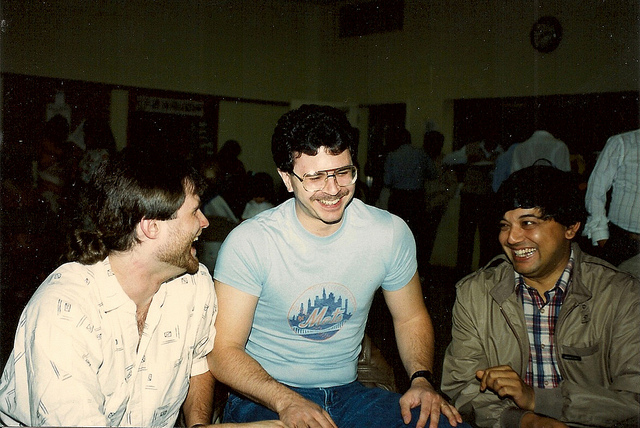
I lived and worked in New York for several years. My job was in Westchester County, which was so expensive, that I was a boarder in a wonderful family's basement. My best friends were two guys from India: one of which was my colleague Prayag: born in Assam and who moved to Meghalaya, a fascinating state where the indigenous people, the Khasis, are matrilineal and Christian and have a tradition of archery. Prayag was a Hindu, and he taught me how to make masala chai long before it became a "thing" in America. I also learned to appreciate sandlewood incense - which I still burn at home to this day. And there is nothing like the tar-black Assam tea that practically leaves a residue on the roof of your mouth!
My other buddy was Prayag's roommate Bhaya, a Muslim from Bengal (India, not Pakistan), who was educated in Boston. Bhaya was uproariously funny and quick-witted.
I used to spend weekends with my friends in their Upper East Side apartment. I ate the greatest Indian food of my life. I loved the noise of the city, the hustle and bustle, and the cosmopolitan devil-may-care attitude of New Yorkers. My friends taught me enough words in Hindi (including some colorful curses) that I once kept an Indian cab driver in stitches to the point that he didn't want to take my fare money. One time, Prayag, Bhaya, two other Indian friends, and I (that's five adults!) piled into my minuscule Ford Escort and drove from Manhattan to Wheeling, West Virginia to see a gilded Hare Krishna shrine. Epic road trip! Before it even started, I got rear-ended by a taxi at 4:00 am on the Upper-East side. My car was disabled until AAA came and hit a reset switch (as I learned that morning, Escorts would shut down when hit to prevent explosions). We were on our way. Our trip was an absolute hoot.
My friends also routinely took me to Edison, New Jersey for Indian festivals. Did I mention Indian food? :-) It's funny how no matter what nationality of people you're dealing with, the older ladies all seem to think the young people are starving, and sternly (and lovingly) compel you to have another plate. I was keen to oblige. I can't tell you how much I loved my time in New York.
 |
| That's me with the mullet sitting on the steps! :-) |
 |
| Indian food makes everyone happy! |
Poor Anja totally missed out on some great stories, preferring instead to paint me as a two-dimensional cartoon trope in her pre-written stereotype: half neanderthal, half Nazi. I guess that sells copy in Switzerland.
There is another break for pictures with a caption that defies explanation:
Pater Larry Beanes lutheranische Gemeinde ist im Begriff auszusterben. Doch landesweit feiern konservative Christen, die wie der Pastor für ein Verbot von Abtreibungen und muslimischer Einwanderung einstehen, eine Renaissance, seit Trump an der Macht ist.
Pater Larry Beane’s Lutheran congregation is about to die. Yet nationally there are celebrations among conservative Christians, who like the pastor are taking a stand for a ban on abortions and against Muslim immigration—a renaissance since Trump is in power.About to die? Aren't journalists at least supposed to pretend not to be fake news? I told her that after Hurricane Katrina, we lost a lot of people. The decline was gradual, as a lot of folks got other jobs and sold their homes.
She could have included some of my Katrina stories, such as my 80-year old parishioner who was rescued from his roof by helicopter (with his German shepherd), or the relief work several of us Lutheran pastors and laymen engaged in after the storm. Katrina's impact on our region cannot be overstated. I'm sure that didn't fit the McNarrative.
The post-Katrina demographic downturn in our region also caused the close of our parochial school in 2011.
But that trend has begun to reverse. Our little city of Gretna is coming back to life, with new businesses and restaurants opening - right in our neighborhood. In fact, I took Anja and her colleagues to eat at a newer restaurant that has a lovely view of the Mississippi River and the City of New Orleans across the river. That didn't fit the stereotype either.
Our congregation is actually doing quite well! Of course, Christianity is on the decline in our country, as younger people tend not to be interested in the faith. That is the case everywhere.
The mention of Trump is important, as it really is what this story is about: hatred for Trump. The Trump election was the trigger for this entire concept. The caricature is that Trump is a racist, if not a full-blown Nazi, and he could only get elected because of evil, backward, gun-toting hillbilly Christians. In fact, Anya and Yvonne's sojourn across America included a trek to West Virginia - not to see the magnificent scenery, or even to visit the people struggling with poverty after the coal mines closed - but rather to look into the opioid crisis.
Maybe one of the stereotypes they sought was the holy grail of the "Hillbilly Running a Meth Lab" (and Trump voter) - as each section in their series of articles had the name of the trope or stereotype for each person (mine being "Das Superchrist" that is "The Extreme Christian").
They were quite interested in guns as well. Yvonne was visibly deflated when I told her that I don't carry a gun. Notice how that tidbit didn't make the article either. I bet it would have been highlighted if I did carry a weapon.
In our discussions over the Confederate monuments and the story they tell, Yvonne was fixated on racism. I tried to explain that in American history, there were always two visions of America: one, a strongly centralized nationalized model more in line with industrialization as put forth by Alexander Hamilton, the other, a decentralized democratic and agrarian model favored by Jefferson. These two visions clashed all throughout our history. In 1861, this crisis brought about a secession of the Southern states. Our War Between the States was the nation's most deadly. I had ancestors on both sides of the war. My Southern ancestors weren't slave owners. Why did they fight? It was because of this vision of a decentralized America. The light bulb seemed to go off in Anja's head at this point, as she chimed in: "Federalism!" I explained that yes, that is exactly it, like Switzerland's decentralized structure of governance. There are still many of us in America that favor true federalism: a Jeffersonian model of our Republic. Like Lord Acton, that is the philosophy we see in the Confederate experience and in our monuments. They are not, as leftists often report, tributes to white supremacy or anything of the sort (all one must do is read the inscriptions). Of course, none of this conversation made the article.
That is my story - a story not given voice by my biased guests. It didn't fit the narrative.
Yvonne wanted to know why Christians voted for Trump, you know, because Trump used bad language. I explained that the American people were not voting for a pastor, but rather for a person to preside over the executive branch of the federal government. They seemed ignorant about how our system works. One of the president's duties is to appoint Supreme Court justices - which is critical when it comes to abortion.
We talked at length about abortion and why it matters - which of course did not make it into the article, as it doesn't fit the stereotype. I explained that Christians believe each and every human being is created in God's image, and that every life is sacred, regardless of size, utility to society, race, creed, sex or sexual preference, etc. That being said, we view abortion as a holocaust. People are free to disagree with us, but we see each abortion as the murder of a person, a human being. We do not oppose abortion because we hate women, but to the contrary, we love them. They have the right to be born. Our doctrine of the sacredness of life applies to people in comas, the handicapped, elderly people who are seen as "inconvenient" - everybody. Yvonne seemed surprised to hear this, but I noticed that neither of them had the guts to put any of this in the article.
It didn't fit their agenda.
They also asked about Muslims. They seemed surprised to hear that not far from my church is a mosque and a Muslim school. We routinely see Muslim families at our local Chick-Fil-A restaurant. I explained the stereotype-defying meaning of this. Chick-Fil-A is owned by Christians. They play Christian instrumental music in the restaurants. They close on Sunday so that employees can go to church. The New Yorker just ran a hit piece on Chick-Fil-A that serves to expose their own prejudices and hatreds.
And this restaurant, near my home and church, is where you will meet many Muslims. Clearly, they feel accepted there.
None of that made it into the article.
Neither did this:
The local Muslim school has Girl Scouts. Their troop ran into a problem and could not meet at their usual place. Our Girl Scout leaders asked if they could meet in our church's parish hall. Of course! The Muslim group offered to pay, and we declined. We opened our doors to them. I thought nothing more about it, but a few days later, I received a gift from them: a box of some souvenirs from Jerusalem. Anja and Yvonne wanted to find anti-Muslim hatred. Instead, they found something else that they could not report in their article. They didn't dare. They might have had to rewrite the story from scratch. The truth did not fit their agenda.
This next section serves to demonstrate the laziness of these Republikan writers:
So radikal er denkt, so höflich ist er. Galant verabschiedet er uns. Später, zurück im Hotel, schaue ich mir sein Facebook-Profil genauer an. Beane postet dort Artikel über die «Feminazisierung» der Kirche, über Chelsea Clintons angebliche Grussbotschaft an die «Kirche Satans», über den «IS-Terroristen», den London zum Bürgermeister gewählt hat. Fake-News und Hasstiraden: Im Netz ist der nette Pastor ein Hetzer. Er zählt zu den Superchristen, die in den USA zuletzt rasant an Einfluss gewonnen haben – Hardcore-Evangelikale, die Tugendhaftigkeit für Nächstenliebe halten und das Jüngste Gericht herbeisehnen, weil sie an keine andere Gerechtigkeit glauben können als an die von Himmel und Hölle.This is the crescendo of the article, where Anja sums up the "Extreme Christian" stereotype and really gets ugly in the process. But her laziness and sloppiness are a thing to behold. If I were her editor, I would be pretty upset with the quality of her work, her lack of fact-checking, her snap judgments, and her quickness to draw cocksure conclusions in this, her one and only visit to the United States, not to mention her conclusions about me after one conversation and three social media posts.
He is as polite as his thinking is radical. Gallantly he bids us adieu. Later, back in the hotel, I examine his Facebook profile in greater detail. There Beane posts articles about the “feminazification” of the church, about Chelsea Clinton’s greetings message to the “church of Satan,” about the “IS-Terrorist” which London elected as mayor. Fake News and hate tirades: online, the nice pastor is an agitator. He counts as extreme Christians those who have rapidly gained influence in the USA — Hardcore evangelicals, who regard virtue as a love for neighbor, and long for the Final Judgment, because they cannot believe in any other righteousness than that of heaven and hell.
Notice that Anja merely mentions these posts. She doesn't provide a link or a screen-shot, nor even a quote. Nearly all of my posts at the time of her article were public. You can search for the posts she is referencing. The first one about the "feminazification of the church" is egregious. The word is not "feminazification" but "feminization." Here is the link (posted on January 5 of this year).
This was posted on January 5 of this year, and is a three-part presentation (audio) of Rev. Dr. Steven Hein, presenting at the CCLE (Consortium of Classical Lutheran Education) conference last year.
His presentation has nothing to do with "feminazis" or anything to do with feminism or the modern controversy about gender and gender identity. Had Anja listened to the first three minutes of the first lecture, she would have known that this talk involves the Biblical feminine metaphor of the Bride of Christ (the church collectively) and its counterpart, the Biblical masculine metaphor of the individual Christian, and how this balance evolved from the middle ages, especially reflected in prayers, hymns, and devotional literature through the ages.
Anja is virtually accusing this truly gentle professor of "hate speech" (Hasstiraden). In some jurisdictions, hate-speech is criminal. In American jurisprudence, falsely accusing someone of a crime may be actionable. Anja would do well to be less reckless for the sake of her career and her editors who may be exposed to lawsuits on account of her lack of verbal precision.
Her next of three "mentions" (not citations) involves Chelsea Clinton and the Church of Satan. She implies that this is "fake news." Is it? Here is the link (posted on January 4 of this year):
I shared this piece from The Hill. Far from being "fake news," The Hill is the newspaper of record on Capitol Hill and in DC. The article cites Chelsea Clinton's own tweets, giving the Church of Satan a shout-out. I defend her right to do so. But I find the whole thing funny, and so I made a joke about it.
It sure sounds different than Anja's sinister implications when you actually have the citations, doesn't it? Her reticence to avoid any citation also makes sense because Anja lied about finding these posts, "Later, back in the hotel, I examine his Facebook profile in greater detail." Well, that's impossible because the "Feminization" article was posted on January 5, 2018, and the Chelsea Clinton Article was posted on January 6 (the byline of the Hill piece is January 3). Both of these posts to my Facebook page, which she claims to have found back in September 2017, did not exist until January, 2018. Her article was published January 24, 2018.
Remember what Mark Twain said about telling the truth?
Finally, Anja claims I called the mayor of London an "IS terrorist" - which she surrounds in quotation marks (with no actual citation, of course). Well, here is the link (September 15, 2017 - this one's timing is plausible):
Sadiq Khan, like most of his leftist political cohorts in Europe, is more concerned about political correctness than in protecting the people who elected him. I never called him an "IS-terrorist" but rather made a satirical joke that he is helping the terrorists.
Looking at how unsafe London has become, combined with Khan's complete inability to take responsibility, makes him part of the problem.
This is Anja's "evidence"? I can see why she didn't cite or quote these Facebook posts, and in one case, changed the name of the presentation and mischaracterized it. How is this anywhere near actual journalism? What makes Anja's writing any different than amateur blogging or casual Facebook posting? Why would anyone want to pay for this kind of writing?
And she got yet another fact wrong. Lutherans are not Evangelicals in this context. This takes some understanding of the religious landscape in America to understand - something Anja clearly didn't, nor cared to find out. In Reformation Germany, Lutherans preferred to be called Evangelicals instead of Lutherans. Many American churches - including my own - use both terms in their official names.
But the term "Evangelical" has evolved over time to include non-Lutherans. The term has further been winnowed to indicate Protestant churches that are not "mainline" or "historic" bodies, including Baptists, Pentecostals, and non-denominational Christians. These churches have a specific culture, exegetical tradition, worship practice, and view of politics. Although there is some overlap, Lutherans (and Roman Catholics) are not in this category. Anja ought to know better, especially as she is setting herself up as an authority and pontificating about the role of religion in America and American culture.
She should at least get the basics correct.
I suspect that Anja had already planned out the "Extreme Christian" trope, and had to make due with me. With ham fists, she has to pound the square peg into the round hole, by means of omission and commission, using deception, and outright lying.
Truth be told, I'm not a very good stereotype of the "Extreme Christian" that she wants to portray. As I told both Yvonne and Anja, there are things I like about Trump, and things I don't. I'm too much of a peacenik to fit the mold. I believe the U.S. should close its bases around the world and bring our troops home. I believe the US is much too belligerent and bellicose, and its interventions have caused blowback and radicalization that has not made the world safer. I'm against Trump's bombing of Syria. I believe that the federal government is too large and too powerful. I believe we could learn from Switzerland.
Moreover, I support the legalization of prostitution and drugs - not because these things are moral, but because regulation of these things are not the job of the state. I'm culturally conservative, but politically libertarian. I do not believe the government should support religion, but I do believe that the state has an obligation to respect the religious liberties of all people.
I live in a racially mixed neighborhood. It might be difficult for Anja and Yvonne to relate to this, living in a nation whose demographics are nowhere near as racially diverse as my neighborhood. Switzerland admits very few migrants, even as Anja and Yvonne bash Donald Trump for enforcing national borders. The EU's mandates to take in refugees from the middle east have no effect on Switzerland. Switzerland also has a minaret ban.
Anja and Yvonne do not understand America, and they really don't understand the South and South Louisiana. They are ignorant of our history and clueless of our folkways. But none of that stops them from pontificating as if they have lived their entire lives here. They are not 21st century versions of Alexis de Tocqueville. Nowhere near.
I'm 54 years old, and I have lived my entire life here. I've lived and worked in the north and south, the east coast and the midwest. I've lived in big cities, small cities, small towns, and suburbs. I have traveled to thirty-seven of our states. I know my country, and I love my country - warts and all. I get the subtleties and nuances that a girl in her twenties who has never been here before cannot even begin to comprehend, let alone hold forth as an expert.
On Anja's Facebook timeline, on the day that she contacted me by FB text, she posted that her "colleague came prepared" with a picture of the book called White Trash (it was not a public post, but I have a screen shot). At least Anja and Yvonne were honest online about their smugness, their bias, and their hatred of our country and its people. The next day, September 11, the same day that we met for the first time, Anja posted an unflattering picture of herself drinking a beer out of a paper bag (again, a non-public post, but I have a copy). I suppose this is the time frame when she claims she was researching my social media posts. That about sums it up for me. I can only wonder if Anja and Yvonne were as sloppy and outright dishonest with other people they met in their romp through America. I know they were in their interview with KK and Shirlron. Unfortunately, my German is not good enough to read the rest of their series. Maybe others can look into it.
My final thoughts about this encounter is that Anja and Yvonne are going to get caught. They will lie about the wrong person and harm someone's reputation, someone important. They and Republik will find themselves in court.
If Anja and Yvonne want to see Nazi-style propaganda and fake news, perhaps they could read their own article. Whoever financed Anja's and Yvonne's trip ought to get their money back.
So will we keep the Republik? Not even Dr. Franklin could answer that.
It seems that our Benjamin Franklin actually did say this:

Not to be outdone, maybe we need to give the last word to the cheeky Mark Twain, who I think may be onto Swiss Journalism in our own day: