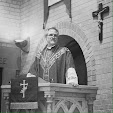
Sunday, April 12, 2020

Sermon: Easter Sunday - 2020


12 April 2020

Text: Mark 16:1-8

In the name of + Jesus.  Amen.

Christ is risen!  He is risen indeed!  Alleluia!

Christians have been greeting each other this way for hundreds of years.  It is said in every language.  And it summarizes the entire Christian faith in a way that has become how Christians say “hello” to each other.

For Adam and Eve rebelled against God’s plan.  Tempted by the devil, they thought only of themselves.  And their sin brought death into the world, and everything else that goes along with it: the struggle for survival, conflicts, violence, and yes, even viruses.  None of this is God’s will.

But for us fallen men, and for the gift of our salvation, God took  flesh for our rescue.  He kept the Law for us.  He fulfilled God’s plan for us.  He overcame the temptations of the devil for us.  He did not think of Himself, but in love obeyed His Father and He saved us!  He conquered death for us at the cross.  And His rising from the dead is a both a victory lap, and a preview for what is to come for us!

That first Easter morning, the Marys went to the tomb expecting to find a body.  Instead, they found an angel who told them not to be afraid, who told them that Jesus had risen, who told them to send word to the apostles who would break the news, the Good News, to the whole world.

For indeed, to this day, the whole world is afraid.  The whole world is confronting death.  The whole world needs to hear the Good News that Jesus left His tomb empty, so that ours too will be empty.

And no matter what some may say, the services of the Church are “essential services,” for we have the Medicine of Immortality, and we have the Good News to share with a frightened and dying world, even as we Christians boldly and joyfully greet one another:

Christ is risen!  He is risen indeed!  Alleluia!

Amen.

In the name of the Father and of the + Son and of the Holy Spirit.  Amen.

Friday, April 10, 2020

Sermon: Good Friday - 2020


10 April 2020

Text: John 18:1-19:42

In the name of + Jesus.  Amen.

We Christians say today is a “good” day.  It is the day of the cross.  The cross is our chief Christian symbol.  We decorate our homes with them.  We wear them.  Our churches have them inside and out.  The cross.  The good cross.

But what is a cross?  The cross was not merely a way to execute prisoners, it was a means of humiliation and torture.  It was so awful that the great statesman Cicero urged polite people to never say the word.  To the shame of the civilized Romans, the cross was the most evil, psychopathic, and inhuman device in the Imperial toolbox for subjugating other peoples and encouraging obedience to the government.  To the emperors and the governors the cross was indeed good.

The word “cross” is often used as a metaphor.  The word “excruciating” that we use in English to this day, meaning severe pain, is based on the word cross.  We speak of suffering as “bearing one’s cross.”  It was actually Jesus who taught us this metaphor.  “Take up your cross,” says our Lord, “and follow Me.”  To follow Jesus is to bear the cross.  The good cross.

Sometimes, it means a literal cross: as it did for St. Peter, who went to his own death, literally following our Lord Jesus Christ, to a cross of his own.  And other early disciples of Jesus were likewise crucified.  A hundred years ago in Muslim Turkey (a country that used to be the Christian Asia Minor), Armenian Christians – men, women, and even children – were crucified rather than renounce the faith and become Muslim.  The good cross.

But for most of us, the cross is metaphorical.  As followers of our Lord Jesus Christ, we suffer mockery, abuse, perhaps the loss of job, some endure lawsuits and severe threats to their ability to make a living.  At many times and places, Christians have been hated and even persecuted.  Today, Christians in Muslim countries may be somewhat tolerated, but typically cannot worship, cannot talk to Muslims about Jesus, cannot live free from fear of beatings and executions and yes, in some cases, a literal cross.  The good cross.

To be human is to bear the cross: the cross of mortality, the cross of aging, the cross of conflict, the cross of the struggle to survive, the cross of loneliness and depression, the cross of temptation, the cross of addiction, the cross of health issues, and yes the cross of our body’s susceptibility to viruses.  The good cross.

What is so good about the cross, dear friends?  What is so good about Good Friday?

“So they took Jesus, and He went out, bearing His own cross, to the place called the place of the skull, which in Aramaic is called Golgotha.  There they crucified Him.”

Many times, our Lord said that to follow Him, we must “take up our cross.”  Many times He said that He would be arrested, treated shamefully, be crucified, die, and rise the third day.  In the Gospels, whenever our Lord made these plain declarations of what would happen on the first Good Friday, it was as if nobody believed Him.  The disciples dismissed His words.  Perhaps they thought Jesus was being metaphorical, that this was just a figure of speech.  But no, Jesus was sent to a literal cross, and He suffered the excruciating torture of the ordeal of crucifixion, which for Jesus was more than just the physical and psychological pain.  He suffered spiritually, to the depths of His perfect soul, because He felt the burden of the sins of the world and the wrath of His Father – His literal Father – placed upon His head, like the Scapegoat of the Old Testament.  Jesus suffered betrayal, denial, and abandonment of His closest and most beloved friends.  He felt the wrath of God.  He and He alone bore the cross, the good cross, the cross of the atonement of the world.

And why is this good, dear friends?  Obviously, it is good for us who were spared the cross that we deserve.  We benefit from this “happy exchange” of our sins for His righteousness.  We are the beneficiaries of the cross, like the terrorist Barabbas, who was released from prison in exchange for the miscarriage of justice of crucifying the innocent Jesus.  We can all say, “I am Barabbas.”  But how is any of this good?  To the militant atheist, this seems perverted.  It seems unjust.  It seems as if our Father is arbitrary and abusive, and the Son is a fool.  It seems as if we Christians are very sick people indeed to adopt the symbol of the cross and to call this day “good.”

What the atheists and the mockers of the world are missing, dear friends, is the concept of love.  Jesus went willingly to the cross out of love.  He suffered the abuse and torture of the Jews and the Romans out of love.  He bore the wrath of the Father out of love – love for the Father whose will He obeys, and love for us whom He redeemed by His mercy, by His exchange of our sins for His righteousness, by His good cross.  The cross is indeed a symbol of death, but it has been transformed into a symbol of love.  Jesus said that greater love has no man than that He would die for His friends.  And because of love, Jesus dies even for His enemies, even as He called Judas “friend.”  As Pilate was concerned about remaining “Caesar’s friend,” he did not understand that Jesus died for Him as well, that He is Christ’s friend.  Jesus dies for the sins of the world, and He does this voluntarily out of love.

The world struggles to understand love.  Our culture sees love in twisted and selfish ways.  The world calls lust “love” and calls love “foolishness.”  Those who devote their lives to love are seen as fools.  The world celebrates wealth and power and fame.  The world idolizes Caesar and looks upon the Church with scorn.  That has always been the cross of the Christian.  The good cross.

Ultimately, the cross, the cross of Jesus, is a good cross, and this day of the cross, this Friday before Easter is Good Friday, because the cross of Jesus is the cross of love, the cross of the redemption of the entire world.  The gift of salvation is offered to all, to friend and foe, for when it comes to the death of Jesus for His friends, even His foes are His friends.  The entire world bears the cross of the virus of sin, and only the cross is the treatment, the universal treatment, that people are free to accept or reject.  This good cross is the inoculation that we all need against Satan, the one who afflicted us, “patient zero” in the universe who continues to torment us and make us terminally ill.  The cross is the antidote.  The good cross.

Dear friends, because of our Lord’s love for us, the cross is also a symbol of life.  In the greatest irony in the history of the world, Jesus takes this psychopathic instrument that was put into the service of Caesar: the state ruler who considered himself to be a god – a symbol of inhumanity and death – and Jesus Himself, the true King who is truly God, transforms the cross into the symbol of our Redemption, of life, of healing, of reconciliation, and of what it means to be truly human: love.  The good cross!

In suffering, Jesus overcomes suffering.  In death, Jesus conquers death.  In bearing the brunt of Satan, Jesus destroys Satan.  In His innocence, Jesus removes the virus of sin forever. The cross.  The good cross.

“When Jesus had received the sour wine, He said, “It is finished,” and He bowed His head and gave up His Spirit.”  On the cross “it is finished.”  The mission is completed.  Satan is defeated.  Death is destroyed.  Sins are forgiven.  Love conquers all.  And this cross, though it took our Lord’s life, will not keep it.  For “in the place where He was crucified there was a garden, and in the garden a new tomb.”  We know what happens in the garden tomb, dear brothers and sisters.  The whole world knows. 

And so today is the day of the cross.  We are bold to call it a good cross.  We are bold to call this Friday a Good Friday.  And on this Good Friday, we metaphorically stand at the cross, the good cross, with our eyes now turned to the tomb.  And we wait with joyful expectation for what comes next.
Amen.

In the name of the Father and of the + Son and of the Holy Spirit.  Amen.


Thursday, April 09, 2020

Sermon: Maundy Thursday - 2020


9 April 2020

Text: 1 Cor 11:23-32

In the name of + Jesus.  Amen.

“For I received from the Lord what I also delivered to you.”

Dear brothers and sisters, Maundy Thursday begins the Triduum, the three-day pinnacle of Holy Week leading to Easter Sunday.  We reconnect with our Lord’s passion, death, and resurrection beginning with this annual remembrance in which He gave us His body and blood to eat and to drink for the forgiveness of sins, the strengthening of our faith, and to bring us into a physical communion with God.

The Lord authorized the apostles – those who were “sent” (that is what the word “apostle” means in Greek) – to preach and to administer the sacraments.  And this is why the Church focuses on mission work, for the Lord works through His Word, and as St. Paul teaches us, “faith comes by hearing… the Word of Christ.”  And people can’t believe unless they hear, and they can’t hear without someone preaching to them, and they can’t have preachers unless they are “sent.” 

St. Paul came to things very late.  Jesus ordained him into the ministry after His resurrection and ascension into heaven, appearing to him on the road to Damascus.  St. Paul became the 13th apostle, but he certainly was one of the sent ones who preached the Gospel to the ends of the known world, and left us the Word of God in half of the New Testament of which he is the human author.

St. Paul was called to preach and administer the sacraments in the churches he established, and through Holy Communion, our Lord Jesus Christ remains physically present with His people, whether they are gathering in Corinth, Philippi, Antioch, or even Gretna.  The Church has the commission from Jesus to call pastors, men who are called by the Holy Spirit and ordained by other pastors, so that they too may hear the Word of Christ and believe, so they too may partake of the Holy Supper.

But how easy it is, dear friends, to take this gift for granted.  In normal circumstances, we can take communion any time.  Our church offers the sacrament every Sunday and every Wednesday.  And if you are laid up at home or in the hospital, the pastor can typically visit you with the Holy Scriptures and the body and blood of Jesus.  He can absolve you with the authority of one who has been sent.  Jesus is generous in making these gifts available, and it is easy to cheapen them in our sinful flesh – even to the point of skipping church if we have something more interesting to do.  

Sadly, not just in our parish, but all across our country and even in Europe – where most of us have our roots, where most of our ancestors became Christians, where St. Paul was the first to bring the Gospel – we see the churches emptying and closing.  The old die off, and the young have better things to do than to worship, than to hear the Word, than to receive Christ’s body and blood.  And it isn’t only the young.  The faith is just not that important to many people anymore, especially when they can turn on the TV and attend “St. Mattress,” watching a TV preacher say who knows what?  We can today stay at home and “read our Bibles” (which we should in addition to attending the Divine Service), we can worship God on the golf course or while sleeping in, because God is everywhere, right?

God is everywhere, but He is there for you, dear friends, where He has promised to be there for you: in the preached Word and in the Holy Sacraments.  And that is why He established the Church – which means, the “assembly.”  Christianity is not a hobby or a spectator sport.  Christianity is the people of God who gather week after week around a Christian pulpit to hear one of those who has been sent to preach the saving Word; who gather around the Christian font to be reminded that they have been baptized and set apart from the world; and the Christian altar to receive what one of the early Christian bishops and preachers, St. Ignatius of Antioch, called “the medicine of immortality.”

And indeed, now more than ever, dear friends, the world understands that we need medicine, and the world must come to grips with every person’s mortality.  

We are still in a state of shock to have nearly every Christian church on the planet shuttered – even in this holy season of Lent, and even extending to the annual worldwide celebration of our Lord’s resurrection.  We are like the children of Israel wandering in the wilderness and later exiled to Babylon.  This is a time of self-examination, even as we should be doing each week before receiving communion, as St. Paul says, “Let a person examine himself, then, and so eat of the bread and drink of the cup.  For anyone who eats and drinks without discerning the body eats and drinks judgment on himself.”

Have we been too lax in our self-examination?  Have we taken the assembling of the saints together around Word and Sacrament for granted?  Has the Christian Church around the world become complacent?  We cannot look into the hidden will of God, but for whatever reason, our Lord has allowed this horrific situation to come to pass – both upon the unbeliever and the believer.  The blessings that we have come to accept as normal –24-hour access to grocery stores, the freedom to travel and enjoy wealth that kings of 200 years ago would envy, the simple pleasure of a sit-down meal in a restaurant, the ability to greet our loved ones, or even the opportunity to attend a Divine Service and hear the Word preached, and to partake of Holy Communion – have been temporarily revoked from us.

St. Paul tells us – under the inspiration of the Holy Spirit – that lax self-examination in our communion practices can make us “weak and ill” and that as a result, “some have died.”  Sin itself is a dangerous virus.

We would do well to examine ourselves and reassess our priorities.  We would do well to repent.

Bishop Vsevolod Lytkin heard about a small group of Lutherans of Polish descent who had been exiled to a remote Siberian village in the 1930s under Stalin’s purge.  Their pastor had been shot.  Their church – and all Lutheran church buildings – were closed and permanently destroyed.  This little flock had no pastor.  They only had emergency baptisms and parents teaching the Catechism to the younger people who were born and who grew up under government persecution.  No pastor meant no communion – for decades.

The Bishop met an elderly woman from this village who told him that she had waited her entire life to meet a pastor.  She had never had the opportunity to take Holy Communion.  She knew the Catechism.  She confessed that Christ was truly present in the Sacrament of the Altar.  The Bishop was able to give her the body and blood of Christ.  She was then ready to depart in peace.

Again, we don’t know why this severe judgment is taking place at this time.  We must examine ourselves.  We must repent.  But we do know that we think we have all the answers.  We put our trust in our technology and our “can-do” American spirit.  Some are even taking it upon themselves to say the words of institution over bread and wine at home – sometimes with the help of livestreaming technology – as a way to resist this judgment.  Rather than submit to the temporary chastening of the Lord, they are looking for workarounds.  And shamefully, there are a few pastors participating in this fraud.  Ironically, these congregations typically downplay the importance of Holy Communion, even to the point of celebrating it in a casual way, celebrating it infrequently, even taking it upon themselves to use chemically altered grape juice instead of what our Lord instructs us to use: wine.  Rebellious mankind always thinks he knows better than God.  This goes back to the tower of Babel, and even further back to the Fall in Eden.  Will we ever learn, dear friends?

Our doctors tell us that we will not get through this crisis without “social distancing.”  And in a sense, we have been “social distanced” from receiving what St. Paul received from the Lord and delivered to us.

Dear brothers and sisters, this is a time of judgment.  And so let us humbly repent.  Let us turn to the Lord in search of forgiveness and restoration, and the eradication of this virus.

Let us take to heart the Lord’s word given by St. Paul who was sent to preach the Word to us: “If we judged ourselves truly, we would not be judged.  But when we are judged by the Lord, we are disciplined so that we may not be condemned along with the world.”

Let us receive this discipline with gratitude for what our Lord has done for us at the cross, and with faith in His promise to save us and to once more send the “sent” ones to us – whether we are in a remote village in Siberia or on the outskirts of a prosperous American city.  Let us repent, and let us look to our restoration – even as we celebrate this coming Sunday – whether with Holy Communion or not – our Lord’s resurrection from the dead; His triumph over sin, death, and the devil; and His promise to be with us always even to the end of the world.

Amen.

In the name of the Father and of the + Son and of the Holy Spirit.  Amen.

Tuesday, April 07, 2020

Sermon: Wittenberg Academy – Tuesday of Lent 6 (Holy Week) – 2020


7 April 2020

Text: Heb 3:1-19

In the name of + Jesus.  Amen.

Lent is a penitential season, a time for reflection on our sins and our need to repent.  It is a call to renewal in our commitment to walk the Christian walk, to participate in the Word of God and the Sacraments of the Church.  Our Eastern brothers and sisters speak of this time as “the Great Lent.”  Our Lenten journey for the year of our Lord 2020 could only be called a “Great Lent.”

We do not know why our Lord has allowed this scourge upon the world to take place, why our churches are nearly all shuttered, and why most Christians on the planet will not attend Divine Services and take the Holy Supper on the Feast of the Resurrection.  We don’t know “why,” but we do know what we are called to do: to repent and pray for mercy, for ourselves, for our Church, for our country, and for the world.

“Therefore, as the Holy Spirit says, ‘Today, if you hear His voice, do not harden your hearts as in the rebellion, on the day of testing in the wilderness, where your fathers put Me to the test and saw My works for forty years….  As I swore in My wrath, they shall not enter My rest.”

These is strong medicine from the Holy Spirit and from the author of Hebrews.  And indeed, dear friends, the whole world needs strong medicine at this time.

We are encouraged to “Take care” to avoid an “evil, unbelieving heart.”  We are encouraged not to “fall away from the living God.  We are encouraged to “exhort one another” to avoid being “hardened by the deceitfulness of sin.”  For we are all in this together.  We are suffering this pandemic together, even as we struggle against sin, death, and the devil in this fallen world together!

And the togetherness that we have taken for granted, our shameful forsaking of assembling together of which we are guilty as God’s people, our “rebellion” that has hardened our hearts should be in the forefront of our minds this Great Lent, dear friends!

In the Exodus, the rebellion took many forms which should be familiar to us today: the idolatry of the golden calf, the grumbling of the people about the food, rebellion against Moses’ authority as the leader of the people, the rebellion of Korah who believed that everyone was a minister and all, not just the ordained, had equal rights to lead worship services.  Our rebellions are similar: the idolatry of entertainment, our spoiled sense of entitlement to wealth, our refusal to acknowledge the authority of our pastors, or even asserting the rights of laymen to consecrate the bread and wine in the sacrament: a shameful recent development in our church.  Our western civilization is in rebellion by calling men women and women men, by treating infanticide as a right or as healthcare, by deeming liquor stores as “essential services” while shuttering churches, and by turning the state into a god.

The entire world is being called to repent, dear friends.  We know from Scripture that as the time of our Lord’s return gets closer, we will deal with increasing trials and tribulations.  And we also know that our Lord instructed us not to be beaten down, but to hold our heads high as Christians, knowing that our redemption is drawing near!

The author of Hebrews reminds us that it is Jesus who is the “apostle and high priest of our confession.”  As great as Moses was, Jesus is greater.  As wonderful as the Law is to call us to repentance, the Gospel, secured by our Lord’s death on the cross, is greater!  For “Christ is faithful over God’s house as a Son.”  Let us repent of our rebellion, calling upon our High Priest who is also the Victim, the atoning sacrifice who restores our communion with God, and brings us to eternal life!  Easter is very near, dear friends.  Our Lord has not abandoned us, though He chastens us.  Let us indeed, “hold our original confidence firm to the end.” 

Lent is a penitential season, a time for reflection on our sins and our need to repent.  And not even the Greatest Lent that the world has known will last forever.  For the Lord is merciful.  He has atoned for us.  He does forgive us.  He has conquered sin, death, the devil, and He has indeed risen from the dead to give us new life as well. 

Let us wait in anticipation of the celebration of His resurrection, for the restoration of our public services, and let us wait expectantly for our Lord’s return in glory!  Amen.

In the name of the Father and of the + Son and of the Holy Spirit.  Amen.

Sunday, April 05, 2020

Sermon: Palmarum - 2020


5 April 2020

Text: Matt 21:1-9, 26:1-27:66

In the name of + Jesus.  Amen.

The passion of our Lord might lead one to think that Jesus is not in control of what is happening.  After all, look at the terrible things that happen to Him:

He tells them outright that, “the Son of Man will be delivered up to be crucified.”  He takes no evasive action, but goes like a lamb to the slaughter.

The chief priests and scribes hatch a plot to trap Jesus.  When a kindly woman anoints Him with oil, His own disciples call this a “waste.”  Judas plots with the chief priests to betray Him for a few coins.  At the Passover supper, our Lord acknowledges that He is being betrayed – and does nothing to stop it.  Afterward, Jesus tells Peter that Peter will deny Him.  Again, He submits to this cruelty.  He does not prevent it.

Jesus is handed over to the police, and not even Peter’s sword seems to be able to prevent His arrest.  Jesus even tells Peter, “Put your sword back in its place.”  He adds that He could have an army of angels to help Him, but He refuses the help of the angels.

He is lied about at His illegal trial, but “Jesus remained silent.”  He confesses that He is the Christ, the Son of God, and is spit upon and struck.  Jesus does nothing to stop it.  Jesus is put on trial before the governor – who wants to release Him, but Jesus “gave him no answer.” 

Jesus is condemned, scourged, and crucified.  He prays, “My God, My God, why have You forsaken Me.”  And He dies, yielding up His spirit.  And He is laid in a tomb, one that was guarded for fear of His earlier prediction about rising again.  

It is as though Jesus is powerless to put a stop to this injustice.  It is as though God refuses to hear the cries of the faithful for mercy.  It seems as if God no longer hears anyone’s prayers.  Has He been forsaken?  Have we?  The chief priests, scribes, and elders mock Jesus: “He saved others; He cannot save Himself.”

He cannot.  It appears as if our Lord’s claims of divinity are false.  For how can we worship a God who “cannot,” do something, dear friends?

But we do worship a God who cannot be anything other than God.  God cannot lie.  God cannot be unjust.  God cannot abstain from loving His people – even in their sin.  Jesus cannot save Himself, not for lack of power, but because He is who He is.  Just as God told Moses from the burning bush: “I am who I am.”  Even as our Lord told the crowds, “Before Abraham was, I am.”  He is who He is, and He is our Savior.  

And far from being a feather tossed about in a windstorm, our Lord is in control at all times.  The cross was the goal, for at the cross, Satan was defeated, and we are saved from sin, death, and the devil.  His blood atones for our sins, for He is the Lamb who takes away the sin of the world! 

And we see our Lord causing these events to unfold all along, like pushing chessmen around a board.  With unbendable will and uncompromising mercy, He offers Himself as the atonement for the sins of the world.  He does this so that we might live.  He bears the punishment that sets us free, dear brothers and sisters!

And we especially see Jesus in control in the Gospel reading for when we enter the church on Palm Sunday, remembering our Lord’s royal welcome into the Royal City.  For there was no detail that our Lord left to chance.  Using His divine power, Jesus arranges everything.  He crosses every tee and dots every iota.  For He is the alpha and the omega!  He is the Word by whom all things were made.

How silly it was for the chief priests, the scribes, the elders, Judas, Pontius Pilate, and even the mob that called for His crucifixion to think they called the shots.  How ridiculous is their fantasy that they have power over God, that they can extinguish the Messiah by force.  All the while, dear friends, they were being played.  Jesus is in control.

For “when they drew near to Jerusalem and came to Bethphage,” our Lord gave specific instructions.  “Go into the village in front of You,” He commanded, “and immediately you will find a donkey tied, and a colt with her.  Untie them and bring them to Me,” He orders.  Jesus even tells them a kind of password to dispel any resistance on the part of the person whose animals are being requisitioned!

And so we see each action of each person working together in a kind of symphony to carry out our Lord’s plan to rescue us by His death on the cross.  

Dear friends, it is easy to think that Jesus is out of control.  Churches around the world are shuttered today.  We are seemingly bullied by a microscopic virus that prevents us from worship, that is killing thousands of people around the world, that is causing entire economies to collapse.

We see government officials – some with good intentions and some with hidden agendas – issuing decrees about what we can and cannot do.  In many states, liquor stores are open while churches are closed.  Our right to assemble and practice our faith is denied by government officials, with the claim that the Christian Church, the Gospel, the Word and the Sacraments are not “essential services.” 

And where is God’s power to put a stop to this, to bring us back into our churches, to save lives, and to exorcise this demon that seems to have the whole world under its thumb?  Why can’t God seem to do anything about this? 

And here, dear friends, is where we are called to put our faith in God, to trust our Lord Jesus Christ, knowing that he is indeed in command of every molecule in the universe.  We do not understand His will, but we pray, “Thy will be done” in spite of our lack of understanding.  We trust that He is carrying out the plan of salvation, even when it looks like the Church is the laughingstock of the world’s powers, when it appears that God is impotent, and when it feels like we are helpless and left alone.

We are not alone, dear friends!  God has not forsaken us.  Jesus is in control.  He is our Savior, and He cannot act in any other way other than showing love and mercy toward us, keeping His promises, and fulfilling the Father’s will.

Just like those who witnessed the crucifixion, we are called to believe even when belief is hard.  This is what faith is, dear friends, it is trusting in God even when we watch Him die on a cross, and when we see His lifeless body placed into a tomb.

For we know that He calls the shots, that He has nothing but good in store for us, and we know that Satan is defeated even when it looks otherwise.

And so even in remembering our Lord’s passion, with grief and with mourning – we still are not conquered and not defeated.  We know how it all ends.  And even though we don’t know specifically how this pandemic will end, even though we are prevented from waving our palms and singing, “Hosanna” together in our sanctuary today, we know how it ends, dear friends.  It ends with resurrection: our Lord’s and ours.  It ends with the saints in heaven, clad in white robes, waving palms, and singing “Hosanna,” that is, “Save us, Lord!”

We know that He does indeed save us by grace – even when we don’t know exactly how.  We have His Word, and that is sufficient for us, dear friends.  Let us look forward to a bright future, one in which Satan is thrown into the lake of fire, along with malignant viruses and with death itself.  Let us look forward to being raised from the dead by our Lord who controls all things, the One who dies so that we might live, and live abundantly – even unto eternity!  Amen.

In the name of the Father and of the + Son and of the Holy Spirit.  Amen.

Tuesday, March 31, 2020

Sermon: Wittenberg Academy – Tuesday of Lent 5 – 2020


31 March 2020

Text: Mark 14:53-72

In the name of + Jesus.  Amen.

Our Lord’s passion is underway.  He has been arrested and brought to the high priest – where the “chief priests and the elders and the scribes” are in on the conspiracy.  Our Lord’s followers are gone – except for Peter, who perhaps motivated by morbid curiosity, lurks about.  

The court proceedings look like a comedy sketch.  The false witnesses that they had lined up aren’t working out: “their testimony did not agree.” 

Everybody there knew that Jesus was innocent.  And if He is innocent, then He is the Messiah.  And if He is the Messiah, they are not in a position of supremacy.  And what’s more, their Messiah does things that only God can do.  None of His accusers believe that He is an illusionist or a magician.  In fact, our Lord’s arrest warrant as recorded in the Talmud accuses Him of “sorcery,” that is, they admit His supernatural works, but they attribute them to Satan – as if the devil is in the business of making the blind see, the deaf hear, the lame walk; as if Satan cured lepers and forgave contrite sinners.  They know the truth, but they conspire against it.

What they don’t realize is that God is using them, playing them like violins to carry out His will of redeeming mankind by the sacrifice of the One True Lamb at the cross.

And to show that He is in charge, and not their kangaroo court, our Lord Himself gives them the evidence that their bungling buffoons on the witness stand cannot provide.  In answer to the question, “Are you the Christ, the Son of the Blessed,” Jesus replies, “I am, and you will see the Son of Man seated at the right hand of Power, and coming with the clouds of heaven.”

“I am,” says God in the flesh!  He is the Great I AM; He is God in human form; He is the eternal Son of the eternal Father.  And had these men been faithful sons of Israel and true followers of the eternal God, they would have prostrated themselves before their Messiah.  But they are the spawn of Satan, and they begin to torture and mock Him, in line with their lost, unrepentant souls.

St. Peter denies Him – not in malice, but in weakness.  For when the roster crows, Peter weeps.  Peter and all of the apostles will repent, will be restored, will be forgiven, and will be empowered by the Holy Spirit to proclaim Christ to the world with courage and power.  And those who took part in the diabolical conspiracy, in the worlds of the hymn, “deeply wailing, shall their true Messiah see.”  But as for Peter and the apostles, and His disciples of every age, our confession of the Man of Sorrows upon His return will be this: “Thou shalt reign, and Thou alone!”  Amen.

In the name of the Father and of the + Son and of the Holy Spirit.  Amen.

Sunday, March 29, 2020

Sermon: Judica (Lent 5) - 2020


29 March 2020

Text: John 8:42-59

In the name of + Jesus.  Amen.

The Gospel reading sounds like one of those awkward moments at a family gathering when an angry argument breaks out and the children are shooed off to go outside and play.

If anyone thinks that the message of Jesus and of Christianity is to “be kind,” such a person has clearly never read the Bible – especially the Gospels – and is clueless about Jesus.  Far from being a Mister Rogers character, our Lord often comes on like a bull in a china shop.

Today’s Gospel is an example of this.

Our Lord is actually speaking not to the Pharisees or scribes, but rather to “the Jews who had believed in Him.”  Maybe they did at one time, but instead of abiding in His Word, they are falling back on their old habits of thinking that God owes them grace because they are children of Abraham.  Our Lord basically says, “So what?”

God doesn’t care about the things that matter in this world: who your people are, where you went to school, how much education you have, how much money you make – all of that counts for literally nothing.  No matter who you are or what you are, you’re a poor, miserable sinner, and you need Jesus.

And as our Lord tells His hearers very bluntly: “If God were your Father, you would love Me, for I came from God and I am here…  He sent Me.”  And He further tells them that they are not tracking with what He is saying because, “You are of your father, the devil.”

Jesus is not trying to win friends and influence people.  He is telling the truth.  He is calling these bitter and entrenched sinners to repent.  He is telling them that they are in eternal peril if they do not turn to Him for help.  This is no time for tea and crumpets.  This is no time for political correctness.  Satan has them in his grip, and they need a dose of the Word of God.  And it is bitter medicine indeed.  It strikes to the essence of their problem: pride.  It is the same sin that drove Satan into rebellion and brought death into the world.  

Instead of falling upon their knees in sorrow, seeking forgiveness and appealing to God’s mercy, our Lord’s hearers just get angry.  They call Jesus a childish racial taunt and then accuse Him of having a demon.

And even in the face of their insults, Jesus is offering them the crown of life: “Truly, truly, I say to you, if anyone keeps My Word, he will never see death.”

And here the Jews become indignant once again that Jesus is not impressed with their descent from Abraham.  “Are You greater than our father Abraham, who died?  And the prophets died!  Who do You make yourself out to be?”

They know what He is saying.  He is confessing to them about Himself, that He is God in the flesh.  They know He is saying this.  They know that He works miracles.  They know that He is not of the devil.  But their sinful hearts, racked with pride, refuse to submit.

Jesus tells them that they only think they know God.  Jesus calls them liars.  And Jesus tells them that “Abraham rejoiced that he would see [Jesus’] day.  He saw it and was glad.”

Now there can be no question that Jesus is claiming to have met Abraham, and that Abraham, the source of their misplaced ethnic pride, is rejoicing because of the coming of Jesus.  The Jews are trying to justify themselves because of their descent from Abraham, when Jesus, who is the very promised Seed of Abraham, who created Abraham, who is the fulfillment of the promise made to Abraham – plays the Abraham card right back at them.

They mock Jesus because Jesus claims to know Abraham.  They deny the supernatural and that which they cannot explain, saying, “You are not yet fifty years old, and have you seen Abraham?”

And here is where Jesus activates their demons of rage: “Truly, truly, I say to you, before Abraham was, I am.”

Jesus says the forbidden words “I am.”  He is telling them that He knows Abraham because He, Jesus, is Abraham’s God.  In the face of this testimony, all they have is blind rage.  They cannot argue against Jesus.  They cannot prove Him wrong.  They cannot explain away His miracles.  And they cannot force Him to be impressed by their family tree.  Jesus has called them sinners, and they refuse to repent.  Instead, “they picked up stones to throw at Him.”  Like their father the devil, they attempt to settle the argument with violence, with murder.  They are filled with hatred, and they cannot just walk away.  The critique of Jesus has stung them to the core.  But still they will not submit.

Dear friends, the Law stings.  As much as we would like to think that God is impressed by us, He isn’t.  The Lord doesn’t care about your ancestors, or if you serve in the church somehow, or if your family has been Lutheran for generations.  God doesn’t judge us based on our perceived good works, because we are so racked with sin that even our good works are not so good.  We are like the Lord’s hearers in the Gospel in that God confronts us with the Ten Commandments, and He doesn’t act like Mister Rogers toward us.

So what should we do, dear friends?  We must confess.  We must repent.  We must beg mercy from Jesus, and acknowledge Him as our only hope for salvation.  And when we do, the sting of the Law is no longer hurled at us.  It is then that Jesus does treat us with kindness and compassion, when He assures us that everything is okay, and that in spite of our sins, we will never see death!

On this day, the mob did not get its wish.  Jesus “hid Himself and went out of the temple.”  This was not His day to die.  But the time was coming when the mob would get its way, when the Jews would turn Jesus over to the Romans on false charges, and when our Lord would allow Himself to be crucified as a ruse to defeat the devil and to be the “firstfruits of those who have fallen asleep.”

And when we keep His Word, when we confess our sins and also confess Jesus as our Redeemer by means of His death on the cross, it is then that we have the free gift of eternal life.

Let us not be prideful or arrogant, dear brothers and sisters, never taking the attitude that God should be impressed by us or by our pedigree.  Instead, let us love Jesus and seek His grace and mercy – based not on our works, but rather on His works in defeating the devil and reconciling us to the Father by His blood.

Let us put away our foolish pride, and let us humbly rejoice in Jesus, the great I AM: God in the flesh who dies to set us free.  Amen.

In the name of the Father and of the + Son and of the Holy Spirit.  Amen.

Tuesday, March 24, 2020

Sermon: Wittenberg Academy – Tuesday of Lent 4 – 2020


24 March 2020

Text: Gen 43:1-28

In the name of + Jesus.  Amen.

God’s plan is good, and it is grounded in His mercy and His love.  But from our perspective, it doesn’t always seem that way.  In fact, God sometimes appears to us to be cruel, or arbitrary, or even out of control.  It seems like there is senseless suffering and pointless events that just look like chaos.

This is captured in the narrative of Joseph, whose jealous brothers sold him into slavery.  And from there, he was falsely accused and imprisoned.  Year after year went by, and innocent Joseph suffered because of his brothers’ wickedness.  And Joseph continued to serve God and His neighbor to the best of his ability, even though it must have been unspeakably frustrating and baffling to him.

But God was with him, and he rose to become the governor of Egypt.  

His father and his brothers faced famine in their homeland, and they went to the breadbasket of the region: Egypt.  And again, God was with Joseph and with his father Jacob, and yes, even with his wicked brothers.  For God had a plan for their survival.  And from this family would come the New and Greater Joseph, our Lord Jesus Christ, whose life is previewed by the suffering and the service of Joseph, the savior of his people.

In order to see his younger brother Benjamin (who was jealously protected by his father Jacob), Joseph pretended to suspect his brothers of being spies, and demanded to see Benjamin to check out their story.  He also had money planted into the bags to give them a scare.  And when the grain ran out back home, as “the famine was severe in the land,” their father sent them back to Egypt buy more food.  Reluctantly, he allowed young Benjamin to accompany his brothers. 

The sons of Jacob were very much afraid of Joseph’s wrath, unaware that he was the brother they had betrayed years ago.  And when they were summoned to Joseph’s house, they feared the worst.  Their minds raced, as they went through the worst-case scenario: being accused of theft, being assaulted and sold into slavery, and having their donkeys stolen.  Clearly, they still felt guilt and shame for their crime against Joseph, and they feared that what they had done would be done to them.

But they could not have been more wrong, dear friends!  This was all part of God’s plan to save their old father, to preserve the lives of their wives and children, to keep the nation alive by moving them to the fertile lands of Goshen, and to reconcile them with their brother and forgive their sins!  It is when we think that God must have abandoned us, when our minds race through the worst-case scenario, that we surely must trust that what seems to be bad for us is actually good!  We don’t know the future, but our merciful Lord is the author of the future!

Though we cannot see the meaning of our suffering in the present, our suffering is never meaningless or arbitrary.  God’s plan is unknown to us, and so we must pray for faith: faith to endure, and faith to trust.  And in time, His will shall be revealed, and His mercy shall be manifest, and the cross of our Lord Jesus Christ shall stand as a beacon – not of mindless suffering, but of love and hope and forgiveness and everlasting life!

In times of suffering, we are called upon to lift our eyes heavenward, to pray that God’s will be done, and to rejoice even in our sufferings, for our Lord Jesus Christ took the suffering of the cross and reconciled us to God.  And only after the blessings have been poured out generously upon us will the suffering of this present time make sense.  Let us, like Joseph’s brothers, hear these words: “Peace to you, do not be afraid.”  Amen.

In the name of the Father and of the + Son and of the Holy Spirit.  Amen.