
Sunday, January 01, 2006

Sermon: Circumcision and Name of Jesus

1 January 2006, Salem Lutheran Church, Gretna, LA

Text: Luke 2:21 (and Gen 17:1-14; Gal 3:23-29) (Historic)

In the Name of + Jesus. Amen.

Circumcision isn’t a topic we typically address in polite conversation. In fact, when the topic comes up in, say a sixth-grade religion class, there’s usually some nervous laughter going on. And yet circumcision is a pretty major thing in the Scriptures – both Old and New Testaments.

In the Old Testament, circumcision is established by God with the patriarch Abraham as a sign of the covenant, an Old Testament sacrament that initiates a boy into the promise and people of God. And by virtue of that boy growing up, it initiates his wife and daughters into the covenant as well.

In the New Testament, a dispute over whether or not Christian men need to be circumcised threatened the very existence of the Church even before the New Testament had been written! It caused St. Paul all sorts of headaches, to the point where he wished his opponents would do even more to themselves than administer circumcision. Only a meeting of bishops in Jerusalem, as recorded in Acts 15, would prevent the Church from dividing over the issue of circumcision.

And notice that the Church in her wisdom has decreed today – which the whole world now recognizes as New Year’s Day – to be a commemoration of the circumcision of our Lord Jesus Christ. So important is this considered that our Gospel text for today is only a single verse!

Why all of this fuss over circumcision?

In our Old Testament lesson, God establishes circumcision as a sign of his covenant with Abraham. Every male descendant of Abraham, every son of the promise, must submit to this ritual bloodletting. Any son of Abraham who is uncircumcised has forfeited his standing as a son of the promise, and breaks the covenant.

Why did God choose such a sign? He doesn’t tell us. But we do know that circumcision is a permanent sign. It can’t be undone. Perhaps it serves as a reminder to a descendant of Abraham that his body is holy to God, and any offspring he procreates is also a child of the promise. In any case, this is the sign, an Old Testament sacrament that joins the Word of God to a physical element bringing grace and salvation.

This sign, this sacrament, this guarantee that the son of Abraham has not broken the covenant was fulfilled, as was the rest of the ceremonial law, by Jesus. Jesus is the Promised One, the Messiah, the True Son of Abraham, Isaac, and Jacob. He is the one man who truly keeps the covenant as a man, just as he is also God who likewise keeps the covenant from God’s end of the deal.

Our Lord’s circumcision was the first shedding of his holy blood, a foreshadowing of the draining of all his holy blood on the cross. And in this first shedding of blood, this event which calls to mind the sacrifices of the Old Testament, was done to fulfill the law. Ever obedient, our Lord submits to a covenant he himself, as Yahweh, established. The circle is complete, and the ceremonial law is no longer binding on us children of the covenant. In fact, we have a new sacrament of initiation, one which is administered to male and female children alike, one which permanently marks us as children of the promise, one which, like circumcision, can never be undone: Holy Baptism.

When a boy was circumcised, he was also named. Today is known to the Church as the Circumcision and Name of Jesus – as our Lord was named according to custom, on his eighth day of age at the time of his circumcision and initiation into the people of God.

Our Lord’s name “Jesus” is also of great importance. It is a Greek rendering of his Hebrew name: “Joshua.” Remember that Moses, the great lawgiver, could not bring the people of God into the promised land. His own sins held him back. That task was given to a general named Joshua, the successor of Moses, who by right of conquest led the children of the covenant to the Promised Land.

Jesus is a new and better Joshua, another successor of Moses, who fulfills the Law, who conquers sin, death, the devil, and hell. He leads his people into he Promised Land as a conquering general and king.

The prophet Zechariah tells of another Joshua, who served as high priest as the children of Israel were returning from exile. In a vision, Zechariah’s sees Joshua, the high priest, standing before the Lord in filthy garments while Satan accuses him. But Satan is rebuked, and Joshua (whose name in Greek is Jesus) is clothed with new garments, priestly vestments. God tells him he is given “charge of my courts” and “right of access among those who are standing here.” God says: “Hear now, O Joshua, the high priest, you and your friends who sit before you, for they are men who are a sign: behold, I will bring my servant, the Branch.”

Jesus is the greater Joshua, the general, the high priest, the Branch, the maker of the covenant, and the fulfillment of the covenant. He is the maker and the fulfillment of the law. He is the alpha and the omega. He is the one whose name is above every other name, who was named as the angels instructed: as Jesus – whose name means “savior.”

All of these signs of the Old Testament point to Jesus, and are fulfilled in Jesus. The ceremonial law of the Old Testament – including circumcision – points us to their fulfillment in Jesus. For as Paul tells us in our epistle text, “the law was our tutor to bring us to Christ, that we might be justified by faith. But after faith has come, we are no longer under a tutor.” Circumcision is there to lead us to Christ. Once it has done that, once our Lord fulfilled it, we have outgrown it. For we are not sons of Abraham through circumcision, but rather as Paul tells us: “you are all sons of God through faith in Christ Jesus. For as many of you as were baptized into Christ have put on Christ.”

You are all sons, and as sons, you are heirs. You, dear Christian friends, men and women alike, are adopted sons. The kingdom is yours, not by virtue of circumcision and the Law, but by virtue of baptism and the Gospel. For notice what Paul says: “There is neither Jew nor Greek” (remember that Jews were circumcised while Greeks were not). Paul says: “There is neither male nor female” (though women benefited from circumcision, they didn’t directly receive it). Notice what Paul concludes: “if you are Christ’s, then you are Abraham’s seed, and heirs according to the promise.”

In other words, dear brothers and sisters, in baptism, you have all been “circumcised” and are all sons of Abraham –Not by virtue of your own obedience, but by virtue of Christ’s obedience. Not by virtue of your own flesh, but by virtue of Christ’s flesh. Not by virtue of your own shed blood, but by virtue of Christ’s shed blood.

And that holy flesh and blood of Jesus is yours, for just as you share in our Lord’s circumcision, and just as you have been given our Lord’s name in Holy Baptism, you have been given his body and blood to eat and drink in Holy Communion.

We worship a real, flesh and blood God. We don’t worship a distant, far off character from a story book. We worship a God who was a baby boy, who bled at his circumcision at the age of eight days, who was given a name, who fulfilled the law, who died in the flesh, and who rose from the dead at the age of thirty-three years. He still lives in the flesh, still bears the scars from all of his holy wounds, and who will come again in glory to raise our flesh from the dead and to once and for all rid the universe of the devil and his followers.

Our God, the only True God, is a man. He is the new and better Adam, one who did not yield to the serpent’s temptation. He is the new and better Moses, who completes and fulfills the law for us. He is the new and better Joshua, who defeats the enemies of God and leads his people forth in joy. He is the new and better high priest, who not only stands as a man before God, but is both man and God. He is a high priest who is also the high victim. He is the sacrificer, and the sacrifice.

Dear friends, welcome to a new anno domini, a new year of our Lord. We are indeed another year closer to the fulfillment. While making New Year’s resolutions and striving to keep them is certainly a good and noble thing, there is only one New Year’s resolution that will never be broken. That is the covenant, the promise our Lord made with Abraham, Isaac, and Jacob, the promise whose sign was circumcision, the promise fulfilled when a little boy named Jesus was circumcised, and when an innocent grown man named Jesus was crucified.

In the Garden of Eden, God made a promise, a resolution of sorts, to the devil that the seed of the woman would crush his head. God spoke the same promise to Abraham when he promised a savior from his seed. God spoke the same promise to Moses and all the prophets when he told of one who would fulfill the law. And God kept his promise by taking flesh and dying for us, by achieving victory over the devil on the cross, and by fulfilling the destiny of his name by keeping the law for us. And God continues to keep that promise with you, and for you, by giving you his flesh and blood to eat and drink for the forgiveness of all your transgressions of the law.

You children of Abraham, rejoice in the circumcision of Jesus – for the flesh of that baby boy is your salvation! You children of God, rejoice in the divine name of Jesus – for there is no other name by which we can be saved! For you who have been baptized into Christ are all sons of God through faith in Christ Jesus! Amen.

In the Name of the Father and of the + Son and of the Holy Spirit. Amen.

Happy New (Orleans) Year!

Hope y'all are having a great new year! So far, no hurricanes - so 2006 is a great year here in the Big Easy up to now. ;-) We thought we'd share with y'all our amusing New Year's Eve in Post Katrina N'Awlins.

In the afternoon, with the weather a beautiful seventy-something degrees and sunny, we decided to go "out" and do something "normal." Things have not been "normal" around here since the end of August. So, we decided to visit the only store where Grace likes to shop: "Prima Donna's Closet" - a consignment clothing boutique. This was our first Post-Katrina visit.

The owner is an outgoing lady named Stephanie - who on this day was wearing a "Make Levees Not War" T-shirt. She recognized us from our Pre-K visits to her shop, and immediately were exchanged The Two Questions, viz, 1) How d'ya do? (translation: do you have a home?) and 2) Where d'ya go? (translation: where did you evacuate to?). We learned that one of her two stores was completely destroyed. However, the store we were in was doing well. Grace went all out and bought a skirt for four bucks. I read Swedish while Leo pointed at, and chatted with, the caged birds around the store.

We decided to head to Magazine Street for Indian Food. Magazine Street is on the edge of the French Quarter, and is lined with shops and bars. However, we arrived five minutes after the buffet closed, so we had to activate Plan B, which in this case was "Igor's Buddha Belly Bar, Grill, Laundromat, and Game Room" (that's what it's called, no lie). There was an older man at the bar reading the paper. The loudly-dressed barmaid was conversing with him about new movies. As a result, the topic of gay cowboys came up. We settled at a table near the window, and ordered burgers and beers. Some more patrons came into the bar, and the older man began involving a twenty-something guy in his discussion about gay cowboys. Soon the topic was changed to rock and roll music.

The bar/grill/laudromat/gameroom sported a large laughing Buddha, a video poker area, and humorous signs. One read: "Gentlemen: No Shirt, No Service. Ladies: No Shirt, Free Beer." I asked Grace if Leo needed to nurse...

Just outside the window, a couple drank beer, read the paper, and discreetly smoked marijuana. Three cops on motorcycles stopped in front of the bar. Two of them preceded to block the street while a third came into the Buddha Belly. He hastily ordered three burgers, and rushed out, promising to be back in a few. New Orleans' Finest were blocking the street for a parade. Along they came, the Pussyfooters and Highsteppers with their little brass band. They were followed by a couple dozen malt-beverage-equipped citizens. The parade was completely over and done in about five minutes.

We strolled on over to the Boulangerie (a French bakery) across the street. We took a table outside and enjoyed the sunshine, the breeze, and the strolling crowds lingering after the parade. I got in line. There was a large sign above the counter that read: "Le patron mange ici" (the boss eats here). In front of me, a middle aged woman spoke in French as her young-adult daughter responded to her in a mixture of English and French - with no rhyme or reason as to when which language was being employed. The owner spoke French with the employees and with some customers. Beautiful large round loaves and delicate pastries were for sale, as were "gateaux de roi" (king cakes) - a French/New Orleans tradition of a festive cake with an effigy of the Baby Jesus baked inside. King cakes are signs that Carnival (the pre-Mardi Gras time of partying) is near. It officially begins on Epiphany Day (January 6).

I took our order outside (coffee, blueberry tarte, and an apple-cinnamon danish).

People from all walks of life promenaded by - some with pets. Several people hooked their dog leashes to a pole out front, which made Leo happy. A couple of guys walked by, one of whom was carrying his large pet hen in his hands. Nobody batted an eye. The two guys took the chicken into a bar (I suspect many of these types of jokes originated in New Orleans).

We drove around and ended up in the French Quarter. Being New Year's Eve, it was rather busy. By happenstance, we found our minivan right in front of the main stage that was being set up for the evening's festivities. Arlo Guthrie was strolling by with his long curly white locks blowing in the breeze. We drove around the French Market and saw a lady wearing a "Christ Is Our Hope" T-shirt - the slogan of Lutheran Church Charities headquartered in Addison, Illinois. I have spent the last three months working closely with this wonderful organization. I hollered out of the window: "Lutheran Church Charities! Y'all do good work!" The lady was stunned that someone recognized the shirt. I told her I was a local pastor. She was in New Orleans with a group of volunteers from Chicago.

Before dark, we went home. We watched Dick Clark on TV. We went to bed at about 12:30 am. We really enjoyed the return to "normalcy," but all in all, we had a pretty boring "normal" time for New Year's Eve. But that's not so bad - we've all had enough excitement here in New Orleans for a while. But hurricane season is only six months away!

Bonne annee, et laissez les bons temps roulez! (Happy New Year, and let the good times roll!)

Sunday, December 25, 2005

Sermon: Christmas

25 Dec 2005 at Salem Lutheran Church, Gretna, LA

Text: John 1:1-14

In the Name of + Jesus. Amen.

John opens his Gospel using the very same words Moses uses to begin the Book of Genesis: “In the beginning.” He takes us back to the beginning of everything – of time and space itself. And notice that during this, the very first nanosecond of everything, we find that something was already in existence: the Word. Before the beginning of time and space, the Word existed with God, and the Word was God.

Isn’t this a great way to begin a Gospel? Instead of starting with Jesus’ genealogy, or the Christmas story, St. John talks in riddles.

But this is so important, because John is telling us about Jesus. Jesus existed before Jesus. Jesus existed before existence. Jesus is eternal, and not bound by time. In other words, Jesus is God. This is important because it sets up the wonder of Christmas! Jesus is not a created being, and yet when he was born, he took on created flesh. Jesus transcends all time and space, and yet he was born on a specific date at a specific time, and he occupied a tiny area contained within the skin of an infant. Jesus is almighty, and yet became all-helpless. Jesus is all glorious, and yet veiled his glory to the point of wearing diapers.

Why does God do this? This, dear friends, is the great question. The world gets it wrong. Time and Newsweek get it wrong. Sadly, a lot of Christian churches get it wrong. Jesus didn’t come to give us the law – Moses already did that. Jesus didn’t come to teach us morality, we all know right from wrong. Jesus didn’t come to be only a teacher – the world has seen thousands of great teachers before and after Jesus. Jesus didn’t come to advocate a political position, to advance a social agenda, or to tell us what kind of vehicle to drive.

God becomes one with his creation, he breaks into space and time, because there is a plan. There is a real and profound need for him to be here. “The Word became flesh and made his dwelling among us.”

Theologians argue about whether or not God would have taken flesh even if we had not fallen into sin. Who can say one way or the other? But this much we know for sure: “to all who received him, to those who believed in his name, he gave the right to become children of God… born of God.” He was “born to raise each child of earth, born to give us second birth.”

And what is the connection between the baby lying in a manger and our being born again? How are we born again? Notice what our Gospel text says: “not of natural descent, nor of human decision or a husband’s will, but born of God.” Our being born again is a lot like Jesus’ birth: it is supernatural, it is divine, it is mysterious. Our being born again, becoming children of God, is not a “human decision.” Nobody decides to follow Jesus or makes a decision to accept Jesus as savior. Rather we are “born of God.” It happens to us without our will, even in spite of our will!

Our epistle text speaks of how Christmas is tied to being born again: “But when the kindness and love of God our Savior appeared, he saved us, not because of righteous things we had done, but because of his mercy. He saved us through the washing of rebirth and renewal by the Holy Spirit, whom he poured out on us generously through Jesus Christ our Savior.”

We are born again not by our willpower, not by our good deeds, not by our decision to accept Jesus, not by some waterless baptism of the Holy Spirit championed by certain sects – but by a “washing of rebirth.” We are washed clean by water and the Word! This baptismal font is where the Holy Spirit hovers – just as surely as the glory of the Lord appeared as a pillar of fire and as a cloud over the children of Israel. When the water was poured on us with the Lord’s words, the Holy Spirit was placed on us, and we were indeed, in the very words of Jesus, “born again… born of water and the Spirit.”

So, the Word took on flesh, Jesus was born, so that we might be born anew. Through the washing of rebirth, Jesus saves us. And this is for no other reason than that God is merciful and he loves his whole creation.

John describes this incarnation of God as life and light. These are the opposites of death and darkness. The old priest Zacharias, the father of John the Baptist, prophesied in words we still sing in the liturgy: “Through the tender mercy of our God, with which the Dayspring from on high has visited us, to give light to those who sit in darkness and the shadow of death, to guide our feet into the way of peace.”

Apart from Jesus, we sit in the dark, and wait to die. There is no hope, and no direction, no guidance. But with the coming of Jesus, the Dayspring, who has come to us on a mission of mercy, he brings us light and guides our feet. Jesus is the fulfillment of the psalmists’ prophecy: “Your word is a lamp to my feet and a light to my path.” The Word, dear Christian friends, is Jesus. The Word isn’t information recorded in a book – the Word is the living, breathing Christ, God in the flesh, who has snatched us from darkness and death, whose light guides us to eternal life.

“The true light that gives light to every man was coming in the world.” Notice that John says the light is given to all men. And yet, not all men want it! It is as though a winning lottery ticket were distributed to every person, but most people decided they didn’t need it – some politely, others violently. The twisted response of the world to the coming of Jesus is testimony to the wretchedness of man. “He was in the world, and though the world was made through him, the world did not recognize him. He came to that which was his own, but his own did not receive him.” The world rejects Jesus, rejects the Church, rejects the Scriptures, rejects the sacraments, and rejects eternal life itself. The world embraces the culture of darkness and death.

But thanks be to God that we baptized, reborn children of God have seen the light, and have received the gift of eternal life! “We have seen his glory, the glory of the One and Only, who came from the Father, full of grace and truth.”

Thanks be to God St. John has written a new account of “in the beginning,” that the fall of Genesis was conquered by the rising of Jesus. The degradation of human flesh by sin into the stuff of corruption and death has been checked and turned around by the One who has taken on our flesh, and yet who is incorruptible, and who has conquered death for all time.

In the beginning, God created the heavens and the earth. In six days, he created all things, and on the seventh day, he rested. But there has followed an Eighth Day, the first day in a new age of creation. That new creation has begun, dear friends. On the Eighth Day, the Creator became one with his creation. We are in the last days as we move ever closer to the end of the Book of Revelation, in which all darkness, misery, suffering, and death are conquered and overthrown.

For the baby Jesus, God in the flesh, was born in a manger – a food trough. He was born in a place called Bethlehem – literally, the House of Bread. He is the true bread from heaven, the new manna, which he bids us to eat. His blood is the blood of the new passover, the new testament, which he bids us to drink. His divine body and blood are melded with ours, raising us to himself.

This, all ye faithful, is the meaning of Christmas. The birth of Jesus, the Son in flesh appearing, has heralded a new age, the beginning of the end of time, the beginning of the end of death. God and man are one in flesh and in eternity. We are claimed as his own by holy baptism, and nourished by holy communion and holy absolution. The Word made flesh is a lamp to our feet as he proclaims his Gospel to us. Sin, death, and the devil have been conquered. The new heaven and the new earth are now under construction, and we are citizens of this heaven above.

“Glory to God in the highest! Oh come, let us adore him, Christ the Lord.” Amen.

In the Name of the Father and of the + Son and of the Holy Spirit. Amen.

Saturday, December 24, 2005

Sermon: Christmas Eve

24 Dec 2005 at Salem Lutheran Church, Gretna, LA

Text: various

In the Name of + Jesus. Amen.

All of history is divided into before Christmas and after Christmas. We use the terms BC and AD to indicate whether a year is Before Christ, or Anno Domini (in the year of our Lord). Even in non-Christian countries this convention is followed. In places that are outright hostile to the Christian faith, the same numbers for years are used – history is still divided between before Christmas and after Christmas, yet the artificial terms Before the Common Era (BCE) and Common Era (CE) are used. They think they’re being clever in removing Jesus from the very reason we divide history this way.

But the joke is on them. For there is some divine truth in their terminology! On the first Christmas, at the birth of our Lord, when God took on human flesh – this is indeed the beginning of the “common era.” For now, God and man have something in common that they did not have in the BC era – humanity. Human flesh. For almighty God “put our human vesture on and came to us as Mary’s Son.”

This commonality, this communion between God and man, between God and us, is especially remarkable because we had rejected God. Eve gave in to the serpent’s temptation while Adam watched and later participated. Adam and Eve wanted something that was not theirs: commonality with God. They wanted to bridge the gap between the almighty Lord and lowly humanity by their own deceitful act. They wanted commonality on their own terms. And since that day, we have been a fallen race, “banished children,” people sitting in darkness, cursed, and mortal.

And how does God react? In the fullness of time, in the reign of Herod in Bethlehem, “the Word became flesh and made his dwelling among us.” He, the “Savior of our fallen race,” the “brightness of the Father’s face.” And thanks to that light, we no longer sit in darkness and in the shadow of death. We, “the people that in darkness sat, a glorious light have seen, the light has shined on them who long in shades of death have been.”

Instead of destroying us “poor miserable sinners,” God became one of us, taking the name “Jesus” – “because he will save his people from their sins.” By our sins, we have made ourselves enemies of God. And the “stump of Jesse,” the one born in royal David’s city, has come to crush the head of his enemy. But he has not come to crush us! For we are no longer his enemies – because we have commonality, we have communion, we share our flesh with Immanuel – “God with us.” He has come to make peace with us, and to make war against the devil. He has come to crush the serpent’s head, and to undo the curse of darkness mankind had been under those many millennia before Christ, before the common era, before God took flesh to become our savior.

Dear Christian brothers and sisters: this is why we celebrate Christmas! This is why the devil seeks to destroy Christmas! The incarnation of God into human flesh is the greatest event in history – it separates every human endeavor into two halves – and it made commonality, union, communion with God possible – on his terms, not on ours.

In ancient prayer books, four words in the Nicene Creed were printed in capital letters: “And was made man.” For centuries, Christians around the world would kneel for these four words. “And was made man” is the greatest of all mysteries. This divine commonality that unites God and man to where they can never be separated again. And we continue to kneel before the Lord as did the magi presenting gifts, only we, dear friends, kneel before the Lord to receive his gifts – the gifts of his very flesh and blood, the gift of his humanity we take into our own bodies. God not only became human, but man became divine.

So celebrate the mystery with joy, feasting, worship, commonality with those with whom you share flesh and blood. And remember that you not only share flesh and blood with your kith and kin, but also with God himself, whose very flesh and blood becomes your flesh and blood today and every day when the divine commonality of God and man is celebrated through a holy and mysterious communion. Jesus is still incarnate, still among us, and still saves us from our sin and darkness, from our separation from God, and from death itself.

“Haste, haste to bring him laud, the babe the Son of Mary.” We have seen his glory, the glory of the One and Only, who came from the Father, full of grace and truth.” Amen.

In the Name of the Father and of the + Son and of the Holy Spirit. Amen.
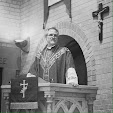
Sunday, December 11, 2005

Sermon: Advent 3 (Gaudete)

11 Dec 2005 at Salem Lutheran Church, Gretna, LA

Text: Matt 11:2-11 (Historic)

In the Name of + Jesus. Amen.

Today’s Gospel deals with a man who is typically treated as a minor character in Scripture. Indeed, if the Bible were only literature, John the Baptist wouldn’t be very important – given that he’s killed off very early in the story. And yet, notice what Jesus says about him: “among those born of women there has not risen one greater than John the Baptist.” Jesus submitted to John and was willing to be baptized by him. Jesus’ words about his courageous cousin are not merely polite commentary given at a retirement banquet. Indeed, this is very high praise coming from God himself.

But notice the circumstances. John has been put in jail, and he hears “about the works of Christ.” Instead of rejoicing, John – this greatest of all men, this bold preacher who took on the political establishment of his day – begins to wonder if he’s made a mistake. “Are You the coming one, or do we look for another?” Jesus, are you really the Christ, or are you yet one more prophet making promises. I heard about your works, Jesus, and that’s not quite what we all had in mind of our Messiah. So what’s the deal?

It seems like everyone misunderstood Jesus. Many Jews were looking for a political king to overthrow the Roman government. Herod certainly was. Certainly nobody expected the Messiah to be put on trial by Herod and executed by the Roman government.

So John is in doubt. How does Jesus reassure him? Notice he doesn’t go to John himself, but sends men, messengers, under the orders: “go and tell.” We sometimes describe ordination into the preaching office as “holy orders.” In order to comfort John, to assure him of his own work, Jesus sent two preachers.

And notice these preachers are told exactly what to say. They aren’t instructed to make small talk, crack a few jokes, and make up something to make John feel better. No, these disciples of Jesus are sent with a specific message. And that message points to Jesus.

Notice the increasing order of importance. They say: “Look, John, look at what Jesus is doing: he’s healing sick people, he’s even raising the dead, but there’s something even greater: he is preaching the Gospel!”

They are telling John that Jesus is fulfilling John’s own preaching: “Behold, the Lamb of God, that takes away the sin of the world!” This preaching unto the forgiveness of sins is the Gospel. And of all the miracles of our Lord, this is the greatest. It not only restores the flesh, but takes away the sin that places the flesh on a collision course with death! The miraculous preaching of the Gospel, and the offering of himself as the Lamb of God, that we eat in the Church’s weekly passover, is what Jesus presents to John to bring him comfort.

Our reading from Isaiah includes this word “comfort.” “Comfort, yes, comfort my people! Says your God. Speak comfort to Jerusalem, and cry out to her that her warfare is ended, that her iniquity is pardoned: for she has received from the Lord’s hand double for all her sins.” The very next line in this reading is a direct prophecy of John the Baptist: “the voice of one crying in the wilderness.” Notice how the word “comfort” is used here. It doesn’t refer to air conditioning, heated leather seats, power steering and a built-in DVD player. Rather it is used as forgiveness and pardon. In fact, the Hebrew word translated “comfort” literally means sorrow and repentance.

So Jesus doesn’t remove John’s suffering to comfort him. He doesn’t save him from his upcoming death any more than he would later save himself from his cross in response to his mockers. He doesn’t send John blankets and pillows. No, to bring him comfort, he sends him preachers armed with the Holy Spirit-inspired Word of God – with the Gospel. In fact, the Greek name for the Holy Spirit is: the Paraclete, literally, the Comforter.

And notice Jesus’ final word sent to John: “Blessed is he who is not offended because of me.” Time and again in the Gospels we find people taking offense, being scandalized, by Jesus. How relevant this is today! Every Christmas it seems we re-fight the battle over “Merry Christmas,” Christmas carols, and the “inappropriate” displays of Jesus in “Holiday” decorations. The world is still offended by Jesus. Our flesh is still offended by Jesus. This is why Jesus is a scandal – the word translated as “offended” is literally “to scandalize.”

Christianity is scandalous. It always has been, and always will be. Why? Because our sinful flesh hates the Gospel. We’re proud. We don’t want charity and handouts. We want to be self-sufficient – so we can continue to hold ourselves higher than welfare-recipients and folks we consider to be moochers. We want to earn our salvation – or at least have a hand in it.

Also, like the Jews, we want a powerful, swaggering, “cool” Jesus. We want a wise-cracking macho Jesus like Will Smith or Bruce Willis. We don’t want a weak Jesus who goes silently to the slaughter. We don’t want a crucified Jesus. The cross is offensive and scandalous – Paul tells us so in these very words: “We preach Christ crucified, a stumbling-block (literally: scandal) to the Jews and foolishness to the Greeks.” The last thing you will ever see in a megachurch that has theater seating and cup-holders is a crucifix. This is because preachers in these so-called churches misunderstand the command of our Lord to his preachers to give comfort to his people. They don’t know what the word means. They think the word “comfort” has something to do with wearing khakis and golf shirts and sipping on a Starbuck’s during worship.

Dear friends, there is no greater comfort than to have the crucifix before our eyes at all times. Every room in our homes should have one on the wall – for it is the most powerful reminder of the Gospel, of our comfort. And yet, it is a scandal to those who don’t believe. Those who seek a different Gospel, a different Jesus, will always turn up their noses and roll their eyes at Christ crucified.

Now, after Jesus sent his preachers to see John, Jesus addresses the crowds. He confronts them with their motives for coming to hear John preach. “So, what did you people make the long trip into the dessert to see? Grass being blown around? A big-shot in a nice suit? Some kind of entertainment? No, you came to see a prophet, a preacher of the Word of God.”

Just as Jesus sent his preachers to bring comfort to John, God had sent his prophet John to fulfill our Old Testament lesson to bring comfort, that is, the refreshment of repentance, to his people. Jesus later sent out more preachers two by two. And just before he ascended, he placed the Eleven under holy orders, breathing the Holy Spirit, the Comforter on them, ordering them to fan out into the world spreading comfort, making disciples by baptizing and teaching. In turn, these apostles ordained future ministers to administer sacraments and preach and teach.

And so on it goes, and will go until the Lamb of God who takes away the sin of the world returns to be our Judge. This is what Paul speaks of in our epistle text when he tells God’s people to regard their pastors as “servants of Christ and stewards of the mysteries of God.” That is to say, pastors are under orders to their master Jesus and are charged with serving, dishing out, the mysteries of God, that is, the sacraments.

So, dear friends, as we gather around the mysteries of God this Gaudete Sunday, a day of rejoicing within this penitential season of Advent, what did you come here to see? A reed shaken by the wind? A man clothed in soft garments? No, you came to hear a preacher proclaim comfort. You came to have the mysteries served to you. You came to hear Jesus himself speak his words, words of comfort, the Gospel, through his messengers. And as great as St. John the Baptist is, our Lord reminds us that paradoxically, in God’s Kingdom, the first are last and the last first. All of us who are the least in God’s Kingdom, are even greater than John. Our Lord sees us as, and holds us with the same high regard, as he does his servant John the Baptist who was faithful unto death. St. John the Baptist is no minor character, and neither are you, O baptized saints of God!

“Behold your God! Behold, the Lord, God shall come with a strong hand, and his arm shall rule for him, behold his reward is with him, and his work before him. He will feed his flock like a shepherd; he will gather the lambs with his arm, and carry them in his bosom, and gently lead those who are with young.”

O Salem, your warfare is ended, your iniquity is pardoned:

In the Name of the Father and of the + Son and of the Holy Spirit. Amen.

Sunday, December 04, 2005

Sermon: Advent 2 (Populus Zion)

4 Dec 2005 at Salem Lutheran Church, Gretna, LA

Text: Luke 21:25-36 (Historic)

In the Name of + Jesus. Amen.

On this the 21st shopping day until Christmas, the secular world is beautifully decorated with happy and gentle images of smiling snowmen, winking Santas, joyful music, and beautiful decorations. There are songs of peace on earth and even shocking displays of the baby Jesus in places where at other times of the year this would be forbidden.

But what do we find in this church on the second week of Advent? What do our readings say? Well, in the Old Testament lesson, we have people burning in an oven, described as ashes under the soles of our feet, the coming great and dreadful day of the Lord, striking the earth with a curse. The Gospel reading is rather horrifying: signs in the sky, distress and perplexity among nations, roaring waves, heart failure due to fear, and the powers of heaven itself being shaken.

Fa-la-la-la-la!

And then we have this epistle reading in which Paul uses words like comfort, hope, joy, and peace.

Advent is a confusing time in many ways. We speak of the anticipation of our Lord’s coming – but which coming? We reflect back in time on the Incarnation, that greatest of all miracles in which God Almighty wriggled helplessly as a gentle newborn in a swaddle-blanket being tenderly nursed by his virginal mother. We also look forward to the Lord’s triumphal second coming amidst chaos and suffering, trial and tribulation, and the physical persecution of the Church. This coming will bring history to a close, will result in the destruction of the world, and a new creation. And in the present, we reflect on our Lord’s coming here and now, in his Word and Sacraments.

All three of these advents of Jesus are physical. In the Lord’s first advent, he came to offer salvation to the world. In his ongoing eucharistic advent, he delivers salvation to those who believe. But his final advent will not be to offer his gifts, nor to nourish his Church through her earthly sojourn. No, indeed, the Lord’s second coming will be one of judgment, of separating sheep from goat, of eternal life for the Church, and eternal damnation for those who reject him.

The world revels in the imagery of a gentle baby as God (as do we). The world takes comfort in a helpless God who can be carried about (as do we). But is there comfort in Jesus the Great Judge, whose coming will be amid the descent of our world into total devastation?

That depends.

The world deals with our Lord’s preaching about judgment and hell with mocking and disbelief. They are in denial that the same gentle meek and mild baby Jesus would preach what he preaches to us today. But we dare not do this. In fact, the Church needs to listen to her master – especially in these days of increasing natural disasters, strife around the world, and a descent of humanity into a universal culture of death and evil. It should not surprise Christians when abortion is treated as a virtue. Or when even Christian judges and politicians do nothing while a handicapped woman is starved to death by court order. Or when homosexuality has been normalized to the point where “conservative” churches are now in various states of approval of this abomination. We ought not be shocked to learn that Christians are being persecuted around the globe, that magnificent and ancient cathedrals in Europe are empty today. Or that the Scriptures are being distorted by so-called Christian churches to the point where women dress up as pastors and mock the Lord’s office of the keys in repeating Eve’s sin of wanting something off-limits to her.

And, dear friends, there’s no reason to believe things won’t get worse. But what does our Lord say? “Now.” Notice, he begins this sentence with “Now.” “Now when these things begin to happen, look up and lift up your heads, because your redemption draws near.” The worse things get, the more chaos spreads, we are to look to heaven, to look up in hope and expectation. For our Redeemer lives, and he is coming, and he’s coming not to destroy us, but to redeem us!

No matter what passes away – our life, goods, fame, child and wife. No matter if we lose our homes, our treasures, our family pictures, our heirlooms, our health, our mental capacities, and even our lives – there is something that will never pass away. Jesus says: “Heaven and earth will pass away, but My words will by no means pass away.” The Word of the Lord – the saving, life-giving, redeeming Word of the Lord is eternal. This is why we need to lift up our heads. This is why we ponder the Lord’s return on the great and terrible day surrounded by the color blue, the color of hope.

The Church pauses these few weeks to consider the end of the ages and the return of our Lord as a warning. Our Lord says: Take heed to yourselves.” He says: “Don’t get careless. Stay awake and watch. Abide in my Word!” We must not let sin drive a wedge between us and our lifeline – we must not let the “cares of this life” take precedence over being immersed in the Word of God. We are in the last days, brothers and sisters! When the time is expiring in a hockey game, the side that is behind pulls its goalie in a desperate attempt to stay alive. When a football team is down and the time is running out, the team runs quickly without a huddle. When a category 5 hurricane is bearing down on us, we do something extraordinary out of caution. We heed the warning!

Jesus is telling us to heed his warning. We must not get so bogged down by the “cares of this life” shopping for Christmas presents that we neglect the only eternal Christmas present! It is our Lord’s prayer that we be counted worthy to escape all these things and stand before the Son of man.

This word translated as “to be counted worthy” is not used often in Scripture. It’s used in Matthew 16 when Jesus says that the gates of hell will not prevail against his Church. And notice the context: this is right after Peter confesses Jesus to be the Christ, and right before Jesus entrusts him with the office of the keys.

You, dear friends, are counted worthy – for you confess Jesus as the Son of God, as your Redeemer, and your confession, your faith is nourished by the office of the keys – the pastors of the Church. You are indeed counted worthy when you remain in his Word, when that Word is preached to you, when that Word is pronounced over you in absolution, when that Word is added to water and poured on you, and when that Word is given to you to eat and drink.

The Lord’s Word endures forever! Take heed, and remain in his Word, for that Word in Scripture is indeed for patience and comfort and hope. By that Word we are of one mind and one mouth as we confess that Word. By that Word we receive each other, and we too are received into the Kingdom. By that Word we Gentiles might glorify God for his mercy.

So hold your heads up, dear brothers and sisters! “Now... now may the God of hope fill you with all joy and peace in believing, that you may abound in hope by the power of the Holy Spirit.” Amen.

In the Name of the Father and of the + Son and of the Holy Spirit. Amen.

Sunday, November 20, 2005

Sermon: Last Sunday of the Church Year

20 November 2005 at Salem Lutheran Church, Gretna, LA

Text: Matt 25:1-13 (Historic)

In the Name of + Jesus. Amen.

Today marks the end of the Church year – 1,975 years since the death and resurrection of our Lord. And as we end this year, we reflect anew on the end of all years – the end of the world, the end of time, and of the great judgment. And even as we prepare for the Season of Advent, in which we ponder our Lord’s first coming, we now ponder his second advent.

Our Lord preaches about his second coming in the form of the parable in today’s Gospel lesson. The fathers of the Church wisely determined that we Christians ought to be reminded of the Lord’s warning every year on the Sunday before Advent.

The Parable of the Wise and Foolish Virgins has a rather simple plot. Ten young girls are on their way to a wedding. The groom is picking them up. They don’t know exactly when to expect him, and as this is long before cell phones and instant messaging, they need to be ready. One of the things they need in order to be prepared is oil – which fuels their small, hand-held lamps.

Five of the girls are wise – having sufficient oil. Five are foolish – they are not prepared. Maybe they are lazy, maybe they are just procrastinators. Maybe they had their priorities out of order. But for whatever reason, the foolish girls are not prepared. The groom’s messenger shows up at midnight to warn them the time is at hand. The foolish girls want to glom off of the wise ones, but there is simply not enough. They will have to find a merchant, and buy their oil at this late hour. While they are out shopping, preparing too little too late, the bridegroom comes, like a thief in the night. The wise girls are let into the wedding with the groom. The foolish girls are locked out.

This parable is similar to Aesop’s fable, the Ant and the Grasshopper. Jesus may well have heard Aesop’s tale growing up. Aesop’s story is similar to Jesus’ parable – but there are differences as well.

Aesop’s story goes something like this:

Ants are hard-working, industrious critters. They prepare all year for winter. They slave away and store food. They repair their homes. By contrast, the grasshopper makes no such preparation, opting to sing and dance the summer days away – having fun, and procrastinating his work. Of course, winter comes suddenly, and there is no more time to prepare. The ants are warm and fed in their winterized homes, while the grasshopper is no longer so happy-go-lucky. He is cold and hungry, and asks the ants to take him in – but there is no room, and not enough food. The moral is be prepared, don’t procrastinate, and work, work, work!

The moral of Jesus’ parable is similar. We are to be wise and prepared. We are to watch, for we “know not the day nor the hour in which the Son of Man is coming.”

Our sinful flesh likes to believe we can work our way to being prepared – like the ants in Aesop’s story. And hard work is a good and wise thing in this world, but Jesus’ parable deals with the “kingdom of heaven.” If we could work our way to being prepared, we would need no savior. But again, it is easy for us to forget this, and sinfully read Aesop’s moral into Jesus’ parable – like the bumper sticker that says: “Jesus is coming – everybody look busy.” Indeed, church signs often ask us “Are you ready?” (which is certainly one of the questions Jesus asks us in this parable). But then they turn Jesus into Aesop by asking us: “Have you gotten right with God?” – as though we can do any such thing, whether by our own industry or wisdom.

Notice that in Jesus’ parable, only the foolish virgins are mentioned as toiling – in running out to buy oil. They have frittered away their opportunity, and now when it is too late, they want admitted to the wedding. They have been forced to rely on themselves, on their ability to buy their preparedness. And you can see where their work, their attempt to buy their way in, gets them – with a door slammed in their faces.

So, my dear Christian friends, how can we be prepared? How are we made ready for that Day of the Lord that will come as a thief in the night? How do we emulate the wise virgins, while at the same time, not relying on our own works to prepare us?

It’s no accident that our Lord used oil and lamps as examples in this story. Oil is not only fuel that allows a light to burn, it is a medicine that heals. The Word of God is indeed a lamp unto our feet and a light unto our path. But that lamp must have a means of burning, a way for the light to be made to shine for us. Oil is the fuel, the means to the grace of light. And just as Jesus is the light of the world, so too, our good works reflect that light. Jesus tells us not to hide our lamps under a basket, but put them on a stand, so all may be enlightened and give glory to God. Oil is also ointment used to heal the sick – such as in the Parable of the Good Samaritan. What did the Samaritan treat the victim’s wounds with? Wine and oil.

Wine is the element used to become our Lord’s Blood in the Holy Eucharist. Oil is that which the pastors of the church are commanded by the Apostle James to anoint the sick with. Oil was used to anoint kings and prophets. Oil was used in the early church as a sign of Holy Baptism, since bishops would “confirm” a baptism by administering oil to the baptized person – a custom which has come down to us today as the Rite of Confirmation.

And just as oil is a means to the light (the light of Christ), the Gospel and the sacraments are today a means to the light of Christ. The title Christ actually means “the anointed one.” Oil is a healing agent that cleanses our wounds and sterilizes us – just as Holy Baptism washes away our sins. We are prepared for the coming of our Lord by being well-stocked in the oil of Christ, his Gospel, and his Sacraments! We are prepared by being wise, by coming to this place where the oil of the gospel is distributed without charge and without limit!

The oil of God’s grace is applied to you into your ears as you hear the words of Holy Absolution, the reading of God’s Holy Word, and the preaching of his Holy Gospel! The oil of God’s grace is poured on your head in your Holy Baptism, and brought to remembrance every time you make the sign of the cross! The oil of God’s grace is poured into your very mouth as you take Holy Communion! Dear friends, we are being prepared for that great day – by being here and being filled with the oil of God’s love and mercy!

Those who choose to procrastinate, those who ridicule the wise virgins, those whose priorities are out of whack, those who are lazy and refuse the free gift of God’s grace will sadly find themselves unprepared. And when the day of grace finally ends, they will seek to buy the oil of God’s love and mercy – and they will find that it is not for sale. They will run around desperate like Christmas eve shoppers – in the end doing more work than their wise counterparts. They will learn the hard way that the Gospel is not for sale, it cannot be earned, and there will come a time when it will come to an end.

Jesus is warning us not to procrastinate, not to delude ourselves into thinking we have enough oil, not to figure we can always take advantage of God’s grace at a later date. For we know not the day nor the hour of our Lord’s return. And as Paul warns us, we ought not think 1,975 years is such a long time, nor should we fool ourselves into thinking the Lord will come back millennia from now, if at all. We ought not emulate the foolish virgins, nor Aesop’s grasshopper. For we all confess with the Church that the Lord will return, bodily, and triumphant against all sin. He will welcome the wise virgins, the Church, but will cast out the foolish virgins along with their true master, Satan, into hell.

And while the Lord’s warning is harsh and stern, and is clearly a call to repentance - what comfort we have knowing that it is not up to us to “get right with God,” that we are not obliged to buy our way into heaven. For the oil is a gift from God. It is the oil that enables our light to shine before men! It is the oil that enables us to do good works and acts of mercy without concern that we must do so in order to be prepared for his coming! This holy oil is given out to you, dear friends, every Sunday and every Wednesday in this sanctuary. And if you can’t get here due to age or infirmity, the Lord’s servants will come to you and refill your lamp where you are.

So, my dear wise virgins, rejoice, and continue to be prepared – by the Gospel! Because of the Gospel, we can indeed comfort one another and edify one another. You are all sons of light and sons of the day! And we will indeed enter with our Lord to the wedding feast that has no end! Let us leave behind this church year and enter Advent anew, with repentance, fully clad in the armor of salvation, glowing with the oil of God’s grace, and awaiting with hope and joy the new heavens and the new earth. Amen!

In the Name of the Father and of the + Son and of the Holy Spirit. Amen.

Sunday, November 06, 2005

Sermon: All Saints Day (Transferred)

6 November 2005 at Salem L.C., Gretna, LA

Text: Matt 5:1-12 (Historic)

In the Name of + Jesus. Amen.

Today’s Gospel text is the beloved passage from Jesus’ Sermon on the Mount known as the Beatitudes – from the Latin word for “blessed.” Jesus rattles off nine “blesseds” in this passage – and the characteristics that are blessed are pretty feeble in the eyes of the world. Poverty of spirit, mournfulness, meekness, and desire for righteousness aren’t exactly the goals of most people – including us Christians. And mercy, purity of heart, and peacemaking aren’t typically the kinds of things we naturally excel at. Even when we do these things, our sinful flesh is looking for some kind of compliment. And how about these last two? Persecution and reviling? You won’t find promises of persecution in any of the latest “Christian” bestsellers. Somehow, I don’t foresee a book called “40 Days of Persecution,” nor do I think the Left Behind series is going to change course and tell us that Christians are indeed going to suffer a great tribulation. Of course, our epistle lesson from Revelation uses those very words to describe just what those who “washed their robes in the blood of the Lamb” have endured and overcome.

So why does Jesus preach like this, and why does the Church use this Gospel reading on All Saints Day?

Jesus is not giving us laws that we must do, that if we do it well enough, we get a prize. No, in fact, just as every faithful preacher, Jesus is preaching about Jesus! He is teaching us about himself!

He is the one poor in spirit, born in humble and scandalous circumstances – and yet he is the very king of heaven.

He is the one who mourns, weeping for his friend Lazarus and mourning over doomed Jerusalem – and yet he is comforted by the Comforter, the ever-present Holy Spirit.

He is the meek one, who takes the form of a servant, and yet who inherits the earth from his Father.

He is the one who hungers and thirsts for righteousness who was filled with that righteousness by virtue of his divinity.

He is the merciful one, to whom the Father shows mercy by raising him from the dead.

He is the one pure in heart, the one who sees God.

And he is the peacemaker, the one who reconciles man’s enmity toward God, and thus he is truly called the Son of God.

And he is certainly the one persecuted for righteousness, crucified on a cross with the word “king” on the sign, and he is the one who owns the kingdom of heaven.

So how does this apply to the saints, those here as well as those already in eternity? Notice how our Lord changes from third person to second person: he says: “Blessed are you.” For when youChrist is persecuted. are persecuted, And the blessings given to Jesus as the only-begotten Son of God are also given to you adopted sons of God.

And notice the three little words Jesus uses in describing persecution: “For my sake.” These words not only mean that we’re being hassled for being Christians, they also proclaim how we are blessed – “for my sake.” For we have all of these same characteristics as Jesus “for Jesus’ sake.” In other words, Jesus does the work, we receive the blessing. But notice that Jesus does say that we, the Church, will be persecuted for his sake. And when we are, we are to rejoice, for this is proof that we stand in the train of those who came before us: “souls in endless rest… patriarchs and prophets blest.”

Jesus is telling us what Luther would tell us 15 centuries later. One of the “marks of the church” is the cross that we bear, the suffering we endure at the hands of those who hate us. We can identify the Church because she is the one being persecuted. We’re not the rich, powerful, successful ones – no matter what the televangelists like to boast, no matter what the latest fad in the Christian bookstore is pushing. No, dear friends, we’re the harried ones, constantly under the “crafts and assaults of the devil,” not to mention the world and our own flesh.

Satan has waged war against God’s messengers and confessors since the Garden of Eden. And from righteous Abel all the way down to Christians who are being tortured and murdered at this very moment for the faith are proof that the Holy Catholic and Apostolic Church is still God’s beloved and the enemy of the Devil. Not even the gates of Hell will overcome her.

This location of the Church amid suffering and tribulation is testified to in our Epistle. In his holy Revelation, St. John sees the enormous crowds praising God, all clad in white baptismal robes, waving palm branches, just as those who welcomed Jesus into Jerusalem. “They stand with palms and sing their psalms before the throne of light.” They join with angels and archangels, the watchers and the holy ones, all the company of heaven, falling on their faces before God’s throne. And who are they? “Sir, you know. These are the ones who came out of the great tribulation, and washed their robes and made them white in the blood of the Lamb.”

For theirs is the kingdom of heaven by virtue of the blood of the Lamb. For when their blood was spilled, it was really the blood of Christ that was spilled. Be it by wild animals at the Roman Coliseum (as were the young mothers Sts. Perpetua and Felicity). Or by crucifixion at the hands of sadistic soldiers and deranged emperors (as was St. Peter). Or by burning at the stake by order of a church gone mad (as was Blessed John Huss), or even by diabolical Nazi thugs (as was the Blessed Dietrich Bonhoeffer).

For in all of these cases, it was Christ’s blood that was drained. For all of these saints drank his blood and ate his body - the very same body and blood born of Mary, put to death on the cross, and resurrected in the tomb! Their blood is the blood of Jesus, the same blood we will drink in a few moments. This is part of that great mystery, that great communion we have with Jesus, and through him, all the saints in every time and place, “of all nations, tribes, peoples, and tongues.” His body becomes our body, his blood becomes our blood. He fortifies us with his very own faith, faith enough to withstand the sword, the stake, the arena, and the cross. Faith enough to stand alone if necessary and take abuse for confessing Christ.

Indeed, the history of the Church is bloody – as bloody as the stains that still brown the floor of the Coliseum. Jesus tells us plainly to take up our crosses and follow him. And we see the witness of those who have born the cross for two thousand years. In the first century, the Apostle Paul was beheaded for preaching the Gospel. In the middle ages, Archbishop Thomas Becket was murdered at Canterbury Cathedral as he prayed Vespers, and Fr. John Wycliffe was burned at the stake for translating God’s Word into English. In the early twentieth century, thousands of Russian Orthodox priests were put to death by the Communists. And even more recently, a young girl named Cassie Bernall was martyred in a place called Columbine when she confessed her Christian faith looking down the barrel of a gun.

This, dear friends, is how the Church grows – by a true confession of the faith, the one true faith, the Holy Catholic and Apostolic faith, the faith of the martyrs. And that confession is sanctified by the blood of the saints of every time and place – which is to say, by the very blood of Jesus. The Church is not about marketing schemes, entertainment, pins, pads, and pens, or other gimmicks. The Church has nothing to do with slogans and programs – whether approved by our synodical leaders or not. For Jesus doesn’t promise us success and wealth in the worldly sense – but rather ownership of the kingdom of heaven, by his blood, through the faith confessed by the martyrs and saints throughout these latter days.

One has to wonder what holy St. Polycarp would make of the “ablaze” program – considering this beloved soldier of the cross died in the flames of his persecutors. This single 2nd-century martyr, stooped with age, has spread the Gospel in ways that a website can never do. He confessed the one true faith. He washed his robe in the blood of the Lamb.

For that robe worn by the saints is nothing other than Holy Baptism. The blood which cleanses the garments of the saints is Holy Communion. And that which the saints proclaim and chant around the Lord’s throne for all eternity is none other than his Holy Word. They’re singing the Liturgy with us!

And we do well to remember that the word “martyr” simply means witness. Giving our witness before the world is to confess. It isn’t about a sales pitch, or clever arguments, or pestering people door-to-door, but rather our witness is in the blood – Christ’s blood, the blood of those in the Church whom Christ empowered to lay down their lives for his sake and for the sake of his Gospel.

And even if we are never called upon to shed blood for the Gospel, we are given the gifts of Jesus’ poverty of spirit, Jesus’ compassion in mourning, Jesus’ meekness, Jesus’ desire for righteousness, Jesus’ ability to show mercy to others, Jesus’ purity of heart, and Jesus’ will to reconcile and make peace. Only by Jesus’ doing, only by his grace, can we live out the beatitudes. For it isn’t us, but Christ who lives in us.

And as Christians we will endure persecution of some sort. But through this tribulation we will endure – not by our own strength (remember our meekness), but rather through the blood of the Lamb. And that Lamb will indeed dwell with us. “We shall neither hunger anymore nor thirst anymore; the sun shall not strike us, nor any heat.” The Lamb himself will shepherd us, and God will remove every tear from our faces.

This, dear friends, is why we celebrate All Saints Day. For the testimony of the saints, the confession of the faithful, is none other than Jesus. Their blood, and our blood, is his blood.

“The myriad angels raise their song, O saints, sing with that happy throng. Lift up one voice, let heaven rejoice, in our Redeemer’s song.” Amen.

In the Name of the Father and of the + Son and of the Holy Spirit. Amen.