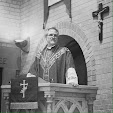
Sunday, April 15, 2018

Sermon: Misericordias Domini (Easter 3) and Baptism of Anastasia Tindell - 2018


15 April 2018

Text: John 10:11-16 (Ezek 34:11-16, 1 Pet 2:21-25)

In the name of + Jesus.  Amen.

Christ is risen!  He is risen indeed!  Alleluia!

Because of the Gospel reading this week, in which Jesus says, “I am the good shepherd,” this Sunday is often called Good Shepherd Sunday.  Our Old Testament lesson from Ezekiel prophesies that God Himself will shepherd His people (a prophecy fulfilled by Jesus, the Good Shepherd).  Our epistle lesson from St. Peter also follows this theme: “For you were straying like sheep, but have now returned to the Shepherd and Overseer of your souls.”

And this is what has happened with little Anastasia this morning, dear friends.  As part of her baptism, you heard these words: “The Word of God also teaches that we are all conceived and born sinful and are under the power of the devil.”  This is what Peter means when he says, “You were straying like sheep.”  That goes for all of us sons of Adam and daughters of Eve – including Anastasia.

We strayed when we listened to the serpent.  We strayed when we disobeyed God.  We strayed with that first murder between brothers.  We strayed when we brought on the worldwide flood.  We strayed when we built the Tower of Babel.  We strayed when we followed after idols instead of the true God.  We strayed when we demanded to have an earthly king rule over us.  We strayed when we mocked the prophets who called us to repent and who faithfully spoke the Word of God to us.  We strayed when we took the Lord’s blessing for granted.

We strayed just by being born into this fallen world in our own sinful flesh, programmed by our broken DNA to be selfish and evil, riddled with sin, and destined for death and hell.

But, dear friends, St. Peter says, “you were straying like sheep.”  He uses the past tense: “you were.”  But now, because you “have now returned to the Shepherd and Overseer of your souls,” you are now hearing the Good Shepherd as He gathers you into His “one flock” as “one shepherd.”  This is what Holy Baptism is all about.  The Lord Jesus is the Good Shepherd.  He “lays down His life for the sheep.”  He, the Shepherd, is willing to die so that His sheep might live.  He defends His sheep against the wolf.  He doesn’t run away like a “hired hand,” but interposes Himself bodily against the enemy, out of love and devotion for the sheep. 

He is the good shepherd!  He is the “Shepherd and Overseer of your souls.” 

And that “your” now includes Anastasia, whose very name is a confession of the Good Shepherd.  Her name is the Biblical Greek word that means “resurrection.”  She is the new birth, born again from death itself, reborn by water and the Spirit, born to live forever according to the promises of Jesus Christ, the Good Shepherd!

In the baptismal liturgy, we heard that “the apostle Peter has written, “Baptism now saves you.”  This baptism, St. Peter explains, is “an appeal to God for a good conscience through the resurrection of Jesus Christ.”  Anastasia now has a good conscience because of the death and resurrection of the Good Shepherd.  She has been made a disciple and named as one of the Good Shepherd’s little lambs, whom our Shepherd and Overseer specifically knows by name.  And again, that “good conscience” comes “through the resurrection,” that is, the ἀναστάσεως, of Jesus Christ.

Anastasia has been buried with Christ in Holy Baptism.  This means that she has been reborn by resurrection, and she will be resurrected by being reborn.  This is not of her own goodness or works, but rather by the grace of the Good Shepherd.  For “He Himself bore our sins in His body on the tree, that we might die to sin and live to righteousness.  For by His wounds you have been healed.”

Little Anastasia has her whole life ahead of her.  We, her pastor, her brothers and sisters in Christ, her family, her sponsors, and all Christians whom the Lord will bring into her life, are called to teach this little resurrected one, by word and by deed, just what it means to “die to sin and live to righteousness.”  It doesn’t mean that she will be perfect, but she will learn right from wrong.  She will be taught the Ten Commandments.  She will also know of the Gospel and the love and redemption of Christ by being taught the Creed and the Lord’s Prayer.  She will be brought up in the Lord’s House, surrounded by the Word of God and prayer, by worship and praise, by forgiveness and acceptance.  She will, God willing, live a long life of mercy of partaking of the body and blood of the Good Shepherd, and constantly being drawn back to the safety of the flock by the “Shepherd and Overseer of your souls.” 

She will know what the cross is: the one that our Lord died on for the forgiveness of sins, by which His blood pleads for our forgiveness and life and salvation, as well as her own cross of life in this fallen world, dealing with pain and disappointment, and death.  But she will also know what it means to be “Anastasia,” to be a child of the resurrection!  She will know both Good Friday and Easter Sunday, and She will know her Good Shepherd! 

But more importantly, her Good Shepherd will know her!  “So will I seek out My sheep, and I will rescue them from all places,” thus says the Lord God.

This is why we sheep of the Good Shepherd have been singing our opening hymn for eighteen hundred years:

Shepherd of tender youth,
Guiding in love and truth
Through devious ways;
Christ our triumphant King,
We come Your name to sing
And here our children bring
To join your praise.

Christ is risen!  He is risen indeed!  Alleluia!

In the name of the Father and of the + Son and of the Holy Spirit.  Amen.

Friday, April 13, 2018

A Tale of Two Crosses


The roadside cross in the first picture is in the United States (Bladensburg, Maryland).  It is a memorial to Americans who died in World War I.  The roadside cross in the second picture is in the Russian Federation (Yekaterinburg, Sverdlovskaya).  It is a memorial to Russian GULAG victims who died in Stalin's purges.

One of these memorials has been declared illegal by the government, and now must be torn down.

If you think that the illegal cross must be the one in Russia, you would be wrong.  The American cross is illegal; the Russian cross is legal.  The iconoclastic federal judges who ruled the nearly century-old memorial unconstitutional were overwhelmingly Obama-appointees.

It looks like we Americans are, in the words of the Beatles' song, "Back in the US, back in the US, back in the USSR."


Sermon: Funeral of Jean Richoux


13 April 2018

Text: John 20:1-18 (Isa 49:13-16a, 1 Cor 15:51-57)

In the name of + Jesus.  Amen.

Christ is risen!  He is risen indeed!  Alleluia!

Dear Liz, Jason, Matthew, Mark, family, friends, brothers and sisters in Christ, honored guests: Peace be with you.

It might seem strange to the average person to come to a funeral and to look around and see the church decked out in the happy festive color of white, to be surrounded with gleeful lilies, to hear readings that encourage us to “sing for joy” and proclaim the “victory through our Lord Jesus Christ,” and to sing hymns that, while acknowledging the reality of death in our fallen world, are nevertheless defiantly happy.

But for Christians, this makes perfect sense. 

Indeed, we are sad.  We are grieving.  We are stunned.  We miss our sister, mother, grandmother, friend, and parishioner.  We wanted her to recover, but it was not God’s will.  And this hurts.  And it will continue to hurt.  We Christians grieve, but, dear friends, we do not grieve in the same manner as everyone else.  For we grieve as those who have hope. 

For us Christians, death is a temporary parting.  And we know that our reunion will be joyful and glorious beyond anything our eyes will ever see in this fallen world.  And we know that Jean, a baptized child of God, who confessed Jesus as Lord over the span of her life, she whose sins were forgiven through the blood of the Lamb, she who partook of the body and blood of Christ, she who heard the Word of God and took to heart the Gospel – she has eternal life as a free gift of Jesus Christ.  She has been reunited to her Lord Jesus, to her husband Ronald, and to her loved ones who live eternally in Christ.

And this, dear friends, is why even in our sadness, we have joy.  And like Jean did all her life, and as she now does for eternity, we are bold to “Sing for joy,” even the mountains “break forth… into singing” because “the Lord has comforted His people and will have compassion on His afflicted.”  These are the words of the prophet Isaiah, who spoke the literal words of Christ in a promise made to Jean, to her family, to her friends, to all baptized Christians everywhere, saying: “Behold, I have engraved you on the palms of My hands.”

Dear friends, that is why we sing these beautiful and joyful Easter hymns.  For they are hymns of the resurrection of Jesus, of His victory of life over death.  And that is Jean’s victory over death as well.  And that is something to sing about!  When you come to this sanctuary and you lift up your voice in song, your voice is intermingled with Jean’s voice.  She sings in the presence of Jesus – even as Jean loved to sing on this side of the grave – be it here in our sanctuary, or in a Karaoke bar!  These hymns that we sing on this day, and every other day in the church, are not merely entertainment – they are defiance against Satan, who would try to rob us of our joy.  Our songs defy the grave itself, the same grave that was powerless against our Lord Jesus Christ.  And that is indeed something to sing about.

The Church’s song is Jean’s song.  So sing boldly, dear friends!  For you sing with Jean and with all the saints and angels of every age.

As St. Paul wrote to the Corinthians, “When the perishable puts on the imperishable, and the mortal puts on immortality, then shall come to pass the saying that is written, ‘Death is swallowed up in victory.’  ‘O death, where is your victory?  O death, where is your sting?’  The sting of death is sin, and the power of sin is the law.  But thanks be to God, who gives us the victory through our Lord Jesus Christ.”

Yes, we still feel the sting of death on this side of the grave, because we miss our loved ones who have departed.  But we also know that Jesus has defeated sin, death, and the devil, and we can mock death and Satan himself –
because of our Lord’s victory.

Even as Jean was bearing her cross in the hospital, she was at that moment confessing the resurrection of Jesus – as the children of our congregation joyfully received the candy that Jean bought them for Easter.  For ultimately, the Christian faith is not about a beautiful church sanctuary and white lilies, but rather these things of beauty are signs and symbols that point to the most beautiful reality of all: that Jesus rose from death, to conquer death, and to give us life.

On that first Easter Sunday, Mary Magdalene came to the tomb.  She was mourning the loss of her Master and Lord.  But she found some unexpected things that day: a tomb that was a place of joy and victory, angels dressed in white, and folded linen on the table where the body of Jesus was supposed to be.  The angels asked her why she was weeping, for this was no longer a place of death, but of life. 

And then the risen Lord Jesus appeared, called her by name, and comforted her. 

And even as the Lord comforts us, He calls Jean by name.  Her mourning is no more!  And we all wait for that great and glorious day when we will see her again in the flesh.

And we can join with Jean and with all the faithful of every time and place, singing:

And then from death awaken me,
That these mine eyes with joy may see,
O Son of God, Thy glorious face,
My Savior and my fount of grace.
Lord Jesus Christ, my prayer attend, my prayer attend,
And I will praise Thee without end.

Christ is risen!  He is risen indeed!  Alleluia!

In the name of the Father and of the + Son and of the Holy Spirit.  Amen.

Sunday, April 08, 2018

Sermon: Quasimodo Geniti (Easter 2) - 2018


8 April 2018

Text: John 20:19-31

In the name of + Jesus.  Amen.

Christ is risen!  He is risen indeed!  Alleluia!

“Do not disbelieve, but believe,” says our risen Lord Jesus Christ.  He doesn’t order us to believe based on blind faith, but He does require faith – faith in something that we experience in person, even as He says, “Blessed are those who have not seen and yet have believed.”

In the case of doubting Thomas, our crucified and risen Lord was so merciful as to allow Thomas to touch the wounds made by the nails and the spear at His crucifixion, because, for whatever reason, Thomas was hung up on this point: that Jesus had risen from the dead.  Our Lord gave Thomas’s faith something to cling to.

And Thomas responds: “My Lord and my God!”

As for us, we are given the Scriptures, for as the Evangelist explains: “These are written so that you may believe that Jesus is the Christ, the Son of God, and that by believing you may have life in His name.”

“Do not disbelieve, but believe.”

Often the difference between disbelief and belief is a thin line.  Consider St. Thomas: a disciple of Jesus for three years, who would become an apostle, carrying the Gospel as far as India, and, it seems, dying as a martyr, making the good confession of the faith of Jesus Christ.  Thomas witnessed the great miracles of our Lord: turning water into wine, feeding the five thousand, curing lepers, the deaf, the blind, casting out demons, and even raising the dead.  But for some reason, the idea that His Lord Jesus Christ, whom he saw crucified, was raised from the dead, just did not seem credible – even when the other disciples claimed that they had seen Him.

Maybe this was part of Thomas’s stumbling-block: being excluded from that first appearance. 

For whatever reason, it seems remarkable that Thomas would be so filled with disbelief, and passionately so, stubbornly saying: “Unless I see in His hands the mark of the nails, and place my finger into the mark of the nails, and place my hand into His side, I will never believe.” 

Often the difference between belief and disbelief has less to do with evidence, and more to do with emotion.

Similarly, there are two kinds of atheists: those who do not believe in God, and those who do.  Honest atheists, for whatever reason, truly do not believe in God.  They generally don’t believe in the supernatural.  They are typically materialists, and in a sense, like St. Thomas, requiring a level of physical evidence that they are yet to see.  But there is another kind of atheist, one who is actually angry at God, or one who thinks God is horrible, or one who doesn’t want God to impose rules on his lifestyle. 

Of course, this latter form of atheist is a walking contradiction.  What he knows and what he “believes” are out of sync.  Often this is an atheist that is governed by emotion, not reason.  His disbelief is caused by resentment rather than reasonable doubt.

Similarly, Thomas’s doubt was unreasonable.  Perhaps he was hurt that the Lord had excluded him on that first appearance.  Maybe the disciples came across as condescending when they said, “We have seen the Lord” to Thomas, who did not see Him. 

At any rate, the Lord, in His mercy, provided Thomas with the gift of faith.  He allowed Thomas to see and to touch.  And He bade Thomas, “Do not disbelieve, but believe.”

“My Lord and my God!” says believing Thomas!

“My Lord and my God!” says the Christian confronted with the paradox of his own existence, when faced with the dilemma of creation out of nothing, when he comes to grips with the reality that not everything that is real can be put into a test tube and analyzed: things like love, things like personality, things like the blessing of “those who have not seen and yet have believed.”

Dear brothers and sisters, the story of Thomas and his week of doubt is of great comfort to us.  Our weak flesh often doubts.  We may doubt the existence of God.  We may wonder if Jesus is the Son of God.  We may question the incarnation or the resurrection.  We may be skeptical of the atonement.  We may simply lack the faith that our Lord’s death on the cross forgives my sins, or saves me from sin, death, and the devil.  Our doubts may not be addressed to Jesus at all, but rather towards ourselves. 

But let us remember Thomas, whose account has been placed before us by the Holy Spirit.  St Thomas walked with Jesus, saw miracles with his own eyes, and would himself be one of the Lord’s greatest evangelists.  Yet even Thomas struggled with doubt.  And what restored him, dear friends, was not his “own reason or strength,” but the Holy Spirit who “called [him] by the Gospel, enlightened [him] with His gifts” and “sanctified and kept [him] in the one true faith.”

And, dear brothers and sisters, “in the same way, He calls, gathers, enlightens, and sanctifies” you, “with Jesus Christ in the one true faith.”  This is how it is that the Lord Jesus, in His very flesh and blood, can simply tell Thomas: “Do not disbelieve, but believe.”

For we have “these [things that] are written so that you may believe that Jesus is the Christ.”  We also have His very flesh and blood in physical form, in the bread that we eat, in the wine that we drink, that are His true body and blood: the very same body touched by Thomas, and the very same blood that Thomas saw shed upon the cross from the very wounds that he handled.

“Do not disbelieve, but believe.”

Jesus rose from the grave, and He has won the victory for us.  Jesus continues to come to us in Word and Sacrament, so that we too might see and hear and take and eat – and believe.  Jesus continues to convert the unbeliever into the believer, even as He strengthens our faith – especially given that by our own “reason or strength” we cannot believe in Jesus or come to Him.

But, dear brothers and sisters, by His own reason and by His own strength, Jesus believes in us and He comes to us.  He loves us; He dies for us; He atones for us; He forgives us; He instills faith in us, and He gives us eternal life.  By the Holy Spirit, He changes our unbelief into belief. 

And we respond in joyful wonder and in exuberant belief: “My Lord and my God!”

“Do not disbelieve, but believe.”  Amen.

Christ is risen!  He is risen indeed!  Alleluia!

In the name of the Father and of the + Son and of the Holy Spirit.  Amen.

Sunday, April 01, 2018

Sermon: Easter Sunday - 2018


1 April 2018

Text: Mark 16:1-8 (Job 19:23-27, 1 Cor 15:51-57)

In the name of + Jesus.  Amen.

Christ is risen!  He is risen indeed!  Alleluia!

Our Gospel reading for Easter Sunday, the holiest and most glorious day of the church year, the feast in which we celebrate the victory of our crucified, dead, and buried Lord Jesus Christ who has risen from the dead – our Gospel reading actually ends with the word “afraid.”

The very first people on the planet to get this greatest of all good news in the history of mankind were “afraid.” 

This goes to show you how real, how authentic, our Gospel is.  This natural reaction of the Marys and Salome to this mind-blowing experience wasn’t doctored up.  Their very real human weakness in reacting to the supernatural with “trembling and astonishment” and not speaking to anyone because “they were afraid” truly captures the moment.  The fact that the Evangelist reports the first witnesses of this momentous change in the fabric of the universe being women is also something that a fiction writer would not make up.  For in those days, the testimony of women was considered unreliable.

But God has broken all the rules.  More accurately, He has thrown out the rulebook.  He mocks the rulebook (the rulebook being the way things are supposed to work in this fallen world).  Oh, that’s all done for now.  Death’s reign of terror has ended.  Satan’s tyranny has been abruptly shattered.  Hell’s frightening jaws have been snapped shut.  And starting now, the world is going to be turned upside down.  We are never going back to the way things were. 

In the span of a few minutes, everything changed. 

Think about what the women experienced that Easter morning at the tomb.  As the gloom of night begins to give way to the initial rays of daylight, they sadly trudged their way to the grave of the one Man in whom they had placed all their hope.  They watched Him perform Godlike miracles for three years.  They watched prophecy after prophecy fulfilled.  They saw Him heal the sick, expel the demon, and even raise the dead.  They listened to Him destroy the arguments of the chief priests and scribes and Pharisees.  They watched Him raise up the downcast, forgive the penitent, and preach about the Kingdom of God with authority never before seen, not even in the days of Abraham and Moses. 

They watched Him cheered as King, riding into the Holy City to inaugurate the Kingdom so long awaited by the people.  It was actually happening!

And then they watched Him arrested on false charges.  They watched Him caged like an animal and chained like a slave.  They watched Him being beaten and tortured like an enemy of the state, and condemned to death like a terrorist.  It seemed as if His powers had left Him.  It had all unraveled so quickly.  He was betrayed by one of his disciples.  The rest of them fled.  The one appointed for leadership denied even knowing Him.  His followers were nowhere to be seen.  And His poor mother, living this nightmare in real time!  Then they all watched Him die, nailed to a Roman cross, His body bloodied and misshapen, a monstrous sight as He heaved in agony for each breath.  They could do nothing.  He was finally pierced by a soldier’s spear as blood and cardiac fluid gushed from His side.  His lifeless body was hurried into a tomb so that the people could enjoy the feast of Passover, celebrating lustily with festal roast lamb, with bread and wine and fellowship around a table.  They watched life go on for the evil, while their Lord’s corpse lay in infamy and shame, without even a proper burial.

Not knowing why or how all of this happened, perhaps questioning the reality of the events of the past three years, the women nevertheless did their feminine duty, motivated by love and custom to provide the last dignity to their Master’s body – bringing “spices, so that they might anoint Him.”  Of course, He needed no anointing, as the title “Christ” means Anointed One.  Jesus is already ahead of them, having already risen and begun the First Day of a new and greater week, a new era, the inauguration of eternity.  Even as they are walking and weeping, He is working. 

The stone had already been rolled back, and the tomb has already been transformed from being a sad sepulcher of decay and death into being the epicenter of the good news of life and vibrancy.  At this moment, this is the center of the universe.  The women saw the curious sight of a tomb without a dead body, but with a living creature who appears to be a “young man… dressed in a white robe.”

His job is to be part comforter and part news reporter.  He encourages them not to be alarmed (easy for him to say…).  And then He reports the news, just the facts: “You seek Jesus of Nazareth, who was crucified.  He has risen; He is not here.”  And to drive the point home, our angelic reporter invites them to examine the tomb for themselves: “See the place where they laid Him.”

And now, our councilor and journalist also becomes a dispatcher.  For there is no time to waste.  The world must hear of this greatest news of all.  “Go” he tells them.  “Go, tell His disciples and Peter that He is going before you to Galilee.  There you will see Him, just as He told you.”

Our angelic friend cannot help himself but to seemingly inject a little bit of “He told you so” at the very end. 

Mary, Mary, and Salome went from mourning, to puzzling, to being tasked with the most important job in the history of the universe in a matter of minutes.  There will indeed be time for rejoicing, but not yet.  They are still playing catch up.  Their heads are still spinning.  They are still trying to make sense of what is happening.  But how natural and how honest is St. Mark’s Gospel in describing the women as being afraid.

Through their fear, they will faithfully carry this Good News to the men who will carry this same Good News to the ends of the earth.  The testimony of these women will be believed – even by you and me, even by people on every corner of the globe, even by people spanning two millennia.  Joy will replace their fear, as they will see the risen Lord Jesus Christ, even as they will see the spread of this good news of His death and resurrection – as the miracles of Jesus will continue wherever His Word is preached and wherever His sacraments are celebrated.

The fear of the women is not a bad reaction.  Indeed, as we ponder the First Commandment, we are reminded that “we should fear, love, and trust in God above all things.”  The Psalmist teaches us that the “fear of the Lord is the beginning of wisdom.”  And in their fear, they obey. They become “apostles to the apostles.”  The testimony of these Holy Women will be believed to this very day. 

The world has never been the same since that moment when our Lord rose again, nor since that moment when the first of our human race were told what had happened: one little word changed everything for our human race:  ἠγέρθη – which requires three words in English: “He has risen.”

“He has risen,” dear brothers and sisters!

He has risen, and death has been destroyed.  He has risen, and He continues to deliver His Word to us.  He has risen, and Satan’s counterfeit kingdom has been exposed and derailed.  He has risen, and we are justified by the forgiveness that He won for us at the cross.  He has risen, and so we have hope, and joy, and meaning in our lives.  He has risen, and there is a world in need of this greatest of all good news. 

He has risen, and so shall we!  Amen.

Christ is risen!  He is risen indeed!  Alleluia!

In the name of the Father and of the + Son and of the Holy Spirit.  Amen.

Friday, March 30, 2018

Sermon: Good Friday - 2018


30 March 2018

Text: John 18:1-19:42

In the name of + Jesus.  Amen.

Hearing the biblical texts on Good Friday is a bit like walking into a heated discussion in the middle.  You have to figure out how we got here, and you don’t know how this is going to end.

But the fact of the matter is, for us Christians, we already know how it ends.  It’s next to impossible to preach a Good Friday sermon without “spoilers.”  So I’m going to “spoil” Good Friday for you right now.  Our Gospel lesson began with Jesus and His disciples in a garden, and ended with His burial in a tomb in a garden.  We heard anew of the betrayal, arrest, denial, trial, flogging, condemnation, the march to Golgotha, the crucifixion, the controversies involving the wording of the accusation and the confiscation of His garments, the meeting with Mary and John, our Lord’s death, and His entombment.

All of this happens before Sundown, before the high holy Sabbath, on that first and greatest Good Friday of all.  As our narrative ends, Jesus lies sleeping in the garden tomb.  And this is where we all go home at the end of the service.

But of course, the greatest spoiler of all is our Blessed Lord’s spoiling of Satan’s plan to rule the universe by stealth and spite.  For we all know that after Good Friday comes Easter Sunday, the Sunday of the Resurrection.  This is why our sadness and our grief are tempered with joy – even as we meditate upon our Lord’s agony and suffering, even as we ponder our own mortality and things to come upon us in this fallen world. 

It is because of this “spoiler” that we have the audacity to call this Friday “good.”  For we know what came before the end of this Holy Week, this week of redemption.  In the beginning, we began with another Holy Week, the Week of Creation.  There was another Good Friday in that first Holy Week of Creation – the sixth day when man was created from the dust of the ground, when life was breathed into him, and when his wife was crafted of the man’s own flesh, and the two of them lived in a garden.  “And it was very good,” declares the Lord.

But we know that the tempter, Satan, operating in the form of a serpentine liar, was to lead Adam and Eve astray, and bring corruption into the good garden.  The garden was no longer a place of abundant life, but a place where life competes for scarce resources, and where life struggles and dies.  Our good creation has become corrupted – and death is the greatest corruption of all.

And it is here where we step into the conversation after thousands of years of God’s meticulous plan to redeem mankind and to save the world through a New and Greater Adam.  On this Good Friday, the New Adam, our Lord Jesus Christ, would surrender His breath of life and would be laid back into the dust of the earthen tomb, resting on the Sabbath day, having defeated Satan and death at the cross, and now awaiting the triumph of Easter morning’s garden discovery of the empty tomb.

Sin, death, and Satan have been spoiled by the ultimate spoiler of all, our Lord Jesus Christ.  And as Eve was created out of the flesh of her bridegroom that original Good Friday, so is the Church created out of the flesh of the Lord Jesus Christ when His flesh was nailed to the cross, and when His blood was shed upon the earth to renew its goodness. 

And just as Eve was the mother of all living, the New and Greater Eve, our mother that is the Church, has given us a new and eternal birth from the matrix of the baptismal font.  We are Eve’s children, and we are the Church’s children.  God has become our Father.  The Lord Jesus Christ has become our redeemer.  Satan has become our defeated enemy.

Yes, we know how it all ends.

And yet, we are still faced with many unknowns.  For we cannot see into our own immediate future.  Though our Lord has redeemed us by the cross, we still live, for the time being, in the corrupted world in our fallen flesh.  Even as our Lord endured the cross on His way to the resurrection, so do we, as followers of our Lord Jesus Christ.  Our own crosses will come upon us in ways that are both expected and unexpected, and crosses are horrific.  The only way that we can endure them is by faith – the very faith that is a gift of God delivered to us in Word and Sacrament, the faith of Jesus as He endured the cross and the tomb, the faith given to us by His grace, mercy, and love.  It is the faith that grasps the Lord by the hand and refuses to let go, come what may.

For just as sure as the sun sets and rises again, so too does Sunday follow Friday.  So too does joy follow sadness.  So too does eternity follow time.  So too does life follow death.

And so we follow Jesus – from the garden to the garden.  We too are betrayed by people we trusted.  We too are bullied by the world, in some cases arrested for the sake of the Gospel.  We too are denied by friends who flee from us in times of trial.  We too are physically beaten down and condemned to die.  Along the march of this life, we are subjected to humiliations and degradations.  We bear the crosses laid upon our own shoulders, including false accusations and being deprived of things that are rightfully ours.  We struggle with family issues, and we too breathe our last and are buried back into the earth from which our human race came on the original Good Friday.

Enduring these struggles and bearing these crosses are not easy.  They are not trifles.  Our suffering is very real.  Even though we know how the narrative ends, we live in the present, and not in the future.  It is only by faith that we can endure what we must in this no-man’s land between the gardens.

And so even though we know Easter is coming, we still pause and meditate on the journey from the Garden of Eden to the Garden Tomb.  Though we anticipate the resurrection, we nevertheless meditate upon the cross.  For the cross of Jesus is what redeems us; the blood of Jesus is what cleanses us; the flesh of Jesus is what restores us; the death of Jesus is what revivifies us.  Our debt is paid.  Our sins are atoned for.  Our lives have been bought back.  Our narrative has been rewritten.  And we can live our lives under the cross with a knowing smile that sin, death, and the devil have been defeated.  We can go to our own tombs in the garden knowing that a New and Greater Garden awaits us.

So here we are once again, dear friends, here we are pondering the cross and being strengthened by the Word.  Here we are literally eating and drinking life, delivered to us by our Lord upon the cross, looking forward in faith to the resurrection.

We know how we got here, and we know how this ends.  Thanks be to God!  Amen.

In the name of the Father and of the + Son and of the Holy Spirit.  Amen.

Thursday, March 29, 2018

Sermon: Maundy Thursday - 2018


29 March 2018

Text: John 13:1-15, 34-35 (Ex 12:1-14, 1 Cor 11:23-32)

In the name of + Jesus.  Amen.

“A new commandment I give to you, that you love one another.” 

And when we love our fellow Christians the way our Lord loves us, the world will know that we are disciples of Jesus.

Of course, there are many different kinds of love: that between parents and children, brothers and sisters, husbands and wives, love of friends, love of country, even the kind of love that Jesus commands us to have for our enemies.

But on this Maundy Thursday, Jesus mandates that we disciples of Jesus love one another, even as He has loved us.  This is part of our task to evangelize the world. In a sense, it is a mark of the Church that we love other Christians, that we see and treat one another as brothers and sisters.  We may not like each other sometimes, but Jesus doesn’t command us to like each other, but rather to love one another.

Jesus isn’t ordering us to conjure up a feeling or to display emotion.  That isn’t what love is.  Jesus isn’t commanding us to be nice, because that too is not the meaning of the word “love.”  In this specific Greek usage of the word translated “love,” Jesus is commanding us to put others ahead of ourselves, to, in a sense, become the slave of other members of the Church.  We are to serve.  And in case this is something that could get lost in translation, our Blessed Lord shows us what He means by love: He washes the feet of the disciples. 

This was shocking, even to the point of scandal.  Jesus is their Master.  And yet He is doing the work that the lowliest slave would have performed.  Our Lord’s actions were so radical and controversial, that Peter initially refused to obey the Lord’s instructions.  But He changed His mind when Jesus said to refuse the Lord’s washing is to refuse salvation.  The Lord cleanses His disciples with water, not only an act of humble service, but also as an allusion to the “washing of regeneration” that He will later command the disciples to carry out among all the nations as a way to make disciples. 

“Do you understand what I have done to you?” He asks.  “You call Me Teacher and Lord,” He says, “and you are right, for so I am.  If I then, your Lord and Teacher, have washed your feet, you also ought to wash one another’s feet.  For I have given you an example, that you also should do just as I have done to you.”

This kind of love, dear friends, is not a thought in the mind or a feeling in the heart.  Rather it is commitment in action, in service, in humility.  It is not seeing any task as beneath our dignity, nor any of our brothers and sisters as unworthy of our service.  We are, as it were, to get our hands dirty.  This is hardly what the world has in mind when it views everything through the lens of sexuality, and trumpeting the slogan, “love wins.”

Love indeed wins, dear friends, but the kind of love that wins is the love that Jesus has for us, the love that we are commanded to imitate.  It is the love of God humbling Himself to be born of the virgin Mary, to breathe our “poisoned air” (in the words of the hymn), to become covered in dirt, and yes also with tears and sweat and blood – all out of love for each one of us for whom He died.  Love wins because Jesus, out of love, offers Himself as the sacrifice, and He even shares that sacrificial body and blood with us in another way: in the Holy and Mystical Meal that the Lord shared with His beloved disciples on that Maundy Thursday.

In fact, the Christians would from this point forward gather around the Lord’s body and blood each week, and they would also share another meal with each other, which was called the “love feast,” a kind of potluck in which all Christians: rich, poor, free, slave, young, old, Jew, and Gentile would sit together at table, as brothers and sisters, and would feast together, even as the Lord calls us to feast on His sacrificial flesh and blood in the greatest love feast known as the Holy Eucharist.

St. Paul delivers to us what He received from the Lord, that on the “night when He was betrayed,” He took bread; He took wine; He said, “Take, eat;” He said, “Take, drink.”  “For as often as you eat this bread and drink the cup, you proclaim the Lord’s death until He comes.”

Another way that we share the love of Christ as His disciples is to keep the feast of Passover, that is, the Feast of His body and blood.  As a congregation, we ensure that the body and blood of Christ – as well as the proclamation of the Gospel in the very Word of God – are made available every Sunday and usually every Wednesday, as well as on other feast days.  For in this Holy Supper, the love of Jesus is made manifest for us poor miserable sinners, a salvific gift that we eat and drink, a participation, that is, a fellowship in the one all atoning sacrifice of the cross through a miracle that transcends space and time.  We love our neighbor by supporting this ministry and by upholding this holy place where Jesus continues to wash us and serve us; a place where disciples are made, where sins are forgiven, where the love of God is made manifest in word and in deed.

We also serve our neighbors by not handing out the Holy Supper to anyone and everyone.  For “anyone who eats and drinks without discerning the body eats and drinks judgment on himself.”  Just as a doctor loves and serves his patients by refraining from prescribing a drug that might cause an allergic reaction, we are careful and discerning about giving the body and blood of Christ to those whom we don’t know, for as St. Paul warns the Corinthian Christians, “That is why many of you are weak and ill, and some have died.”

We love our neighbors in various ways according to our vocations.  Pastors love their neighbors by preaching and carefully administering the sacraments.  Hearers of the Word love their neighbors by their careful attention and by supporting each other by their presence.  We all love our brothers and sisters in Christ by our prayers, our visits, our help with things that need done, our offerings, our labor, and by carrying out the tasks that the Lord has called us to do.  In the words of a litany: “those who bring offerings, those who do good works in this congregation, those who toil, those who sing, and all the people here present who await from the Lord great and abundant mercy.” 

The Lord commands us to love one another.  We do this by serving each other, even as the Lord serves us.  We serve in many and various ways, but our service is to be offered willingly, humbly, and without expectation of repayment.  When we serve our brother, we serve our Lord.  And let us not forget that our Lord serves us, and in His service to us, we find our salvation, we are enabled to love because He has first loved us.  He loves us right here and right now, pouring out His mercy upon us in His Word and in the Holy Supper.  His mercies never depart from His beloved.  His service to us never lapses. 

On this day, we remember His love for us, His command to love one another, and most of all, we participate in this miraculous meal “in remembrance” of Him.

As our Lord promises: “This day shall be for you a memorial day, and you shall keep it as a feast to the Lord; throughout your generations, as a statute forever, you shall keep it as a feast.”  Amen.

In the name of the Father and of the + Son and of the Holy Spirit.  Amen.


Sunday, March 25, 2018

Sermon: Palm Sunday - 2018


25 March 2018

Text: Matt 21:1-9 (Zech 9:9-12, Phil 2:5-11, Matt 26:1-27:66)

In the name of + Jesus.  Amen.

Today is known as Palm Sunday, or more accurately, the Sunday of the Palms, because of our Lord’s reception into the Holy City for the High Feast as the people “cut branches from the trees and spread them on the road” –
as was read just before our own procession into the church.  It is also known as the Sunday of the Passion, because of our Gospel reading, which explains why the Lord was coming into the Holy City.

Unless you understand a couple very important things about what is happening, this all just won’t seem to make any sense.

Why palms?  The palm branch symbolizes the nation of Israel – often appearing on ancient coins.  And as the palm represents the nation, the kingdom, its use acknowledges the King.  The people strew the branches before Jesus in celebration of his accession to the throne.  There was one occasion when the crowds wanted to take Him by force to crown Him, and He departed.  But now, it is time for His departure, and a different crowd, a mob, will indeed take Him by force to crown Him – but this time it will be with a crown of thorns.

As our account of the passion painfully recounts, our Lord, our King, will be crowned and robed; He will carry a scepter, and will be hailed as the King of the Jews.  For Jesus is the one and only King in history who saves us: from sin, from death, from the devil, from the world, and from our sinful flesh.  This King doesn’t rule by lording over us; rather this Lord rules in love, in sacrifice, in laying down His perfect life for us poor miserable sinners. 

And this is why on that Palm Sunday, that initial Holy Week, our Lord was not only welcomed with royal palms, but also by the royal chant recognizing Him as the King: “the Son of David.”  For David is the founder of the dynasty of the kings of Israel, a dynasty that is eternal.  It is eternal, dear friends, because Jesus is eternal.  He dies, and yet He rises – and so will we.  For where the King is, His loving subjects follow.  He treads our filthy roads – the last of which leads to death.  And we filthy sinners likewise tread the road to death.  But we do not tread alone.  We follow Him through the valley of the shadow of death, we join Him through baptism into death, and we continue to follow Him to eternal life.

For only a King can rule us, dear friends, and only this King rules us in love.

This King hears us praise His name, and this King hears our petitions before the throne – and our most urgent prayer, dear friends, is our Hosanna.  Hosanna is such an important plea to our Lord and King that we left it in the original Hebrew.  “Hosanna” is a word of prayer for salvation.  “Save us, O Son of David,” we are bold to cry, “Save us, O King,” we cry out in joy waving our own palms.  We are joyful because we know that our King will do as we ask: “Save us from our sins, from the grave, from hell itself, O Son of David,” is our plea that accompanies our palms and our singing.

“Blessed is He,” our song continues, our song that is a prayer; our song that is a cry of triumph, “Blessed is He who comes in the name of the Lord!  Hosanna in the highest!”  And the cloaks we spread before Him, dear brothers and sisters, is our life.  We serve our King with our very lives, because He first served us with His own life – even as His sacrificial lifeblood was poured out upon the cross as a full atonement, a complete sacrifice, an all-sufficient oblation before the Father on our behalf, the payment of the penalty of our sins, and the promised deathblow delivered to the devil: the old evil foe, the tempter who brought misery and death into our world by making us doubt that Word by whom all things were made.
Do not doubt, dear friends!  For we know where this Sunday of Palms leads.  It will lead to the Thursday of the Eucharist, the Friday of the cross, the Saturday of the Lord’s Sabbath rest in the tomb, and finally to a new and greater Sunday, the First Day of a new and greater week of a new and greater creation, the Sunday of the Resurrection, the Sunday in which our palms not only symbolize the King, but also victory and peace.

But before Easter Sunday there is Good Friday.  Before the empty tomb there is a cross – a cross that is not empty; a cross adorned by the King, a cross that serves as a throne, a throne from which our King offers the greatest decree ever uttered by any King: “Father, forgive them.”  

This is why, dear friends, we process into church this morning.  This is the meaning behind the palms and the hosannas.  This is why we sing, “Blessed is He that cometh in the name of the Lord.”  

We pray for Him to save us as Holy Week begins because we know how Holy Week ends!  Our salvation has been won at the cross.  Our eternal life has been sealed at the tomb.  Our participation in eternal life has been given to us at the font.  We go into Holy Week knowing that our King is also our champion, the one who has saved us, the one who has heard our pleas, the one at whose name is above every name” before whom every knee will bow, “and every tongue confess” – even as our lips sweet hosannas sing – that “Jesus Christ is Lord, to the glory of God the Father.”  

“Hosanna to the Son of David!  Blessed is He who comes in the name of the Lord!  Hosanna in the highest!”  Amen.

In the name of the Father and of the + Son and of the Holy Spirit.  Amen.


Sunday, March 18, 2018

Sermon: Judica (Lent 5) - 2018


18 March 2018

Text: John 8:42-59 (Gen 22:1-14, Heb 9:11-15)

In the name of + Jesus.  Amen.

Our Old Testament passage, the non-sacrifice of Isaac, is one of the most maligned and misunderstood passages in the entire Bible.

When I was a little kid, I had science books that included records that taught various lessons.  One record told the story of Abraham and Isaac as mankind’s first rebellion against primitive superstition and believing in the supernatural, replacing those beliefs with science.  According to this child’s record, Abraham, who believed the thunder and lightning of a storm had to be appeased by human sacrifice, refused, and instead offered a goat.  Thus mankind freed himself to believe in science.  Other skeptics criticize the text based on the supposed cruelty of God, whose sadism is finally expressed by abusing and torturing His own Son to death on the cross.

Unless you have the key, the Bible remains a locked and mysterious book.  Unless you have the key, it all seems pointless.  The key is Christ, dear friends, and the shape of that key is the form of the cross.  Without connecting Abraham and Isaac to their descendant Jesus, and without understanding sin and atonement, without seeing this passage through the lens of the cross, passages like our text just sound like mythology or bad pop psychology.

In the beginning, when Adam and Eve sinned, bringing death and disorder to our world, God promised a Savior.  That Savior was also to be a descendant of Abraham, born of the line of Isaac: the miracle baby born to Abraham and Sarah in their old age.  God promised Abraham that the blessing would come through Isaac – not Isaac’s half-brother, and not from the children of one of the family’s slaves – but from Isaac.  So when God tested Abraham by ordering him to sacrifice his one and only son whom he loved, Abraham obeyed.  He loved his son, but he also trusted the promise of God.  He knew that somehow, the Lord would provide, and that his son, his one and only son whom he loved – would indeed live somehow.

So after Abraham watched his son carry the wood of his own execution and sacrifice up the hill, Isaac asked his father where the lamb for the sacrifice was.  Abraham answered, “God will provide for Himself the lamb for the burnt offering, my son.”

Abraham then bound his son to the wood on the altar atop the hill.  Before Abraham could slay his son, the angel stopped the execution.  God praised Abraham’s faith: “Now I know that you fear God, seeing that you have not withheld your son, your only son, from Me.”

Abraham’s faith was rewarded by the appearance of a substitute, a ram, “caught in the thicket by his horns.”  And the son of Abraham, Isaac, lived because of the substitute that the Lord Himself provided.  Isaac and the ram both served as previews of the Son of Abraham, the Lamb of God to come: Jesus Christ, who was born two thousand years after Abraham, but who, being God, preceded Abraham.

When the Lord Jesus was still in Mary’s womb, blessed Mary called Him her God and her Savior.  He was a descendant of Abraham, Isaac, and Jacob, of the royal line of David, born of the virgin, conceived by the word of the angel.  He was, and is, His Father’s only begotten Son, His one and only Son whom He loves eternally.  And for the sake of love, God the Father withholds nothing from us, dear brothers and sisters, even watching His own Son carry the wood of his own execution and sacrifice up the hill.  He watches His Son laid out upon the wood for the sacrifice.  And God provides for Himself the Lamb for the sacrifice: Christ, the Lamb of God, that takest away the sin of the world.

And upon that hill called Golgotha, where God withholds nothing from us, we see Jesus as the sacrificial Lamb, even being caught in the thicket of thorns around His head, being the burnt offering, that is, the holocaust, the atonement for the sins of the world, the substitute who dies in our place. 

For on that day, that Good Friday, the Lord provided, “on the mount of the Lord” it was indeed provided.

Abraham did not refuse to sacrifice his son because of science, nor because of rejecting the supernatural, but rather He did so because the angel told Abraham to stop.  Abraham had faith, and his faith was credited to him as righteousness.  Isaac was not the son of Abraham to be sacrificed, rather that Son of Abraham is Jesus.

As the author of Hebrews says, “He entered once and for all into the holy places, not by means of the blood of goats and calves, but by means of His own blood, thus securing an eternal redemption.  For it is the “blood of Christ, who through the eternal Spirit offered Himself without blemish to God,” which purifies “our conscience from dead works to serve the living God.”

Jesus is the new and greater Isaac, but also the new and greater Lamb.  Jesus is the Son of Abraham, but also the God of Abraham.  Jesus appears in the flesh two thousand years after Abraham, but according to His divinity, lived eternally before Abraham.  Our Lord Jesus made it clear when He said, to the raging of the mob: “Before Abraham was, I am.” 

And indeed, Abraham rejoiced to see the day of Christ come, the day when the mystery of the lamb provided by God would be made clear, when Abraham would see His descendant, that is, his Son Jesus, offer Himself as the sacrificial Lamb provided by God Himself.  Indeed, it is Jesus Himself who dies in the place of Isaac, and in our place as well, dear friends. 

Just as Isaac lived because of God’s merciful intervention, so too do we live, dear friends, so too do we live forever.  We live forever by the blood of the Lamb, the Lamb provided by God Himself, the Lamb that is the Son of God Himself, the God who provides, who gives us life – even life eternal. 

We Christians have the key to understanding this passage, because we Christians have Christ.  Christ the crucified is the key that opens the door not only to understand the Bible, but to receive the blessings of forgiveness, life, and salvation through the sacrificial death of the Son of God, the Son of Abraham, Isaac, and Jacob, the Lamb of God.

The Lord will provide.  

Amen.

In the name of the Father and of the + Son and of the Holy Spirit.” Amen.


Sunday, March 11, 2018

Sermon: Laetare (Lent 4) - 2018


11 March 2018

Text: John 6:1-15

In the name of + Jesus.  Amen.

“Man does not live by bread alone, but … by every word that comes from the mouth of the Lord,” says Moses when he preached about Manna to the children of Israel. And thus says our Lord Jesus when He preached about stones to the devil.

And the children of Israel were certainly vexed by the devil as their flesh got the best of them in the desert. Their growling bellies made them irrationally yearn for their former bitter days of slavery, forgetting the signs and wonders given them by the Lord’s prophet Moses.

The Lord heard their pleas, and literally rained bread from heaven upon them. Even in their unbelief, He reminded them to believe. Even as they complained against His prophet, the Lord commanded His servants Moses and Aaron to oversee the feeding of the Lord’s people.

Every year, at Passover, the children of Israel would call to mind their escape from Egypt under the leadership of Moses and Aaron. This memorial took the form of a meal, a meal in which the sacrificial lamb’s blood brought about the passing over of the angel of death. A meal in which blessed bread and blessed wine were consumed.

And it is as Passover approaches that our Lord took bread, “And when He had given thanks,” broke it, gave it to His disciples, and invited the five thousand to sit on the grassy hillside and eat with Him. This miracle was a kind of a memorial of Passover, though the people did not realize that the Passover Lamb Himself stood in their presence, that the One who is the Word of God, the very One through whom all things were made, the One who sustains us not only by bread, but by His every Word – was Himself distributing miraculous bread through His ministers, bread that combines with the Word of God to nourish, strengthen, and give life.

Like the Manna and like the Passover, this feeding of the multitudes was a great sign of something better to come, a foretaste of the real feast. That later Passover feast would be the day before the Passover Lamb to end all Passover lambs would be sacrificed, that He would once more take bread, give thanks, break it, and give it to the disciples saying: “Take, eat,” giving His flesh for the life of the world. He would also give them the cup of the New Testament, saying: “Take, drink,” giving His blood for the forgiveness of sins.

It is through this miracle, the feeding of the five thousand, that our Lord would proclaim Himself to be the bread of life. And it would be through this proclamation that the Lord would explain that in eating the bread of life, we are eating His flesh – given for the life of the world. Indeed, unless we eat His flesh and drink His blood, we have no life in us.

Our Lord, in His mercy, doesn’t only feed the five thousand because they were hungry, but also because we are hungry – not merely for earthly food, but for supernatural food. For we live not by bread alone. The Word of God that creates, also forgives, also re-creates, also makes new, also gives eternal life.

And just as not everyone in the days of Moses would receive this blessing, refusing to heed the words of the Lord’s prophet, seeking to hoard, acting without faith in the Lord’s providence, so too we see such rebellion in the days of our Lord’s earthly sojourn. For after using the feeding of the five thousand as a lesson of the Eucharist to come, one third of our Lord’s followers would abandon Him, refusing to accept and trust in His Word that we are to eat His flesh and drink His blood unto eternal life.

And we see a similar lack of faith in these last days. Many of our brethren in the Christian Church refuse to believe our Lord’s clear words that “this is my body” and “this is my blood.” Many in our own communion believe these words, but attach greater importance to turning worship into entertainment, measuring “success” according to numbers. And even if we confess the Lord’s presence in the sacrament, and even if we profess it to be of the highest importance, and even if we strive to do so reverently - our lives do not bear out this confession and profession.

Too often we ponder things earthly minded instead of the Lamb of God who has taken away the sin of the world. Too often we find other priorities competing for our time on those days when the Lord’s ministers are distributing the miraculous bread of life and the holy blood of the New Testament to starving sinners who trust in these words: “given and shed for you.” Too often we see the liturgy as a show of reverence that comes to an end when the final chord of the postlude sounds, and when we leave the sanctuary and return to our secular vocations. And far too often, we, like the Israelites in the days of Moses, grouse and complain, gripe and moan, rant and rave – all in the face of the Lord’s abundant and boundless mercy.

And like the multitudes that wanted to make Jesus a king by force, we too depend on our own means, seeking to take the will of God into our own hands – rather than humbly submitting to Him and to His will.

How often do we try to make the Kingdom of God into our own image? What kind of faith is shown when we think we have all the answers, when we try to impose our vision of the kingdom of God into others instead of, as Luther said, letting God be God.

The Christian life is about submission and surrender, about putting our faith and trust in Him by whose every Word we live. He will give us this day our daily bread. He will not let us starve in the wilderness. He will feed us according to His own means and measure. And look at His measure! None of the children of Israel lacked food in the form of daily provisions of Manna. And when the True Son of Israel provided bread for those who came to hear the Word of God, twelve baskets of this miraculous bread were left over!

Dear children of God, “Rejoice with Jerusalem, and be glad with her, all you who love her; that you may feed and be satisfied with the consolation of her bosom.”

Let us receive the Bread of Life Himself. Let us commune with the Word of God, from whose mouth comes “all that we need to sustain this body and life.” Let us continue “steadfastly in the apostles’ doctrine and fellowship, in the breaking of bread, and in prayers.” Let us repent of our complaining and lack of faith. Let us joyfully receive the good gifts of the Lamb of God, who gives Himself for us, “for us men and for our salvation,” “for the life of the world.” Let us continue “daily with one accord in the temple, and breaking bread from house to house,” eating our daily bread “with gladness and simplicity of heart.”

And “let us give thanks unto the Lord, for He is good, and His mercy endureth forever.” Amen.

In the name of the Father and of the + Son and of the Holy Spirit.” Amen.

Sunday, March 04, 2018

Sermon: Oculi (Lent 3) - 2018

4 March 2018

Text: Luke 11:14-28

In the name of + Jesus.  Amen.

One of the most popular books for high school students to read is a 1954 novel by William Golding called Lord of the Flies.  Like most great novels, it’s disturbing and thought provoking.  It tells a story of the underlying evil inside of human beings – even in children.  I wonder how many modern readers of Lord of the Flies know why that expression is used in the book, where it comes from, and why that became the book’s title.

In our Gospel, our Lord Jesus Christ casts out a demon.  But some people, reflecting that underlying evil inside of human beings, attack Jesus for doing this good work.  They come up with a ridiculous accusation.  They accuse Him of casting out demons “by Beelzebul, the prince of demons.”  “Beelzebul” is a nickname of the devil taken from the name of one of the false gods of the Philistines.  The name “Beelzebul” translates into English as “the lord of the flies.”

It’s a fitting name for the devil, for he fancies himself to be a lord, when he is really just a rotten imitation.  And his lordship is found in dead bodies and on dungheaps.  Flies begin their lives as maggots eating rotting things and end up in filth.  They carry disease, and are associated with death.  Flies are loathed by man and beast alike.

This lordship of flies represents everything that Jesus came into our world to change.  And it is ironic that even as He is casting out demons He is Himself accused of working for the lord of the flies, that is, Satan.

Satan was created by God and rebelled.  Jesus was begotten of the Father and obeys.  Satan is filled with hatred and rage to be beneath God and seeks to become God’s superior.  Jesus is equal to the Father, but submits to the Father out of love.  Satan is a lion seeking whom He may devour unto damnation. Jesus is the Lamb of God who offers Himself to us in the form of bread and wine to be eaten and drunk for our salvation.  Satan commands demons to possess and oppress people.  Jesus commands demons to depart in order to liberate and release people.  Satan is a liar.  Jesus is the Truth.  Satan brings death to Adam and Eve and their descendants through disobedience and disbelief of God’s Word.  Jesus is obedient even unto death and brings life to Adam and Eve and their descendants who believe in Him as the Word Made Flesh.  Satan is king of nothing and the lord of the flies.  Jesus is the King of kings and the Lord of lords.

You cannot get more opposite than the Lord of Life: Jesus Christ, and the lord of death, Beelzebul.

Even as our Lord is healing the sick by delivering them from the power of the devil, He is attacked by the mob.  Jesus shows how ridiculous their accusation is, saying, “Every kingdom divided against itself is laid waste, and a divided household falls.  And if Satan is divided against himself, how will his kingdom stand?”

In other words, the charge doesn’t even make logical sense.

But our Lord Jesus doesn’t stop there.  For the problem isn’t just that our Lord’s detractors have committed a logical fallacy.  The issue isn’t that they made a mistake in their reasoning.  No indeed!  They are acting out of evil and spite.  Jesus turns the tables on them with an insult of His own: “And if I cast out demons by Beelzebul, by whom do your sons cast them out?”

Our Lord warns them: “But if it is by the finger of God that I cast out demons, then the kingdom of God has come upon you….  Whoever is not with Me is against Me, and whoever does not gather with Me scatters.”

So who is Jesus?  Is He the Son of God who casts out demons by His own power, or is He a demon who only has power over demons because Satan has given Him power?

This is the crucial question, dear friends. 

What is your confession?  In the words of a book title by one of our Lutheran professors, “What do you think about Jesus?”  Do you think Jesus is a fictional character?  Do you think Jesus is just a first century Jewish rabbi?  Do you think Jesus is some sort of manifestation of evil?  Do you think Jesus is God in the flesh who died for the sins of the world on the cross, rose again from the dead, defeated Satan, destroyed sin’s power, and now calls us to follow Him to eternal life – which He gives us as a free gift?

Our Lord’s attackers – then and now – allow their jealousy, hatred, and refusal to confess their own sins to blind them to the only Man in history who is truly righteous, and who loves them, and is willing to die for them.  And even though He works miracles before their eyes, they refuse to believe.  They refuse to believe out of stubbornness and selfishness.  They refuse to believe because deep down inside, they are the ones who worship the lord of the flies, still hoping beyond hope that Satan can deliver on the promise that he made to Adam and Eve, that by disobeying God, we can all be like God.

The enemies of our Lord don’t simply disbelieve, they are consumed with hatred for those who do.  The enemies of our Lord don’t simply disbelieve that He is God, rather they hate Him because they know that He is God, and they refuse to bow down to Him.  They would rather worship their pathetic little buzzing maggot god that eats garbage and dung.  And it’s little wonder that what we see in Hollywood and on our TVs, in our news reports, and on social media, in our schools and among our politicians, is a continuous diet of garbage and dung.

Jesus has come to deliver us from this sad, nihilistic life that ends in death and hell.  He comes to give us life that we might live it abundantly.  He comes to deliver us from sin and lead us to righteousness.  He comes to conquer the devil who deceived us, hates us, and corrupts us, so that by means of the cross and through our Holy Baptism, we might enjoy eternal fellowship with the God who created us, loves us, and redeems us.

Jesus has come to sweep our house and put it in order, to cast out our demons, to forgive our sins, to heal us from our mortality, and to bring us to everlasting life.  For blessed indeed are “those who hear the Word of God and keep it.”  Amen.

In the name of the Father and of the + Son and of the Holy Spirit.  Amen.