Tuesday, April 09, 2013

Thank You, Hamilton Jewelry!

Hamilton Jewelry is located at 113 Lapalco Blvd, Suite 105, Gretna, LA 70056
It is easy to be cynical when dealing with businesses.  It seems like they are all dishonest and eager to get over on their customers.  And while that is certainly true in some instances, there are also some really outstanding businesses and owners, managers, and workers out there who are honest and upright, who still see their work as craftsmanship.

A couple years ago, I had meant to blog about Hamilton Jewelry at the intersection of Lapalco and Belle Chasse Highway.  I'm sorry that I didn't at the time - better late than never!  This began because I have a pocket watch that is a gift from my dad (of more than 20 years ago), a quartz-driven Jules Jurgensen  that had developed a problem with the date display.  I braced myself for a very bad prognosis.  I figured it would cost me a hundred bucks (maybe more!) to get it fixed (parts from Europe, labor, etc.).  And given the sentimental value of the watch, I would have paid it.  What choice did I have?  I'm not going to throw it in the garbage.

So I brought it to Mr. Hamilton.

It turns out that the watch just needed a minor lubrication.  In fact, I think he did it for free and only charged me for a new battery that it needed.  I was absolutely blown away.  This says to me that this business is reputable and honest.  And when it comes to things like watches and jewelry, that's pretty important.  He could have easily ripped me off and I would not have known the difference.  Instead, he took the high road, and that has won my loyalty.  I ended up buying a watch chain from him.

So, fast forward to about three weeks ago.  I looked down at my hand, and was horrified to see that my wedding band had cracked completely through.  I have no idea how or why.  I had not banged it against anything.  I leave it on my finger all the time.  How do such things happen?  So, once again I was thinking I was in for a really expensive repair job - even if it were possible.  I mean, how do you fix a broken wedding ring, especially one that has intricate scrollwork on it?

Ouch!
Well, given my last experience, I knew exactly where to go.

And once again, it was Mr. Hamilton and his wonderful staff to the rescue!  It was also time for a new battery in the pocket watch.  Both repair jobs were done in a week for $50 out the door.  Even upon close examination of the ring, I can't even find evidence of the former break.  Mr. Hamilton is a true craftsman.  He soldered the ring with gold.  He even gave it a good cleaning.  How he made the repair "invisible" I don't know.  That's why he is a master at fixing jewelry and I can only look upon his work with wonder.

After Mr. Hamilton's expertise
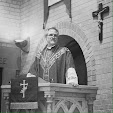
As a funny side note, I just had to wear something on my left hand during the interim.  After 19 years, my wedding-ring finger felt downright indecent being publicly unclad.  So I brought out my old class ring from Walsh Jesuit High School and placed it on my wedding finger.  This turned into a display of the divine sense of humor.  While I was saying Mass at the altar with my hands held up in the "orans" (praying) position, I saw, out of the corner of my eye to the left, the coat of arms of St. Ignatius of Loyola, the founder of the Society of Jesus (the Jesuits) on my left hand.  In my right periphery, I espied the statue of Bl. Martin Luther, the leader of the Evangelical Catholic reform movement (the Lutherans) on my Concordia Theological Seminary class ring on the other hand.

This called to mind the old joke:
A Roman Catholic boy asked his pastor the difference between the Dominicans and the Jesuits.  The priest replied: "The Dominicans were founded to get rid of the Albigensians.  The Jesuits were founded to get rid of the Lutherans."  The boy asked: "Which order is better?"  "Well," retorted the priest with a sly grin, "how many Albigensians have you met?"

Ignatius of Loyola
Martin Luther


At any rate, "Thank you" to Hamilton Jewelry!  If any FH readers are looking to buy jewelry or have something repaired (or even designed from scratch!), I think their honesty and integrity speaks volumes!  There are indeed more quality jewelers with integrity and top-notch customer service in the Gretna area than there are Albigensians.

19 years and still going strong!  

Friday, April 05, 2013

Two Perspectives on Life


(use the cc button at the bottom to turn on English subtitles)


John 13:35


HT: Lew Rockwell blog.

Wednesday, April 03, 2013

Shoe Repair Shop Fixes Bible!


There is a local shoe repair business in Gretna that Mrs. H. and I have been frequenting for many years: Moran's, located at 301 Westbank Expressway.

It is a husband and wife business run by C.J. and Mary Moran.  They always give prompt, courteous and professional service.  They have facilitated the near-miraculous reincarnation of my loafers many times beyond their normal lifespan with sole and heel replacements - as well as repairs to the stitching.  They have also provided Mrs. H. with countless heel tips for her boots and shoes. 

I want to give C.J. and Mary a public pat on the back for going "above and beyond."  I have a pocket-sized leather-bound ESV Bible that I bought while I was still a seminarian.  It has given me years of excellent service.  There is, however, a weak link: the leather strap that holds the bible closed.  It had frayed to the point of wearing out.

The bible really needs a way to hold it closed.  I could not find a good solution.  I certainly did not want to discard the Bible.  I'm always loathe to do so as this is God's Word.  Moreover, I like it.  It is "comfortable."  It is also well-made.  Aside from the Achilles Heel of the strap, it could last for decades more.  It has already been with me my entire ministry, from my vicarage in South Carolina, to teaching and pastoral work in New Orleans, and on planes, trains, and automobiles across North America for private meditation and public lecture.  It even went with me to Russia two years ago - from Moscow to the mountainous Republic of Khakassia in Siberia just north of Mongolia.  In fact, my colleague, the Rev. Dan Johnson, made use of it in the pulpit of St. James Lutheran Church in Novokuznetsk where he preached a sermon.  This proclamation of the Word of God and the open carrying of an English Bible by an American clergyman would have been unthinkable only twenty years ago.  My little globetrotting ESV has quite a story, and it is clearly not finished yet!

Looking for a solution, I took the Bible to Moran's.  Mary looked it over, and said that she could replace the leather strap and have it for me within a week.  It would cost me the princely ransom of $8.95 plus tax.  I was thrilled!

She actually called me back about an hour later to let me know the job was done.  I picked it up right away, and it looks great!  She has breathed new life into this little Bible.  I wonder how many other shoe repair businesses would have just automatically said "no."  Mary Moran didn't!  She thought outside the box and found a way to meet her customer's needs.  That, to me, is the greatest argument for a free market: everybody wins and the standard of living improves for all involved.  And it also gives us the opportunity to serve our neighbor and glorify God by our life and work.

So way to go C.J. and Mary!  You will certainly see us the next time our loafers and heels need to be born again.  If you live in the area and are looking for prompt and quality shoe repair service, I heartily recommend Moran's!

Sunday, March 31, 2013

New Salem Pics Uploaded!


Here is the link to the album of today's Easter pictures.

Christ is risen!  He is risen indeed!  Alleluia!

Accidental Kitchen Sink Engine

Sermon: Easter – The Resurrection of our Lord – 2013


31 March 2013 at Salem Lutheran Church, Gretna, LA

Text: Mark 16:1-8 (Job 19:23, 1 Cor 15:51-57)

In the name of + Jesus.  Amen.

Christ is risen!  He is risen indeed!  Alleluia!

Dear brothers and sisters in Christ, the Marys went to the tomb that first Easter morning as the sun rose, bearing spices and oils with the intention of slowing down the corruptibility of death.  For in our fallen world, bodies break down very quickly upon dying.  Our sinful flesh rapidly begins its journey back to dust.  And the best we can normally do is to delay the process a bit, or at least cover up the effects long enough to show our respects to the deceased.

In love and respect for their seemingly-defeated Master, they came to perform this one last act of mercy.

But instead, the tables were turned.  For it was Jesus who went on the offensive against death, corruption, and decay, not merely in a cosmetic way, but in a cosmic way.  It was the risen Lord who has come to perform a universal act of mercy, halting the corruptibility of the Marys and of all believers, by dying for our sins and by rising again to blaze the trail to eternal life.  And our Lord Jesus Christ does so in a way that no application of spices and oils could ever do. 

For “when the perishable puts on the imperishable, and the mortal puts on immortality, then shall come to pass the saying that is written: ‘Death is swallowed up in victory.’  ‘O death, where is your victory?  O death, where is your sting?’”

Death is a formidable foe.  But death has been in God’s crosshairs since that fateful day when the serpent overcame humanity by means of a tree.  And now, the Lord Jesus, in His own humanity, overcame the serpent by means of the tree of the cross.  And indeed, now death is swallowed up in victory.

The Marys discovered to their astonishment (and to their salvation) an empty tomb.  In spite of the warnings of the Jews and the military guard of the Romans to appease them, the grave was wide open.  There is no force on earth that could contain the Word of God made flesh.  The sealing boulder had been rolled away like a pebble.  And instead of the decaying body of their crucified friend, they saw an angel in the form of a vibrant youth lounging in a white robe.  They were understandably alarmed.  The Greek word can also be translated as “astonished” or maybe even more colloquially as “gobsmacked.”  This is not what they expected to see when they made that early Sunday morning walk laden down with spices and oils.  Not what they expected at all.  And their minds were now racing to make some sense of it all.

The angel sitting in his robe says bluntly to them: “Do not be alarmed.  You seek Jesus of Nazareth, who was crucified.  He has risen; He is not here.  See the place where they laid Him.”  Then the angel reminds them that Jesus predicted this all along.  And the angel gives them instructions to take this good news to Peter and the disciples – who in turn would take this gospel to the very ends of the earth, their proclamation continuing to reverberate throughout the entire world to this very day.

For we continue to ask rhetorically with St. Paul: “O death, where is your victory?  O death, where is your sting?” 

The spices and the oil were not to be used for embalming on that day, dear friends.  Perhaps they were used to prepare a feast instead.  The Marys were not to clean and treat a dead body on that day.  Instead, their own mortal bodies were given proof that they too would rise because of their Redeemer.  For the Marys, and indeed, all believers had “put on immortality” thanks to our Lord’s final and eternal victory over the grave, over corruptibility of the flesh, over sin, and over our ancient serpentine enemy, the devil.

For that is the meaning behind the empty tomb.

“For I know that my Redeemer lives….  In my flesh I shall see God.”  Indeed, “death is swallowed up in victory.”  In our flesh we shall see God in the flesh, the God who takes flesh, the God who comes to us in His flesh, the God who continues to give us His flesh and blood “for the forgiveness of sins.”

There is nothing more repugnant to the devil, who lacks flesh, than the fleshly Christ who redeems our flesh by offering His own flesh to us fleshly men out of love.  Satan has no concept of love, no concept of flesh, and no longer any dominion over us!  For in being baptized into Christ, His empty tomb is our empty tomb, His resurrection is our resurrection, and with St. Paul, we cry out: “Thanks be to God, who gives us the victory through our Lord Jesus Christ.”  His victory is truly our victory!

Dear brothers and sisters, it is AD 2013, and the tomb of Jesus of Nazareth, the Christ, is still empty.  Death is still swallowed up in victory: His victory and our victory.  He has taken our punishment once and for all; He has shed His blood to redeem us; He has won the battle for us, and now He gives us His own body and blood as a ransom of our own bodies so that we too might put on the imperishable.  He is our Redeemer.  He is our Savior.  He is our victorious Lord and Master.  He has risen, never more to die!  And He shares this incorruptibility and eternal life with us by grace, through faith, in His name and by His Word.  It belongs to the Marys and it belongs to us!

This is the greatest news of all, dear friends.  Jesus has won the battle, and has done so on our behalf.  He has triumphed where we and all of our ancestors have failed.  He has slammed the door on death itself, and has rolled way the stone that holds us in bondage to sin and beholden to the grave.  And as the angel told the Marys, we have no reason to fear: neither death, nor the devil, nor the grave.

Do not be alarmed.  He is risen.  He is not in the tomb.  Death is swallowed up in victory.  For I know that my redeemer lives. 

Christ is risen!  He is risen indeed!  Alleluia!

His
on the sickness of sinto the next - and d w liars and sons of the devil, tament, a bloodye people on In the name of the Father and of the + Son and of the Holy Spirit.  Amen.

Saturday, March 30, 2013

Sermon: Funeral of Robert Bealer


30 March 2013 at Salem Lutheran Church, Gretna, LA

Text: John 10:14-15, 27-30 (Rev 7:9-17, Rom 8:28-39)

In the name of + Jesus.  Amen.

Dear Claire, Amie, Jennifer, Robert, Charles, Christa, Michael, family, friends, brothers and sisters in Christ, and honored guests, peace be with you!

Today is Holy Saturday, a day of “now” but “not yet.”  For on this day, Christians around the world are caught in the middle of two extremes of sadness and joy.  We have commemorated the Lord’s crucifixion on Good Friday, in which our blessed Lord declared victory over death and the grave by crying out: “It is finished!” – and yet, on the day after Good Friday, He lies in a tomb awaiting His resurrection.  The Creator who created the world in six days takes His Sabbath rest in the tomb, and on the eighth day, the first week of the new creation, will rise again in glory to claim His victory to the world.

This “now” but “not yet” is where Robert is right now.  For Robert has borne his own share of crosses, of sorrows, of suffering in this fallen world.  And indeed, “now” he rests in peace, taking His place as a baptized child of God called to his heavenly home, but “not yet” being raised bodily from the dead.

Dear friends, we find ourselves in this same Holy Saturday no-man’s land, caught between the “now” of the cross, of our baptism, and of the promises of God in Christ, and the “not yet” of our own “resurrection of the body and the life everlasting.”  We also seem to be stuck between the “now” of life in this fallen world – a vale of tears, a world of mourning and loss, of pain, suffering, struggle, and yes, our own deaths – between this “now” and the “not yet” of the promised world to come, in which we will surround the throne of the Lamb rejoicing and “crying out with a loud voice, ‘Salvation belongs to our God who sits on the throne, and to the Lamb!”  Our dear brother Robert has preceded us to this heavenly banquet where, “They shall hunger no more, neither thirst anymore….  For the Lamb in the midst of the throne will be their Shepherd, and He will guide them to springs of living water, and God will wipe away every tear from their eyes.”  For Robert, this is an eternal “now,” even though for us, it is a promised “not yet.”

Robert has this existence in eternity not owing to his own goodness.  For nobody is perfect.  We are all poor, miserable sinners, none righteous, no not one.  We are all sheep that have gone astray, all of us are condemned to death by virtue of our own iniquities.  For the wages of sin is death.  It was because of our iniquities that our Lord was crucified and suffered death for us.  And when, in His death, He was pierced for our transgressions on Good Friday, water and blood flowed from the side of His sacrificial body.  Dear friends, Robert was washed in that baptismal water, and partook of that saving blood, and lives forever in the promise of one who has eaten the saving body of Christ, taking part in that cosmic sacrifice of the Lamb who bears the guilt of our sins unto forgiveness and eternal life.

And starting tonight, Christians around the world will joyfully proclaim the resurrection of our Lord.  And because He lives, Robert lives!  For just as I read to Robert only hours before he left this side of the grave, it was our once-dead and now risen Lord Himself who promised: “I am the Good Shepherd.  I know My own and My own know Me, just as the Father knows Me and I know the Father; and I lay down My life for the sheep.  My sheep hear My voice, and I know them, and they follow Me.  I give them eternal life, and they will never perish, and no one will snatch them out of My hand.  My Father, who has given them to Me, is greater than all, and no one is able to snatch them out of the Father’s hand.  I and the Father are one.”

Dear brothers and sisters, no one is able to snatch the Lord’s redeemed out of His nail-scarred hands that have rescued us, that embrace us, and that protect us from the assaults of the devil, the fallen world, and even our own flesh.  Robert is one of the Lord’s sheep, marked with the sign of the cross and forgiven of all his sins, all by the work of our Lord on the cross, and given to him as a free gift through the Lord’s ministry of Word and sacrament.

It was my great privilege to give Robert this good news of Jesus Christ and to share with him the body and blood of the Lord over the course of many years.

And this is how even in the face of death, even in our sadness and mourning, even in our own mortality, we can proclaim with St. Paul: “We know that for those who love God all things work together for good, for those who are called according to His purpose.”

And we are comforted by the words of the holy apostle: “What then shall we say to these things?  If God is for us, who can be against?.... Who shall separate us from the love of Christ?  Shall tribulation, or distress, or persecution, or famine, or nakedness, or danger, or sword?”

Paul answers his own question: “No, in all these things we are more than conquerors through Him who loved us.  For I am sure that neither death nor life, nor angels nor rulers, nor things present nor things to come, nor powers, nor height nor depth, nor anything else in all creation, will be able to separate us from the love of God in Christ Jesus our Lord.”

This promise is for Robert, dear friends, and it is for all of us who likewise confess the faith once delivered to the saints.  For us, Holy Saturday bridges the gap between Good Friday and the Easter that is sure to follow.  For in Christ, life is wrenched from death, and death itself is swallowed up in victory: Christ’s victory, Robert’s victory, and our victory!

We are indeed in that Holy Saturday gap between the “now” and the “not yet.”  But we have the promises of the Risen Christ, dear friends, and we have the testimony of His empty tomb.  

Tomorrow, we will rejoice in the resurrection of our Lord Jesus Christ, Robert’s Good Shepherd who promises eternal life to Robert and all who believe.  And let us join Robert and all the saints gathered around the throne of the Lamb to sing their unending hymn: “Amen!  Blessing and glory and wisdom and thanksgiving and honor and power and might be to our God forever and ever!  Amen.

The peace of our Lord Jesus Christ be with you all, now and forever.  Amen. 

His
on the sickness of sinto the next - and d w liars and sons of the devil, tament, a bloodye people on In the name of the Father and of the + Son and of the Holy Spirit.  Amen.

Friday, March 29, 2013

Sermon: Good Friday - 2013


29 March 2013 at Salem Lutheran Church, Gretna, LA

Text: John 18:1-19:42 (Isa 52:13-53:12, 2 Cor 5:14-21)

In the name of + Jesus.  Amen.

“His appearance was so marred beyond human semblance.”  “His form beyond that of the children of mankind.”  “No form or majesty.”  “No beauty.”  “Despised and rejected.”  “Man of sorrows.”  “Acquainted with grief.”  “Men hide their faces.”  “Despised.”  “We esteemed Him not.” 

“Stricken, smitten by God, and afflicted.”  “Pierced.”  “Crushed.”  “Chastisement.”  “Wounds.”  “Iniquity.”

“Oppressed… afflicted… slaughter.”

“Oppression and judgment… He was taken away… Cut off from the land of the living.”

“Stricken.”  “Grave.”  “Death.” 

“Yet it was the will of the Lord to crush Him.”  “Grief… offering… anguish.”  “Poured out His soul to death… numbered with the transgressors… bore the sin of many.”

These are hardly the word-pictures of one who has triumphed, of a hero, a rescuer, the King of kings and Lord of lords.  This is the last thing one would expect of God in the flesh, the conquering general who has crushed the head of the source of all evil forever.  Instead, these are disturbing images of torture that one might expect in a dungeon, the fate of a horrific criminal suffering under the oppression of sadistic criminals in a horrific and oppressive justice system.

Dear friends, that is what Good Friday is all about.  The prophet Isaiah paints a picture that is disturbing and repulsive, right out of our worst nightmares, something that could only have been dreamed up by the most deranged and evil people who ever lived.

For that is what we are.  We are those who delivered the blows upon the innocent Jesus, by our sins in thought, word, and deed; by our sins and iniquities by which we have offended God.  We surely deserve punishment both temporal and eternal.  And that punishment is laid out for us in shocking graphic imagery by the holy prophet, “the holy, innocent, bitter sufferings and death” of the Lord’s beloved Son, Jesus Christ.

It is enough to make us hate ourselves and the sin-laden world we inhabit with billions of others just as deranged, disturbed, demented, and death-destined.  It is enough to make us lose hope.

But dear friends, hope is exactly why this terrifying prophecy was fulfilled in Christ.  All of the punishment we deserve was diverted to Jesus, to the suffering Servant, to the Lamb of God pure and holy, to the Atonement, the Sacrifice, the Scapegoat, to Him whose love controls us.  The cruel passion and scandalous death of our Lord Jesus Christ is not a random act of meaningless violence, but rather the supreme act of love by the Supreme God who is Love in the very flesh, a flesh that was “pierced for our transgressions,” and “crushed for our iniquities.”  For “all this is from God, who through Christ reconciled us to Himself and gave us the ministry of reconciliation; that is, Christ was reconciling the world to Himself, not counting their trespass against them, and entrusting to us the message of reconciliation.”

Reconciliation.

The ancient enmity between God and man has been ended by  God who is a Man, a Man who is God.  The punishment demanded by divine justice was absorbed and fulfilled by divine mercy.  The blood that had to be shed to pay the penalty was paid by our Lamb, for “He died for all.”

The Lord Jesus endured a heart-wrenching betrayal to save us.  He allowed Himself to be taken into custody – even though the mention of our Lord saying “I am” hurled His captors to the ground by the sheer power of His Word, and by the divine revelation of who he is.  He endured this to rescue us.

He allowed Himself to be bound and marched to kangaroo religious trials even as the wicked so-called high priest Caiaphas was to prophetically declare that Jesus is that “one man” who “should die for the people.”  He suffered exactly that for us.

Our Lord was denied, struck, tried in a civil case under the mighty and cruel Roman Empire.  He was again betrayed, this time by a mealy-mouthed politician.  He was passed over and sacrificed by the people for the sake of releasing a terrorist whose name ironically means “son of the father.”  He was flogged.  He was mocked.  He was crowned with thorns.  He was exposed for ridicule in His suffering.  And He did all of this so that we, who deserve the treatment He received, might be reconciled to God.

He was condemned.  He carried His own cross.  He was crucified.  And though He was, is, and ever shall be, our true King, He was treated as an impostor by the real impostors.  Even His only remaining possessions, His clothes, were stolen and made the object of a dice game.  He was reduced to poverty in order that we might be rich.  He suffered anguish so that we might be spared.  He permitted Himself to taste the bitterness of death so that we might savor the sweetness of life.

“It is finished,” He proclaimed, fulfilling the demands of God’s perfect law.  And even in death, He was still saving us by freely lavishing upon the world His atoning blood and saving water as He was indeed “pierced for our transgressions.”

And in a final act of humiliation in which was mankind’s redemption, the Lord Jesus was put into a borrowed tomb, where His lifeless corpse awaited a visit from the Marys, to be given one last act of kindness in the form of treating the body, an act that turned out differently than they expected.

For even though the universe-shattering events of these few days in April nearly two millennia ago were prophesied by Isaiah seven centuries prior, it is still shocking and surprising to us, still appalling to our ears, and yet music to our desperate and dying souls.

No, dear brothers and sisters in Christ, this is no random act of violence, but rather a carefully planned act of love, a heroic rescue, a redemption beyond that which any mere human author or tale-teller can come up with.

For “behold My Servant shall act wisely… high and lifted up… exalted.”  “So shall He sprinkle many nations; kings shall shut their mouths because of Him.  “The will of the Lord shall prosper in His hand.”  “He shall see and be satisfied.”  “Many to be accounted righteous.”  “He… makes intercession for the transgressors.”

This is the imagery of victory, of healing, of reconciliation, of the destruction of death.  These are word-pictures of love, of mercy, and of everlasting life.

“For the love of Christ controls us.”  “If anyone is in Christ, he is a new creation.  The old has passed away; behold the new has come.  All this is from God.”

“Therefore,” we preachers repeat to the beloved people of God, people redeemed by Christ Jesus, in the very words of St. Paul, “we are ambassadors for Christ, God making His appeal through us.  We implore you on behalf of Christ…”  “We implore you on behalf of Christ, be reconciled to God.  For our sake He made Him to be sin who knew no sin, so that in Him we might become the righteousness of God.”

We implore you, dear friends, on behalf of Christ, be reconciled to God.  For we know what is coming.  We forgiven sinners loved by God know the great surprise that awaited the Marys.  And with our fellow redeemed around the globe, we wait in joyful hope and expectation to see what they saw. 

“It is finished.”  Amen. 

His
on the sickness of sinto the next - and d w liars and sons of the devil, tament, a bloodye people on In the name of the Father and of the + Son and of the Holy Spirit.  Amen.

Thursday, March 28, 2013

Sermon: Maundy Thursday – 2013


28 March 2013 at Salem Lutheran Church, Gretna, LA

Text: John 13:1-15, 34-35, Ex 12:1-14, 1 Cor 11:23-32

In the name of + Jesus.  Amen.

The true story of a daring rescue in space was told in the 1995 movie Apollo 13.  In the face of life-threatening mechanical problems, the flight director on earth rallied his team by saying: “Failure is not an option!”

When something is not open to choice one way or another, we say it is a “mandate” or we might say that something is “mandatory.”  It is not an option.

Today is Maundy Thursday, and the title of this holy day is based on the Latin word translated as “mandatory.”  And it is a curious name for something as gracious as the Lord’s Supper.  But it comes from our Lord’s remarks after He demonstrated in a shocking way what it means to love.  In this poignant act, the Lord Jesus, the Almighty God, the King of the Universe, the One who is the Word Made Flesh whose breath called all things into being, stripped off His clothing, knelt on the floor and washed the filthy feet of his disciples, wiping them up with a towel.

Peter was shocked, scandalized even, by this humble act of mercy, and it took words of wisdom from the Word who is Wisdom Himself to get Peter to humbly receive this grace and this surprising act of love.

And here is where the word “mandatory” comes into being.  Jesus said: “A new commandment I give to you, that you love one another: just as I have loved you, you are also to love one another.”

A commandment is not a choice, not a preference, not something we do if we feel like it.  A commandment is not an option.  “Love one another.”

The Lord Jesus performed this act of love after He “rose from supper.”  And this was not just any supper, it was the Lord’s Supper, the final Passover in which the True Lamb appeared in space and time, in the flesh, the reality foreshadowed by thousands if not millions of sacrificial beasts whose blood was shed, pointing to this one final and all-availing sacrifice of our Lord Jesus on the cross as the full atonement for our sins.  For what the apostles “received from the Lord,” they have delivered to us, “that the Lord Jesus on the night when He was betrayed took bread, and when He had given thanks, He broke it, and said, ‘This is My body which is for you.”  And after giving them, and us, this most infinite and miraculous gift, He made this mandatory for us by commanding us: ‘Do this in remembrance of Me.’  “In the same way also He took the cup, after supper, saying, ‘This cup is the new covenant in My blood.’”  And again, the Lord mandates: “Do this, as often as you drink it, in remembrance of Me.”

This command to “take eat” and “take drink” is part and parcel of the command to love one another.  For that phrase “one another” is an expression of unity, of community, of communion.  It is fellowship, an act of participation.  It is the community meal of brothers and sisters who love one another.  And this meal is a miraculous meal, for it is, not that is symbolizes or represents, but is the participation in the Lord’s body and blood according to His universe-creating Word.  And when it comes to the Word of God, failure is not an option. 

The Lord also mandates that we who join in this Holy Communion “examine” ourselves.  We are to honestly consider our sins.  For when it comes to our spiritual condition on this fallen planet, failure is our only option.  We are damaged goods living in a damaged world.  And like the crew of the Apollo 13, we are hurling through space on this once good, but now broken, vessel traveling at thousands of miles an hour, reeling out of control for a sure destruction unless we are saved by someone from the outside.  And what’s even better, dear brothers and sisters, our Savior comes to us to rescue us.  He takes flesh and blood in space and time.  He offers His flesh and sheds His blood in space and time.  And He continues to come to us in His flesh and blood in space and time – under the forms of the Paschal bread and wine, the meal of the Passover, brought to fullness and completion “for us men and for our salvation!”

And when it comes to this rescue mission, failure is not an option, because our Lord is both almighty and all merciful.  He has come to save us.  He has come to offer His body and blood.  He has come to wash us in baptismal water.  He has come to serve, not to be served.  And indeed, He has set an example of the conduct that proclaims Him in this fallen world.  For in keeping this mandate to love one another, our Lord says emphatically: “By this all people will know that you are My disciples, if you have love for one another.”

This familial love among brothers and sisters in Christ is a witness before the world of the love of Christ Himself.  It is an invitation to be washed clean by Jesus, to participate in His saving action on the cross, to come to His table to commune with Him and with one another in this one eternal “memorial day” – for we have been mandated to “keep it as a feast to the Lord” throughout our generations, “as a statute forever, you shall keep it as a feast.”

It is not an option.  It is a mandate.

But, dear friends, this is no work of drudgery.  This is not a command like paying taxes or cleaning our rooms.  This is a loving command, an invitation to receive the love of Christ, and then to share that love of Christ, by Christ, through Christ, and to the glory of Christ and of His Father.  For like a cup that is filled to the top, it begs to be poured out again, even as Christ was poured out for us as a final and eternal sacrifice, even as His cup is poured into the mouths of His rescued people day after day, week after week, year after year, and century after century, proclaiming the Lord’s death “until He comes.”  Indeed “Forever, you shall keep it as a feast.”

Failure is not an option!

The Lord has come into our world to save us, redeem us, love us, recreate us, give us life, and set us at liberty – just as the children of Israel made their exodus from slavery in Egypt, and just as the crew of the Apollo 13 were given the gift of life anew as they were safely brought home and rescued from the jaws of certain death that lurked over every inch of that space-and-time odyssey back to earth.

And this holy blood signifies to the angel of death to pass over.  “And when I see the blood, I will pass over you, and no plague will befall you to destroy you.”

This promise of rescue, of salvation, of life is given to us, dear friends, for the Passover celebrated to the children of Israel is the foreshadowing of our own saving paschal feast of the Lamb, as His blood marks the doors of our hearts so that death itself is not an option.

And though we fail in our obligations, dear friends, let us take comfort that our Lord never fails.  His love never fails.  His mercy never fails, for it endures forever!  The body and blood of our Lord never fail.  Baptism never fails.  Absolution never fails.  Forgiveness, life, and salvation never fail!  And this is all true because for our Lord, our merciful rescuer, the One who calls all things into being, “failure is not an option.”  Glory and honor, thanks and praise be to our Paschal Lamb, the One who loves us in His infinite mercy, forever and ever.  Amen. 

His
on the sickness of sinto the next - and d w liars and sons of the devil, tament, a bloodye people on In the name of the Father and of the + Son and of the Holy Spirit.  Amen.

Friday, February 15, 2013

Meteorite Lands Near Chelyabinsk


Here is the account of today's extraordinary meteorite strike in Chelyabinsk, Russia.

The meteorite was the size of a bus, and it landed in ice near the city.  It nearly missed landing in Lake Cherbakul.  This happened in broad daylight, and the meteorite left a contrail as it broke apart, leaving debris and at the end of its journey, a crater.

The velocity of the rock (estimated at 20,000 mph) created a sonic boom that blasted out windows.  This is what caused most of the injuries, now estimated over 1,200.

Russia Today also has reports here, here, here, and here.

I have friends and colleagues in Chelyabinsk.  I sent a facebook to Father Vladislav Ivanov, the pastor of Holy Spirit Lutheran Church, as well as to Bishop Vsevolod Lytkin (the Siberian Evangelical Lutheran Church's bishop) and Deacon Victor Shtraube.  I heard back from Father Vlad:
"Father Larry, all is well. No one is hurt. Many broken windows. We saw everything. Drinking coffee in the kitchen, flash, and big explosions. Mobile communication was bad. How will the news, I'll write. Thank you for your prayers."
Bishop Vsevolod also replied:
"Dear father, everything is OK with our Church people... as with most of people in Cheliabinsk. There about thousand persons are injured but not hard. Mostly people are hurt by pieces of glass windows. By the big grace the meteorite fallen down near the chemical plant, but not into. If it fallen into... then it could be big ecological catastrophe. But the meteorite just broke the fences and walls of this chemical plant. And fallen down into a lake." 
'via Blog this'

Tuesday, February 12, 2013

Another Primal Success!


Read here for an epic primal success story.

Heath is a 35 year old self-described former "doughnut eating cop" who, in six months, went from 299 pounds, wearing size 42 pants, carrying 40% body fat, to 206 pounds, size 32 pants, and 17% body fat.

Heath explains how two of his friends lost a combined 70 pounds in two months - which mirrors my own timeframe and weight loss.  Anyone can do this.  And it is worth it!

With Lent starting tomorrow, a person could be looking at a virtually new body in the mirror, with more energy and greater overall health by Easter.

Monday, February 11, 2013

Secession, Freedom, and the "Impossible"


[The heroic dissident Vladimir Bukovsky wrote about the changing attitudes by 1970 in the USSR, approximately 20 years before the collapse of the Union, from page 353 of  To Build a Castle: My Life as a Dissenter, Viking Press, New York, 1979. - Ed.]

"There had been quite an upsurge in national movements during my absence [incarceration].  They were extremely varied and even had different external aims.  The Meskhetians and Crimean Tartars, for instance, who in Stalin's time had been forcibly deported from their homelands to Central Asia, were trying to obtain the right to return home.  The Jews wanted the right to go to Israel, the Volga and Baltic Germans to Germany.  The Ukrainians, the Caucasians, and the Baltic peoples wanted secession, national independence, and the right to a national culture.  Five years before, the mere mention of national independence or the right to secession would have been sufficient to guarantee you fifteen years for 'high treason.'  And leaving for abroad was still regarded as treason.  But citizens who had resolved to submit to their conscience instead of their Party card were beginning to force their own reality upon the state.

"This wasn't a political struggle, there were no heroics.  It was like a 'club of the sane' in a lunatic asylum.  All that was left to us was to be normal people....

"Here there was no right, left, and middle of the road.  Everyone had been made equal by the Soviet concentration camps.  Just as before, there were no leaders and led, no pushers and pushed, no rules and regulations - only it was easier, much easier.  There were more people, there was more publicity, and the people came from higher up the social scale: professors, academicians, writers - not to be compared with us striplings of the early 1960s.  Rights were now claimed on the spur of the moment, and yesterday's 'impossible' was a commonplace today."

Tuesday, February 05, 2013

Bye Bye Babylon


The perfect rock anthem for 8-year old Legomaniacs (and Russian priests...).

Wednesday, January 09, 2013

The Sons of Confederate Veterans


I had a blast from the past a couple days ago.

I got a call from Pat, an old friend from about 15 years ago. He and I were members of the same Sons of Confederate Veterans camp when we lived in Pennsylvania. Pat was a teacher and did a stint working in law enforcement. He is now retired. Unbeknownst to me, Pat had done some traveling in Russia, and has even been farther east than I was last year during my visit to Siberia! He is thinking of moving to Russia to teach English, and I was able to link him up with some of my friends in the Siberian Evangelical Lutheran Church. 

We had a great chat, and it reminded me of the many wonderful friendships and contacts I have made over the years in the SCV. I met Compatriot Nelson Winbush (in the above video) whose grandfather actually rode with General Nathan Bedford Forrest. I met one of the last living Confederate widows, and one of the last living Union widows (whose husband was a freed slave). I met a lady whose father saw the body of Jesse James shortly after he was shot. I met "real sons" whose fathers were Confederate soldiers - a link in our history that is quickly dying off. I met compatriots from every walk of life, men of every ethnic background, men from every religion and political stripe who are united in their desire to honor their ancestors who fought for the Confederate military forces in the War for Southern Independence of 1861-1865.

My own ancestors in the 25th Virginia Infantry were prisoners of war at the notorious Point Lookout prison in swampy Maryland - which was more like a concentration camp than anything else. One of my uncles (Richard J. McLaughlin) died a POW at the age of 23 - yet still a veteran of nearly every major engagement of the Army of Northern Virginia - being wounded and twice captured.  He died of pneumonia because he was treated in a tent, while a world-class hospital (for Union soldiers) was literally yards away from where he was allowed to die.  His brother (James B. McLaughlin) survived Point Lookout and was sent to the equally inhumane and horrific Elmira prison in cold upstate New York.  He survived and lived to be 97 years old.

Ironically, I was much more active in the SCV when I lived in Pennsylvania. I served as a camp commander for two terms of the J.E.B. Stuart Camp 1506, which I helped become an active camp. I briefly served as the founding commander of the fledgling W. Baxter Perkinson Camp 1926 as well. Today, Pennsylvania has a Division within the SCV organization - which was founded in 1896 as an auxiliary to the veterans' organization, the United Confederate Veterans (see this great New Orleans UCV connection!). There is no local camp of the SCV in Gretna - although even if there was, I would not likely have the time to be very active. We have a local chapter of the United Daughters of the Confederacy in Gretna, and at least two of my parishioners are members, as are several prominent ladies from Gretna. I have been invited to attend meetings, and even to give a presentation, but alas, the UDC meets on the same day as the David Crockett Fire Company No. 1, whom I serve as chaplain (which, interestingly, formed a Confederate militia unit at the beginning of the war!). In spite of not being very active in the Sons, I still hold membership and receive the outstanding Confederate Veteran magazine.

 It was great to hear from you, Pat!  Deo vindice!

Tuesday, January 08, 2013

Do They Own Us and Our Children?


The above comedy video by Christian humorist Tim Hawkins is a self-parody of homeschooling. There is some truth in this little video, though (like all good humor) it is exaggerated and blended with stereotypes and misconceptions.

A relative recently decided to start homeschooling, and found out the snarky attitude of some of the establishment, one of whom told her that she "needed permission" to do it.  Now, in her locale, this permission consists of basically notifying the government with a simple letter.

This is basically the case in Louisiana - which is quite a homeschool-friendly state. Nevertheless, the fact that one has to petition the state to homeschool one's children does raise the question: "Why?" What is it any business of a bureaucrat - be it in Baton Rouge, Washington, or Geneva? Why should we seek their permission - especially considering the track record of a lot of these government schools (some of which allow children free access to contraception without parental notification, many of which allow for pseudo-religious indoctrination which may run contrary to the parents' religion, not to mention the foisting of a political point of view at odds with those of many people who do not agree with the dominant views of many in the educational establishment)?

So why should parents seek permission from the state? Why should it not be the other way around? Does the state own our children?  Does the state own us?

Why shouldn't the default position be that the parents have the right to educate their children as they see fit, and that the state should seek permission to indoctrinate the children? Or as member of the European parliament Nigel Farage famously challenged his power-grubbing "colleagues" in Strasbourg: "Just who the hell do you people think you are?"

The more people start asking these fundamental questions, the more people realize that the state has long since overstepped its bounds, that the servant now presumes to be the master, that the Frankenstein Monster is running amok and the constitutional chains that were designed to keep him in tow have been snapped like balsa wood, and that it doesn't matter whether the state is a democracy, a republic, a monarchy, or a dictatorship, it is wrong for any agency to presume to tell parents how to raise their children.  And if the state's wings were not still somewhat clipped as they are here, we would have a system like Germany and Sweden where homeschooling has been basically criminalized, and children have been taken away from their parents!  Think about that, dear reader, children have been taken away from their loving parents and placed into foster homes because the parents were homeschooling their children.  We are not talking about beating them or starving them, but educating them.

Their real "crime" is showing the inferiority of the bureaucratic John Dewey progressive model of "education" as well as taking the (God-given) liberty of handing down their own moral and political views.  In unbridled statist models of society, the state is omnipotent over the individual.  There are some in American capital cities and capitol domes who lust after such power to dominate.

But in the final analysis, who does a better job, the government (with its mercenary armies of paid bureaucrats pulling the strings with money and regulations in the luxury of marbled domed edifices)?  Or parents themselves, who love their children, sacrifice for their well-being, and who have a moral and natural right to teach their values to their children?  And by what authority does the state claim authority to lord over the parent-child relationship?  Just who do they think they are?

Homeschool families often get to see these questions in action, not merely presented as theoretical poly-sci premises for academic discussion, but rather up close and personal in the very real world.

Maybe that's why Tim Hawkins also made this video:


Even the Troupe Can't Help Laughing


A classic SNL sketch in which nobody can avoid cracking up.

WAH-wah......

On Flags in the Sanctuary


The question recently came up in my congregation about the lack of a U.S. flag in the sanctuary of the church.  I did not remove it; my predecessor actually did it years ago, before I was called to my current congregation.

And I support his decision to do so.

Of course, this was not a popular decision at the time.  But pastors are not called to be popular.  And for people who simply want what they want, and who stop up their ears to any explanation, they will simply choose to be angry.  They may even pass along veiled (or not so veiled) accusations of evil motives.  And yet even though I did not always agree with my predecessor in liturgical matters, I know he had no evil intention in making this decision - a decision that had the unanimous concurrence of the Board of Elders.

Everything in the church is about Jesus.  Everything in the sanctuary points us to Jesus.  Art is a powerful communicator of Christ and the Gospel - from the candles (representing the Light of Christ, the Light of the World), to the linen-shrouded altar (representing the empty tomb), to the baptismal font (often eight-sided pointing us to the eight people saved through water in the ark), to the stained glass windows depicting events in the life of our Lord and of the church, to statues and paintings, even to the plants and flowers (reminding us of Eden and of "the Lord and giver of life," everything in the church points us to the Father, Son, and Holy Spirit, and ultimately to the restored communion with the Triune God won for us by the atoning sacrifice of our Lord Jesus Christ.

The pastor's vestments, the symbols sewn on them and on the paraments, the colors used in the course of the year, the advent candles, the art depicted on banners, all point us to Jesus.  Crosses and chi-rhos, alphas and omegas, images of nails and crowns of thorns, even the dignified precious metals used in the communion vessels communicate the holiness of the sacramental reality of the Lord's presence.

Some might argue that Christmas trees and poinsettias and lilies that adorn our chancels are exceptions to this rule, but not so.  The Christmas tree is a tree - symbolic of both the Tree of Life in the Garden of Eden, as well as the Tree of the Knowledge of Good and Evil from which comes all death and misery.  The Christmas tree symbolizes both the manger (the rough-hewn cradle of the Christ child) and the cross (the tree upon which the cursed Man is hanged).  Poinsettias and lilies are both plants that are at the height of their beauty during the holy seasons of Christmas and Easter.  There is nothing more natural and Christ-centered than to bring the beauty of life at the fullness of its vitality into the place where eternal life is given by grace!

The lily, in particular, is sometimes manifested (especially in my region) as a fleur-de-lis.  It is a symbol of Louisiana's French heritage because it is a religious symbol of a people steeped in the Christian faith.  The lily is often symbolic of Easter and the resurrection, also the Blessed Virgin Mary, as well as the Holy Trinity.  It is a symbol of the football team called the Saints because it was first a symbol of Christian sainthood, that is, holiness.

Similarly, the pelican appears on the state flag of Louisiana, not only because these creatures are native to our state, but also because the pelican is a venerable symbol of Christ, based on the medieval fable of the mother pelican giving her life to feed her brood with her own blood (see also LSB 640, stanza 3).  The symbol of our region is so because the people of our region have an ancient Christian heritage.

The Fleur-de-lis and pelicans have been used in Christian symbolism and art for centuries.  There is a rich and deep christology and Trinitarian confession made with these symbols.

So where do national flags come into all of this?

In the vast majority of churches around the world, you will not find a national flag.  Visitors to the U.S. are sometimes shocked to visit churches and find flags adorning the sanctuary.  It sends a mixed signal about what Lutherans refer to as "the two kingdoms" - that is, the Church (the right hand) and the State (the left hand).  In some European state churches, there is a mixing of the two to the point where in England, the head of the Church is the Queen, and where until recently, in Sweden, pastors were paid out of compulsory taxes.

Some brutal regimes forced flags into the churches, such as Nazi Germany, which compelled churches to display the desecrated cross of National Socialism - which was essentially a competing religion of state-worship.  Sadly, many clergy fell for this false religion and its symbols.

Modern Roman Catholic churches do display the coat of arms of the pope - which so happens to be the national flag of the Vatican.  This probably explains why Roman Catholic churches in the United States do often display U.S. flags - as it is a breach of U.S. etiquette (according to the flag code) to display a foreign ensign without a U.S. flag.  Here in New Orleans, the St. Louis Cathedral in the French Quarter - a historic landmark and tourist attraction - actually displays dozens of historic flags that flew over New Orleans - including the official governmental flag of the Confederate States of America.  And even though I enjoy history and have an affection for the Stars and Bars and other symbols of my heritage, I believe none of these flags have a place in a Christian sanctuary.  The Cathedral has an impressive history, but its most important historical connection is to the body and blood of Christ that are physically present on the holy altar - all other history pales in comparison to Him whose incarnation is why we number our years Anno Domini.

The practice of displaying the U.S. flag in Lutheran churches is a recent phenomenon - and it began because during the World War I era (and again during the Second world war) mainstream Americans were harassing ethnic Germans, and the German Lutherans felt compelled to abandon their German language and heritage and to try very hard to show their American patriotism - partially out of fear of being terrorized - as the U.S. was at war against Germany twice in the last century.

The LCMS website addresses this history as well as the overall issue of whether or not having a U.S. flag in the sanctuary is appropriate:
Rev. Prof. William Schmelder, seasoned parish pastor, historian and professor emeritus of Concordia Seminary, St. Louis, has responded to a query from the Commission on Worship regarding this matter:
“To the best of my knowledge, the U.S. flag began appearing in our churches in response to two things: the desire to express an unquestioned loyalty as U.S. citizens (a reaction to WWI sentiment) and the growing sacralization of the flag in U.S. culture. In the history of my home congregation (Immanuel, Bristol, CT), the story of the responses to both WWI and WWII is given in some detail. However, the picture of the church after the renovation in 1948 does not show a flag. There was a flag on the grounds between the church and the school, and it was raised and lowered with considerable ceremony when school was in session. I think that is one response evident in many congregations: we could show our loyalty in many ways without placing the flag in the church; other congregations seem to have brought it into the building itself, with great debate about the proper location (nave, chancel, narthex, etc.).
“Non-Americans are often astounded to see a national symbol in the church (perhaps they have memories of the Nazi flag being touched to the altars of German churches).
“The so-called Christian flag is another matter entirely. It has no tradition of the church behind it. In fact, it violates much of what anyone knows of ecclesiastical heraldry. It seems to be the design of one man, who both drew it and profits from it. He or his heirs still get a royalty on every one sold. People seem to think that you need something to balance the U.S. flag on the other side, so you have a Christian flag.”
Obviously, the inclusion of the American and Christian flags is widespread in the LCMS. As Professor Schmelder mentioned, this probably developed out of the desire of congregations of prominently German-American heritage not to appear German during and after the world wars. Likewise, many veterans of those wars returned with great patriotic zeal, which probably manifested itself in the desire to display “Old Glory” in the sanctuary.
Today, however, it may be time to reconsider this short-lived tradition among us (Lutherans never did this prior to WWI, and then only in America). One may observe that many congregations today, when considering a sanctuary renovation or even building a new sanctuary, will opt to display the flag in a location other than the chancel or nave. Many will place a flag outside of the building proper, or perhaps in the narthex. In such ways, as Professor Schmelder noted, we can demonstrate our patriotism, but not blur the distinction between the kingdom of Christ with the kingdom of the world/government. Our Lord’s words, of course, come to bear on this issue ultimately: “Render unto Caesar the things that are Caesar’s; and render unto God the things that are God’s” (Luke 20:22). Both are good and right … in their respective places and times.
Flags are popular in some cultures, and the United States is one of them.  Flags evoke strong feelings and loyalty to hearth and home.  Soccer fans will often wave flags during matches to show affection for their home countries as they are represented on the field.  The same is certainly true in the Olympics.  Flags are displayed on houses and in various community displays out of love of country.

Flags are so common in the United States that they are beloved and comforting symbols.  They appear at sports events, in military or Boy Scout ceremonies, and sometimes even in ways that it could be argued might not be entirely appropriate - such as on decals on cars and on belt buckles.  Some people want the flag in the church because they like it.  But that fact alone is not justification to include it.  I once had a lively debate with a motorcycle-church pastor who argued that it is appropriate to adorn church walls with exhaust pipes and gas tanks.  How these things point us toward Jesus, I don't know.  There is a difference between a Hard Rock Cafe or a Cracker Barrel (both of which have interesting things hanging on the wall) and a Christian church sanctuary - in which the art exists to point us to Christ.

But there is another context and use of flags: a show of jurisdiction.

For example, a Kentucky State court will display the flag of the Commonwealth as a confession of sorts, that this court is convened under Kentucky (not Ohio and not Indiana) law.  A 1988 movie called Judgment in Berlin is an adaptation of the 1984 non-fiction book of the same name written by a U.S. federal judge named  Herbert J. Stern.  Stern presided over an unusual case in 1978, held on German soil, but because of the way post-war Germany had been divided up by the allies, this trial was held under the auspices of U.S. law.  Juries had been abolished by Germany in 1924, and yet this trial, held in Germany, had to have a jury and be conducted under American law and juridical procedure.  The U.S. flag in the courtroom was not a symbol of patriotism or nostalgic feelings of home - it indicated a legal jurisdiction.

Similarly, ships on the high seas are flagged and are under the jurisdictions of the flags they fly.  

Another example of the jurisdictional use of national flags involves embassies.  The Saudi Embassy, for example, is located in Washington, DC.  But it does not fly the U.S. flag.  Embassies are outposts of the countries they serve, and the Saudi Embassy in Washington is actually "Saudi soil" (not sand in Washington!).  U.S. law does not apply there.  The Saudi flag is indicative of sovereignty and jurisdiction.

In a sense, the church (whose space we sometimes call the "nave" - that is, the "ship") is like a ship or an embassy that flies under its own flag.  Churches, though located in the U.S. or Canada or Russia or Ethiopia - are actually missions or consulates or embassies of heaven.  The sovereign of the Church is not the king or the queen or the president - but the King of Kings, the Lord Jesus Christ, He who said, "My kingdom is not of this world," He who rebuffed Satan's temptations to give Him all of the kingdoms of the world.

And in the west, there is a long tradition of ecclesiastical law (canon law) being applied to the church instead of civil law.  The controversy between King Henry II and Archbishop Thomas Becket began as a dispute over who had legal jurisdiction over priests: the king or the bishop.

Even in funerals of soldiers, the draping on the casket inside the sanctuary is not the national flag, but rather the white baptismal pall.  The flag is placed onto the casket only after the body leaves the church and the casket is being prepared to be placed into the grave.  There is a liturgical break between the rites of the church and the rites of the military.  

Finally, it is important to understand that the Church is universal and transcends nation and tribe.  The Lord reveals His Church to be from "every nation, from all tribes and peoples and languages."  The Church is not contiguous with any national jurisdiction.  And Lutheran Christians can traverse the planet and can feel right at home in the Divine Service in the presence of their brothers and sisters in Christ (in the very presence of Christ) even if the language of the Mass is unknown to the worshiper.  There is no American Church, German Church, Russian Church, Kenyan Church, or Icelandic Church.  There is only one holy catholic and apostolic Church, a "holy nation" that knows no boundaries, but spans the globe and transcends time itself, even unto eternity.

Nations will rise and fall - and they have.  Kingdoms will come and go - and they have.  Flags will be raised and lowered - and they have.  But God's kingdom "shall stand forever!"

Monday, January 07, 2013

Monday, December 31, 2012

Sunday, December 30, 2012

"Better late than never" and a Lesson from the Magnificat


I just got caught up on posting my Advent sermons - from 2011.  As of now, I have 531 sermons posted here on FH.  I am actually only lacking my earliest sermons from vicarage - and I'll get those caught up when I get the proverbial "round tuit."  But I'm really pleased to be caught up to this point.

This is one of those lingering "to dos" that I can now scratch off on the old Moleskine!

Anyway, in last year's Rorate Coeli (Advent 4) sermon, I made an observation about the Blessed Virgin Mary and how Protestants and Catholics squabble over her significance to the Christian faith.  I believe that this matter ought to be put to rest by the Blessed Virgin's own words in the Magnificat - which are God's Words as recorded by the holy evangelist St. Luke (1:46-55).

Here is an except...

There is a belief about Christianity among the unbelievers in Christianity that the first Christian was St. Paul.  What they mean by this is that Paul invented the Christian religion, that the Jesus he preached was not the “historical” Jesus, and that we are really more followers of Paul than of Christ.
This is an interesting theory that awkwardly tries to explain the origin of Christianity.  But if we believe Christianity is true, the question of who is the first Christian becomes interesting.  Some might argue that the first disciple, St. Andrew, was the first Christian.  Others might say that Abraham, as the first man called by God under the old covenant would be the first Christian.  We could even argue that Adam was the first Christian, the first to see God face to face.
It all depends on how you want to define “Christian.” 
The Blessed Virgin Mary was the first human being to be in the physical presence of the fleshly incarnate Jesus, and immediately, she confesses Him as both God and Savior.  In that sense, Mary is the first Christian.  She is not only the beloved mother of Jesus, but also the beloved elder sister of every Christian.  And this young girl, a lay person: not a rabbi or a priest, not an apostle or a pastor, not a deaconess or a professional church worker – blazes a trail for all Christians in confessing the Christ within her very body: “My soul magnifies the Lord, and my spirit rejoices in God my Savior.” 
“God my Savior.” 
Dear friends, this confession of the Blessed Virgin Mary, the mother of God, is the beating heart of the Christian faith.  For the Christ child within her is not only a savior, a prophet, a deliverer like Moses – but He is also God.  And equally important, she is not merely worshiping a God who is afar off, but a God who has come into space and time, becoming an embryo within the womb of His mother – even as have been every one of billions of human beings ever born (with the exceptions of Adam and Eve). 
And notice also that the Blessed Virgin confesses Jesus as not only “God” and as “Savior” – but also as “My.”  For even the devil has to confess the truth that Jesus is God and that He is a Savior.  But Christians also confess the “my” part.  Mary’s threefold confession is a complete confession of Christ: Almighty God, humble human being, our Savior. 
This “first Christian” is utterly unique in all of human history.  For she is indeed as we confess in our Lutheran confessions and with the Church of every age: “holy” and “pure.”  She is the mother of God.  And yet she too needs a “Savior” – a rescuer from sin.  Mary is pure because Jesus has made her so.  Jesus is born because He came to our world through His mother.  God created Mary, the God the Father called Mary, God the Holy Spirit overshadowed Mary with His presence, and Mary conceived God the Son within her womb.  And from this created creature emerges the uncreated Creator.  From one descended from sin comes One who is sinless.  The tiny embryonic Christ child conceived miraculously within the virgin is also the Savior of the Virgin who created for Himself a pure portal into our impure world. 
Christians sometimes squabble over how this can be.  Such arguments happen when fallen man attempts to impose reason on a miracle.  Was Mary conceived without sin?  God did not reveal this to us to be either true or false.  He did something to protect His Son from inherited sin – beyond that, God is silent.  But we know this much: Mary calls her Son her Savior, and Jesus was born of a pure womb.  Rather than argue over dogma, we Christians, like the first Christian herself, would do well to fight less and rejoice more!

"Fight less, rejoice more."  That might be a good New Year's Resolution for each and every member of the One Holy Catholic and Apostolic Church as a witness to this conflicted world.

!שלום   Pax!   !سلام  ειρήνη!  Frieden!  Paix!  ¡Paz!  Мир!  Peace!