Saturday, September 02, 2006

Society of St. Polycarp Retreat

The Society of St. Polycarp had its first retreat this past week. The SSP is a religious Society for traditionalist Lutheran pastors and laymen.

As time came for our planned retreat at Camp Wartburg near St. Louis, a lot of guys had to back out due to family and church emergencies. In fact, I was nearly unable to attend due to the risk of Hurricane Ernesto entering the Gulf of Mexico.

With our dwindling numbers, it made sense to either postpone, or simply move the retreat to the rectory of the Rev. Dave Juhl at Trinity Lutheran Church in Iuka, Illinois.

I'm sure glad we opted for the latter! On very short notice, Father David and his wife Becky (and 2-year old daughter Caty) were most gracious hosts, offering wonderful hospitality: comfortable lodging, excellent food, fine company, and the opportunity for the brethren to carry out Society business and pray together. In addition to Fr. Juhl and myself, Br. Joe Greene and Br. Latif Gaba were also in attendance. Br. Joe brought along organic delectables from his farm, and Br. Latif put together the comprehensive prayer book for our worship (Latif's wife Ruth also brought along her home-made Albanian baklava and chocolate-chip bars (a staple of prairie Lutheranism).

We had the opportunity to pray several of the traditional monastic prayer hours together, including Matins, Lauds, Sext, Vespers, and Compline. We concluded with Mass on Thursday, followed by the traditional Itinerarium prayer. There is simply no substitute for traditional prayer, rooted in the Word of God (especially the Psalms), along with ancient hymns of the Church, including some of the prayers in Latin.

A return to traditional doctrine and forms of worship is the only antidote to the encroachment of the modern and postmodern heresies into the life of the Church. It's high time the Church assert herself and cease and desist bowing and scraping before the false god of Change and dabbling in the Cult of Popularity. The Society of St. Polycarp is certainly a part of that movement - especially among American confessors of Augsburg.

In addition to prayer, we took time to discuss matters of organization for our Society and strategies for the future. We also had discussion about Canadian author Michael O'Brien's apocalyptic novel Father Elijah (which many of us in the SSP have been reading) as well as the consideration of a theological exchange between Dr. Stephenson (of the Lutheran Church - Canada) and Dr. Brug (of the Wisconsin Synod) regarding the theology of the Office of the Holy Ministry.

As my wife and son were present, as were Pr. Juhl's wife and daughter and Br. Latif's wife Ruth, the retreat was largely a family event with lots of time built in to eat together, socialize, and play with the children outside. We enjoyed everything from Italian venison and farm-fresh chicken and eggs to crawfish etoufee and beignets - in addition to "Lutheran beverages." The brethren attended Trinity Lutheran's Wednesday Bible class, and I was able to make a presentation of the work of New Orleans pastors in the aftermath of Hurricane Katrina.

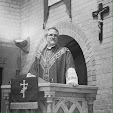
Here are some pictures from the retreat, as well as the text of Fr. Juhl's sermon at the Mass of the Beheading of St. John the Baptist (which we transferred to Thursday). I served as celebrant, and Becky Juhl was the organist.

Anyone interested in the SSP can read the Rule of the Society at www.societyofsaintpolycarp.blogspot.com.

We're already planning next year's retreat, and we are looking forward to a more formal setting with a larger number of brethren taking part.

Ad majorem Dei gloriam!

Sunday, August 27, 2006

Christ Lutheran in Chalmette

I had the honor to lead the Divine Service today at the temporary sanctuary of Christ Lutheran Church in Chalmette. In two days, it will be one year since their building was devastated by Hurricane Katrina. They are still in the process of rebuilding - even as much of St. Bernard Parish (County) still lies in rubble.

To the left is a picture of myself and Leo with Mrs. Ruth Friedrich. Ruth is the wife of the sainted Rev. Martin Friedrich, my colleague in the ministry at Salem whose funeral I served as liturgist this past Friday (see my earlier post). Ruth insisted on playing organ for the service today, and even with a little electronic keyboard, she can really make it sing!

We are certainly privileged to have such stalwart saints as Ruth in our midst, serving Christ and His Church.

Please keep the people of Christ Lutheran in your prayers. They are really struggling, but determined to stay together. They are led by a faithful pastor, the Rev. Philip Miller. Pastor Miller and his wife Monique were at seminary at the same time as Grace and I were. They and their three little children (Isaiah, Grace, and Silas) are committed to stay with this determined congregation. They are currently finishing up some much-needed rest and recreation.

The people of this parish commute from unbelievable distances when it would be so easy to give up. They even share a meal after the service so as not to lose the sense of community that they share with one another. They were so grateful for my filling in for them, and their sense of humor and gritty St. Bernard Parish sense of survival demonstrates their determination and faith.

I want to thank the people of Christ Lutheran for their hospitality, their kindness, their patience with a toddler running around, their affection, and for the wonderful meals over the past two Sundays - as well as the opportunity to partake of the Holy Sacrament with them and preach the Holy Gospel to them! The text of my sermon is in the previous entry below.

Finally, here are a handful of pictures from today.

Sermon: Pentecost 12

27 August 2006 at Christ L.C., Chalmette, LA
Text: John 6:41-51 (1 Kings 19:4-8, Eph 4:30-5:2 (Three Year Series)

In the Name of + Jesus. Amen.

We are a people who are easily discouraged. It seems we drip with negativity, discouragement, and complaint. In little things and in big things, we lose heart and become depressed, embittered, and without hope for the future.

And this is nothing new.

The children of Israel, even as God was freeing them from 400 years of bondage and leading them to a promised land, grumbled against Moses. Even when God provided for all their needs of body and soul, even as manna literally rained down from heaven to nourish them, they complained because the menu didn’t provide enough variety for their tastes.

In today’s Old Testament lesson, Elijah becomes so negative about his work and his own sinfulness that he wishes for death. This man of God who worked miracles and heard the Word of the Lord spoken to him became despondent and depressed.

In our epistle lesson, Paul pleads with us not to grieve the Holy Spirit, and the first of a list of sins he cites is “bitterness.”

And finally, those people who listened to Jesus preach in his earthly ministry, they who saw him work miracles and perform healings, those who heard the promises of God from the lips of God himself respond by grumbling about him because they didn’t approve of what he said about himself.

And this is why we grumble. We have expectations, and God doesn’t meet them. Elijah had a certain level of success he expected in his ministry, and when he couldn’t see it, he counted himself a failure and demanded that God do things Elijah’s way, demanding that God give into Elijah’s depression. In our Gospel text, the people expected the Messiah to be something different, not one of them, not a human being who looked no different than any other person. Since God’s plan did not meet their preconceived idea, since God did not bow to their wishes, they grumbled.

Jesus picks right up on this. He tells them to stop it. He doesn’t mince words or coddle them. He orders them to knock it off. And further, he points out that they are no different than their ancestors who were so ungrateful to the Lord, who thought only of their bellies, who seemed to think it was their job to give Moses his orders, when in reality, that was God’s job.

Jesus further explains that unless they came to grips with the reality of who Jesus is, they would have no access to God the Father. He tells them that they don’t decide to follow him, but rather God draws them to his Son. Jesus tells them that he will raise them on the last day. He tells them that he is the teacher, and that they are being taught by God.

These are hard sayings that many of Jesus’ followers do not want to hear. This is not what they bargained for when they joined the church. They expected to maintain control, and to have some say about what the church teaches. They certainly didn’t expect to be talked to like this by some guy who grew up in Nazareth, whose mother wasn’t married and whose real Father is nowhere to be seen. And the nerve of this guy, talking about his Father as though his Father were God!

If this were not enough, Jesus compares himself to the manna from the Old Testament (the same thing his listeners’ ancestors grumbled about some 17 centuries earlier). He calls himself bread from heaven, living bread, and promises eternal life to anyone who eats this bread. He says his flesh is bread for the world to eat. In fact, in the next few verses after our lesson ends (which is next week’s gospel text), Jesus tells his listeners that in order to have eternal life, they must eat his flesh and drink his blood. His listeners will be shocked, and a third of them will abandon him.

But Jesus is not saying anything new. Holy Scripture proclaims that man doesn’t live by bread alone, but by every word that proceeds from the mouth of God. Yes, he needs bread, but he also needs the Word of God. Yes, he needs the Word of God, but he also needs bread. The Holy Sacrament is indeed both. It is the Word of God you can eat, and it is bread that you physically consume.

For we are both physical and spiritual creatures. When we fell into sin, our flesh became mortal and our spirits became impure. Both body and soul are corrupted. Both need medicine. The Lord Jesus came to be that medicine. Jesus comes to us to heal us in his Word. When the Holy Gospel is read, we stand at attention because Jesus is miraculously present in his Word, and we confess that the Word of God is powerful and does what it claims to do. And when that same Word of God is breathed out over bread and wine according to Christ’s institution, those physical elements literally and physically become Jesus. We not only hear our Lord, we touch him physically. His body becomes united to ours in this mystical meal. This bread is his flesh, and it is given for the life of the world.

And so, even though we grumble, the Lord gives us the remedy that we don’t deserve. The Bread of Life and the Word that proceeds from the Mouth of God is truly a miracle cure. A church father named Ignatius, who was a disciple of the Apostle John and the bishop of Antioch, called the Holy Supper “the medicine of immortality.”

Dear friends, we need medicine. We are sick in body and soul. Even the most faithful among us, those who serve the Lord faithfully for decades, will die in this mortal flesh. Not a single one of us is exempt from disappointments, from sickness, from natural disasters, from family problems, and from grumbling against God. Even the most faithful Christians, even those who take St. Paul’s exhortation to heart, the kind, compassionate, forgiving imitators of God, are sinful and in dire need of a Savior.

We need to eat this bread and drink this cup, and we need to do it, in the words of our Blessed Lord, “often.” The Lord’s Supper isn’t an add-on, it’s not just something that makes church longer, it’s not just a nice meal of unity that makes us think of Jesus. The Holy Supper is a very real physical miraculous cure, because it is the very real physical miraculous Jesus. If you eat this bread, my dear brothers and sisters in Christ, you will be strengthened in body and soul. You will have eternal life. Just as Elijah was told to eat miraculous bread to regain his strength, so you, dear Christian, will find supernatural strength in this supernatural Supper, this new manna that is given to you. You do not have to prepare this meal, you need no prescription for this medicine. If you cannot raise your arms to take it, the Lord, using his unworthy servant, will literally drop it in your mouth for you.

There are Christians, very sincere and devout Christians, who grumble still against Jesus. They, like those who leave Jesus in John 6, can’t accept his teaching that we are to eat his flesh and drink his blood for eternal life. They come up with all sorts of clever arguments about how when Jesus says “This is my Body,” he really means “This is not my body.” Some of these Christians will accuse us of bread-worship, of being idolators for calling this bread and wine “Jesus” and claiming it has the power of the Word of God.

But these grumblers have different expectations of Jesus. They want a Jesus who doesn’t come to them physically, but who only comes spiritually, whose body is safely millions of miles away, who no longer eats and drinks with sinners, who is only here with us “in spirit” like a well-intentioned parent who is too busy to attend a school function. But Jesus is almighty God. If he says he is bread, he is bread. If he says “This is my body,” then it is. And there is nothing more reliable in this world than when God says it is.

Over and against those who deny Jesus’ real presence in the sacrament, over and against those who see church as nothing more than learning how to be a good person, or worse yet, just another source of entertainment, we confess with Jesus and the church throughout history that Jesus is true bread from heaven, that his flesh is the bread that gives eternal life. We cling to this Holy Supper like the desperate and dying sinners that we are, knowing that this bread and wine, which are in fact, the true body and blood of Jesus, is the cure that brings us to everlasting life.

So, my brothers and sisters, if you want to be, in the words of Paul, imitators of God, if you wish to rid yourself of bitterness, rage, anger, brawling, slander, and malice, if you want to live forever, if you want to be a partaker of the resurrection of the body and the life everlasting, then you need the treatment, the therapy, the drug. You need to come to the hospital of the church where the medicine of immortality is given to those who grumble (but don’t want to), to those who grow weary of the godly life (and yet hunger and thirst for righteousness), to those whose bodies weaken day by day (and yet who desire to be restored to full health).

We are partakers of Christ in his Word and in the mystical feast. We are sons of God through the blood shed for us. We have eternal life through the Word of God, the Word we can eat, the Word of God whose flesh is the life of the world. This is most certainly true! Thanks be to God!

In the Name of the Father and of the + Son and of the Holy Spirit. Amen.

Friday, August 25, 2006

Rev. Martin Friedrich, R.I.P.

Today was the funeral for one of our pastors at Salem, the Rev. Martin Friedrich, aged 81. Technically, Pastor Friedrich was "emeritus," but that was only a title. He continued to serve Salem, taking care of almost all shut-in visits for the parish. He also filled in for area clergy when they had to be away. He had been at Salem since 1977, and had served in the Office of the Holy Ministry for 57 years.

In fact, just last Sunday, Martin was scheduled to fill in for the Rev. Philip Miller at Christ Lutheran in Chalmette - a faithful congregation whose church was destroyed by Hurricane Katrina that has met ever since in a warehouse. However, the previous Thursday, Martin was suffering with back pain and asked one of the other pastors at Salem to fill in for him.

I celebrated the Divine Service and preached at Christ Lutheran last Sunday, and learned shortly before the service that our dear Reverend Father had gone to his eternal reward only a few hours before he was to proclaim the Gospel and distribute the Body and Blood of Jesus yet again. His wife of 57 years, Ruth, was scheduled to play the organ at the service.

I had the honor to be the liturgist for today's requiem. Martin had selected the readings for his funeral: Isaiah 53:4-12, Revelation 7:9-17, 2 Timothy 4:1-8, and John 14:1-6. He and Ruth had selected the hymns, all powerful anthems of the Christian life, the Gospel, and the Resurrection: "Fight the Good Fight," "For All the Saints," and "I Know That My Redeemer Lives." After the tolling of the bell, the procession at the beginning was to the tune "Jesu Joy of Main's Desiring." The procession out of the church at the end of the service was to the tune of a glorious fanfare, after which the bells rang out joyfully to celebrate Martin's victory over the grave.

As is customary when a pastor is laid to rest, his casket was oriented at the front of the church with his head toward the altar - to symbolize his proclamation to the people.

The church was packed to the gills.

The pinnacle of the service, however, was the sermon delivered by my colleague, the Rev. Keith Brda. This is the finest funeral sermon I have ever heard, and represents the pinnacle of Father Brda's evangelical grasp of this moment of pastoral care to a grieving family and congregation. I do not exagerate when I say that I thank God every day that He has sent me to Salem Lutheran Church. I could not ask for a better brother in the ministry to serve with, and to learn from. And if that were not enough, I had the privilege to serve with, and learn from, Pastor Friedrich for the couple years that our pastorates at Salem overlapped.

"Well done, thou good and faithful servant!"

What follows is today's sermon by the Rev. Keith Brda, senoir pastor, Salem Evangelical Lutheran Church, Gretna, LA.


“THERE IS LAID UP FOR ME THE CROWN OF RIGHTEOUSNESS”
Funeral for Rev. Martin Friedrich
Text: 2 Timothy 4:1-8 August 25, 2006

Text: “I have fought the good fight, I have finished the race, I have kept the faith. Finally, there is laid up for me the crown of righteousness, which the Lord, the righteous Judge, will give to me on that Day, and not to me only but also to all who have loved His appearing.” 2 Timothy 4:7,8.

Dearest Ruth, Ron and Robert, Janie and Ruthie and all my brothers and sisters in Christ. Martin is at rest. Heaven rejoices. The Lord is pleased to give the kingdom to His son, Martin. The world will little notice his passing. It will little note its impoverishment at his departure. Through our tears and sorrow, we ache with a bittersweet rejoicing, a bittersweet rejoicing that only the saints of God can know. We await the day when we can depart and be with the Lord. We mourn that a husband, a father and grandfather is no longer at our side to share the burden of this life. We mourn that a pastor of Christ’s Church is no longer in our midst to point us unfailingly to the Lord who has overcome this world, to give us the Lord’s gifts that strengthen us in the midst of our earthly struggle. We are bereft of the Lord’s man, that one Whom our Savior placed among us for our comfort; that one Whom our Savior placed among us to call us to repentance, to teach us the eternal truth of the Son of God and the salvation He has given to us, to proclaim His Gospel anew to us. That voice that God made holy to proclaim His Word is silent in this world, but his voice continues to sing the praises of Him who called him out of darkness and into His marvelous light, the fullness of that Light he now sees with holy eyes.

Indeed, Martin was/is the Lord’s man. And as the text reminds us, he fought the good fight, he finished the race, he kept the faith. That was the Lord’s own doing, and it is marvelous in our eyes, at least it should be, even though sin still clouds our poor vision. Martin, called by the Triune God to be His own in infancy in the waters of Baptism. From that moment on, Martin was called to a pilgrimage, little knowing where he was going, but clinging to the knowledge where that pilgrimage would take him at the last. From that moment on, Martin was called to join in the sufferings of Christ and to participate in His blessings as well. From that moment on, the Spirit of Jesus was preparing him to be His undershepherd. The Holy Spirit instructed him in the catechism, the very catechism which he would spend a lifetime learning and teaching to others, right up to the end. From that moment on, the Lord was leading Martin into the fight, into the fray, into the struggle that has always marked God’s people.

That struggle is always against the sin that is ever present to our fallen flesh. Martin knew that struggle. And he knew the healing and comfort that the Lord provided to His saints, the Words of Holy Absolution. Martin knew that a Christian life is lived from baptism and in baptism so, when he was distressed with his own sin, he knew that the Lord had proclaimed him righteous through the forgiveness of his sins and rejoiced to hear those words of the Lord’s Absolution confirmed to him personally. That was the Lord’s verdict, the Lord’s estimation of Martin: he was pure and clean because His Lord Jesus, the righteous judge had declared him so. Jesus declared him so because He had borne Martin’s sin to the cross and suffered in his place and rose again so that he would be justified in God’s sight. And that Holy Absolution delivered to Martin the Lord’s own verdict. Maybe that is why I never heard Martin preach a sermon without referring to that wondrous Gospel passage from St. Paul to the Corinthians, “God made Him who had no sin to be sin for us, so that in Him we might become the righteousness of God.” (2 Corinthians 5:21) It was more than a proclaiming God’s great mystery to His people. It was Martin reminding himself what the Lord Jesus accomplished for him in His death and resurrection. After all, the best preaching is when we preachers preach to ourselves.

Yes, Martin, from his baptism was called to be the Lord’s man, called to the struggle with sin. And here, I must point out, that more than just the Christian struggle with sin, Martin was called to the struggle that is the Office of the Holy Ministry. My brothers in the Holy Office, you know of what I speak. Ruth, you and all pastors’ wives know much, but not all, of what I am speaking. The PKs, the pastors’ kids know of it too. It is the struggle and immense pressures to which a pastor is called. The lay people cannot know what this is, at least not the full import. I know why Martin chose this text to be read at his funeral. It was his cry of victory and peace in the Lord Jesus who had given him this special burden.

For a pastor is called to a struggle that is more than the struggle with his own sin. The Lord had called him into the struggle, the fight against the sin which attacks the Christ’s Bride, His Holy Church. He was called to be a fighter, to be fierce and relentless against the threatening attacks of Satan. He was called to protect God’s beloved people from all that threatened the security and peace of their salvation. He was to be ever vigilant against any incursion of false and seductive teaching that might lead God’s people away from the Lord’s righteousness to a righteousness of their own making. It was the responsibility to defend the flock from the incessant attacks of the powers and principalities of this dark age.

Now that seems to be a contradiction when applied to Martin. There could be no gentler, meeker, humbler man than Martin. Soft-spoken, not forceful nor one who was given to a hot temper. Like the Savior, he was more willing to suffer injury rather than inflict an injury. But the visible betrayed the hidden struggle of the Lord’s man.

And so Martin prayed knowing that he had no strength of his own to protect God’s people except the strength the Lord promised. He knew that he had not the words to persuade and convince, but proclaimed the life-giving Gospel so that sin might be undone, Satan banished, false teaching confounded and the saints strengthened for their daily tasks. He never pointed to himself, nor sought to attract the crowds to himself, but always pointed people to the cross where the God-man Jesus Christ conquered in the fight and brought life and immortality to light. He didn’t make a big deal of himself, but of the Lord Jesus who swallowed up death once for all and rose again that all might have eternal life. He himself had little to give, but gave to those who hungered and thirsted for righteousness the true body and blood of Christ in accordance with the Lord’s institution of His Supper. In those gifts, he and all who received them were filled with the perfect righteousness of Christ.

Martin fought the good fight, but in reality, we now see that it was the Lord going to battle daily through his servant. Martin finished the race, but we know that all along, it was Jesus Who gave the strength to run and kept his feet sure. Martin kept the faith, but in reality, it was the faith that kept Martin, from Baptism, to the Gospel proclamation that filled his ears and mouth, to the Absolution that pronounced him holy, to the Sacrament of the Altar that nourished him with forgiveness, to the resurrection of all flesh and to the crown of righteousness that the righteous Judge will give to him on that Day, and not to him only, but to all who have loved His appearing.

“Oh blest communion, fellowship divine,
We feebly struggle, they in glory shine;
Yet all are one in Thee, for all are Thine.
Alleluia! Alleluia! Amen.”

Gottesblog: A Priestly Blessing

Blogs are funny things. You can read an article on someone else's blog, leave a comment, and that person can then turn your comment into an article, which you can then, in turn, blog on your blog, which then in turn, can be commented upon.

Whew!

Anyway, here's a link to a comment I had left on the Rev. Dr. Fritz Eckardt's Gottesblog

And, by the way, Dr. Eckhardt is the editor in chief of one of the finest Lutheran journals in publication. If you enjoy this blog and those like it, you really need to support Gottesdienst with a subscription. It is always top-notch, and never disappoints.

I should make one qualification to that last sentence. Gottesdienst does cause me disapointment every time I receive "official" LCMS publications. I am disappointed that they are nowhere near as scholarly, insightful, witty, churchly, and relevant as Gottesdienst. The only criticism I can offer is that Gottesdienst is only a quarterly publication.

Please keep up the good work, Fr. Eckardt, and everybody, get yourself a subscription! Now, having made a "clear presentation of the Gospel" and having logged a "critical event," I'll have to go to the Ablaze!(tm) webpage and give myself a pat on the back.

Wednesday, August 23, 2006

The Bad Samaritan

This article should have been called "The Bad Samaritan." It goes to show how far removed from common sense and simple human compassion we have become in this culture.

Tuesday, August 22, 2006

Take a Walk in the Wild Synod(tm)

According to a certain LCMS district newsletter, a congregation hosted a "Women's Weekend." Of course, they needed a "theme," so they went with: "Walk on the Wild Side." Only in the LCMS would a group of women adopt a line from gay icon Lou Reed's rock anthem about transvestism as its theme. Of course, these LCMS ladies no doubt did so ignorantly, whereas other Lutherans perhaps would have been making a statement of solidarity with their trans-sisters. I suspect none of these church basement gals are Lou Reed fans.

It's still funny.

The article goes on to say they had an exegesis of scripture - not led by a pastor (mais, non!), but rather by a lady "Christian singer/songwriter" (mais, oui!). There was also a skit based on a passage from the Song of Solomon. Hopefully, it wasn't too explicit. Fortunately King Solomon doesn't quite hit the same themes as Lou Reed in "Wild Side."

Finally, in keeping with the Lou Reed theme, their husbands dressed up in costumes and did all the cooking and cleaning. Maybe next year's theme will be "Rocky Horror Picture Show."

I know they all meant well, but what else is there to say other than:

Valium would have helped that bash
Said, Hey babe,
Take a walk on the wild side
I said, Hey honey,
Take a walk on the wild side
and the coloured girls say,
doo do doo do doo do do doo
- Lou Reed, "Walk on the Wild Side"

[n.b. Hopefully, this won't find its way into the LSB Electronic Edition!]

Sunday, August 20, 2006

Sermon: Trinity 10

20 August 2006 at Christ L.C., Chalmette, LA
Text: Luke 19:41-48 (Jer 8:4-12, Rom 9:30-10:4) (Historic)


In the Name of + Jesus. Amen.

Jesus is certainly not the first nor the last to weep over Jerusalem. Jerusalem means “city of peace” and yet to this day, she is one of the most controverted and least peaceful places on the planet.

Jews in modern day Israel greet one another with the word “shalom” and Arabs in modern day Lebanon say hello with the greeting “Salaam.” Both are wishes of peace in related languages, and yet for all of the greetings of “peace, peace,” there is no peace.

Peace has indeed been next to impossible to find in this world since the day when Adam and Eve declared war against God by disobeying his command, by seeking to place themselves above God (instead of in submission to him), and in listening to the lies of the clever creature, the Serpent, instead of the truths of the loving Creator. This act of rebellion spawned the murder of Abel and the rampant lawlessness that led to the flood.

In spite of our ways of violence and bloodshed, the Lord has been merciful to us. He provided a way for violence and bloodshed of innocent creatures to cover the sins of his beloved chosen people Israel. These sacrifices were a preview of the one great sacrifice to come, the unthinkable sacrifice of the Son of God as a ransom for the life of the world.

And as the time for that sacrifice comes close, Jesus draws near to Jerusalem, the holy city, the city of David, the place of the habitation of the Lord – and he weeps. For he knows that the children of Israel will reject him, will reject God, and will reject the gift of eternal life. It has been foretold in the prophets and in the parables of Jesus – and yet the realization of this tragedy brings God himself to tears.

Jerusalem, he says, “If you had known, even you, especially in this your day, the things that make for your peace! But now they are hidden from your eyes.”

The children of Abraham, Isaac, and Jacob are blinded. Jesus prophesies of the impending destruction of Jerusalem and the annihilation of the holy temple – as well as the holocaust against the Jews by the Roman Empire. And this all happened “because you did not know the time of your visitation.” For God has visited and redeemed his people as Zechariah sang 30 years before. But his own people knew him not. They foolishly rejected the protection against evil that the Lord had provided them – and Jesus weeps at the destruction to come, which was so preventable.

In considering Jesus’ weeping over Jerusalem and his stern warnings of judgment against the unbelieving Jews, we must avoid falling into the anti-semitic trap of blaming Jews for killing the Christ. For Jesus absolved those who murdered him on the cross: Jews and Romans alike. “father forgive them, they know not what they do.” Indeed, the blood of the Lamb “takest away the sin of the world,” and so God does not judge them for their sin of crucifying him. We are as much “Christ killers” as any Jewish person, ancient or modern, for by our sins we too have blood-guilt.

There is another error we must avoid: the Neo-evangelical error of treating modern unbelieving Jews as “God’s chosen people.” For look at Jeremiah’s prophecy: “Behold, they have rejected the word of the Lord… therefore I will give their wives to others, and their fields to those who will inherit them.” As Jesus prophesied many times, the children of Israel would reject him, while other adopted sons of Abraham would be grafted onto the tree. Jeremiah’s words are harsh: “Therefore, they shall fall among those who fall; in the time of their punishment they shall be cast down.”

In rejecting Jesus, in not knowing the time of their divine visitation, they have rejected the one antidote to their sins. They have refused to take the pill, they have spurned the cure. And in so doing, they destroy themselves – which is why the Lord weeps. God wants nothing but life and redemption for all of his creation. Purely by abundant grace the offer is there, hanging like low fruit literally dropping unaided into our mouths. And yet, not even God will force and coerce anyone to believe. Judgment doesn’t come upon anyone because God hates them or has rejected them. To the contrary, the lost, the judged, the damned have condemned themselves by “not knowing the time of their visitation” by rejecting Jesus as the Messiah.

And so the Lord begins his housecleaning by cleaning his own house. He drives out the arrogant, the ones Paul says in our epistle who have “stumbled at the stumbling stone,” the ones Jeremiah in our Old Testament lesson describes as the operators of “the false pen of the scribe.” Jesus clears out the unholy from the holy space while quoting the word of God: “My house is a house of prayer, but you have made it a den of thieves.” The buying and selling have reduced the holy temple – where the blood of millions of innocent creatures have been offered as a sacrifice for sin (looking forward to the sin of the One True Sacrifice) – to the level of a two-bit flea market where junk and trinkets are sold.

Jesus not only judges the temple-defilers with his violent act of expelling them, he is quoting Isaiah 56:7. The rest of this passage is telling, for the prophet speaks of a time when the temple would not be for Jews only, but rather “a house of prayer for all nations” – which in the Hebrew means: “gentiles.” The Lord is putting on notice the merchants, the scribes, the Pharisees, the high priest, and Herod himself that the time is coming when the gentiles would receive the kingdom. Their own lack of repentance is bringing judgment upon them, and the Lord’s patience is being tried. And this was the last straw, as St. Luke testifies: “the chief priests, scribes, and leaders of the people sought to destroy him.”

Instead of repenting of their sins, instead of heeding the word of the Lord, the self-righteous and faithless children of Israel find their hearts hardened, much like that of the Pharaoh who oppressed them nearly two thousand years before. Instead of repentance, instead of seeking peace with God, these inhabitants of the City of Peace seek violence and bloodshed.

As Jeremiah preached: “From the prophet even to the priest everyone deals falsely.” They cry out “‘peace, peace’ when there is no peace. Were they ashamed when they had committed abomination? No! They were not at all ashamed, nor did they know how to blush.” Their hearts have grown so hard that the law no longer stings them. They will not repent. They will not make peace.

And yet, God is merciful. Again and again, he gives us poor miserable sinners grace that we don’t deserve. For not every child of Israel followed the chief priests and scribes into hell. The Jewish followers of Jesus became the trunk of a New Israel, upon which were grafted the limbs of gentile believers. This New and Greater Israel is the Church. And we see this Church in our Gospel text. For amid all the judgment, destruction, doom, and devastation is the glimmer of hope shining like the rainbow that proclaimed mercy and forgiveness to Noah. The last verse of our text reads: “For all the people were very attentive to hear him.”

In spite of their misguided political and religious leaders, in spite of the scorn of the scribe and the strong-arming of the Pharisee, the rank and file of the children of Israel heard Jesus preaching the kingdom into their hearts. Literally in the Greek text, they “hung on” every word uttered by the Word of God himself.

This, my dear brothers and sisters, is our only hope, the only way we have a part in the Kingdom of God. We do not reject Jesus as the Christ, but confess him. And that confession includes listening to him. We poor miserable sinners who hang on every word of our Lord Jesus Christ do indeed know the time of our visitation. And this is the source of true peace. The Word of God, the proclamation of the Gospel places us into the true and eternal City of Peace.

Immediately after the bread and wine are consecrated, the pastor holds up the body and blood of Jesus for all to see, and Jesus says something to us. And like these first Christians, we must hang on every word, cling to them, embrace them, and be attentive to them. For as the pastor holds the consecrated elements aloft, Jesus speaks through the pastor to say: “The peace of the Lord be with you always!” This is not the pastor wishing you good luck. This is not the Church saying “hope all goes well for you.” Rather this is a declaration from Christ that the war is over. Jesus has called off the dogs of death and has declared a permanent armistice between God and his beloved people. And you, dearly beloved children of God, will reply by singing “Amen!” You are saying “It is so! We have peace!”

And this is not a false peace, an imposed cease fire, a “peace” in which the former combatants are plotting for revenge in a future battle, no indeed, this is true peace, cosmic peace, the peace which the world cannot give. It is the peace of God that passes all understanding.

And that peace which does indeed pass all understanding, keep your hearts and minds in Christ Jesus our Lord, now and unto eternity. Amen.

In the Name of the Father and of the + Son and of the Holy Spirit. Amen.

Saturday, August 19, 2006

Alcohol, Christianity, and Truth

I'm always amazed at how people turn Christianity into something it isn't, and how they can selectively read Scripture to draw predetermined conclusions.

I belong to a genealogical and historical society called the Sons of Confederate Veterans (SCV). The SCV was founded in 1896 by the sons of the men who made up the Unived Confederate Veterans (UCV), an organization that took care of aging veterans, widows, and orphans of the men who wore the gray.

The SCV is (to the surprise of many) a very diverse group. We have country folk and city slickers. We have members who are white, black, brown, and yellow. We have members from all parts of Christianity, as well as some representatives of other religions. Though mostly of a right-wing stripe, we also have left-wing members. Some of our members are extremely wealthy and influential, while others live in extremely humble circumstances (though most of us are in the middle somewhere).

The thing that binds us together is our descent from specific soldiers, sailors, and marines who were Confederate veterans.

Any time you get such a diverse group together, there will be conflicts among ourselves (especially among Southerners, who just love to fight with one another. If you want to see fireworks, get a bunch of Southerners arguing about who has the best barbecue!).

Anyway, one point of contention involves our magazine, Confederate Veteran. Every now and then, there are ads for commemorative collectors' items (guns, swords, belt buckles, busts, etc.). One such commemorative item is a special edition of Rebel Yell whiskey emblazoned with the SCV's logo.

Of course, many Southerners are of Baptist and Methodist sensibilities, and frown upon alcohol. Some believe even one sip of alcohol is sinful (which is why many Protestant churches replace the biblically mandated wine with modern grape juice in their version of the Lord's Supper).

On the other hand, the most famous whiskey distilleries in the U.S. are in Kentucky and Tennessee. Beer and Southern NASCAR are not strangers to one another (though hopefully the drivers aren't mixing it with the Gatorade!). Here in New Orleans, we have daiquiri shops by the dozens. Episcopalians in Virginia and South Carolina have never been known as teetotalers. Margaritas are more common in Texas than Unitarian churches are in Boston. My friends in Georgia enjoy the legendary mint julep, and North Carolina moonshine has been known to be sipped at SCV conventions. (Interestingly, the temperence movement was originally a Northern phenomenon, not a "Bible belt" thing. It was the dour 19th century New Englanders who determined that Southerners were having too much fun, and needed to be more like them - gloomy, miserable, and feminist).

So, predictably, there was a barrage of letters in Confederate Veteran magazine about the ad. I wrote my own contribution (in response to readers whose argument consisted of explaining that Jesus (not to mention Robert E. Lee and Stonewall Jackson) didn't drink, the Bible condemns drinking as sin, and that if children saw an ad for Rebel Yell in the magazine they would soon be getting tattoos, shacking up with heroine users, and voting for Hillary Clinton. I'm kidding about the last part (I think), but the level of hysteria, and the appeal to Jesus and the Bible was just too much.

Anyway, my letter was printed, and here it is...

As an SCV member and Lutheran pastor, I must respectfully disagree with Compatriot xxxx xxxx’s complaint about the ads for Rebel Yell whiskey which appear in Confederate Veteran.

The Bible not only approves of drinking alcohol (which is, after all, a gift of God), Holy Scripture lauds its use (while condemning its abuse). See Ps 104:15, Prov 31:6-7, Isa 25:6, 1 Tim 5:23, etc. It was regularly used in Old Testament feasts. Our Lord Jesus Christ turned water into wine, used illustrations involving alcoholic beverages in his preaching, and employed wine at the Last Supper. He Himself was accused of being a drunkard (Luke 7:34) – precisely because he enjoyed drinking wine with us sinners. He promises to drink it with us sinner-saints again in eternity (Matt 26:29). Meanwhile, Christians all around the world continue to follow our Lord’s example by celebrating the Lord’s Supper.

Abstinence from alcohol is a choice one may well make – and for some people it is the right choice. But let’s not forget that alcohol has certainly been traditionally enjoyed by Southerners. The "temperance movement" and federal prohibition were products of dour, self-righteous, do-gooder, big-government, feminist, Yankee left-wingers. Mint juleps and margaritas are not typically associated with Massachusetts.

Like Compatriot xxxx, I have an infant child. And when my son Leonidas - perhaps observing daddy enjoying a beer, wine, or daiquiri – "asks me about it and wants to try it," I will simply tell him the same thing as when he wants to drive, get a credit card, or join the SCV: "You may when you are old enough!" Meanwhile, I can teach him to be responsible about alcohol by drinking responsibly in front of him.

There is nothing immoral, scandalous, un-Christian, or anti-Southern about the SCV’s advertisement of Rebel Yell.

Though we Lutherans are traditionally beer-drinkers, I may have to enjoy a jigger of Rebel Yell (or Pritchard's Confederate States rum) after this Sunday’s Divine Service in honor of our dear Lord’s resurrection!


The debate has raged on for (literally) months! Some of the arguments have just been beyond belief.

Now, I want to be clear here. If a person does not want to drink and doesn't want his children exposed to liquor ads, I respect that. In fact, if such folks make up a large contingent of SCV members, and they are genuinely scandalized, I am in favor of abolishing the ads. There is no reason to become a stumbling block to a person who doesn't want to fall into sin. But on the other hand, when such people adopt a militancy that condemns those of us who are not teetotalers, when they equate drinking with sin and falsely enlist our Lord and the Word of God to do their bidding, I can't let that one go.

In the latest issue, a Confederate Veteran reader from Oklahoma wrote (and this is only an excerpt)...

Reverend Larry Beene [sic] said that alcohol was a gift from God, and that he wanted to teach his son to drink in moderation. Now, Reverend, I really don't mean any disrespect, but you show me one person that drinks in moderation and I'll show you ten that intended to drink in moderation but ended up alcoholics.

King Solomon was the wisest man who ever lived and in Proverbs 20:1, it says wine gives false courage and hard liquor leads to brawls. What fools men are to let it master them, making them reel drunkenly down the street. Also, 1 Timothy 3:3 says a pastor must not be a drinker.

Alcohol and the decline of morality are destroying our nation, which also destroyed Rome. Why don't we wake up before it's too late?


Again, it may be a wise decision for certain individuals to abstain from alcohol, and it may also be a wise decision for our organization to steer clear of liquor ads, but there is the problem of truth. Is this compatriot's letter "true." He is entitled to his opinion, but are the facts he promulgates "true"?

First of all, I did not say alcohol is a gift from God, God says it is a gift from God! I cited Scripture, I was not merely putting forth a personal opinon. This is a subtle way of reducing my argument to one opinion among many. But once again, God's Word declares that the use (not the abuse) of alcohol is a divine grace.

Next, the argument that there is a ten to one ratio of alcoholics to moderate drinkers, is there any proof of this? Frankly, there are billions on the planet who drink alcohol (including a couple billion Christians who still believe in the Bible and still use real wine at communion). There would have to be tens of billions of alcoholics for this argument to be true. Even in America, it is ridiculous to claim that only one drinker in ten is not an alcoholic. Such made up statistics don't help a person's argument, they just make one look silly.

Third, King Solomon was certainly a font of wisdom, but he was most certainly not the wisest man who ever lived - that would be our Lord Jesus Christ. And this Truly Wisest Man did indeed drink alcohol, often enough in fact for the leaders of the "temperence movement" of the day (the Pharisees) to spread rumors that He was a drunk. Jesus drank wine repeatedly in Scripture, and established the sacrament of the Lord's Supper using God's gift of the fermented grape, and bids us "do this in memory of Me."

Fourth, King Solomon is decrying the excessive use of alcohol. One or two drinks does not give false courage, encourage brawls, and cause people to reel. Solomon himself drank wine - as did pretty much every person in the ancient world. In Proverbs 31, we see the right use of alcohol being praised.

Fifth, 1 Timothy 3:3 says a bishop must not be "paroinon" - translated as "given to wine" (NKJV) or "a drunkard" (ESV). It does not mean he must never drink wine, rather that he be self-controlled, in the same way that the same verse says that he must be "aphilagoron" translated "not greedy for money" (NKJV) or "not a lover of money" (ESV). The text certainly doesn't say the pastor must be destitute. The pastor must be a man of self-control, and must manage himself and his household reasonably. Besides, two chapters later (5:23), Paul specifically instucts Timothy, who is a pastor, to drink wine!

Finally, alcohol did not destroy Rome. The Romans had been drinking wine for centuries - even at the apex of their power. They weren't all teetotalers until the fifth century when they suddenly began to drink, to then be punished by God for their imbibing. If someone thinks alcohol destroyed the Roman society and empire, that person needs to read more history.

In this brief excerpt of his letter, the writer said six things that are demonstrably wrong (in addition to getting my name wrong in his citation). Christians are called upon to speak the truth, not to distort. Opinions can be, and are, varied. Some of my best SCV pals disagree with me. But facts are facts. To draw a conclusion and lie about the facts in order to get there is simply sinful.

While I'm sure the Lord smiles on alcoholics who practice self-control, on fathers and mothers who try to instill a sense of decency in their children, God will not be mocked. He no more appreciates his Word being distorted by believers than by unbelievers. Jesus is still being decried as a glutton and drunkard by those Christians who see any form of pleasure, and moderate use of God's gift of alcohol as sinful. Every time a church celebrates their form of the Lord's Supper using grape juice, they mock God, by claiming to know better than he, by subsituting a technological solution (grape juice is a chemically created substance) as a Tower of Babel over the clear testimony of God's Word. In so doing, they claim to be holier than Jesus - for Jesus was (and is) one of those "drinkers."

There is nothing wrong in abstaining from alcohol for medical, psychological, and even spiritual reasons. It is a fine discipline, and certainly one way to avoid abuse. But to decry those who do use alcohol properly and work toward its abolition for the sake of the few who abuse it is to adopt the philosophy of the gun-grabber, who seeks to disarm the vast majority of those who use firearms properly, for the sake of the few criminals who abuse them. It's the same mentality as those who seek the abolition and banning of Confederate symbols (the vast majority of which are displayed honorably) just because a handful of miscreants and fools misuse it. There's a very old saying "abusus non tollit usus" - which means that abuse doesn't preclude the proper use. Now that is a very Solomonlike (and even Christlike) sentiment (as opposed to the heavy-handed, big-government philosophy of limiting or curtailing the freedom of all instead of punishing the excesses of the few).

Finally, none of the ten commandments prohibit drinking, but the 8th commandment certainly condemns playing loose with the facts - even when (and perhaps especially if) person is convinced of the righteousness of his cause.

Friday, August 18, 2006

Video of the "Truly Ablaze!(tm)" Congregation

This is the video for the previous post. Have barf bag at the ready...

A Truly "Ablaze!(tm)" Congregation

Dear friends, this is where feminism in the Church ends up - a rejection of the Holy Trinity and a return to idolatry. The Serpent is still asking: "Did God really say...?"

Let this serve as a warning to "Lutherans" (and other traditional and Scriptural Christians who have abandoned tradition and Scripture) who dabble in feminism and surrender to the popular culture. Notice the emphases on non-traditional worship and open "communion" in addition to the more obvious self-obsession with the feminine sex.

This is where the Missouri Synod is headed unless we stop trying to figure out ways to weasel around our own confessions. Let this serve as Marley warning Scrooge about the unholy "Ghost of Christless Future" unless we repent. We need to heed Jesus' first sermon in Mark's Gospel (1:15).

Here is a description of this video in this "pastor's" own words...

Her Church is a diverse community, standing firmly within the Christian tradition in order to re-image the divine by claiming her feminine persona in thealogy, liturgy, church structure, art, language, practices, leadership, and acts of justice. Challenging the church's restricted language of the past, we pay special attention to images and metaphors that attempt to embrace divine fullness and that offer a witness of holy nurture and inclusive justice, both to the church and to the world.

A new form of church is happening at Ebenezer Lutheran Church, 678 Portola Drive in San Francisco. Gather at 10:30 AM Sundays for a lively, engaging, thoroughly inclusive and feminist service of worship. Led by Pastor Stacy Boorn, the liturgy features images and metaphors that will enlarge understanding of and connection with the sacred. Music and readings further reflect this commitment to reclaiming the feminine persona of the divine. Come as you are you'll find hope, healing, and community. All are welcome at this table! Worship Sunday mornings at 10:30

Our Christian/Lutheran feminist prayers and liturgy reach back into the storehouse of tradition to bring forth names as Mother, Shaddai, Sophia, Womb, Midwife, Shekinah, She Who Is. They do so out of renewed insights into the nature of the Gospel!

Let your relationship with the Divine be opened and expanded
.

Saturday, August 12, 2006

"Who Are the Romanizers?" reposted

I occasionally have problems with Blogger, and some of my posts get lost when I attempt to edit them. This happened with my recent post "Who Are the Romanizers?" So if you read it, and it made no sense (thanks to several paragraphs being chopped out), please try again. I have reposted it, and hopefully this time it will take.

Pax Domini vobiscum!

Fr. Hollywood

Monday, August 07, 2006

Defensor Fidei

I'm very honored.

My friend Kirk and three of his sons Nathaniel (16), William (14), and Stuart (12) spent a few days with our family here in New Orleans for the 111th annual reunion of the Sons of Confederate Veterans.

The young Lyonses have given me the honor of being declared "Defender of the Faith" with a caricature made by using HeroMachine 2.0.

A very flattering picture, don't you think? There I am in my cassock with claymore and shield in hand, and my ever-loyal sidekick Vicar at my feet. Of course, in reality, I'm no superhero with a sword, just a poor, miserable sinner armed only with the Holy Gospel, the Holy Sacraments - and Holy Ordination which enables me to use them in the name of Christ for the sake of the Church.

But just the same, I still like the picture. Thank you, Lyons boys! You are also "defenders of the faith" in your own right.

DEO VINDICE

Sunday, August 06, 2006

Politician stands up for freedom of religion

It's not often that I applaud politicians of any political stripe. I find most of them to be smarmy, self-serving, dull, and more concerned about re-election than anything else. However, once in a while, even I have to give credit where credit is due.

Some of my Northern friends may be shocked to find that we in the South still have what are called "colorful" politicians. They speak their minds - no matter how politically incorrect. They don't have highly paid "handlers" carefully crafting a suave and debonair image for them.

Even our political parties are not as cut and dried as in the North (it's not terribly uncommon to have a right-wing Democrat running against a left-wing Republican).

Anyway, I have to tip my hat to one of our local "colorful" Southern politicians: Henry "Junior" Rodriguez (yes, Southern politicians still use monikers like "Junior" and "Bubba"), who is the St. Bernard Parish president.

In Louisiana, we don't have counties, we have "parishes." Our parishes are not governed by sheriffs (they are strictly law enforcement), but rather by "presidents." And finally, many of our parishes have politically incorrect names such as those named after Christian saints and Confederate States of America President Jefferson Davis.

It may shock many of my Northern friends to learn that Junior Rodriguez is a Democrat who is standing up for religious expression against the ACLU. I'm sure the party leadership is not happy about an elected official actually thinking for himself instead of taking partisan marching orders.

Junior Rodriguez and other parish officials have decided to place a monument to the 129 residents of St. Bernard Parish who died in Hurricane Katrina. The momunent is to be completed and erected on the one-year anniversary of the storm (August 29). Problem is, the monument is considered by the ACLU to be unfit for public display: it features a cross and the face of Jesus.

Even though the project is completely privately funded, all parish officials who worked on it did so on their own time, and the monument will be placed on private property, the ACLU still thinks this is a violation of the First Amendment! Maybe next year they can assert that the name of the parish (St. Bernard) is illegal as it is named after a Christian monk. Maybe next they can challenge the State's use of the term "parish" - since this is also a Christian term.

Anyway, you will no doubt enjoy Junior's "colorful" retort to the ACLU in this article.

Who Are the Romanizers?

[Note: This post is an article of mine that appears as a letter to the editor in the latest issue of Gottesdienst: A Quarterly Journal of the Evangelical-Lutheran Liturgy].

Things are seldom what they seem,
Skim milk masquerades as cream;
Highlows pass as patent leathers;
Jackdaws strut in peacock's feathers.
- Sir W.S. Gilbert from "H.M.S. Pinafore"


It seems one can hardly turn around without hearing the charge of Romanism. It's often hurled at those who have been labeled by the epithet "high church", or "those who call themselves 'Father' and sling pots of incense," strutting about in gold copes and "peacock's feathers".

But what is this nefarious Romanism? Just who are the Romanizers in our midst? Sometimes the obvious isn't so obvious. The cream in your coffee may be nothing more than skim milk (if not non-dairy chemical powder). Things are indeed seldom what they seem.

The author of a recent letter to the editor of "New Oxford Review" made an interesting point about how terminology is itself a form of confession. He relates that in his former days as an Anglican, he made a point to always refer to his pastor as a "priest" and to address him as "Father." This was a confession against the Roman Catholic Church, which has doctrinally declared that priests and bishops of the Anglican Communion lack proper orders, and are therefore not in the Office of the Holy Ministry. It further follows that the Eucharists over which they preside are (per Roman dogma) nothing more than bread and wine. However, when the writer converted to Roman Catholicism, he did a U-turn in his terminology. Consistent with his embracing of Roman doctrine, he now confesses his beliefs by refusing to refer to Anglican ministers as "priests", nor addressing them as "Father" as he did before his conversion.

As is the case with Anglicanism, there is a great diversity of terminology used in world Lutheranism. In parts of Scandinavia and Africa, for instance, traditional churchly polity and confessional terminology has survived unscathed. Therefore, outside of the United States and Germany, it is not uncommon to hear a minister referred to as a "priest", to be addressed as "Father," and for the Divine Service to be called the "Mass." In fact, in the Swedish language, the Eucharistic service is called the "High Mass Divine Service."

Of course, the Roman Catholic Church denies the validity of our ministerial orders, and thus would deny the title "priest" to our pastors. They could therefore express a denial of the validity of our priestly orders by refusing to call our pastors by the traditional address "Father." Similarly, the Roman Catholic Church denies that we have the Mass at all.

Therefore, when we use the traditional and ancient terminology of the Church, it is an assertion of our confession that our ministers are indeed rightly called and legitimately ordained, that our Eucharist is in fact valid - over and against Roman Catholic theology! This is certainly the approach of our Lutheran confessions. The Book of Concord has never conceded that Rome is correct in her denial of our ministry and sacraments. In fact, the early Lutherans saw themselves entirely in proper succession to the apostles as a continuation of the Church Catholic, not as Protestants with individual relationships with Jesus in their hearts. Innovations and novelties in doctrine and practice are roundly condemned by our Symbols. Therefore, the ones who claim those ancient and traditional terms and use them freely are confessing against the Pope!

So, ironically, when people become incensed (pun intended) and register charges of Romanism when a Lutheran pastor is called "Reverend Father," when he is referred to as a "priest", when the Church is described as "Catholic," and when the Lord's Supper is called the "Mass", they are the ones (though unintentionally) affirming the doctrine of the papacy. They are, in fact, the Romanizers strutting about in "peacock's feathers"!

Thursday, August 03, 2006

Book Tag

My friend, classmate, fellow pastor, and brother in the Society of St. Polycarp, Rev. Dave Juhl has "tagged" me on his blog.

It's taken me a long time to reply, as I'm on vacation and very, very busy (y'all know how that goes...). Anyway, here goes. His "tag" is a list of questions about books.


1. One Book that changed your life:
The Augsburg Confession. This little booklet is what drew me in to Lutheran Christianity and made an Evangelical Catholic of me.


2. One book you've read more than once:
The Hammer of God by Bo Giertz. This is a novel that every Lutheran pastor ought to read at least once a year, and I would recommend the same to laymen (of both sexes) as well. It is a series of three novellas set in a rural parish in Sweden from the early 1800s to the WW2 ear. Bumbling Lutheran pastors struggle with the major enemies of the Christian faith from each era, and in the process, they themselves learn the grace of God in giving pastoral care to their flocks.


3. One book you'd want on a desert island:
The Holy Bible. Of course, that's cheating, in a way, as it is a collection of books. If I had to pick one and only one, I suppose I would choose the Psalms.


4. One book that made you laugh:
Several of the Jeeves books by P.G. Wodehouse (I know the question says "one book," but I don't have a favorite). They are especially great in their Recorded Books versions - guaranteed to make long driving trips pleasurable. Wodehouse is a brillaint storyteller with a gift for farce and characterization.


5. One book that made you cry:
Though I can't honestly say the book made me cry (I guess I was raised in a more masculine era...), I found The Long Surrender by Burke Davis to be incredibly moving. This is a well-written narrative of the last days of the Confederate States government, as well as the case of President Jefferson Davis' two years as a POW after the war in which he was imprisoned without charges, and never tried. His personal physician, a Union veteran, was so appalled by the systematic torture of Davis, that he wrote a book exposing what the U.S. government was doing. A shocked public demanded Davis' release - including the abolitionist Horace Greely, who signed Davis' bond at his parole. Though he insisted on his day in court, he was never tried for treason (as the Chief Justice of the Supreme Court feared Davis would be exonerated by an impartial court, and the Confederate cause of secession would have been constitutionally vindicated!). Davis' wife, children (including an adopted black child who was taken away by federal authorities and never heard from again), and even former slaves suffered along with President Davis. In the end, the President's funeral dwarfed even Lincoln's. President Jefferson Finis Davis is one of my greatest heroes - in no small measure because of this book.


6. One book that you wish had been written:
I can't say. I'm working on it. ;-)


7. One book that you wish had never been written:
The DaVinci Code by Dan Brown. This nouveau-riche pulp author and pseudo-historian calls our mother a whore and then is shocked that Christians aren't thanking him for the favor. He asserts his ridiculous tale as fact, while cloaking it in fiction - all the while people around the world who are ignorant of history (ecclesiatical and secular) are lapping it up.


8. One book you're currently reading:
I just started a new book called Overthrow: America's Century of Regine Change from Hawaii to Iraq by Steven Kinzer. It's a history of American foreign policy since the 1890s to the present. This isn't a topic that is well covered in school, and even less so among the political talking heads on TV - whether left-wing or right-wing.


9. One book you've been meaning to read:
St, Augustine's City of God. I believe it is germaine to the times in which we live.


10. Now tag eight people.
Oh, boy. Everyone I know who has a blog has already been "tagged." So, I'm going to list some names, and invite them to post their lists right here as comments on this post.

Mrs. Grace Beane
Mr. Michael Green
Mr. Lee Honeycutt
Mrs. Syler Womack
Rev. Dr. John Stephenson
Mr. Aaron Wolf
Rev. Dr. Peter J. Scaer
Mr. Martin Fonda

Any other readers are invited to volunteer as well!

Tuesday, August 01, 2006

Church Conventions

With kind permission, here is an article written by Aaron D. Wolf, a lay theologian and historian who belongs to a congregation of The Lutheran Church - Missouri Synod. It can be found online here.

Aaron is not only a brilliant writer, but a profound thinker whose finger (and I won't say which one) is always taking the pulse of American culture. He is one of the editors of Chronicles Magazine. If you don't subscribe to this magnificent journal, I'm telling you now, under penalty of excommunication (okay, that's a bit strong, but only a bit) to do so. Some, but not nearly all, of the articles can be found online. Aaron's column is entitled "Heresies." Need I say more?

Anyway, enjoy this article. No, wait. Not yet. Print it. Curl up on your favorite leather armchair with a Lutheran beverage of your choice. The gents may wish to ignite a cheroot. Now, dear reader, you may commence! This one is to be savored. Ahhh!

Bon appetit!


Church Conventions and Temporary Insanity

CHURCH CONVENTIONS are the business of summertime in democratized Christian America. While normal, sane men are taking their boys to ball games or running trot lines by the light of a Coleman lantern, grown men (and women) are sitting in earnest before professional parliamentarians and video monitors in conference centers across the fruited plane, armed with wireless keypads, ready to decide the fate of their beloved denominations, if not the Faith once delivered to the saints Itself.

Being temporarily insane, I agreed to serve as a delegate to the Northern Illinois District Convention of the Lutheran Church-Missouri Synod, which was held (appropriately) at The Q Center in St. Charles, Illinois—the former national training compound for the recently deceased Arthur Andersen LLP. Amid seemingly endless rounds of voting on the multiple Whereases and Resolveds of a variety of heterodox resolutions, we were treated to various bush-league video presentations on five jumbotron screens, all centered on the LCMS’s Ablaze!™ evangelism program/advertising campaign, which appears to be designed to transform Lutherans into Baptists.

At least we had domestic beer and cheap Merlot to help us through. Down in Greensboro, North Carolina, four fifths of the “Messengers” to the Southern Baptist Convention’s Annual Meeting voted in favor of a resolution condemning the manufacture and consumption of alcoholic beverages and “urging the exclusion of Southern Baptists who drink from election to the convention’s boards, committees and entities.” (One conservative, the Rev. Tom Ascol, voiced his opposition to the resolution by noting that Our Lord did, in fact, turn water into wine.) Fortunately, the sober Messengers voted nearly unanimously in favor of a resolution urging “the federal government to provide for the security of our nation by controlling and securing our borders.”

The real hay was made among denominations that would take a different approach to both the alcohol question and the immigration question. In fact, the liberal Presbyterian Church, U.S.A., and the liberaler Episcopal Church, U.S.A., seemed to be in competition to outdo each other in the heresy sweepstakes and capture space in the nation’s newspapers.

In recent years, the headline-grabbing EC-USA has distinguished itself for having elected Eugene “Vicky” Robinson, an open sodomite and homewrecker (his own), as bishop, causing schism within the American communion and with other Anglican communions worldwide. Despite significant opposition, on June 18, 50.5319 percent of the House of Bishops elected Katharine Jefferts Schori, who has pledged her full support to “Canon Robinson,” as presiding bishop—the first ever female primate in the Anglican communion.

The Rt. Rev. Dr. Jefferts Schori, who holds a Ph.D. in oceanography from Oregon State University and has served as a 2nd lieutenant in the U.S. Air Force, has, in her own words, spent time on the cross because of her boldness in standing up for sodomy and homewrecking. In 2003, on the occasion of the elevation of “Canon Robinson,” in which she played a part, she appealed to the principle of ecclesiastic democracy: “I believe that the people of New Hampshire have the right to choose the person they believe is best suited to their particular ministry needs.” “Several years ago,” she continued, “my spiritual director asked me to reflect on the situations in which I was being crucified. This is one of them, and I believe it is a reminder of the presence of God, who suffers with us in our disunity. However, I know Jesus as the one who welcomes those on the margin.”

One-upping the Episcopal primate, the PC-USA, after its convention in late June, would have to rephrase the Rt. Rev. Dr. Jefferts Schori’s statement to read: “I know Beloved Child as the one who welcomes those on the margin.” In a stunning example of lex orandi, lex credendi, delegates to the PC-USA’s convention voted 282 to 212 to “receive” a document recommending alternatives to the traditional appellations “Father, Son, and Holy Ghost.” The new names for the Persons of the Holy Trinity include “Compassionate Mother, Beloved Child, and Life-giving Womb”; “Rainbow of Promise, Ark of Salvation, and Dove of Peace”; “Sun, Light, and Burning Ray”; and “Overflowing Font, Living Water, and Flowing River.”

Besides the obvious benefit of stamping out the bright-burning flames of patriarchal domination that glow in the hearts of America’s Episcopalians, these creative substitutions are designed to foster continuous liturgical renewal. For the Presbyterian celebrant is now free to choose the appropriate appellation for whatever pericopal context in which s/he finds herself. As the L.A. Times reports, “a prayer noting God’s ‘wrath in the face of evil’ might use “Fire That Consumes, Sword That Divides and Storm That Melts Mountains.” (As in, perhaps, “Keep us from grieving the Storm That Melts Mountains by offering blasphemy in the name of political correctness”?)
“In the last days,” writes Saint Paul, “some shall depart from the faith, giving heed to seducing spirits and doctrines of devils.” When the doctrines of devils are brought to the convention floor, it’s safe to say that the plane has already left the runway.

—Aaron D. Wolf

This article first appeared in the August 2006 issue of Chronicles: A Magazine of American Culture.

Sunday, July 23, 2006

Sermon: Trinity 6

23 July 2006 at Salem L.C., Gretna, LA
Text: Matt 5:17-26 (Ex 20:1-17; Rom 6:1-11) (Historic)

In the Name of + Jesus. Amen.

Well, if you like controversy, you picked a good Sunday to come to church. Of course, every Sunday is a good Sunday to worship our blessed Lord and receive his gifts, but today we address the Ten Commandments – something that is the source of fierce debate in our body politic and public life as citizens of our republic.

And to put fuel on the fire, Jesus is going to make sure we know just how demanding the commandments are, and St. Paul is going to make sure we don’t abuse the gift of grace we enjoy by seeing that grace as a license to break the commandments.

There’s surely enough controversy here to upset and challenge everyone in the sanctuary. God’s Word is certainly not dull, and it commands our attention twenty centuries after its writing.

Of course, the Ten Commandments were written long before that time – some 17 centuries, in fact. They were written by the very finger of God on tablets of stone. They lay down a foundation for civilized society, the oldest formula of law and order – but there is so much more to them.

Both sides in the current debate about the public display of the Ten Commandments miss the point. On the one hand, there are those who treat the Ten Commandments as though they are pornographic, somehow unfit for public display, something shameful and dirty that ought to be wheeled behind closed doors. And then the other side, which sees their display as somehow necessary, that if they are not displayed, God is going to get even with America. Of course, the commandments against murder, theft, breaking the marriage contract, and perjury are basic laws that are common to all people – and the Ten Commandments should be recognized for their role in the history of jurisprudence. But on the other hand, laws against idolatry, abusing God’s name, Sabbath-breaking, and coveting are really not the business of the Federal and State governments – even if such things were enforceable.

So what do we make of these commandments? Do we join lawsuits and demonstrations for their display? Or do we join the anti-Christian forces who seek to remove them from public view? Must we do one or the other?

Jesus tells us Christians that the Ten Commandments are God’s Law. Nothing has made them obsolete – for Jesus did not come to abolish, but to fulfill the law. The Ten Commandments remain a basic staple of our catechism. We require children and adults to be able to recite them before being able to take communion. We encourage Christians to meditate on the Ten Commandments. Indeed, this law is written on our hearts.

The Law of God is more than words on a monument that people are fighting over. The Commandments convict all of us of our sins. When the Law reads: “You shall not murder,” we dare not breathe a sigh of relief since we have never carried out the physical act of slaying a person. Indeed, Jesus warns us that our righteousness must exceed that of the Pharisees and scribes who used this kind of logic to pat themselves on the back. No, indeed, we must ask ourselves: have we called anyone a name, wished violence against anyone in our hearts, have we, in our anger, hurt another person’s feelings? We all know the answer. We are all murderers. And this kind of murder is so common to each of us, and we commit such murders many times a day with no remorse. Neither the State nor the Federal governments can truly enforce this law. There is a tribunal higher than the Supreme Court before which we will stand.

In fact, in our thoughts, words, and deeds, we have all broken every commandment, and do so often. Our adversary, the devil, accuses us. And on this count, Satan is right. He tells the truth when he accuses us of breaking the Law. And though he tells the truth, he does not tell the “whole truth and nothing but the truth.” For our Lord Jesus tells us to agree with our adversary quickly. We are to say the same thing, that is, to confess. The devil and the Law both point the accusing finger at us, and we are guilty. But we have an advocate who is also the judge. Though we deserve the guilty verdict, we are declared righteous. That, dear friends, is a truth the devil will not say to you. You can only hear this from Jesus, from his Word, as testified to you in the court of the sanctuary of the Church.

We can settle with our adversary because our advocate has done so. Jesus has outwitted the prosecution by defeating him. We have been vindicated and declared “not guilty” at the cross – and that declaration of innocence is read every time we poor miserable sinners darken the door of the Church, every time we hear the Good News of the verdict we don’t deserve read by the Judge’s servants.

And so we are free. The handcuffs are removed. The door of our cell is opened. We are set at liberty, as our debt has been paid in full. We are pardoned, with no restrictions.

And so, dear Christians, we are free from the law as Paul tells us. We are free from the prosecutorial finger of the devil. And so, we can do anything we want, right? Jesus has paid for all of our sins, so we ought to sin even more so we receive even more grace, doesn’t that make sense? Having been sprung from prison, we can now commit even greater sins, revel in their filth, and have no fear of punishment. What does Paul say in our epistle lesson?

“What shall we say then, shall we continue in sin that grace may abound? Certainly not! How shall we who died to sin live any longer in it? Or do you know that as many of us who were baptized into Christ Jesus were baptized into his death?” Paul goes on to point out that by baptism, we share in Christ’s death and his resurrection. We have been recreated, made anew, born again by water and the Spirit. Hence, we are different than we were before baptism.

And so, being freed from sin’s penalty isn’t license to commit more sins, rather it is the opposite. For as our blessed Lord preaches, not one dot of an “i” or cross of a “t” has been, or ever will be, removed from the Law. For Jesus fulfills it all, and he does so for us. Therefore, instead of being freed for evil, freed to explore the basest and most vile elements of our fallen flesh, we are freed from evil, freed in order to do good works. We have been freed to identify our own sins, freed to confess those sins, freed to be forgiven of them, and freed to struggle against sin as we live out the Christian life.

Freedom from the law isn’t freedom to be evil – for being evil has nothing to do with being free. In fact, our sinfulness is a form of bondage, we were enslaved in our sins until Jesus freed us from the shackles. We have been freed from sin, freed from trying to use good works to bribe God. Now that we realize that our sins have been paid for, that our good works don’t earn our salvation, we are freed to do good works out of love, without counting the cost, without the ulterior motive of trying to save ourselves from punishment.

You, dear children of God, are heirs of the Kingdom. God has given everything to you – not only his Son for the forgiveness of sins, but his own righteousness, his own victory over sin, death, and the devil, his own divine nature, his own perfection, his own eternal life. It’s all yours. Your works do not count – so you’re free to not count them, but rather to do them in thanksgiving and joy, flowing out of the New Adam, with no reason to ask “what’s in it for me.”

For if you could obey the Ten Commandments, you would need no savior. And if your eternal life depended on your keeping of the commandments, you would have no hope. Let us thank God for his commandments that show us our inability to keep them – which drives us to the cross. Let us praise God for sending his Son to keep the commandments for us and on our behalf, and let us honor God by offering him our good works – not only as a thank offering, but as a means by which He works though us to give this gift of life to others.

“Death no longer has dominion over him,” nor over you, brothers and sisters. “Reckon yourselves to be dead indeed to sin, but alive to God in Christ Jesus our Lord.” Amen.

In the Name of the Father and of the + Son and of the Holy Spirit. Amen.

Friday, July 21, 2006

A Post-Katrina Post

I received a nice e-mail from "Father Hollywood" reader Rev. Rob Franck of Mt. Olive Lutheran Church in Duluth, Minn. In this note, he called to mind that I hadn't posted anything in my blog regarding the aftermath of Hurricane Katrina. This reminded me that I did write an article for Lutheran Church Charities that was published on their online newsletter. So, I posted it to Father Hollywood and backdated it to October, 2005. You can get to it here, just scroll down to October 10, and look for the post entitled "Kyrie After Katrina."

Pastor Franck's son and daughter are coming to NOLA in a couple weeks to help with relief work, which incidently, is ongoing. There is still a lot of work to be done, and churches are still sending volunteer crews to help. They have been wonderful, and we are so very grateful beyond anything you can imagine for all of the help you have provided, and continue to provide!

By the way, if you don't read my Lutheran Church Charities article, let me take a moment to tell you what a blessing they have been, and continue to be. They are the real deal. If you or your church are looking for a genuine charity to support, I can recommend LCC without reservation. They cut through red tape like you wouldn't believe, and soared above all the usual synodical politics to make sure that people who needed help in the immediate aftermath of Katrina got it - without regard to the political leanings of the parish or pastor. They simply help people in need, Lutherans and non-Lutherans alike, all over the country. They get the job done. While FEMA was floundering, while the Post Office and FedEx were crippled, and while even the Red Cross seemed to be in a state of confusion, LCC was in full communication with those of us in NOLA and getting supplies to us in an almost miraculous fashion. I can't tell you how many refugees who had nothing but the clothing on their backs were helped by LCC and its generous supporters.

LCC's president, Tim Hetzner, was helpful beyond measure to our post-Katrina work.

I know a lot of you are probably weary of hearing about Hurricane Katrina, but it still dominates our lives here in the Big Easy. This was the worst natural disaster to hit the U.S. in modern times, and I'm humbled by the dedication and hard work of so many Lutheran pastors and laymen in the aftermath of the storm.

But anyway, in case any of you would like to read my scribblings of our work after the storm, there they are - along with links to articles in the New York Times and the Times of London who covered some of the work made possible by Lutheran Church Charities.

Please keep New Orleans and her brave and determined people in your prayers. Come visit us! We love tourists, and if your church is looking for some volunteer work to do, there is plenty here. If you've never been to New Orleans, you are in for a treat! It's like no other city in America.

Though I've only lived here a couple years, I could not imagine myself anywhere else. Laissez les bons temps rouler! (Let the good times roll!)

Sunday, July 16, 2006

Orthodox Christianity is Hated

From time to time, I clip (in the figurative sense) articles from the mainline and electronic media that deal with Christianity and culture. Sometimes I blog them, sometimes they just sit around for a few weeks until I delete them. But sometimes there are a few tidbits that I can tie together into a theme. This is one of those times.

What I notice time and again is that we are like Alice in Wonderland, living in a culture and in times in which up is down, left is right, good is evil, and evil is good. At the center of most of the hatred and bile of our culture is Christ's Church. Although the kinds of things we seem to read every other day make no logical sense, they should come as no surprise.

The sixteenth century reformer and theologian Martin Luther identified "the cross" as one of the marks of the Christian Church. In other words, if you want to identify whether a group of people are truly members of the Holy Catholic and Apostolic Church, there are "marks" that tell us whether they are the true church or not. One of those marks, the cross, is the fact that where the true faith is, there will be persecution.

Our Lord told us as much when he said:

"If the world hates you, you know that it hated me before it hated you. If you were of the world, the world would love you as its own; but because you are not of the world, but I chose you out of the world, therefore the world hates you.... They will also persecute you.... Indeed, the hour is coming when whoever kills you will think he is offering service to God. And they will do these things because they have not known the Father, nor me." (John 15:18 - 16:2)

It has been a long time since the days of persecution of Christians in the Roman Empire, when the faithful were crucified, tortured in the arena, and martyred for refusing to bend the knee to the false god Caesar. But the time of ease for the Church is at an end, and in fact, it is long since past in many places of the world where the Church is under physical duress. Christians are still arrested, tortured, and martyred in places like Sudan and China.

But in "civilized" countries, we see the hostility against the Church take a different tack. It is what our suffering brethren in Sweden call a "gray martyrdom." No-one is being sent to the arena or burned at the stake in Scandinavia for preaching the Christian faith - but we do see a marginalization of Christians, a social and political apartheid, and even charges of "hate speech" for proclaiming Christian truth as revealed in Scripture that conflicts with the Official Party Line of the Government.

Once again, the Christians are told to burn just a wee bit of incense before the false god of Government. Be patriotic. Be good citizens.

In the U.S., we don't even have the "gray martyrdom" of Sweden - not yet. What we have instead is an Orwellian redefinition of right and wrong, a reordering of morality that conflicts with the built-in sense of propriety that has been shared by civilized people for centuries.

Here is a news account of a private business owner who runs a skating rink. He is being charged with a violation by the Human Rights Division of the State of New York and is under investigation. What is his alleged crime? He plays Christian music on Sunday afternoons at his skating rink. It seems that this is a violation of the human rights of non-Christians.

Think about this for a moment: a "human rights violation." This is the language of the gulag, of concentration camps, of barbed wire. What has this man done? He played Christian music for people who skate after church. Now, I'm no fan of "contemporary Christian music" - much of its theology is weak and its style is unfit for Lutheran worship services. But having said that, this is America, and why should anyone - be they Jehovah's Winesses, Jews, Moslems, or Christians have their music criminalized - especially on private property? There is only one explanation for what is behind something so contrary to cherished American freedom. This is diabolical. It is a Satanic assault on Christ and His Bride.

Or how about this remarkable story of a judge that criminalized prayer at a graduation ceremony. What makes this otherwise commonplace happening unique is the reaction of the students. During the graduation ceremony, some 200 students defied the judge's order by defiantly reciting the Lord's Prayer contrary to the sanitized official program. The overwhelmingly Christian audience joined in.

I'm not militant about school prayer. In fact, I have no problem with public school events being completely secular. However, having said that, people do have freedom of speech. Public schools that have overwhelming populations of, say Orthodox Jews, Moslems, Evangelical Christians, or Roman Catholics can hardly expect that this cultural reality will simply be swept under the rug and hid under a bushel. Why is it only Christianity that is placed under a gag order of this nature? No-one was being forced to participate. Once again, where are the champions of free speech? Or is freedom only defended for people who think along approved lines? Is this "free speech" Castro-style?

So, what will now happen to these people? Will there be an investigation? Will there be fines? How about jail time for violating a judge's order? Can you imagine the outrage if any other type of free speech were banned at a graduation? And consider these "lawbreaking" kids. Were they spraying their school with graffiti? Were they roaming around with automatic weapons? Dealing drugs? Committing theft, rape, threats? No, these awful kids were praying. Oh, how dastardly! Maybe we need to build more prisons...

Consider this little window into our culture. A small indy film produced by Baptists that is utterly spic-and-span - no profanity, no violence, no nudity, no glorification of crime, no sexual innuendo, no drug references, etc. - a squeaky-clean family film - has been given a PG rating by the Motion Picture Association. Why? Because one of the characters talks about Jesus. Jesus. Not Hitler, not Pol Pot, but Jesus. A character in the film talks about Jesus Christ! Hence, "Parental Guidance" is suggested! First of all, Father Hollywood is not prudish when it comes to movies, nor is he a big fan of evangelism by asking people to "accept Jesus" or "make a decision for Christ" - but having said this: when I was growing up, a PG rating meant a movie had some element that made parents of small children consider whether or not to see the movie, maybe some bad language or adult plot themes. These days, the f-word, nudity, and violence can lurk under a PG rating. But a Baptist character talking to somebody about Jesus? Wow. That's crude stuff. Better not let the kiddies see something like that - it might warp them for life. Better send them to the sex and violence in the next screen at the multiplex. Are you getting the picture?

This approach to good and evil, right and wrong, reminds me of pop-star George Michael's outburst against a rendition of the Lord's Prayer by rock musician Cliff Richard a few years back. Michael called it "vile." "Vile" is a word that we used to use for people who torture animals, or those who hurt children, or those who harm innocent people in order to get ahead. "Vile" is a very strong word to describe something evil - er, like the Lord's Prayer. Indeed. George Michael ought to know the word "vile" - this is the same fellow who was arrested for indecent exposure and deviant sexual behavior with total strangers in public toilets on the highway. You know, the rest areas where you bring your children to go to the bathroom. But the Lord's Prayer is "vile." Got it.

So what happens culturally when people are constantly told good is evil and evil is good, where Christians are vilified, and attacking them becomes the routine job of government agencies and cultural gatekeepers?

Well, how about this lad? He desecrates Christian graves with paint and Satanic symbols and lacks all remorse. But why should he feel sorry? Isn't he just striking back at those evil Christians who are so bitterly opposed by our culture? He seems to expect to get a medal or something. In a few years, maybe he will.

And what other things happen when evil is called good, and good evil? In a culture where children are routinely sexualized and sexual deviance enjoys legimized status in many countries and states - a British pastor is fired from teaching school for giving a 10-year old girl, one of his students, a congratulatory peck on the cheek. Notice that the vicar did this completely in the open during an emotional moment. He did not jam his tongue down her throat or try to undress her. What kind of a culture do we live in where this sort of thing can be confused with pedophilia? There is absolutely nothing off-color or shady here - a priest gave a struggling student an innocent and fatherly kiss on the cheek after presenting her with an award. He was proud of this little girl who worked so hard. What a cad! Throw away the key!

My goodness! My little son is routinely smooched by parishioners of both sexes after church. Maybe it's the Francophone influence here in New Orleans, but people kiss one another all the time. St. Paul was always imploring Christian brothers and sisters to greet one another with a kiss. How can anything so spontaneous, tender, and innocent be dragged in the mud and made to seem "dirty"? It's because the waters themselves have been muddied. Thanks to perverted pop-stars and deviant members of the clergy who molest children - we now live in a culture where we are forced to treat one another like we have the bubonic plague - or risk lawsuits and firings. How said. But let's not forget: the Lord's Prayer is "vile."

I have no idea what this vicar's stand on women's ordination is, but this distortion of the roles of the sexes is also a symptom of our confused morality in which evil is called good, and good evil. About a hundred priests of the Church of England who oppose women's ordination were given assurances when women were first being ordained that they would not have to run afoul of their consciences and be forced to work with, or acknowledge women clergy. But now, as women are being considered for consecration as bishops by the Church of England, those promises are being broken. Conscience now counts for nothing, promises are now null and void, and those who stand up for orthodoxy are portrayed as evil.

This should come as no surprise, for the same scenario unfolded over the last 40 years in the (Lutheran) Church of Sweden. Opponents of women's ordination were allowed to opt out of participating with women priests and bishops by virtue of a "conscience clause." Gradually, as the culture began to shift, the conscience clause was grandfathered out. Now, a man must, as a test, accept communion from the hands of a woman pastor before he is permitted to attend seminary. He may well deny the resurrection, the miracles of Jesus, the atonement, the resurrection, etc. and he is permitted to hold these opinions and still study for the ministry. But he may not oppose women's ordination. There is only one explanation for this topsy-turvy turn of events - it is nothing short of diabolical.

We now live in a culture where Disney endorses special events for homosexuals while the Boy Scouts are treated as an amoral pariah. Morning talk radio hosts routinely use profanity and carry on at length about their genitalia while Baptists who make movies with Christian characters are slapped with "parental guidance" warnings due to content. Mel Gibson's record-breaking movie "The Passion of the Christ" was locked out of the Oscars, while a song entitled "It's Hard Out Here For a Pimp" is recognized for its esthetic and artistic virtuousity and given an Academy Award.

Do you feel like Alice yet?

Let's keep things in perspective, however. Our Lord told us this was coming:

"Blessed are you when others revile you and persecute you and utter all kinds of evil against you falsely on my account. Rejoice and be glad, for your reward is great in heaven, for so they persecuted the prophets who were before you." (Matt 5:11-12).

Amen! And come quickly Lord Jesus!